Industrial Engineering
Presented By :- Dhruv Shah
TOPIC : X-bar and R Control Charts
X-bar and R Control
Charts
It is used to monitor the mean and variation of a
process based on samples taken from the process at given
times (hours, shifts, days, weeks, months, etc.). The
measurements of the samples at a given time constitute a
subgroup. Typically, an initial series of subgroups is used to
estimate the mean and standard deviation of a process. The
mean and standard deviation are then used to produce control
limits for the mean and range of each subgroup. During this
initial phase, the process should be in control. If points are out-
of-control during the initial (estimation) phase, the assignable
cause should be determined and the subgroup should be
removed from estimation. Determining the process capability
may also be useful at this phase.
Once the control limits have been established of the X-bar
and R charts, these limits may be used to monitor the mean
and variation of the process going forward. When a point is
outside these established control limits it indicates that the
mean (or variation) of the process is out-of-control. An
assignable cause is suspected whenever the control chart
indicates an out-of-control process.
X-bar and R Control
Charts
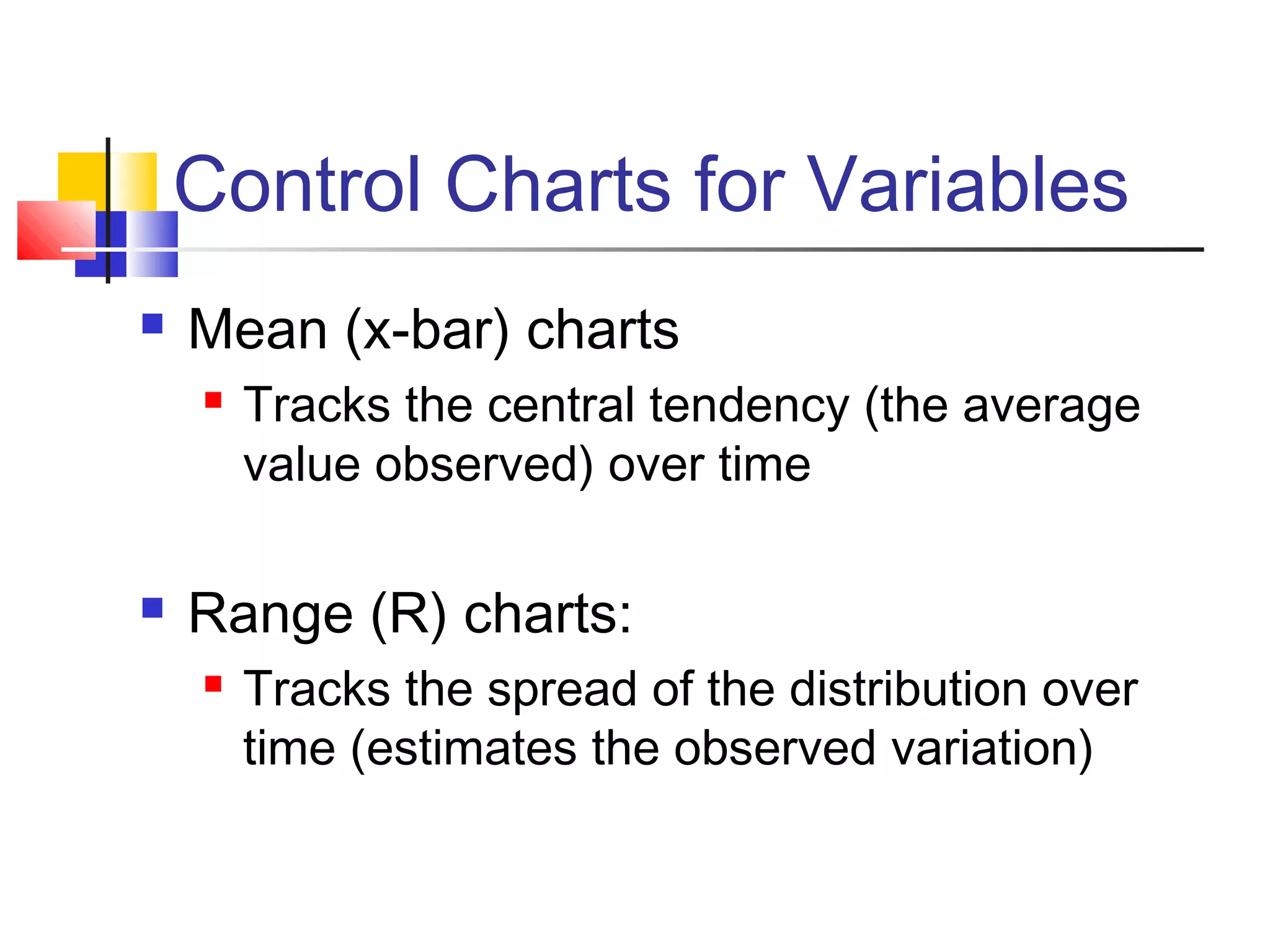
Control Charts for Variables
 Mean (x-bar) charts
 Tracks the central tendency (the average
value observed) over time
 Range (R) charts:
 Tracks the spread of the distribution over
time (estimates the observed variation)
Constructing a X-bar
Chart :-
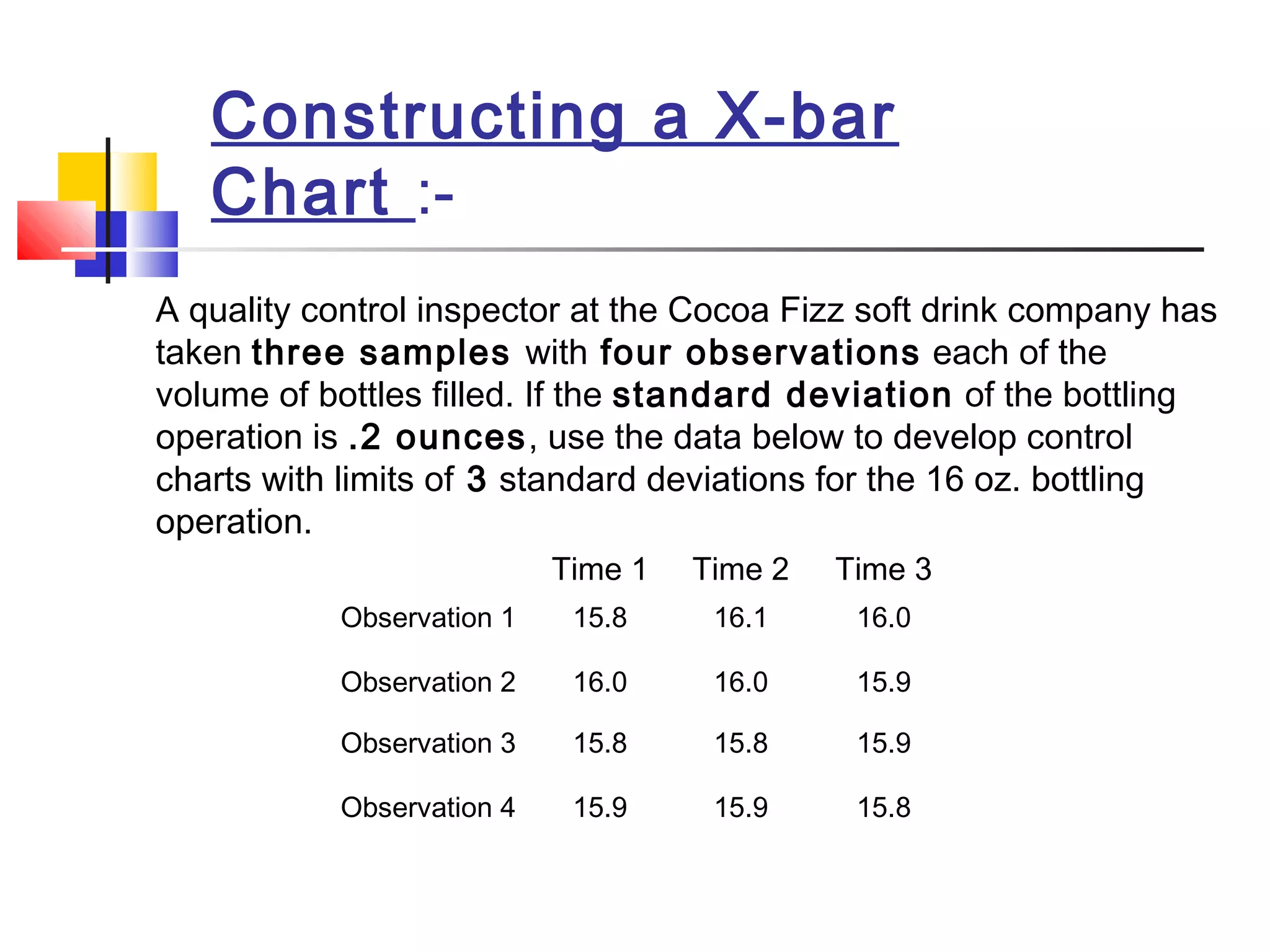
A quality control inspector at the Cocoa Fizz soft drink company has
taken three samples with four observations each of the
volume of bottles filled. If the standard deviation of the bottling
operation is .2 ounces, use the data below to develop control
charts with limits of 3 standard deviations for the 16 oz. bottling
operation.
Time 1 Time 2 Time 3
Observation 1 15.8 16.1 16.0
Observation 2 16.0 16.0 15.9
Observation 3 15.8 15.8 15.9
Observation 4 15.9 15.9 15.8
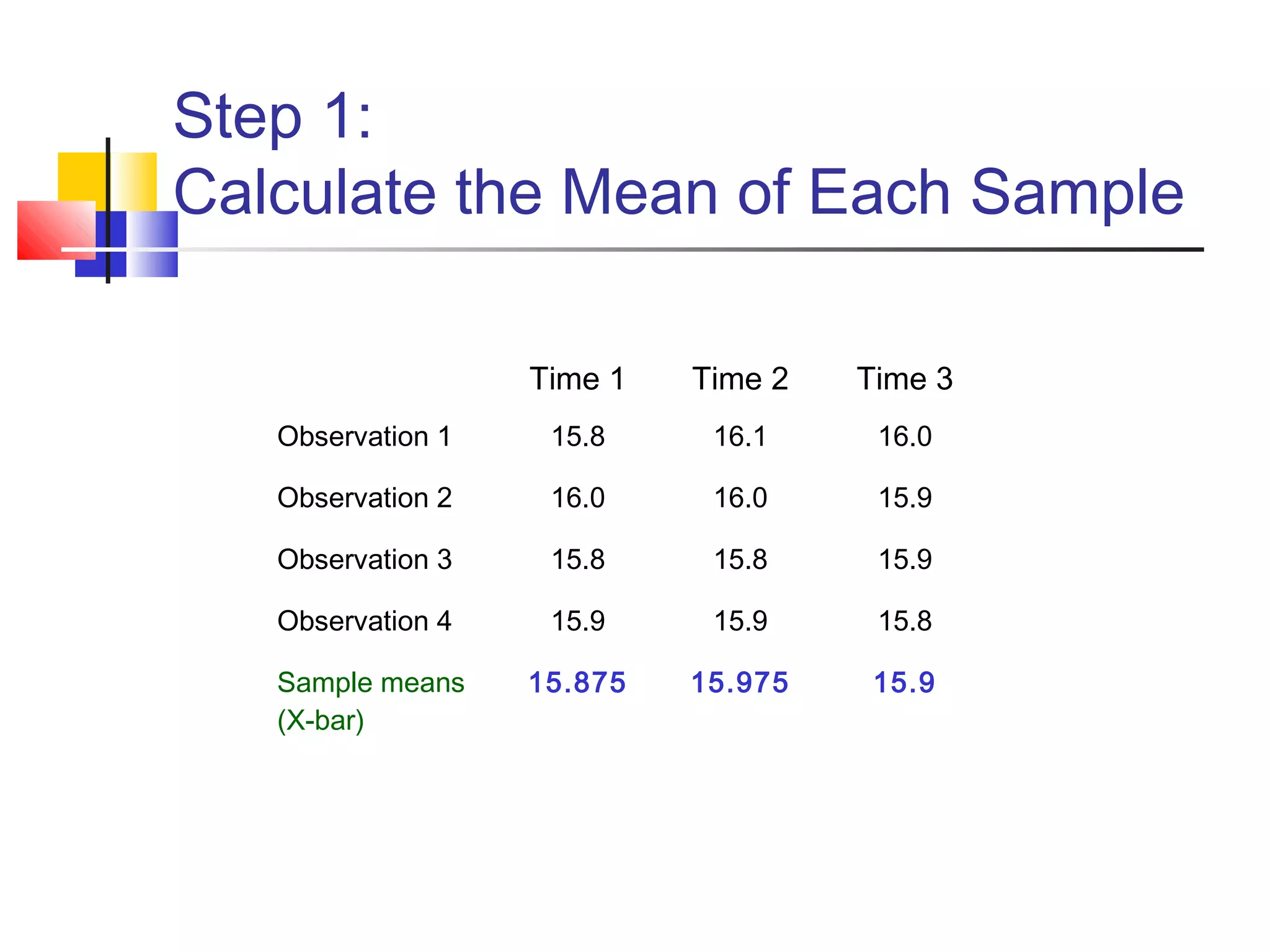
Step 1:
Calculate the Mean of Each Sample
Time 1 Time 2 Time 3
Observation 1 15.8 16.1 16.0
Observation 2 16.0 16.0 15.9
Observation 3 15.8 15.8 15.9
Observation 4 15.9 15.9 15.8
Sample means
(X-bar)
15.875 15.975 15.9
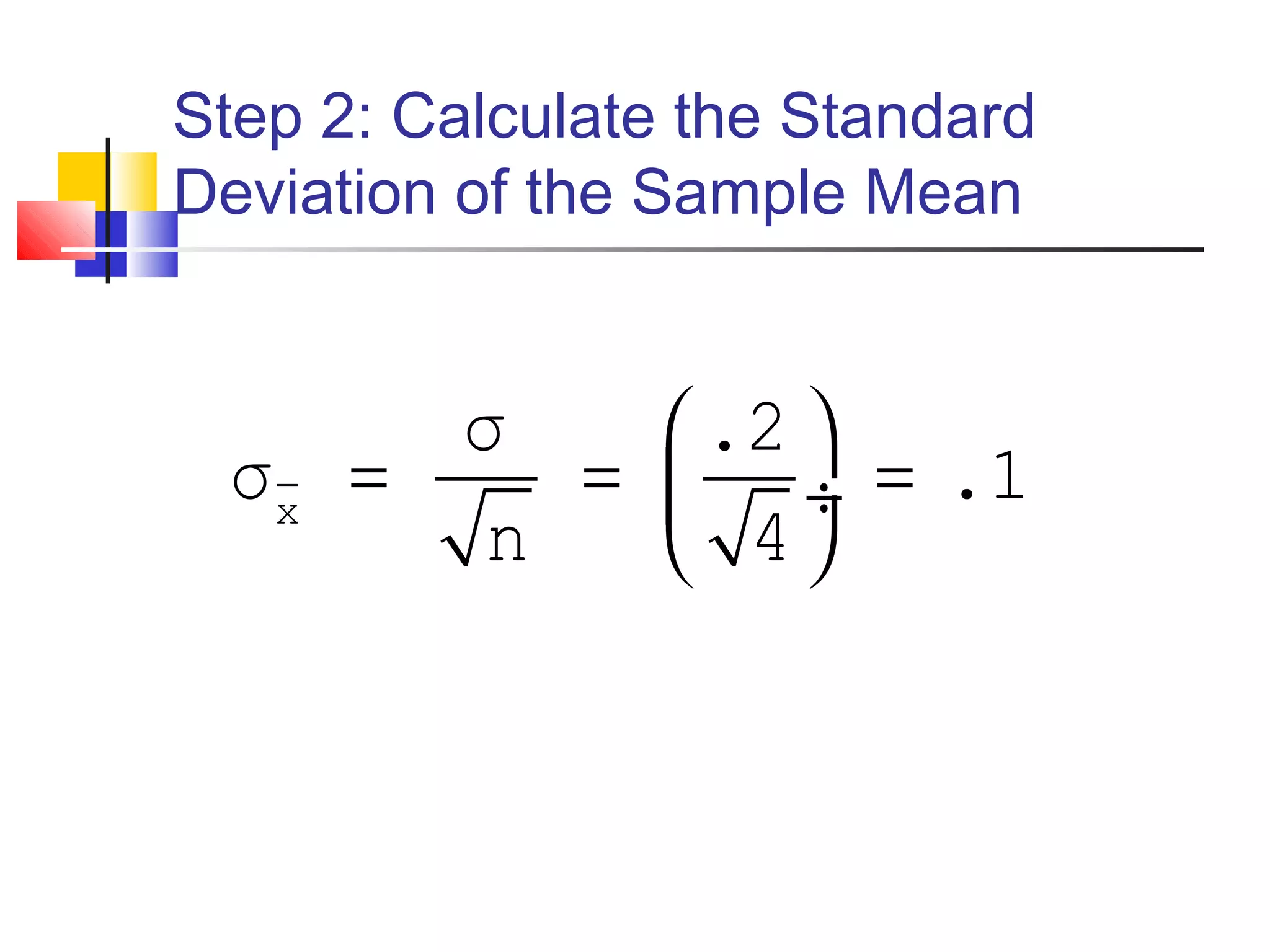
Step 2: Calculate the Standard
Deviation of the Sample Mean
x
σ .2
σ .1
n 4
 
= = = ÷
 
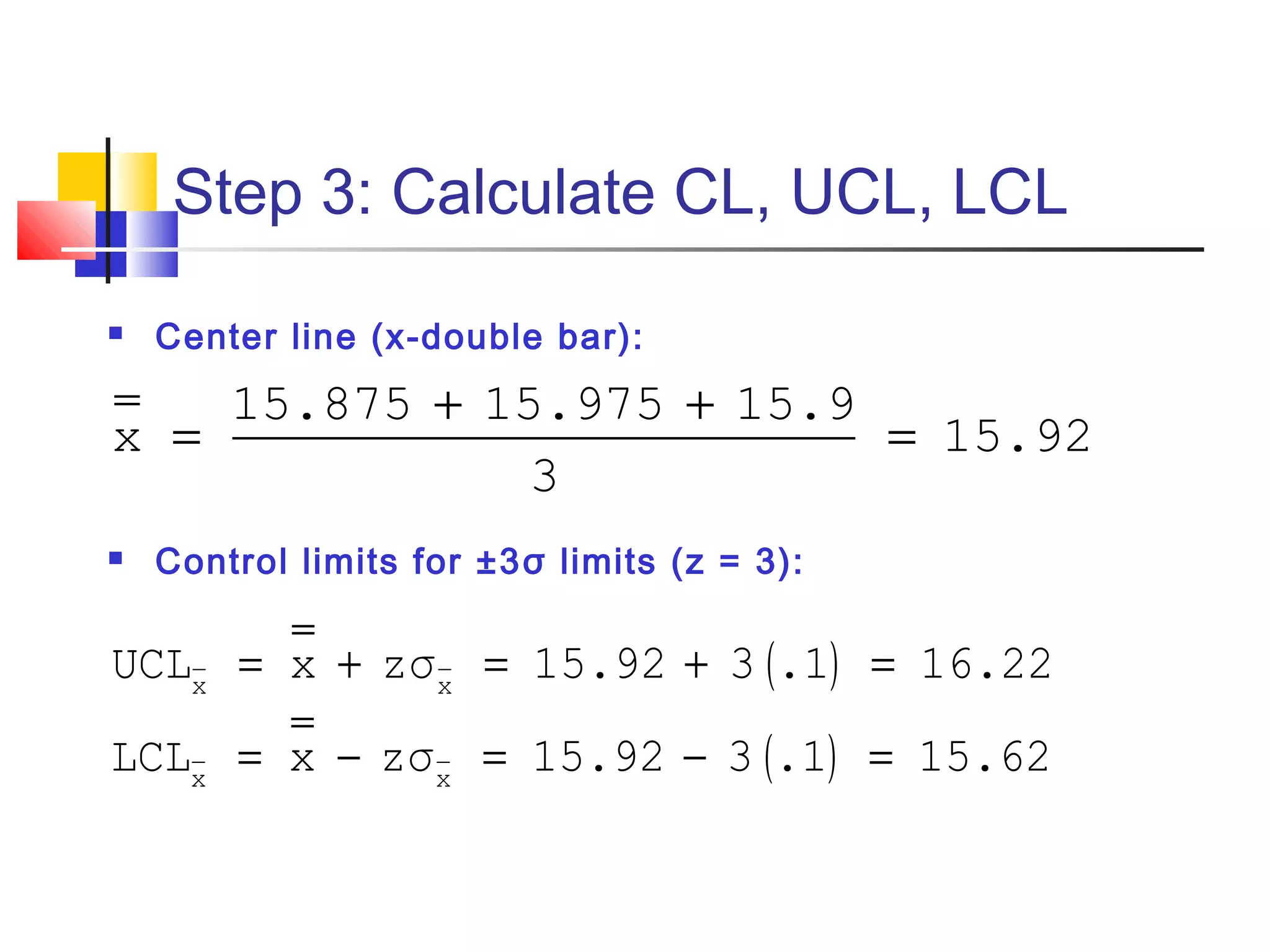
Step 3: Calculate CL, UCL, LCL
 Center line (x-double bar):
 Control limits for ±3σ limits (z = 3):
15.875 15.975 15.9
x 15.92
3
+ +
= =
( )
( )
x x
x x
UCL x zσ 15.92 3 .1 16.22
LCL x zσ 15.92 3 .1 15.62
= + = + =
= − = − =
Step 4: Draw the Chart
An Alternative Method for the X-bar
Chart Using R-bar and the A2 Factor
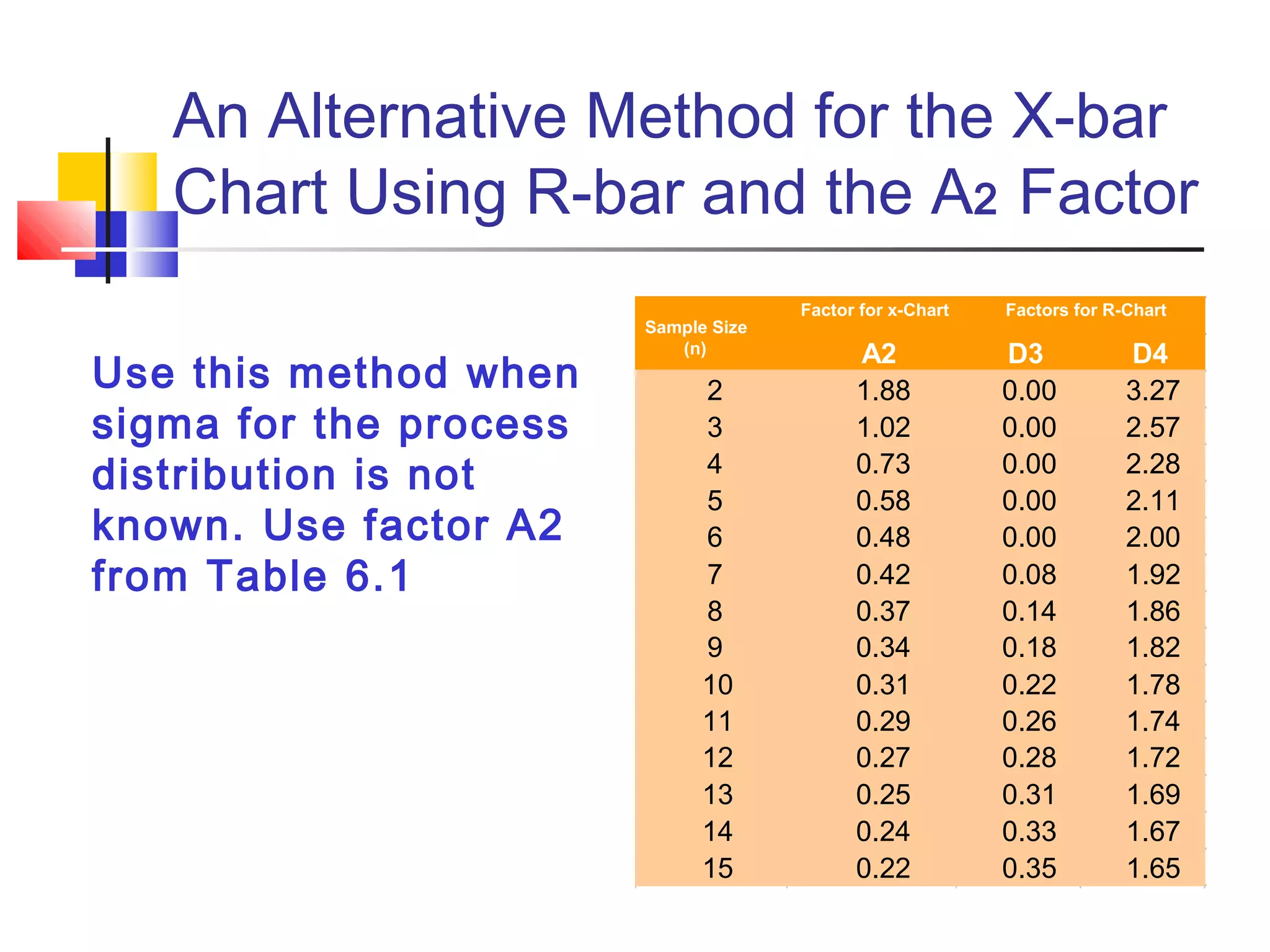
Use this method when
sigma for the process
distribution is not
known. Use factor A2
from Table 6.1
Factor for x-Chart
A2 D3 D4
2 1.88 0.00 3.27
3 1.02 0.00 2.57
4 0.73 0.00 2.28
5 0.58 0.00 2.11
6 0.48 0.00 2.00
7 0.42 0.08 1.92
8 0.37 0.14 1.86
9 0.34 0.18 1.82
10 0.31 0.22 1.78
11 0.29 0.26 1.74
12 0.27 0.28 1.72
13 0.25 0.31 1.69
14 0.24 0.33 1.67
15 0.22 0.35 1.65
Factors for R-Chart
Sample Size
(n)
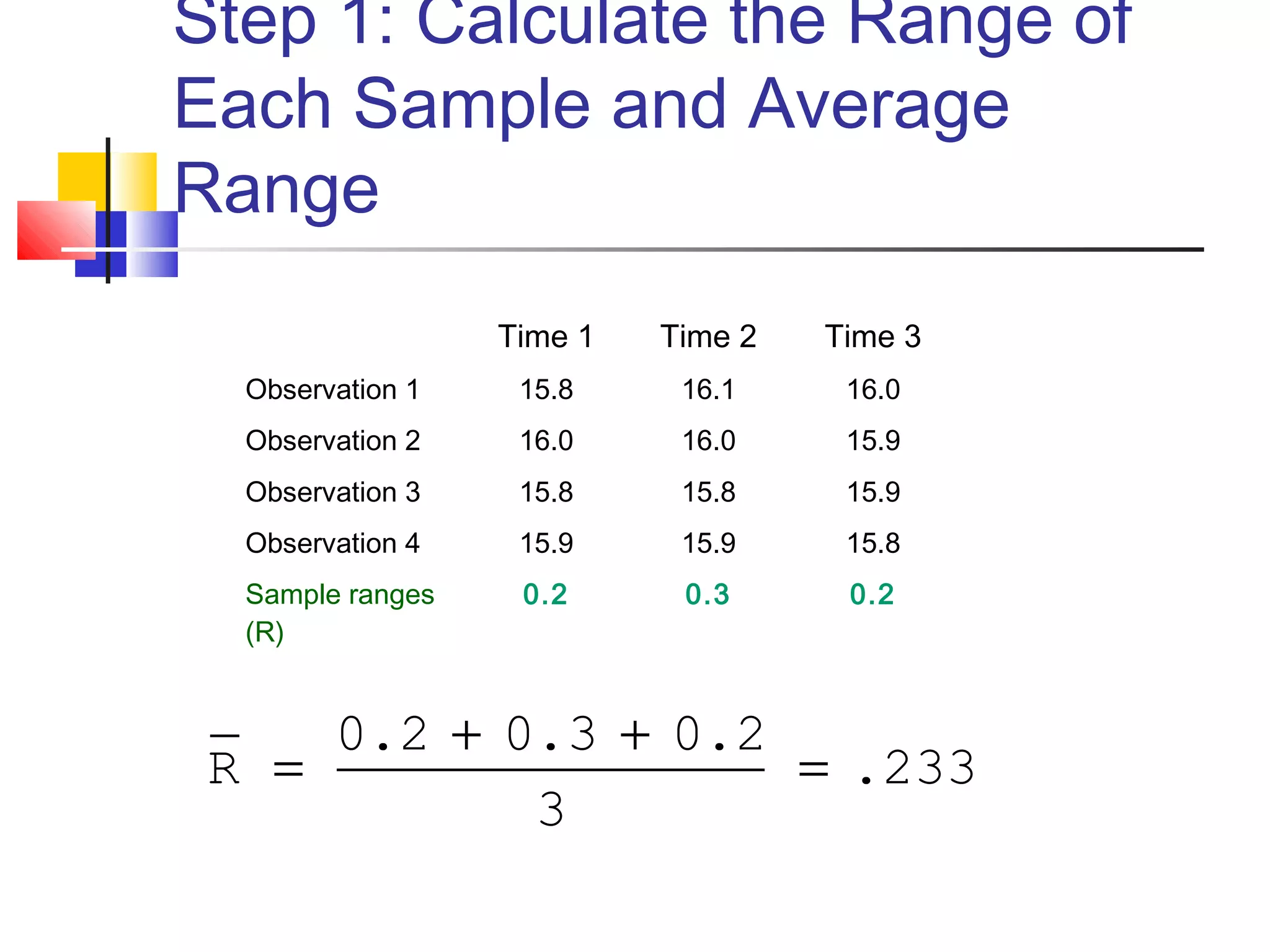
Step 1: Calculate the Range of
Each Sample and Average
Range
Time 1 Time 2 Time 3
Observation 1 15.8 16.1 16.0
Observation 2 16.0 16.0 15.9
Observation 3 15.8 15.8 15.9
Observation 4 15.9 15.9 15.8
Sample ranges
(R)
0.2 0.3 0.2
0.2 0.3 0.2
R .233
3
+ +
= =
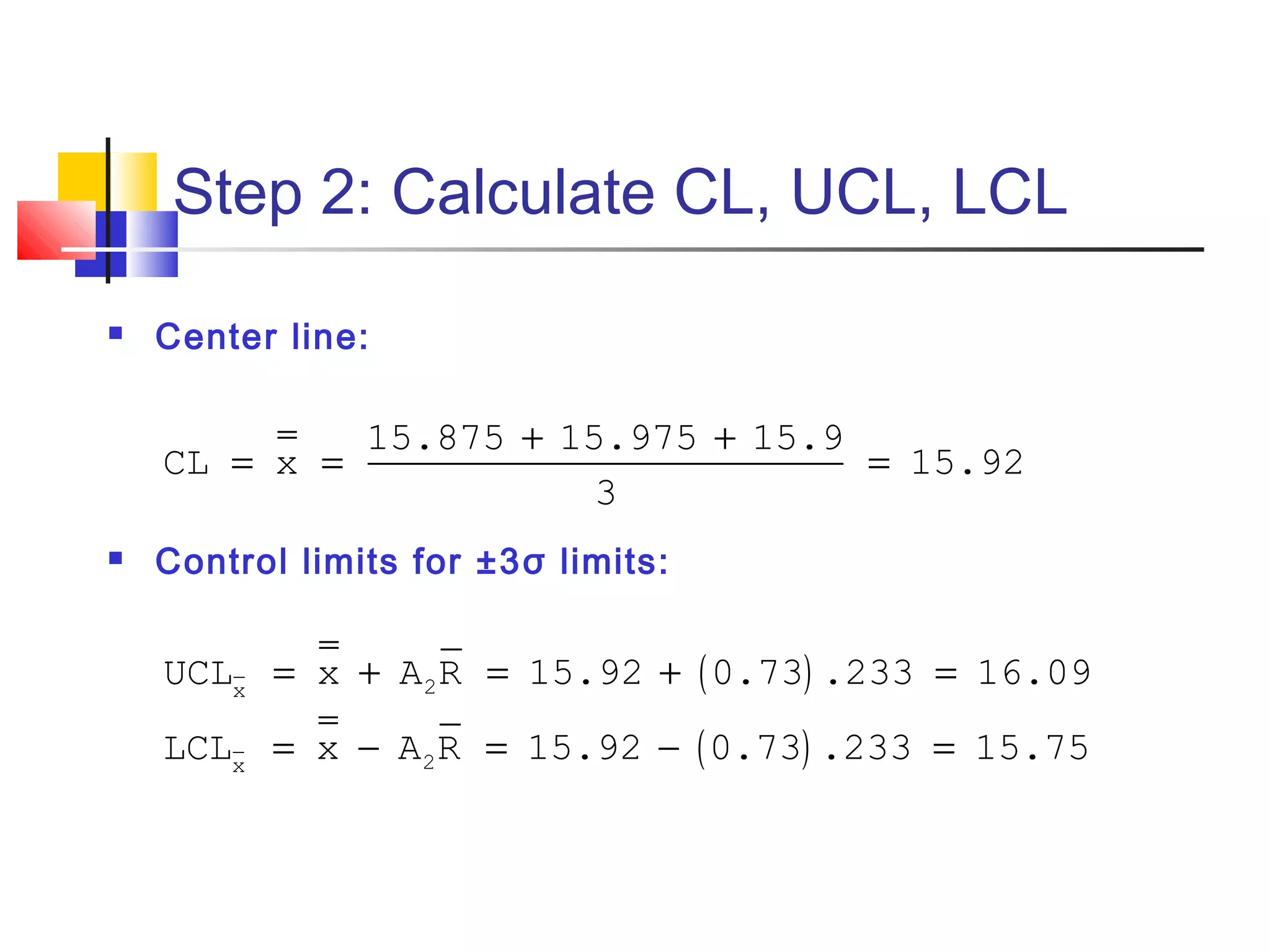
Step 2: Calculate CL, UCL, LCL
 Center line:
 Control limits for ±3σ limits:
( )
( )
2x
2x
15.875 15.975 15.9
CL x 15.92
3
UCL x A R 15.92 0.73 .233 16.09
LCL x A R 15.92 0.73 .233 15.75
+ +
= = =
= + = + =
= − = − =
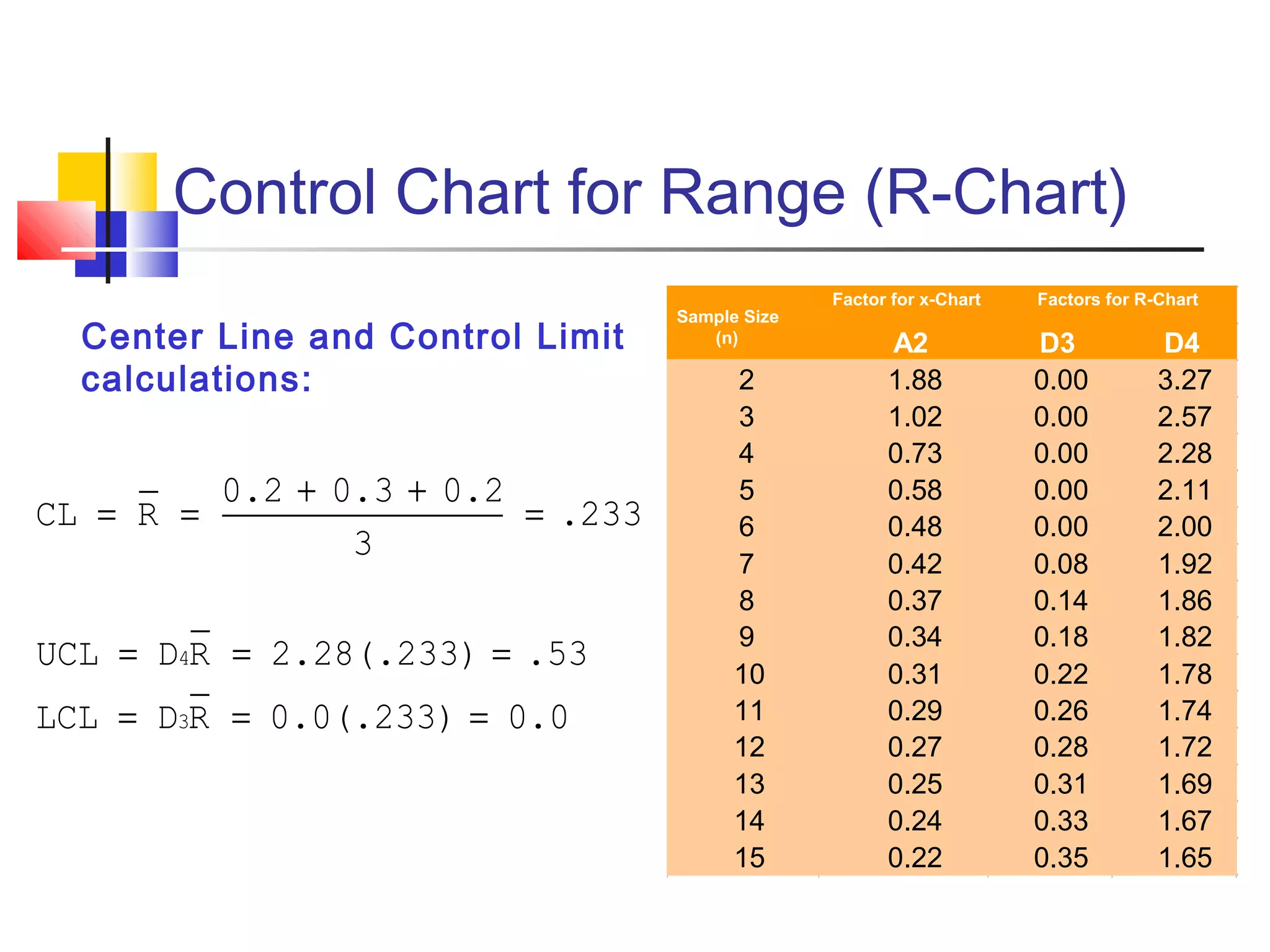
Control Chart for Range (R-Chart)
Center Line and Control Limit
calculations:
4
3
0.2 0.3 0.2
CL R .233
3
UCL D R 2.28(.233) .53
LCL D R 0.0(.233) 0.0
+ +
= = =
= = =
= = =
Factor for x-Chart
A2 D3 D4
2 1.88 0.00 3.27
3 1.02 0.00 2.57
4 0.73 0.00 2.28
5 0.58 0.00 2.11
6 0.48 0.00 2.00
7 0.42 0.08 1.92
8 0.37 0.14 1.86
9 0.34 0.18 1.82
10 0.31 0.22 1.78
11 0.29 0.26 1.74
12 0.27 0.28 1.72
13 0.25 0.31 1.69
14 0.24 0.33 1.67
15 0.22 0.35 1.65
Factors for R-Chart
Sample Size
(n)
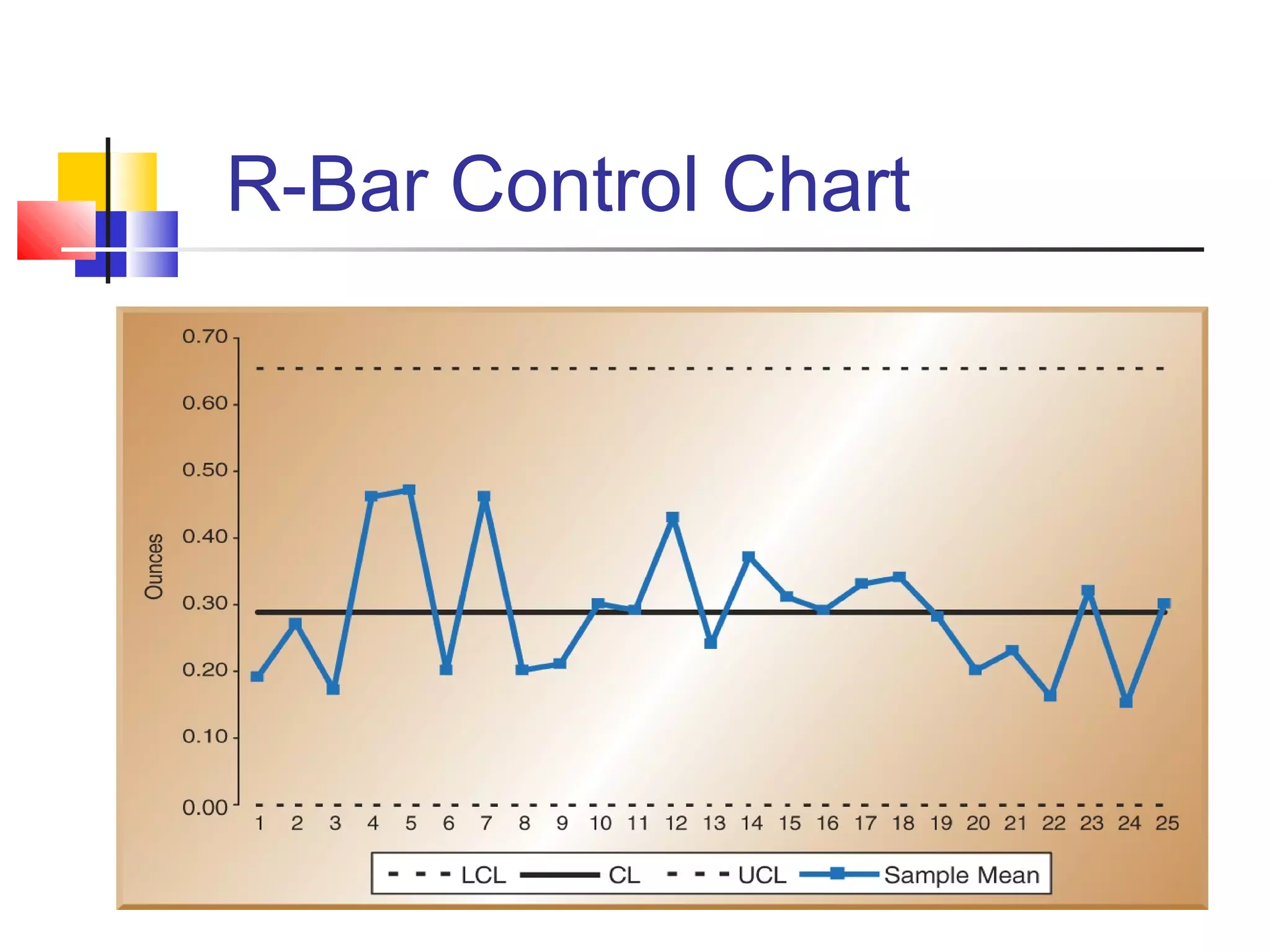
R-Bar Control Chart
X bar and R control charts

X bar and R control charts

  • 1.
    Industrial Engineering Presented By:- Dhruv Shah TOPIC : X-bar and R Control Charts
  • 2.
    X-bar and RControl Charts It is used to monitor the mean and variation of a process based on samples taken from the process at given times (hours, shifts, days, weeks, months, etc.). The measurements of the samples at a given time constitute a subgroup. Typically, an initial series of subgroups is used to estimate the mean and standard deviation of a process. The mean and standard deviation are then used to produce control limits for the mean and range of each subgroup. During this initial phase, the process should be in control. If points are out- of-control during the initial (estimation) phase, the assignable cause should be determined and the subgroup should be removed from estimation. Determining the process capability may also be useful at this phase.
  • 3.
    Once the controllimits have been established of the X-bar and R charts, these limits may be used to monitor the mean and variation of the process going forward. When a point is outside these established control limits it indicates that the mean (or variation) of the process is out-of-control. An assignable cause is suspected whenever the control chart indicates an out-of-control process. X-bar and R Control Charts
  • 4.
    Control Charts forVariables  Mean (x-bar) charts  Tracks the central tendency (the average value observed) over time  Range (R) charts:  Tracks the spread of the distribution over time (estimates the observed variation)
  • 5.
    Constructing a X-bar Chart:- A quality control inspector at the Cocoa Fizz soft drink company has taken three samples with four observations each of the volume of bottles filled. If the standard deviation of the bottling operation is .2 ounces, use the data below to develop control charts with limits of 3 standard deviations for the 16 oz. bottling operation. Time 1 Time 2 Time 3 Observation 1 15.8 16.1 16.0 Observation 2 16.0 16.0 15.9 Observation 3 15.8 15.8 15.9 Observation 4 15.9 15.9 15.8
  • 6.
    Step 1: Calculate theMean of Each Sample Time 1 Time 2 Time 3 Observation 1 15.8 16.1 16.0 Observation 2 16.0 16.0 15.9 Observation 3 15.8 15.8 15.9 Observation 4 15.9 15.9 15.8 Sample means (X-bar) 15.875 15.975 15.9
  • 7.
    Step 2: Calculatethe Standard Deviation of the Sample Mean x σ .2 σ .1 n 4   = = = ÷  
  • 8.
    Step 3: CalculateCL, UCL, LCL  Center line (x-double bar):  Control limits for ±3σ limits (z = 3): 15.875 15.975 15.9 x 15.92 3 + + = = ( ) ( ) x x x x UCL x zσ 15.92 3 .1 16.22 LCL x zσ 15.92 3 .1 15.62 = + = + = = − = − =
  • 9.
    Step 4: Drawthe Chart
  • 10.
    An Alternative Methodfor the X-bar Chart Using R-bar and the A2 Factor Use this method when sigma for the process distribution is not known. Use factor A2 from Table 6.1 Factor for x-Chart A2 D3 D4 2 1.88 0.00 3.27 3 1.02 0.00 2.57 4 0.73 0.00 2.28 5 0.58 0.00 2.11 6 0.48 0.00 2.00 7 0.42 0.08 1.92 8 0.37 0.14 1.86 9 0.34 0.18 1.82 10 0.31 0.22 1.78 11 0.29 0.26 1.74 12 0.27 0.28 1.72 13 0.25 0.31 1.69 14 0.24 0.33 1.67 15 0.22 0.35 1.65 Factors for R-Chart Sample Size (n)
  • 11.
    Step 1: Calculatethe Range of Each Sample and Average Range Time 1 Time 2 Time 3 Observation 1 15.8 16.1 16.0 Observation 2 16.0 16.0 15.9 Observation 3 15.8 15.8 15.9 Observation 4 15.9 15.9 15.8 Sample ranges (R) 0.2 0.3 0.2 0.2 0.3 0.2 R .233 3 + + = =
  • 12.
    Step 2: CalculateCL, UCL, LCL  Center line:  Control limits for ±3σ limits: ( ) ( ) 2x 2x 15.875 15.975 15.9 CL x 15.92 3 UCL x A R 15.92 0.73 .233 16.09 LCL x A R 15.92 0.73 .233 15.75 + + = = = = + = + = = − = − =
  • 13.
    Control Chart forRange (R-Chart) Center Line and Control Limit calculations: 4 3 0.2 0.3 0.2 CL R .233 3 UCL D R 2.28(.233) .53 LCL D R 0.0(.233) 0.0 + + = = = = = = = = = Factor for x-Chart A2 D3 D4 2 1.88 0.00 3.27 3 1.02 0.00 2.57 4 0.73 0.00 2.28 5 0.58 0.00 2.11 6 0.48 0.00 2.00 7 0.42 0.08 1.92 8 0.37 0.14 1.86 9 0.34 0.18 1.82 10 0.31 0.22 1.78 11 0.29 0.26 1.74 12 0.27 0.28 1.72 13 0.25 0.31 1.69 14 0.24 0.33 1.67 15 0.22 0.35 1.65 Factors for R-Chart Sample Size (n)
  • 14.