
Instructor:
M. Mujiya Ulkhaq
Department of Industrial Engineering
Shewhart Charts for Variables:
XandRcharts
Statistical Process Control
• Notations, assumptions, and rule of thumb;
• Control limits;
• Phase I and Phase II;
• Estimating process capability;
• Example of application;
• Designing control charts;
• Charts based on standard values;
• Patterns interpretation;
• The operating-characteristic function;
• Average run length.
3-2
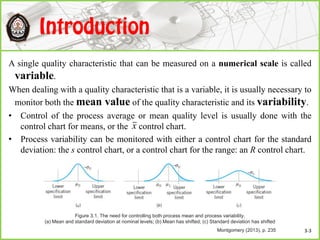
A single quality characteristic that can be measured on a numerical scale is called
variable.
When dealing with a quality characteristic that is a variable, it is usually necessary to
monitor both the mean value of the quality characteristic and its variability.
• Control of the process average or mean quality level is usually done with the
control chart for means, or the control chart.
• Process variability can be monitored with either a control chart for the standard
deviation: the s control chart, or a control chart for the range: an R control chart.
x
Figure 3.1. The need for controlling both process mean and process variability.
(a) Mean and standard deviation at nominal levels; (b) Mean has shifted; (c) Standard deviation has shifted
Montgomery (2013), p. 235 3-3
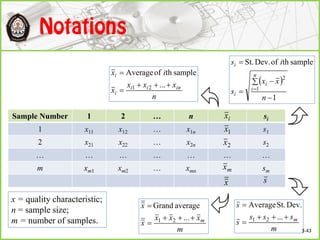
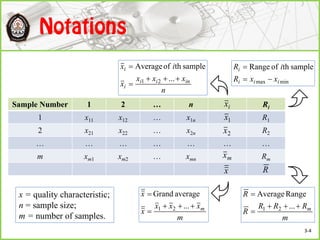
Sample Number 1 2 … n Ri
1 x11 x12 … x1n R1
2 x21 x22 … x2n R2
… … … … … … …
m xm1 xm2 … xmn Rm
ix
1x
2x
mx
n
xxx
x
ix
inii
i
i



...
samplethofAverage
21
m
xxx
x
x
m


...
averageGrand
21
x R
minmax
samplethofRange
iii
i
xxR
iR


m
RRR
R
R
m


...
RangeAverage
21
x = quality characteristic;
n = sample size;
m = number of samples.
3-4
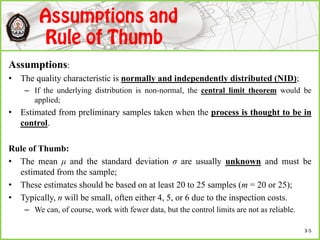
Assumptions:
• The quality characteristic is normally and independently distributed (NID);
– If the underlying distribution is non-normal, the central limit theorem would be
applied;
• Estimated from preliminary samples taken when the process is thought to be in
control.
Rule of Thumb:
• The mean μ and the standard deviation σ are usually unknown and must be
estimated from the sample;
• These estimates should be based on at least 20 to 25 samples (m = 20 or 25);
• Typically, n will be small, often either 4, 5, or 6 due to the inspection costs.
– We can, of course, work with fewer data, but the control limits are not as reliable.
3-5
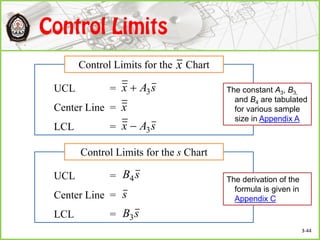
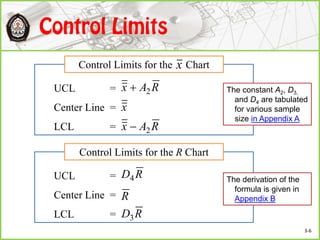
UCL =
Center Line =
LCL =
Control Limits for the Chartx
x
RAx 2
RAx 2
UCL =
Center Line =
LCL =
Control Limits for the R Chart
R
RD3
RD4 The derivation of the
formula is given in
Appendix B
The constant A2, D3,
and D4 are tabulated
for various sample
size in Appendix A
3-6
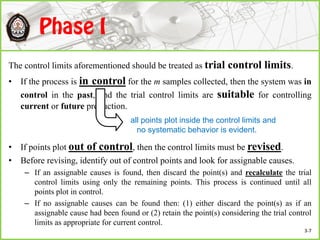
The control limits aforementioned should be treated as trial control limits.
• If the process is in control for the m samples collected, then the system was in
control in the past, and the trial control limits are suitable for controlling
current or future production.
• If points plot out of control, then the control limits must be revised.
• Before revising, identify out of control points and look for assignable causes.
– If an assignable causes is found, then discard the point(s) and recalculate the trial
control limits using only the remaining points. This process is continued until all
points plot in control.
– If no assignable causes can be found then: (1) either discard the point(s) as if an
assignable cause had been found or (2) retain the point(s) considering the trial control
limits as appropriate for current control.
all points plot inside the control limits and
no systematic behavior is evident.
3-7
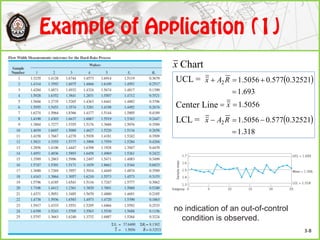
UCL =
Center Line
LCL =
Chartx
 
693.1
32521.0577.05056.12

 RAx
5056.1 x
 
318.1
32521.0577.05056.12

 RAx
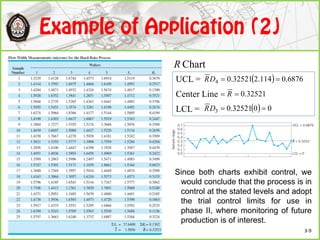
no indication of an out-of-control
condition is observed.
3-8
UCL =
Center Line
LCL =
ChartR
  6876.0114.232521.04 DR
32521.0 R
Since both charts exhibit control, we
would conclude that the process is in
control at the stated levels and adopt
the trial control limits for use in
phase II, where monitoring of future
production is of interest.
  0032521.03 DR
3-9
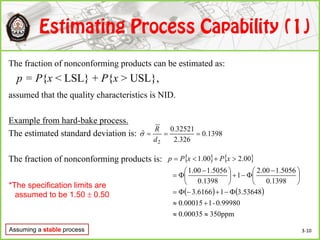
The fraction of nonconforming products can be estimated as:
p = P{x < LSL} + P{x > USL},
assumed that the quality characteristics is NID.
Example from hard-bake process.
The estimated standard deviation is:
The fraction of nonconforming products is:
Assuming a stable process
1398.0
326.2
32521.0
ˆ
2

d
R

   
   
ppm3500.00035
0.99980-10.00015
53648.316166.3
1398.0
5056.100.2
1
1398.0
5056.100.1
00.200.1








 





 

 xPxPp
*The specification limits are
assumed to be 1.50  0.50
3-10
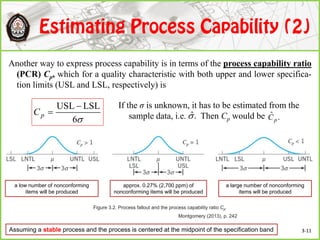
Another way to express process capability is in terms of the process capability ratio
(PCR) Cp, which for a quality characteristic with both upper and lower specifica-
tion limits (USL and LSL, respectively) is
If the σ is unknown, it has to be estimated from the
sample data, i.e. Then Cp would be
Assuming a stable process and the process is centered at the midpoint of the specification band
6
LSLUSL 
pC .ˆ .ˆ
pC
Figure 3.2. Process fallout and the process capability ratio Cp.
Montgomery (2013), p. 242
a low number of nonconforming
items will be produced
a large number of nonconforming
items will be produced
approx. 0.27% (2,700 ppm) of
nonconforming items will be produced
3-11
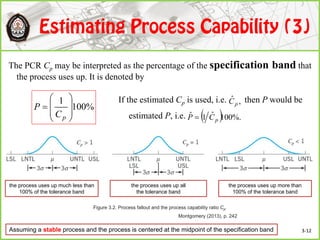
The PCR Cp may be interpreted as the percentage of the specification band that
the process uses up. It is denoted by
If the estimated Cp is used, i.e. then P would be
estimated P, i.e.
%100
1









pC
P
,ˆ
pC
  %.100ˆ1ˆ
pCP 
Figure 3.2. Process fallout and the process capability ratio Cp.
Montgomery (2013), p. 242
the process uses up much less than
100% of the tolerance band
the process uses up more than
100% of the tolerance band
the process uses up all
the tolerance band
Assuming a stable process and the process is centered at the midpoint of the specification band 3-12
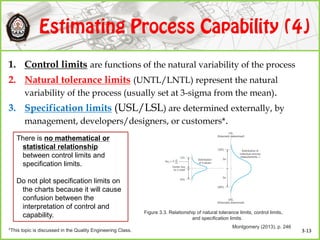
1. Control limits are functions of the natural variability of the process
2. Natural tolerance limits (UNTL/LNTL) represent the natural
variability of the process (usually set at 3-sigma from the mean).
3. Specification limits (USL/LSL) are determined externally, by
management, developers/designers, or customers*.
*This topic is discussed in the Quality Engineering Class.
There is no mathematical or
statistical relationship
between control limits and
specification limits.
Do not plot specification limits on
the charts because it will cause
confusion between the
interpretation of control and
capability. Figure 3.3. Relationship of natural tolerance limits, control limits,
and specification limits.
Montgomery (2013), p. 246
3-13
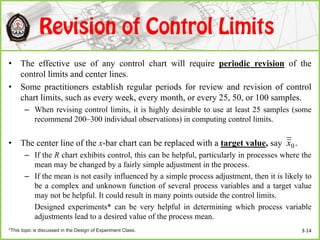
• The effective use of any control chart will require periodic revision of the
control limits and center lines.
• Some practitioners establish regular periods for review and revision of control
chart limits, such as every week, every month, or every 25, 50, or 100 samples.
– When revising control limits, it is highly desirable to use at least 25 samples (some
recommend 200–300 individual observations) in computing control limits.
• The center line of the x-bar chart can be replaced with a target value, say
– If the R chart exhibits control, this can be helpful, particularly in processes where the
mean may be changed by a fairly simple adjustment in the process.
– If the mean is not easily influenced by a simple process adjustment, then it is likely to
be a complex and unknown function of several process variables and a target value
may not be helpful. It could result in many points outside the control limits.
Designed experiments* can be very helpful in determining which process variable
adjustments lead to a desired value of the process mean.
.0x
*This topic is discussed in the Design of Experiment Class. 3-14
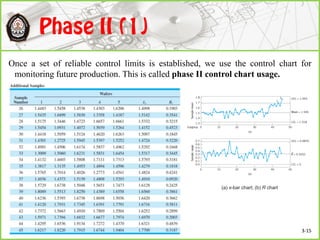
Once a set of reliable control limits is established, we use the control chart for
monitoring future production. This is called phase II control chart usage.
(a) x-bar chart; (b) R chart
3-15
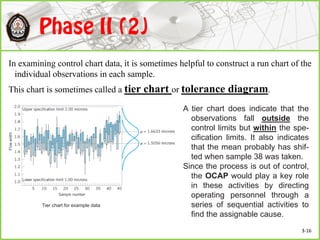
In examining control chart data, it is sometimes helpful to construct a run chart of the
individual observations in each sample.
This chart is sometimes called a tier chart or tolerance diagram.
Tier chart for example data
A tier chart does indicate that the
observations fall outside the
control limits but within the spe-
cification limits. It also indicates
that the mean probably has shif-
ted when sample 38 was taken.
Since the process is out of control,
the OCAP would play a key role
in these activities by directing
operating personnel through a
series of sequential activities to
find the assignable cause.
3-16
• The x-bar chart monitors the average quality level in the process, or monitors
between-sample variability (variability in the process over time).
– Samples should be selected in such a way that maximizes the chances for shifts in the
process average to occur between samples.
• The R chart measures the variability within a sample, or measures within-
sample variability (the instantaneous process variability at a given time).
– Samples should be selected so that variability within samples measures only chance
or random causes.
3-17
To design the x-bar and R charts, we must specify the sample size, control
limit width, and frequency of sampling to be used.
Choice of sample size: Choose larger or small sample size?
• If the x-bar chart is used to detect moderate to large process shifts—say, on the
order of 2σ or larger—then relatively small samples of size n = 4, 5, or 6 are
reasonably effective.
• If one want to detect the small mean shift, then larger sample sizes are needed
(as much as 15 to 25). However, it is considered as impractical. If increasing the
sample size is not an option, then sensitizing procedures (such as warning
limits) can be used. However, this can result in increased false alarms.
The CUSUM or EWMA charts* are recommended to be used.
3-18*This topic will be discussed later.
To design the x-bar and R charts, we must specify the sample size, control
limit width, and frequency of sampling to be used.
Choice of sample size: Choose larger or small sample size?
• The R chart is relatively insensitive to small mean shift. Larger sample would be
more effective, but the range method for estimating the standard deviation drops
dramatically in efficiency as n increases, say when n > 10 or 12.
When using large sample size, the s chart or s2 charts* could be used.
The OC curves* can be helpful in determining an appropriate sample size. They
provide a feel for the magnitude of process shift that will be detected with a stated
probability for any sample size n.
*This topic will be discussed further in the following slides. 3-19
To design the x-bar and R charts, we must specify the sample size, control
limit width, and frequency of sampling to be used.
Allocating Sampling Effort: Choose a larger sample size and sample less
frequently? or, Choose a smaller sample size and sample more frequently?
The method to use will depend on the situation.
• If the cost associated with producing defective items is high, smaller, more
frequent samples are better than larger, less frequent ones.
• If the rate production is high—say, 50,000 units per hour, then more
frequent sampling is better than if the production rate is extremely slow.
• If per unit inspection and testing costs are not excessive, high-speed production
processes are often monitored with moderately large sample size.
3-20
To design the x-bar and R charts, we must specify the sample size, control
limit width, and frequency of sampling to be used.
Choice of Control Limits: Choose wider or narrower control limits?
• If false alarms or type I errors are very expensive to investigate, then it may be
best to use wider control limits than 3-σ—perhaps as wide as 3.5-σ.
• If the process is such that out-of-control signals are quickly and easily investiga-
ted with a minimum of lost time and cost, then narrower control limits—
perhaps at 2.5-σ of 2.75-σ be of appropriate
3-21
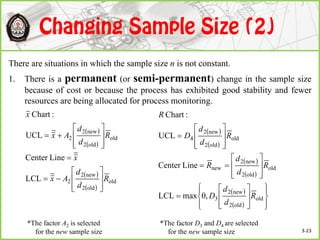
There are situations in which the sample size n is not constant.
1. There is a permanent (or semi-permanent) change in the sample size
because of cost or because the process has exhibited good stability and fewer
resources are being allocated for process monitoring.
Notations:
= average range for the old sample size
= average range for the new sample size
nold = old sample size
nnew = new sample size
d2(old) = factor d2 for the old sample size
d2(new) = factor d2 for the new sample size
oldR
newR
3-22
There are situations in which the sample size n is not constant.
1. There is a permanent (or semi-permanent) change in the sample size
because of cost or because the process has exhibited good stability and fewer
resources are being allocated for process monitoring.
 
 
 
 
old
old2
new2
2
old
old2
new2
2
LCL
LineCenter
UCL
:Chart
R
d
d
Ax
x
R
d
d
Ax
x



















*The factor A2 is selected
for the new sample size
 
 
 
 
 
  


































old
old2
new2
3
old
old2
new2
new
old
old2
new2
4
,0maxLCL
LineCenter
UCL
:Chart
R
d
d
D
R
d
d
R
R
d
d
D
R
*The factor D3 and D4 are selected
for the new sample size 3-23
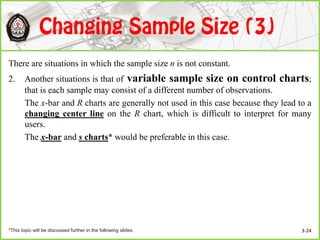
There are situations in which the sample size n is not constant.
2. Another situations is that of variable sample size on control charts;
that is each sample may consist of a different number of observations.
The x-bar and R charts are generally not used in this case because they lead to a
changing center line on the R chart, which is difficult to interpret for many
users.
The x-bar and s charts* would be preferable in this case.
*This topic will be discussed further in the following slides. 3-24
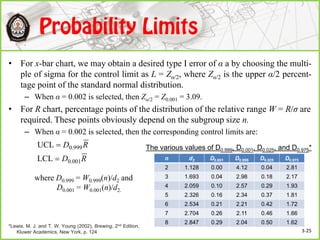
• For x-bar chart, we may obtain a desired type I error of α a by choosing the multi-
ple of sigma for the control limit as L = Zα/2, where Zα/2 is the upper α/2 percent-
tage point of the standard normal distribution.
– When α = 0.002 is selected, then Zα/2 = Z0.001 = 3.09.
• For R chart, percentage points of the distribution of the relative range W = R/σ are
required. These points obviously depend on the subgroup size n.
– When α = 0.002 is selected, then the corresponding control limits are:
where D0.999 = W0.999(n)/d2 and
D0.001 = W0.001(n)/d2.
RD
RD
001.0
999.0
LCL
UCL

 The various values of D0.999, D0.001, D0.025, and D0.975*
*Lewis, M. J. and T. W. Young (2002), Brewing, 2nd Edition,
Kluwer Academics, New York, p. 124 3-25
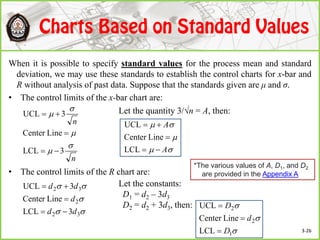
When it is possible to specify standard values for the process mean and standard
deviation, we may use these standards to establish the control charts for x-bar and
R without analysis of past data. Suppose that the standards given are μ and σ.
• The control limits of the x-bar chart are:
• The control limits of the R chart are:
n
n





3LCL
LineCenter
3UCL


 Let the quantity 3/√n = A, then:
*The various values of A, D1, and D2
are provided in the Appendix A



32
2
32
3LCL
LineCenter
3UCL
dd
d
dd


 Let the constants:
D1 = d2 – 3d3
D2 = d2 + 3d3, then:



A
A



LCL
LineCenter
UCL



1
2
2
LCL
LineCenter
UCL
D
d
D



3-26
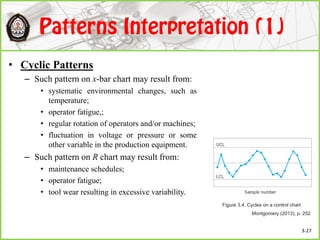
• Cyclic Patterns
– Such pattern on x-bar chart may result from:
• systematic environmental changes, such as
temperature;
• operator fatigue,;
• regular rotation of operators and/or machines;
• fluctuation in voltage or pressure or some
other variable in the production equipment.
– Such pattern on R chart may result from:
• maintenance schedules;
• operator fatigue;
• tool wear resulting in excessive variability.
Figure 3.4. Cycles on a control chart.
Montgomery (2013), p. 252
3-27
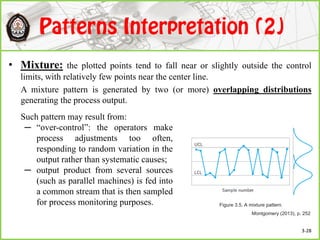
• Mixture: the plotted points tend to fall near or slightly outside the control
limits, with relatively few points near the center line.
A mixture pattern is generated by two (or more) overlapping distributions
generating the process output.
Figure 3.5. A mixture pattern.
Montgomery (2013), p. 252
Such pattern may result from:
─ “over-control”: the operators make
process adjustments too often,
responding to random variation in the
output rather than systematic causes;
─ output product from several sources
(such as parallel machines) is fed into
a common stream that is then sampled
for process monitoring purposes.
3-28
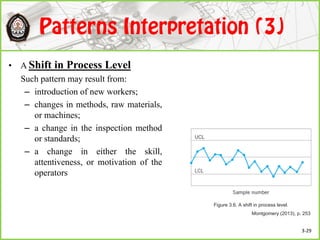
• A Shift in Process Level
Such pattern may result from:
– introduction of new workers;
– changes in methods, raw materials,
or machines;
– a change in the inspection method
or standards;
– a change in either the skill,
attentiveness, or motivation of the
operators
Figure 3.6. A shift in process level.
Montgomery (2013), p. 253
3-29
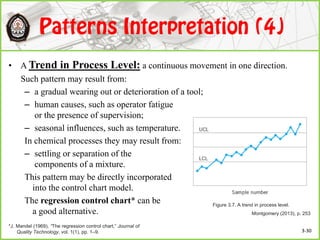
• A Trend in Process Level: a continuous movement in one direction.
Such pattern may result from:
– a gradual wearing out or deterioration of a tool;
– human causes, such as operator fatigue
or the presence of supervision;
– seasonal influences, such as temperature.
In chemical processes they may result from:
– settling or separation of the
components of a mixture.
This pattern may be directly incorporated
into the control chart model.
The regression control chart* can be
a good alternative.
Figure 3.7. A trend in process level.
Montgomery (2013), p. 253
*J. Mandel (1969), “The regression control chart,” Journal of
Quality Technology, vol. 1(1), pp. 1–9. 3-30
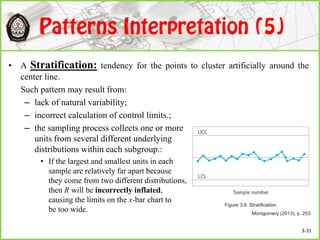
• A Stratification: tendency for the points to cluster artificially around the
center line.
Such pattern may result from:
– lack of natural variability;
– incorrect calculation of control limits.;
– the sampling process collects one or more
units from several different underlying
distributions within each subgroup.:
• If the largest and smallest units in each
sample are relatively far apart because
they come from two different distributions,
then R will be incorrectly inflated,
causing the limits on the x-bar chart to
be too wide.
Figure 3.8. Stratification.
Montgomery (2013), p. 253
3-31
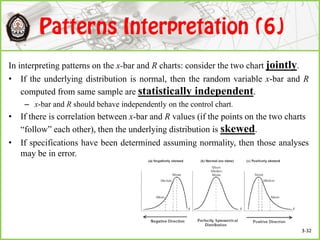
In interpreting patterns on the x-bar and R charts: consider the two chart jointly.
• If the underlying distribution is normal, then the random variable x-bar and R
computed from same sample are statistically independent.
– x-bar and R should behave independently on the control chart.
• If there is correlation between x-bar and R values (if the points on the two charts
“follow” each other), then the underlying distribution is skewed.
• If specifications have been determined assuming normality, then those analyses
may be in error.
3-32
In general, x-bar chart is insensitive (robust) to small departures from normality.
• The usual normal theory control limit constants are very robust to the normality
assumption and can be employed unless the population is extremely non-normal.*
• When the underlying distribution is uniform, right triangular, gamma (with λ = 1 and r =
½, 1, 2, 3, 4), and two bimodal distributions formed as mixtures of two normal
distributions, sample of size 4 or 5 are sufficient to ensure reasonable robustness to the
normality assumption**
– Worst case were for small values of r in the gamma distribution [r = ½ and r = 1 (the
exponential distribution)]: the α will be 0.014 or less if n ≥ 4 with r = ½.
In contrast, R-chart is more sensitive than x-bar chart.
• The sampling distribution of R is not symmetric, even when sampling from the
normal distribution. When 3-sigma is used, the α is not 0.0027 (in fact, for n = 4,
the α is 0.00461).
*I. J. Burr (1967). “The effect of nonnormality on constants for x and R charts,” Industrial Quality Control, 23(11), pp. 563–569.
**E. G. Schilling and P. R. Nelson (1976), “The effect of nonnormality on the control limits of x charts,” Journal of Quality
Technology, 8(4), pp. 183–188. 3-33
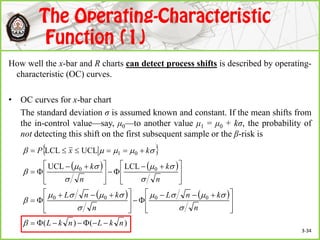
How well the x-bar and R charts can detect process shifts is described by operating-
characteristic (OC) curves.
• OC curves for x-bar chart
The standard deviation σ is assumed known and constant. If the mean shifts from
the in-control value—say, μ0—to another value μ1 = μ0 + kσ, the probability of
not detecting this shift on the first subsequent sample or the β-risk is
 
   
   
)()(
LCLUCL
UCLLCL
0000
00
01
nkLnkL
n
knL
n
knL
n
k
n
k
kxP








 








 








 








 














3-34
How well the x-bar and R charts can detect process shifts is described by operating-
characteristic (OC) curves.
• OC curves for x-bar chart
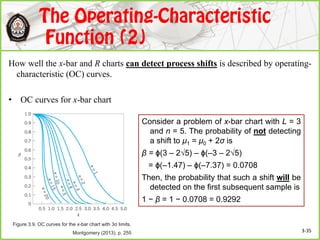
Consider a problem of x-bar chart with L = 3
and n = 5. The probability of not detecting
a shift to μ1 = μ0 + 2σ is
β = ϕ(3 – 2√5) – ϕ(–3 – 2√5)
= ϕ(–1.47) – ϕ(–7.37) = 0.0708
Then, the probability that such a shift will be
detected on the first subsequent sample is
1 − β = 1 − 0.0708 = 0.9292
Figure 3.9. OC curves for the x-bar chart with 3σ limits.
Montgomery (2013), p. 255 3-35
How well the x-bar and R charts can detect process shifts is described by operating-
characteristic (OC) curves.
• OC curves for R chart
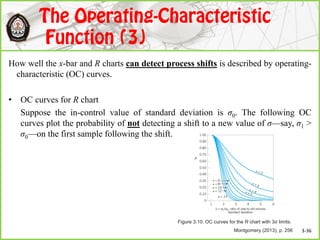
Suppose the in-control value of standard deviation is σ0. The following OC
curves plot the probability of not detecting a shift to a new value of σ—say, σ1 >
σ0—on the first sample following the shift.
Figure 3.10. OC curves for the R chart with 3σ limits.
Montgomery (2013), p. 256 3-36
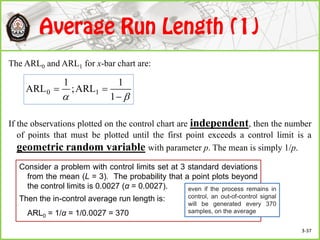
The ARL0 and ARL1 for x-bar chart are:
If the observations plotted on the control chart are independent, then the number
of points that must be plotted until the first point exceeds a control limit is a
geometric random variable with parameter p. The mean is simply 1/p.
 

1
1
ARL;
1
ARL 10
Consider a problem with control limits set at 3 standard deviations
from the mean (L = 3). The probability that a point plots beyond
the control limits is 0.0027 (α = 0.0027).
Then the in-control average run length is:
ARL0 = 1/α = 1/0.0027 = 370
even if the process remains in
control, an out-of-control signal
will be generated every 370
samples, on the average
3-37
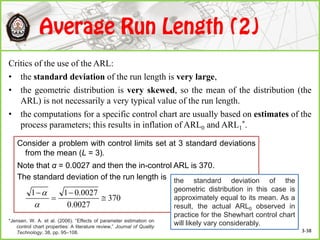
Critics of the use of the ARL:
• the standard deviation of the run length is very large,
• the geometric distribution is very skewed, so the mean of the distribution (the
ARL) is not necessarily a very typical value of the run length.
• the computations for a specific control chart are usually based on estimates of the
process parameters; this results in inflation of ARL0 and ARL1
*.
Consider a problem with control limits set at 3 standard deviations
from the mean (L = 3).
Note that α = 0.0027 and then the in-control ARL is 370.
The standard deviation of the run length is
370
0027.0
0027.011






the standard deviation of the
geometric distribution in this case is
approximately equal to its mean. As a
result, the actual ARL0 observed in
practice for the Shewhart control chart
will likely vary considerably.
3-38
*Jensen. W. A. et al. (2006). “Effects of parameter estimation on
control chart properties: A literature review,” Journal of Quality
Technology, 38, pp. 95–108.
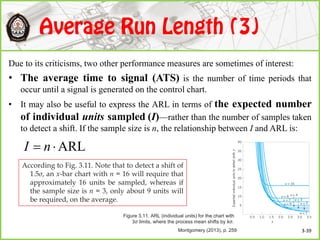
Due to its criticisms, two other performance measures are sometimes of interest:
• The average time to signal (ATS) is the number of time periods that
occur until a signal is generated on the control chart.
• It may also be useful to express the ARL in terms of the expected number
of individual units sampled (I)—rather than the number of samples taken
to detect a shift. If the sample size is n, the relationship between I and ARL is:
3-39
ARL nI
Figure 3.11. ARL (individual units) for the chart with
3σ limits, where the process mean shifts by kσ.
Montgomery (2013), p. 259
According to Fig. 3.11. Note that to detect a shift of
1.5σ, an x-bar chart with n = 16 will require that
approximately 16 units be sampled, whereas if
the sample size is n = 3, only about 9 units will
be required, on the average.
Instructor:
M. Mujiya Ulkhaq
Department of Industrial Engineering
Shewhart Charts for Variables:
Xandscharts
Statistical Process Control
• Notations, assumptions, and rule of thumb;
• Control limits;
• Variable sample size;
• Charts based on standard values;
• Example of application;
• Estimation of σ;
• The s2 control chart.
3-41
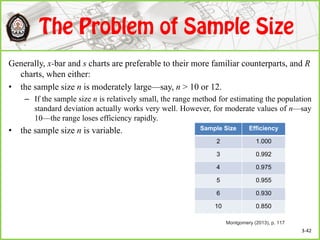
Generally, x-bar and s charts are preferable to their more familiar counterparts, and R
charts, when either:
• the sample size n is moderately large—say, n > 10 or 12.
– If the sample size n is relatively small, the range method for estimating the population
standard deviation actually works very well. However, for moderate values of n—say
10—the range loses efficiency rapidly.
• the sample size n is variable. Sample Size Efficiency
2 1.000
3 0.992
4 0.975
5 0.955
6 0.930
10 0.850
Montgomery (2013), p. 117
3-42
Sample Number 1 2 … n si
1 x11 x12 … x1n s1
2 x21 x22 … x2n s2
… … … … … … …
m xm1 xm2 … xmn sm
ix
1x
2x
mx
n
xxx
x
ix
inii
i
i



...
samplethofAverage
21
m
xxx
x
x
m


...
averageGrand
21
x s
 
1
samplethofDev.St.
1
2

 



n
xx
s
is
n
i
i
i
i
m
sss
s
s
m


...
Dev.St.Average
21
x = quality characteristic;
n = sample size;
m = number of samples.
3-43
UCL =
Center Line =
LCL =
Control Limits for the Chartx
x
sAx 3
sAx 3
UCL =
Center Line =
LCL =
Control Limits for the s Chart
s
sB3
sB4 The derivation of the
formula is given in
Appendix C
The constant A3, B3,
and B4 are tabulated
for various sample
size in Appendix A
3-44
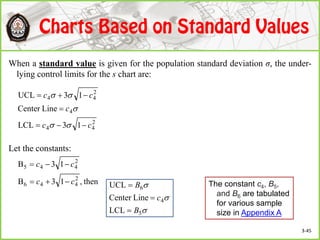
When a standard value is given for the population standard deviation σ, the under-
lying control limits for the s chart are:
Let the constants:
2
44
4
2
44
13LCL
LineCenter
13UCL
cc
c
cc









5
4
6
LCL
LineCenter
UCL
B
c
B


then,13B
13B
2
446
2
445
cc
cc


The constant c4, B5,
and B6 are tabulated
for various sample
size in Appendix A
3-45
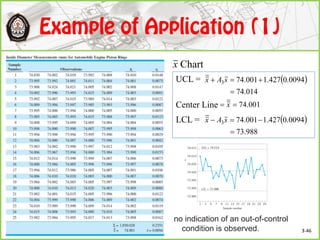
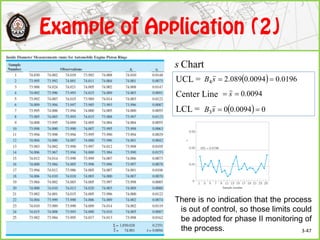
UCL =
Center Line
LCL =
Chartx
 
014.74
0094.0427.1001.743

 sAx
001.74 x
 
988.73
0094.0427.1001.743

 sAx
no indication of an out-of-control
condition is observed. 3-46
UCL =
Center Line
LCL =
Charts
  0196.00094.0089.24 sB
0094.0 s
There is no indication that the process
is out of control, so those limits could
be adopted for phase II monitoring of
the process.
  00094.003 sB
3-47
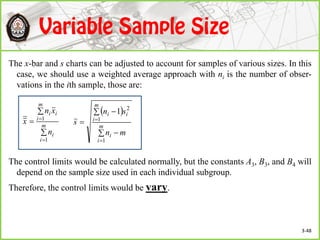
The x-bar and s charts can be adjusted to account for samples of various sizes. In this
case, we should use a weighted average approach with ni is the number of obser-
vations in the ith sample, those are:
The control limits would be calculated normally, but the constants A3, B3, and B4 will
depend on the sample size used in each individual subgroup.
Therefore, the control limits would be vary.





m
i
i
m
i
ii
n
xn
x
1
1
 
 
 



m
i
i
m
i
ii
mn
sn
s
1
1
2
1
3-48
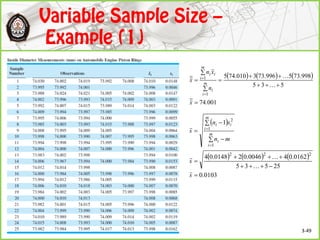
     
001.74
535
998.735996.733010.745
1
1









x
n
xn
x m
i
i
m
i
ii


 
     
0103.0
25535
0162.040046.020148.04
1
222
1
1
2




 
 



s
s
mn
sn
s m
i
i
m
i
ii


3-49
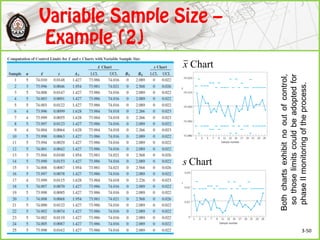
Chartx
Charts
Bothchartsexhibitnooutofcontrol,
sothoselimitscouldbeadoptedfor
phaseIImonitoringoftheprocess.
3-50
σ
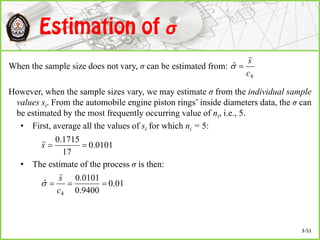
When the sample size does not vary, σ can be estimated from:
However, when the sample sizes vary, we may estimate σ from the individual sample
values si. From the automobile engine piston rings’ inside diameters data, the σ can
be estimated by the most frequently occurring value of ni, i.e., 5.
• First, average all the values of si for which ni = 5:
• The estimate of the process σ is then:
3-51
4
ˆ
c
s

0101.0
17
1715.0
s
01.0
9400.0
0101.0
ˆ
4

c
s

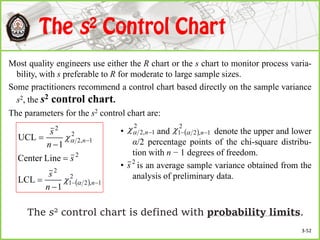
Most quality engineers use either the R chart or the s chart to monitor process varia-
bility, with s preferable to R for moderate to large sample sizes.
Some practitioners recommend a control chart based directly on the sample variance
s2, the s2 control chart.
The parameters for the s2 control chart are:
• and denote the upper and lower
α/2 percentage points of the chi-square distribu-
tion with n − 1 degrees of freedom.
• is an average sample variance obtained from the
analysis of preliminary data.
 
2
1,21
2
2
2
1,2
2
1
LCL
LineCenter
1
UCL







n
n
n
s
s
n
s




2
1,2 n  
2
1,21  n
2
s
The s2 control chart is defined with probability limits.
3-52
Instructor:
M. Mujiya Ulkhaq
Department of Industrial Engineering
Shewhart Charts for Variables:
IndividualandMovingRangeCharts
Statistical Process Control
• Control limits;
• Example of application;
• Interpretation;
• Average run length;
• The effect of non-normality;
• Estimation of σ.
3-54
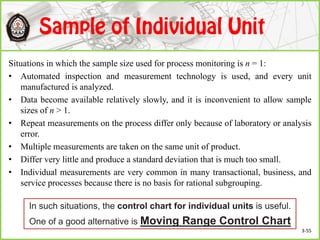
Situations in which the sample size used for process monitoring is n = 1:
• Automated inspection and measurement technology is used, and every unit
manufactured is analyzed.
• Data become available relatively slowly, and it is inconvenient to allow sample
sizes of n > 1.
• Repeat measurements on the process differ only because of laboratory or analysis
error.
• Multiple measurements are taken on the same unit of product.
• Differ very little and produce a standard deviation that is much too small.
• Individual measurements are very common in many transactional, business, and
service processes because there is no basis for rational subgrouping.
In such situations, the control chart for individual units is useful.
One of a good alternative is Moving Range Control Chart
3-55
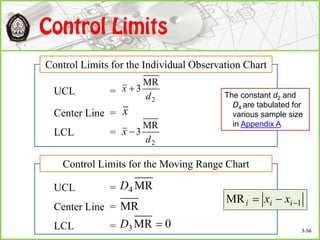
UCL =
Center Line =
LCL =
Control Limits for the Individual Observation Chart
x
2
MR
3
d
x 
UCL =
Center Line =
LCL =
Control Limits for the Moving Range Chart
MR
0MR3 D
MR4D
The constant d2 and
D4 are tabulated for
various sample size
in Appendix A
2
MR
3
d
x 
1MR  iii xx
3-56
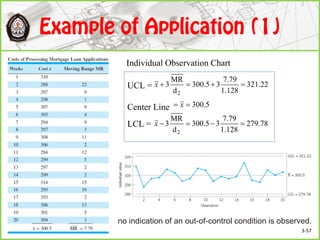
UCL =
Center Line
LCL =
22.321
128.1
79.7
35.300
d
MR
3
2
x
5.300 x
no indication of an out-of-control condition is observed.
Individual Observation Chart
78.279
128.1
79.7
35.300
d
MR
3
2
x
3-57
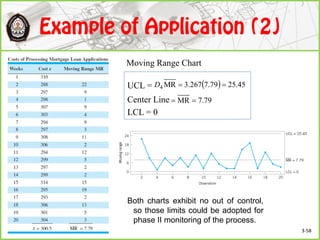
UCL =
Center Line
LCL = 0
  45.2579.7267.3MR4 D
79.7MR 
Moving Range Chart
Both charts exhibit no out of control,
so those limits could be adopted for
phase II monitoring of the process.
3-58
• The interpretation of individual observation chart is similar with x-bar chart.
– A shift in the process mean will result in a single point or a series of points that plot
outside the control limits on the control chart for individuals.
– A large value of x will also lead to a large value of the moving range.
– It is likely an indication that the mean is out of control and not an indication that
both the mean and the variance of the process are out of control.
• However, MR chart cannot be interpreted the same as x-bar or R charts.
• The moving ranges are correlated; it is a contradiction since the individual
observation is assumed to be independent (uncorrelated). Hence, any appa-
rent pattern on this chart should be carefully investigated.
– MR chart cannot really supply useful information about process variability.
– More emphasis should be placed on interpretation of the individual chart.
3-59
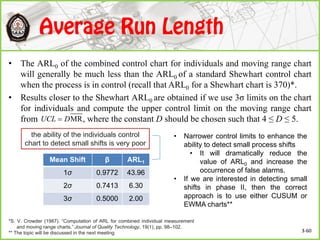
• The ARL0 of the combined control chart for individuals and moving range chart
will generally be much less than the ARL0 of a standard Shewhart control chart
when the process is in control (recall that ARL0 for a Shewhart chart is 370)*.
• Results closer to the Shewhart ARL0 are obtained if we use 3σ limits on the chart
for individuals and compute the upper control limit on the moving range chart
from , where the constant D should be chosen such that 4 ≤ D ≤ 5.
*S. V. Crowder (1987). “Computation of ARL for combined individual measurement
and moving range charts,” Journal of Quality Technology, 19(1), pp. 98–102.
** The topic will be discussed in the next meeting
MRDUCL 
Mean Shift β ARL1
1σ 0.9772 43.96
2σ 0.7413 6.30
3σ 0.5000 2.00
• Narrower control limits to enhance the
ability to detect small process shifts
• It will dramatically reduce the
value of ARL0 and increase the
occurrence of false alarms.
• If we are interested in detecting small
shifts in phase II, then the correct
approach is to use either CUSUM or
EWMA charts**
the ability of the individuals control
chart to detect small shifts is very poor
3-60
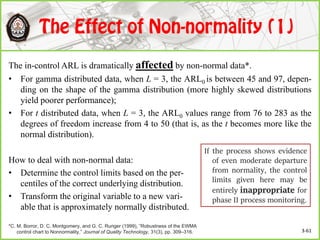
The in-control ARL is dramatically affected by non-normal data*.
• For gamma distributed data, when L = 3, the ARL0 is between 45 and 97, depen-
ding on the shape of the gamma distribution (more highly skewed distributions
yield poorer performance);
• For t distributed data, when L = 3, the ARL0 values range from 76 to 283 as the
degrees of freedom increase from 4 to 50 (that is, as the t becomes more like the
normal distribution).
How to deal with non-normal data:
• Determine the control limits based on the per-
centiles of the correct underlying distribution.
• Transform the original variable to a new vari-
able that is approximately normally distributed.
*C. M. Borror, D. C. Montgomery, and G. C. Runger (1999), “Robustness of the EWMA
control chart to Nonnormality,” Journal of Quality Technology, 31(3), pp. 309–316.
If the process shows evidence
of even moderate departure
from normality, the control
limits given here may be
entirely inappropriate for
phase II process monitoring.
3-61
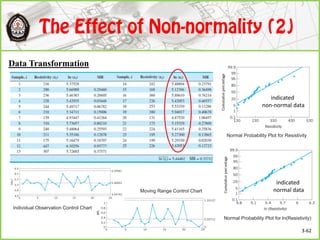
Data Transformation
Normal Probability Plot for Resistivity
Normal Probability Plot for ln(Resistivity)
Individual Observation Control Chart
Moving Range Control Chart
3-62
indicated
non-normal data
indicated
normal data
σ
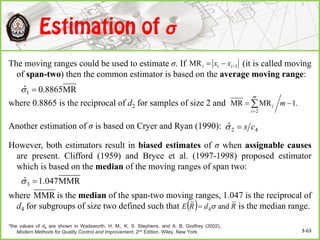
The moving ranges could be used to estimate σ. If (it is called moving
of span-two) then the common estimator is based on the average moving range:
where 0.8865 is the reciprocal of d2 for samples of size 2 and
Another estimation of σ is based on Cryer and Ryan (1990):
However, both estimators result in biased estimates of σ when assignable causes
are present. Clifford (1959) and Bryce et al. (1997-1998) proposed estimator
which is based on the median of the moving ranges of span two:
where is the median of the span-two moving ranges, 1.047 is the reciprocal of
d4 for subgroups of size two defined such that is the median range.
3-63
MR8865.0ˆ1 
1MR  iii xx
.1MRMR
2
 

m
m
i
i
42ˆ cs
MMR047.1ˆ3 
  RdRE
~
and
~
4
MMR
*the values of d4 are shown in Wadsworth, H. M., K. S. Stephens, and A. B. Godfrey (2002),
Modern Methods for Quality Control and Improvement, 2nd Edition. Wiley, New York.
Instructor:
M. Mujiya Ulkhaq
Department of Industrial Engineering
Statistical Process Control
Thank You for Your Attention

Shewhart Charts for Variables

  • 1.
    Instructor: M. Mujiya Ulkhaq Departmentof Industrial Engineering Shewhart Charts for Variables: XandRcharts Statistical Process Control
  • 2.
    • Notations, assumptions,and rule of thumb; • Control limits; • Phase I and Phase II; • Estimating process capability; • Example of application; • Designing control charts; • Charts based on standard values; • Patterns interpretation; • The operating-characteristic function; • Average run length. 3-2
  • 3.
    A single qualitycharacteristic that can be measured on a numerical scale is called variable. When dealing with a quality characteristic that is a variable, it is usually necessary to monitor both the mean value of the quality characteristic and its variability. • Control of the process average or mean quality level is usually done with the control chart for means, or the control chart. • Process variability can be monitored with either a control chart for the standard deviation: the s control chart, or a control chart for the range: an R control chart. x Figure 3.1. The need for controlling both process mean and process variability. (a) Mean and standard deviation at nominal levels; (b) Mean has shifted; (c) Standard deviation has shifted Montgomery (2013), p. 235 3-3
  • 4.
    Sample Number 12 … n Ri 1 x11 x12 … x1n R1 2 x21 x22 … x2n R2 … … … … … … … m xm1 xm2 … xmn Rm ix 1x 2x mx n xxx x ix inii i i    ... samplethofAverage 21 m xxx x x m   ... averageGrand 21 x R minmax samplethofRange iii i xxR iR   m RRR R R m   ... RangeAverage 21 x = quality characteristic; n = sample size; m = number of samples. 3-4
  • 5.
    Assumptions: • The qualitycharacteristic is normally and independently distributed (NID); – If the underlying distribution is non-normal, the central limit theorem would be applied; • Estimated from preliminary samples taken when the process is thought to be in control. Rule of Thumb: • The mean μ and the standard deviation σ are usually unknown and must be estimated from the sample; • These estimates should be based on at least 20 to 25 samples (m = 20 or 25); • Typically, n will be small, often either 4, 5, or 6 due to the inspection costs. – We can, of course, work with fewer data, but the control limits are not as reliable. 3-5
  • 6.
    UCL = Center Line= LCL = Control Limits for the Chartx x RAx 2 RAx 2 UCL = Center Line = LCL = Control Limits for the R Chart R RD3 RD4 The derivation of the formula is given in Appendix B The constant A2, D3, and D4 are tabulated for various sample size in Appendix A 3-6
  • 7.
    The control limitsaforementioned should be treated as trial control limits. • If the process is in control for the m samples collected, then the system was in control in the past, and the trial control limits are suitable for controlling current or future production. • If points plot out of control, then the control limits must be revised. • Before revising, identify out of control points and look for assignable causes. – If an assignable causes is found, then discard the point(s) and recalculate the trial control limits using only the remaining points. This process is continued until all points plot in control. – If no assignable causes can be found then: (1) either discard the point(s) as if an assignable cause had been found or (2) retain the point(s) considering the trial control limits as appropriate for current control. all points plot inside the control limits and no systematic behavior is evident. 3-7
  • 8.
    UCL = Center Line LCL= Chartx   693.1 32521.0577.05056.12   RAx 5056.1 x   318.1 32521.0577.05056.12   RAx no indication of an out-of-control condition is observed. 3-8
  • 9.
    UCL = Center Line LCL= ChartR   6876.0114.232521.04 DR 32521.0 R Since both charts exhibit control, we would conclude that the process is in control at the stated levels and adopt the trial control limits for use in phase II, where monitoring of future production is of interest.   0032521.03 DR 3-9
  • 10.
    The fraction ofnonconforming products can be estimated as: p = P{x < LSL} + P{x > USL}, assumed that the quality characteristics is NID. Example from hard-bake process. The estimated standard deviation is: The fraction of nonconforming products is: Assuming a stable process 1398.0 326.2 32521.0 ˆ 2  d R          ppm3500.00035 0.99980-10.00015 53648.316166.3 1398.0 5056.100.2 1 1398.0 5056.100.1 00.200.1                    xPxPp *The specification limits are assumed to be 1.50  0.50 3-10
  • 11.
    Another way toexpress process capability is in terms of the process capability ratio (PCR) Cp, which for a quality characteristic with both upper and lower specifica- tion limits (USL and LSL, respectively) is If the σ is unknown, it has to be estimated from the sample data, i.e. Then Cp would be Assuming a stable process and the process is centered at the midpoint of the specification band 6 LSLUSL  pC .ˆ .ˆ pC Figure 3.2. Process fallout and the process capability ratio Cp. Montgomery (2013), p. 242 a low number of nonconforming items will be produced a large number of nonconforming items will be produced approx. 0.27% (2,700 ppm) of nonconforming items will be produced 3-11
  • 12.
    The PCR Cpmay be interpreted as the percentage of the specification band that the process uses up. It is denoted by If the estimated Cp is used, i.e. then P would be estimated P, i.e. %100 1          pC P ,ˆ pC   %.100ˆ1ˆ pCP  Figure 3.2. Process fallout and the process capability ratio Cp. Montgomery (2013), p. 242 the process uses up much less than 100% of the tolerance band the process uses up more than 100% of the tolerance band the process uses up all the tolerance band Assuming a stable process and the process is centered at the midpoint of the specification band 3-12
  • 13.
    1. Control limitsare functions of the natural variability of the process 2. Natural tolerance limits (UNTL/LNTL) represent the natural variability of the process (usually set at 3-sigma from the mean). 3. Specification limits (USL/LSL) are determined externally, by management, developers/designers, or customers*. *This topic is discussed in the Quality Engineering Class. There is no mathematical or statistical relationship between control limits and specification limits. Do not plot specification limits on the charts because it will cause confusion between the interpretation of control and capability. Figure 3.3. Relationship of natural tolerance limits, control limits, and specification limits. Montgomery (2013), p. 246 3-13
  • 14.
    • The effectiveuse of any control chart will require periodic revision of the control limits and center lines. • Some practitioners establish regular periods for review and revision of control chart limits, such as every week, every month, or every 25, 50, or 100 samples. – When revising control limits, it is highly desirable to use at least 25 samples (some recommend 200–300 individual observations) in computing control limits. • The center line of the x-bar chart can be replaced with a target value, say – If the R chart exhibits control, this can be helpful, particularly in processes where the mean may be changed by a fairly simple adjustment in the process. – If the mean is not easily influenced by a simple process adjustment, then it is likely to be a complex and unknown function of several process variables and a target value may not be helpful. It could result in many points outside the control limits. Designed experiments* can be very helpful in determining which process variable adjustments lead to a desired value of the process mean. .0x *This topic is discussed in the Design of Experiment Class. 3-14
  • 15.
    Once a setof reliable control limits is established, we use the control chart for monitoring future production. This is called phase II control chart usage. (a) x-bar chart; (b) R chart 3-15
  • 16.
    In examining controlchart data, it is sometimes helpful to construct a run chart of the individual observations in each sample. This chart is sometimes called a tier chart or tolerance diagram. Tier chart for example data A tier chart does indicate that the observations fall outside the control limits but within the spe- cification limits. It also indicates that the mean probably has shif- ted when sample 38 was taken. Since the process is out of control, the OCAP would play a key role in these activities by directing operating personnel through a series of sequential activities to find the assignable cause. 3-16
  • 17.
    • The x-barchart monitors the average quality level in the process, or monitors between-sample variability (variability in the process over time). – Samples should be selected in such a way that maximizes the chances for shifts in the process average to occur between samples. • The R chart measures the variability within a sample, or measures within- sample variability (the instantaneous process variability at a given time). – Samples should be selected so that variability within samples measures only chance or random causes. 3-17
  • 18.
    To design thex-bar and R charts, we must specify the sample size, control limit width, and frequency of sampling to be used. Choice of sample size: Choose larger or small sample size? • If the x-bar chart is used to detect moderate to large process shifts—say, on the order of 2σ or larger—then relatively small samples of size n = 4, 5, or 6 are reasonably effective. • If one want to detect the small mean shift, then larger sample sizes are needed (as much as 15 to 25). However, it is considered as impractical. If increasing the sample size is not an option, then sensitizing procedures (such as warning limits) can be used. However, this can result in increased false alarms. The CUSUM or EWMA charts* are recommended to be used. 3-18*This topic will be discussed later.
  • 19.
    To design thex-bar and R charts, we must specify the sample size, control limit width, and frequency of sampling to be used. Choice of sample size: Choose larger or small sample size? • The R chart is relatively insensitive to small mean shift. Larger sample would be more effective, but the range method for estimating the standard deviation drops dramatically in efficiency as n increases, say when n > 10 or 12. When using large sample size, the s chart or s2 charts* could be used. The OC curves* can be helpful in determining an appropriate sample size. They provide a feel for the magnitude of process shift that will be detected with a stated probability for any sample size n. *This topic will be discussed further in the following slides. 3-19
  • 20.
    To design thex-bar and R charts, we must specify the sample size, control limit width, and frequency of sampling to be used. Allocating Sampling Effort: Choose a larger sample size and sample less frequently? or, Choose a smaller sample size and sample more frequently? The method to use will depend on the situation. • If the cost associated with producing defective items is high, smaller, more frequent samples are better than larger, less frequent ones. • If the rate production is high—say, 50,000 units per hour, then more frequent sampling is better than if the production rate is extremely slow. • If per unit inspection and testing costs are not excessive, high-speed production processes are often monitored with moderately large sample size. 3-20
  • 21.
    To design thex-bar and R charts, we must specify the sample size, control limit width, and frequency of sampling to be used. Choice of Control Limits: Choose wider or narrower control limits? • If false alarms or type I errors are very expensive to investigate, then it may be best to use wider control limits than 3-σ—perhaps as wide as 3.5-σ. • If the process is such that out-of-control signals are quickly and easily investiga- ted with a minimum of lost time and cost, then narrower control limits— perhaps at 2.5-σ of 2.75-σ be of appropriate 3-21
  • 22.
    There are situationsin which the sample size n is not constant. 1. There is a permanent (or semi-permanent) change in the sample size because of cost or because the process has exhibited good stability and fewer resources are being allocated for process monitoring. Notations: = average range for the old sample size = average range for the new sample size nold = old sample size nnew = new sample size d2(old) = factor d2 for the old sample size d2(new) = factor d2 for the new sample size oldR newR 3-22
  • 23.
    There are situationsin which the sample size n is not constant. 1. There is a permanent (or semi-permanent) change in the sample size because of cost or because the process has exhibited good stability and fewer resources are being allocated for process monitoring.         old old2 new2 2 old old2 new2 2 LCL LineCenter UCL :Chart R d d Ax x R d d Ax x                    *The factor A2 is selected for the new sample size                                                old old2 new2 3 old old2 new2 new old old2 new2 4 ,0maxLCL LineCenter UCL :Chart R d d D R d d R R d d D R *The factor D3 and D4 are selected for the new sample size 3-23
  • 24.
    There are situationsin which the sample size n is not constant. 2. Another situations is that of variable sample size on control charts; that is each sample may consist of a different number of observations. The x-bar and R charts are generally not used in this case because they lead to a changing center line on the R chart, which is difficult to interpret for many users. The x-bar and s charts* would be preferable in this case. *This topic will be discussed further in the following slides. 3-24
  • 25.
    • For x-barchart, we may obtain a desired type I error of α a by choosing the multi- ple of sigma for the control limit as L = Zα/2, where Zα/2 is the upper α/2 percent- tage point of the standard normal distribution. – When α = 0.002 is selected, then Zα/2 = Z0.001 = 3.09. • For R chart, percentage points of the distribution of the relative range W = R/σ are required. These points obviously depend on the subgroup size n. – When α = 0.002 is selected, then the corresponding control limits are: where D0.999 = W0.999(n)/d2 and D0.001 = W0.001(n)/d2. RD RD 001.0 999.0 LCL UCL   The various values of D0.999, D0.001, D0.025, and D0.975* *Lewis, M. J. and T. W. Young (2002), Brewing, 2nd Edition, Kluwer Academics, New York, p. 124 3-25
  • 26.
    When it ispossible to specify standard values for the process mean and standard deviation, we may use these standards to establish the control charts for x-bar and R without analysis of past data. Suppose that the standards given are μ and σ. • The control limits of the x-bar chart are: • The control limits of the R chart are: n n      3LCL LineCenter 3UCL    Let the quantity 3/√n = A, then: *The various values of A, D1, and D2 are provided in the Appendix A    32 2 32 3LCL LineCenter 3UCL dd d dd    Let the constants: D1 = d2 – 3d3 D2 = d2 + 3d3, then:    A A    LCL LineCenter UCL    1 2 2 LCL LineCenter UCL D d D    3-26
  • 27.
    • Cyclic Patterns –Such pattern on x-bar chart may result from: • systematic environmental changes, such as temperature; • operator fatigue,; • regular rotation of operators and/or machines; • fluctuation in voltage or pressure or some other variable in the production equipment. – Such pattern on R chart may result from: • maintenance schedules; • operator fatigue; • tool wear resulting in excessive variability. Figure 3.4. Cycles on a control chart. Montgomery (2013), p. 252 3-27
  • 28.
    • Mixture: theplotted points tend to fall near or slightly outside the control limits, with relatively few points near the center line. A mixture pattern is generated by two (or more) overlapping distributions generating the process output. Figure 3.5. A mixture pattern. Montgomery (2013), p. 252 Such pattern may result from: ─ “over-control”: the operators make process adjustments too often, responding to random variation in the output rather than systematic causes; ─ output product from several sources (such as parallel machines) is fed into a common stream that is then sampled for process monitoring purposes. 3-28
  • 29.
    • A Shiftin Process Level Such pattern may result from: – introduction of new workers; – changes in methods, raw materials, or machines; – a change in the inspection method or standards; – a change in either the skill, attentiveness, or motivation of the operators Figure 3.6. A shift in process level. Montgomery (2013), p. 253 3-29
  • 30.
    • A Trendin Process Level: a continuous movement in one direction. Such pattern may result from: – a gradual wearing out or deterioration of a tool; – human causes, such as operator fatigue or the presence of supervision; – seasonal influences, such as temperature. In chemical processes they may result from: – settling or separation of the components of a mixture. This pattern may be directly incorporated into the control chart model. The regression control chart* can be a good alternative. Figure 3.7. A trend in process level. Montgomery (2013), p. 253 *J. Mandel (1969), “The regression control chart,” Journal of Quality Technology, vol. 1(1), pp. 1–9. 3-30
  • 31.
    • A Stratification:tendency for the points to cluster artificially around the center line. Such pattern may result from: – lack of natural variability; – incorrect calculation of control limits.; – the sampling process collects one or more units from several different underlying distributions within each subgroup.: • If the largest and smallest units in each sample are relatively far apart because they come from two different distributions, then R will be incorrectly inflated, causing the limits on the x-bar chart to be too wide. Figure 3.8. Stratification. Montgomery (2013), p. 253 3-31
  • 32.
    In interpreting patternson the x-bar and R charts: consider the two chart jointly. • If the underlying distribution is normal, then the random variable x-bar and R computed from same sample are statistically independent. – x-bar and R should behave independently on the control chart. • If there is correlation between x-bar and R values (if the points on the two charts “follow” each other), then the underlying distribution is skewed. • If specifications have been determined assuming normality, then those analyses may be in error. 3-32
  • 33.
    In general, x-barchart is insensitive (robust) to small departures from normality. • The usual normal theory control limit constants are very robust to the normality assumption and can be employed unless the population is extremely non-normal.* • When the underlying distribution is uniform, right triangular, gamma (with λ = 1 and r = ½, 1, 2, 3, 4), and two bimodal distributions formed as mixtures of two normal distributions, sample of size 4 or 5 are sufficient to ensure reasonable robustness to the normality assumption** – Worst case were for small values of r in the gamma distribution [r = ½ and r = 1 (the exponential distribution)]: the α will be 0.014 or less if n ≥ 4 with r = ½. In contrast, R-chart is more sensitive than x-bar chart. • The sampling distribution of R is not symmetric, even when sampling from the normal distribution. When 3-sigma is used, the α is not 0.0027 (in fact, for n = 4, the α is 0.00461). *I. J. Burr (1967). “The effect of nonnormality on constants for x and R charts,” Industrial Quality Control, 23(11), pp. 563–569. **E. G. Schilling and P. R. Nelson (1976), “The effect of nonnormality on the control limits of x charts,” Journal of Quality Technology, 8(4), pp. 183–188. 3-33
  • 34.
    How well thex-bar and R charts can detect process shifts is described by operating- characteristic (OC) curves. • OC curves for x-bar chart The standard deviation σ is assumed known and constant. If the mean shifts from the in-control value—say, μ0—to another value μ1 = μ0 + kσ, the probability of not detecting this shift on the first subsequent sample or the β-risk is           )()( LCLUCL UCLLCL 0000 00 01 nkLnkL n knL n knL n k n k kxP                                                       3-34
  • 35.
    How well thex-bar and R charts can detect process shifts is described by operating- characteristic (OC) curves. • OC curves for x-bar chart Consider a problem of x-bar chart with L = 3 and n = 5. The probability of not detecting a shift to μ1 = μ0 + 2σ is β = ϕ(3 – 2√5) – ϕ(–3 – 2√5) = ϕ(–1.47) – ϕ(–7.37) = 0.0708 Then, the probability that such a shift will be detected on the first subsequent sample is 1 − β = 1 − 0.0708 = 0.9292 Figure 3.9. OC curves for the x-bar chart with 3σ limits. Montgomery (2013), p. 255 3-35
  • 36.
    How well thex-bar and R charts can detect process shifts is described by operating- characteristic (OC) curves. • OC curves for R chart Suppose the in-control value of standard deviation is σ0. The following OC curves plot the probability of not detecting a shift to a new value of σ—say, σ1 > σ0—on the first sample following the shift. Figure 3.10. OC curves for the R chart with 3σ limits. Montgomery (2013), p. 256 3-36
  • 37.
    The ARL0 andARL1 for x-bar chart are: If the observations plotted on the control chart are independent, then the number of points that must be plotted until the first point exceeds a control limit is a geometric random variable with parameter p. The mean is simply 1/p.    1 1 ARL; 1 ARL 10 Consider a problem with control limits set at 3 standard deviations from the mean (L = 3). The probability that a point plots beyond the control limits is 0.0027 (α = 0.0027). Then the in-control average run length is: ARL0 = 1/α = 1/0.0027 = 370 even if the process remains in control, an out-of-control signal will be generated every 370 samples, on the average 3-37
  • 38.
    Critics of theuse of the ARL: • the standard deviation of the run length is very large, • the geometric distribution is very skewed, so the mean of the distribution (the ARL) is not necessarily a very typical value of the run length. • the computations for a specific control chart are usually based on estimates of the process parameters; this results in inflation of ARL0 and ARL1 *. Consider a problem with control limits set at 3 standard deviations from the mean (L = 3). Note that α = 0.0027 and then the in-control ARL is 370. The standard deviation of the run length is 370 0027.0 0027.011       the standard deviation of the geometric distribution in this case is approximately equal to its mean. As a result, the actual ARL0 observed in practice for the Shewhart control chart will likely vary considerably. 3-38 *Jensen. W. A. et al. (2006). “Effects of parameter estimation on control chart properties: A literature review,” Journal of Quality Technology, 38, pp. 95–108.
  • 39.
    Due to itscriticisms, two other performance measures are sometimes of interest: • The average time to signal (ATS) is the number of time periods that occur until a signal is generated on the control chart. • It may also be useful to express the ARL in terms of the expected number of individual units sampled (I)—rather than the number of samples taken to detect a shift. If the sample size is n, the relationship between I and ARL is: 3-39 ARL nI Figure 3.11. ARL (individual units) for the chart with 3σ limits, where the process mean shifts by kσ. Montgomery (2013), p. 259 According to Fig. 3.11. Note that to detect a shift of 1.5σ, an x-bar chart with n = 16 will require that approximately 16 units be sampled, whereas if the sample size is n = 3, only about 9 units will be required, on the average.
  • 40.
    Instructor: M. Mujiya Ulkhaq Departmentof Industrial Engineering Shewhart Charts for Variables: Xandscharts Statistical Process Control
  • 41.
    • Notations, assumptions,and rule of thumb; • Control limits; • Variable sample size; • Charts based on standard values; • Example of application; • Estimation of σ; • The s2 control chart. 3-41
  • 42.
    Generally, x-bar ands charts are preferable to their more familiar counterparts, and R charts, when either: • the sample size n is moderately large—say, n > 10 or 12. – If the sample size n is relatively small, the range method for estimating the population standard deviation actually works very well. However, for moderate values of n—say 10—the range loses efficiency rapidly. • the sample size n is variable. Sample Size Efficiency 2 1.000 3 0.992 4 0.975 5 0.955 6 0.930 10 0.850 Montgomery (2013), p. 117 3-42
  • 43.
    Sample Number 12 … n si 1 x11 x12 … x1n s1 2 x21 x22 … x2n s2 … … … … … … … m xm1 xm2 … xmn sm ix 1x 2x mx n xxx x ix inii i i    ... samplethofAverage 21 m xxx x x m   ... averageGrand 21 x s   1 samplethofDev.St. 1 2       n xx s is n i i i i m sss s s m   ... Dev.St.Average 21 x = quality characteristic; n = sample size; m = number of samples. 3-43
  • 44.
    UCL = Center Line= LCL = Control Limits for the Chartx x sAx 3 sAx 3 UCL = Center Line = LCL = Control Limits for the s Chart s sB3 sB4 The derivation of the formula is given in Appendix C The constant A3, B3, and B4 are tabulated for various sample size in Appendix A 3-44
  • 45.
    When a standardvalue is given for the population standard deviation σ, the under- lying control limits for the s chart are: Let the constants: 2 44 4 2 44 13LCL LineCenter 13UCL cc c cc          5 4 6 LCL LineCenter UCL B c B   then,13B 13B 2 446 2 445 cc cc   The constant c4, B5, and B6 are tabulated for various sample size in Appendix A 3-45
  • 46.
    UCL = Center Line LCL= Chartx   014.74 0094.0427.1001.743   sAx 001.74 x   988.73 0094.0427.1001.743   sAx no indication of an out-of-control condition is observed. 3-46
  • 47.
    UCL = Center Line LCL= Charts   0196.00094.0089.24 sB 0094.0 s There is no indication that the process is out of control, so those limits could be adopted for phase II monitoring of the process.   00094.003 sB 3-47
  • 48.
    The x-bar ands charts can be adjusted to account for samples of various sizes. In this case, we should use a weighted average approach with ni is the number of obser- vations in the ith sample, those are: The control limits would be calculated normally, but the constants A3, B3, and B4 will depend on the sample size used in each individual subgroup. Therefore, the control limits would be vary.      m i i m i ii n xn x 1 1          m i i m i ii mn sn s 1 1 2 1 3-48
  • 49.
         001.74 535 998.735996.733010.745 1 1          x n xn x m i i m i ii           0103.0 25535 0162.040046.020148.04 1 222 1 1 2            s s mn sn s m i i m i ii   3-49
  • 50.
  • 51.
    σ When the samplesize does not vary, σ can be estimated from: However, when the sample sizes vary, we may estimate σ from the individual sample values si. From the automobile engine piston rings’ inside diameters data, the σ can be estimated by the most frequently occurring value of ni, i.e., 5. • First, average all the values of si for which ni = 5: • The estimate of the process σ is then: 3-51 4 ˆ c s  0101.0 17 1715.0 s 01.0 9400.0 0101.0 ˆ 4  c s 
  • 52.
    Most quality engineersuse either the R chart or the s chart to monitor process varia- bility, with s preferable to R for moderate to large sample sizes. Some practitioners recommend a control chart based directly on the sample variance s2, the s2 control chart. The parameters for the s2 control chart are: • and denote the upper and lower α/2 percentage points of the chi-square distribu- tion with n − 1 degrees of freedom. • is an average sample variance obtained from the analysis of preliminary data.   2 1,21 2 2 2 1,2 2 1 LCL LineCenter 1 UCL        n n n s s n s     2 1,2 n   2 1,21  n 2 s The s2 control chart is defined with probability limits. 3-52
  • 53.
    Instructor: M. Mujiya Ulkhaq Departmentof Industrial Engineering Shewhart Charts for Variables: IndividualandMovingRangeCharts Statistical Process Control
  • 54.
    • Control limits; •Example of application; • Interpretation; • Average run length; • The effect of non-normality; • Estimation of σ. 3-54
  • 55.
    Situations in whichthe sample size used for process monitoring is n = 1: • Automated inspection and measurement technology is used, and every unit manufactured is analyzed. • Data become available relatively slowly, and it is inconvenient to allow sample sizes of n > 1. • Repeat measurements on the process differ only because of laboratory or analysis error. • Multiple measurements are taken on the same unit of product. • Differ very little and produce a standard deviation that is much too small. • Individual measurements are very common in many transactional, business, and service processes because there is no basis for rational subgrouping. In such situations, the control chart for individual units is useful. One of a good alternative is Moving Range Control Chart 3-55
  • 56.
    UCL = Center Line= LCL = Control Limits for the Individual Observation Chart x 2 MR 3 d x  UCL = Center Line = LCL = Control Limits for the Moving Range Chart MR 0MR3 D MR4D The constant d2 and D4 are tabulated for various sample size in Appendix A 2 MR 3 d x  1MR  iii xx 3-56
  • 57.
    UCL = Center Line LCL= 22.321 128.1 79.7 35.300 d MR 3 2 x 5.300 x no indication of an out-of-control condition is observed. Individual Observation Chart 78.279 128.1 79.7 35.300 d MR 3 2 x 3-57
  • 58.
    UCL = Center Line LCL= 0   45.2579.7267.3MR4 D 79.7MR  Moving Range Chart Both charts exhibit no out of control, so those limits could be adopted for phase II monitoring of the process. 3-58
  • 59.
    • The interpretationof individual observation chart is similar with x-bar chart. – A shift in the process mean will result in a single point or a series of points that plot outside the control limits on the control chart for individuals. – A large value of x will also lead to a large value of the moving range. – It is likely an indication that the mean is out of control and not an indication that both the mean and the variance of the process are out of control. • However, MR chart cannot be interpreted the same as x-bar or R charts. • The moving ranges are correlated; it is a contradiction since the individual observation is assumed to be independent (uncorrelated). Hence, any appa- rent pattern on this chart should be carefully investigated. – MR chart cannot really supply useful information about process variability. – More emphasis should be placed on interpretation of the individual chart. 3-59
  • 60.
    • The ARL0of the combined control chart for individuals and moving range chart will generally be much less than the ARL0 of a standard Shewhart control chart when the process is in control (recall that ARL0 for a Shewhart chart is 370)*. • Results closer to the Shewhart ARL0 are obtained if we use 3σ limits on the chart for individuals and compute the upper control limit on the moving range chart from , where the constant D should be chosen such that 4 ≤ D ≤ 5. *S. V. Crowder (1987). “Computation of ARL for combined individual measurement and moving range charts,” Journal of Quality Technology, 19(1), pp. 98–102. ** The topic will be discussed in the next meeting MRDUCL  Mean Shift β ARL1 1σ 0.9772 43.96 2σ 0.7413 6.30 3σ 0.5000 2.00 • Narrower control limits to enhance the ability to detect small process shifts • It will dramatically reduce the value of ARL0 and increase the occurrence of false alarms. • If we are interested in detecting small shifts in phase II, then the correct approach is to use either CUSUM or EWMA charts** the ability of the individuals control chart to detect small shifts is very poor 3-60
  • 61.
    The in-control ARLis dramatically affected by non-normal data*. • For gamma distributed data, when L = 3, the ARL0 is between 45 and 97, depen- ding on the shape of the gamma distribution (more highly skewed distributions yield poorer performance); • For t distributed data, when L = 3, the ARL0 values range from 76 to 283 as the degrees of freedom increase from 4 to 50 (that is, as the t becomes more like the normal distribution). How to deal with non-normal data: • Determine the control limits based on the per- centiles of the correct underlying distribution. • Transform the original variable to a new vari- able that is approximately normally distributed. *C. M. Borror, D. C. Montgomery, and G. C. Runger (1999), “Robustness of the EWMA control chart to Nonnormality,” Journal of Quality Technology, 31(3), pp. 309–316. If the process shows evidence of even moderate departure from normality, the control limits given here may be entirely inappropriate for phase II process monitoring. 3-61
  • 62.
    Data Transformation Normal ProbabilityPlot for Resistivity Normal Probability Plot for ln(Resistivity) Individual Observation Control Chart Moving Range Control Chart 3-62 indicated non-normal data indicated normal data
  • 63.
    σ The moving rangescould be used to estimate σ. If (it is called moving of span-two) then the common estimator is based on the average moving range: where 0.8865 is the reciprocal of d2 for samples of size 2 and Another estimation of σ is based on Cryer and Ryan (1990): However, both estimators result in biased estimates of σ when assignable causes are present. Clifford (1959) and Bryce et al. (1997-1998) proposed estimator which is based on the median of the moving ranges of span two: where is the median of the span-two moving ranges, 1.047 is the reciprocal of d4 for subgroups of size two defined such that is the median range. 3-63 MR8865.0ˆ1  1MR  iii xx .1MRMR 2    m m i i 42ˆ cs MMR047.1ˆ3    RdRE ~ and ~ 4 MMR *the values of d4 are shown in Wadsworth, H. M., K. S. Stephens, and A. B. Godfrey (2002), Modern Methods for Quality Control and Improvement, 2nd Edition. Wiley, New York.
  • 64.
    Instructor: M. Mujiya Ulkhaq Departmentof Industrial Engineering Statistical Process Control Thank You for Your Attention