Atkinson Cycle, Ericsson Cycle
and Stirling Cycle
-by Group 11
[Dhaval Shukla,
Abhishek Singh R.,
Abhishek Singh
Aman Singh]
-Engineering Thermodynamics
-A.C.E.T.
Atkinson Cycle
 The Atkinson cycle was
conceived and developed
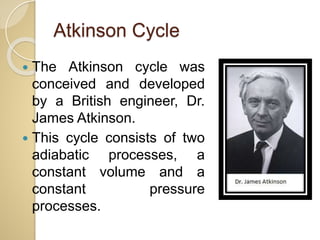
by a British engineer, Dr.
James Atkinson.
 This cycle consists of two
adiabatic processes, a
constant volume and a
constant pressure
processes.
Atkinson Cycle
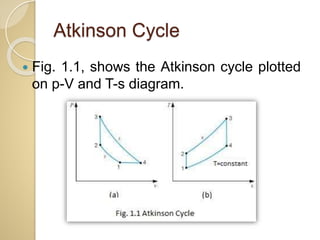
 Fig. 1.1, shows the Atkinson cycle plotted
on p-V and T-s diagram.
Atkinson Cycle
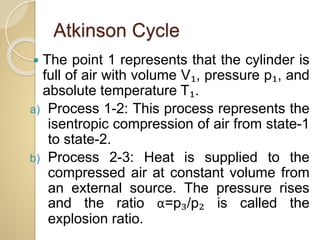
 The point 1 represents that the cylinder is
full of air with volume V₁, pressure p₁, and
absolute temperature T₁.
a) Process 1-2: This process represents the
isentropic compression of air from state-1
to state-2.
b) Process 2-3: Heat is supplied to the
compressed air at constant volume from
an external source. The pressure rises
and the ratio α=p₃/p₂ is called the
explosion ratio.
Atkinson Cycle
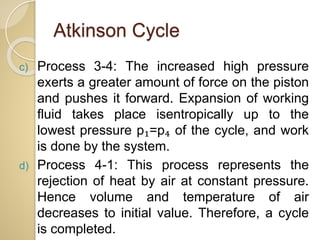
c) Process 3-4: The increased high pressure
exerts a greater amount of force on the piston
and pushes it forward. Expansion of working
fluid takes place isentropically up to the
lowest pressure p₁=p₄ of the cycle, and work
is done by the system.
d) Process 4-1: This process represents the
rejection of heat by air at constant pressure.
Hence volume and temperature of air
decreases to initial value. Therefore, a cycle
is completed.
Atkinson Cycle
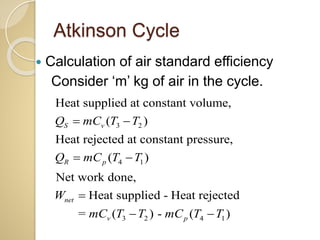
 Calculation of air standard efficiency
Consider ‘m’ kg of air in the cycle.
3 2
4 1
3 2 4 1
Heat supplied at constant volume,
( )
Heat rejected at constant pressure,
( )
Net work done,
Heat supplied - Heat rejected
= ( ) - ( )
S v
R p
net
v p
Q mC T T
Q mC T T
W
mC T T mC T T
 
 

 
Atkinson Cycle
 
3 2 4 1
3 2
4 1
3 2
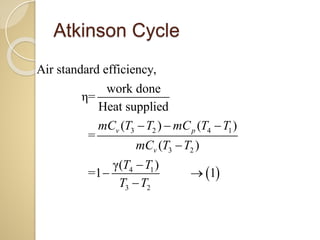
Air standard efficiency,
work done
η=
Heat supplied
( ) ( )
=
( )
γ( )
=1 1
v p
v
mC T T mC T T
mC T T
T T
T T
  


 

Atkinson Cycle
γ-1
γ-11
2 1 1
2
γ-13
3 2 2 1
2
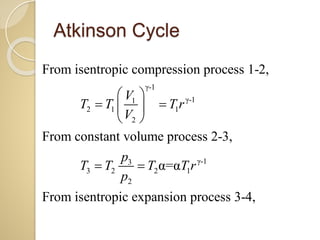
From isentropic compression process 1-2,
From constant volume process 2-3,
α=α
From isentropic expansion process 3-4,
V
T T T r
V
p
T T T T r
p
 
  
 
 
Atkinson Cycle
 
γ-1 γ-1
3 3 1
4 3 3
4 1 4
γ-1
2 1
3 2 3
1 4
γ-1
3 1
γ-1
4
4
4 1
1
=
=
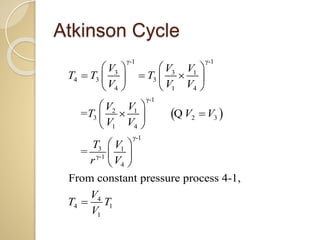
From constant pressure process 4-1,
V V V
T T T
V V V
V V
T V V
V V
T V
r V
V
T T
V
   
     
   
 
  
 
 
 
 

Q
Atkinson Cycle
 
 
 
1
γ
1 1
γ-1 γ-1
1 1
1
γ
γ-1
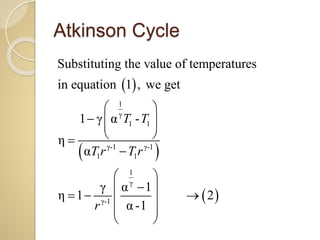
Substituting the value of temperatures
in equation 1 , we get
1 γ α -
η
α
γ α 1
η 1 2
α -1
T T
T r T r
r
 
   
 

 
 
   
 
 
Atkinson Cycle
 Which is the required equation for air
standard efficiency of the cycle.
 The idea of the Atkinson cycle is to get
more work than that given by Otto cycle.
 The area 4 onwards represents this
increased work.
 Further it is to be noted that heat rejection
occurs at lower average temperature (T₅
being higher than T₁).
Atkinson Cycle
 This aspects make Atkinson cycle more
efficient than Otto cycle.
 However, it is very difficult to construct
an engine working on Atkinson cycle.
Atkinson Cycle
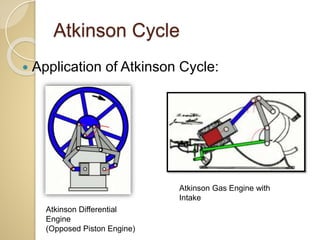
 Application of Atkinson Cycle:
Atkinson Differential
Engine
(Opposed Piston Engine)
Atkinson Gas Engine with
Intake
Atkinson Cycle
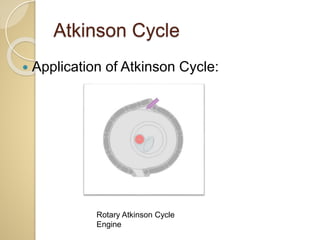
 Application of Atkinson Cycle:
Rotary Atkinson Cycle
Engine
Ericsson Cycle
 The Ericsson cycle is
named after inventor John
Ericsson, who designed and
built many unique heat
engines based on various
thermodynamic cycles.
 He is credited with inventing
two unique heat engine
cycles and developing
practical engines based on
Ericsson Cycle
 His first cycle is now known as the closed
Brayton cycle, while his second cycle is
what is now called the Ericsson cycle.
 The Ericsson cycle consists of two
isothermal and two constant pressure
processes.
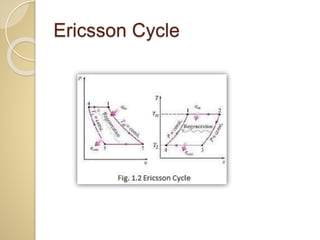
 The p-V and T-s diagram with the
mainframe structure of Ericsson Cycle is
shown in Fig.1.2:
Ericsson Cycle
Ericsson Cycle
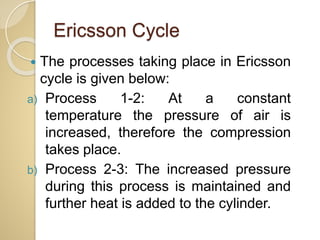
 The processes taking place in Ericsson
cycle is given below:
a) Process 1-2: At a constant
temperature the pressure of air is
increased, therefore the compression
takes place.
b) Process 2-3: The increased pressure
during this process is maintained and
further heat is added to the cylinder.
Ericsson Cycle
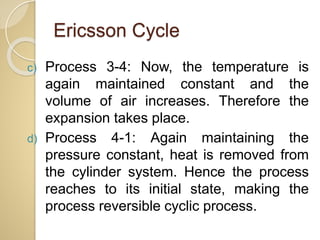
c) Process 3-4: Now, the temperature is
again maintained constant and the
volume of air increases. Therefore the
expansion takes place.
d) Process 4-1: Again maintaining the
pressure constant, heat is removed from
the cylinder system. Hence the process
reaches to its initial state, making the
process reversible cyclic process.
Ericsson Cycle
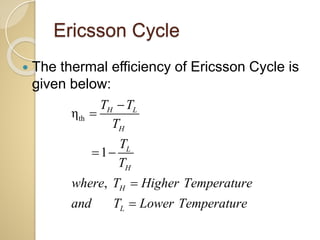
 The thermal efficiency of Ericsson Cycle is
given below:
thη
1
,
H L
H
L
H
H
L
T T
T
T
T
where T Higher Temperature
and T Lower Temperature


 


Ericsson Cycle
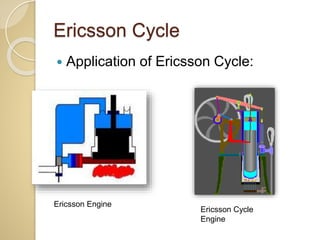
 Application of Ericsson Cycle:
Ericsson Engine
Ericsson Cycle
Engine
Stirling Cycle
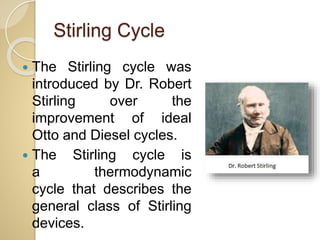
 The Stirling cycle was
introduced by Dr. Robert
Stirling over the
improvement of ideal
Otto and Diesel cycles.
 The Stirling cycle is
a thermodynamic
cycle that describes the
general class of Stirling
devices.
Stirling Cycle
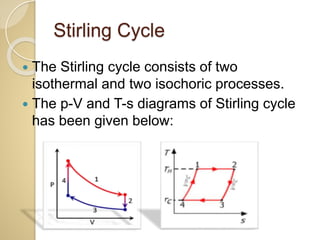
 The Stirling cycle consists of two
isothermal and two isochoric processes.
 The p-V and T-s diagrams of Stirling cycle
has been given below:
Stirling Cycle
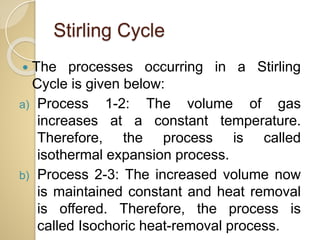
 The processes occurring in a Stirling
Cycle is given below:
a) Process 1-2: The volume of gas
increases at a constant temperature.
Therefore, the process is called
isothermal expansion process.
b) Process 2-3: The increased volume now
is maintained constant and heat removal
is offered. Therefore, the process is
called Isochoric heat-removal process.
Stirling Cycle
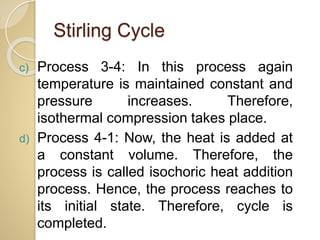
c) Process 3-4: In this process again
temperature is maintained constant and
pressure increases. Therefore,
isothermal compression takes place.
d) Process 4-1: Now, the heat is added at
a constant volume. Therefore, the
process is called isochoric heat addition
process. Hence, the process reaches to
its initial state. Therefore, cycle is
completed.
Stirling Cycle
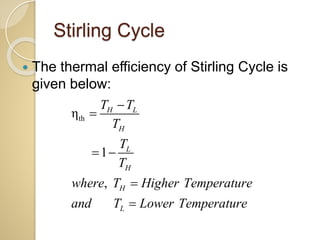
 The thermal efficiency of Stirling Cycle is
given below:
thη
1
,
H L
H
L
H
H
L
T T
T
T
T
where T Higher Temperature
and T Lower Temperature


 


Stirling Cycle
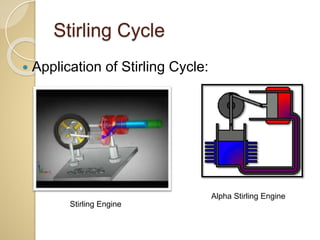
 Application of Stirling Cycle:
Stirling Engine
Alpha Stirling Engine
Stirling Cycle
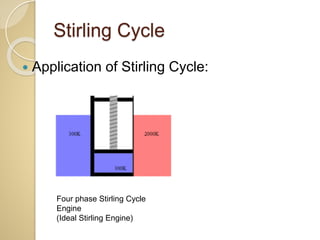
 Application of Stirling Cycle:
Four phase Stirling Cycle
Engine
(Ideal Stirling Engine)
Thank you!

Atkinson Cycle, Ericsson Cycle And Stirling Cycle

  • 1.
    Atkinson Cycle, EricssonCycle and Stirling Cycle -by Group 11 [Dhaval Shukla, Abhishek Singh R., Abhishek Singh Aman Singh] -Engineering Thermodynamics -A.C.E.T.
  • 2.
    Atkinson Cycle  TheAtkinson cycle was conceived and developed by a British engineer, Dr. James Atkinson.  This cycle consists of two adiabatic processes, a constant volume and a constant pressure processes.
  • 3.
    Atkinson Cycle  Fig.1.1, shows the Atkinson cycle plotted on p-V and T-s diagram.
  • 4.
    Atkinson Cycle  Thepoint 1 represents that the cylinder is full of air with volume V₁, pressure p₁, and absolute temperature T₁. a) Process 1-2: This process represents the isentropic compression of air from state-1 to state-2. b) Process 2-3: Heat is supplied to the compressed air at constant volume from an external source. The pressure rises and the ratio α=p₃/p₂ is called the explosion ratio.
  • 5.
    Atkinson Cycle c) Process3-4: The increased high pressure exerts a greater amount of force on the piston and pushes it forward. Expansion of working fluid takes place isentropically up to the lowest pressure p₁=p₄ of the cycle, and work is done by the system. d) Process 4-1: This process represents the rejection of heat by air at constant pressure. Hence volume and temperature of air decreases to initial value. Therefore, a cycle is completed.
  • 6.
    Atkinson Cycle  Calculationof air standard efficiency Consider ‘m’ kg of air in the cycle. 3 2 4 1 3 2 4 1 Heat supplied at constant volume, ( ) Heat rejected at constant pressure, ( ) Net work done, Heat supplied - Heat rejected = ( ) - ( ) S v R p net v p Q mC T T Q mC T T W mC T T mC T T       
  • 7.
    Atkinson Cycle   32 4 1 3 2 4 1 3 2 Air standard efficiency, work done η= Heat supplied ( ) ( ) = ( ) γ( ) =1 1 v p v mC T T mC T T mC T T T T T T        
  • 8.
    Atkinson Cycle γ-1 γ-11 2 11 2 γ-13 3 2 2 1 2 From isentropic compression process 1-2, From constant volume process 2-3, α=α From isentropic expansion process 3-4, V T T T r V p T T T T r p         
  • 9.
    Atkinson Cycle   γ-1γ-1 3 3 1 4 3 3 4 1 4 γ-1 2 1 3 2 3 1 4 γ-1 3 1 γ-1 4 4 4 1 1 = = From constant pressure process 4-1, V V V T T T V V V V V T V V V V T V r V V T T V                             Q
  • 10.
    Atkinson Cycle      1 γ 1 1 γ-1 γ-1 1 1 1 γ γ-1 Substituting the value of temperatures in equation 1 , we get 1 γ α - η α γ α 1 η 1 2 α -1 T T T r T r r                     
  • 11.
    Atkinson Cycle  Whichis the required equation for air standard efficiency of the cycle.  The idea of the Atkinson cycle is to get more work than that given by Otto cycle.  The area 4 onwards represents this increased work.  Further it is to be noted that heat rejection occurs at lower average temperature (T₅ being higher than T₁).
  • 12.
    Atkinson Cycle  Thisaspects make Atkinson cycle more efficient than Otto cycle.  However, it is very difficult to construct an engine working on Atkinson cycle.
  • 13.
    Atkinson Cycle  Applicationof Atkinson Cycle: Atkinson Differential Engine (Opposed Piston Engine) Atkinson Gas Engine with Intake
  • 14.
    Atkinson Cycle  Applicationof Atkinson Cycle: Rotary Atkinson Cycle Engine
  • 15.
    Ericsson Cycle  TheEricsson cycle is named after inventor John Ericsson, who designed and built many unique heat engines based on various thermodynamic cycles.  He is credited with inventing two unique heat engine cycles and developing practical engines based on
  • 16.
    Ericsson Cycle  Hisfirst cycle is now known as the closed Brayton cycle, while his second cycle is what is now called the Ericsson cycle.  The Ericsson cycle consists of two isothermal and two constant pressure processes.  The p-V and T-s diagram with the mainframe structure of Ericsson Cycle is shown in Fig.1.2:
  • 17.
  • 18.
    Ericsson Cycle  Theprocesses taking place in Ericsson cycle is given below: a) Process 1-2: At a constant temperature the pressure of air is increased, therefore the compression takes place. b) Process 2-3: The increased pressure during this process is maintained and further heat is added to the cylinder.
  • 19.
    Ericsson Cycle c) Process3-4: Now, the temperature is again maintained constant and the volume of air increases. Therefore the expansion takes place. d) Process 4-1: Again maintaining the pressure constant, heat is removed from the cylinder system. Hence the process reaches to its initial state, making the process reversible cyclic process.
  • 20.
    Ericsson Cycle  Thethermal efficiency of Ericsson Cycle is given below: thη 1 , H L H L H H L T T T T T where T Higher Temperature and T Lower Temperature      
  • 21.
    Ericsson Cycle  Applicationof Ericsson Cycle: Ericsson Engine Ericsson Cycle Engine
  • 22.
    Stirling Cycle  TheStirling cycle was introduced by Dr. Robert Stirling over the improvement of ideal Otto and Diesel cycles.  The Stirling cycle is a thermodynamic cycle that describes the general class of Stirling devices.
  • 23.
    Stirling Cycle  TheStirling cycle consists of two isothermal and two isochoric processes.  The p-V and T-s diagrams of Stirling cycle has been given below:
  • 24.
    Stirling Cycle  Theprocesses occurring in a Stirling Cycle is given below: a) Process 1-2: The volume of gas increases at a constant temperature. Therefore, the process is called isothermal expansion process. b) Process 2-3: The increased volume now is maintained constant and heat removal is offered. Therefore, the process is called Isochoric heat-removal process.
  • 25.
    Stirling Cycle c) Process3-4: In this process again temperature is maintained constant and pressure increases. Therefore, isothermal compression takes place. d) Process 4-1: Now, the heat is added at a constant volume. Therefore, the process is called isochoric heat addition process. Hence, the process reaches to its initial state. Therefore, cycle is completed.
  • 26.
    Stirling Cycle  Thethermal efficiency of Stirling Cycle is given below: thη 1 , H L H L H H L T T T T T where T Higher Temperature and T Lower Temperature      
  • 27.
    Stirling Cycle  Applicationof Stirling Cycle: Stirling Engine Alpha Stirling Engine
  • 28.
    Stirling Cycle  Applicationof Stirling Cycle: Four phase Stirling Cycle Engine (Ideal Stirling Engine)
  • 29.