‫معهد اعداد المدربين التقنيين‬
                                   ‫قسم المكائن والمعدات‬


                                ‫الحقيبة التعليمية‬
              ‫االساسية لمحركات االحتراق الداخلي‬
              ‫اعداد‬
‫المهندس : نزار فيصل عودة العبيدي‬


                                                               ‫1‬
Conversion of Thermal Energy
•Almost all of the mechanical energy produced
 today is produced from the conversion of thermal
 energy in some sort of heat engine.
• The operation of all heat-engine cycles can usually
 be approximated by an ideal thermodynamic power
 cycle of some kind.
•A basic understanding of these cycles can often
 show the power engineer how to improve the
 operation and performance of the system.


                                                        2
Conversion of Thermal Energy
•Almost all of the mechanical energy produced
 today is produced from the conversion of thermal
 energy in some sort of heat engine.
• The operation of all heat-engine cycles can usually
 be approximated by an ideal thermodynamic power
 cycle of some kind.
•A basic understanding of these cycles can often
 show the power engineer how to improve the
 operation and performance of the system.


                                                        3
P- and T-s Diagrams of Power Cycles
The area under the heat addition process on a T-s
diagram is a geometric measure of the total heat
supplied during the cycle qin, and the area under the
heat rejection process is a measure of the total heat
rejected qout. The difference between these two (the
area enclosed by the cyclic curve) is the net heat
transfer, which is also the net work produced during
the cycle.


                                                        4
Reversible Heat-Engine Cycles
•The second law of thermodynamics states that it is
 impossible to construct a heat engine or to develop a
 power cycle that has a thermal efficiency of 100%.
 This means that at least part of the thermal energy
 transferred to a power cycle must be transferred to a
 low-temperature sink.
•There are four phenomena that render any
 thermodynamic process irreversible. They are:
   Friction
   Unrestrained expansion
   Mixing of different substances
   Transfer of heat across a finite temperature difference

                                                              5
Categorize Cycles
• Thermodynamic cycles can be divided into two
general categories: Power cycles and refrigeration
cycles.
• Thermodynamic cycles can also be categorized as
gas cycles or vapor cycles, depending upon the phase
of the working fluid.
• Thermodynamic cycles can be categorized yet
another way: closed and open cycles.
• Heat engines are categorized as internal or external
combustion engines.


                                                         6
Air-Standard Assumptions
To reduce the analysis of an actual gas power cycle to a
   manageable level, we utilize the following
   approximations, commonly know as the air-
   standard assumptions:
1. The working fluid is air, which continuously circulates
   in a closed loop and always behaves as an ideal gas.
2. All the processes that make up the cycle are internally
   reversible.
3. The combustion process is replaced by a heat-
   addition process from an external source.
4. The exhaust process is replaced by a heat rejection
   process that restores the working fluid to its initial
   state.
                                                             7
Air-Standard Cycle
Another assumption that is often utilized to simplify
the analysis even more is that the air has constant
specific heats whose values are determined at room
temperature (25oC, or 77oF). When this assumption is
utilized, the air-standard assumptions are called the
cold-air-standard assumptions. A cycle for which the
air-standard assumptions are applicable is frequently
referred to as an air-standard cycle.
The air-standard assumptions stated above provide
considerable simplification in the analysis without
significantly deviating from the actual cycles.
The simplified model enables us to study qualitatively
the influence of major parameters on the performance
of the actual engines.
                                                         8
Bore and
stroke of a
  cylinder


              9
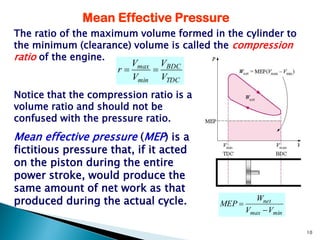
Mean Effective Pressure
The ratio of the maximum volume formed in the cylinder to
the minimum (clearance) volume is called the compression
ratio of the engine.
                        V     V
                     r  max  BDC
                        Vmin VTDC
Notice that the compression ratio is a
volume ratio and should not be
confused with the pressure ratio.
Mean effective pressure (MEP) is a
fictitious pressure that, if it acted
on the piston during the entire
power stroke, would produce the
same amount of net work as that
produced during the actual cycle.        MEP 
                                                    Wnet
                                                 Vmax  Vmin

                                                               10
Three Ideal Power Cycles
•Three ideal power cycles are completely reversible
 power cycles, called externally reversible power
 cycles. These three ideal cycles are the Carnot cycle,
 the Ericsson cycle, and the Stirling Cycle.


                                                          11
Three Ideal Power Cycles
•The Carnot cycle is an externally reversible power cycle
 and is sometimes referred to as the optimum power
 cycle in thermodynamic textbooks. It is composed of
 two reversible isothermal processes and two reversible
 adiabatic (isentropic) processes.
•The Ericsson power cycle is another heat-engine cycle
 that is completely reversible or “externally reversible.” It
 is composed of two reversible isothermal processes and
 two reversible isobaric processes (with regenerator).
•The Stirling cycle is also an externally reversible
                                                   heat-
 engine cycle and is the only one of the three ideal power
 cycles that has seen considerable practical application.
 It is composed of two reversible isothermal processes
 and two reversible isometric (constant volume)
 processes.
                                                                12
Carnot Cycle and Its Value in Engineering
The Carnot cycle is composed
of four totally reversible
processes: isothermal heat
addition, isentropic expansion,
isothermal heat rejection, and
isentropic compression (as
shown in the P- diagram at
right). The Carnot cycle can be
executed in a closed system (a
piston-cylinder device) or a
steady-flow system (utilizing
two turbines and two                                TL
                                  th ,Carnot   1
compressors), and either a gas                      TH
or vapor can be used as the
working fluid.
                                                         13
Internal-Combustion Engine Cycles
• Internal-combustion (IC) engines cannot operate on
an ideal reversible heat-engine cycle but they can be
approximated by internally reversible cycles in which
all the processes are reversible except the heat-
addition and heat-rejection processes.
•In general, IC engines are more polluting than
 external-combustion (EC) engines because of the
 formation of nitrogen oxides, carbon dioxide, and
 unburned hydrocarbons.
•The Otto cycle is the basic thermodynamic power
 cycle for the spark-ignition (SI), internal-
 combustion engine.


                                                        14
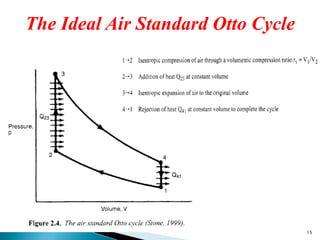
The Ideal Air Standard Otto Cycle


                                    15
Otto Cycle: The ideal Cycle for Spark-Ignition Engines
Figures below show the actual and ideal cycles in spark-
ignition (SI) engines and their P- diagrams.


                                                           16
Ideal Otto Cycle
                      The thermodynamic analysis of
                      the actual four-stroke or two-
                      stroke cycles can be simplified
                      significantly if the air-standard
                      assumptions are utilized. The T-
                      s diagram of the Otto cycle is
                      given in the figure at left.

The ideal Otto cycle consists of four internally
reversible processes:
12   Isentropic compression
23   Constant volume heat addition
34   Isentropic expansion
41   Constant volume heat rejection
                                                          17
Thermal Efficiency of an Otto Cycle
The Otto cycle is executed in a closed system, and
disregarding the changes in kinetic and potential
energies, we have
qin  qout   win  wout   u
 qin  u3  u 2  Cv T3  T2 
 qout  u 4  u1  Cv T4  T1 
              wnet     qout     T4  T1
th ,Otto         1      1
              qin      qin      T3  T2
               T1 T4 / T1  1      T         1
        1                      1  1  1  k 1
               T2 T3 / T2  1      T2      r

                         k 1             k 1
        T1   2                 3            T4        Vmax V1 1
 Where,                                     ;and r        
        T2  1 
            
                                  
                                  4             T3        Vmin V2  2

                                                                          18
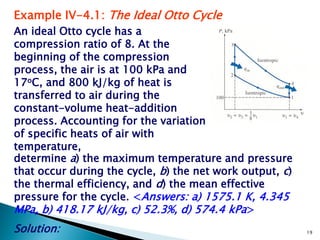
Example IV-4.1: The Ideal Otto Cycle
An ideal Otto cycle has a
compression ratio of 8. At the
beginning of the compression
process, the air is at 100 kPa and
17oC, and 800 kJ/kg of heat is
transferred to air during the
constant-volume heat-addition
process. Accounting for the variation
of specific heats of air with
temperature,
determine a) the maximum temperature and pressure
that occur during the cycle, b) the net work output, c)
the thermal efficiency, and d) the mean effective
pressure for the cycle. <Answers: a) 1575.1 K, 4.345
MPa, b) 418.17 kJ/kg, c) 52.3%, d) 574.4 kPa>
Solution:                                                 19
a  Maximum temperatur e and pressure in an Otto cycle:
T1  290K  u1  206.91kJ / kg, vr1  676.1
Process 1- 2 (isentropic compressio n of an ideal gas) :
vr 2 v2 1            vr1 676.1
       vr 2                84.51  T2  652.4 K , u 2  475.11kJ / kg
vr1 v1 r              r     8
P2 v2 P v1           T2  v1   652.4
      1
            P2  P     100
                   1     v           8  1799.7 kPa
 T2    T1            T1  2     290
Process 2 - 3 (constant volume heat addition) :
qin  u3  u 2  u3  qin  u 2  800  475.11  1275.11kJ / kg  T3  1575.1 K
P3v3 P2 v2            T3  v2          1575.1
                        1.797 MPa 
            P3  P2                          1  4.345MPa
 T3   T2              T2  v3          652.4
Note : The property vr (relative specific volume) is a dimensionl ess
quantity used in the analysis of isentropic processes,and should not
be confused w ith the property specific volume.
                                                                                  20
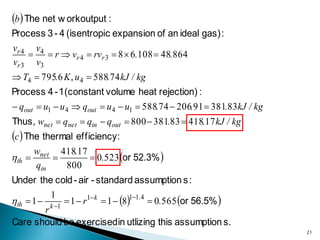
b  The net w ork output :
Process 3 - 4 (isentropic expansion of an ideal gas) :
vr 4 v4
      r  vr 4  rv r 3  8  6.108  48.864
vr 3 v3
 T4  795.6 K , u 4  588.74 kJ / kg
Process 4 - 1 (constant volume heat rejection) :
 qout  u1  u 4  qout  u 4  u1  588.74  206.91  381.83 kJ / kg
Thus, wnet  qnet  qin  qout  800  381.83  418.17 kJ / kg
c  The thermal efficiency:
                   0.523 or 52.3% 
      wnet 418.17
th      
      qin   800
Under the cold - air - standard assumption s :

th  1  k 1  1  r1 k  1  811.4  0.565 or 56.5% 
           1
         r
Care should be exercised in utlizing this assumption s.
                                                                         21
d  The mean effectivepressure is determined    from its definition :
                 kPa.m 3
           0.287          290K
     RT1          kg .K                 m3
v1                             0.832
      P1          100kPa                kg
              wnet    wnet       418.17  1kPa.m 3 
                                                      574.4 kPa
Thus, mep                
             v1  v2 v  v1 0.832  0.832  1 kJ 
                      1
                                                     
                         r             8
Therefore, a constant pressure of 574.4 kPa during the pow er stroke
w ould produce the same net w ork output as the entire cycle.

Note that this problem could be solved by using equations show non
Slide #17 w ith given constant specific heats c p , cv (at room temperatur e).


                                                                             22
Diesel Cycle: The Ideal Cycle for Compression-Ignition Engines

The diesel cycle is the ideal cycle for CI (Compression-
Ignition) reciprocating engines. The CI engine first
proposed by Rudolph Diesel in the 1890s, is very
similar to the SI engine, differing mainly in the method
of initiating combustion. In SI engines (also known as
gasoline engines), the air-fuel mixture is compressed
to a temperature that is below the autoignition
temperature of the fuel, and the combustion process is
initiated by firing a spark plug. In CI engines (also
known as diesel engines), the air is compressed to a
temperature that is above the autoignition temperature
of the fuel, and combustion starts on contact as the
fuel is injected into this hot air. Therefore, the spark
plug and carburetor are replaced by a fuel injector in
diesel engines.
                                                                   23
The Ideal Air Standard Diesel Cycle


                                      24
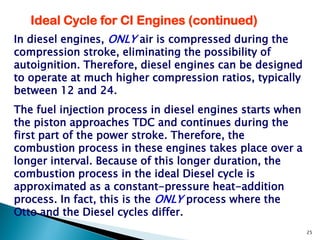
Ideal Cycle for CI Engines (continued)
In diesel engines, ONLY air is compressed during the
compression stroke, eliminating the possibility of
autoignition. Therefore, diesel engines can be designed
to operate at much higher compression ratios, typically
between 12 and 24.
The fuel injection process in diesel engines starts when
the piston approaches TDC and continues during the
first part of the power stroke. Therefore, the
combustion process in these engines takes place over a
longer interval. Because of this longer duration, the
combustion process in the ideal Diesel cycle is
approximated as a constant-pressure heat-addition
process. In fact, this is the ONLY process where the
Otto and the Diesel cycles differ.
                                                           25
Ideal Cycle for CI Engines (continued)
qin  wb ,out  u3  u2  qin  h3  h2  C p T3  T2 
qout  u4  u1  Cv T4  T1 
              wnet     qout       T4  T1           1  rck  1 
th ,Diesel       1      1               1  k 1             
              qin      qin      k T3  T2       r      k rc  1 
                                                                    


                                                                         Where,
                                                                             1
                                                                         r
                                                                             2
                                                                         and
                                                                              
                                                                         rc  3
                                                                             2


                                                                                  26
Thermal efficiency of Ideal Diesel Cycle
Under the cold-air-standard assumptions, the
efficiency of a Diesel cycle differs from the efficiency of
Otto cycle by the quantity in the brackets. (See Slide
#26)
The quantity in the
brackets is always greater
than 1. Therefore, th,Otto
> th, Diesel when both
cycles operate on the
same compression ratio.
Also the cuttoff ratio, rc
decreases, the efficiency
of the Diesel cycle
increases. (See figure at
right)
                                                              27
Internal-Combustion Engines
The two basic types of ignition or firing systems are
the four-stroke-cycle engines, commonly called four-
cycle engines, and the two-stroke-cycle engines,
commonly called two-cycle engines.
The four-cycle engines has a number of advantages
over the usual two-cycle engine, including better fuel
economy, better lubrication, and easier cooling.
The two-cycle engine has a number of advantages,
including fewer moving parts, lighter weight, and
smoother operation. Some two-cycle engines have
valves and separate lubrication systems.


                                                         28
Cylinder Arrangements for Reciprocating Engines
Figure below shows schematic diagrams of some of the
different cylinder arrangements for reciprocating
engines.


                                                       29
• Vertical in-line engine is commonly used today in
four- and six-cylinder automobile engines.
• The V-engine is commonly employed in eight-
cylinder (V-8) and some six-cylinder (V-6) automobile
engines.
• The horizontal engine is essentially a V-engine with
180o between the opposed cylinders. This system was
used as the four-cylinder, air-cooled engine that
powered the Volkswagon “bug”.
• The opposed-piston engine consists of two pistons,
two crankshafts, and one cylinder. The two crankshafts
are geared together to assure synchronization. These
opposed-piston systems are often employed in large
diesel engines.

                                                         30
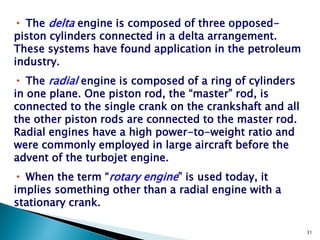
• The delta engine is composed of three opposed-
piston cylinders connected in a delta arrangement.
These systems have found application in the petroleum
industry.
• The radial engine is composed of a ring of cylinders
in one plane. One piston rod, the “master” rod, is
connected to the single crank on the crankshaft and all
the other piston rods are connected to the master rod.
Radial engines have a high power-to-weight ratio and
were commonly employed in large aircraft before the
advent of the turbojet engine.
• When the term “rotary engine” is used today, it
implies something other than a radial engine with a
stationary crank.

                                                          31
Engine Performance
There are several performance factors that are common
to all engines and prime movers. One of the main
operating parameters of interest is the actual output of
the engine. The brake horsepower (Bhp) is the power
delivered to the driveshaft dynamometer.
The brake horsepower is usually measured by
determining the reaction force on the dynamometer
and using the following equation:
                            2FRNd
                      Bhp 
                             33,000
Where F is the net reaction force of the dynamometer,
in lbf, R is the radius arm, in ft, and Nd is the angular
velocity of the dynamometer, in rpm.
                                                            32
Horsepower
For a particular engine, the relationship between the
mean effective pressure (mep) and the power is:
          mepVdis N p 
  Bhp 
            33,000
                  Wnet
  w here mep 
               Vmax  Vmin
                    bore2 stroke 
          Vdis 
                           4
              CN e
  and N p           is the number of pow er strokes per minute.
               

Where C is the number of cylinders in the engine, Ne is
the rpm of the engine, and  is equal to 1 for a two-
stroke-cycle engine and 2 for a four-stroke-cycle
engine.                                                            33
Brake Thermal Efficiency
The brake thermal efficiency of an engine, th, unlike
power plants, is usually based on the lower heating
value (LHV) of the fuel. The relationship between
efficiency and the brake specific fuel consumption
(Bsfc) is:
                           2545
                 th 
                       Bsfc LHV 
                 w here

                 Bsfc 
                        fuel rate, lbm/h 
                                Bhp

Note that the brake specific fuel consumption (Bsfc) of
an engine is a measure of the fuel economy and is
normally expressed in units of mass of fuel consumed
per unit energy output.

                                                          34
External-Combustion Systems
External-combustion power systems have several
advantages over internal-combustion systems. In
general, they are less polluting. The primary pollutants
from internal-combustion engines are unburned
hydrocarbons, carbon monoxide, and oxides of
nitrogen.
In external-combustion engines, the CHx and CO can
be drastically reduced by carrying out the combustion
with excess air and the NOx production can be
markedly reduced by lowering the combustion
temperature. By burning the fuel with excess air, more
energy is released per pound of fuel.
There are three general ideal external-combustion
engine cycles, the Stirling and Brayton are ideal gas-
power, and vapor power cycles.                             35
Brayton Cycle:
     The Ideal Cycle for Gas-Turbine Engines
The Brayton cycle was first proposed by George Brayton
for use in the reciprocating oil-burning engine that he
developed around 1870.
Fresh air at ambient conditions is drawn into the compressor,
where its temperature and pressure are raised. The high-
pressure air proceeds into the
combustion chamber, where
the fuel is burned at constant
pressure. The resulting high-
temperature gases then enter
the turbine, where they
expand to the atmospheric
pressure, thus producing
power. (An open cycle.)

                                                                36
Brayton Cycle (continued)
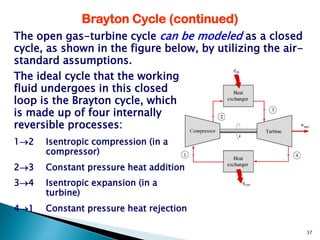
The open gas-turbine cycle can be modeled as a closed
cycle, as shown in the figure below, by utilizing the air-
standard assumptions.
The ideal cycle that the working
fluid undergoes in this closed
loop is the Brayton cycle, which
is made up of four internally
reversible processes:
12   Isentropic compression (in a
      compressor)
23   Constant pressure heat addition
34   Isentropic expansion (in a
      turbine)
41   Constant pressure heat rejection

                                                             37
T-s Diagram of Ideal Brayton Cycle
Notice that all four processes
of the Brayton cycle are
executed in steady-flow
devices (as shown in the
figure on the previous slide,
T-s diagram at the right), and
the energy balance for the
ideal Brayton cycle can be
expressed, on a unit-mass
basis, as
qin  qout   win  wout   hexit  hinlet
w here qin  h3  h2  C p T3  T2 
and qout  h4  h1  C p T4  T1 

                                                 38
P- Diagram and th of Ideal Brayton Cycle
Then the thermal efficiency of
the ideal Brayton cycle under
the cold-air-standard
assumptions becomes
                 wnet     qout
th ,Brayton         1
                 qin      qin
       C p T4  T1   T1 T4 / T1  1
1                1
    C p T3  T2      T2 T3 / T2  1
            1
1
       rp k 1 / k
                       k 1 / k            k 1 / k
       T P                         P                      T3           P
 w here 2   2                     3                       , and rp  2 is the pressure ratio.
       T1  P 
             1
                                     P 
                                      4                     T4           P1


                                                                                                       39
Thermal Efficiency of the Ideal Brayton Cycle
Under the cold-air-standard
assumptions, the thermal
efficiency of an ideal Brayton
cycle increases with both the
specific heat ratio of the
working fluid (if different from
air) and its pressure ratio (as
shown in the figure at right) of
the isentropic compression
process.
The highest temperature in the cycle occurs at the end
of the combustion process, and it is limited by the
maximum temperature that the turbine blades can
withstand. This also limits the pressure ratios that can
be used in the cycle.

                                                           40
With the demise of the steam powered tractor in the
late 1800’s, most modern tractors are equipped with
internal combustion engines.


 Internal combustion engines are identified by the
number of strokes
    in the cycle and by the fuel that is used to run them.

 Common Tractor Classifications:
 4 stroke cycle
- gasoline
- diesel
- LP


                                                             41
42
43
Intake
Exhaust
Lubricating
Electrical
Cooling
Fuel
Hydraulic
Drive Train


              44
    Parts:
1.   Pre-Cleaner
2.   Air Cleaner
3.   Intake Manifold
4.   Intake Valve
5.   Turbocharger (if
     used)
6.   Intercooler (if used)

                             45
    Parts:
1.   Exhaust Valve
2.   Exhaust Manifold
3.   Muffler
4.   Cap


                        46
    Parts:
1.   Crankcase Oil Reservoir (Oil
     Pan)
2.   Oil Pump
3.   Oil Filter
4.   Oil Passages
5.   Pressure Regulating Valve


    Oil goes to:
1.   Camshaft Bearings
2.   Crankshaft Main Bearings
3.   Piston Pin Bearing
4.   Valve Tappet Shaft
                                    47
     Parts:
1.    Battery
2.    Ground Cable
3.    Key Switch
4.    Ammeter
5.    Voltage Regulator
6.    Starter Solenoid
7.    Starter
8.    Distributor * Gasoline
      Only
9.    Coil
10.   Alternator
11.   Spark Plug
12.   Power Cable
                               48
Cooling System
                          Liquid & Air

Parts:
1.   Radiator
2.   Pressure Cap
3.   Fan
4.   Fan Belt
5.   Water Pump
6.   Engine Water Jacket
7.   Thermostat
8.   Connecting Hoses
9.   Liquid or Coolant


                                          49
Cooling System

Air cooled
Fins are used to dissipate heat


Liquid cooled
Coolant is used to dissipate heat.


                                     50
   Gasoline
   Diesel
   Liquid Propane (LP)
   Alternate Fuels


                          51
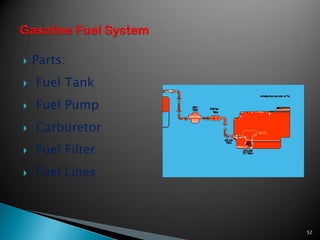
   Parts:
   Fuel Tank
   Fuel Pump
   Carburetor
   Fuel Filter
   Fuel Lines


                  52
Diesel Fuel System

Parts:   1. Fuel Tank
         2. Fuel Pump
         3. Fuel Filters
         4. Injection Pump
         5. Injection Nozzles


                                      53
Power Transmission
                      Mechanical & Hydraulic


Parts:
1.   Clutch Pedal
2.   Clutch
3.   Shift Controls
4.   Transmission
5.   Differential
6.   Differential Lock Pedal
7.   Final Drives
8.   Power Take Off (PTO)


                                               54
CONVENTIONAL INTERNAL
           COMBUSTION ENGINES


TWO STROKE ENGINES
      Migrating Combustion Chamber Engine (MCC)

FOUR CYCLE ENGINES

       Conventional Four Cycle (OTTO ENGINE)
       Rotary Engine (WANKEL)
       Rotating Cylinder Valve Engine (RCV)


                                                  55
TWO STROKE ENGINES


Two-stroke engines do not have valves,
which simplifies their construction and
lowers their weight.

Two-stroke engines fire once every
revolution, while four-stroke engines fire
once every other revolution. This gives
two-stroke engines a significant power
boost.

                                             56
TWO STROKE ENGINES


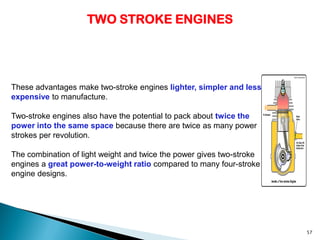
These advantages make two-stroke engines lighter, simpler and less
expensive to manufacture.

Two-stroke engines also have the potential to pack about twice the
power into the same space because there are twice as many power
strokes per revolution.

The combination of light weight and twice the power gives two-stroke
engines a great power-to-weight ratio compared to many four-stroke
engine designs.


                                                                       57
TWO STROKE ENGINES

Two-stroke engines don't last nearly as
long as four-stroke engines. The lack of
a dedicated lubrication system means
that the parts of a two-stroke engine
wear a lot faster.


Two-stroke oil is expensive, and you
need about 4 ounces of it per gallon of
gas. You would burn about a gallon of
oil every 1,000 miles if you used a two-
stroke engine in a car.
                                           58
TWO STROKE ENGINES


Two-stroke engines do not use fuel
efficiently, so you would get fewer miles
per gallon.

Two-stroke engines produce a lot of
pollution

so much, in fact, that it is likely that you won't
see them around too much longer.


                                                     59
FUEL
INTAKE


         60
COMPRESSION


              61
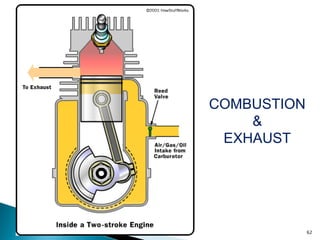
COMBUSTION
    &
 EXHAUST


             62
TWO STROKE
 OPERATION


             TWO
             STROKE
             OPERATI
             ON


                       63
FOUR CYCLE ENGINES
conventional Otto engines


                            64
FOUR CYCLE ENGINE OPERATION
                              65
FOUR CYCLE ENGINE
                       CHARACTERISTICS

FOUR STROKE ENGINES LASTS LONGER THAN TWO STROKE ENGINES. The
lack of a dedicated lubrication system means that the parts of a two-stroke engine
wear a lot faster.

FOUR STROKE ENGINES DON’T BURN OIL IN COMBUSTION CHAMBER. Two-
stroke oil is expensive, and you need about 4 ounces of it per gallon of gas. You
would burn about a gallon of oil every 1,000 miles if you used a two-stroke engine in
a car.

FOUR STROKE ENGINES ARE MORE FUEL EFFICIENT. Two-stroke engines do
not use fuel efficiently, so you would get fewer miles per gallon.

FOUR STROKE ENGINES ARE CLEANER. Two-stroke engines produce a lot of
pollution

INVERTED FLIGHTS MAY NOT BE EASY IN FOUR STROKE ENGINES. Two-
stroke engines can work in any orientation, which can be important in acrobatic
flights. A standard four-stroke engine may have problems with oil flow unless it is
upright, and solving this problem can add complexity to the engine.
                                                                                        66
Unusual Four stroke engines
              applications


    ROTARY ENGINES         WANKEL ENGINE


ROTARY CYLINDER VALVE ENGINE       RCV ENGINE


                                                67
ROTARY ENGINES
                Wankel Engine


Rotary engines use the four-stroke combustion
cycle, which is the same cycle that four-stroke
piston engines use. But in a rotary engine, this is
accomplished in a completely different way.           68
The heart of a rotary engine is the rotor. This is roughly the
equivalent of the pistons in a piston engine. The rotor is
mounted on a large circular lobe on the output shaft. This
lobe is offset from the centerline of the shaft and acts like the
crank handle on a winch, giving the rotor the leverage it
needs to turn the output shaft. As the rotor orbits inside the
housing, it pushes the lobe around in tight circles, turning
three times for every one revolution of the rotor.                69
How Rotary Engines Work


                          For every three
                          rotations of the
                            engine shaft
                          corresponds to
                            one complete
                          piston rotation
                           (360 degrees)


WANKEL ENGINE OPERATION
                                             70
How Rotary Engines Work

If you watch carefully, you'll see the offset
lobe on the output shaft spinning three times
for every complete revolution of the rotor.


                   As the rotor moves through the
                   housing, the three chambers
                   created by the rotor change size.
                   This size change produces a
                   pumping action. Let's go through
                   each of the four stokes of the
                   engine looking at one face of the
                   rotor.
                                                       71
Four Stroke Gas Engines
The four strokes of a internal combustion engine are:


       •Intake
       •Compression
       •Power
       •Exhaust
Each stroke = 180˚ of
crankshaft revolution.

Each cycle requires two revolutions
of the crankshaft (720˚ rotation), and
one revolution of the camshaft to complete
(360˚ rotation).
                                                        72
Intake Stroke
First Stroke

The piston moves down the cylinder
from TDC (Top Dead Center) to BDC
(Bottom Dead Center).


This movement of piston causes low
 air pressure in the cylinder (vacuum)


 Mixture of Air and Fuel in the ratio
 of 14.7 : 1 (air : fuel) is drawn into
 the cylinder.


  Intake valve stays open and the
  Exhaust valve stays closed during
  this stroke.
                                          73
   This starts at the
    highest point
    known as top
    dead center and
    ends at bottom
    dead center

    The intake stroke
    allows the piston
    to suck fuel and
    air into the
    combustion
    chamber through
    the intake valve     74
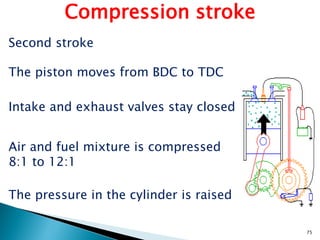
Compression stroke
Second stroke

The piston moves from BDC to TDC

Intake and exhaust valves stay closed


Air and fuel mixture is compressed
8:1 to 12:1

The pressure in the cylinder is raised

                                         75
   Compression starts
    at bottom dead
    center and ends at
    top dead center.

   The second motion of
    the stroke takes all
    the fuel and air that
    was stored and
    compresses it into
    one tenth its original
    sizes. Making the
    air/fuel mixture
    increase in
    temperature
    preparing it for the
    next stage in its
    combustion cycle.        76
Power stroke
Third stroke
At the end of compression stroke
the sparkplug fires, igniting the air/fuel
mixture.
 Both the valves stay closed in
 this stroke.
The expanding gases from the
combustion in the cylinder
(with no escape) push the piston
down.
The piston travels from TDC to BDC.
                                             77
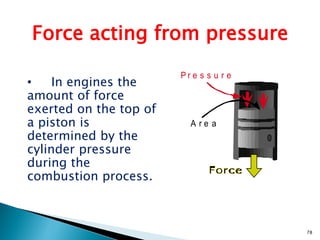
Force acting from pressure
                        Pr e s s u r e
•    In engines the
amount of force
exerted on the top of
a piston is               A re a
determined by the
cylinder pressure
during the
combustion process.


                                         78
   The power stroke starts as
    soon as the piston reaches
    top dead center allowing the
    spark plug to ignite.

   This electric current created
    by the spark plug ignites the
    fuel and air mixture sending
    the piston back down the
    cylinder with a pressure
    reaching high as 600 PSI.


                                    79
Exhaust stroke
Fourth and last stroke
The momentum created by the
Counter-weights on the crankshaft,
move the piston from BDC to TDC.
The exhaust valve opens and
the burned gases escape into the
exhaust system.

Intake valve remains closed.


                                     80
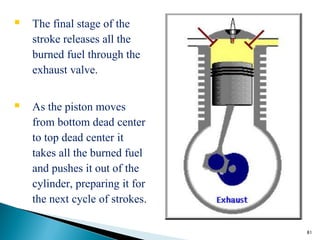
 The final stage of the
  stroke releases all the
  burned fuel through the
  exhaust valve.

 As the piston moves
  from bottom dead center
  to top dead center it
  takes all the burned fuel
  and pushes it out of the
  cylinder, preparing it for
  the next cycle of strokes.

                               81
Indicator Diagrams and Internal Combustion Engine
               Performance Parameters


• Much can be learned from a record of the cylinder pressure
  and volume. The results can be analyzed to reveal the rate at
  which work is being done by the gas on the piston, and the rate
  at which combustion is occurring. In its simplest form, the
  cylinder pressure is plotted against volume to give an indicator
  diagram.


                                                                     82
Pressure-Volume Graph 4-stroke SI engine

One power stroke for every two crank shaft revolutions


Pressure   Spark

                                        Exhaust valve
           Exhaust                      opens
           valve
           closes

   1 atm                                Intake valve
                                        closes
           Intake
           valve
           opens

              TC                   BC

                     Cylinder volume
                                                         83
Exhaust Valve : Valve Timing Diagram


 Pcyl

                               Patm


                                       84
Inlet Valve : Valve Timing Diagram


Pcyl
                                  Patm


                                            85
Valve Timing for Better Flow


                               86
Efficiency
• In general, energy conversion efficiency is the ratio between
  the useful output of a device and the input. For thermal
  efficiency, the input, to the device is heat, or the heat-content
  of a fuel that is consumed. The desired output is mechanical
  work, or heat, or possibly both. Because the input heat
  normally has a real financial cost, a memorable, generic
  definition of thermal efficiency is;


                                                                      87
• When expressed as a percentage, the thermal efficiency must be
  between 0% and 100%. Due to inefficiencies such as friction,
  heat loss, and other factors, thermal engines' efficiencies are
  typically much less than 100%. For example, a typical gasoline
  automobile engine operates at around 25% efficiency. The largest
  diesel engine in the world peaks at 51.7%.

                                                               88
• Work done on the piston due to
  pressure


                                   89
• The term indicated work is used to define the net work done
  on the piston per cycle


• the indicated mean effective pressure (imep),can be defined
  by;


                                                                90
• The imep is a hypothetical pressure that would produce the
  same indicated work if it were to act on the piston throughout
  the expansion stroke. The concept of imep is useful because it
  describes the thermodynamic performance of an engine, in a
  way that is independent of engine size and speed and frictional
  losses.
• Unfortunately, not all the work done by the gas on the piston is
  available as shaft work because there are frictional losses in
  the engine. These losses can be quantified by the brake mean
  effective pressure (bmep,), a hypothetical pressure that acts on
  the piston during the expansion stroke and would lead to the
  same brake work output in a frictionless engine.


                                                                     91
Mechanical Efficiency

Some of the power generated in the cylinder is used to overcome engine
friction and to pump gas into and out of the engine.

                          
The term friction power, W f , is used to describe collectively these power
losses, such that:
                                            
                              W f  Wi , g  Wb

Friction power can be measured by motoring the engine.

The mechanical efficiency is defined as:
                                 
                       Wb Wi , g  W f
                                                 
                                                  Wf
                 m                         1
                       Wi , g     Wi , g         
                                                  Wi , g


                                                                              92
Mechanical Efficiency, cont’d

• Mechanical efficiency depends on pumping losses
(throttle position) and
frictional losses (engine design and engine speed).

• Typical values for automobile engines at WOT are:
             90% @2000 RPM and 75% @ max
speed.

• Throttling increases pumping power and thus the
mechanical efficiency
decreases, at idle the mechanical efficiency
approaches zero.


                                                      93
• Brake Specific Fuel Consumption (BSFC) is a measure of fuel
  efficiency within a shaft reciprocating engine. It is the rate
  of fuel consumption divided by the power produced. Specific
  fuel consumption is based on the torque delivered by the
  engine in respect to the fuel mass flow delivered to the engine.
  Measured after all parasitic engine losses is brake specific fuel
  consumption [BSFC] and measuring specific fuel consumption
  based on the in-cylinder pressures (ability of the pressure to do
  work) is indicated specific fuel consumption [ISFC].


                                                                      94
• The final parameter to be defined is the volumetric
  efficiency of the engine; the ratio of actual air flow to
  that of a perfect engine is


• In general, it is quite easy to provide an engine with
  extra fuel; therefore, the power output of an engine
  will be limited by the amount of air that is admitted to
  an engine.


                                                              95
Volumetric Efficiency
• Volumetric efficiency a measure of overall effectiveness of
  engine and its intake and exhaust system as a natural
  breathing system.
• It is defined as:         
                            2 ma
                     v 
                          r a , 0Vd N
• If the air density ra,0 is evaluated at inlet manifold conditions, the
  volumetric efficiency is a measure of breathing performance of the
  cylinder, inlet port and valve.
• If the air density ra,0 is evaluated at ambient conditions, the volumetric
  efficiency is a measure of overall intake and exhaust system and other
  engine features.
• The full load value of volumetric efficiency is a design feature of entire
  engine system.


                                                                               96
• Systems which are thermally insulated from their surroundings
  undergo processes without any heat transfer; such processes
  are called adiabatic. Thus during an isentropic process there
  are no dissipative effects and the system neither absorbs nor
  gives off heat.
• A reversible process, is a process that can be "reversed" by
  means of infinitesimal changes in some property of the system
  without loss or dissipation of energy.
• Isentropic process is a process which is a process is both
  adiabatic and reversible .


                                                                  97
• A closed cylinder with a locked piston contains air. The
  pressure inside is equal to the outside air pressure. This
  cylinder is heated to a certain target temperature. Since the
  piston cannot move, the volume is constant, while temperature
  and pressure rise. When the target temperature is reached, the
  heating is stopped. The piston is now freed and moves
  outwards, expanding without exchange of heat (adiabatic
  expansion). Doing this work cools the air inside the cylinder to
  below the target temperature. To return to the target
  temperature (still with a free piston), the air must be heated.
  This extra heat amounts to about 40% more than the previous
  amount added. In this example, the amount of heat added with
  a locked piston is proportional to CV, whereas the total amount
  of heat added is proportional to CP. Therefore, the heat
  capacity ratio in this example is 1.4


                                                                     98
99
Efficiencies of Real Engines


• The efficiencies of real engines are below
  those predicted by the ideal air standard cycles
  for several reasons. Most significantly, the
  gases in internal combustion engines do not
  behave perfectly with a ratio of heat capacities.


                                                      10
                                                       0
Ignition and Combustion in Spark Ignition
            and Diesel Engines
 • Spark ignition (SI) engines usually have pre-mixed combustion, in which a
   flame front initiated by a spark propagates across the combustion chamber
   through the unburned mixture. Compression ignition (CI) engines normally
   inject their fuel toward the end of the compression stroke, and the
   combustion is controlled primarily by diffusion.
 • Whether combustion is pre-mixed (as in SI engines) or diffusion controlled
   (as in CI engines) has a major influence on the range of air-fuel ratios
   (AFRs) that will burn.
 • In pre-mixed combustion, the AFR must be close to stoichiometric-the AFR
   value that is chemically correct for complete combustion. In practice,
   dissociation and the limited time available for combustion will mean that
   even with the stoichiometric AFR, complete combustion will not occur.
 • In diffusion combustion, much weaker AFRs can be used (i.e., an excess of
   air) because around each fuel droplet will be a range of flammable AFRs.
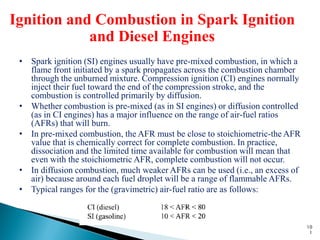
 • Typical ranges for the (gravimetric) air-fuel ratio are as follows:


                                                                                10
                                                                                 1
Diesel engines have a higher maximum
  efficiency than spark ignition engines for three
  reasons:
• The compression ratio is higher.
• During the initial part of compression, only air
  is present.
• The air-fuel mixture is always weak of
  stoichiometric.


                                                     10
                                                      2
Simple Combustion Equilibrium

• For a given combustion device, say a piston engine, how
  much fuel and air should be injected in order to completely
  burn both? This question can be answered by balancing the
  combustion reaction equation for a particular fuel. A
  stoichiometric mixture contains the exact amount of fuel
  and oxidizer such that after combustion is completed, all the
  fuel and oxidizer are consumed to form products.


                                                                  10
                                                                   3
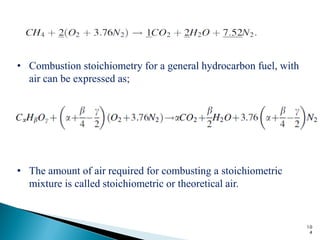
• Combustion stoichiometry for a general hydrocarbon fuel, with
  air can be expressed as;


• The amount of air required for combusting a stoichiometric
  mixture is called stoichiometric or theoretical air.


                                                                  10
                                                                   4
Methods of Quantifying Fuel and Air Content
         of Combustible Mixtures


• In practice, fuels are often combusted with an amount of air
  different from the stoichiometric ratio. If less air than the
  stoichiometric amount is used, the mixture is described as fuel
  rich. If excess air is used, the mixture is described as fuel lean.
  For this reason, it is convenient to quantify the combustible
  mixture using one of the following commonly used methods:
• Fuel-Air Ratio (FAR): The fuel-air ratio, f, is given by


                                                                        10
                                                                         5
• Equivalence Ratio: Normalizing the actual fuel-air ratio by the
  stoichiometric fuel air ratio gives the equivalence ratio,


• The subscript s indicates a value at the stoichiometric
  condition. f <1 is a lean mixture , f¼1 is a stoichiometric
  mixture, and f >1 is a rich mixture

• Lambda is the ratio of the actual air-fuel ratio to the
  stoichiometric air-fuel ratio defined as


                                                                    10
                                                                     6
Fuel Requirements

• Gasoline is a mixture of hydrocarbons (with 4 to
  approximately 12 carbon atoms) and a boiling point range of
  approximately 30-200°C. Diesel fuel is a mixture of higher
  molarmass hydrocarbons (typically 12 to 22 carbon atoms),
  with a boiling point range of approximately180-380°C. Fuels
  for spark ignition engines should vaporize readily and be
  resistant to self-ignition, as indicated by a high octane rating.
  In contrast, fuels for compression ignition engines should self-
  ignite readily, as indicated by a high cetane number.


                                                                      10
                                                                       7
• Octane number is a standard measure of the anti-knock
  properties (i.e. the performance) of a motor or aviation fuel.
  The higher the octane number, the more compression the fuel
  can withstand before detonating. In broad terms, fuels with a
  higher octane rating are used in high-compression engines that
  generally have higher performance.
• Knocking (also called knock, detonation, spark knock, pinging
  or pinking) in spark-ignition internal combustion engines
  occurs when combustion of the air/fuel mixture in the cylinder
  starts off correctly in response to ignition by the spark plug,
  Effects of engine knocking range from inconsequential to
  completely destructive.
.


                                                                    10
                                                                     8
• Cetane number or CN is a measurement of the combustion
  quality of diesel fuel during compression ignition. It is a
  significant expression of diesel fuel quality among a number of
  other measurements that determine overall diesel fuel quality.


                                                                    10
                                                                     9
• The octane or cetane rating of a fuel is established by
  comparing its ignition quality with respect to reference fuels in
  CFR (Co-operative Fuel Research) engines, according to
  internationally agreed standards. The most common type of
  octane rating worldwide is the Research Octane Number
  (RON). RON is determined by running the fuel in a test engine
  with a variable compression ratio under controlled conditions,
  and comparing the results with those for mixtures of iso-
  octane and n-heptane.


                                                                      11
                                                                       0
Engine Knock and thermal Efficiency of an Engine
 The thermal efficiency of the ideal Otto cycle increases
 with both the compression ratio and the specific heat
 ratio.
  When high compression ratios
 are used, the temperature of the
 air-fuel mixture rises above the
 autoignition temperature
 produces an audible noise,
 which is called engine knock.
 (antiknock, tetraethyl lead? 
 unleaded gas)
  For a given compression ratio, an ideal Otto cycle using
 a monatomic gas (such as argon or helium, k = 1.667) as
 the working fluid will have the highest thermal efficiency.
                                                               11
                                                                1
Charge Stratification


                        11
                         2
Combustion Chamber Designs


                             11
                              3
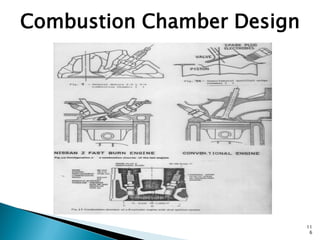
Combustion Chamber Design


                            11
                             4
Combustion Chamber Design


                            11
                             5
Combustion Chamber Design


                            11
                             6
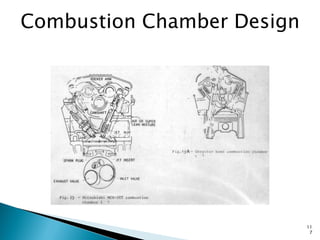
Combustion Chamber Design


                            11
                             7
Combustion Chamber Design


                            11
                             8
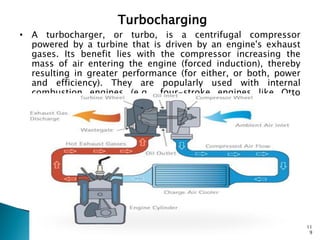
Turbocharging
• A turbocharger, or turbo, is a centrifugal compressor
  powered by a turbine that is driven by an engine's exhaust
  gases. Its benefit lies with the compressor increasing the
  mass of air entering the engine (forced induction), thereby
  resulting in greater performance (for either, or both, power
  and efficiency). They are popularly used with internal
  combustion engines (e.g., four-stroke engines like Otto
  cycles and Diesel cycles).


                                                                 11
                                                                  9
Engine Artificial Respiratory System: An Inclusion of
CV


                        Turbo-Charged Engine       12
                                                    0
Turbo -Charger


                 12
                  1

محركات احتراق داخلي معهد اعداد المدربين-مكائن ومعدات

  • 1.
    ‫معهد اعداد المدربينالتقنيين‬ ‫قسم المكائن والمعدات‬ ‫الحقيبة التعليمية‬ ‫االساسية لمحركات االحتراق الداخلي‬ ‫اعداد‬ ‫المهندس : نزار فيصل عودة العبيدي‬ ‫1‬
  • 2.
    Conversion of ThermalEnergy •Almost all of the mechanical energy produced today is produced from the conversion of thermal energy in some sort of heat engine. • The operation of all heat-engine cycles can usually be approximated by an ideal thermodynamic power cycle of some kind. •A basic understanding of these cycles can often show the power engineer how to improve the operation and performance of the system. 2
  • 3.
    Conversion of ThermalEnergy •Almost all of the mechanical energy produced today is produced from the conversion of thermal energy in some sort of heat engine. • The operation of all heat-engine cycles can usually be approximated by an ideal thermodynamic power cycle of some kind. •A basic understanding of these cycles can often show the power engineer how to improve the operation and performance of the system. 3
  • 4.
    P- and T-sDiagrams of Power Cycles The area under the heat addition process on a T-s diagram is a geometric measure of the total heat supplied during the cycle qin, and the area under the heat rejection process is a measure of the total heat rejected qout. The difference between these two (the area enclosed by the cyclic curve) is the net heat transfer, which is also the net work produced during the cycle. 4
  • 5.
    Reversible Heat-Engine Cycles •Thesecond law of thermodynamics states that it is impossible to construct a heat engine or to develop a power cycle that has a thermal efficiency of 100%. This means that at least part of the thermal energy transferred to a power cycle must be transferred to a low-temperature sink. •There are four phenomena that render any thermodynamic process irreversible. They are:  Friction  Unrestrained expansion  Mixing of different substances  Transfer of heat across a finite temperature difference 5
  • 6.
    Categorize Cycles • Thermodynamiccycles can be divided into two general categories: Power cycles and refrigeration cycles. • Thermodynamic cycles can also be categorized as gas cycles or vapor cycles, depending upon the phase of the working fluid. • Thermodynamic cycles can be categorized yet another way: closed and open cycles. • Heat engines are categorized as internal or external combustion engines. 6
  • 7.
    Air-Standard Assumptions To reducethe analysis of an actual gas power cycle to a manageable level, we utilize the following approximations, commonly know as the air- standard assumptions: 1. The working fluid is air, which continuously circulates in a closed loop and always behaves as an ideal gas. 2. All the processes that make up the cycle are internally reversible. 3. The combustion process is replaced by a heat- addition process from an external source. 4. The exhaust process is replaced by a heat rejection process that restores the working fluid to its initial state. 7
  • 8.
    Air-Standard Cycle Another assumptionthat is often utilized to simplify the analysis even more is that the air has constant specific heats whose values are determined at room temperature (25oC, or 77oF). When this assumption is utilized, the air-standard assumptions are called the cold-air-standard assumptions. A cycle for which the air-standard assumptions are applicable is frequently referred to as an air-standard cycle. The air-standard assumptions stated above provide considerable simplification in the analysis without significantly deviating from the actual cycles. The simplified model enables us to study qualitatively the influence of major parameters on the performance of the actual engines. 8
  • 9.
    Bore and stroke ofa cylinder 9
  • 10.
    Mean Effective Pressure Theratio of the maximum volume formed in the cylinder to the minimum (clearance) volume is called the compression ratio of the engine. V V r  max  BDC Vmin VTDC Notice that the compression ratio is a volume ratio and should not be confused with the pressure ratio. Mean effective pressure (MEP) is a fictitious pressure that, if it acted on the piston during the entire power stroke, would produce the same amount of net work as that produced during the actual cycle. MEP  Wnet Vmax  Vmin 10
  • 11.
    Three Ideal PowerCycles •Three ideal power cycles are completely reversible power cycles, called externally reversible power cycles. These three ideal cycles are the Carnot cycle, the Ericsson cycle, and the Stirling Cycle. 11
  • 12.
    Three Ideal PowerCycles •The Carnot cycle is an externally reversible power cycle and is sometimes referred to as the optimum power cycle in thermodynamic textbooks. It is composed of two reversible isothermal processes and two reversible adiabatic (isentropic) processes. •The Ericsson power cycle is another heat-engine cycle that is completely reversible or “externally reversible.” It is composed of two reversible isothermal processes and two reversible isobaric processes (with regenerator). •The Stirling cycle is also an externally reversible heat- engine cycle and is the only one of the three ideal power cycles that has seen considerable practical application. It is composed of two reversible isothermal processes and two reversible isometric (constant volume) processes. 12
  • 13.
    Carnot Cycle andIts Value in Engineering The Carnot cycle is composed of four totally reversible processes: isothermal heat addition, isentropic expansion, isothermal heat rejection, and isentropic compression (as shown in the P- diagram at right). The Carnot cycle can be executed in a closed system (a piston-cylinder device) or a steady-flow system (utilizing two turbines and two TL th ,Carnot 1 compressors), and either a gas TH or vapor can be used as the working fluid. 13
  • 14.
    Internal-Combustion Engine Cycles •Internal-combustion (IC) engines cannot operate on an ideal reversible heat-engine cycle but they can be approximated by internally reversible cycles in which all the processes are reversible except the heat- addition and heat-rejection processes. •In general, IC engines are more polluting than external-combustion (EC) engines because of the formation of nitrogen oxides, carbon dioxide, and unburned hydrocarbons. •The Otto cycle is the basic thermodynamic power cycle for the spark-ignition (SI), internal- combustion engine. 14
  • 15.
    The Ideal AirStandard Otto Cycle 15
  • 16.
    Otto Cycle: Theideal Cycle for Spark-Ignition Engines Figures below show the actual and ideal cycles in spark- ignition (SI) engines and their P- diagrams. 16
  • 17.
    Ideal Otto Cycle The thermodynamic analysis of the actual four-stroke or two- stroke cycles can be simplified significantly if the air-standard assumptions are utilized. The T- s diagram of the Otto cycle is given in the figure at left. The ideal Otto cycle consists of four internally reversible processes: 12 Isentropic compression 23 Constant volume heat addition 34 Isentropic expansion 41 Constant volume heat rejection 17
  • 18.
    Thermal Efficiency ofan Otto Cycle The Otto cycle is executed in a closed system, and disregarding the changes in kinetic and potential energies, we have qin  qout   win  wout   u  qin  u3  u 2  Cv T3  T2   qout  u 4  u1  Cv T4  T1  wnet qout T4  T1 th ,Otto  1 1 qin qin T3  T2 T1 T4 / T1  1 T 1 1  1  1  1  k 1 T2 T3 / T2  1 T2 r k 1 k 1 T1   2   3  T4 Vmax V1 1 Where,      ;and r    T2  1       4 T3 Vmin V2  2 18
  • 19.
    Example IV-4.1: TheIdeal Otto Cycle An ideal Otto cycle has a compression ratio of 8. At the beginning of the compression process, the air is at 100 kPa and 17oC, and 800 kJ/kg of heat is transferred to air during the constant-volume heat-addition process. Accounting for the variation of specific heats of air with temperature, determine a) the maximum temperature and pressure that occur during the cycle, b) the net work output, c) the thermal efficiency, and d) the mean effective pressure for the cycle. <Answers: a) 1575.1 K, 4.345 MPa, b) 418.17 kJ/kg, c) 52.3%, d) 574.4 kPa> Solution: 19
  • 20.
    a  Maximumtemperatur e and pressure in an Otto cycle: T1  290K  u1  206.91kJ / kg, vr1  676.1 Process 1- 2 (isentropic compressio n of an ideal gas) : vr 2 v2 1 vr1 676.1    vr 2    84.51  T2  652.4 K , u 2  475.11kJ / kg vr1 v1 r r 8 P2 v2 P v1  T2  v1  652.4  1  P2  P     100 1  v   8  1799.7 kPa T2 T1  T1  2  290 Process 2 - 3 (constant volume heat addition) : qin  u3  u 2  u3  qin  u 2  800  475.11  1275.11kJ / kg  T3  1575.1 K P3v3 P2 v2  T3  v2  1575.1      1.797 MPa   P3  P2     1  4.345MPa T3 T2  T2  v3  652.4 Note : The property vr (relative specific volume) is a dimensionl ess quantity used in the analysis of isentropic processes,and should not be confused w ith the property specific volume. 20
  • 21.
    b  Thenet w ork output : Process 3 - 4 (isentropic expansion of an ideal gas) : vr 4 v4   r  vr 4  rv r 3  8  6.108  48.864 vr 3 v3  T4  795.6 K , u 4  588.74 kJ / kg Process 4 - 1 (constant volume heat rejection) :  qout  u1  u 4  qout  u 4  u1  588.74  206.91  381.83 kJ / kg Thus, wnet  qnet  qin  qout  800  381.83  418.17 kJ / kg c  The thermal efficiency:  0.523 or 52.3%  wnet 418.17 th   qin 800 Under the cold - air - standard assumption s : th  1  k 1  1  r1 k  1  811.4  0.565 or 56.5%  1 r Care should be exercised in utlizing this assumption s. 21
  • 22.
    d  Themean effectivepressure is determined from its definition : kPa.m 3 0.287  290K RT1 kg .K m3 v1    0.832 P1 100kPa kg wnet wnet 418.17  1kPa.m 3     574.4 kPa Thus, mep    v1  v2 v  v1 0.832  0.832  1 kJ  1  r 8 Therefore, a constant pressure of 574.4 kPa during the pow er stroke w ould produce the same net w ork output as the entire cycle. Note that this problem could be solved by using equations show non Slide #17 w ith given constant specific heats c p , cv (at room temperatur e). 22
  • 23.
    Diesel Cycle: TheIdeal Cycle for Compression-Ignition Engines The diesel cycle is the ideal cycle for CI (Compression- Ignition) reciprocating engines. The CI engine first proposed by Rudolph Diesel in the 1890s, is very similar to the SI engine, differing mainly in the method of initiating combustion. In SI engines (also known as gasoline engines), the air-fuel mixture is compressed to a temperature that is below the autoignition temperature of the fuel, and the combustion process is initiated by firing a spark plug. In CI engines (also known as diesel engines), the air is compressed to a temperature that is above the autoignition temperature of the fuel, and combustion starts on contact as the fuel is injected into this hot air. Therefore, the spark plug and carburetor are replaced by a fuel injector in diesel engines. 23
  • 24.
    The Ideal AirStandard Diesel Cycle 24
  • 25.
    Ideal Cycle forCI Engines (continued) In diesel engines, ONLY air is compressed during the compression stroke, eliminating the possibility of autoignition. Therefore, diesel engines can be designed to operate at much higher compression ratios, typically between 12 and 24. The fuel injection process in diesel engines starts when the piston approaches TDC and continues during the first part of the power stroke. Therefore, the combustion process in these engines takes place over a longer interval. Because of this longer duration, the combustion process in the ideal Diesel cycle is approximated as a constant-pressure heat-addition process. In fact, this is the ONLY process where the Otto and the Diesel cycles differ. 25
  • 26.
    Ideal Cycle forCI Engines (continued) qin  wb ,out  u3  u2  qin  h3  h2  C p T3  T2  qout  u4  u1  Cv T4  T1  wnet qout T4  T1 1  rck  1  th ,Diesel  1 1  1  k 1   qin qin k T3  T2  r  k rc  1    Where, 1 r 2 and  rc  3 2 26
  • 27.
    Thermal efficiency ofIdeal Diesel Cycle Under the cold-air-standard assumptions, the efficiency of a Diesel cycle differs from the efficiency of Otto cycle by the quantity in the brackets. (See Slide #26) The quantity in the brackets is always greater than 1. Therefore, th,Otto > th, Diesel when both cycles operate on the same compression ratio. Also the cuttoff ratio, rc decreases, the efficiency of the Diesel cycle increases. (See figure at right) 27
  • 28.
    Internal-Combustion Engines The twobasic types of ignition or firing systems are the four-stroke-cycle engines, commonly called four- cycle engines, and the two-stroke-cycle engines, commonly called two-cycle engines. The four-cycle engines has a number of advantages over the usual two-cycle engine, including better fuel economy, better lubrication, and easier cooling. The two-cycle engine has a number of advantages, including fewer moving parts, lighter weight, and smoother operation. Some two-cycle engines have valves and separate lubrication systems. 28
  • 29.
    Cylinder Arrangements forReciprocating Engines Figure below shows schematic diagrams of some of the different cylinder arrangements for reciprocating engines. 29
  • 30.
    • Vertical in-lineengine is commonly used today in four- and six-cylinder automobile engines. • The V-engine is commonly employed in eight- cylinder (V-8) and some six-cylinder (V-6) automobile engines. • The horizontal engine is essentially a V-engine with 180o between the opposed cylinders. This system was used as the four-cylinder, air-cooled engine that powered the Volkswagon “bug”. • The opposed-piston engine consists of two pistons, two crankshafts, and one cylinder. The two crankshafts are geared together to assure synchronization. These opposed-piston systems are often employed in large diesel engines. 30
  • 31.
    • The deltaengine is composed of three opposed- piston cylinders connected in a delta arrangement. These systems have found application in the petroleum industry. • The radial engine is composed of a ring of cylinders in one plane. One piston rod, the “master” rod, is connected to the single crank on the crankshaft and all the other piston rods are connected to the master rod. Radial engines have a high power-to-weight ratio and were commonly employed in large aircraft before the advent of the turbojet engine. • When the term “rotary engine” is used today, it implies something other than a radial engine with a stationary crank. 31
  • 32.
    Engine Performance There areseveral performance factors that are common to all engines and prime movers. One of the main operating parameters of interest is the actual output of the engine. The brake horsepower (Bhp) is the power delivered to the driveshaft dynamometer. The brake horsepower is usually measured by determining the reaction force on the dynamometer and using the following equation: 2FRNd Bhp  33,000 Where F is the net reaction force of the dynamometer, in lbf, R is the radius arm, in ft, and Nd is the angular velocity of the dynamometer, in rpm. 32
  • 33.
    Horsepower For a particularengine, the relationship between the mean effective pressure (mep) and the power is: mepVdis N p  Bhp  33,000 Wnet w here mep  Vmax  Vmin  bore2 stroke  Vdis  4 CN e and N p  is the number of pow er strokes per minute.  Where C is the number of cylinders in the engine, Ne is the rpm of the engine, and  is equal to 1 for a two- stroke-cycle engine and 2 for a four-stroke-cycle engine. 33
  • 34.
    Brake Thermal Efficiency Thebrake thermal efficiency of an engine, th, unlike power plants, is usually based on the lower heating value (LHV) of the fuel. The relationship between efficiency and the brake specific fuel consumption (Bsfc) is: 2545 th  Bsfc LHV  w here Bsfc  fuel rate, lbm/h  Bhp Note that the brake specific fuel consumption (Bsfc) of an engine is a measure of the fuel economy and is normally expressed in units of mass of fuel consumed per unit energy output. 34
  • 35.
    External-Combustion Systems External-combustion powersystems have several advantages over internal-combustion systems. In general, they are less polluting. The primary pollutants from internal-combustion engines are unburned hydrocarbons, carbon monoxide, and oxides of nitrogen. In external-combustion engines, the CHx and CO can be drastically reduced by carrying out the combustion with excess air and the NOx production can be markedly reduced by lowering the combustion temperature. By burning the fuel with excess air, more energy is released per pound of fuel. There are three general ideal external-combustion engine cycles, the Stirling and Brayton are ideal gas- power, and vapor power cycles. 35
  • 36.
    Brayton Cycle: The Ideal Cycle for Gas-Turbine Engines The Brayton cycle was first proposed by George Brayton for use in the reciprocating oil-burning engine that he developed around 1870. Fresh air at ambient conditions is drawn into the compressor, where its temperature and pressure are raised. The high- pressure air proceeds into the combustion chamber, where the fuel is burned at constant pressure. The resulting high- temperature gases then enter the turbine, where they expand to the atmospheric pressure, thus producing power. (An open cycle.) 36
  • 37.
    Brayton Cycle (continued) Theopen gas-turbine cycle can be modeled as a closed cycle, as shown in the figure below, by utilizing the air- standard assumptions. The ideal cycle that the working fluid undergoes in this closed loop is the Brayton cycle, which is made up of four internally reversible processes: 12 Isentropic compression (in a compressor) 23 Constant pressure heat addition 34 Isentropic expansion (in a turbine) 41 Constant pressure heat rejection 37
  • 38.
    T-s Diagram ofIdeal Brayton Cycle Notice that all four processes of the Brayton cycle are executed in steady-flow devices (as shown in the figure on the previous slide, T-s diagram at the right), and the energy balance for the ideal Brayton cycle can be expressed, on a unit-mass basis, as qin  qout   win  wout   hexit  hinlet w here qin  h3  h2  C p T3  T2  and qout  h4  h1  C p T4  T1  38
  • 39.
    P- Diagram andth of Ideal Brayton Cycle Then the thermal efficiency of the ideal Brayton cycle under the cold-air-standard assumptions becomes wnet qout th ,Brayton  1 qin qin C p T4  T1  T1 T4 / T1  1 1 1 C p T3  T2  T2 T3 / T2  1 1 1 rp k 1 / k k 1 / k k 1 / k T P  P  T3 P w here 2   2   3   , and rp  2 is the pressure ratio. T1  P   1 P   4 T4 P1 39
  • 40.
    Thermal Efficiency ofthe Ideal Brayton Cycle Under the cold-air-standard assumptions, the thermal efficiency of an ideal Brayton cycle increases with both the specific heat ratio of the working fluid (if different from air) and its pressure ratio (as shown in the figure at right) of the isentropic compression process. The highest temperature in the cycle occurs at the end of the combustion process, and it is limited by the maximum temperature that the turbine blades can withstand. This also limits the pressure ratios that can be used in the cycle. 40
  • 41.
    With the demiseof the steam powered tractor in the late 1800’s, most modern tractors are equipped with internal combustion engines. Internal combustion engines are identified by the number of strokes in the cycle and by the fuel that is used to run them. Common Tractor Classifications: 4 stroke cycle - gasoline - diesel - LP 41
  • 42.
  • 43.
  • 44.
  • 45.
    Parts: 1. Pre-Cleaner 2. Air Cleaner 3. Intake Manifold 4. Intake Valve 5. Turbocharger (if used) 6. Intercooler (if used) 45
  • 46.
    Parts: 1. Exhaust Valve 2. Exhaust Manifold 3. Muffler 4. Cap 46
  • 47.
    Parts: 1. Crankcase Oil Reservoir (Oil Pan) 2. Oil Pump 3. Oil Filter 4. Oil Passages 5. Pressure Regulating Valve  Oil goes to: 1. Camshaft Bearings 2. Crankshaft Main Bearings 3. Piston Pin Bearing 4. Valve Tappet Shaft 47
  • 48.
    Parts: 1. Battery 2. Ground Cable 3. Key Switch 4. Ammeter 5. Voltage Regulator 6. Starter Solenoid 7. Starter 8. Distributor * Gasoline Only 9. Coil 10. Alternator 11. Spark Plug 12. Power Cable 48
  • 49.
    Cooling System Liquid & Air Parts: 1. Radiator 2. Pressure Cap 3. Fan 4. Fan Belt 5. Water Pump 6. Engine Water Jacket 7. Thermostat 8. Connecting Hoses 9. Liquid or Coolant 49
  • 50.
    Cooling System Air cooled Finsare used to dissipate heat Liquid cooled Coolant is used to dissipate heat. 50
  • 51.
    Gasoline  Diesel  Liquid Propane (LP)  Alternate Fuels 51
  • 52.
    Parts:  Fuel Tank  Fuel Pump  Carburetor  Fuel Filter  Fuel Lines 52
  • 53.
    Diesel Fuel System Parts: 1. Fuel Tank 2. Fuel Pump 3. Fuel Filters 4. Injection Pump 5. Injection Nozzles 53
  • 54.
    Power Transmission Mechanical & Hydraulic Parts: 1. Clutch Pedal 2. Clutch 3. Shift Controls 4. Transmission 5. Differential 6. Differential Lock Pedal 7. Final Drives 8. Power Take Off (PTO) 54
  • 55.
    CONVENTIONAL INTERNAL COMBUSTION ENGINES TWO STROKE ENGINES Migrating Combustion Chamber Engine (MCC) FOUR CYCLE ENGINES Conventional Four Cycle (OTTO ENGINE) Rotary Engine (WANKEL) Rotating Cylinder Valve Engine (RCV) 55
  • 56.
    TWO STROKE ENGINES Two-strokeengines do not have valves, which simplifies their construction and lowers their weight. Two-stroke engines fire once every revolution, while four-stroke engines fire once every other revolution. This gives two-stroke engines a significant power boost. 56
  • 57.
    TWO STROKE ENGINES Theseadvantages make two-stroke engines lighter, simpler and less expensive to manufacture. Two-stroke engines also have the potential to pack about twice the power into the same space because there are twice as many power strokes per revolution. The combination of light weight and twice the power gives two-stroke engines a great power-to-weight ratio compared to many four-stroke engine designs. 57
  • 58.
    TWO STROKE ENGINES Two-strokeengines don't last nearly as long as four-stroke engines. The lack of a dedicated lubrication system means that the parts of a two-stroke engine wear a lot faster. Two-stroke oil is expensive, and you need about 4 ounces of it per gallon of gas. You would burn about a gallon of oil every 1,000 miles if you used a two- stroke engine in a car. 58
  • 59.
    TWO STROKE ENGINES Two-strokeengines do not use fuel efficiently, so you would get fewer miles per gallon. Two-stroke engines produce a lot of pollution so much, in fact, that it is likely that you won't see them around too much longer. 59
  • 60.
  • 61.
  • 62.
    COMBUSTION & EXHAUST 62
  • 63.
    TWO STROKE OPERATION TWO STROKE OPERATI ON 63
  • 64.
  • 65.
    FOUR CYCLE ENGINEOPERATION 65
  • 66.
    FOUR CYCLE ENGINE CHARACTERISTICS FOUR STROKE ENGINES LASTS LONGER THAN TWO STROKE ENGINES. The lack of a dedicated lubrication system means that the parts of a two-stroke engine wear a lot faster. FOUR STROKE ENGINES DON’T BURN OIL IN COMBUSTION CHAMBER. Two- stroke oil is expensive, and you need about 4 ounces of it per gallon of gas. You would burn about a gallon of oil every 1,000 miles if you used a two-stroke engine in a car. FOUR STROKE ENGINES ARE MORE FUEL EFFICIENT. Two-stroke engines do not use fuel efficiently, so you would get fewer miles per gallon. FOUR STROKE ENGINES ARE CLEANER. Two-stroke engines produce a lot of pollution INVERTED FLIGHTS MAY NOT BE EASY IN FOUR STROKE ENGINES. Two- stroke engines can work in any orientation, which can be important in acrobatic flights. A standard four-stroke engine may have problems with oil flow unless it is upright, and solving this problem can add complexity to the engine. 66
  • 67.
    Unusual Four strokeengines applications ROTARY ENGINES WANKEL ENGINE ROTARY CYLINDER VALVE ENGINE RCV ENGINE 67
  • 68.
    ROTARY ENGINES Wankel Engine Rotary engines use the four-stroke combustion cycle, which is the same cycle that four-stroke piston engines use. But in a rotary engine, this is accomplished in a completely different way. 68
  • 69.
    The heart ofa rotary engine is the rotor. This is roughly the equivalent of the pistons in a piston engine. The rotor is mounted on a large circular lobe on the output shaft. This lobe is offset from the centerline of the shaft and acts like the crank handle on a winch, giving the rotor the leverage it needs to turn the output shaft. As the rotor orbits inside the housing, it pushes the lobe around in tight circles, turning three times for every one revolution of the rotor. 69
  • 70.
    How Rotary EnginesWork For every three rotations of the engine shaft corresponds to one complete piston rotation (360 degrees) WANKEL ENGINE OPERATION 70
  • 71.
    How Rotary EnginesWork If you watch carefully, you'll see the offset lobe on the output shaft spinning three times for every complete revolution of the rotor. As the rotor moves through the housing, the three chambers created by the rotor change size. This size change produces a pumping action. Let's go through each of the four stokes of the engine looking at one face of the rotor. 71
  • 72.
    Four Stroke GasEngines The four strokes of a internal combustion engine are: •Intake •Compression •Power •Exhaust Each stroke = 180˚ of crankshaft revolution. Each cycle requires two revolutions of the crankshaft (720˚ rotation), and one revolution of the camshaft to complete (360˚ rotation). 72
  • 73.
    Intake Stroke First Stroke Thepiston moves down the cylinder from TDC (Top Dead Center) to BDC (Bottom Dead Center). This movement of piston causes low air pressure in the cylinder (vacuum) Mixture of Air and Fuel in the ratio of 14.7 : 1 (air : fuel) is drawn into the cylinder. Intake valve stays open and the Exhaust valve stays closed during this stroke. 73
  • 74.
    This starts at the highest point known as top dead center and ends at bottom dead center  The intake stroke allows the piston to suck fuel and air into the combustion chamber through the intake valve 74
  • 75.
    Compression stroke Second stroke Thepiston moves from BDC to TDC Intake and exhaust valves stay closed Air and fuel mixture is compressed 8:1 to 12:1 The pressure in the cylinder is raised 75
  • 76.
    Compression starts at bottom dead center and ends at top dead center.  The second motion of the stroke takes all the fuel and air that was stored and compresses it into one tenth its original sizes. Making the air/fuel mixture increase in temperature preparing it for the next stage in its combustion cycle. 76
  • 77.
    Power stroke Third stroke Atthe end of compression stroke the sparkplug fires, igniting the air/fuel mixture. Both the valves stay closed in this stroke. The expanding gases from the combustion in the cylinder (with no escape) push the piston down. The piston travels from TDC to BDC. 77
  • 78.
    Force acting frompressure Pr e s s u r e • In engines the amount of force exerted on the top of a piston is A re a determined by the cylinder pressure during the combustion process. 78
  • 79.
    The power stroke starts as soon as the piston reaches top dead center allowing the spark plug to ignite.  This electric current created by the spark plug ignites the fuel and air mixture sending the piston back down the cylinder with a pressure reaching high as 600 PSI. 79
  • 80.
    Exhaust stroke Fourth andlast stroke The momentum created by the Counter-weights on the crankshaft, move the piston from BDC to TDC. The exhaust valve opens and the burned gases escape into the exhaust system. Intake valve remains closed. 80
  • 81.
     The finalstage of the stroke releases all the burned fuel through the exhaust valve.  As the piston moves from bottom dead center to top dead center it takes all the burned fuel and pushes it out of the cylinder, preparing it for the next cycle of strokes. 81
  • 82.
    Indicator Diagrams andInternal Combustion Engine Performance Parameters • Much can be learned from a record of the cylinder pressure and volume. The results can be analyzed to reveal the rate at which work is being done by the gas on the piston, and the rate at which combustion is occurring. In its simplest form, the cylinder pressure is plotted against volume to give an indicator diagram. 82
  • 83.
    Pressure-Volume Graph 4-strokeSI engine One power stroke for every two crank shaft revolutions Pressure Spark Exhaust valve Exhaust opens valve closes 1 atm Intake valve closes Intake valve opens TC BC Cylinder volume 83
  • 84.
    Exhaust Valve :Valve Timing Diagram Pcyl Patm 84
  • 85.
    Inlet Valve :Valve Timing Diagram Pcyl Patm 85
  • 86.
    Valve Timing forBetter Flow 86
  • 87.
    Efficiency • In general,energy conversion efficiency is the ratio between the useful output of a device and the input. For thermal efficiency, the input, to the device is heat, or the heat-content of a fuel that is consumed. The desired output is mechanical work, or heat, or possibly both. Because the input heat normally has a real financial cost, a memorable, generic definition of thermal efficiency is; 87
  • 88.
    • When expressedas a percentage, the thermal efficiency must be between 0% and 100%. Due to inefficiencies such as friction, heat loss, and other factors, thermal engines' efficiencies are typically much less than 100%. For example, a typical gasoline automobile engine operates at around 25% efficiency. The largest diesel engine in the world peaks at 51.7%. 88
  • 89.
    • Work doneon the piston due to pressure 89
  • 90.
    • The termindicated work is used to define the net work done on the piston per cycle • the indicated mean effective pressure (imep),can be defined by; 90
  • 91.
    • The imepis a hypothetical pressure that would produce the same indicated work if it were to act on the piston throughout the expansion stroke. The concept of imep is useful because it describes the thermodynamic performance of an engine, in a way that is independent of engine size and speed and frictional losses. • Unfortunately, not all the work done by the gas on the piston is available as shaft work because there are frictional losses in the engine. These losses can be quantified by the brake mean effective pressure (bmep,), a hypothetical pressure that acts on the piston during the expansion stroke and would lead to the same brake work output in a frictionless engine. 91
  • 92.
    Mechanical Efficiency Some ofthe power generated in the cylinder is used to overcome engine friction and to pump gas into and out of the engine.  The term friction power, W f , is used to describe collectively these power losses, such that:    W f  Wi , g  Wb Friction power can be measured by motoring the engine. The mechanical efficiency is defined as:  Wb Wi , g  W f    Wf m    1 Wi , g Wi , g  Wi , g 92
  • 93.
    Mechanical Efficiency, cont’d •Mechanical efficiency depends on pumping losses (throttle position) and frictional losses (engine design and engine speed). • Typical values for automobile engines at WOT are: 90% @2000 RPM and 75% @ max speed. • Throttling increases pumping power and thus the mechanical efficiency decreases, at idle the mechanical efficiency approaches zero. 93
  • 94.
    • Brake SpecificFuel Consumption (BSFC) is a measure of fuel efficiency within a shaft reciprocating engine. It is the rate of fuel consumption divided by the power produced. Specific fuel consumption is based on the torque delivered by the engine in respect to the fuel mass flow delivered to the engine. Measured after all parasitic engine losses is brake specific fuel consumption [BSFC] and measuring specific fuel consumption based on the in-cylinder pressures (ability of the pressure to do work) is indicated specific fuel consumption [ISFC]. 94
  • 95.
    • The finalparameter to be defined is the volumetric efficiency of the engine; the ratio of actual air flow to that of a perfect engine is • In general, it is quite easy to provide an engine with extra fuel; therefore, the power output of an engine will be limited by the amount of air that is admitted to an engine. 95
  • 96.
    Volumetric Efficiency • Volumetricefficiency a measure of overall effectiveness of engine and its intake and exhaust system as a natural breathing system. • It is defined as:  2 ma v  r a , 0Vd N • If the air density ra,0 is evaluated at inlet manifold conditions, the volumetric efficiency is a measure of breathing performance of the cylinder, inlet port and valve. • If the air density ra,0 is evaluated at ambient conditions, the volumetric efficiency is a measure of overall intake and exhaust system and other engine features. • The full load value of volumetric efficiency is a design feature of entire engine system. 96
  • 97.
    • Systems whichare thermally insulated from their surroundings undergo processes without any heat transfer; such processes are called adiabatic. Thus during an isentropic process there are no dissipative effects and the system neither absorbs nor gives off heat. • A reversible process, is a process that can be "reversed" by means of infinitesimal changes in some property of the system without loss or dissipation of energy. • Isentropic process is a process which is a process is both adiabatic and reversible . 97
  • 98.
    • A closedcylinder with a locked piston contains air. The pressure inside is equal to the outside air pressure. This cylinder is heated to a certain target temperature. Since the piston cannot move, the volume is constant, while temperature and pressure rise. When the target temperature is reached, the heating is stopped. The piston is now freed and moves outwards, expanding without exchange of heat (adiabatic expansion). Doing this work cools the air inside the cylinder to below the target temperature. To return to the target temperature (still with a free piston), the air must be heated. This extra heat amounts to about 40% more than the previous amount added. In this example, the amount of heat added with a locked piston is proportional to CV, whereas the total amount of heat added is proportional to CP. Therefore, the heat capacity ratio in this example is 1.4 98
  • 99.
  • 100.
    Efficiencies of RealEngines • The efficiencies of real engines are below those predicted by the ideal air standard cycles for several reasons. Most significantly, the gases in internal combustion engines do not behave perfectly with a ratio of heat capacities. 10 0
  • 101.
    Ignition and Combustionin Spark Ignition and Diesel Engines • Spark ignition (SI) engines usually have pre-mixed combustion, in which a flame front initiated by a spark propagates across the combustion chamber through the unburned mixture. Compression ignition (CI) engines normally inject their fuel toward the end of the compression stroke, and the combustion is controlled primarily by diffusion. • Whether combustion is pre-mixed (as in SI engines) or diffusion controlled (as in CI engines) has a major influence on the range of air-fuel ratios (AFRs) that will burn. • In pre-mixed combustion, the AFR must be close to stoichiometric-the AFR value that is chemically correct for complete combustion. In practice, dissociation and the limited time available for combustion will mean that even with the stoichiometric AFR, complete combustion will not occur. • In diffusion combustion, much weaker AFRs can be used (i.e., an excess of air) because around each fuel droplet will be a range of flammable AFRs. • Typical ranges for the (gravimetric) air-fuel ratio are as follows: 10 1
  • 102.
    Diesel engines havea higher maximum efficiency than spark ignition engines for three reasons: • The compression ratio is higher. • During the initial part of compression, only air is present. • The air-fuel mixture is always weak of stoichiometric. 10 2
  • 103.
    Simple Combustion Equilibrium •For a given combustion device, say a piston engine, how much fuel and air should be injected in order to completely burn both? This question can be answered by balancing the combustion reaction equation for a particular fuel. A stoichiometric mixture contains the exact amount of fuel and oxidizer such that after combustion is completed, all the fuel and oxidizer are consumed to form products. 10 3
  • 104.
    • Combustion stoichiometryfor a general hydrocarbon fuel, with air can be expressed as; • The amount of air required for combusting a stoichiometric mixture is called stoichiometric or theoretical air. 10 4
  • 105.
    Methods of QuantifyingFuel and Air Content of Combustible Mixtures • In practice, fuels are often combusted with an amount of air different from the stoichiometric ratio. If less air than the stoichiometric amount is used, the mixture is described as fuel rich. If excess air is used, the mixture is described as fuel lean. For this reason, it is convenient to quantify the combustible mixture using one of the following commonly used methods: • Fuel-Air Ratio (FAR): The fuel-air ratio, f, is given by 10 5
  • 106.
    • Equivalence Ratio:Normalizing the actual fuel-air ratio by the stoichiometric fuel air ratio gives the equivalence ratio, • The subscript s indicates a value at the stoichiometric condition. f <1 is a lean mixture , f¼1 is a stoichiometric mixture, and f >1 is a rich mixture • Lambda is the ratio of the actual air-fuel ratio to the stoichiometric air-fuel ratio defined as 10 6
  • 107.
    Fuel Requirements • Gasolineis a mixture of hydrocarbons (with 4 to approximately 12 carbon atoms) and a boiling point range of approximately 30-200°C. Diesel fuel is a mixture of higher molarmass hydrocarbons (typically 12 to 22 carbon atoms), with a boiling point range of approximately180-380°C. Fuels for spark ignition engines should vaporize readily and be resistant to self-ignition, as indicated by a high octane rating. In contrast, fuels for compression ignition engines should self- ignite readily, as indicated by a high cetane number. 10 7
  • 108.
    • Octane numberis a standard measure of the anti-knock properties (i.e. the performance) of a motor or aviation fuel. The higher the octane number, the more compression the fuel can withstand before detonating. In broad terms, fuels with a higher octane rating are used in high-compression engines that generally have higher performance. • Knocking (also called knock, detonation, spark knock, pinging or pinking) in spark-ignition internal combustion engines occurs when combustion of the air/fuel mixture in the cylinder starts off correctly in response to ignition by the spark plug, Effects of engine knocking range from inconsequential to completely destructive. . 10 8
  • 109.
    • Cetane numberor CN is a measurement of the combustion quality of diesel fuel during compression ignition. It is a significant expression of diesel fuel quality among a number of other measurements that determine overall diesel fuel quality. 10 9
  • 110.
    • The octaneor cetane rating of a fuel is established by comparing its ignition quality with respect to reference fuels in CFR (Co-operative Fuel Research) engines, according to internationally agreed standards. The most common type of octane rating worldwide is the Research Octane Number (RON). RON is determined by running the fuel in a test engine with a variable compression ratio under controlled conditions, and comparing the results with those for mixtures of iso- octane and n-heptane. 11 0
  • 111.
    Engine Knock andthermal Efficiency of an Engine The thermal efficiency of the ideal Otto cycle increases with both the compression ratio and the specific heat ratio.  When high compression ratios are used, the temperature of the air-fuel mixture rises above the autoignition temperature produces an audible noise, which is called engine knock. (antiknock, tetraethyl lead?  unleaded gas)  For a given compression ratio, an ideal Otto cycle using a monatomic gas (such as argon or helium, k = 1.667) as the working fluid will have the highest thermal efficiency. 11 1
  • 112.
  • 113.
  • 114.
  • 115.
  • 116.
  • 117.
  • 118.
  • 119.
    Turbocharging • A turbocharger,or turbo, is a centrifugal compressor powered by a turbine that is driven by an engine's exhaust gases. Its benefit lies with the compressor increasing the mass of air entering the engine (forced induction), thereby resulting in greater performance (for either, or both, power and efficiency). They are popularly used with internal combustion engines (e.g., four-stroke engines like Otto cycles and Diesel cycles). 11 9
  • 120.
    Engine Artificial RespiratorySystem: An Inclusion of CV Turbo-Charged Engine 12 0
  • 121.