
Bioethanol Production from Bagasse
BIOETHANOL
Bioethanol is a form of renewable energy that can
be produced from agricultural feedstocks.
Bioethanol is an alcohol made by fermentation,
mostly from carbohydrates produced in sugar or
starch crops such as corn, sugarcane, or sweet
sorghum.
used as a petrol substitute for road transport
vehicles.
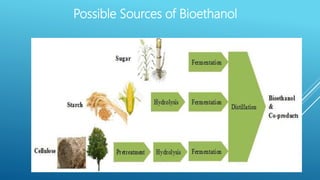
Possible Sources of Bioethanol
Comes with The Ideas
Bioethanol Bioethanol is one of the
alternative fuels that have
advantage than fossil fuel
Why
Bioethanol?
Bioethanol used plants as the raw material, so
it does not make accumulation of carbon in
the atmosphere Ethanol can also increase the
efficiency of combustion because it contains
35% oxygen and environmental friendly
because dump of gas emissions such as
carbon monoxide, nitrogen oxides, and other
gases are low (19-25%) o
How we make
it? During this time, bioethanol was produced
from molasses (sugar production process
waste) or starchy materials (cassava or corn).
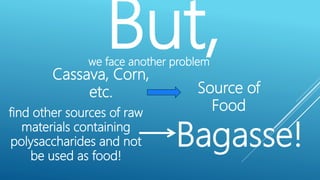
But,we face another problem
Cassava, Corn,
etc. Source of
Foodfind other sources of raw
materials containing
polysaccharides and not
be used as food!
Bagasse!
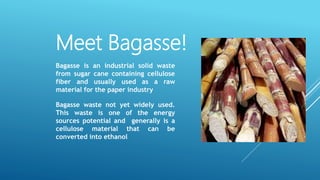
Meet Bagasse!
Bagasse is an industrial solid waste
from sugar cane containing cellulose
fiber and usually used as a raw
material for the paper industry
Bagasse waste not yet widely used.
This waste is one of the energy
sources potential and generally is a
cellulose material that can be
converted into ethanol
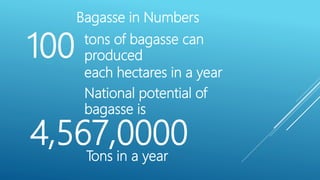
tons of bagasse can
produced100
each hectares in a year
Bagasse in Numbers
National potential of
bagasse is
4,567,0000
Tons in a year
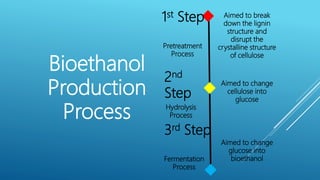
Bioethanol
Production
Process
1st Step
2nd
Step
3rd Step
Pretreatment
Process
Hydrolysis
Process
Fermentation
Process
Aimed to break
down the lignin
structure and
disrupt the
crystalline structure
of cellulose
Aimed to change
glucose into
bioethanol
Aimed to change
cellulose into
glucose
Bioethanol
Production
Process*
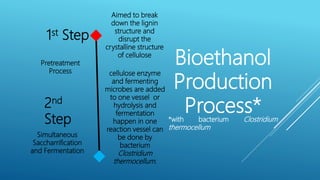
1st Step
2nd
Step
Pretreatment
Process
Simultaneous
Saccharrification
and Fermentation
Aimed to break
down the lignin
structure and
disrupt the
crystalline structure
of cellulose
cellulose enzyme
and fermenting
microbes are added
to one vessel or
hydrolysis and
fermentation
happen in one
reaction vessel can
be done by
bacterium
Clostridium
thermocellum.
*with bacterium Clostridium
thermocellum
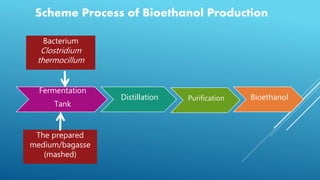
Fermentation
Tank
Distillation Purification Bioethanol
The prepared
medium/bagasse
(mashed)
Bacterium
Clostridium
thermocillum
Scheme Process of Bioethanol Production
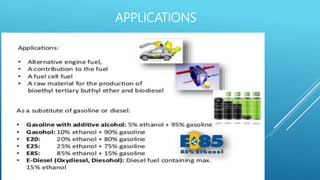
APPLICATIONS
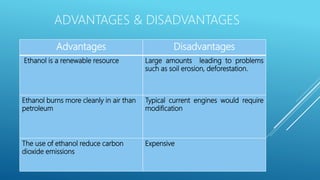
Advantages Disadvantages
Ethanol is a renewable resource Large amounts leading to problems
such as soil erosion, deforestation.
Ethanol burns more cleanly in air than
petroleum
Typical current engines would require
modification
The use of ethanol reduce carbon
dioxide emissions
Expensive
ADVANTAGES & DISADVANTAGES
CONCLUSION
 Bangladesh annually imports about 3.5 million tons of different fuel
oils.
 Bioethanol is the most potential renewable energy source to mitigate
this energy crisis.
REFERENCES-
• Abbi M., Kuhad R.C., Singh A.(1996). Bioconversion of pentose sugars to ethanol by
free and immobilized cells of Candida shehatate: Fermentation behaviour, Process
Biochemistry.31(6):555-560.
• Brandberg T., Karimi K., Taherzadeh M., Franzen C J., Gustasson L.(2007).
Continuous fermentation of wheat supplemented lignocellulose hydrolysate with
different types of cell retention, Biotechnology Bioengineering.98(1):80-9
• Cardona C.A., Sanchez O J.(2007). Fuel ethnol production: process design trends
and integration opportunities, Bioresource Technology.98:2415-2457
• Oura E.(1977). Reaction products of yeast fermentation, Process
Biochemistry.12(3):19-21
• Nguyen Q., Tucker M., Boynton B., Keller F., Schell D.(1998). Dilute acid
pretreatment of softwood, Applied Biochemistry Biotechnology.70-72, 77-87.
Bioethanol

Bioethanol

  • 1.
  • 2.
    BIOETHANOL Bioethanol is aform of renewable energy that can be produced from agricultural feedstocks. Bioethanol is an alcohol made by fermentation, mostly from carbohydrates produced in sugar or starch crops such as corn, sugarcane, or sweet sorghum. used as a petrol substitute for road transport vehicles.
  • 3.
  • 4.
    Comes with TheIdeas Bioethanol Bioethanol is one of the alternative fuels that have advantage than fossil fuel Why Bioethanol? Bioethanol used plants as the raw material, so it does not make accumulation of carbon in the atmosphere Ethanol can also increase the efficiency of combustion because it contains 35% oxygen and environmental friendly because dump of gas emissions such as carbon monoxide, nitrogen oxides, and other gases are low (19-25%) o How we make it? During this time, bioethanol was produced from molasses (sugar production process waste) or starchy materials (cassava or corn).
  • 5.
    But,we face anotherproblem Cassava, Corn, etc. Source of Foodfind other sources of raw materials containing polysaccharides and not be used as food! Bagasse!
  • 6.
    Meet Bagasse! Bagasse isan industrial solid waste from sugar cane containing cellulose fiber and usually used as a raw material for the paper industry Bagasse waste not yet widely used. This waste is one of the energy sources potential and generally is a cellulose material that can be converted into ethanol
  • 7.
    tons of bagassecan produced100 each hectares in a year Bagasse in Numbers National potential of bagasse is 4,567,0000 Tons in a year
  • 8.
    Bioethanol Production Process 1st Step 2nd Step 3rd Step Pretreatment Process Hydrolysis Process Fermentation Process Aimedto break down the lignin structure and disrupt the crystalline structure of cellulose Aimed to change glucose into bioethanol Aimed to change cellulose into glucose
  • 9.
    Bioethanol Production Process* 1st Step 2nd Step Pretreatment Process Simultaneous Saccharrification and Fermentation Aimedto break down the lignin structure and disrupt the crystalline structure of cellulose cellulose enzyme and fermenting microbes are added to one vessel or hydrolysis and fermentation happen in one reaction vessel can be done by bacterium Clostridium thermocellum. *with bacterium Clostridium thermocellum
  • 10.
    Fermentation Tank Distillation Purification Bioethanol Theprepared medium/bagasse (mashed) Bacterium Clostridium thermocillum Scheme Process of Bioethanol Production
  • 11.
  • 12.
    Advantages Disadvantages Ethanol isa renewable resource Large amounts leading to problems such as soil erosion, deforestation. Ethanol burns more cleanly in air than petroleum Typical current engines would require modification The use of ethanol reduce carbon dioxide emissions Expensive ADVANTAGES & DISADVANTAGES
  • 13.
    CONCLUSION  Bangladesh annuallyimports about 3.5 million tons of different fuel oils.  Bioethanol is the most potential renewable energy source to mitigate this energy crisis.
  • 14.
    REFERENCES- • Abbi M.,Kuhad R.C., Singh A.(1996). Bioconversion of pentose sugars to ethanol by free and immobilized cells of Candida shehatate: Fermentation behaviour, Process Biochemistry.31(6):555-560. • Brandberg T., Karimi K., Taherzadeh M., Franzen C J., Gustasson L.(2007). Continuous fermentation of wheat supplemented lignocellulose hydrolysate with different types of cell retention, Biotechnology Bioengineering.98(1):80-9 • Cardona C.A., Sanchez O J.(2007). Fuel ethnol production: process design trends and integration opportunities, Bioresource Technology.98:2415-2457 • Oura E.(1977). Reaction products of yeast fermentation, Process Biochemistry.12(3):19-21 • Nguyen Q., Tucker M., Boynton B., Keller F., Schell D.(1998). Dilute acid pretreatment of softwood, Applied Biochemistry Biotechnology.70-72, 77-87.

Editor's Notes

  • #10 The hydrolysis of polysaccharides to soluble sugars is called "saccharification".
  • #11 Distillation-action of purifying a liquid by a process of heating and cooling. Pretreatment- hot water + steam