By: Vidhi Vashisht
CONTENTS:
• Ethanol
• Why do we need ethanol?
• Ethanol Fermentation
• Substrates for ethanol production.
• Microorganisms utilized for production of ethanol.
• Biochemistry of the reaction
• Immobilization of cells.
• Process of ethanol production
• Ethanol as a biofuel.
ETHANOL- GRAIN ALCOHOL/ ETHYL
ALCOHOL
• Ethanol is a volatile, flammable, colorless
liquid with a slight chemical odor.
• It is used as an antiseptic, a solvent, and a
fuel.
WHY DO WE NEED ETHANOL?
INGREDIENT
Principle ingredient in
alcoholic beverages like beer,
wine, or brandy.
EFFECTIVE SOLVENT
Mixes easily with water &
many organic compounds
FOOD ADDITIVES
Ethanol can help evenly
distribute food colorings, as
well as it enhances the flavor
of food extracts.
ASTRINGENT
Acts as an astringent to help
clean skin,
In lotions as a PRESERVATIVE
and used in other
pharmaceutical products.
DISTILLERS GRAINS
By-product of ethanol
production which can be fed to
livestock either wet or dried.
BIOFUEL
It can be blended with gasoline
and used in motor vehicles.
E
T
H
A
N
O
L
ETHANOL FERMENTATION
• A biological process in which sugars such as glucose, fructose,
and sucrose are converted into cellular energy and thereby
produces ethanol and CO2 as metabolic waste products.
• It is an anaerobic process.
• Performed by microbes such as yeast and bacteria.
• The type of the organism chosen mostly depends on the
nature of the substrate used.
• Among the yeast, Saccharomyces cerevisiae is the most
commonly used, while among the bacteria, Zymomonas
mobilis is the most frequently employed for ethanol
production.
SUBSTRATES FOR ETHANOL
PRODUCTION
• The substrates are chosen based on the regional availability
and economical efficiency.
• Categories of substrates are :
SUCROSE
CONTAINING
MATERIALS
Sugarcane
Sugar beet
Sugar sorghum
STARCHY
MATERIALS
Corn
Other starchy
materials( sweet
potato, wheat etc.)
LIGNOCELLULOSI
C AND
CELLULOSIC
MATERIALS
Maize silage
Barley hull
Paper sludge
Wood etc
MICROORGANISMS INVOLVED
• Microorganisms such as yeasts and bacteria play an essential
role in ethanol production by fermenting a wide range of
sugars to ethanol.
• They are used in industrial plants due to valuable properties in
ethanol yield (>90.0% theoretical yield), ethanol tolerance
(>40.0 g/L), ethanol productivity (>1.0 g/L/h), growth in
simple, inexpensive media and undiluted fermentation broth
with resistance to inhibitors and retard contaminants from
growth condition.
• These microorganisms provide the enzymes needed to catalyze
the reaction.
Saccharomyces
cerevisiae
 has no amylases.
 specific growth rate of 0.13.
 can tolerate high concentrations of
ethanol .
 ethanol production is coupled with
yeast cell growth
 by- products like glycerol, organic
acids, are also produced.
 uses the Embden-Meyerhof
Pathway, generating 2 moles of ATPs
under anaerobic conditions.
Zymomonas mobilis
 high specific growth rate (0.27).
 high ethanol tolerance up to 130g/l.
 a broad pH range for production
(pH 3.5-7.5).
 consumes glucose faster than
S.cerevisiae, leading to higher ethanol
productivity.
 anaerobic carbohydrate metabolism
is carried out through the Entner-
Doudoroff pathway, where only one
mole of ATP is produced per mole of
glucose used, thus reducing the
amount of glucose that is converted to
biomass rather than ethanol.
SOME PROPERTIES OF MICROORGANISMS USED IN
FERMENTATION
BIOCHEMISTRY OF THE REACTION
BIOCHEMISTRY CONTD…
• The overall reaction can be divided in two steps:
1.Glycolysis – where the yeast breaks don glucose to form 2
pyruvate molecules
2. Fermentation- where the 2 pyruvate molecules are converted
into 2 CO2 molecules and 2 molecules of ethanol.
• before pyruvate can be converted to ethanol, it is first
converted into an intermediary molecule-acetaldehyde, by
decarboxylation of pyruvate and this releases CO2.
• Now acetaldehyde is converted to ethanol by reduction
• Enzyme responsible for decarboxylation is pyruvate
decarboxylase while for reduction of acetaldehyde is alcohol
dehydrogenase.
IMMOBILIZATION OF CELLS
• defined as the physical confinement or localization of intact
cells to a certain defined region of space (alginate) with the
preservation of some desired activity.
• immobilization of cells refers to the technique of confining/
anchoring the cells in or on an inert support for their stability
and functional reuse.
•Products abandon the system in cell free effluent system
leading to easier product recovery.
• The main advantage that immobilization confers to whole
cells are low sensitivity to temperature and pH- immobilized
cells gain temporary protection against any potentially
degenerative changes in the new environment.
METHODS OF
IMMOBILIZATION
FACTORS AFFECTING
IMMOBILIZATION
Advantages of using immobilized cells:
 allows for more efficient operation by reducing the non-
productive growth phase.
 high cell density of immobilized cells improves the product
yield and the volumetric productivity of bioreactors.
 protects the cells from shear forces and imparts a special
stability to the microorganism against environmental stresses
(pH, temperature, organic solvents, salts, inhibiting substrates
and products, poisons, self-destruction)
The activity, viability, and productivity of immobilized cells
can be maintained for a long time period, which facilitates
continuous cultivation processes and results in better
operational stability.
Immobilized cells can be handled more easily and recovered
from the solution without difficulty
PROCESS OF ETHANOL
PRODUCTION
• The proces is carried out in a fermenter/ bioreactor.
•There are five basic steps for ethanol production. These are-
1.Pretreatment of raw materials
 depends on the chemical composition of the raw material/substrate,
 sugary raw materials require mild or no pretreatment,
 cellulosic and lignocellulosic materials need extensive pretreatment,
 involves Liquefaction and Saccharification.
2. Preparation of nutrient solution (media)
 media composition must contains specific nutrients, such as trace
elements, vitamins, nitrogen, phosphorus, growth regulators etc.
 fermentation performance of the microbes highly depends on the
composition of media.
 thermotolerant vitamins ( inositol, pantothenic acid, and biotin) are
required to obtain rapid fermentation and high ethanol levels.
Process contd…
3. Preparation of inoculum
 INOCULUM : a small amount of substance containing
bacteria or any other micoorganism from a pure culture which
is used to start a new culture.
 the desired organism is isolated and organisms are first
cultured in flasks under aerobic condition to increase the size
of the inoculum.
Process contd…
4. Fermentation process
•For the production of ethanol to occur properly, following conditions
should be maintained-
1.Fermentation conditions-
 Temperature : a moderate temperature of 25ᵒC to 50ᵒC [ if the
temperature is too low, the yeast will be inactive and if it is too high,
the enzymes in the yeast will be denatured and will stop working]
pH : 4.0-4.5
 Sugar concentration : higher glucose concentration rate does not
enhance the production of ethanol due to substrate inhibition at a
higher glucose concentration in the system.
2.Intrinsic Factors-
 Culture medium
 Dissolved Oxygen : Aeration is initially required for good growth of
the organisms. Later, anaerobic conditions are created by withdrawal
of oxygen coupled with production of CO2.
 Immobilization
 Other micronutrients.
Process contd…
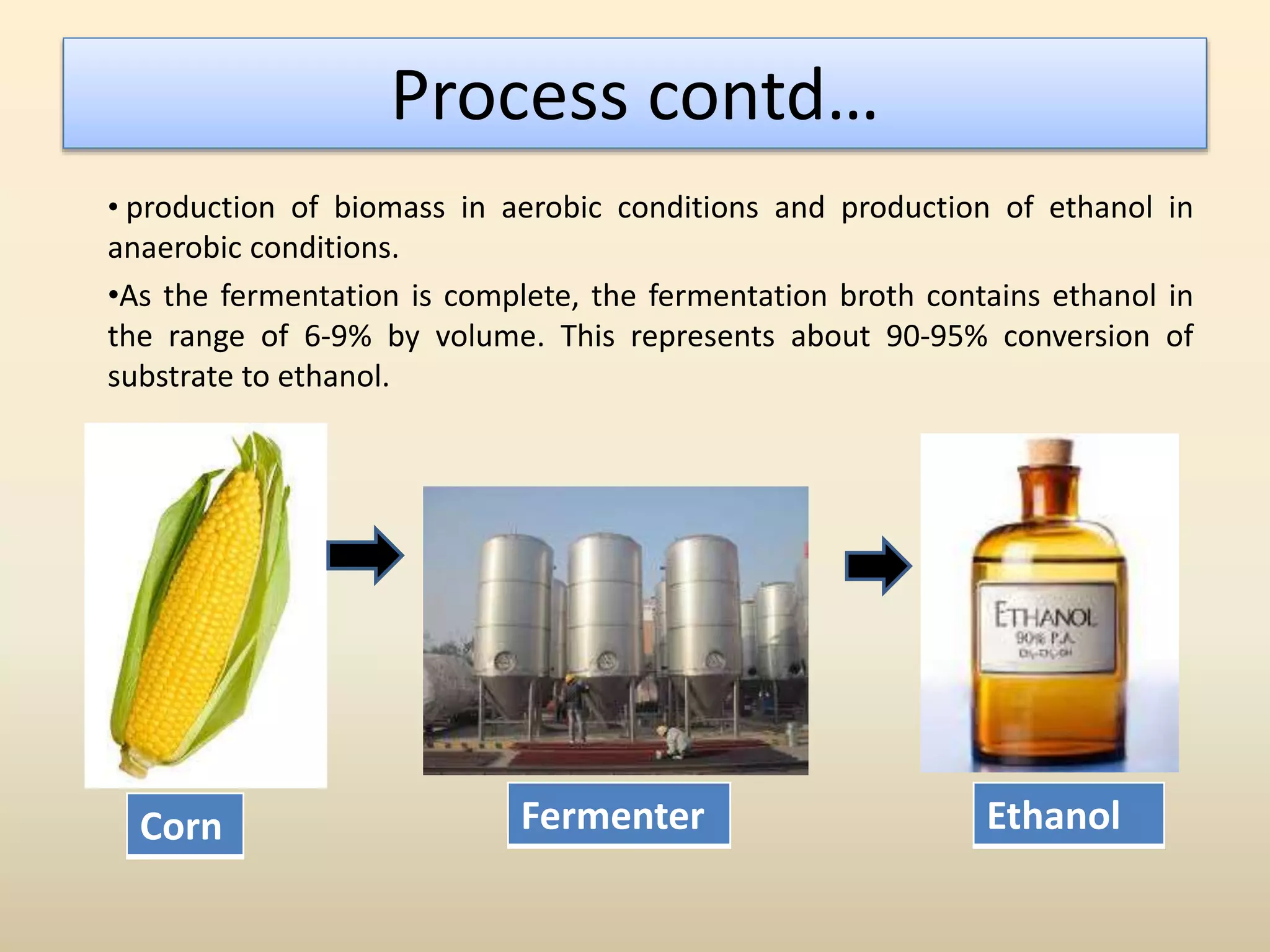
• production of biomass in aerobic conditions and production of ethanol in
anaerobic conditions.
•As the fermentation is complete, the fermentation broth contains ethanol in
the range of 6-9% by volume. This represents about 90-95% conversion of
substrate to ethanol.
Corn Fermenter Ethanol
Process contd…
5. Recovery of ethanol
 Energy demanding step.
 Fermentation by-products are mostly removed by distillation.
 Distillation is the most dominant and recognized industrial
purification technique .
It utilizes the differences of volatilities of components in a
mixture.
 Principle : by heating a mixture, low boiling point
components are concentrated in the vapor phase. By
condensing this vapor, more concentrated less volatile
compounds is obtained in liquid phase.
• It involves two main problems:
 Separation of volatile compounds- impurities with similar
boiling points to ethanol lodges in ethanol even after
distillation.
 Cost
 We cannot completely separate ethanol from water since they
are strongly bound to each other due to the presence of -OH
group in both of them ( ethanol and water).
 An additional method must be utilized to remove all the
water from ethanol ( since the ethanol fraction contains about
5% water and 95% ethanol) : DEHYDRATION.
 material used in this is called ZEOLITE.
 Zeolite absorbs the water into it, but the ethanol will not go
into the zeolite ( because the pore sizes of zeolite are too
small to allow the ethanol to enter.)
Diagrammatic view of process-
THREE TYPES OF FERMENTATION PROCESSES
The three fermentation processes are:
1. BATCH CULTURE
2. FED-BATCH CULTURE
3. CONTINUOUS CULTURE
ETHANOL AS A BIOFUEL
• Ethanol fuel is cost effective compared to other
biofuels.
• Ecologically effective.
• Minimizes global warming
• Easily accessible
• Minimizes dependence on fossil fuels
• Contributes to creation of employment to the country
• Opens up untapped agricultural sector
• Variety of sources of raw material
• Ethanol is classified as a renewable energy source
References
• Ethanol production, purification, and analysis techniques: a review
https://lib.dr.iastate.edu/cgi/viewcontent.cgi?article=1070&context=abe_en
g_conf
• Enzyme and Cell Immobilization Techniques PPT
https://www.slideshare.net/EasyBiologyClassEBC/enzyme-
cellimmobilizationtechniquesppteasybiologyclass
• Zymomonas mobilis as a model system for production of biofuels and
biochemicals
https://www.ncbi.nlm.nih.gov/pmc/articles/PMC5072187/
• Krueger and krueger
•Saccharomyces cerevisiae in the Production of Fermented Beverages
www.mdpi.com/2306-5710/2/4/30
Ethanol production

Ethanol production

  • 1.
  • 3.
    CONTENTS: • Ethanol • Whydo we need ethanol? • Ethanol Fermentation • Substrates for ethanol production. • Microorganisms utilized for production of ethanol. • Biochemistry of the reaction • Immobilization of cells. • Process of ethanol production • Ethanol as a biofuel.
  • 4.
    ETHANOL- GRAIN ALCOHOL/ETHYL ALCOHOL • Ethanol is a volatile, flammable, colorless liquid with a slight chemical odor. • It is used as an antiseptic, a solvent, and a fuel.
  • 5.
    WHY DO WENEED ETHANOL? INGREDIENT Principle ingredient in alcoholic beverages like beer, wine, or brandy. EFFECTIVE SOLVENT Mixes easily with water & many organic compounds FOOD ADDITIVES Ethanol can help evenly distribute food colorings, as well as it enhances the flavor of food extracts. ASTRINGENT Acts as an astringent to help clean skin, In lotions as a PRESERVATIVE and used in other pharmaceutical products. DISTILLERS GRAINS By-product of ethanol production which can be fed to livestock either wet or dried. BIOFUEL It can be blended with gasoline and used in motor vehicles. E T H A N O L
  • 6.
    ETHANOL FERMENTATION • Abiological process in which sugars such as glucose, fructose, and sucrose are converted into cellular energy and thereby produces ethanol and CO2 as metabolic waste products. • It is an anaerobic process. • Performed by microbes such as yeast and bacteria. • The type of the organism chosen mostly depends on the nature of the substrate used. • Among the yeast, Saccharomyces cerevisiae is the most commonly used, while among the bacteria, Zymomonas mobilis is the most frequently employed for ethanol production.
  • 7.
    SUBSTRATES FOR ETHANOL PRODUCTION •The substrates are chosen based on the regional availability and economical efficiency. • Categories of substrates are : SUCROSE CONTAINING MATERIALS Sugarcane Sugar beet Sugar sorghum STARCHY MATERIALS Corn Other starchy materials( sweet potato, wheat etc.) LIGNOCELLULOSI C AND CELLULOSIC MATERIALS Maize silage Barley hull Paper sludge Wood etc
  • 8.
    MICROORGANISMS INVOLVED • Microorganismssuch as yeasts and bacteria play an essential role in ethanol production by fermenting a wide range of sugars to ethanol. • They are used in industrial plants due to valuable properties in ethanol yield (>90.0% theoretical yield), ethanol tolerance (>40.0 g/L), ethanol productivity (>1.0 g/L/h), growth in simple, inexpensive media and undiluted fermentation broth with resistance to inhibitors and retard contaminants from growth condition. • These microorganisms provide the enzymes needed to catalyze the reaction.
  • 9.
    Saccharomyces cerevisiae  has noamylases.  specific growth rate of 0.13.  can tolerate high concentrations of ethanol .  ethanol production is coupled with yeast cell growth  by- products like glycerol, organic acids, are also produced.  uses the Embden-Meyerhof Pathway, generating 2 moles of ATPs under anaerobic conditions. Zymomonas mobilis  high specific growth rate (0.27).  high ethanol tolerance up to 130g/l.  a broad pH range for production (pH 3.5-7.5).  consumes glucose faster than S.cerevisiae, leading to higher ethanol productivity.  anaerobic carbohydrate metabolism is carried out through the Entner- Doudoroff pathway, where only one mole of ATP is produced per mole of glucose used, thus reducing the amount of glucose that is converted to biomass rather than ethanol. SOME PROPERTIES OF MICROORGANISMS USED IN FERMENTATION
  • 10.
  • 11.
    BIOCHEMISTRY CONTD… • Theoverall reaction can be divided in two steps: 1.Glycolysis – where the yeast breaks don glucose to form 2 pyruvate molecules 2. Fermentation- where the 2 pyruvate molecules are converted into 2 CO2 molecules and 2 molecules of ethanol. • before pyruvate can be converted to ethanol, it is first converted into an intermediary molecule-acetaldehyde, by decarboxylation of pyruvate and this releases CO2. • Now acetaldehyde is converted to ethanol by reduction • Enzyme responsible for decarboxylation is pyruvate decarboxylase while for reduction of acetaldehyde is alcohol dehydrogenase.
  • 12.
    IMMOBILIZATION OF CELLS •defined as the physical confinement or localization of intact cells to a certain defined region of space (alginate) with the preservation of some desired activity. • immobilization of cells refers to the technique of confining/ anchoring the cells in or on an inert support for their stability and functional reuse. •Products abandon the system in cell free effluent system leading to easier product recovery. • The main advantage that immobilization confers to whole cells are low sensitivity to temperature and pH- immobilized cells gain temporary protection against any potentially degenerative changes in the new environment.
  • 13.
  • 14.
  • 15.
    Advantages of usingimmobilized cells:  allows for more efficient operation by reducing the non- productive growth phase.  high cell density of immobilized cells improves the product yield and the volumetric productivity of bioreactors.  protects the cells from shear forces and imparts a special stability to the microorganism against environmental stresses (pH, temperature, organic solvents, salts, inhibiting substrates and products, poisons, self-destruction) The activity, viability, and productivity of immobilized cells can be maintained for a long time period, which facilitates continuous cultivation processes and results in better operational stability. Immobilized cells can be handled more easily and recovered from the solution without difficulty
  • 16.
    PROCESS OF ETHANOL PRODUCTION •The proces is carried out in a fermenter/ bioreactor. •There are five basic steps for ethanol production. These are- 1.Pretreatment of raw materials  depends on the chemical composition of the raw material/substrate,  sugary raw materials require mild or no pretreatment,  cellulosic and lignocellulosic materials need extensive pretreatment,  involves Liquefaction and Saccharification. 2. Preparation of nutrient solution (media)  media composition must contains specific nutrients, such as trace elements, vitamins, nitrogen, phosphorus, growth regulators etc.  fermentation performance of the microbes highly depends on the composition of media.  thermotolerant vitamins ( inositol, pantothenic acid, and biotin) are required to obtain rapid fermentation and high ethanol levels.
  • 17.
    Process contd… 3. Preparationof inoculum  INOCULUM : a small amount of substance containing bacteria or any other micoorganism from a pure culture which is used to start a new culture.  the desired organism is isolated and organisms are first cultured in flasks under aerobic condition to increase the size of the inoculum.
  • 18.
    Process contd… 4. Fermentationprocess •For the production of ethanol to occur properly, following conditions should be maintained- 1.Fermentation conditions-  Temperature : a moderate temperature of 25ᵒC to 50ᵒC [ if the temperature is too low, the yeast will be inactive and if it is too high, the enzymes in the yeast will be denatured and will stop working] pH : 4.0-4.5  Sugar concentration : higher glucose concentration rate does not enhance the production of ethanol due to substrate inhibition at a higher glucose concentration in the system. 2.Intrinsic Factors-  Culture medium  Dissolved Oxygen : Aeration is initially required for good growth of the organisms. Later, anaerobic conditions are created by withdrawal of oxygen coupled with production of CO2.  Immobilization  Other micronutrients.
  • 19.
    Process contd… • productionof biomass in aerobic conditions and production of ethanol in anaerobic conditions. •As the fermentation is complete, the fermentation broth contains ethanol in the range of 6-9% by volume. This represents about 90-95% conversion of substrate to ethanol. Corn Fermenter Ethanol
  • 21.
    Process contd… 5. Recoveryof ethanol  Energy demanding step.  Fermentation by-products are mostly removed by distillation.  Distillation is the most dominant and recognized industrial purification technique . It utilizes the differences of volatilities of components in a mixture.  Principle : by heating a mixture, low boiling point components are concentrated in the vapor phase. By condensing this vapor, more concentrated less volatile compounds is obtained in liquid phase.
  • 22.
    • It involvestwo main problems:  Separation of volatile compounds- impurities with similar boiling points to ethanol lodges in ethanol even after distillation.  Cost  We cannot completely separate ethanol from water since they are strongly bound to each other due to the presence of -OH group in both of them ( ethanol and water).  An additional method must be utilized to remove all the water from ethanol ( since the ethanol fraction contains about 5% water and 95% ethanol) : DEHYDRATION.  material used in this is called ZEOLITE.  Zeolite absorbs the water into it, but the ethanol will not go into the zeolite ( because the pore sizes of zeolite are too small to allow the ethanol to enter.)
  • 23.
  • 24.
    THREE TYPES OFFERMENTATION PROCESSES The three fermentation processes are: 1. BATCH CULTURE 2. FED-BATCH CULTURE 3. CONTINUOUS CULTURE
  • 25.
    ETHANOL AS ABIOFUEL • Ethanol fuel is cost effective compared to other biofuels. • Ecologically effective. • Minimizes global warming • Easily accessible • Minimizes dependence on fossil fuels • Contributes to creation of employment to the country • Opens up untapped agricultural sector • Variety of sources of raw material • Ethanol is classified as a renewable energy source
  • 26.
    References • Ethanol production,purification, and analysis techniques: a review https://lib.dr.iastate.edu/cgi/viewcontent.cgi?article=1070&context=abe_en g_conf • Enzyme and Cell Immobilization Techniques PPT https://www.slideshare.net/EasyBiologyClassEBC/enzyme- cellimmobilizationtechniquesppteasybiologyclass • Zymomonas mobilis as a model system for production of biofuels and biochemicals https://www.ncbi.nlm.nih.gov/pmc/articles/PMC5072187/ • Krueger and krueger •Saccharomyces cerevisiae in the Production of Fermented Beverages www.mdpi.com/2306-5710/2/4/30