By:-
CONTENTS
Abstract
Introduction
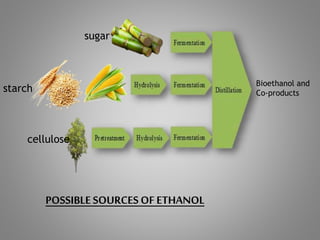
Possible sources of Bioethanol
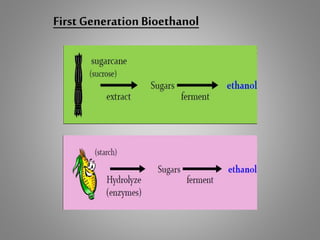
First generation Bioethanol
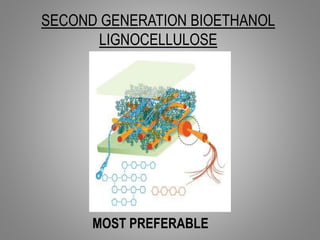
Second generation Bioethanol
Why Bioethanol?
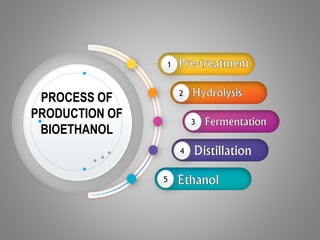
Scheme process of production of Bioethanol
Lignocellulose
Advantages and Disadvantages
Conclusion
References
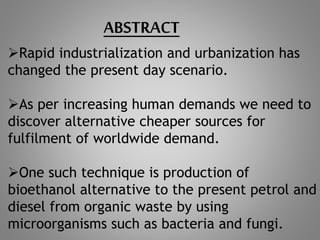
ABSTRACT
Rapid industrialization and urbanization has
changed the present day scenario.
As per increasing human demands we need to
discover alternative cheaper sources for
fulfilment of worldwide demand.
One such technique is production of
bioethanol alternative to the present petrol and
diesel from organic waste by using
microorganisms such as bacteria and fungi.
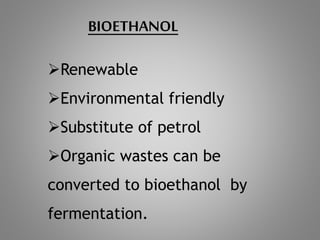
BIOETHANOL
Renewable
Environmental friendly
Substitute of petrol
Organic wastes can be
converted to bioethanol by
fermentation.
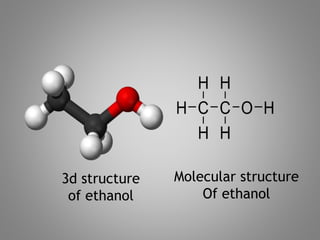
3d structure
of ethanol
Molecular structure
Of ethanol
POSSIBLESOURCES OF ETHANOL
Bioethanol and
Co-products
sugar
starch
cellulose
First Generation Bioethanol
SECOND GENERATION BIOETHANOL
LIGNOCELLULOSE
MOST PREFERABLE
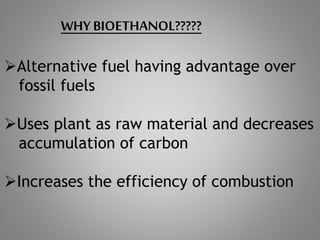
WHY BIOETHANOL?????
Alternative fuel having advantage over
fossil fuels
Uses plant as raw material and decreases
accumulation of carbon
Increases the efficiency of combustion
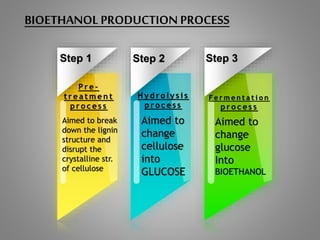
Step 1
P r e -
t r e a t m e n t
p r o c e s s
Aimed to break
down the lignin
structure and
disrupt the
crystalline str.
of cellulose
Step 2 Step 3
Aimed to
change
glucose
Into
BIOETHANOL
Aimed to
change
cellulose
into
GLUCOSE
Fe r m e n t a t i o n
p r o c e s s
H y d r o l y s i s
p r o c e s s
BIOETHANOL PRODUCTION PROCESS
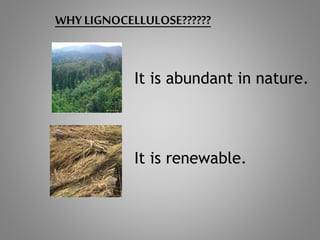
WHY LIGNOCELLULOSE??????
It is abundant in nature.
It is renewable.
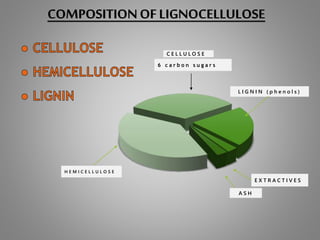
COMPOSITIONOF LIGNOCELLULOSE
6 c a r b o n s u g a r s
C E L L U L O S E
A S H
E X T R A C T I V E S
L I G N I N ( p h e n o l s )
H E M I C E L L U L O S E
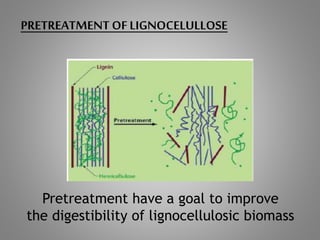
PRETREATMENT OF LIGNOCELULLOSE
Pretreatment have a goal to improve
the digestibility of lignocellulosic biomass
1
PROCESS OF
PRODUCTION OF
BIOETHANOL
2
3
4
5
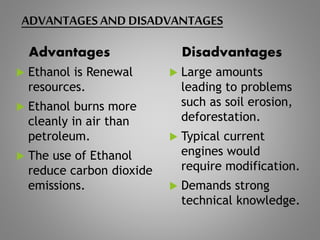
ADVANTAGES AND DISADVANTAGES
Advantages
 Ethanol is Renewal
resources.
 Ethanol burns more
cleanly in air than
petroleum.
 The use of Ethanol
reduce carbon dioxide
emissions.
Disadvantages
 Large amounts
leading to problems
such as soil erosion,
deforestation.
 Typical current
engines would
require modification.
 Demands strong
technical knowledge.
CONCLUSION
Bioethanol is the most potential renewable
energy source to mitigate this energy crisis.
This process is cost effective.
Does not yield any toxic residues.
Hence it can be run as a small industries.
REFERENCES
www.biosciencejournals.com
www.ncbi.nlm.nih.gov
Tahemzadeh, M.J. and K. Karini, Pretreatment
Of lignocellulosic wastes to improve ethanol.
International journal of Molecular Science
www.sciencedirect.com
BIOETHANOL
BIOETHANOL

BIOETHANOL