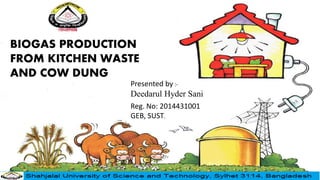
BIOGAS PRODUCTION
FROM KITCHEN WASTE
AND COW DUNG
Presented by :-
Deedarul Hyder Sani
Reg. No: 2014431001
GEB, SUST.
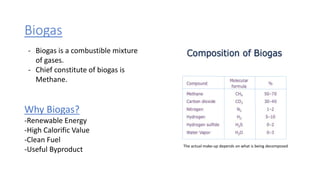
Biogas
The actual make-up depends on what is being decomposed
- Biogas is a combustible mixture
of gases.
- Chief constitute of biogas is
Methane.
Why Biogas?
-Renewable Energy
-High Calorific Value
-Clean Fuel
-Useful Byproduct
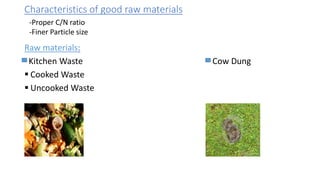
Characteristics of good raw materials
Raw materials:
Kitchen Waste Cow Dung
 Cooked Waste
 Uncooked Waste
-Proper C/N ratio
-Finer Particle size
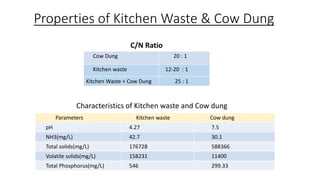
Properties of Kitchen Waste & Cow Dung
Parameters Kitchen waste Cow dung
pH 4.27 7.5
NH3(mg/L) 42.7 30.1
Total solids(mg/L) 176728 588366
Volatile solids(mg/L) 158231 11400
Total Phosphorus(mg/L) 546 299.33
Characteristics of Kitchen waste and Cow dung
Cow Dung 20 : 1
Kitchen waste 12-20 : 1
Kitchen Waste + Cow Dung 25 : 1
C/N Ratio
Structure of a Biogas plant
Parts of Biogas plant :
Mixing tank
Inlet chamber
Outlet chamber
Digester
Gas holder
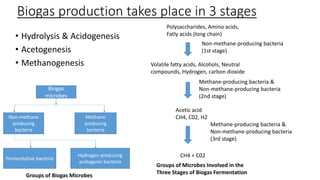
Biogas production takes place in 3 stages
• Hydrolysis & Acidogenesis
• Acetogenesis
• Methanogenesis
Polysaccharides, Amino acids,
Fatly acids (long chain)
Non-methane-producing bacteria
(1st stage)
Volatile fatty acids, Alcohols, Neutral
compounds, Hydrogen, carbon dioxide
Methane-producing bacteria &
Non-methane-producing bacteria
(2nd stage)
Acetic acid
CH4, C02, H2
Methane-producing bacteria &
Non-methane-producing bacteria
(3rd stage)
CH4 + C02
Groups of Microbes Involved in the
Three Stages of Biogas Fermentation
Biogas
microbes
Non-methane
producing
bacteria
Methane
producing
bacteria
Hydrogen-producing
acetogenic bacteria
Fermentative bacteria
Groups of Biogas Microbes
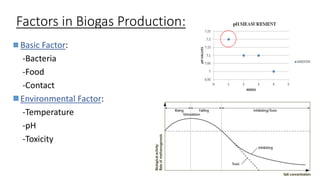
Factors in Biogas Production:
Basic Factor:
-Bacteria
-Food
-Contact
Environmental Factor:
-Temperature
-pH
-Toxicity
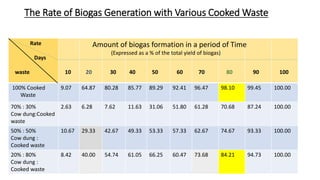
The Rate of Biogas Generation with Various Cooked Waste
Rate
Days
waste 10 20 30 40 50 60 70 80 90 100
100% Cooked
Waste
9.07 64.87 80.28 85.77 89.29 92.41 96.47 98.10 99.45 100.00
70% : 30%
Cow dung:Cooked
waste
2.63 6.28 7.62 11.63 31.06 51.80 61.28 70.68 87.24 100.00
50% : 50%
Cow dung :
Cooked waste
10.67 29.33 42.67 49.33 53.33 57.33 62.67 74.67 93.33 100.00
20% : 80%
Cow dung :
Cooked waste
8.42 40.00 54.74 61.05 66.25 60.47 73.68 84.21 94.73 100.00
Amount of biogas formation in a period of Time
(Expressed as a % of the total yield of biogas)
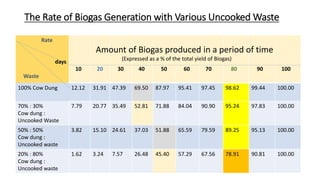
The Rate of Biogas Generation with Various Uncooked Waste
Rate
days
Waste
10 20 30 40 50 60 70 80 90 100
100% Cow Dung 12.12 31.91 47.39 69.50 87.97 95.41 97.45 98.62 99.44 100.00
70% : 30%
Cow dung :
Uncooked Waste
7.79 20.77 35.49 52.81 71.88 84.04 90.90 95.24 97.83 100.00
50% : 50%
Cow dung :
Uncooked waste
3.82 15.10 24.61 37.03 51.88 65.59 79.59 89.25 95.13 100.00
20% : 80%
Cow dung :
Uncooked waste
1.62 3.24 7.57 26.48 45.40 57.29 67.56 78.91 90.81 100.00
Amount of Biogas produced in a period of time
(Expressed as a % of the total yield of Biogas)
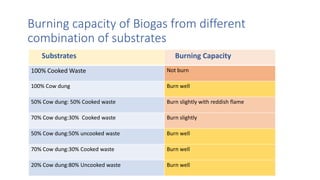
Burning capacity of Biogas from different
combination of substrates
Substrates Burning Capacity
100% Cooked Waste Not burn
100% Cow dung Burn well
50% Cow dung: 50% Cooked waste Burn slightly with reddish flame
70% Cow dung:30% Cooked waste Burn slightly
50% Cow dung:50% uncooked waste Burn well
70% Cow dung:30% Cooked waste Burn well
20% Cow dung:80% Uncooked waste Burn well
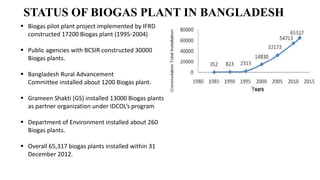
STATUS OF BIOGAS PLANT IN BANGLADESH
 Biogas pilot plant project implemented by IFRD
constructed 17200 Biogas plant (1995-2004)
 Public agencies with BCSIR constructed 30000
Biogas plants.
 Bangladesh Rural Advancement
Committee installed about 1200 Biogas plant.
 Grameen Shakti (GS) installed 13000 Biogas plants
as partner organization under IDCOL’s program
 Department of Environment installed about 260
Biogas plants.
 Overall 65,317 biogas plants installed within 31
December 2012.
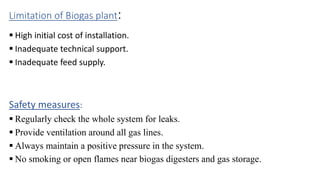
Limitation of Biogas plant:
 High initial cost of installation.
 Inadequate technical support.
 Inadequate feed supply.
Safety measures:
 Regularly check the whole system for leaks.
 Provide ventilation around all gas lines.
 Always maintain a positive pressure in the system.
 No smoking or open flames near biogas digesters and gas storage.
References
• APH, 1989, The Biogas Technology in China. Chengdu Biogas Research Institute of the
Ministry of Agriculture, PRC
• Balch, WE. Fox, G.E., Magrum, LJ, Woese, C.R. and Wolfe, RS., 1979. "Methanogens reevaluation of a unique
biological group". Microbial reviews, 43: PP 260-296.
• Barker, HA 1956 "Bacterial Fermentation" CIBA Lectures in Microbial Biochemistry, Institute of Microbiology,
Rutgers, New Jersey, USA.
• BBS, 1994. Analytical Report on Bangladesh Population Census.
• Chowdhury, M .Y .1988 " Biomass and Bioferlilizer Production". A Research paper Presented at International
Seminar on Energy from Biomas Bangladesh Agricultural University, Mymensingh, Feb.27-19.
• Rahman, M.H., 1996: Biogas: environmental aspects and potential for generation in Bangladesh, Int. J. Env.
Educ. & Inf., UK.
• Unicef and DPHE, 1994: The status of rural water supply and sanitation in Bangladesh, Repot of Unicef and
Department of Public Health Engineering, Bangladesh.
• A. Al-muyeed, A. M. Shadullah, “Electrification through biogas”, forum, monthly publication of the daily star,
Dhaka, Bangladesh (2010), volume. 3, issue.1
• M. Islam, B. Salam and A. Mohajan , “Generation of biogas from anaerobic digestion of vegetable waste”,
Proceeding of the 8th International Conference on Mechanical Engineering (2009), 26- 28 December, Dhaka,
Bangladesh
Thank You 

Biogas

  • 1.
    BIOGAS PRODUCTION FROM KITCHENWASTE AND COW DUNG Presented by :- Deedarul Hyder Sani Reg. No: 2014431001 GEB, SUST.
  • 2.
    Biogas The actual make-updepends on what is being decomposed - Biogas is a combustible mixture of gases. - Chief constitute of biogas is Methane. Why Biogas? -Renewable Energy -High Calorific Value -Clean Fuel -Useful Byproduct
  • 3.
    Characteristics of goodraw materials Raw materials: Kitchen Waste Cow Dung  Cooked Waste  Uncooked Waste -Proper C/N ratio -Finer Particle size
  • 4.
    Properties of KitchenWaste & Cow Dung Parameters Kitchen waste Cow dung pH 4.27 7.5 NH3(mg/L) 42.7 30.1 Total solids(mg/L) 176728 588366 Volatile solids(mg/L) 158231 11400 Total Phosphorus(mg/L) 546 299.33 Characteristics of Kitchen waste and Cow dung Cow Dung 20 : 1 Kitchen waste 12-20 : 1 Kitchen Waste + Cow Dung 25 : 1 C/N Ratio
  • 5.
    Structure of aBiogas plant Parts of Biogas plant : Mixing tank Inlet chamber Outlet chamber Digester Gas holder
  • 6.
    Biogas production takesplace in 3 stages • Hydrolysis & Acidogenesis • Acetogenesis • Methanogenesis Polysaccharides, Amino acids, Fatly acids (long chain) Non-methane-producing bacteria (1st stage) Volatile fatty acids, Alcohols, Neutral compounds, Hydrogen, carbon dioxide Methane-producing bacteria & Non-methane-producing bacteria (2nd stage) Acetic acid CH4, C02, H2 Methane-producing bacteria & Non-methane-producing bacteria (3rd stage) CH4 + C02 Groups of Microbes Involved in the Three Stages of Biogas Fermentation Biogas microbes Non-methane producing bacteria Methane producing bacteria Hydrogen-producing acetogenic bacteria Fermentative bacteria Groups of Biogas Microbes
  • 7.
    Factors in BiogasProduction: Basic Factor: -Bacteria -Food -Contact Environmental Factor: -Temperature -pH -Toxicity
  • 8.
    The Rate ofBiogas Generation with Various Cooked Waste Rate Days waste 10 20 30 40 50 60 70 80 90 100 100% Cooked Waste 9.07 64.87 80.28 85.77 89.29 92.41 96.47 98.10 99.45 100.00 70% : 30% Cow dung:Cooked waste 2.63 6.28 7.62 11.63 31.06 51.80 61.28 70.68 87.24 100.00 50% : 50% Cow dung : Cooked waste 10.67 29.33 42.67 49.33 53.33 57.33 62.67 74.67 93.33 100.00 20% : 80% Cow dung : Cooked waste 8.42 40.00 54.74 61.05 66.25 60.47 73.68 84.21 94.73 100.00 Amount of biogas formation in a period of Time (Expressed as a % of the total yield of biogas)
  • 9.
    The Rate ofBiogas Generation with Various Uncooked Waste Rate days Waste 10 20 30 40 50 60 70 80 90 100 100% Cow Dung 12.12 31.91 47.39 69.50 87.97 95.41 97.45 98.62 99.44 100.00 70% : 30% Cow dung : Uncooked Waste 7.79 20.77 35.49 52.81 71.88 84.04 90.90 95.24 97.83 100.00 50% : 50% Cow dung : Uncooked waste 3.82 15.10 24.61 37.03 51.88 65.59 79.59 89.25 95.13 100.00 20% : 80% Cow dung : Uncooked waste 1.62 3.24 7.57 26.48 45.40 57.29 67.56 78.91 90.81 100.00 Amount of Biogas produced in a period of time (Expressed as a % of the total yield of Biogas)
  • 10.
    Burning capacity ofBiogas from different combination of substrates Substrates Burning Capacity 100% Cooked Waste Not burn 100% Cow dung Burn well 50% Cow dung: 50% Cooked waste Burn slightly with reddish flame 70% Cow dung:30% Cooked waste Burn slightly 50% Cow dung:50% uncooked waste Burn well 70% Cow dung:30% Cooked waste Burn well 20% Cow dung:80% Uncooked waste Burn well
  • 11.
    STATUS OF BIOGASPLANT IN BANGLADESH  Biogas pilot plant project implemented by IFRD constructed 17200 Biogas plant (1995-2004)  Public agencies with BCSIR constructed 30000 Biogas plants.  Bangladesh Rural Advancement Committee installed about 1200 Biogas plant.  Grameen Shakti (GS) installed 13000 Biogas plants as partner organization under IDCOL’s program  Department of Environment installed about 260 Biogas plants.  Overall 65,317 biogas plants installed within 31 December 2012.
  • 12.
    Limitation of Biogasplant:  High initial cost of installation.  Inadequate technical support.  Inadequate feed supply. Safety measures:  Regularly check the whole system for leaks.  Provide ventilation around all gas lines.  Always maintain a positive pressure in the system.  No smoking or open flames near biogas digesters and gas storage.
  • 13.
    References • APH, 1989,The Biogas Technology in China. Chengdu Biogas Research Institute of the Ministry of Agriculture, PRC • Balch, WE. Fox, G.E., Magrum, LJ, Woese, C.R. and Wolfe, RS., 1979. "Methanogens reevaluation of a unique biological group". Microbial reviews, 43: PP 260-296. • Barker, HA 1956 "Bacterial Fermentation" CIBA Lectures in Microbial Biochemistry, Institute of Microbiology, Rutgers, New Jersey, USA. • BBS, 1994. Analytical Report on Bangladesh Population Census. • Chowdhury, M .Y .1988 " Biomass and Bioferlilizer Production". A Research paper Presented at International Seminar on Energy from Biomas Bangladesh Agricultural University, Mymensingh, Feb.27-19. • Rahman, M.H., 1996: Biogas: environmental aspects and potential for generation in Bangladesh, Int. J. Env. Educ. & Inf., UK. • Unicef and DPHE, 1994: The status of rural water supply and sanitation in Bangladesh, Repot of Unicef and Department of Public Health Engineering, Bangladesh. • A. Al-muyeed, A. M. Shadullah, “Electrification through biogas”, forum, monthly publication of the daily star, Dhaka, Bangladesh (2010), volume. 3, issue.1 • M. Islam, B. Salam and A. Mohajan , “Generation of biogas from anaerobic digestion of vegetable waste”, Proceeding of the 8th International Conference on Mechanical Engineering (2009), 26- 28 December, Dhaka, Bangladesh
  • 14.