Algae Biofuel
Fuel of the Future
MT5009 Analyzing High-Tech Opportunities
Presented by
Adrian (A0027118M)
Dominik (A0133486B)
Hari (A0132989M)
Krem (A0132973R)
Sathish (A0133745E)
Varun (A0133475E)
For information on presentations on other technologies, see http://www.slideshare.net/Funk98/presentations
Agenda
• Introduction to Biofuels
• Why Algae Biofuel?
• Production Process
• Production Costs
• Rates of Improvement
• Entrepreneurial Opportunities
• Conclusion
Biofuels – the green alternative
• Derived form biological materials through biomass conversion
• Renewable
• Production requires more effort and resources
• Can significantly reduce greenhouse gas emissions
• Release CO2 when burning
• Biofuel production consumes it back
• Types:
• Ethanol
• Biodiesel
• Bio gasoline
• Bio butanol
• Methane
• Jet fuel
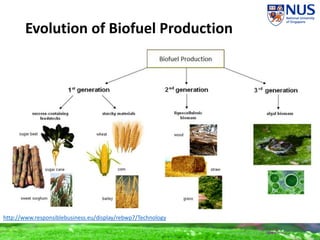
Evolution of Biofuel Production
http://www.responsiblebusiness.eu/display/rebwp7/Technology
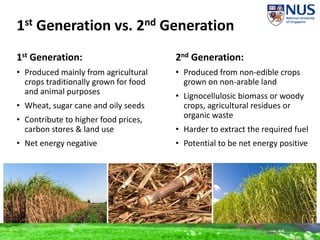
1st Generation vs. 2nd Generation
2nd Generation:
• Produced from non-edible crops
grown on non-arable land
• Lignocellulosic biomass or woody
crops, agricultural residues or
organic waste
• Harder to extract the required fuel
• Potential to be net energy positive
1st Generation:
• Produced mainly from agricultural
crops traditionally grown for food
and animal purposes
• Wheat, sugar cane and oily seeds
• Contribute to higher food prices,
carbon stores & land use
• Net energy negative
Agenda
• Introduction to Biofuels
• Why Algae Biofuel?
• Production Process
• Production Costs
• Rates of Improvement
• Entrepreneurial Opportunities
• Conclusion
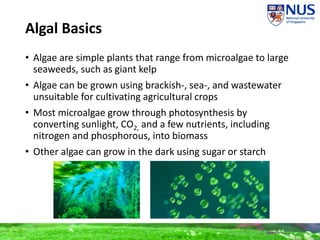
Algal Basics
• Algae are simple plants that range from microalgae to large
seaweeds, such as giant kelp
• Algae can be grown using brackish-, sea-, and wastewater
unsuitable for cultivating agricultural crops
• Most microalgae grow through photosynthesis by
converting sunlight, CO2, and a few nutrients, including
nitrogen and phosphorous, into biomass
• Other algae can grow in the dark using sugar or starch
Why Algae Biofuel?
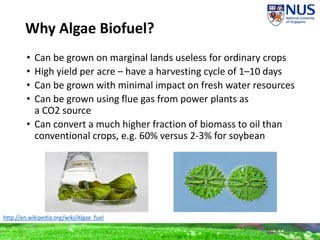
• Can be grown on marginal lands useless for ordinary crops
• High yield per acre – have a harvesting cycle of 1–10 days
• Can be grown with minimal impact on fresh water resources
• Can be grown using flue gas from power plants as
a CO2 source
• Can convert a much higher fraction of biomass to oil than
conventional crops, e.g. 60% versus 2-3% for soybean
http://en.wikipedia.org/wiki/Algae_fuel
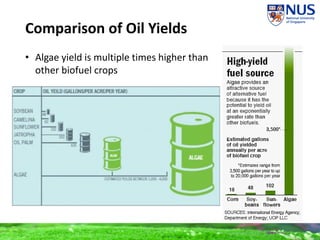
Comparison of Oil Yields
• Algae yield is multiple times higher than
other biofuel crops
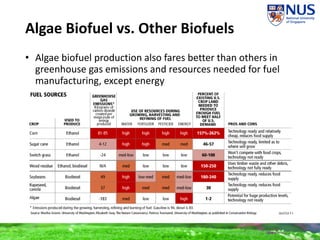
Algae Biofuel vs. Other Biofuels
• Algae biofuel production also fares better than others in
greenhouse gas emissions and resources needed for fuel
manufacturing, except energy
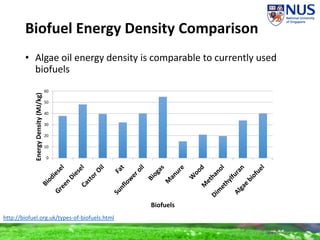
Biofuel Energy Density Comparison
0
10
20
30
40
50
60
EnergyDensity(MJ/kg)
Biofuels
http://biofuel.org.uk/types-of-biofuels.html
• Algae oil energy density is comparable to currently used
biofuels
Agenda
• Introduction to Biofuels
• Why Algae Biofuel?
• Production Process
• Production Costs
• Rates of Improvement
• Entrepreneurial Opportunities
• Conclusion
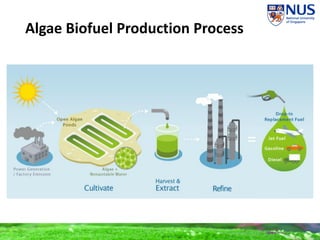
Algae Biofuel Production Process
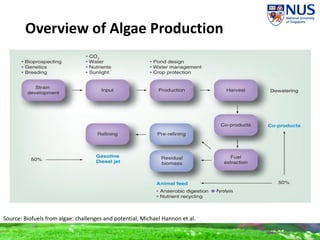
Overview of Algae Production
Source: Biofuels from algae: challenges and potential, Michael Hannon et al.
Pyrolysis
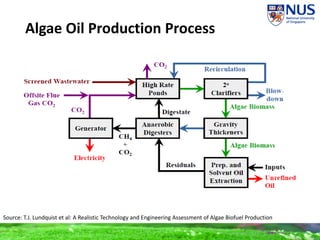
Algae Oil Production Process
Source: T.J. Lundquist et al: A Realistic Technology and Engineering Assessment of Algae Biofuel Production
Algae Species
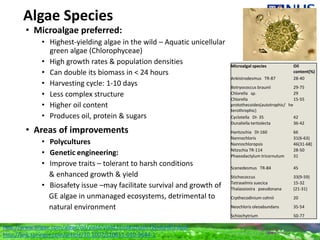
• Microalgae preferred:
• Highest-yielding algae in the wild – Aquatic unicellular
green algae (Chlorophyceae)
• High growth rates & population densities
• Can double its biomass in < 24 hours
• Harvesting cycle: 1-10 days
• Less complex structure
• Higher oil content
• Produces oil, protein & sugars
• Areas of improvements
• Polycultures
• Genetic engineering:
• Improve traits – tolerant to harsh conditions
& enhanced growth & yield
• Biosafety issue –may facilitate survival and growth of
GE algae in unmanaged ecosystems, detrimental to
natural environment
Microalgal species Oil
content(%)
Ankistrodesmus TR-87 28-40
Botryococcus braunii 29-75
Chlorella sp. 29
Chlorella
protothecoides(autotrophic/ he
terothrophic)
15-55
Cyclotella DI- 35 42
Dunaliella tertiolecta 36-42
Hantzschia DI-160 66
Nannochloris 31(6-63)
Nannochloropsis 46(31-68)
Nitzschia TR-114 28-50
Phaeodactylum tricornutum 31
Scenedesmus TR-84 45
Stichococcus 33(9-59)
Tetraselmis suecica 15-32
Thalassiosira pseudonana (21-31)
Crpthecodinium cohnii 20
Neochloris oleoabundans 35-54
Schiochytrium 50-77
http://www.oilgae.com/algae/oil/yield/yield.html#sthash.f2Udun8U.dpuf
http://link.springer.com/article/10.1007/s10811-010-9644-1
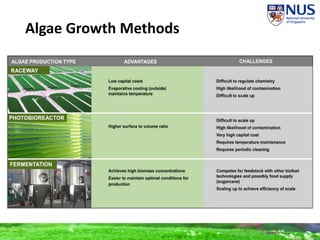
Algae Growth Methods
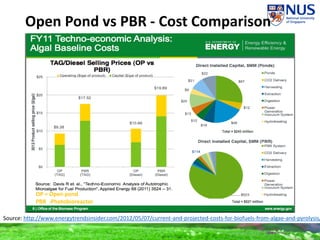
Open Pond vs PBR - Cost Comparison
OP = Open pond
PBR -Photobioreactor
Source: http://www.energytrendsinsider.com/2012/05/07/current-and-projected-costs-for-biofuels-from-algae-and-pyrolysis/
Dominant Growth Method
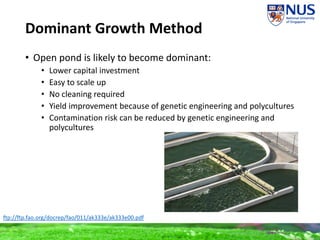
• Open pond is likely to become dominant:
• Lower capital investment
• Easy to scale up
• No cleaning required
• Yield improvement because of genetic engineering and polycultures
• Contamination risk can be reduced by genetic engineering and
polycultures
ftp://ftp.fao.org/docrep/fao/011/ak333e/ak333e00.pdf
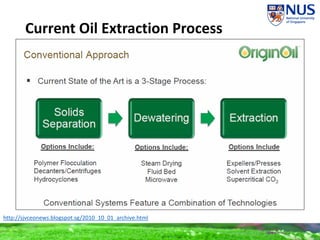
Current Oil Extraction Process
http://sjvceonews.blogspot.sg/2010_10_01_archive.html
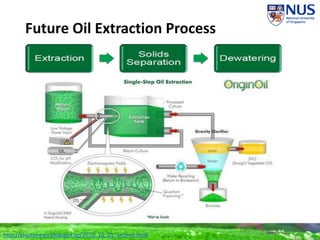
Future Oil Extraction Process
http://sjvceonews.blogspot.sg/2010_10_01_archive.html
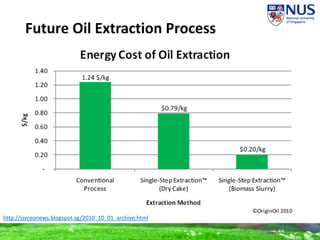
Future Oil Extraction Process
http://sjvceonews.blogspot.sg/2010_10_01_archive.html
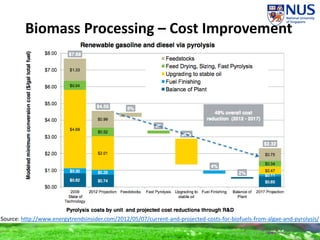
Biomass Processing – Cost Improvement
Source: http://www.energytrendsinsider.com/2012/05/07/current-and-projected-costs-for-biofuels-from-algae-and-pyrolysis/
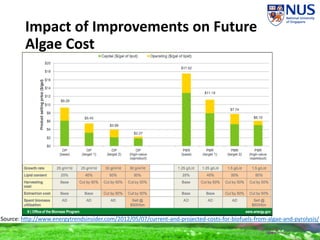
Impact of Improvements on Future
Algae Cost
Source: http://www.energytrendsinsider.com/2012/05/07/current-and-projected-costs-for-biofuels-from-algae-and-pyrolysis/
Agenda
• Introduction to Biofuels
• Why Algae Biofuel?
• Production Process
• Production Costs
• Rates of Improvement
• Entrepreneurial Opportunities
• Conclusion
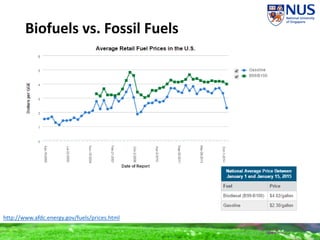
Biofuels vs. Fossil Fuels
http://www.afdc.energy.gov/fuels/prices.html
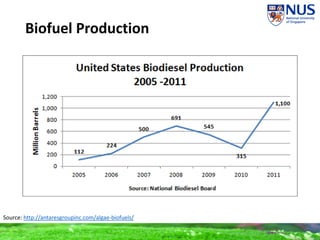
Biofuel Production
Source: http://antaresgroupinc.com/algae-biofuels/
Agenda
• Introduction to Biofuels
• Why Algae Biofuel?
• Production Process
• Production Costs
• Rates of Improvement
• Entrepreneurial Opportunities
• Conclusion
Summary of where Improvements Occur
• Improvement in production methods. For example:
• Using flue gas
• Using waste water
• Using genetically engineered algae to increase oil yield
• Improvement in harvesting methods. For example:
• Liquefaction
• Hydrogenation
• Pyrolysis
• Improvement in technology  Conversion of algae to
different form of fuel. For example:
• Bio-ethanol; Bio-methane;
• Bio-hydrogen; Bio-butanol;
• Bio-Diesel; bio-gasoline;
• Jet fuel
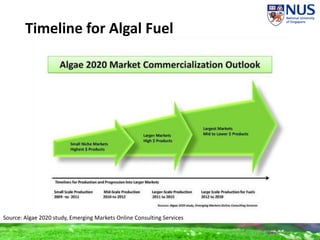
Timeline for Algal Fuel
Source: Algae 2020 study, Emerging Markets Online Consulting Services
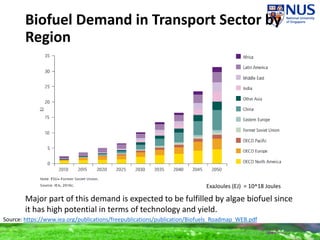
Biofuel Demand in Transport Sector by
Region
Major part of this demand is expected to be fulfilled by algae biofuel since
it has high potential in terms of technology and yield.
Source: https://www.iea.org/publications/freepublications/publication/Biofuels_Roadmap_WEB.pdf
ExaJoules (EJ) = 10^18 Joules
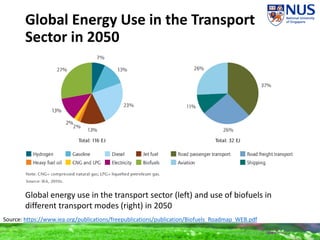
Global Energy Use in the Transport
Sector in 2050
Global energy use in the transport sector (left) and use of biofuels in
different transport modes (right) in 2050
Source: https://www.iea.org/publications/freepublications/publication/Biofuels_Roadmap_WEB.pdf
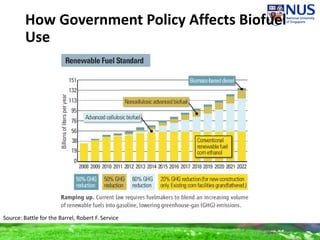
How Government Policy Affects Biofuel
Use
Source: Battle for the Barrel, Robert F. Service
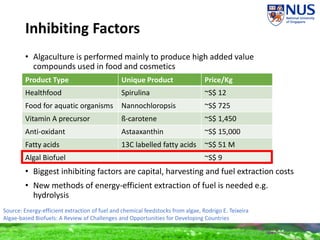
Inhibiting Factors
• Algaculture is performed mainly to produce high added value
compounds used in food and cosmetics
• Biggest inhibiting factors are capital, harvesting and fuel extraction costs
• New methods of energy-efficient extraction of fuel is needed e.g.
hydrolysis
Product Type Unique Product Price/Kg
Healthfood Spirulina ~S$ 12
Food for aquatic organisms Nannochloropsis ~S$ 725
Vitamin A precursor ß-carotene ~S$ 1,450
Anti-oxidant Astaaxanthin ~S$ 15,000
Fatty acids 13C labelled fatty acids ~S$ 51 M
Algal Biofuel ~S$ 9
Source: Energy-efficient extraction of fuel and chemical feedstocks from algae, Rodrigo E. Teixeira
Algae-based Biofuels: A Review of Challenges and Opportunities for Developing Countries
Agenda
• Introduction to Biofuels
• Why Algae Biofuel?
• Production Process
• Production Costs
• Rates of Improvement
• Entrepreneurial Opportunities
• Conclusion
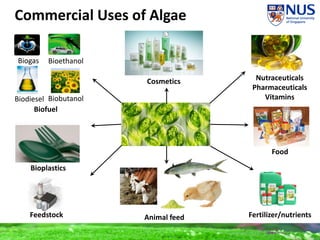
Commercial Uses of Algae
Cosmetics
Bioplastics
Feedstock Fertilizer/nutrients
Food
Nutraceuticals
Pharmaceuticals
Vitamins
Animal feed
BioethanolBiogas
Biodiesel Biobutanol
Biofuel
http://solazyme.com/innovation/
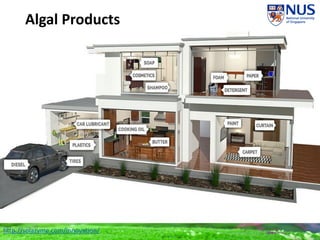
Algal Products
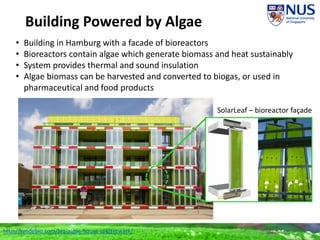
Building Powered by Algae
• Building in Hamburg with a facade of bioreactors
• Bioreactors contain algae which generate biomass and heat sustainably
• System provides thermal and sound insulation
• Algae biomass can be harvested and converted to biogas, or used in
pharmaceutical and food products
http://syndebio.com/biq-algae-house-splitterwerk/
SolarLeaf – bioreactor façade
Algae Architecture
http://www.lyxia.com/algal-architecture-and-automobile-design/
What Changes might enable Algae
Farming in buildings?
Glass Production Technology
• Ultra-strong glass with thinner walls
• Increased light penetration and larger volumes
• Mechanical stability allows continuous in-line cleaning
Efficient use of Lightings
• Redirect sunlight into building interior
• Use of existing LED lightings at night for continuous algae production
Genetic Modification of Algae
• Significantly higher concentration in terms of mass per litre
• Grow in the dark algae strains created through genetic modification
Policies enabling the use of empty spaces
• External walls, rooftops & walls of stairwells
Cost per kilowatt hour needs to become lower
• Current estimates: cost per kilowatt-hour produced by algae bioreactors would be 7
times as much as solar power and 14 times as much as crude oil
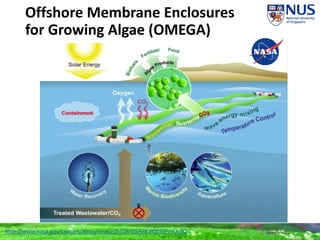
Offshore Membrane Enclosures
for Growing Algae (OMEGA)
http://www.nasa.gov/centers/ames/research/OMEGA/#.VQ1FSPmUc9Q
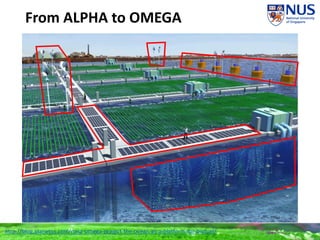
From ALPHA to OMEGA
http://blog.planetos.com/nasa-omega-project-the-ocean-as-a-platform-for-biofuel/
Agenda
• Introduction to Biofuels
• Why Algae Biofuel?
• Production Process
• Production Costs
• Rates of Improvement
• Entrepreneurial Opportunities
• Conclusion
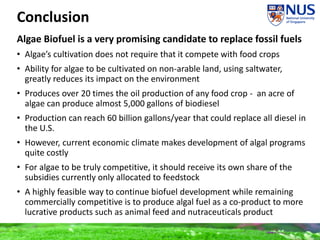
Conclusion
Algae Biofuel is a very promising candidate to replace fossil fuels
• Algae’s cultivation does not require that it compete with food crops
• Ability for algae to be cultivated on non-arable land, using saltwater,
greatly reduces its impact on the environment
• Produces over 20 times the oil production of any food crop - an acre of
algae can produce almost 5,000 gallons of biodiesel
• Production can reach 60 billion gallons/year that could replace all diesel in
the U.S.
• However, current economic climate makes development of algal programs
quite costly
• For algae to be truly competitive, it should receive its own share of the
subsidies currently only allocated to feedstock
• A highly feasible way to continue biofuel development while remaining
commercially competitive is to produce algal fuel as a co-product to more
lucrative products such as animal feed and nutraceuticals product
Thank You!
Any Questions?

Algae Biofuels

  • 1.
    Algae Biofuel Fuel ofthe Future MT5009 Analyzing High-Tech Opportunities Presented by Adrian (A0027118M) Dominik (A0133486B) Hari (A0132989M) Krem (A0132973R) Sathish (A0133745E) Varun (A0133475E) For information on presentations on other technologies, see http://www.slideshare.net/Funk98/presentations
  • 2.
    Agenda • Introduction toBiofuels • Why Algae Biofuel? • Production Process • Production Costs • Rates of Improvement • Entrepreneurial Opportunities • Conclusion
  • 3.
    Biofuels – thegreen alternative • Derived form biological materials through biomass conversion • Renewable • Production requires more effort and resources • Can significantly reduce greenhouse gas emissions • Release CO2 when burning • Biofuel production consumes it back • Types: • Ethanol • Biodiesel • Bio gasoline • Bio butanol • Methane • Jet fuel
  • 4.
    Evolution of BiofuelProduction http://www.responsiblebusiness.eu/display/rebwp7/Technology
  • 5.
    1st Generation vs.2nd Generation 2nd Generation: • Produced from non-edible crops grown on non-arable land • Lignocellulosic biomass or woody crops, agricultural residues or organic waste • Harder to extract the required fuel • Potential to be net energy positive 1st Generation: • Produced mainly from agricultural crops traditionally grown for food and animal purposes • Wheat, sugar cane and oily seeds • Contribute to higher food prices, carbon stores & land use • Net energy negative
  • 6.
    Agenda • Introduction toBiofuels • Why Algae Biofuel? • Production Process • Production Costs • Rates of Improvement • Entrepreneurial Opportunities • Conclusion
  • 7.
    Algal Basics • Algaeare simple plants that range from microalgae to large seaweeds, such as giant kelp • Algae can be grown using brackish-, sea-, and wastewater unsuitable for cultivating agricultural crops • Most microalgae grow through photosynthesis by converting sunlight, CO2, and a few nutrients, including nitrogen and phosphorous, into biomass • Other algae can grow in the dark using sugar or starch
  • 8.
    Why Algae Biofuel? •Can be grown on marginal lands useless for ordinary crops • High yield per acre – have a harvesting cycle of 1–10 days • Can be grown with minimal impact on fresh water resources • Can be grown using flue gas from power plants as a CO2 source • Can convert a much higher fraction of biomass to oil than conventional crops, e.g. 60% versus 2-3% for soybean http://en.wikipedia.org/wiki/Algae_fuel
  • 9.
    Comparison of OilYields • Algae yield is multiple times higher than other biofuel crops
  • 10.
    Algae Biofuel vs.Other Biofuels • Algae biofuel production also fares better than others in greenhouse gas emissions and resources needed for fuel manufacturing, except energy
  • 11.
    Biofuel Energy DensityComparison 0 10 20 30 40 50 60 EnergyDensity(MJ/kg) Biofuels http://biofuel.org.uk/types-of-biofuels.html • Algae oil energy density is comparable to currently used biofuels
  • 12.
    Agenda • Introduction toBiofuels • Why Algae Biofuel? • Production Process • Production Costs • Rates of Improvement • Entrepreneurial Opportunities • Conclusion
  • 13.
  • 14.
    Overview of AlgaeProduction Source: Biofuels from algae: challenges and potential, Michael Hannon et al. Pyrolysis
  • 15.
    Algae Oil ProductionProcess Source: T.J. Lundquist et al: A Realistic Technology and Engineering Assessment of Algae Biofuel Production
  • 16.
    Algae Species • Microalgaepreferred: • Highest-yielding algae in the wild – Aquatic unicellular green algae (Chlorophyceae) • High growth rates & population densities • Can double its biomass in < 24 hours • Harvesting cycle: 1-10 days • Less complex structure • Higher oil content • Produces oil, protein & sugars • Areas of improvements • Polycultures • Genetic engineering: • Improve traits – tolerant to harsh conditions & enhanced growth & yield • Biosafety issue –may facilitate survival and growth of GE algae in unmanaged ecosystems, detrimental to natural environment Microalgal species Oil content(%) Ankistrodesmus TR-87 28-40 Botryococcus braunii 29-75 Chlorella sp. 29 Chlorella protothecoides(autotrophic/ he terothrophic) 15-55 Cyclotella DI- 35 42 Dunaliella tertiolecta 36-42 Hantzschia DI-160 66 Nannochloris 31(6-63) Nannochloropsis 46(31-68) Nitzschia TR-114 28-50 Phaeodactylum tricornutum 31 Scenedesmus TR-84 45 Stichococcus 33(9-59) Tetraselmis suecica 15-32 Thalassiosira pseudonana (21-31) Crpthecodinium cohnii 20 Neochloris oleoabundans 35-54 Schiochytrium 50-77 http://www.oilgae.com/algae/oil/yield/yield.html#sthash.f2Udun8U.dpuf http://link.springer.com/article/10.1007/s10811-010-9644-1
  • 17.
  • 18.
    Open Pond vsPBR - Cost Comparison OP = Open pond PBR -Photobioreactor Source: http://www.energytrendsinsider.com/2012/05/07/current-and-projected-costs-for-biofuels-from-algae-and-pyrolysis/
  • 19.
    Dominant Growth Method •Open pond is likely to become dominant: • Lower capital investment • Easy to scale up • No cleaning required • Yield improvement because of genetic engineering and polycultures • Contamination risk can be reduced by genetic engineering and polycultures ftp://ftp.fao.org/docrep/fao/011/ak333e/ak333e00.pdf
  • 20.
    Current Oil ExtractionProcess http://sjvceonews.blogspot.sg/2010_10_01_archive.html
  • 21.
    Future Oil ExtractionProcess http://sjvceonews.blogspot.sg/2010_10_01_archive.html
  • 22.
    Future Oil ExtractionProcess http://sjvceonews.blogspot.sg/2010_10_01_archive.html
  • 23.
    Biomass Processing –Cost Improvement Source: http://www.energytrendsinsider.com/2012/05/07/current-and-projected-costs-for-biofuels-from-algae-and-pyrolysis/
  • 24.
    Impact of Improvementson Future Algae Cost Source: http://www.energytrendsinsider.com/2012/05/07/current-and-projected-costs-for-biofuels-from-algae-and-pyrolysis/
  • 25.
    Agenda • Introduction toBiofuels • Why Algae Biofuel? • Production Process • Production Costs • Rates of Improvement • Entrepreneurial Opportunities • Conclusion
  • 26.
    Biofuels vs. FossilFuels http://www.afdc.energy.gov/fuels/prices.html
  • 27.
  • 28.
    Agenda • Introduction toBiofuels • Why Algae Biofuel? • Production Process • Production Costs • Rates of Improvement • Entrepreneurial Opportunities • Conclusion
  • 29.
    Summary of whereImprovements Occur • Improvement in production methods. For example: • Using flue gas • Using waste water • Using genetically engineered algae to increase oil yield • Improvement in harvesting methods. For example: • Liquefaction • Hydrogenation • Pyrolysis • Improvement in technology  Conversion of algae to different form of fuel. For example: • Bio-ethanol; Bio-methane; • Bio-hydrogen; Bio-butanol; • Bio-Diesel; bio-gasoline; • Jet fuel
  • 30.
    Timeline for AlgalFuel Source: Algae 2020 study, Emerging Markets Online Consulting Services
  • 31.
    Biofuel Demand inTransport Sector by Region Major part of this demand is expected to be fulfilled by algae biofuel since it has high potential in terms of technology and yield. Source: https://www.iea.org/publications/freepublications/publication/Biofuels_Roadmap_WEB.pdf ExaJoules (EJ) = 10^18 Joules
  • 32.
    Global Energy Usein the Transport Sector in 2050 Global energy use in the transport sector (left) and use of biofuels in different transport modes (right) in 2050 Source: https://www.iea.org/publications/freepublications/publication/Biofuels_Roadmap_WEB.pdf
  • 33.
    How Government PolicyAffects Biofuel Use Source: Battle for the Barrel, Robert F. Service
  • 34.
    Inhibiting Factors • Algacultureis performed mainly to produce high added value compounds used in food and cosmetics • Biggest inhibiting factors are capital, harvesting and fuel extraction costs • New methods of energy-efficient extraction of fuel is needed e.g. hydrolysis Product Type Unique Product Price/Kg Healthfood Spirulina ~S$ 12 Food for aquatic organisms Nannochloropsis ~S$ 725 Vitamin A precursor ß-carotene ~S$ 1,450 Anti-oxidant Astaaxanthin ~S$ 15,000 Fatty acids 13C labelled fatty acids ~S$ 51 M Algal Biofuel ~S$ 9 Source: Energy-efficient extraction of fuel and chemical feedstocks from algae, Rodrigo E. Teixeira Algae-based Biofuels: A Review of Challenges and Opportunities for Developing Countries
  • 35.
    Agenda • Introduction toBiofuels • Why Algae Biofuel? • Production Process • Production Costs • Rates of Improvement • Entrepreneurial Opportunities • Conclusion
  • 36.
    Commercial Uses ofAlgae Cosmetics Bioplastics Feedstock Fertilizer/nutrients Food Nutraceuticals Pharmaceuticals Vitamins Animal feed BioethanolBiogas Biodiesel Biobutanol Biofuel
  • 37.
  • 38.
    Building Powered byAlgae • Building in Hamburg with a facade of bioreactors • Bioreactors contain algae which generate biomass and heat sustainably • System provides thermal and sound insulation • Algae biomass can be harvested and converted to biogas, or used in pharmaceutical and food products http://syndebio.com/biq-algae-house-splitterwerk/ SolarLeaf – bioreactor façade
  • 39.
  • 40.
    What Changes mightenable Algae Farming in buildings? Glass Production Technology • Ultra-strong glass with thinner walls • Increased light penetration and larger volumes • Mechanical stability allows continuous in-line cleaning Efficient use of Lightings • Redirect sunlight into building interior • Use of existing LED lightings at night for continuous algae production Genetic Modification of Algae • Significantly higher concentration in terms of mass per litre • Grow in the dark algae strains created through genetic modification Policies enabling the use of empty spaces • External walls, rooftops & walls of stairwells Cost per kilowatt hour needs to become lower • Current estimates: cost per kilowatt-hour produced by algae bioreactors would be 7 times as much as solar power and 14 times as much as crude oil
  • 41.
    Offshore Membrane Enclosures forGrowing Algae (OMEGA) http://www.nasa.gov/centers/ames/research/OMEGA/#.VQ1FSPmUc9Q
  • 42.
    From ALPHA toOMEGA http://blog.planetos.com/nasa-omega-project-the-ocean-as-a-platform-for-biofuel/
  • 43.
    Agenda • Introduction toBiofuels • Why Algae Biofuel? • Production Process • Production Costs • Rates of Improvement • Entrepreneurial Opportunities • Conclusion
  • 44.
    Conclusion Algae Biofuel isa very promising candidate to replace fossil fuels • Algae’s cultivation does not require that it compete with food crops • Ability for algae to be cultivated on non-arable land, using saltwater, greatly reduces its impact on the environment • Produces over 20 times the oil production of any food crop - an acre of algae can produce almost 5,000 gallons of biodiesel • Production can reach 60 billion gallons/year that could replace all diesel in the U.S. • However, current economic climate makes development of algal programs quite costly • For algae to be truly competitive, it should receive its own share of the subsidies currently only allocated to feedstock • A highly feasible way to continue biofuel development while remaining commercially competitive is to produce algal fuel as a co-product to more lucrative products such as animal feed and nutraceuticals product
  • 45.