Glass Transition Temperature
(Tg)
Presented by
Devansh Gupta
M.Sc Polymer Science
Semester 2
Contents
• Brief Information About Crystallinity
•Glass Transition Temperature (Tg)
• Free Volume Theory For Tg
• Factors Influencing Glass Transition
Temperature (Tg)
• Sources
1
Crystallinity
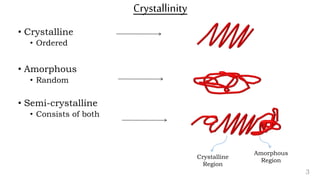
• One of the significant characteristics of polymers is crystallinity,
or the degree of structural order in a polymer.
• When the macromolecular chains of a polymer sample are
arranged in an orderly fashion, it is known as a crystalline
polymer.
• When the chains are not arranged in ordered crystals and are
disordered, even though they are in solid state, the polymer is
identified as amorphous.
• In most cases, there are no fully crystalline polymers; therefore,
we have semi-crystalline polymers, which are composed of both
amorphous and crystalline regions. This is why the same sample
of a polymer can have both a glass transition temperature and a
melting temperature.
2
3
• Crystalline
• Ordered
• Amorphous
• Random
• Semi-crystalline
• Consists of both
Crystallinity
Crystalline
Region
Amorphous
Region
Glass TransitionTemperature
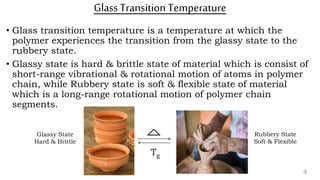
• Glass transition temperature is a temperature at which the
polymer experiences the transition from the glassy state to the
rubbery state.
• Glassy state is hard & brittle state of material which is consist of
short-range vibrational & rotational motion of atoms in polymer
chain, while Rubbery state is soft & flexible state of material
which is a long-range rotational motion of polymer chain
segments.
4
Glassy State
Hard & Brittle
Rubbery State
Soft & Flexible
Tg
• Some polymers are used above their glass transition
temperature, and some are used below.
• Hard plastics like polystyrene and poly methyl
methacrylate are used below their glass transition
temperature; that is in their glassy state. Their Tg’s are
well above room temperature.
• Elastomers like polyisoprene and polyisobutylene are
used above their Tg’s, that is in the rubbery state, where
they are soft & flexible.
5
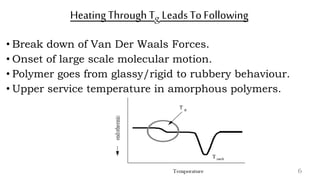
HeatingThrough Tg Leads ToFollowing
• Break down of Van Der Waals Forces.
• Onset of large scale molecular motion.
• Polymer goes from glassy/rigid to rubbery behaviour.
• Upper service temperature in amorphous polymers.
6
Free VolumeTheory
• One of the most useful approaches to analysing the glass
transition temperature of polymer is to use the concept of Free
Volume.
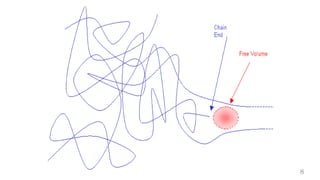
• The free volume is the space in a solid or liquid sample that is not
occupied by molecules, that is the ‘empty space’ between
molecules.
• Free volume is high in liquid state than solid, so molecular motion
is able to take place relatively easy because the unoccupied
volume allows the molecules to move.
• The theory was originally developed for amorphous polymers and
the glass-transition in those polymers.
7
8
• But semi-crystalline polymers also consist of
amorphous regions, so this theory can
also be applied to semi-crystalline polymers.
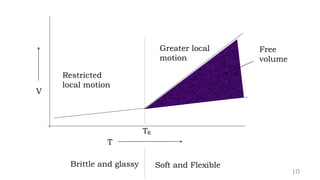
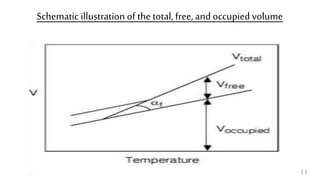
• An amorphous polymer can be considered to be made
up of occupied volume and free volume. As the
temperature is changed, the free volume and the
occupied volume both will change.
• As the temperature of the melt is lowered, the free
volume will be reduced until eventually there will not be
enough free volume to allow molecular motion or
transition to take place.
9
10
T
V
Tg
Restricted
local motion
Greater local
motion
Free
volume
Brittle and glassy Soft and Flexible
Schematic illustration of the total, free, andoccupiedvolume
11
12
• The total sample volume V therefore consists of volume occupied by
molecules V0 and free volume Vf such that
V= Vf +Vo
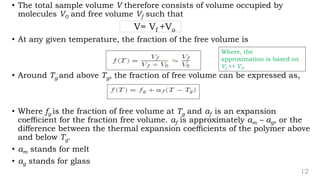
• At any given temperature, the fraction of the free volume is
• Around Tg and above Tg, the fraction of free volume can be expressed as,
• Where fg is the fraction of free volume at Tg and αf is an expansion
coefficient for the fraction free volume. αf is approximately αm – αg, or the
difference between the thermal expansion coefficients of the polymer above
and below Tg.
• αm stands for melt
• αg stands for glass
Where, the
approximation is based on
Vf << V0.
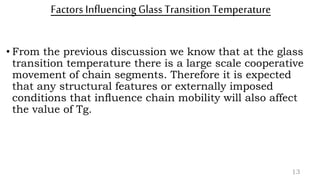
Factors InfluencingGlass TransitionTemperature
• From the previous discussion we know that at the glass
transition temperature there is a large scale cooperative
movement of chain segments. Therefore it is expected
that any structural features or externally imposed
conditions that influence chain mobility will also affect
the value of Tg.
13
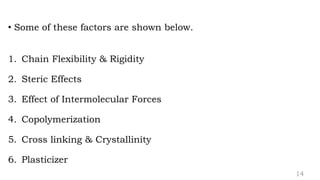
• Some of these factors are shown below.
1. Chain Flexibility & Rigidity
2. Steric Effects
3. Effect of Intermolecular Forces
4. Copolymerization
5. Cross linking & Crystallinity
6. Plasticizer
14
1. ChainFlexibility& Rigidity
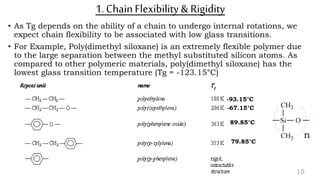
• As Tg depends on the ability of a chain to undergo internal rotations, we
expect chain flexibility to be associated with low glass transitions.
• For Example, Poly(dimethyl siloxane) is an extremely flexible polymer due
to the large separation between the methyl substituted silicon atoms. As
compared to other polymeric materials, poly(dimethyl siloxane) has the
lowest glass transition temperature (Tg = -123.15°C)
15
-93.15°C
-67.15°C
89.85°C
79.85°C
n
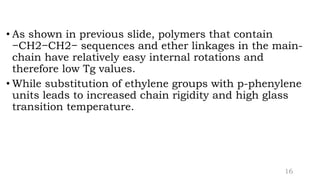
• As shown in previous slide, polymers that contain
−CH2−CH2− sequences and ether linkages in the main-
chain have relatively easy internal rotations and
therefore low Tg values.
• While substitution of ethylene groups with p-phenylene
units leads to increased chain rigidity and high glass
transition temperature.
16
2. StericEffects
• The presence of bulky side groups hinders rotation of the
backbone atoms due to steric hindrance, and therefore results in
an increase in Tg. The magnitude of this effect depends on the
size of the side groups.
• This is illustrated in the following Table for vinyl polymers
having the general structure,
—[CH2 — CHX ]—
17
-93.15°C
-20.15°C
99.85°C
134.85°C
3. Effect of Intermolecular Forces
• The presence of polar side groups leads to strong intermolecular
attractive interactions between chains which hinders molecular
motion thus causing an increase in Glass transition
temperature.
• This effect is illustrated in the following table for the polymers of
type −[CH2−CHX ]−
18
-20.15°C
80.85°C
84.85°C
4. Copolymerization
• It is possible to alter the glass transition of a homo polymer by
copolymerisation with a second monomer. If the two homo polymers
prepared from the monomers have different Tgs, then it is reasonable to
expect that their random copolymer should have a glass transition which
is intermediate between the Tgs of the homo polymers. This is observed
experimentally.
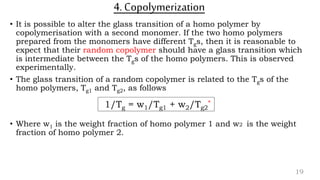
• The glass transition of a random copolymer is related to the Tgs of the
homo polymers, Tg1 and Tg2, as follows
• Where w1 is the weight fraction of homo polymer 1 and w2 is the weight
fraction of homo polymer 2.
19
1/Tg = w1/Tg1 + w2/Tg2
*
5. Cross-linking& Crystallinity
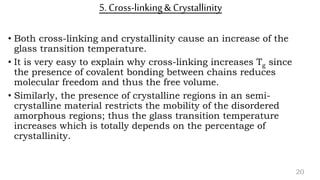
• Both cross-linking and crystallinity cause an increase of the
glass transition temperature.
• It is very easy to explain why cross-linking increases Tg since
the presence of covalent bonding between chains reduces
molecular freedom and thus the free volume.
• Similarly, the presence of crystalline regions in an semi-
crystalline material restricts the mobility of the disordered
amorphous regions; thus the glass transition temperature
increases which is totally depends on the percentage of
crystallinity.
20
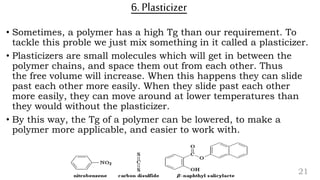
6. Plasticizer
• Sometimes, a polymer has a high Tg than our requirement. To
tackle this proble we just mix something in it called a plasticizer.
• Plasticizers are small molecules which will get in between the
polymer chains, and space them out from each other. Thus
the free volume will increase. When this happens they can slide
past each other more easily. When they slide past each other
more easily, they can move around at lower temperatures than
they would without the plasticizer.
• By this way, the Tg of a polymer can be lowered, to make a
polymer more applicable, and easier to work with.
21
Sources
• Practical Polymer Analysis By T.R. Crompton (595-629)
• Polymer Chemistry - The Basic Concepts By Paul C.
Hiemenz (199)
• Polymer Physics By ULF W. Gedde (77-95)
• Text Book Of Polymer Science By Fred W. Billmeyer (320)
• Polymer Science By V.R. Gowariker (113-130)
22

Glass transition temperature (tg)

  • 1.
    Glass Transition Temperature (Tg) Presentedby Devansh Gupta M.Sc Polymer Science Semester 2
  • 2.
    Contents • Brief InformationAbout Crystallinity •Glass Transition Temperature (Tg) • Free Volume Theory For Tg • Factors Influencing Glass Transition Temperature (Tg) • Sources 1
  • 3.
    Crystallinity • One ofthe significant characteristics of polymers is crystallinity, or the degree of structural order in a polymer. • When the macromolecular chains of a polymer sample are arranged in an orderly fashion, it is known as a crystalline polymer. • When the chains are not arranged in ordered crystals and are disordered, even though they are in solid state, the polymer is identified as amorphous. • In most cases, there are no fully crystalline polymers; therefore, we have semi-crystalline polymers, which are composed of both amorphous and crystalline regions. This is why the same sample of a polymer can have both a glass transition temperature and a melting temperature. 2
  • 4.
    3 • Crystalline • Ordered •Amorphous • Random • Semi-crystalline • Consists of both Crystallinity Crystalline Region Amorphous Region
  • 5.
    Glass TransitionTemperature • Glasstransition temperature is a temperature at which the polymer experiences the transition from the glassy state to the rubbery state. • Glassy state is hard & brittle state of material which is consist of short-range vibrational & rotational motion of atoms in polymer chain, while Rubbery state is soft & flexible state of material which is a long-range rotational motion of polymer chain segments. 4 Glassy State Hard & Brittle Rubbery State Soft & Flexible Tg
  • 6.
    • Some polymersare used above their glass transition temperature, and some are used below. • Hard plastics like polystyrene and poly methyl methacrylate are used below their glass transition temperature; that is in their glassy state. Their Tg’s are well above room temperature. • Elastomers like polyisoprene and polyisobutylene are used above their Tg’s, that is in the rubbery state, where they are soft & flexible. 5
  • 7.
    HeatingThrough Tg LeadsToFollowing • Break down of Van Der Waals Forces. • Onset of large scale molecular motion. • Polymer goes from glassy/rigid to rubbery behaviour. • Upper service temperature in amorphous polymers. 6
  • 8.
    Free VolumeTheory • Oneof the most useful approaches to analysing the glass transition temperature of polymer is to use the concept of Free Volume. • The free volume is the space in a solid or liquid sample that is not occupied by molecules, that is the ‘empty space’ between molecules. • Free volume is high in liquid state than solid, so molecular motion is able to take place relatively easy because the unoccupied volume allows the molecules to move. • The theory was originally developed for amorphous polymers and the glass-transition in those polymers. 7
  • 9.
  • 10.
    • But semi-crystallinepolymers also consist of amorphous regions, so this theory can also be applied to semi-crystalline polymers. • An amorphous polymer can be considered to be made up of occupied volume and free volume. As the temperature is changed, the free volume and the occupied volume both will change. • As the temperature of the melt is lowered, the free volume will be reduced until eventually there will not be enough free volume to allow molecular motion or transition to take place. 9
  • 11.
  • 12.
    Schematic illustration ofthe total, free, andoccupiedvolume 11
  • 13.
    12 • The totalsample volume V therefore consists of volume occupied by molecules V0 and free volume Vf such that V= Vf +Vo • At any given temperature, the fraction of the free volume is • Around Tg and above Tg, the fraction of free volume can be expressed as, • Where fg is the fraction of free volume at Tg and αf is an expansion coefficient for the fraction free volume. αf is approximately αm – αg, or the difference between the thermal expansion coefficients of the polymer above and below Tg. • αm stands for melt • αg stands for glass Where, the approximation is based on Vf << V0.
  • 14.
    Factors InfluencingGlass TransitionTemperature •From the previous discussion we know that at the glass transition temperature there is a large scale cooperative movement of chain segments. Therefore it is expected that any structural features or externally imposed conditions that influence chain mobility will also affect the value of Tg. 13
  • 15.
    • Some ofthese factors are shown below. 1. Chain Flexibility & Rigidity 2. Steric Effects 3. Effect of Intermolecular Forces 4. Copolymerization 5. Cross linking & Crystallinity 6. Plasticizer 14
  • 16.
    1. ChainFlexibility& Rigidity •As Tg depends on the ability of a chain to undergo internal rotations, we expect chain flexibility to be associated with low glass transitions. • For Example, Poly(dimethyl siloxane) is an extremely flexible polymer due to the large separation between the methyl substituted silicon atoms. As compared to other polymeric materials, poly(dimethyl siloxane) has the lowest glass transition temperature (Tg = -123.15°C) 15 -93.15°C -67.15°C 89.85°C 79.85°C n
  • 17.
    • As shownin previous slide, polymers that contain −CH2−CH2− sequences and ether linkages in the main- chain have relatively easy internal rotations and therefore low Tg values. • While substitution of ethylene groups with p-phenylene units leads to increased chain rigidity and high glass transition temperature. 16
  • 18.
    2. StericEffects • Thepresence of bulky side groups hinders rotation of the backbone atoms due to steric hindrance, and therefore results in an increase in Tg. The magnitude of this effect depends on the size of the side groups. • This is illustrated in the following Table for vinyl polymers having the general structure, —[CH2 — CHX ]— 17 -93.15°C -20.15°C 99.85°C 134.85°C
  • 19.
    3. Effect ofIntermolecular Forces • The presence of polar side groups leads to strong intermolecular attractive interactions between chains which hinders molecular motion thus causing an increase in Glass transition temperature. • This effect is illustrated in the following table for the polymers of type −[CH2−CHX ]− 18 -20.15°C 80.85°C 84.85°C
  • 20.
    4. Copolymerization • Itis possible to alter the glass transition of a homo polymer by copolymerisation with a second monomer. If the two homo polymers prepared from the monomers have different Tgs, then it is reasonable to expect that their random copolymer should have a glass transition which is intermediate between the Tgs of the homo polymers. This is observed experimentally. • The glass transition of a random copolymer is related to the Tgs of the homo polymers, Tg1 and Tg2, as follows • Where w1 is the weight fraction of homo polymer 1 and w2 is the weight fraction of homo polymer 2. 19 1/Tg = w1/Tg1 + w2/Tg2 *
  • 21.
    5. Cross-linking& Crystallinity •Both cross-linking and crystallinity cause an increase of the glass transition temperature. • It is very easy to explain why cross-linking increases Tg since the presence of covalent bonding between chains reduces molecular freedom and thus the free volume. • Similarly, the presence of crystalline regions in an semi- crystalline material restricts the mobility of the disordered amorphous regions; thus the glass transition temperature increases which is totally depends on the percentage of crystallinity. 20
  • 22.
    6. Plasticizer • Sometimes,a polymer has a high Tg than our requirement. To tackle this proble we just mix something in it called a plasticizer. • Plasticizers are small molecules which will get in between the polymer chains, and space them out from each other. Thus the free volume will increase. When this happens they can slide past each other more easily. When they slide past each other more easily, they can move around at lower temperatures than they would without the plasticizer. • By this way, the Tg of a polymer can be lowered, to make a polymer more applicable, and easier to work with. 21
  • 23.
    Sources • Practical PolymerAnalysis By T.R. Crompton (595-629) • Polymer Chemistry - The Basic Concepts By Paul C. Hiemenz (199) • Polymer Physics By ULF W. Gedde (77-95) • Text Book Of Polymer Science By Fred W. Billmeyer (320) • Polymer Science By V.R. Gowariker (113-130) 22