Abu jafar md. Sadek
ID:151-23-187
 polymer
 Polymer degradation
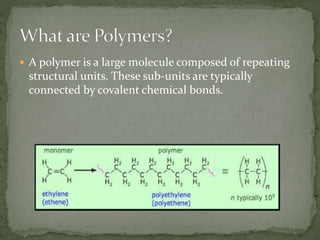
 A polymer is a large molecule composed of repeating
structural units. These sub-units are typically
connected by covalent chemical bonds.
 Synthetic rubber
 Bakelite
 Neoprene
 Nylon
 PVC
 Polystyrene
 Polymer degradation is a change in the properties
tensile strength, colour, shape, etc.
 Polymer-based product under the influence of one or
more environmental factors such as heat, light or
chemicals such as acids, alkalis and some salts. These
changes are usually undesirable, such as cracking and
chemical disintegration of products.
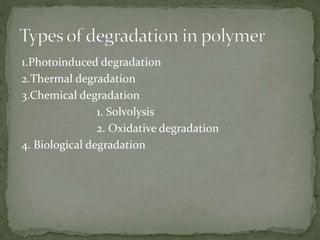
1.Photoinduced degradation
2.Thermal degradation
3.Chemical degradation
1. Solvolysis
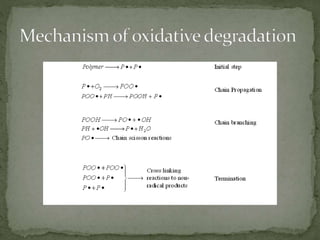
2. Oxidative degradation
4. Biological degradation
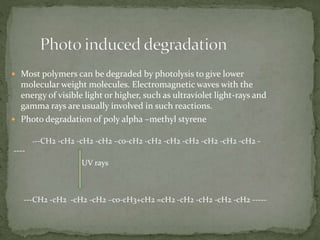
 Most polymers can be degraded by photolysis to give lower
molecular weight molecules. Electromagnetic waves with the
energy of visible light or higher, such as ultraviolet light-rays and
gamma rays are usually involved in such reactions.
 Photo degradation of poly alpha –methyl styrene
---CH2 -cH2 -cH2 -cH2 –co-cH2 -cH2 -cH2 -cH2 -cH2 -cH2 -cH2 -
----
UV rays
---CH2 -cH2 -cH2 -cH2 –co-cH3+cH2 =cH2 -cH2 -cH2 -cH2 -cH2 -----
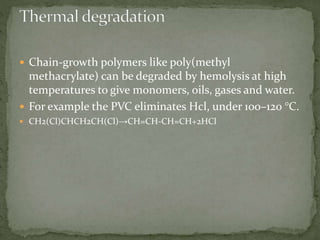
 Chain-growth polymers like poly(methyl
methacrylate) can be degraded by hemolysis at high
temperatures to give monomers, oils, gases and water.
 For example the PVC eliminates Hcl, under 100–120 °C.
 CH2(Cl)CHCH2CH(Cl)→CH=CH-CH=CH+2HCl
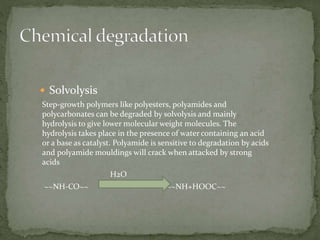
 Solvolysis
Step-growth polymers like polyesters, polyamides and
polycarbonates can be degraded by solvolysis and mainly
hydrolysis to give lower molecular weight molecules. The
hydrolysis takes place in the presence of water containing an acid
or a base as catalyst. Polyamide is sensitive to degradation by acids
and polyamide mouldings will crack when attacked by strong
acids
H2O
~~NH-CO~~ ~~~NH+HOOC~~
 This degradation usally leads hardening,discolaration
as well as surface change .the degree of oxidative
degradation of the polymer depends on its structure.
Thus unstructured polymer such as polyisoperene or
polybutadiene containing double bonds are easily
attacted by oxygen.
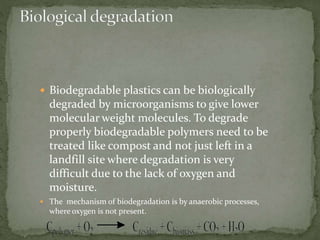
 Biodegradable plastics can be biologically
degraded by microorganisms to give lower
molecular weight molecules. To degrade
properly biodegradable polymers need to be
treated like compost and not just left in a
landfill site where degradation is very
difficult due to the lack of oxygen and
moisture.
 The mechanism of biodegradation is by anaerobic processes,
where oxygen is not present.
 Biodegradable polymers are of significant interest to a
variety of fields including medicine, agriculture, and
packaging. One of the most active areas of research in
biodegradable polymer is in controlled drug delivery
and release

Polymer degradation

  • 1.
    Abu jafar md.Sadek ID:151-23-187
  • 2.
  • 3.
     A polymeris a large molecule composed of repeating structural units. These sub-units are typically connected by covalent chemical bonds.
  • 4.
     Synthetic rubber Bakelite  Neoprene  Nylon  PVC  Polystyrene
  • 5.
     Polymer degradationis a change in the properties tensile strength, colour, shape, etc.  Polymer-based product under the influence of one or more environmental factors such as heat, light or chemicals such as acids, alkalis and some salts. These changes are usually undesirable, such as cracking and chemical disintegration of products.
  • 6.
    1.Photoinduced degradation 2.Thermal degradation 3.Chemicaldegradation 1. Solvolysis 2. Oxidative degradation 4. Biological degradation
  • 7.
     Most polymerscan be degraded by photolysis to give lower molecular weight molecules. Electromagnetic waves with the energy of visible light or higher, such as ultraviolet light-rays and gamma rays are usually involved in such reactions.  Photo degradation of poly alpha –methyl styrene ---CH2 -cH2 -cH2 -cH2 –co-cH2 -cH2 -cH2 -cH2 -cH2 -cH2 -cH2 - ---- UV rays ---CH2 -cH2 -cH2 -cH2 –co-cH3+cH2 =cH2 -cH2 -cH2 -cH2 -cH2 -----
  • 8.
     Chain-growth polymerslike poly(methyl methacrylate) can be degraded by hemolysis at high temperatures to give monomers, oils, gases and water.  For example the PVC eliminates Hcl, under 100–120 °C.  CH2(Cl)CHCH2CH(Cl)→CH=CH-CH=CH+2HCl
  • 9.
     Solvolysis Step-growth polymerslike polyesters, polyamides and polycarbonates can be degraded by solvolysis and mainly hydrolysis to give lower molecular weight molecules. The hydrolysis takes place in the presence of water containing an acid or a base as catalyst. Polyamide is sensitive to degradation by acids and polyamide mouldings will crack when attacked by strong acids H2O ~~NH-CO~~ ~~~NH+HOOC~~
  • 10.
     This degradationusally leads hardening,discolaration as well as surface change .the degree of oxidative degradation of the polymer depends on its structure. Thus unstructured polymer such as polyisoperene or polybutadiene containing double bonds are easily attacted by oxygen.
  • 12.
     Biodegradable plasticscan be biologically degraded by microorganisms to give lower molecular weight molecules. To degrade properly biodegradable polymers need to be treated like compost and not just left in a landfill site where degradation is very difficult due to the lack of oxygen and moisture.  The mechanism of biodegradation is by anaerobic processes, where oxygen is not present.
  • 13.
     Biodegradable polymersare of significant interest to a variety of fields including medicine, agriculture, and packaging. One of the most active areas of research in biodegradable polymer is in controlled drug delivery and release