


Name :- Gohil Devangiba Aniruddhsinh
Roll No. :- 14
Email id :- devangibagohil786@gmail.com
M.A . Semester - 2
Paper No. :- 7 (Literary Theory & Criticism)
Topic :- Archetypal Criticism
Submitted To :- Maharaja Krishnakumarsinhji
Bhavnagar University
Historical
Background
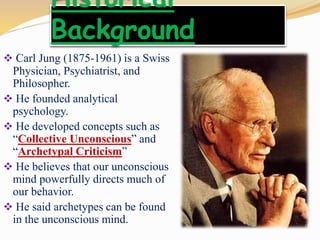
 Carl Jung (1875-1961) is a Swiss
Physician, Psychiatrist, and
Philosopher.
 He founded analytical
psychology.
 He developed concepts such as
“Collective Unconscious” and
“Archetypal Criticism”
 He believes that our unconscious
mind powerfully directs much of
our behavior.
 He said archetypes can be found
in the unconscious mind.
 The analysis of a piece of literature through the examination
of archetypal patterns.
 Archetypes are patterns that are shared across different
cultures as countless forms buried deep in our collective
unconscious.
 The study of archetypes in literatures is known as archetypal
criticism or mythical criticism. Archetypes are also called
universal symbols.
 Archetypes have originated in the unchanging situations of
human beings, such as the rotating seasons or the mysteries
of death, they are not intentionally created or culturally
acquired. Instead, they come to us instinctively as impulses
and knowledge hidden somewhere in our biological
psychologically, and social natures.
Key
Terms
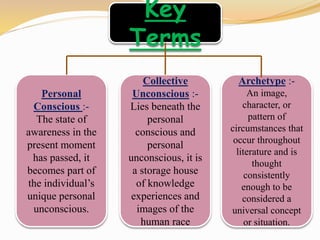
Personal
Conscious :-
The state of
awareness in the
present moment
has passed, it
becomes part of
the individual’s
unique personal
unconscious.
Collective
Unconscious :-
Lies beneath the
personal
conscious and
personal
unconscious, it is
a storage house
of knowledge
experiences and
images of the
human race
Archetype :-
An image,
character, or
pattern of
circumstances that
occur throughout
literature and is
thought
consistently
enough to be
considered a
universal concept
or situation.
What to look for in the
work of Literature
Characters :-
 The hero becomes a leader
after many trials; a champion
 Devil figure-evil, opposes
hero, offers fame or success
in exchange for the hero’s
soul
 mentor - a role model,
guidance, knowledge
 mother - caring, nurturing
 father – powerful, judgment,
the guardian.
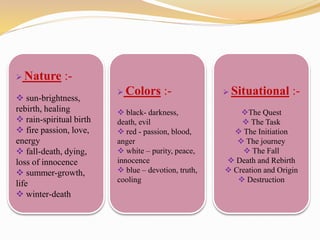
 Nature :-
 sun-brightness,
rebirth, healing
 rain-spiritual birth
 fire passion, love,
energy
 fall-death, dying,
loss of innocence
 summer-growth,
life
 winter-death
 Colors :-
 black- darkness,
death, evil
 red - passion, blood,
anger
 white – purity, peace,
innocence
 blue – devotion, truth,
cooling
 Situational :-
The Quest
 The Task
 The Initiation
 The journey
 The Fall
 Death and Rebirth
 Creation and Origin
 Destruction
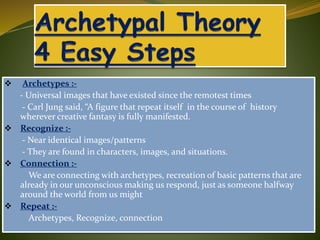
 Archetypes :-
- Universal images that have existed since the remotest times
- Carl Jung said, “A figure that repeat itself in the course of history
wherever creative fantasy is fully manifested.
 Recognize :-
- Near identical images/patterns
- They are found in characters, images, and situations.
 Connection :-
We are connecting with archetypes, recreation of basic patterns that are
already in our unconscious making us respond, just as someone halfway
around the world from us might
 Repeat :-
Archetypes, Recognize, connection
The Hero’s Journey
Archetype
Archetypal criticism

Archetypal criticism

  • 1.
    Name :- GohilDevangiba Aniruddhsinh Roll No. :- 14 Email id :- devangibagohil786@gmail.com M.A . Semester - 2 Paper No. :- 7 (Literary Theory & Criticism) Topic :- Archetypal Criticism Submitted To :- Maharaja Krishnakumarsinhji Bhavnagar University
  • 2.
    Historical Background  Carl Jung(1875-1961) is a Swiss Physician, Psychiatrist, and Philosopher.  He founded analytical psychology.  He developed concepts such as “Collective Unconscious” and “Archetypal Criticism”  He believes that our unconscious mind powerfully directs much of our behavior.  He said archetypes can be found in the unconscious mind.
  • 3.
     The analysisof a piece of literature through the examination of archetypal patterns.  Archetypes are patterns that are shared across different cultures as countless forms buried deep in our collective unconscious.  The study of archetypes in literatures is known as archetypal criticism or mythical criticism. Archetypes are also called universal symbols.  Archetypes have originated in the unchanging situations of human beings, such as the rotating seasons or the mysteries of death, they are not intentionally created or culturally acquired. Instead, they come to us instinctively as impulses and knowledge hidden somewhere in our biological psychologically, and social natures.
  • 4.
    Key Terms Personal Conscious :- The stateof awareness in the present moment has passed, it becomes part of the individual’s unique personal unconscious. Collective Unconscious :- Lies beneath the personal conscious and personal unconscious, it is a storage house of knowledge experiences and images of the human race Archetype :- An image, character, or pattern of circumstances that occur throughout literature and is thought consistently enough to be considered a universal concept or situation.
  • 6.
    What to lookfor in the work of Literature Characters :-  The hero becomes a leader after many trials; a champion  Devil figure-evil, opposes hero, offers fame or success in exchange for the hero’s soul  mentor - a role model, guidance, knowledge  mother - caring, nurturing  father – powerful, judgment, the guardian.
  • 7.
     Nature :- sun-brightness, rebirth, healing  rain-spiritual birth  fire passion, love, energy  fall-death, dying, loss of innocence  summer-growth, life  winter-death  Colors :-  black- darkness, death, evil  red - passion, blood, anger  white – purity, peace, innocence  blue – devotion, truth, cooling  Situational :- The Quest  The Task  The Initiation  The journey  The Fall  Death and Rebirth  Creation and Origin  Destruction
  • 8.
     Archetypes :- -Universal images that have existed since the remotest times - Carl Jung said, “A figure that repeat itself in the course of history wherever creative fantasy is fully manifested.  Recognize :- - Near identical images/patterns - They are found in characters, images, and situations.  Connection :- We are connecting with archetypes, recreation of basic patterns that are already in our unconscious making us respond, just as someone halfway around the world from us might  Repeat :- Archetypes, Recognize, connection
  • 9.