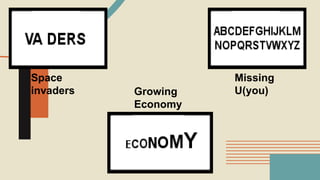
Space
invaders Growing
Economy
Missing
U(you)
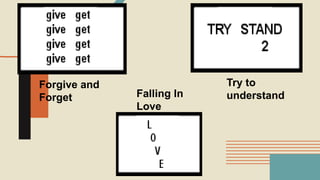
Forgive and
Forget
Try to
understand
Falling In
Love
MYTHOLOGICAL/
ARCHETYPAL
LITERARY THEORY
DISCUSSANT: RENZZELLE
JOY B. BUEN
Mythological criticism
-the combination of anthropology, psychology,
history, and comparative religion.
Mythological criticism explores how the
imagination uses myths, symbols to different
cultures and epochs
-central concept in mythological criticism is
an archetype that analyses symbols and
characters to find a deeper meaning
One key concept in mythological criticism is
the archetype, “a symbol, character, situation,
or image that evokes a deep universal
response,” which entered literary criticism
from Swiss psychologist (Kennedy
& Gioia, 1995).
He believed that all individuals share an
“uncollective thought between all humans
that lies below a person’s unconscious mind”
(Persad, 2012).
Carl Jung
Freud formulated many theories around
the idea of the social archetype, and his
pupil, Carl Jung, expanded and refined
Freud’s theories into a more cross-
cultural philosophy. However, Northrop
Frye defined archetypes as “a symbol,
usually an image, which recurs often
enough in literature to be recognizable
as an element of one’s literary
experience as a whole.”
Carl Jung’s ideas:
■Critics who examine texts from a mythological/archetypal
standpoint are looking for symbols. Jung said that an
archetype is “a figure…that repeats itself in the course of
history wherever creative fantasy is fully manifested.”
■Mythological critics tend to view literary works in the broader
context of works sharing a similar pattern. Further, the
mythological critics view literature as a gateway to reveal
human desires, fears, and expectations.
For example: The Dove means Peace, a Rose means Love.
Through these objects, we can express our emotions.
■The evidence of this, Jung claimed, lay in the fact
that some myths are repeated throughout history in
cultures and eras that could not possibly have had
any contact with one another.
■Most of the myths and symbols represent ideas that
human beings could not otherwise explain (the
origins of life, what happens after death, etc.).
HOW TO USE THE
MYTHOLOGICAL/ARCHET
YPAL APPROACH
1. Archetypal Characters.
■The Hero - The archetypal hero appears in all religions,
mythologies, and epics of the world. He is an
expression of our personal and collective unconscious,
as theorized by Carl Jung and Joseph Campbell (Davis,
2007). Characteristics are:
(a)unusual circumstances of birth
(b)sometimes in danger or born into royalty
(c)leaves family or land and lives with others
(d)an event, sometimes traumatic, leads to adventure or
quest,
(e)hero has a special weapon only he can wield, and
others.
■The Villain - A villain is the bad guy, the one who comes up
with diabolical plots to somehow cause harm or ruin. The
villain may truly believe that he/she is helping society, but
causes harm in the process (Literary Terms, 2015). Types of
villains are: Traitor, Patriarch/Matriarch, Tyrant, Outcast,
Devil, Evil Genius, Schemer, Lunatic, and Fanatic.
■The Temptress – The key ingredient to any Temptress is
allure. In most cases that allure comes from beauty, but it is
beauty with an additive – something that draws men (the
metaphorical Siren song). It may be wit, sensuality,
intelligence, or something undefinable, at least to the
hero( (Kelly, 2020).
■The Scapegoat – a character who is blamed for
everything that goes wrong, and must ultimately
be sacrificed or driven away (Literary Terms,
2015).
■The Loner/Outcast – They are mentally insecure
and troubled. The outcast carries a sense on not
belonging, often displaying feelings of confusion
and loneliness (Fisher, 2020).
■The Underdog- According to Pereira (2019),
underdog is a relatable character with a deep
desire to change something in themselves or in
the world around them.
■The Damsel in Distress - A damsel refers to a
young woman, and a damsel in distress is almost
always a woman who is physically attractive; this
is of course what sparks the interest of her savior.
A Damsel is always helpless and in need of
rescuing ( (dsegal900, 2020).
2. Archetypal Images
■Colours
■Numbers
■Water
■Fire
■Gardens
■Celestial Bodies
■Caves
3. Archetypal Situations
■The Quest
■The Renewal of Life
■Initiation
■The Fall
■Redemptive Sacrifice
■The End of the World
■The Banquet
AN ANALYSIS OF
OEDIPUS REX
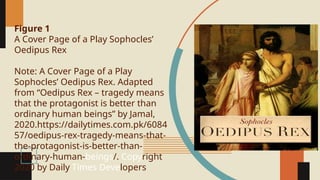
Figure 1
A Cover Page of a Play Sophocles’
Oedipus Rex
Note: A Cover Page of a Play
Sophocles’ Oedipus Rex. Adapted
from “Oedipus Rex – tragedy means
that the protagonist is better than
ordinary human beings” by Jamal,
2020.https://dailytimes.com.pk/6084
57/oedipus-rex-tragedy-means-that-
the-protagonist-is-better-than-
ordinary-human-beings/. Copyright
2020 by Daily Times Developers
According to Northrop Frye’s Anatomy (Landa, 2018),
the idea that characterization is a metaphor of all
human desire – manifested in the Great Chain of
Being: divine, human, animal, vegetable, and mineral.
We can analyze the archetypal plot of Oedipus – a
tragic downfall:
■Born into nobility
■Tries to escape his fate
■Has a rage problem
■Becomes idolized by saving Thebes
■His fate catches up to him
Oedipus Rex Vs The Waterboy
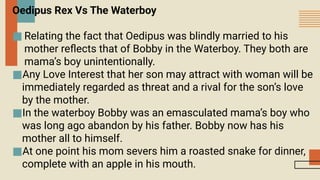
■ Relating the fact that Oedipus was blindly married to his
mother reflects that of Bobby in the Waterboy. They both are
mama’s boy unintentionally.
■Any Love Interest that her son may attract with woman will be
immediately regarded as threat and a rival for the son’s love
by the mother.
■In the waterboy Bobby was an emasculated mama’s boy who
was long ago abandon by his father. Bobby now has his
mother all to himself.
■At one point his mom severs him a roasted snake for dinner,
complete with an apple in his mouth.
Note: The
Waterboy (1998).
Adapted from “No
apologies: The
Waterboy” by
DiCristino,2017.
http://www.fthismo
vie.net/2017/07/n
o-apologies -
waterboy.html.
Copyright 2020 by
This Movie!.
Awesome Inc.
Mythological Criticism
pertaining to Oedipus
Rex
Carl Jung’s archetypal theory towards
the bridge of mythology and the human
psycho-development were an extensive
and critical aspect to functioning society.
These archetypes can be seen throughout
ancient, medieval and modern literature as
they are based on the observations from
different cultures, countries, and thoughts
commonly shared amongst humans.
Jung explained these archetypes to be,
“identical psychic structures common to all,
which together constitute the archaic heritage of
humanity” (Landa, 2018). The believed these
archetypes are summoned to what is called the
collective unconscious.
2 Proponents of Archetypal
Literary Theory
■Carl Gustav Jung- patterns are embedded deep in the
collective unconscious and involve racial memories, situations
and events.
Collective unconscious- primal memories common to
human race , existing below each person’s conscious mind.
■Northrup Fry, a Canadian scholar who proposed the idea that
the main appeal of literature was or is its connection to
primitive story formulas. He claimed that literature is a kind of
displaced mythology that constantly reverts to the same
patterns that we see in ancient myths.
FLIP ME FIRST!!
Activity:

ARCHETYPAL. MYTHOLOGY AND FOLKLOREEEEEEE

  • 2.
  • 3.
  • 4.
  • 5.
    Mythological criticism -the combinationof anthropology, psychology, history, and comparative religion. Mythological criticism explores how the imagination uses myths, symbols to different cultures and epochs -central concept in mythological criticism is an archetype that analyses symbols and characters to find a deeper meaning
  • 6.
    One key conceptin mythological criticism is the archetype, “a symbol, character, situation, or image that evokes a deep universal response,” which entered literary criticism from Swiss psychologist (Kennedy & Gioia, 1995). He believed that all individuals share an “uncollective thought between all humans that lies below a person’s unconscious mind” (Persad, 2012). Carl Jung
  • 7.
    Freud formulated manytheories around the idea of the social archetype, and his pupil, Carl Jung, expanded and refined Freud’s theories into a more cross- cultural philosophy. However, Northrop Frye defined archetypes as “a symbol, usually an image, which recurs often enough in literature to be recognizable as an element of one’s literary experience as a whole.”
  • 8.
    Carl Jung’s ideas: ■Criticswho examine texts from a mythological/archetypal standpoint are looking for symbols. Jung said that an archetype is “a figure…that repeats itself in the course of history wherever creative fantasy is fully manifested.” ■Mythological critics tend to view literary works in the broader context of works sharing a similar pattern. Further, the mythological critics view literature as a gateway to reveal human desires, fears, and expectations. For example: The Dove means Peace, a Rose means Love. Through these objects, we can express our emotions.
  • 9.
    ■The evidence ofthis, Jung claimed, lay in the fact that some myths are repeated throughout history in cultures and eras that could not possibly have had any contact with one another. ■Most of the myths and symbols represent ideas that human beings could not otherwise explain (the origins of life, what happens after death, etc.).
  • 10.
    HOW TO USETHE MYTHOLOGICAL/ARCHET YPAL APPROACH
  • 11.
    1. Archetypal Characters. ■TheHero - The archetypal hero appears in all religions, mythologies, and epics of the world. He is an expression of our personal and collective unconscious, as theorized by Carl Jung and Joseph Campbell (Davis, 2007). Characteristics are: (a)unusual circumstances of birth (b)sometimes in danger or born into royalty (c)leaves family or land and lives with others (d)an event, sometimes traumatic, leads to adventure or quest, (e)hero has a special weapon only he can wield, and others.
  • 12.
    ■The Villain -A villain is the bad guy, the one who comes up with diabolical plots to somehow cause harm or ruin. The villain may truly believe that he/she is helping society, but causes harm in the process (Literary Terms, 2015). Types of villains are: Traitor, Patriarch/Matriarch, Tyrant, Outcast, Devil, Evil Genius, Schemer, Lunatic, and Fanatic. ■The Temptress – The key ingredient to any Temptress is allure. In most cases that allure comes from beauty, but it is beauty with an additive – something that draws men (the metaphorical Siren song). It may be wit, sensuality, intelligence, or something undefinable, at least to the hero( (Kelly, 2020).
  • 13.
    ■The Scapegoat –a character who is blamed for everything that goes wrong, and must ultimately be sacrificed or driven away (Literary Terms, 2015). ■The Loner/Outcast – They are mentally insecure and troubled. The outcast carries a sense on not belonging, often displaying feelings of confusion and loneliness (Fisher, 2020).
  • 14.
    ■The Underdog- Accordingto Pereira (2019), underdog is a relatable character with a deep desire to change something in themselves or in the world around them. ■The Damsel in Distress - A damsel refers to a young woman, and a damsel in distress is almost always a woman who is physically attractive; this is of course what sparks the interest of her savior. A Damsel is always helpless and in need of rescuing ( (dsegal900, 2020).
  • 15.
  • 16.
    3. Archetypal Situations ■TheQuest ■The Renewal of Life ■Initiation ■The Fall ■Redemptive Sacrifice ■The End of the World ■The Banquet
  • 17.
  • 18.
    Figure 1 A CoverPage of a Play Sophocles’ Oedipus Rex Note: A Cover Page of a Play Sophocles’ Oedipus Rex. Adapted from “Oedipus Rex – tragedy means that the protagonist is better than ordinary human beings” by Jamal, 2020.https://dailytimes.com.pk/6084 57/oedipus-rex-tragedy-means-that- the-protagonist-is-better-than- ordinary-human-beings/. Copyright 2020 by Daily Times Developers
  • 19.
    According to NorthropFrye’s Anatomy (Landa, 2018), the idea that characterization is a metaphor of all human desire – manifested in the Great Chain of Being: divine, human, animal, vegetable, and mineral. We can analyze the archetypal plot of Oedipus – a tragic downfall: ■Born into nobility ■Tries to escape his fate ■Has a rage problem ■Becomes idolized by saving Thebes ■His fate catches up to him
  • 20.
    Oedipus Rex VsThe Waterboy ■ Relating the fact that Oedipus was blindly married to his mother reflects that of Bobby in the Waterboy. They both are mama’s boy unintentionally. ■Any Love Interest that her son may attract with woman will be immediately regarded as threat and a rival for the son’s love by the mother. ■In the waterboy Bobby was an emasculated mama’s boy who was long ago abandon by his father. Bobby now has his mother all to himself. ■At one point his mom severs him a roasted snake for dinner, complete with an apple in his mouth.
  • 21.
    Note: The Waterboy (1998). Adaptedfrom “No apologies: The Waterboy” by DiCristino,2017. http://www.fthismo vie.net/2017/07/n o-apologies - waterboy.html. Copyright 2020 by This Movie!. Awesome Inc.
  • 22.
  • 23.
    Carl Jung’s archetypaltheory towards the bridge of mythology and the human psycho-development were an extensive and critical aspect to functioning society. These archetypes can be seen throughout ancient, medieval and modern literature as they are based on the observations from different cultures, countries, and thoughts commonly shared amongst humans.
  • 24.
    Jung explained thesearchetypes to be, “identical psychic structures common to all, which together constitute the archaic heritage of humanity” (Landa, 2018). The believed these archetypes are summoned to what is called the collective unconscious.
  • 25.
    2 Proponents ofArchetypal Literary Theory ■Carl Gustav Jung- patterns are embedded deep in the collective unconscious and involve racial memories, situations and events. Collective unconscious- primal memories common to human race , existing below each person’s conscious mind. ■Northrup Fry, a Canadian scholar who proposed the idea that the main appeal of literature was or is its connection to primitive story formulas. He claimed that literature is a kind of displaced mythology that constantly reverts to the same patterns that we see in ancient myths.
  • 26.