University of Hyderabad 
School of Humanities 
Centre for Comparative 
Literature
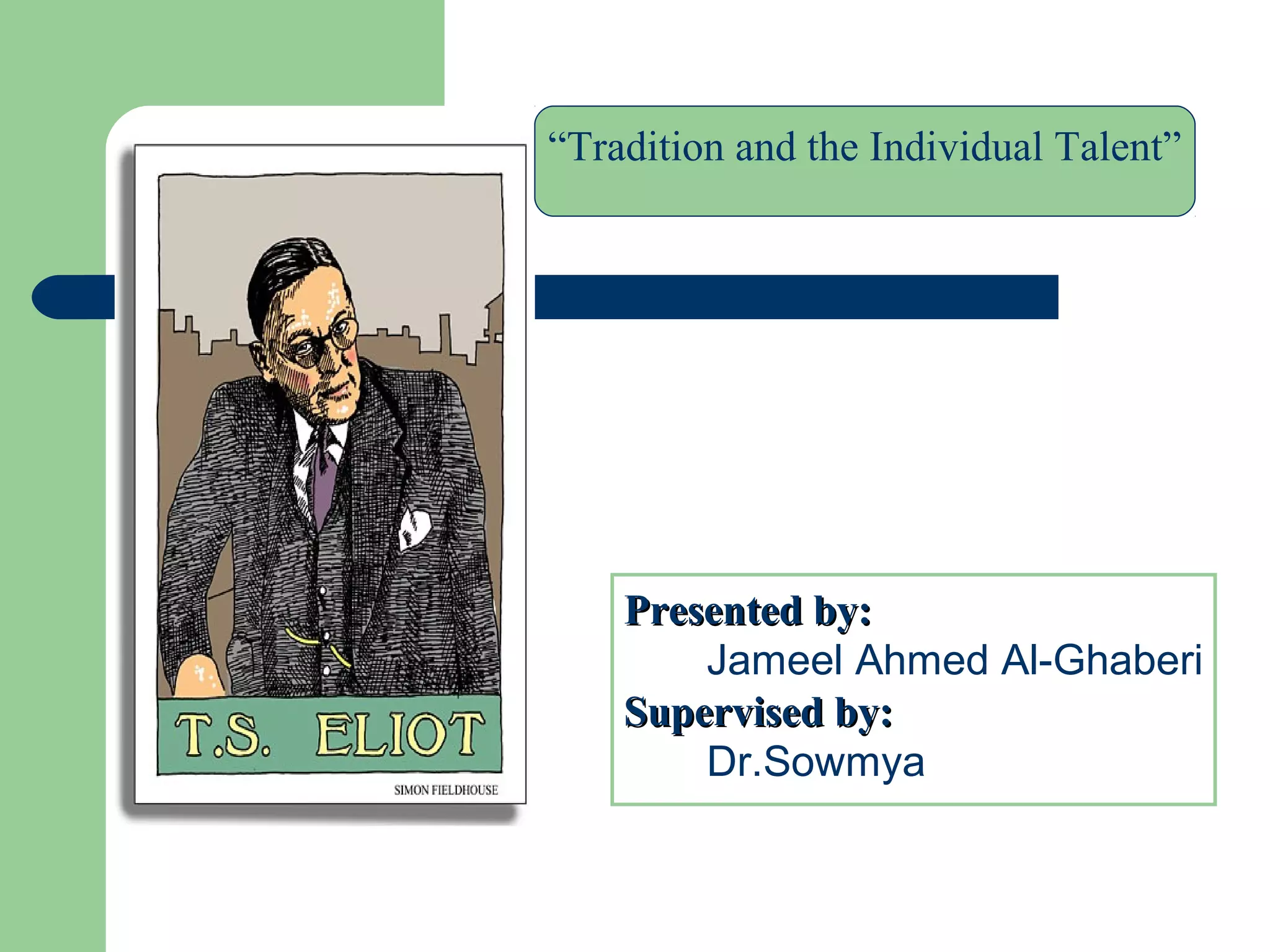
“Tradition and the Individual Talent” 
PPrreesseenntteedd bbyy:: 
Jameel Ahmed Al-Ghaberi 
SSuuppeerrvviisseedd bbyy:: 
Dr.Sowmya
T. S. Eliot 
“Tradition And The Individual Talent” 
 “Tradition and the Individual Talent” is one of 
the more well-known works that Eliot produced 
in his critic capacity. 
 The essay is divided into three parts: 
 Part I:Eliot’s Concept of Tradition 
 Part II:Eliot’s Theory of Impersonality of Poetry 
 PartIII:Summary
Part I:Eliot’s Concept of Tradition 
 The significance of tradition 
1. Tradition doesn’t mean a blind adherence to the 
ways of the previous generation. 
2. Tradition cannot be inherited; it can only be 
obtained by hard labor. 
3. Tradition can only obtained by those who have 
historical sense.
The sense of tradition implies 
 Recognition of the continuity of literature 
 A critical judgment as to which of the writers of 
the past continue to be significant in the 
present. 
 A knowledge of the significant writers obtained 
through painstaking effort.
A dynamic conception of tradition 
 Tradition isn't anything fixed and static; it is constantly 
changing, growing and becoming different from what it 
is. 
When a new work is created, the whole literary 
tradition is modified. 
The relationship between the past and the 
present is not one-sided; it is reciprocal. 
The past directs the present, and is itself 
modified and altered by the present.
The Function of Tradition 
 The work of art of a poet in the present is to be 
compared and contrasted with works of the past… 
 This judgment doesn’t mean “good” or “bad”. 
 The comparison is for knowing the facts about 
the new works of art. 
 The comparison is for the purpose of analysis 
and forming better understanding of the new.
The sense of tradition 
 It doesn’t mean to know the past as a whole without 
any discrimination. 
 The sense of tradition doesn’t mean that the poet 
should know only a few poets whom he admires, a 
particular age, or period which he likes. This is a sign 
of immaturity and inexperience.
Part II: Impersonality of poetry 
(The Extinction of Personality) 
“Honest Criticism and sensitive appreciation is directed not upon the poet but 
upon the poetry.” 
The artist must surrender himself to tradition. 
He must allow his poetic sensibility to be shaped and 
modified by the past. 
His emotions and feeling must be depersonalized; he 
must be as impersonal and objective as a scientist. 
The poet’s personality is merely a medium; as a 
catalytic agent, or a receptacle in which chemical 
reactions take place.
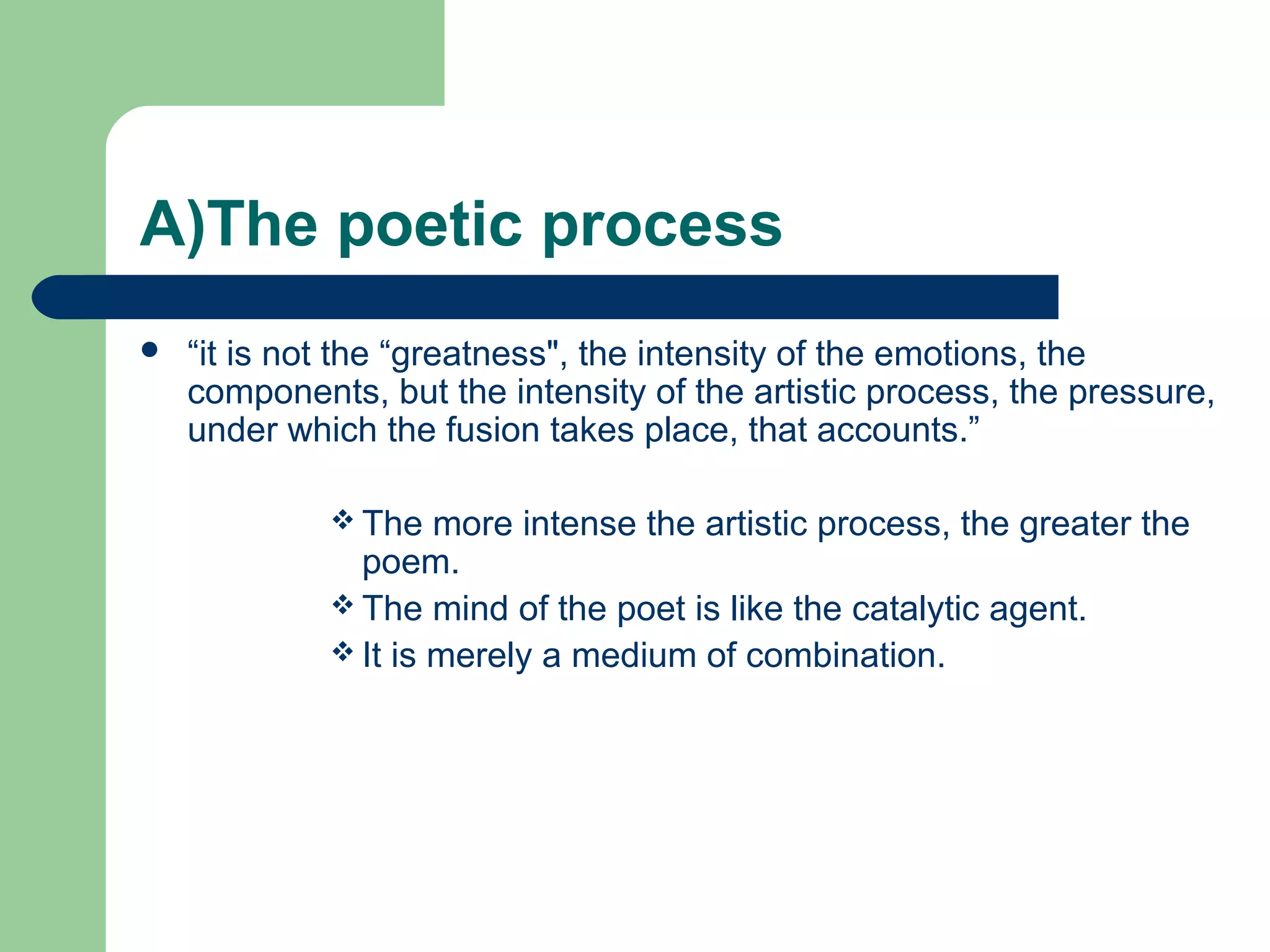
A)The poetic process 
 “it is not the “greatness", the intensity of the emotions, the 
components, but the intensity of the artistic process, the pressure, 
under which the fusion takes place, that accounts.” 
The more intense the artistic process, the greater the 
poem. 
The mind of the poet is like the catalytic agent. 
It is merely a medium of combination.
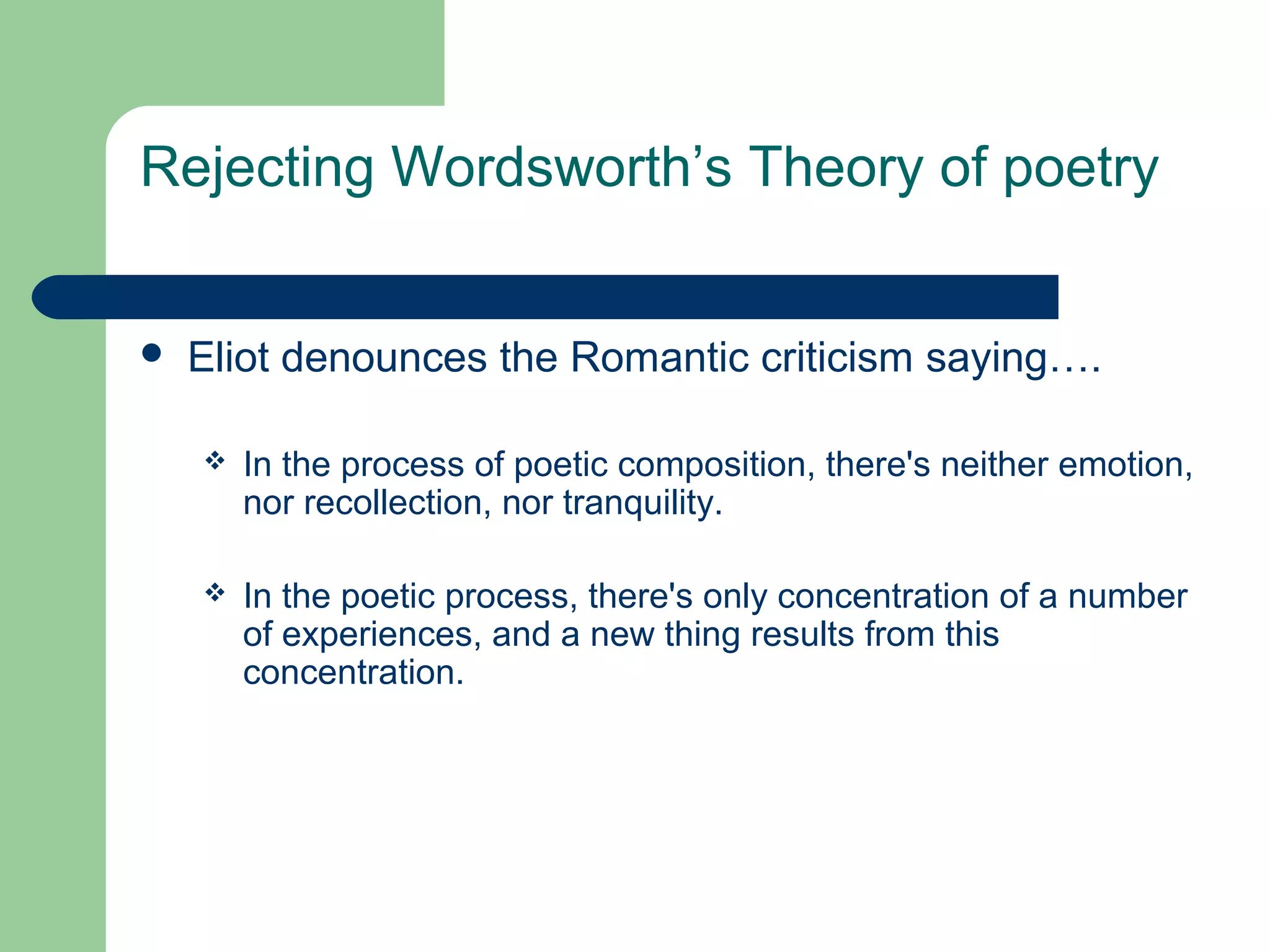
Rejecting Wordsworth’s Theory of poetry 
 Eliot denounces the Romantic criticism saying…. 
 In the process of poetic composition, there's neither emotion, 
nor recollection, nor tranquility. 
 In the poetic process, there's only concentration of a number 
of experiences, and a new thing results from this 
concentration.
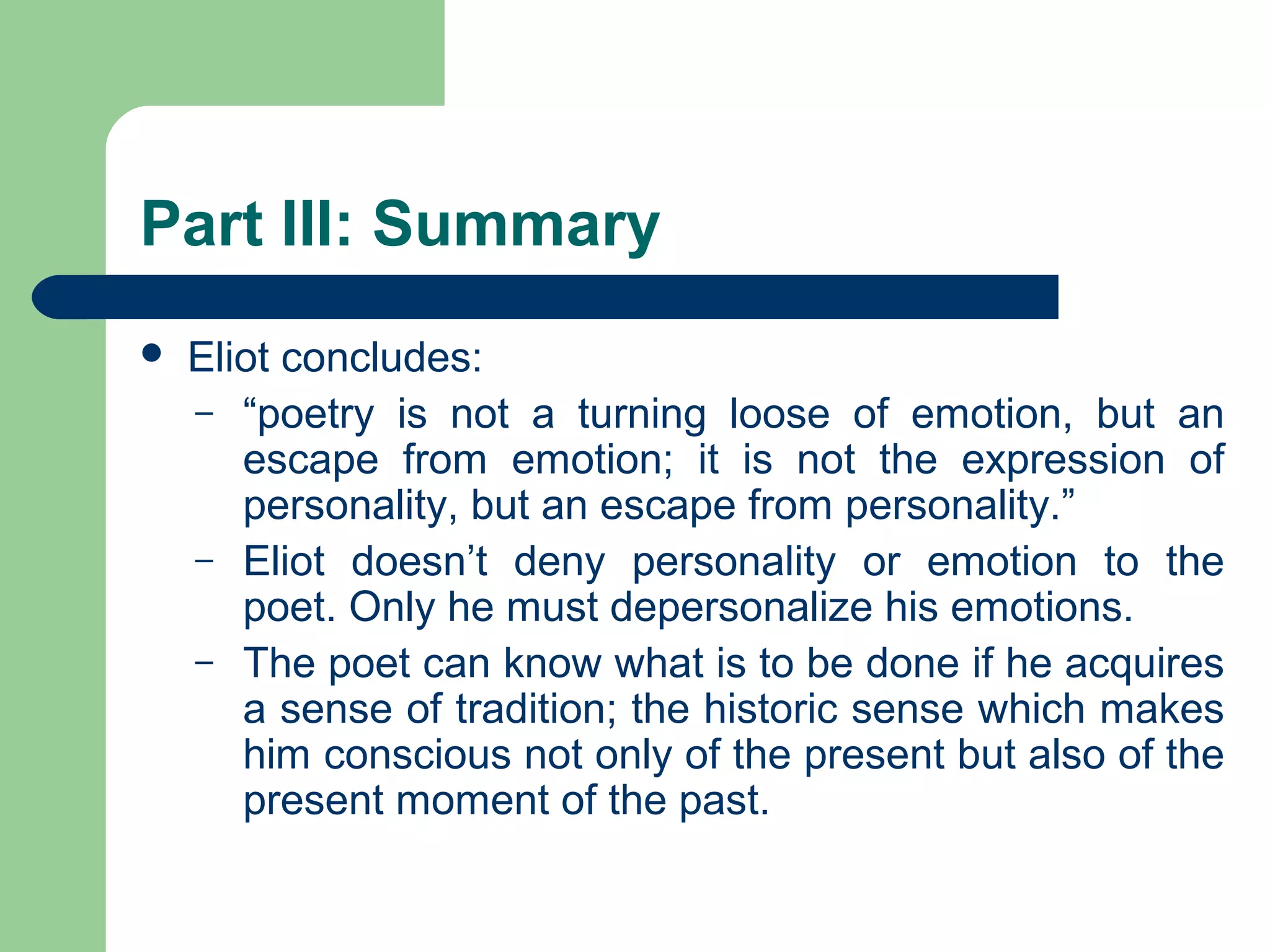
Part III: Summary 
 Eliot concludes: 
– “poetry is not a turning loose of emotion, but an 
escape from emotion; it is not the expression of 
personality, but an escape from personality.” 
– Eliot doesn’t deny personality or emotion to the 
poet. Only he must depersonalize his emotions. 
– The poet can know what is to be done if he acquires 
a sense of tradition; the historic sense which makes 
him conscious not only of the present but also of the 
present moment of the past.
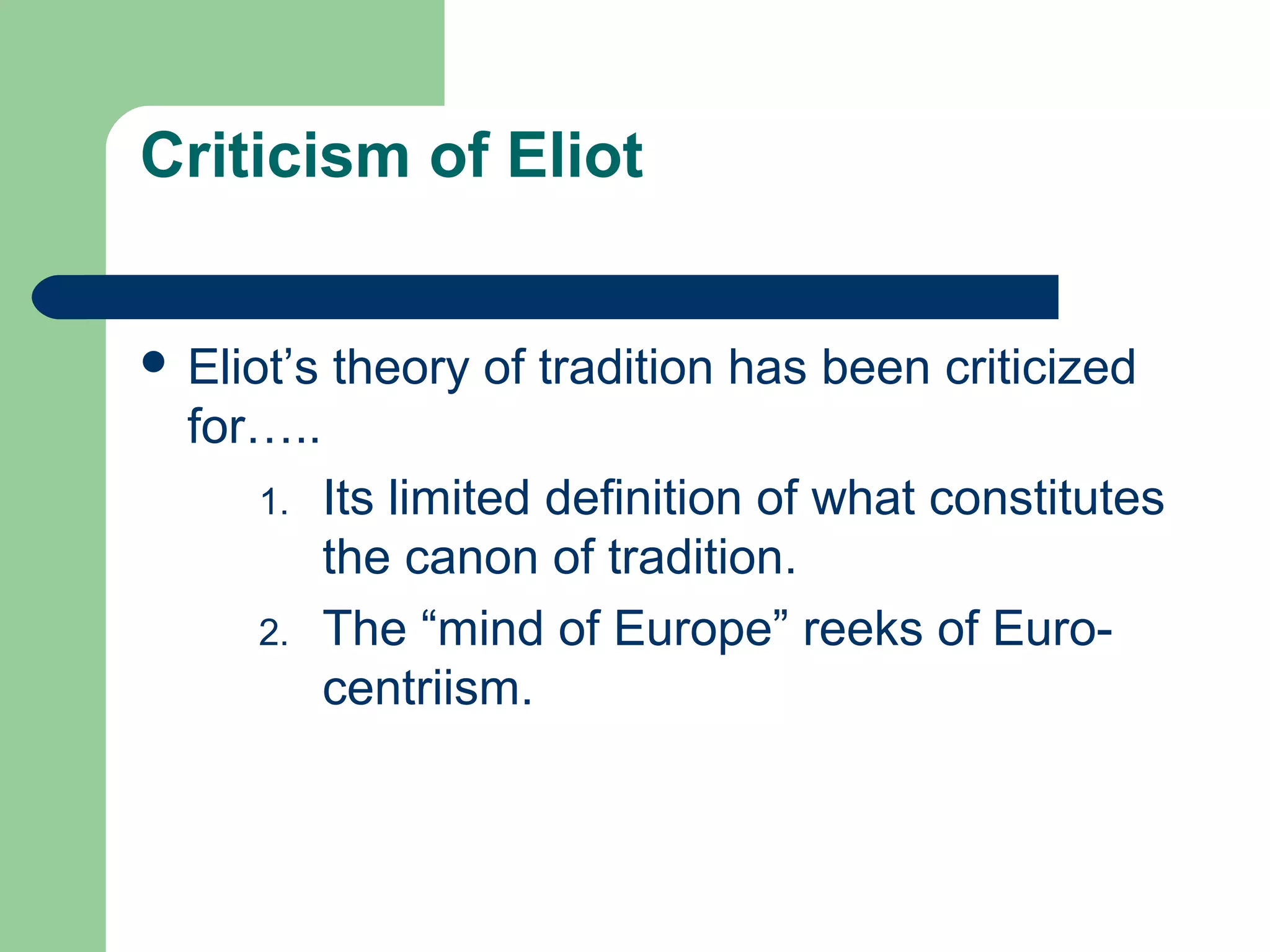
Criticism of Eliot 
 Eliot’s theory of tradition has been criticized 
for….. 
1. Its limited definition of what constitutes 
the canon of tradition. 
2. The “mind of Europe” reeks of Euro-centriism.
Tradition and the individual talent-Jameel Al-Ghaberi

Tradition and the individual talent-Jameel Al-Ghaberi

  • 1.
    University of Hyderabad School of Humanities Centre for Comparative Literature
  • 2.
    “Tradition and theIndividual Talent” PPrreesseenntteedd bbyy:: Jameel Ahmed Al-Ghaberi SSuuppeerrvviisseedd bbyy:: Dr.Sowmya
  • 3.
    T. S. Eliot “Tradition And The Individual Talent”  “Tradition and the Individual Talent” is one of the more well-known works that Eliot produced in his critic capacity.  The essay is divided into three parts:  Part I:Eliot’s Concept of Tradition  Part II:Eliot’s Theory of Impersonality of Poetry  PartIII:Summary
  • 4.
    Part I:Eliot’s Conceptof Tradition  The significance of tradition 1. Tradition doesn’t mean a blind adherence to the ways of the previous generation. 2. Tradition cannot be inherited; it can only be obtained by hard labor. 3. Tradition can only obtained by those who have historical sense.
  • 5.
    The sense oftradition implies  Recognition of the continuity of literature  A critical judgment as to which of the writers of the past continue to be significant in the present.  A knowledge of the significant writers obtained through painstaking effort.
  • 6.
    A dynamic conceptionof tradition  Tradition isn't anything fixed and static; it is constantly changing, growing and becoming different from what it is. When a new work is created, the whole literary tradition is modified. The relationship between the past and the present is not one-sided; it is reciprocal. The past directs the present, and is itself modified and altered by the present.
  • 7.
    The Function ofTradition  The work of art of a poet in the present is to be compared and contrasted with works of the past…  This judgment doesn’t mean “good” or “bad”.  The comparison is for knowing the facts about the new works of art.  The comparison is for the purpose of analysis and forming better understanding of the new.
  • 8.
    The sense oftradition  It doesn’t mean to know the past as a whole without any discrimination.  The sense of tradition doesn’t mean that the poet should know only a few poets whom he admires, a particular age, or period which he likes. This is a sign of immaturity and inexperience.
  • 9.
    Part II: Impersonalityof poetry (The Extinction of Personality) “Honest Criticism and sensitive appreciation is directed not upon the poet but upon the poetry.” The artist must surrender himself to tradition. He must allow his poetic sensibility to be shaped and modified by the past. His emotions and feeling must be depersonalized; he must be as impersonal and objective as a scientist. The poet’s personality is merely a medium; as a catalytic agent, or a receptacle in which chemical reactions take place.
  • 10.
    A)The poetic process  “it is not the “greatness", the intensity of the emotions, the components, but the intensity of the artistic process, the pressure, under which the fusion takes place, that accounts.” The more intense the artistic process, the greater the poem. The mind of the poet is like the catalytic agent. It is merely a medium of combination.
  • 11.
    Rejecting Wordsworth’s Theoryof poetry  Eliot denounces the Romantic criticism saying….  In the process of poetic composition, there's neither emotion, nor recollection, nor tranquility.  In the poetic process, there's only concentration of a number of experiences, and a new thing results from this concentration.
  • 12.
    Part III: Summary  Eliot concludes: – “poetry is not a turning loose of emotion, but an escape from emotion; it is not the expression of personality, but an escape from personality.” – Eliot doesn’t deny personality or emotion to the poet. Only he must depersonalize his emotions. – The poet can know what is to be done if he acquires a sense of tradition; the historic sense which makes him conscious not only of the present but also of the present moment of the past.
  • 13.
    Criticism of Eliot  Eliot’s theory of tradition has been criticized for….. 1. Its limited definition of what constitutes the canon of tradition. 2. The “mind of Europe” reeks of Euro-centriism.