Department of English
Prepared by: Ranjan Velari
Class: M.A. Sem. 1
Roll No.- 25
Paper No.: 3
Topic: What is Hamartia?
Submitted to: Smt.S.B. Gardi &
M.K. Bhavnagar University
What is Hamartia?
 This word is first used by Aristotle in his work
“Poetics”. Aristotle described Hamartia is an
error of judgment or a mistake that was made
by a character in a theatrical tragedy.
 By Aristotle’s definition, the Hamartia, or
mistake, could have been the result by any
character. Often the character was ignorant of
the eventual outcome of the decision.
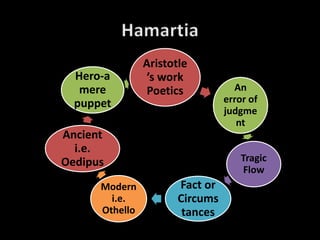
Aristotle
’s work
Poetics An
error of
judgme
nt
Tragic
Flow
Fact or
Circums
tances
Modern
i.e.
Othello
Ancient
i.e.
Oedipus
Hero-a
mere
puppet
What are the other interpretation of the word?
 The fatal flaw present in a tragic hero.
 Tragic flaw- Psychological or behavioral
 Translation of the Bible into Greek.
 Technical translation of Hamartia in the strict
and properly limited sense, the fact that it has
not been adopted, and it is far more
commonly used for a characteristics moral
failing in an otherwise predominantly good
one.
 Hamartia is an error which is derived from
ignorance of some material fact or
circumstances.
 The theory of the ‘tragic flaw’; a theory which
appears at first sight to be a most convenient
device for analyzing tragedy but which leads
the unfortunate user of into a quicksand of
absurdities in which he rapidly sinks, dragging
the tragedies down with him.
 Aristotelian sense of the term is a “mistake or
error of judgment”, and the deed done in
consequence of it is an erratum.
The meaning of the Greek word is closer to
“mistake”, than to “flaw”, “a wrong step blindly
taken”, “the missing of mark”, and it is best
interpretation in the context of what Aristotle
has to say about plot and “the law or
probability or necessity”.
 In the ideal tragedy, claims Aristotle, the
protagonist will mistakenly bring about his
downfall- not because he is sinful or morally
weak, but because he does not know enough.
 The role of Hamartia in tragedy comes not
inevitably of its consequences.
 Two of the best examples of a Hamartia, or
fatal flaw, in a character come from two of
Shakespeare’s best known tragedies.
 Othello was a jealous and proud man, and Iago
was able to exploit these traits until they
eventually brought his downfall.
 Macbeth was an overly ambitious man who
used murder to achieve his success and was
ultimately haunted by his actions.
 An example from an ancient Greek play is
Oedipus, he had a remarkably short fuse and
made very hasty decisions when he was angry.
This anger, like Hamartia of the other
characters mentioned, led to his downfall.
Thank You

Hamartia

  • 1.
    Department of English Preparedby: Ranjan Velari Class: M.A. Sem. 1 Roll No.- 25 Paper No.: 3 Topic: What is Hamartia? Submitted to: Smt.S.B. Gardi & M.K. Bhavnagar University
  • 2.
    What is Hamartia? This word is first used by Aristotle in his work “Poetics”. Aristotle described Hamartia is an error of judgment or a mistake that was made by a character in a theatrical tragedy.  By Aristotle’s definition, the Hamartia, or mistake, could have been the result by any character. Often the character was ignorant of the eventual outcome of the decision.
  • 3.
    Aristotle ’s work Poetics An errorof judgme nt Tragic Flow Fact or Circums tances Modern i.e. Othello Ancient i.e. Oedipus Hero-a mere puppet
  • 4.
    What are theother interpretation of the word?  The fatal flaw present in a tragic hero.  Tragic flaw- Psychological or behavioral  Translation of the Bible into Greek.  Technical translation of Hamartia in the strict and properly limited sense, the fact that it has not been adopted, and it is far more commonly used for a characteristics moral failing in an otherwise predominantly good one.
  • 5.
     Hamartia isan error which is derived from ignorance of some material fact or circumstances.  The theory of the ‘tragic flaw’; a theory which appears at first sight to be a most convenient device for analyzing tragedy but which leads the unfortunate user of into a quicksand of absurdities in which he rapidly sinks, dragging the tragedies down with him.
  • 6.
     Aristotelian senseof the term is a “mistake or error of judgment”, and the deed done in consequence of it is an erratum. The meaning of the Greek word is closer to “mistake”, than to “flaw”, “a wrong step blindly taken”, “the missing of mark”, and it is best interpretation in the context of what Aristotle has to say about plot and “the law or probability or necessity”.
  • 7.
     In theideal tragedy, claims Aristotle, the protagonist will mistakenly bring about his downfall- not because he is sinful or morally weak, but because he does not know enough.  The role of Hamartia in tragedy comes not inevitably of its consequences.  Two of the best examples of a Hamartia, or fatal flaw, in a character come from two of Shakespeare’s best known tragedies.  Othello was a jealous and proud man, and Iago was able to exploit these traits until they eventually brought his downfall.
  • 8.
     Macbeth wasan overly ambitious man who used murder to achieve his success and was ultimately haunted by his actions.  An example from an ancient Greek play is Oedipus, he had a remarkably short fuse and made very hasty decisions when he was angry. This anger, like Hamartia of the other characters mentioned, led to his downfall.
  • 9.