NAME : PANDYA MEHAL JITENDRABHAI
ROLL NO :13
SEM: 2
ENROLLMENT NO : 2069108420200029
SUBJECT :LITERARY CRITICISM
TOPIC :NORTHROP FRYE ARCHETYPE OF THE LITERATURE
DATE :27/2/2020
BEACH -2019-2020
E-MAIL ID -MEHALPANDYA252@GMAIL.COM
SUBMITTED TO – DEPARTMENT OF ENGLISH
M. K. BHAVANAGAR UNIVERSITY
NORTHROP FRYE
• Northrop Frye was born in Canada in 1921. He studied at
Toronto University and Merton College. Oxford University.
Initially he was a student of theology and then he switched
over to literature.
• He published his first book ‘FEARFUL SYMMETRY’ : A study
of William Blake in 1947.The book is a highly original study
of the poetry of Blake and it is considered a classic critical
work.
• Northrop Frye rose to international prominence with the
publication of ‘ANATOMY OF CRITICISM ‘
• Year of 1957.This work is his notabal work in the field of
criticism.
• Through this work Frye established as a one of the most
brilliant, original and influential of modern critic
WHAT IS ARCHETYPAL CRITICISM
• It is a type of critical theory that interpret a text by
focusing on recurring meets and archetypal in the
Narrative symbol image and character types in a
literary work.
• Archetypal criticism is originated from two disciplines
• 1) Social Anthropology
• 2) Psychoanalysis
• We can also see the elements of myth and rituals in
the Archetypal criticism.
CARL JUNG
Frye sees some mystification in Jung notion that literature is originates in
‘collective unconsciou’ .stored as racial memory within each individual. That
memory can be about situations, event, relationship from time immemorial
Jung's theory of the collective unconscious accounts for a considerable share
of writings in archetypal literary criticism; it also pre-dates the height of
archetypal literary criticism by over a decade. The Jungian archetypal
approach treats literary texts as an avenue in which primordial images are
represented.
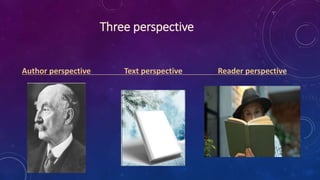
Three perspective
Author perspective Text perspective Reader perspective
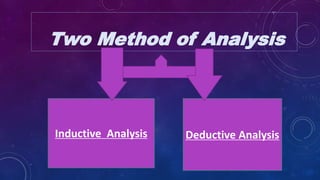
Two Method of Analysis
Inductive Analysis Deductive Analysis
From theory to particular organisation
From general to particular
Othello the play by William Shakespeare we can find the Jealousy.
Inflict upon himself Affiction and this is the particulars truth of drama
from which the reader learn the general truth of life that jealousy is
always destructive.
Reach to a conclusion based on observation.
First introduced and then get the example and rules.
Ex : This cat is black.That cat is black. So all cat are black.
Inductive Analysis
Deductive Analysis
From organisation to theory
From particular to general
Ex Hamlet grave digging scene
In deductive analysis conclusion is already given and we have to give
illustration in support of conclusion.
Ex.- All men are Mortal .
Kim is a man
So, Kim is a mortal.
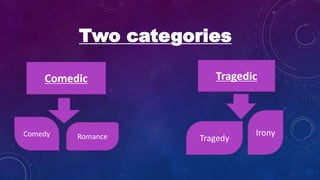
Two categories
Comedic Tragedic
Comedy Romance Tragedy
Irony
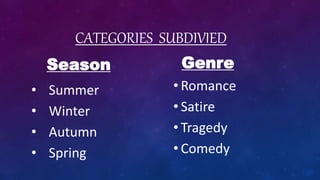
CATEGORIES SUBDIVIED
Season
• Summer
• Winter
• Autumn
• Spring
Genre
• Romance
• Satire
• Tragedy
• Comedy
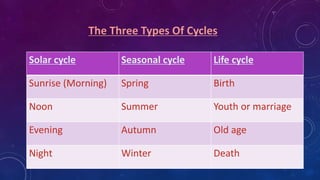
Solar cycle Seasonal cycle Life cycle
Sunrise (Morning) Spring Birth
Noon Summer Youth or marriage
Evening Autumn Old age
Night Winter Death
The Three Types Of Cycles
Symbol
• Water
• Colour
• Fire
• Serpant
• Wise old man
• Season
• Desert
• Garden
• Quest
Conclusion
In literature there are so many symbol and situations we can find. With the
literary term of Archetype of the literature we can go deep and in other words
to the skeleton. Through this kind of knowledge we can understand literature
symbol and situations in better way.
Works Cited
M.H.Abrams. A Glossary Of Litarary Terms. Seventh. New York: Earl McPeek,
1998. A Glossary of Literary Terms. Seventh. New York: Earl McPeek, 1998.
Williamson, Eugene. "Plato's Eidos and the Archetypal of Jung and Frye."
Interpretation volume 1995: 94-104.
C. J. Jung, The Archetypal and collective Unconscious. Second trans.
R. F. C. Hull (Princeton N. J. :princeton Univ. Press, 1968)p,76
Northrop Frye

Northrop Frye

  • 1.
    NAME : PANDYAMEHAL JITENDRABHAI ROLL NO :13 SEM: 2 ENROLLMENT NO : 2069108420200029 SUBJECT :LITERARY CRITICISM TOPIC :NORTHROP FRYE ARCHETYPE OF THE LITERATURE DATE :27/2/2020 BEACH -2019-2020 E-MAIL ID -MEHALPANDYA252@GMAIL.COM SUBMITTED TO – DEPARTMENT OF ENGLISH M. K. BHAVANAGAR UNIVERSITY
  • 2.
    NORTHROP FRYE • NorthropFrye was born in Canada in 1921. He studied at Toronto University and Merton College. Oxford University. Initially he was a student of theology and then he switched over to literature. • He published his first book ‘FEARFUL SYMMETRY’ : A study of William Blake in 1947.The book is a highly original study of the poetry of Blake and it is considered a classic critical work. • Northrop Frye rose to international prominence with the publication of ‘ANATOMY OF CRITICISM ‘ • Year of 1957.This work is his notabal work in the field of criticism. • Through this work Frye established as a one of the most brilliant, original and influential of modern critic
  • 3.
    WHAT IS ARCHETYPALCRITICISM • It is a type of critical theory that interpret a text by focusing on recurring meets and archetypal in the Narrative symbol image and character types in a literary work. • Archetypal criticism is originated from two disciplines • 1) Social Anthropology • 2) Psychoanalysis • We can also see the elements of myth and rituals in the Archetypal criticism.
  • 4.
    CARL JUNG Frye seessome mystification in Jung notion that literature is originates in ‘collective unconsciou’ .stored as racial memory within each individual. That memory can be about situations, event, relationship from time immemorial Jung's theory of the collective unconscious accounts for a considerable share of writings in archetypal literary criticism; it also pre-dates the height of archetypal literary criticism by over a decade. The Jungian archetypal approach treats literary texts as an avenue in which primordial images are represented.
  • 5.
    Three perspective Author perspectiveText perspective Reader perspective
  • 6.
    Two Method ofAnalysis Inductive Analysis Deductive Analysis
  • 7.
    From theory toparticular organisation From general to particular Othello the play by William Shakespeare we can find the Jealousy. Inflict upon himself Affiction and this is the particulars truth of drama from which the reader learn the general truth of life that jealousy is always destructive. Reach to a conclusion based on observation. First introduced and then get the example and rules. Ex : This cat is black.That cat is black. So all cat are black. Inductive Analysis
  • 8.
    Deductive Analysis From organisationto theory From particular to general Ex Hamlet grave digging scene In deductive analysis conclusion is already given and we have to give illustration in support of conclusion. Ex.- All men are Mortal . Kim is a man So, Kim is a mortal.
  • 9.
  • 10.
    CATEGORIES SUBDIVIED Season • Summer •Winter • Autumn • Spring Genre • Romance • Satire • Tragedy • Comedy
  • 11.
    Solar cycle Seasonalcycle Life cycle Sunrise (Morning) Spring Birth Noon Summer Youth or marriage Evening Autumn Old age Night Winter Death The Three Types Of Cycles
  • 12.
    Symbol • Water • Colour •Fire • Serpant • Wise old man • Season • Desert • Garden • Quest
  • 13.
    Conclusion In literature thereare so many symbol and situations we can find. With the literary term of Archetype of the literature we can go deep and in other words to the skeleton. Through this kind of knowledge we can understand literature symbol and situations in better way.
  • 14.
    Works Cited M.H.Abrams. AGlossary Of Litarary Terms. Seventh. New York: Earl McPeek, 1998. A Glossary of Literary Terms. Seventh. New York: Earl McPeek, 1998. Williamson, Eugene. "Plato's Eidos and the Archetypal of Jung and Frye." Interpretation volume 1995: 94-104. C. J. Jung, The Archetypal and collective Unconscious. Second trans. R. F. C. Hull (Princeton N. J. :princeton Univ. Press, 1968)p,76