Name :- Gohil Devangiba
Aniruddhsinh
Roll No. :- 14
Email Id :-
devangibagohil786@gamil.com
Paper No. :- :- 9 (The Modernist
Literature)
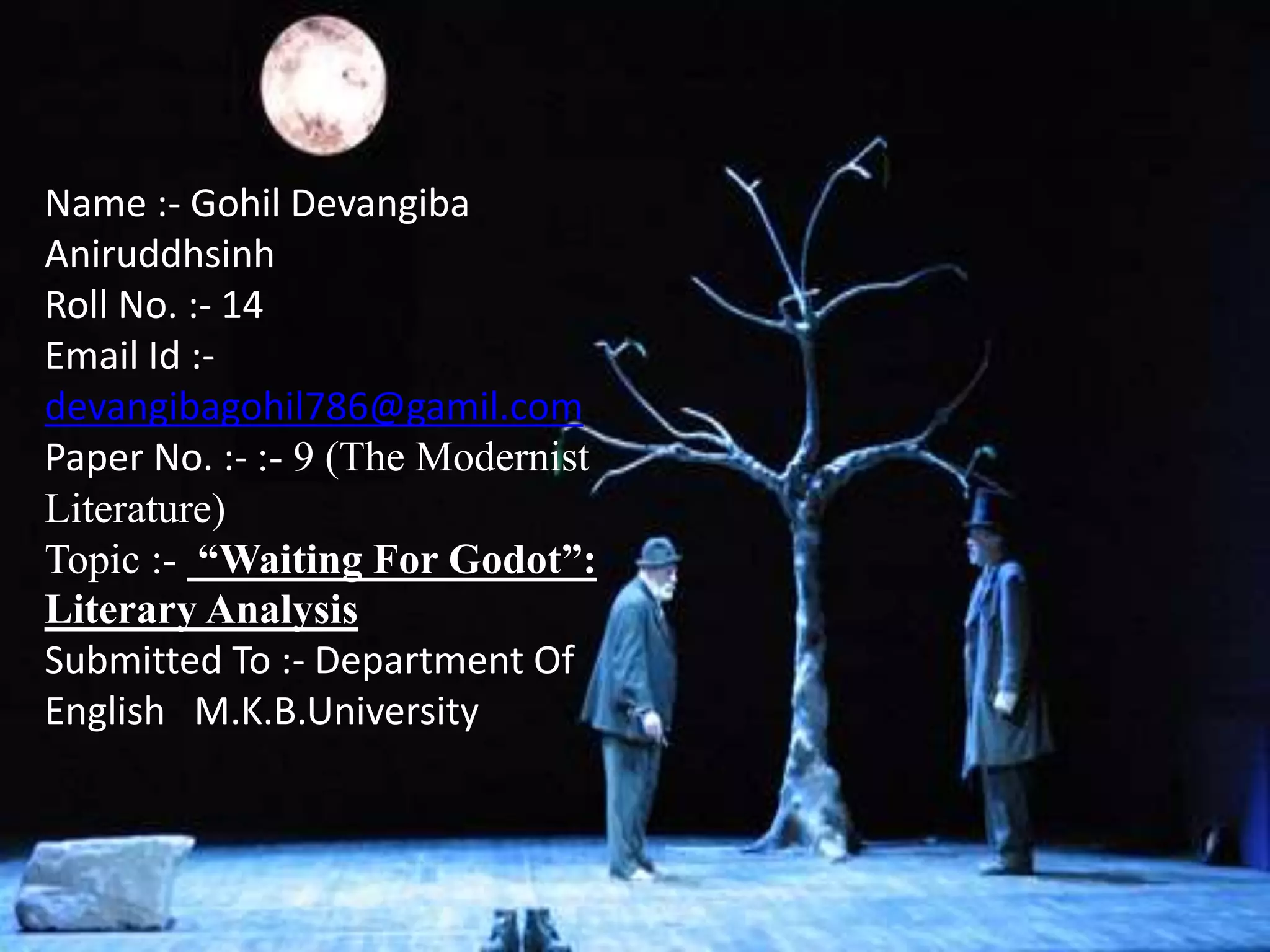
Topic :- “Waiting For Godot”:
Literary Analysis
Submitted To :- Department Of
English M.K.B.University
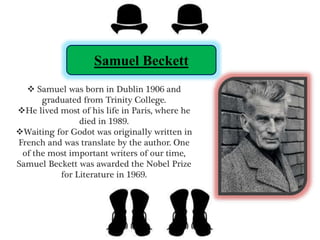
Samuel Beckett
 Samuel was born in Dublin 1906 and
graduated from Trinity College.
He lived most of his life in Paris, where he
died in 1989.
Waiting for Godot was originally written in
French and was translate by the author. One
of the most important writers of our time,
Samuel Beckett was awarded the Nobel Prize
for Literature in 1969.
"Waiting for Godot"
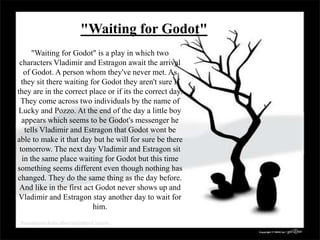
"Waiting for Godot" is a play in which two
characters Vladimir and Estragon await the arrival
of Godot. A person whom they've never met. As
they sit there waiting for Godot they aren't sure if
they are in the correct place or if its the correct day.
They come across two individuals by the name of
Lucky and Pozzo. At the end of the day a little boy
appears which seems to be Godot's messenger he
tells Vladimir and Estragon that Godot wont be
able to make it that day but he will for sure be there
tomorrow. The next day Vladimir and Estragon sit
in the same place waiting for Godot but this time
something seems different even though nothing has
changed. They do the same thing as the day before.
And like in the first act Godot never shows up and
Vladimir and Estragon stay another day to wait for
him.
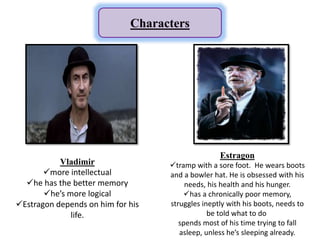
Characters
Vladimir
more intellectual
he has the better memory
he’s more logical
Estragon depends on him for his
life.
Estragon
tramp with a sore foot. He wears boots
and a bowler hat. He is obsessed with his
needs, his health and his hunger.
has a chronically poor memory,
struggles ineptly with his boots, needs to
be told what to do
spends most of his time trying to fall
asleep, unless he’s sleeping already.
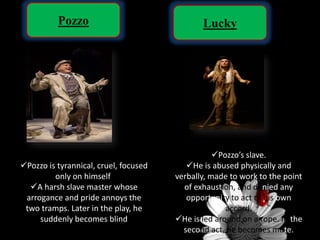
Pozzo Lucky
Pozzo is tyrannical, cruel, focused
only on himself
A harsh slave master whose
arrogance and pride annoys the
two tramps. Later in the play, he
suddenly becomes blind
Pozzo’s slave.
He is abused physically and
verbally, made to work to the point
of exhaustion, and denied any
opportunity to act of his own
accord.
He is led around on a rope. In the
second act, he becomes mute.
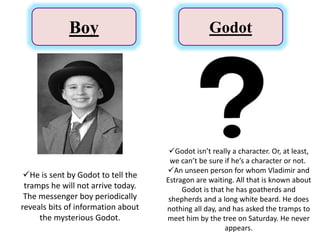
Boy Godot
He is sent by Godot to tell the
tramps he will not arrive today.
The messenger boy periodically
reveals bits of information about
the mysterious Godot.
Godot isn’t really a character. Or, at least,
we can’t be sure if he’s a character or not.
An unseen person for whom Vladimir and
Estragon are waiting. All that is known about
Godot is that he has goatherds and
shepherds and a long white beard. He does
nothing all day, and has asked the tramps to
meet him by the tree on Saturday. He never
appears.
Memory's role in the Play
 It might seem strange to the reader
why the character can remember far
back into the past, but not what occured
yesterday
from playing with the mind of the
characters, every yesterday just another
normal day because of the memory's that
are randomly cleared
there is no progression in the play, this
is why they are stuck in an unending
cycle of actions
they wait for "Godot" everyday at the
same spot, they play the same games,
and ask similar questions, which in turn
repeats everyday they spend together
Effect created by the relationship Vladimir
and Estragon Present
 when reading the play or even
hearing it being read, the person
listening to the words will most
likely fluster because the reader
isn't able to find the differences in
the characters
 this is why the differences are as
important as the similarities
between them
because Vladimir is the more
potent of the two, whatever action
he displays, Estragon follows, this
continues throughout the play
Major Themes
Choices
Philosophical Viewpoints:
The Absurd
Truth
Life, Consciousness, and
Existence
Time
Religion
Friendship
Freedom and Confinement
Suffering
Mortality
SYMBOLS
Duality
The Tree
Nightfall and the Rising Moon
Vladimir's Song that Never Ends
The Carrot
Lucky's Dance
Lucky's Dance
Smell
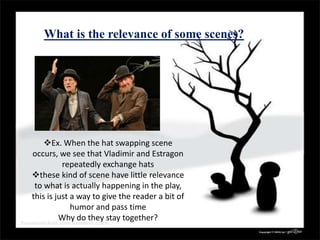
What is the relevance of some scenes?
Ex. When the hat swapping scene
occurs, we see that Vladimir and Estragon
repeatedly exchange hats
these kind of scene have little relevance
to what is actually happening in the play,
this is just a way to give the reader a bit of
humor and pass time
Why do they stay together?
Historical Context and Theatre of the absurd
Theatre of the absurd came about as a reaction of the Second World War. The
existential philosophy was taken as its root and was combined with dramatic
elements to create a style of theatre which presented a world which could not be
logically explained.
This genre of theatre took quite some time to catch on because its playwriting
techniques seemed to be illogical to the theatre world. The scenary was often
unrecognizable and making matters worse, the dialogue never drew any sense.
The Theatre of the Absurd is a phrase used in reference to particular plays
written by number of primarily European playwrights in the late 1940s, 1950s, and
1960s, as well as to the style of theatre which has evolved form their work.
However, this genre of theatre accomplished its eventual popularity when World
War II highlighted the ultimate precariousness of human life.
Works Cited
Shmoop Editorial Team. "Waiting for Godot Theme of Friendship."
Shmoop.com. 11 Nov. 2008. Shmoop University, Inc. 24 Mar. 2014
<http://www.shmoop.com/waiting-for-godot/friendship-theme.html>.
"Waiting for Godot Summary and Analysis." Waiting for Godot Study Guide :
Analysis of the Play. 24 Mar. 2014 <http://www.gradesaver.com/waiting-for-
godot/study-guide/section3/>.
"Waiting for Godot Script." Waiting for Godot Script. 24 Mar. 2014
<http://samuel-beckett.net/Waiting_for_Godot_Part1.html>.
 "Waiting For Godot": Literary Analysis

"Waiting For Godot": Literary Analysis

  • 1.
    Name :- GohilDevangiba Aniruddhsinh Roll No. :- 14 Email Id :- devangibagohil786@gamil.com Paper No. :- :- 9 (The Modernist Literature) Topic :- “Waiting For Godot”: Literary Analysis Submitted To :- Department Of English M.K.B.University
  • 2.
    Samuel Beckett  Samuelwas born in Dublin 1906 and graduated from Trinity College. He lived most of his life in Paris, where he died in 1989. Waiting for Godot was originally written in French and was translate by the author. One of the most important writers of our time, Samuel Beckett was awarded the Nobel Prize for Literature in 1969.
  • 3.
    "Waiting for Godot" "Waitingfor Godot" is a play in which two characters Vladimir and Estragon await the arrival of Godot. A person whom they've never met. As they sit there waiting for Godot they aren't sure if they are in the correct place or if its the correct day. They come across two individuals by the name of Lucky and Pozzo. At the end of the day a little boy appears which seems to be Godot's messenger he tells Vladimir and Estragon that Godot wont be able to make it that day but he will for sure be there tomorrow. The next day Vladimir and Estragon sit in the same place waiting for Godot but this time something seems different even though nothing has changed. They do the same thing as the day before. And like in the first act Godot never shows up and Vladimir and Estragon stay another day to wait for him.
  • 4.
    Characters Vladimir more intellectual he hasthe better memory he’s more logical Estragon depends on him for his life. Estragon tramp with a sore foot. He wears boots and a bowler hat. He is obsessed with his needs, his health and his hunger. has a chronically poor memory, struggles ineptly with his boots, needs to be told what to do spends most of his time trying to fall asleep, unless he’s sleeping already.
  • 5.
    Pozzo Lucky Pozzo istyrannical, cruel, focused only on himself A harsh slave master whose arrogance and pride annoys the two tramps. Later in the play, he suddenly becomes blind Pozzo’s slave. He is abused physically and verbally, made to work to the point of exhaustion, and denied any opportunity to act of his own accord. He is led around on a rope. In the second act, he becomes mute.
  • 6.
    Boy Godot He issent by Godot to tell the tramps he will not arrive today. The messenger boy periodically reveals bits of information about the mysterious Godot. Godot isn’t really a character. Or, at least, we can’t be sure if he’s a character or not. An unseen person for whom Vladimir and Estragon are waiting. All that is known about Godot is that he has goatherds and shepherds and a long white beard. He does nothing all day, and has asked the tramps to meet him by the tree on Saturday. He never appears.
  • 7.
    Memory's role inthe Play  It might seem strange to the reader why the character can remember far back into the past, but not what occured yesterday from playing with the mind of the characters, every yesterday just another normal day because of the memory's that are randomly cleared there is no progression in the play, this is why they are stuck in an unending cycle of actions they wait for "Godot" everyday at the same spot, they play the same games, and ask similar questions, which in turn repeats everyday they spend together
  • 8.
    Effect created bythe relationship Vladimir and Estragon Present  when reading the play or even hearing it being read, the person listening to the words will most likely fluster because the reader isn't able to find the differences in the characters  this is why the differences are as important as the similarities between them because Vladimir is the more potent of the two, whatever action he displays, Estragon follows, this continues throughout the play
  • 9.
    Major Themes Choices Philosophical Viewpoints: TheAbsurd Truth Life, Consciousness, and Existence Time Religion Friendship Freedom and Confinement Suffering Mortality
  • 10.
    SYMBOLS Duality The Tree Nightfall andthe Rising Moon Vladimir's Song that Never Ends The Carrot Lucky's Dance Lucky's Dance Smell
  • 11.
    What is therelevance of some scenes? Ex. When the hat swapping scene occurs, we see that Vladimir and Estragon repeatedly exchange hats these kind of scene have little relevance to what is actually happening in the play, this is just a way to give the reader a bit of humor and pass time Why do they stay together?
  • 12.
    Historical Context andTheatre of the absurd Theatre of the absurd came about as a reaction of the Second World War. The existential philosophy was taken as its root and was combined with dramatic elements to create a style of theatre which presented a world which could not be logically explained. This genre of theatre took quite some time to catch on because its playwriting techniques seemed to be illogical to the theatre world. The scenary was often unrecognizable and making matters worse, the dialogue never drew any sense. The Theatre of the Absurd is a phrase used in reference to particular plays written by number of primarily European playwrights in the late 1940s, 1950s, and 1960s, as well as to the style of theatre which has evolved form their work. However, this genre of theatre accomplished its eventual popularity when World War II highlighted the ultimate precariousness of human life.
  • 13.
    Works Cited Shmoop EditorialTeam. "Waiting for Godot Theme of Friendship." Shmoop.com. 11 Nov. 2008. Shmoop University, Inc. 24 Mar. 2014 <http://www.shmoop.com/waiting-for-godot/friendship-theme.html>. "Waiting for Godot Summary and Analysis." Waiting for Godot Study Guide : Analysis of the Play. 24 Mar. 2014 <http://www.gradesaver.com/waiting-for- godot/study-guide/section3/>. "Waiting for Godot Script." Waiting for Godot Script. 24 Mar. 2014 <http://samuel-beckett.net/Waiting_for_Godot_Part1.html>.