TIC DISORDERS
- Dr. Deepika Singh, 3rd Yr Resident, Dept of Psychiatry, GSMC & KEMH
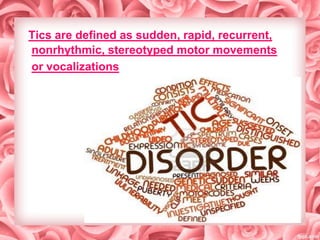
Tics are defined as sudden, rapid, recurrent,
nonrhythmic, stereotyped motor movements
or vocalizations
Motor and vocal tics are divided into:
1]Simple motor tics:

2] Simple vocal tics
3] Complex motor tics
4] Complex vocal tics
DSM-IV-TR TIC DISORDERS:
1] Gilles de la Tourette syndrome
2] chronic motor or vocal tic disorder,
3] transient tic disorder, &
4] tic disorder not otherwise specified
DSM-IV-TR Diagnostic Criteria for
Tourette's Disorder:
1] Multiple motor and one or more vocal tics have been present at
some time during the illness, although not necessarily concurrently.
2] The tics occur many times a day, nearly every day or intermittently
throughout a period of more than 1 year, and during this period there
was never a tic-free period of more than 3 consecutive months
(2 months in ICD-10)
3] The onset is before age 18 years.
4] The disturbance is not due to the direct physiological effects of a
substance (e.g., stimulants) or a general medical condition (e.g.,
Huntington's disease or postviral encephalitis).
• Prevalence: 4 to 5 per 10,000
• Onset of the motor component of the disorder:7 years;
Vocal tics : 11 years
• Boys > Girls
ETIOLOGY
1] Genetic Factors
2] Neurochemical and Neuroanatomical Factors
3] Immunological Factors
A] GENETIC FACTORS:
1)Twin studies.
2)Bilinear mode of familial transmission:
3)Rare sequence variant in SLITRK1 on chr.13q31
4)50% tourette’s patients have ADHD
5)40% tourette’s patients have OCD
6)First degree relatives at risk of tics and OCD
B] NEUROCHEMICAL & NEUROANATOMICAL
FACTORS
1] Dopamine system:
--Anti Dopaminergic agents
[Haloperidol, Pimozide, Fluphenazine] -----tic suppressors.
--Central Dopaminergic activators
[methylphenidate, amphetamines, cocaine]--------tic exacerbators.
--However no concrete evidence

2] choline and n-acetylaspartate:
--Reduction of the above in left putamen and
frontal cortex.
--This leads to reduced density of neurons
3] Endogenous opioids:
pharmacological agents that antagonize endogenous opiates for eg
naltrexone reduce tics.
4] Noradrenergic system:
Clonidine decreases NA and causes reduced Dopamineregic
activity & hence reduces tics.
5] Structural abnormalities
Basal Ganglia lesions are known in movement disorders

C] IMMUNOLOGICAL FACTORS
autoimmune process that is secondary to streptococcal infections is
a potential mechanism for Tourette's disorder.
CLINICAL FEATURES:
• Initial tics are in the face and neck and then they progress
downwards
• The most commonly described tics are those affecting the face &
head, arms & hands, lower extremities, RS & GIT.
• The most frequent initial symptom is an eye-blink tic, followed by
a head tic or a facial grimace.
• The complex tics appear many years later[ coprolalia-1/3rd]
• Prodromal symptoms- irritability, attention difficulties, poor
frustration tolerance……diagnosed as ADHD for which stimulants
are started……25% end up with Tourette’s
• Attention difficulties often precede the onset of tics, whereas
obsessive-compulsive symptoms often occur after their onset.
ASSESSMENT INSTRUMENTS
•
•

Tic Symptom Self Report
Yale global tic severity scale: [ YGTSS ]
Number
(0-5)

Frequency
(0-5)

Intensity
(0-5)

Complexity
(0-5)

Interference Total
(0-5)
(0-25)

Motor Tic
Severity
Vocal tic
severity

Total Tic Severity Score = Motor Tic Severity + Vocal Tic Severity (0-50)

Impairment:

None : 0
Moderate:30

Minimal : 10
Marked : 40

Total Yale Global Tic Severity Scale Score
( Total Tic Severity Score + Impairment ) ( 0-100 )

Mild: 20
Severe: 50
COURSE AND PROGNOSIS:
1] Most often there is reduction in severity and frequency with age.
2] Co-morbid MDD, OCD and ADHD worsen the prognosis and cause
exacerbation.
3] Imaging has revealed presence of smaller
caudate nucleus in patients and has
predictive value in prognosis.
4] Mild forms need not require treatment
if they are socially functional.
DIFFERENTIAL DIAGNOSIS
SYNDROME

DIFFERENTIATING
FEATURE

COURSE

MOVEMENT

HALLERVORDENSPATZ

A/W optic atrophy
dementia,ataxia,lability,
dysarthria

Progresses to death in
15-20 years

Choreic,athetoid,
myoclonic

SYDENHAM’S
CHOREA

F>M, A/W RF

Self limited

Choreiform

HUNTINGTON’S
DISEASE

Late onset[30-50],
dementia, atrophy

Progressive to death

Choreiform

WILSON’S DISEASE

10-25years,KF rings,
liver fn

Chelating agents

Wing beating tremor,
Dystonia

HYPERREFLEXIA
[LATAH,MYRIACHIT]

CHILDHOOD

Non-progressive

Startle
response,echolalia

MYOCLONUS

Any age, no
vocalisations

Variable

Myoclonus

TARDIVE
TOURETTE’S
DISORDER
SYNDROME

After APD

Variable depending on
dosage

Orofacial dyskinesia,
choreoathetosis,tics,
vocalisations
TREATMENT:
1] Not to misinterprest tic as behavioral problem
2] Family psychoeducation
3] Mild cases : no treatment required
4] Severe cases : pharmacotherapy
& behavioral therapy
PHARMACOTHERAPY
1] Haloperidol and Pimozide most widely researched and used.
Haloperidolinitial daily dose for adolescents is 0.25 and 0.5 mg.
not approved in children < 3 years age.
Pimozide- 1mg-2mg----increase alt. days upto 10-20 mg
2] Risperidone and Olanzapine have
also showed beneficial results.
3]Clonidine and guanfacine :
Although presently not approved by US FDA, several studies
reported that clonidine and guanafacine were efficacious in
reducing tics.
4] For associated OCD, SSRI’s used alone or with APD’s.
5] For co-existing ADHD the decision depends on severity and if
reqired Atomoxetine or methylphenidate might have to be started.
BEHAVIORAL THERAPY:
• Habit reversal technique, stopping premonitory urge, relaxation
therapy ( it may reduce the stress that often exacerbates Tourette's
disorder) [as reviewed by Stanley hobbs]
• Premonitary urge :
Older children, adolescents, and adults often report tics to be
preceded by an unpleasant sensation
denoted as a ―premonitory urge‖.
• Premonitory Urge for Tics Scale (PUTS) :
This is a 10 item scale, & 9 items pertaining
to intensity of premonitory urge is graded
on a scale of 1 to 4. Total maximum score
is 36, while minimum score is 9.
CHRONIC MOTOR OR VOCAL TIC DISORDER
DSM-IV-TR Diagnostic Criteria:
• Single or multiple motor or vocal tics but not both, have been
present at some time during the illness.
• The tics occur many times a day nearly every day or intermittently
throughout a period of more than 1 year, and during this period
there was never a tic-free period of more than 3 consecutive
months (2 months in ICD-10)
• The onset is before age 18 years.
• The disturbance is not due to the direct physiological effects of a
substance or a general medical condition
• Criteria have never been met for Tourette's disorder.
• Prevalence is 100-1000 times more than Tourette’s
• Similar hereditary factors as Tourette’s.

• Motor tics >> vocal tics [not as loud … mainly grunting due to
diaphragm, thoracic or abdominal muscles]
• Prognosis- onset between 6-8years,
facial tics—good prognosis
• Management- psychotherapy &
behavior therapy
TRANSIENT TIC DISORDER
DSM-IV-TR Diagnostic Criteria for Transient Tic Disorder
• Single or multiple motor and/or vocal tics
• The tics occur many times a day, nearly every day for at least 4
weeks, but for no longer than 12 consecutive months.
• The onset is before age 18 years.
• The disturbance is not due to the direct physiological effects of a
substance or a general medical condition
• Criteria have never been met for Tourette's Disorder or
Chronic Motor or Vocal Tic Disorder.

• Specify if:
Single episode or Recurrent
• 5-24% of school children

• Organic origin, may progress to Tourette’s or chronic motor or
vocal tic disorder
• Exacerbated by stress and anxiety.
• Good prognosis
• Self limiting mostly
TIC DISORDER NOT OTHERWISE SPECIFIED
• DSM-IV-TR Diagnostic Criteria
• This category is for disorders characterized by tics that do not meet
criteria for a specific tic disorder.
• Examples include tics lasting less than 4 weeks or tics with an onset
after age 18 years.
DSM V CONSIDERATIONS:
DSM – V reclassified Tourette's and tic disorders as motor
disorders listed in the neurodevelopmental disorder category.
Motor disorders include:
307.21 Provisional tic disorder
307.22 Persistent (chronic) motor or
vocal tic disorder
307.23 Tourette's disorder
• Changes in DSM – V :
(1) A more precise definition of motor and vocal tics
(2) simplification of duration criterion for tic disorders
(3) revising the term "transient tic disorder"
to provisional tic disorder
(4) removal of tic disorder not otherwise
specified category
(5) Including a motor tic only and vocal
tic only specifier for the chronic motor
or vocal tic disorder category.
REFERENCES
1] Kaplan & Sadock’s Comprehensive
Textbook Of Psychiatry
2] Kaplan & Sadock’s Synopsis Of
Psychiatry
3] Tourette’s disorder and other tic
disorders in DSM-5: a comment
Eur Child Adolesc Psychiatry. 2013
February; 20(2): 71–74
THANK
YOU..

tic disorder

  • 1.
    TIC DISORDERS - Dr.Deepika Singh, 3rd Yr Resident, Dept of Psychiatry, GSMC & KEMH
  • 2.
    Tics are definedas sudden, rapid, recurrent, nonrhythmic, stereotyped motor movements or vocalizations
  • 3.
    Motor and vocaltics are divided into: 1]Simple motor tics: 2] Simple vocal tics 3] Complex motor tics 4] Complex vocal tics
  • 4.
    DSM-IV-TR TIC DISORDERS: 1]Gilles de la Tourette syndrome 2] chronic motor or vocal tic disorder, 3] transient tic disorder, & 4] tic disorder not otherwise specified
  • 5.
    DSM-IV-TR Diagnostic Criteriafor Tourette's Disorder: 1] Multiple motor and one or more vocal tics have been present at some time during the illness, although not necessarily concurrently. 2] The tics occur many times a day, nearly every day or intermittently throughout a period of more than 1 year, and during this period there was never a tic-free period of more than 3 consecutive months (2 months in ICD-10) 3] The onset is before age 18 years. 4] The disturbance is not due to the direct physiological effects of a substance (e.g., stimulants) or a general medical condition (e.g., Huntington's disease or postviral encephalitis).
  • 6.
    • Prevalence: 4to 5 per 10,000 • Onset of the motor component of the disorder:7 years; Vocal tics : 11 years • Boys > Girls
  • 7.
    ETIOLOGY 1] Genetic Factors 2]Neurochemical and Neuroanatomical Factors 3] Immunological Factors
  • 8.
    A] GENETIC FACTORS: 1)Twinstudies. 2)Bilinear mode of familial transmission: 3)Rare sequence variant in SLITRK1 on chr.13q31 4)50% tourette’s patients have ADHD 5)40% tourette’s patients have OCD 6)First degree relatives at risk of tics and OCD
  • 9.
    B] NEUROCHEMICAL &NEUROANATOMICAL FACTORS 1] Dopamine system: --Anti Dopaminergic agents [Haloperidol, Pimozide, Fluphenazine] -----tic suppressors. --Central Dopaminergic activators [methylphenidate, amphetamines, cocaine]--------tic exacerbators. --However no concrete evidence 2] choline and n-acetylaspartate: --Reduction of the above in left putamen and frontal cortex. --This leads to reduced density of neurons
  • 10.
    3] Endogenous opioids: pharmacologicalagents that antagonize endogenous opiates for eg naltrexone reduce tics. 4] Noradrenergic system: Clonidine decreases NA and causes reduced Dopamineregic activity & hence reduces tics. 5] Structural abnormalities Basal Ganglia lesions are known in movement disorders C] IMMUNOLOGICAL FACTORS autoimmune process that is secondary to streptococcal infections is a potential mechanism for Tourette's disorder.
  • 11.
    CLINICAL FEATURES: • Initialtics are in the face and neck and then they progress downwards • The most commonly described tics are those affecting the face & head, arms & hands, lower extremities, RS & GIT. • The most frequent initial symptom is an eye-blink tic, followed by a head tic or a facial grimace. • The complex tics appear many years later[ coprolalia-1/3rd]
  • 12.
    • Prodromal symptoms-irritability, attention difficulties, poor frustration tolerance……diagnosed as ADHD for which stimulants are started……25% end up with Tourette’s • Attention difficulties often precede the onset of tics, whereas obsessive-compulsive symptoms often occur after their onset.
  • 13.
    ASSESSMENT INSTRUMENTS • • Tic SymptomSelf Report Yale global tic severity scale: [ YGTSS ] Number (0-5) Frequency (0-5) Intensity (0-5) Complexity (0-5) Interference Total (0-5) (0-25) Motor Tic Severity Vocal tic severity Total Tic Severity Score = Motor Tic Severity + Vocal Tic Severity (0-50) Impairment: None : 0 Moderate:30 Minimal : 10 Marked : 40 Total Yale Global Tic Severity Scale Score ( Total Tic Severity Score + Impairment ) ( 0-100 ) Mild: 20 Severe: 50
  • 14.
    COURSE AND PROGNOSIS: 1]Most often there is reduction in severity and frequency with age. 2] Co-morbid MDD, OCD and ADHD worsen the prognosis and cause exacerbation. 3] Imaging has revealed presence of smaller caudate nucleus in patients and has predictive value in prognosis. 4] Mild forms need not require treatment if they are socially functional.
  • 15.
    DIFFERENTIAL DIAGNOSIS SYNDROME DIFFERENTIATING FEATURE COURSE MOVEMENT HALLERVORDENSPATZ A/W opticatrophy dementia,ataxia,lability, dysarthria Progresses to death in 15-20 years Choreic,athetoid, myoclonic SYDENHAM’S CHOREA F>M, A/W RF Self limited Choreiform HUNTINGTON’S DISEASE Late onset[30-50], dementia, atrophy Progressive to death Choreiform WILSON’S DISEASE 10-25years,KF rings, liver fn Chelating agents Wing beating tremor, Dystonia HYPERREFLEXIA [LATAH,MYRIACHIT] CHILDHOOD Non-progressive Startle response,echolalia MYOCLONUS Any age, no vocalisations Variable Myoclonus TARDIVE TOURETTE’S DISORDER SYNDROME After APD Variable depending on dosage Orofacial dyskinesia, choreoathetosis,tics, vocalisations
  • 16.
    TREATMENT: 1] Not tomisinterprest tic as behavioral problem 2] Family psychoeducation 3] Mild cases : no treatment required 4] Severe cases : pharmacotherapy & behavioral therapy
  • 17.
    PHARMACOTHERAPY 1] Haloperidol andPimozide most widely researched and used. Haloperidolinitial daily dose for adolescents is 0.25 and 0.5 mg. not approved in children < 3 years age. Pimozide- 1mg-2mg----increase alt. days upto 10-20 mg 2] Risperidone and Olanzapine have also showed beneficial results.
  • 18.
    3]Clonidine and guanfacine: Although presently not approved by US FDA, several studies reported that clonidine and guanafacine were efficacious in reducing tics. 4] For associated OCD, SSRI’s used alone or with APD’s. 5] For co-existing ADHD the decision depends on severity and if reqired Atomoxetine or methylphenidate might have to be started.
  • 19.
    BEHAVIORAL THERAPY: • Habitreversal technique, stopping premonitory urge, relaxation therapy ( it may reduce the stress that often exacerbates Tourette's disorder) [as reviewed by Stanley hobbs] • Premonitary urge : Older children, adolescents, and adults often report tics to be preceded by an unpleasant sensation denoted as a ―premonitory urge‖. • Premonitory Urge for Tics Scale (PUTS) : This is a 10 item scale, & 9 items pertaining to intensity of premonitory urge is graded on a scale of 1 to 4. Total maximum score is 36, while minimum score is 9.
  • 20.
    CHRONIC MOTOR ORVOCAL TIC DISORDER DSM-IV-TR Diagnostic Criteria: • Single or multiple motor or vocal tics but not both, have been present at some time during the illness. • The tics occur many times a day nearly every day or intermittently throughout a period of more than 1 year, and during this period there was never a tic-free period of more than 3 consecutive months (2 months in ICD-10) • The onset is before age 18 years. • The disturbance is not due to the direct physiological effects of a substance or a general medical condition • Criteria have never been met for Tourette's disorder.
  • 21.
    • Prevalence is100-1000 times more than Tourette’s • Similar hereditary factors as Tourette’s. • Motor tics >> vocal tics [not as loud … mainly grunting due to diaphragm, thoracic or abdominal muscles] • Prognosis- onset between 6-8years, facial tics—good prognosis • Management- psychotherapy & behavior therapy
  • 22.
    TRANSIENT TIC DISORDER DSM-IV-TRDiagnostic Criteria for Transient Tic Disorder • Single or multiple motor and/or vocal tics • The tics occur many times a day, nearly every day for at least 4 weeks, but for no longer than 12 consecutive months. • The onset is before age 18 years. • The disturbance is not due to the direct physiological effects of a substance or a general medical condition • Criteria have never been met for Tourette's Disorder or Chronic Motor or Vocal Tic Disorder. • Specify if: Single episode or Recurrent
  • 23.
    • 5-24% ofschool children • Organic origin, may progress to Tourette’s or chronic motor or vocal tic disorder • Exacerbated by stress and anxiety. • Good prognosis • Self limiting mostly
  • 24.
    TIC DISORDER NOTOTHERWISE SPECIFIED • DSM-IV-TR Diagnostic Criteria • This category is for disorders characterized by tics that do not meet criteria for a specific tic disorder. • Examples include tics lasting less than 4 weeks or tics with an onset after age 18 years.
  • 25.
    DSM V CONSIDERATIONS: DSM– V reclassified Tourette's and tic disorders as motor disorders listed in the neurodevelopmental disorder category. Motor disorders include: 307.21 Provisional tic disorder 307.22 Persistent (chronic) motor or vocal tic disorder 307.23 Tourette's disorder
  • 26.
    • Changes inDSM – V : (1) A more precise definition of motor and vocal tics (2) simplification of duration criterion for tic disorders (3) revising the term "transient tic disorder" to provisional tic disorder (4) removal of tic disorder not otherwise specified category (5) Including a motor tic only and vocal tic only specifier for the chronic motor or vocal tic disorder category.
  • 27.
    REFERENCES 1] Kaplan &Sadock’s Comprehensive Textbook Of Psychiatry 2] Kaplan & Sadock’s Synopsis Of Psychiatry 3] Tourette’s disorder and other tic disorders in DSM-5: a comment Eur Child Adolesc Psychiatry. 2013 February; 20(2): 71–74
  • 28.