- DR DEEPIKA SINGH,
RESIDENT,
DEPT OF PSYCHIATRY,
GSMC & KEMH
DRUG TREATMENT:
• STIMULANT DRUGS
- METHYLPHENIDATE
- DEXTROAMPHETAMINES
•
-

NONSTIMULANT DRUGS
ATOMOXETINE HCL
BUPROPION
VENLAFAXINE
CLONIDINE, GUANAFACINE
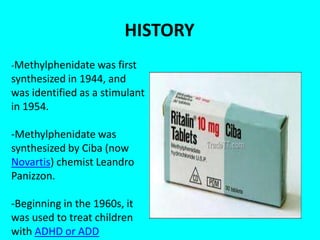
HISTORY
-Methylphenidate was first

synthesized in 1944, and
was identified as a stimulant
in 1954.
-Methylphenidate was
synthesized by Ciba (now
Novartis) chemist Leandro
Panizzon.
-Beginning in the 1960s, it
was used to treat children
with ADHD or ADD
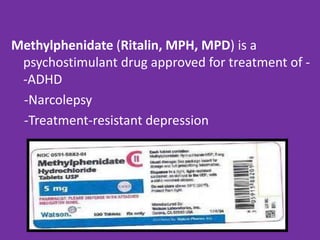
Methylphenidate (Ritalin, MPH, MPD) is a
psychostimulant drug approved for treatment of -ADHD
-Narcolepsy
-Treatment-resistant depression
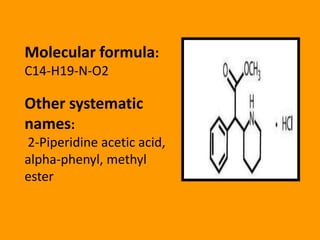
Molecular formula:
C14-H19-N-O2

Other systematic
names:
2-Piperidine acetic acid,
alpha-phenyl, methyl
ester
BRANDS & AVAILABLE FORMS
• The dosage forms of methylphenidate are tablets, capsules, patches,
and liquid.
• A formulation by the Novartis trademark name Ritalin, is an
immediate-release racemic mixture, although a variety of
formulations and generic brand names exist.
• Generic brand names include Ritalina, Rilatine, Attenta, Metadate,
Methylin, and Rubifen.
• sustained release tablets or capsules Concerta, Metadate CD,
Methylin ER, Ritalin LA, and Ritalin-SR
• Focalin is a preparation containing only dextro-methylphenidate
• Transdermal patch (under the brand name Daytrana)
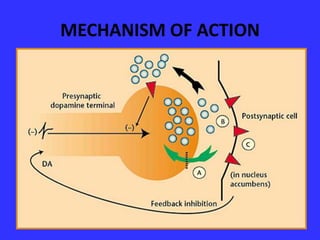
MECHANISM OF ACTION
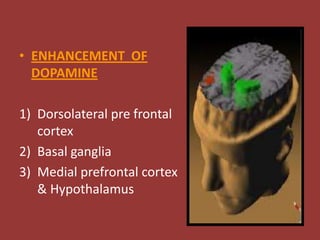
• ENHANCEMENT OF
DOPAMINE
1) Dorsolateral pre frontal
cortex
2) Basal ganglia
3) Medial prefrontal cortex
& Hypothalamus
SIDE EFFECTS
• COMMONLY SEEN:
-Insomnia
-Headache
-Dizziness
-Tremor
-Anorexia
-Abdominal pain
-Weight loss
• LIFE THREATENING SIDE
EFFECTS:
- Psychotic episodes
- Seizures
- CVS adverse effects
• PHARMACOKINETICS:
Half life
Adults- 3.5 hrs
Children- 2.5 hrs
DOSAGE
• ADHD
- Upto 2mg/kg/day
in children > 6yrs age
max dose 60mg/day
- Adults : 20-30mg/day
max dose 40-60mg/day
• NARCOLEPSY
- 20 to 60 mg/day
in 2-3 divided doses
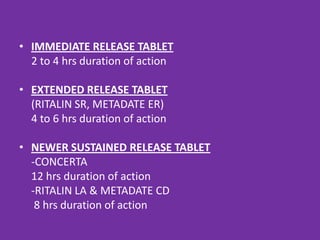
• IMMEDIATE RELEASE TABLET
2 to 4 hrs duration of action
• EXTENDED RELEASE TABLET
(RITALIN SR, METADATE ER)
4 to 6 hrs duration of action
• NEWER SUSTAINED RELEASE TABLET
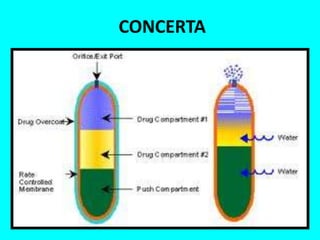
-CONCERTA
12 hrs duration of action
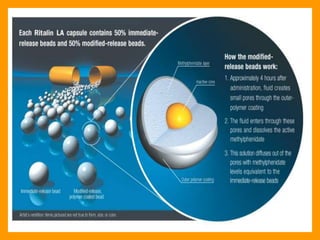
-RITALIN LA & METADATE CD
8 hrs duration of action
CONCERTA
ABUSE POTENTIAL
- Schedule II drug

- Methylphenidate has high potential for abuse due to
its pharmacological similarity to cocaine and
amphetamines
- Methylphenidate, like other stimulants, increases
dopamine levels in the brain, but at therapeutic doses
this increase is slow, and thus euphoria does not
typically occur except in rare instances.
- The abuse potential is increased when
methylphenidate is crushed and insufflated (snorted),
or when it is injected, producing effects somewhat
similar to cocaine.
DRUG INTERACTIONS
1) Methylphenidate use within 14 days of MAO
inhibitors is not advised
2) It could inhibit antipsychotic drugs actions
3) No dose adjustments in hepatic & renal
impairment, used with caution in cardiac
impairment
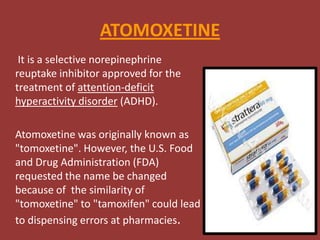
ATOMOXETINE
It is a selective norepinephrine
reuptake inhibitor approved for the
treatment of attention-deficit
hyperactivity disorder (ADHD).

Atomoxetine was originally known as
"tomoxetine". However, the U.S. Food
and Drug Administration (FDA)
requested the name be changed
because of the similarity of
"tomoxetine" to "tamoxifen" could lead
to dispensing errors at pharmacies.
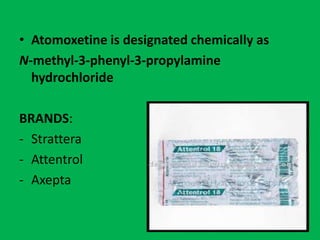
• Atomoxetine is designated chemically as
N-methyl-3-phenyl-3-propylamine
hydrochloride
BRANDS:
- Strattera
- Attentrol
- Axepta
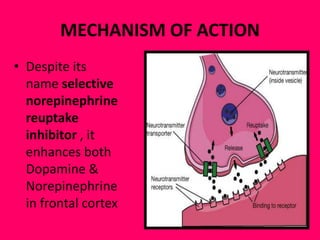
MECHANISM OF ACTION
• Despite its
name selective
norepinephrine
reuptake
inhibitor , it
enhances both
Dopamine &
Norepinephrine
in frontal cortex
• Atomoxetine may be preferred over
amphetamine-based stimulants in patients
with :
• psychiatric disorders,
• those who cannot tolerate stimulants,
• and those with a substance misuse recurring
history.
SIDE EFFECTS
• Commonly seen:
-decreased appetite
-increase HR & BP
-Insomnia, dizziness, anxiety, agitation ,
aggression, irritability, sweating
-Dry mouth , nausea , vomiting, dyspepsia,
abdominal pain,
-Urinary hesitency & retention
-Sexual dysfunctions
•
-

DANGEROUS SIDE EFFECTS:
Increase HR & BP
Liver damage
Induction of mania
Suicidal ideation

• PHARMACOKINETICS:
Hepatic Metabolism by CYP450 2D6
Half life 5 hrs
Excretion : mainly urine
Time to peak , plasma: 1-2 hrs
DOSAGE
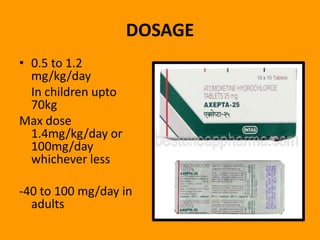
• 0.5 to 1.2
mg/kg/day
In children upto
70kg
Max dose
1.4mg/kg/day or
100mg/day
whichever less

-40 to 100 mg/day in
adults
ABUSE POTENTIAL
• Lack of enhancing
dopamine activity
in limbic area
theoretically
explains
atomoxetine’s lack
of abuse potential.
DRUG INTERACTIONS
• Drugs inhibiting CYP 450 2D6 increases plasma
concentration of atomoxetine
• Atomoxetine not to be used with or within 14
days of MAOIs use.
• No dose adjustment in renal impairment
• Dose adjustment required in hepatic
impairment
• Caution in cardiac impairment.
THANKYOU…
REFERENCES
1] Kaplan & Sadock’s Comprehensive
Textbook Of Psychiatry
2] Stephen Stahl's
Essential Psychopharmacology
3] Stephen Stahl’s
Prescribers guide
4] The Maudsley’s Prescribing
Guidelines
QUESTIONS

atomoxetine & methylphenidilate

  • 1.
    - DR DEEPIKASINGH, RESIDENT, DEPT OF PSYCHIATRY, GSMC & KEMH
  • 3.
    DRUG TREATMENT: • STIMULANTDRUGS - METHYLPHENIDATE - DEXTROAMPHETAMINES • - NONSTIMULANT DRUGS ATOMOXETINE HCL BUPROPION VENLAFAXINE CLONIDINE, GUANAFACINE
  • 4.
    HISTORY -Methylphenidate was first synthesizedin 1944, and was identified as a stimulant in 1954. -Methylphenidate was synthesized by Ciba (now Novartis) chemist Leandro Panizzon. -Beginning in the 1960s, it was used to treat children with ADHD or ADD
  • 5.
    Methylphenidate (Ritalin, MPH,MPD) is a psychostimulant drug approved for treatment of -ADHD -Narcolepsy -Treatment-resistant depression
  • 6.
  • 7.
    BRANDS & AVAILABLEFORMS • The dosage forms of methylphenidate are tablets, capsules, patches, and liquid. • A formulation by the Novartis trademark name Ritalin, is an immediate-release racemic mixture, although a variety of formulations and generic brand names exist. • Generic brand names include Ritalina, Rilatine, Attenta, Metadate, Methylin, and Rubifen. • sustained release tablets or capsules Concerta, Metadate CD, Methylin ER, Ritalin LA, and Ritalin-SR • Focalin is a preparation containing only dextro-methylphenidate • Transdermal patch (under the brand name Daytrana)
  • 8.
  • 9.
    • ENHANCEMENT OF DOPAMINE 1)Dorsolateral pre frontal cortex 2) Basal ganglia 3) Medial prefrontal cortex & Hypothalamus
  • 10.
    SIDE EFFECTS • COMMONLYSEEN: -Insomnia -Headache -Dizziness -Tremor -Anorexia -Abdominal pain -Weight loss
  • 11.
    • LIFE THREATENINGSIDE EFFECTS: - Psychotic episodes - Seizures - CVS adverse effects • PHARMACOKINETICS: Half life Adults- 3.5 hrs Children- 2.5 hrs
  • 12.
    DOSAGE • ADHD - Upto2mg/kg/day in children > 6yrs age max dose 60mg/day - Adults : 20-30mg/day max dose 40-60mg/day • NARCOLEPSY - 20 to 60 mg/day in 2-3 divided doses
  • 13.
    • IMMEDIATE RELEASETABLET 2 to 4 hrs duration of action • EXTENDED RELEASE TABLET (RITALIN SR, METADATE ER) 4 to 6 hrs duration of action • NEWER SUSTAINED RELEASE TABLET -CONCERTA 12 hrs duration of action -RITALIN LA & METADATE CD 8 hrs duration of action
  • 14.
  • 16.
    ABUSE POTENTIAL - ScheduleII drug - Methylphenidate has high potential for abuse due to its pharmacological similarity to cocaine and amphetamines - Methylphenidate, like other stimulants, increases dopamine levels in the brain, but at therapeutic doses this increase is slow, and thus euphoria does not typically occur except in rare instances. - The abuse potential is increased when methylphenidate is crushed and insufflated (snorted), or when it is injected, producing effects somewhat similar to cocaine.
  • 17.
    DRUG INTERACTIONS 1) Methylphenidateuse within 14 days of MAO inhibitors is not advised 2) It could inhibit antipsychotic drugs actions 3) No dose adjustments in hepatic & renal impairment, used with caution in cardiac impairment
  • 19.
    ATOMOXETINE It is aselective norepinephrine reuptake inhibitor approved for the treatment of attention-deficit hyperactivity disorder (ADHD). Atomoxetine was originally known as "tomoxetine". However, the U.S. Food and Drug Administration (FDA) requested the name be changed because of the similarity of "tomoxetine" to "tamoxifen" could lead to dispensing errors at pharmacies.
  • 20.
    • Atomoxetine isdesignated chemically as N-methyl-3-phenyl-3-propylamine hydrochloride BRANDS: - Strattera - Attentrol - Axepta
  • 21.
    MECHANISM OF ACTION •Despite its name selective norepinephrine reuptake inhibitor , it enhances both Dopamine & Norepinephrine in frontal cortex
  • 22.
    • Atomoxetine maybe preferred over amphetamine-based stimulants in patients with : • psychiatric disorders, • those who cannot tolerate stimulants, • and those with a substance misuse recurring history.
  • 23.
    SIDE EFFECTS • Commonlyseen: -decreased appetite -increase HR & BP -Insomnia, dizziness, anxiety, agitation , aggression, irritability, sweating -Dry mouth , nausea , vomiting, dyspepsia, abdominal pain, -Urinary hesitency & retention -Sexual dysfunctions
  • 24.
    • - DANGEROUS SIDE EFFECTS: IncreaseHR & BP Liver damage Induction of mania Suicidal ideation • PHARMACOKINETICS: Hepatic Metabolism by CYP450 2D6 Half life 5 hrs Excretion : mainly urine Time to peak , plasma: 1-2 hrs
  • 25.
    DOSAGE • 0.5 to1.2 mg/kg/day In children upto 70kg Max dose 1.4mg/kg/day or 100mg/day whichever less -40 to 100 mg/day in adults
  • 26.
    ABUSE POTENTIAL • Lackof enhancing dopamine activity in limbic area theoretically explains atomoxetine’s lack of abuse potential.
  • 27.
    DRUG INTERACTIONS • Drugsinhibiting CYP 450 2D6 increases plasma concentration of atomoxetine • Atomoxetine not to be used with or within 14 days of MAOIs use. • No dose adjustment in renal impairment • Dose adjustment required in hepatic impairment • Caution in cardiac impairment.
  • 28.
  • 29.
    REFERENCES 1] Kaplan &Sadock’s Comprehensive Textbook Of Psychiatry 2] Stephen Stahl's Essential Psychopharmacology 3] Stephen Stahl’s Prescribers guide 4] The Maudsley’s Prescribing Guidelines
  • 30.