TIC DISORDER
Dr. Keerat Kaur
Post-graduate psychiatry resident
MGUMST, Jaipur
CONTENTS
Introduction
History
Classification
Epidemiology
Etiology
Clinical features
Diagnosis
Differential Diagnosis
Cormorbid Psychiatric
disorders
Treatment
INTRODUCTION
Tics are defined as:
• rapid, recurring
• Motor movements (Motor Tics), OR
• Vocalisations (Vocal Tics),
• Non-rhythmic
• involuntary/semivoluntary
• sudden in onset
3
They are complex, heterogenous,
neurodevelopmental disorders that are a
manifestation of interplay of genes &
environment.
Tics may change in frequency/anatomical
location/number/complexity/severity over
time.
May even persist during sleep.
4
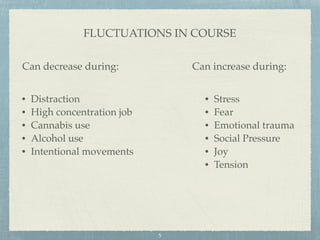
FLUCTUATIONS IN COURSE
Can decrease during: Can increase during:
• Distraction
• High concentration job
• Cannabis use
• Alcohol use
• Intentional movements
• Stress
• Fear
• Emotional trauma
• Social Pressure
• Joy
• Tension
5
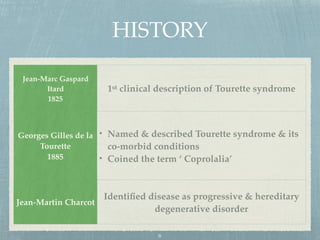
HISTORY
Jean-Marc Gaspard
Itard
1825
1st clinical description of Tourette syndrome
Georges Gilles de la
Tourette
1885
• Named & described Tourette syndrome & its
co-morbid conditions
• Coined the term ‘ Coprolalia’
Jean-Martin Charcot
Identified disease as progressive & hereditary
degenerative disorder
6
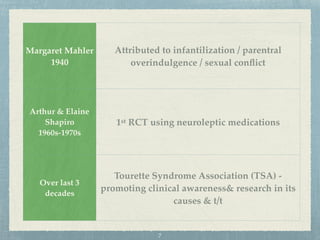
Margaret Mahler
1940
Attributed to infantilization / parentral
overindulgence / sexual conflict
Arthur & Elaine
Shapiro
1960s-1970s
1st RCT using neuroleptic medications
Over last 3
decades
Tourette Syndrome Association (TSA) -
promoting clinical awareness& research in its
causes & t/t
7
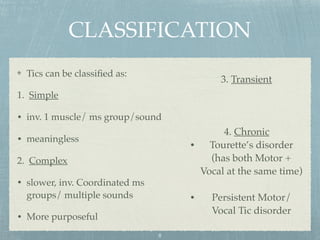
CLASSIFICATION
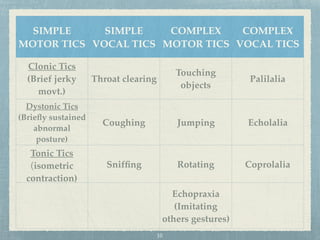
Tics can be classified as:
1. Simple
• inv. 1 muscle/ ms group/sound
• meaningless
2. Complex
• slower, inv. Coordinated ms
groups/ multiple sounds
• More purposeful
8
3. Transient
4. Chronic
• Tourette’s disorder
(has both Motor +
Vocal at the same time)
• Persistent Motor/
Vocal Tic disorder
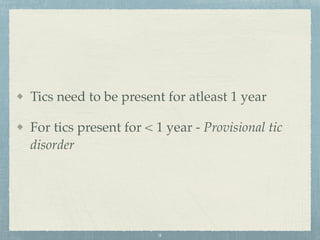
Tics need to be present for atleast 1 year
For tics present for < 1 year - Provisional tic
disorder
9
SIMPLE
MOTOR TICS
SIMPLE
VOCAL TICS
COMPLEX
MOTOR TICS
COMPLEX
VOCAL TICS
Clonic Tics
(Brief jerky
movt.)
Throat clearing
Touching
objects
Palilalia
Dystonic Tics
(Briefly sustained
abnormal
posture)
Coughing Jumping Echolalia
Tonic Tics
(isometric
contraction)
Sniffing Rotating Coprolalia
Echopraxia
(Imitating
others gestures)
10
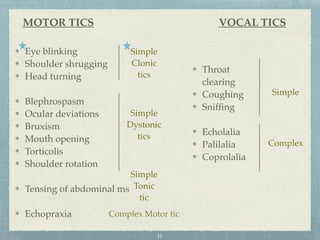
MOTOR TICS VOCAL TICS
Eye blinking
Shoulder shrugging
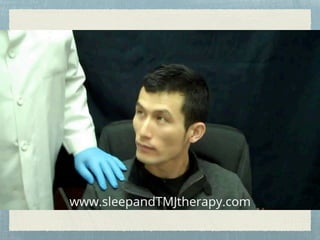
Head turning
Blephrospasm
Ocular deviations
Bruxism
Mouth opening
Torticolis
Shoulder rotation
Tensing of abdominal ms
Echopraxia
Throat
clearing
Coughing
Sniffing
Echolalia
Palilalia
Coprolalia
Simple
Clonic
tics
Simple
Dystonic
tics
Simple
Tonic
tic
Complex Motor tic
Simple
Complex
11
EPIDEMIOLOGY
Provisional tic disorder (motor + vocal
symptom)
• Most common
• Prevalence: 2-4%
3-4% are afflicted by Chronic tic disorder
Males > Females (3-4 times)
13
Tics may often persist into adulthood,
whereas
Tic severity declines in adolescence.
Tourette disorder
• 1% Prevalence
• Average age of onset: 6 years
14
Tics generally occur for the 1st time between
the ages of 2-15 years
However, peak age of onset: 6-8 years
15
Comorbidity with Tics :
1. ADHD
• Most frequent co-occuring condition
• ADHD + Tourette disorder = 60-70%
2. OCD
• OCD + Tourette disorder = 50%
3. Mood disorders
4. Anxiety disorder
16
ETIOLOGY
1. Genetic Factors
2. Neurochemical & Neuroanatomical Factors
3. Immunological Factors
17
Twin studies
Bilinear mode of familial transmission
First degree relatives of patients with Tic disorder are at
risk to develop OCD
Rare sequence variant in SLITRK1 on chromosome
13q31.1 (Abelson & colleagues)
Functional mutation in the HDC gene encoding l-
histidine decarboxylase (Ercan-Sencicek & colleagues)
A. GENETIC FACTORS
18
Involvement of cortico-striato-thalami-cortical
(CSTC) pathways in frontal lobes & basal ganglia
Neurotransmitters involved:
1. Dopamine
2. Serotonin
3. Endogenous opioids
B. NEUROCHEMICAL &
NEUROANATOMICAL FACTORS
19
Pathophysiology includes:
• Cortical & subcortical impairment
• Striatal abnormalities
• Disruption of temporo-limbic pathways of
CSTC circuits
20
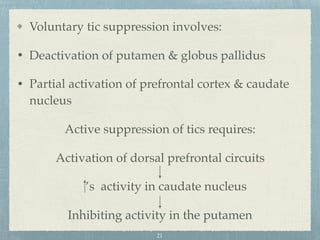
Voluntary tic suppression involves:
• Deactivation of putamen & globus pallidus
• Partial activation of prefrontal cortex & caudate
nucleus
Active suppression of tics requires:
Activation of dorsal prefrontal circuits
’s activity in caudate nucleus
Inhibiting activity in the putamen
21
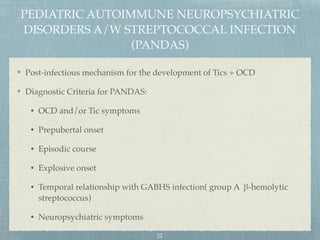
PEDIATRIC AUTOIMMUNE NEUROPSYCHIATRIC
DISORDERS A/W STREPTOCOCCAL INFECTION
(PANDAS)
Post-infectious mechanism for the development of Tics + OCD
Diagnostic Criteria for PANDAS:
• OCD and/or Tic symptoms
• Prepubertal onset
• Episodic course
• Explosive onset
• Temporal relationship with GABHS infection( group A β-hemolytic
streptococcus)
• Neuropsychiatric symptoms
22
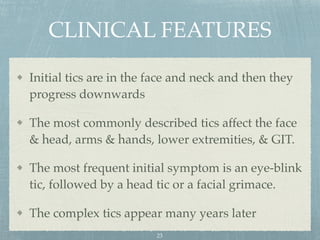
CLINICAL FEATURES
Initial tics are in the face and neck and then they
progress downwards
The most commonly described tics affect the face
& head, arms & hands, lower extremities, & GIT.
The most frequent initial symptom is an eye-blink
tic, followed by a head tic or a facial grimace.
The complex tics appear many years later
23
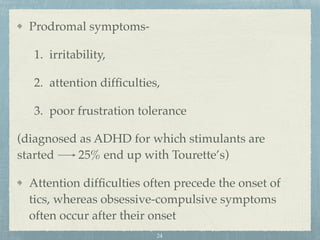
Prodromal symptoms-
1. irritability,
2. attention difficulties,
3. poor frustration tolerance
(diagnosed as ADHD for which stimulants are
started 25% end up with Tourette’s)
Attention difficulties often precede the onset of
tics, whereas obsessive-compulsive symptoms
often occur after their onset
24
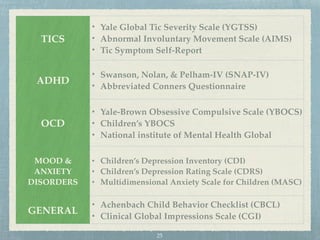
TICS
• Yale Global Tic Severity Scale (YGTSS)
• Abnormal Involuntary Movement Scale (AIMS)
• Tic Symptom Self-Report
ADHD
• Swanson, Nolan, & Pelham-IV (SNAP-IV)
• Abbreviated Conners Questionnaire
OCD
• Yale-Brown Obsessive Compulsive Scale (YBOCS)
• Children’s YBOCS
• National institute of Mental Health Global
MOOD &
ANXIETY
DISORDERS
• Children’s Depression Inventory (CDI)
• Children’s Depression Rating Scale (CDRS)
• Multidimensional Anxiety Scale for Children (MASC)
GENERAL
• Achenbach Child Behavior Checklist (CBCL)
• Clinical Global Impressions Scale (CGI)
25
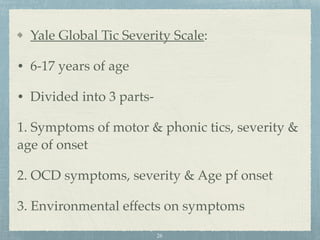
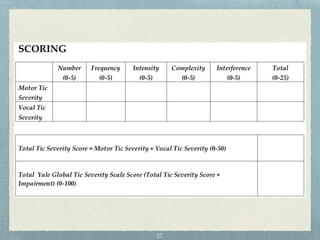
Yale Global Tic Severity Scale:
• 6-17 years of age
• Divided into 3 parts-
1. Symptoms of motor & phonic tics, severity &
age of onset
2. OCD symptoms, severity & Age pf onset
3. Environmental effects on symptoms
26
27
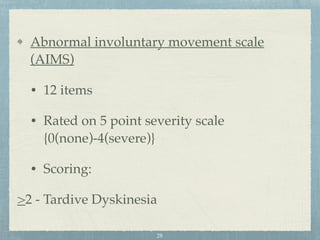
Abnormal involuntary movement scale
(AIMS)
• 12 items
• Rated on 5 point severity scale
{0(none)-4(severe)}
• Scoring:
>2 - Tardive Dyskinesia
28
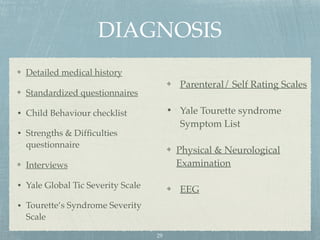
DIAGNOSIS
Detailed medical history
Standardized questionnaires
• Child Behaviour checklist
• Strengths & Difficulties
questionnaire
Interviews
• Yale Global Tic Severity Scale
• Tourette’s Syndrome Severity
Scale
Parenteral/ Self Rating Scales
• Yale Tourette syndrome
Symptom List
Physical & Neurological
Examination
EEG
29
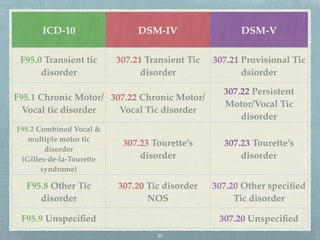
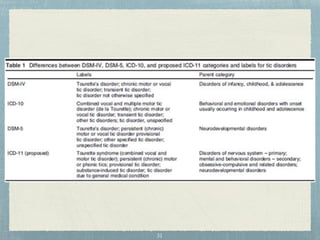
ICD-10 DSM-IV DSM-V
F95.0 Transient tic
disorder
307.21 Transient Tic
disorder
307.21 Provisional Tic
dsiorder
F95.1 Chronic Motor/
Vocal tic disorder
307.22 Chronic Motor/
Vocal Tic disorder
307.22 Persistent
Motor/Vocal Tic
disorder
F95.2 Combined Vocal &
multiple motor tic
disorder
(Gilles-de-la-Tourette
syndrome)
307.23 Tourette’s
disorder
307.23 Tourette’s
disorder
F95.8 Other Tic
disorder
307.20 Tic disorder
NOS
307.20 Other specified
Tic disorder
F95.9 Unspecified 307.20 Unspecified
30
31
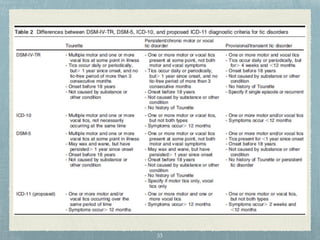
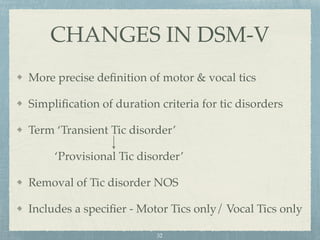
More precise definition of motor & vocal tics
Simplification of duration criteria for tic disorders
Term ‘Transient Tic disorder’
‘Provisional Tic disorder’
Removal of Tic disorder NOS
Includes a specifier - Motor Tics only/ Vocal Tics only
CHANGES IN DSM-V
32
33
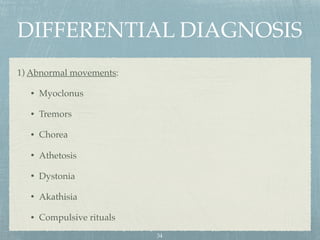
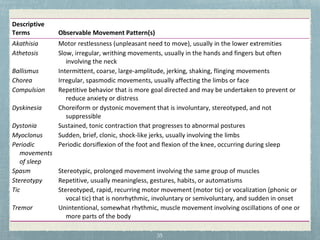
DIFFERENTIAL DIAGNOSIS
1) Abnormal movements:
• Myoclonus
• Tremors
• Chorea
• Athetosis
• Dystonia
• Akathisia
• Compulsive rituals
34
35
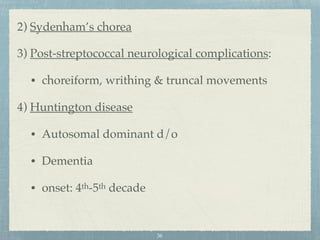
2) Sydenham’s chorea
3) Post-streptococcal neurological complications:
• choreiform, writhing & truncal movements
4) Huntington disease
• Autosomal dominant d/o
• Dementia
• onset: 4th-5th decade
36
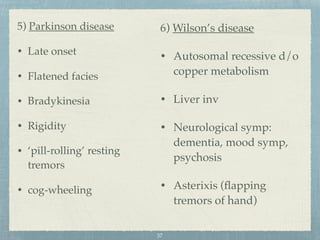
5) Parkinson disease
• Late onset
• Flatened facies
• Bradykinesia
• Rigidity
• ‘pill-rolling’ resting
tremors
• cog-wheeling
6) Wilson’s disease
• Autosomal recessive d/o
copper metabolism
• Liver inv
• Neurological symp:
dementia, mood symp,
psychosis
• Asterixis (flapping
tremors of hand)
37
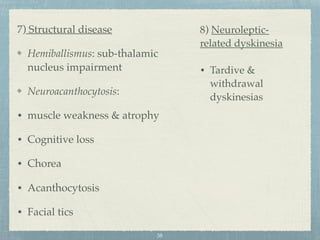
7) Structural disease
Hemiballismus: sub-thalamic
nucleus impairment
Neuroacanthocytosis:
• muscle weakness & atrophy
• Cognitive loss
• Chorea
• Acanthocytosis
• Facial tics
8) Neuroleptic-
related dyskinesia
• Tardive &
withdrawal
dyskinesias
38
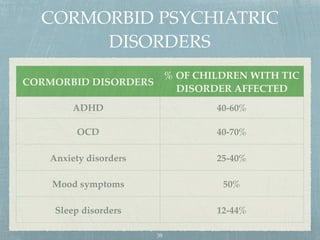
CORMORBID PSYCHIATRIC
DISORDERS
CORMORBID DISORDERS
% OF CHILDREN WITH TIC
DISORDER AFFECTED
ADHD 40-60%
OCD 40-70%
Anxiety disorders 25-40%
Mood symptoms 50%
Sleep disorders 12-44%
39
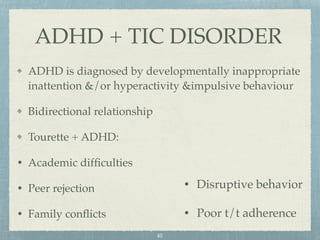
ADHD is diagnosed by developmentally inappropriate
inattention &/or hyperactivity &impulsive behaviour
Bidirectional relationship
Tourette + ADHD:
• Academic difficulties
• Peer rejection
• Family conflicts
ADHD + TIC DISORDER
• Disruptive behavior
• Poor t/t adherence
40
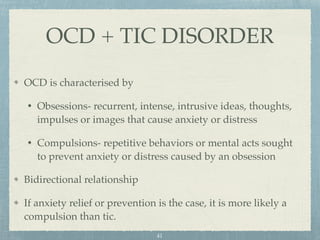
OCD is characterised by
• Obsessions- recurrent, intense, intrusive ideas, thoughts,
impulses or images that cause anxiety or distress
• Compulsions- repetitive behaviors or mental acts sought
to prevent anxiety or distress caused by an obsession
Bidirectional relationship
If anxiety relief or prevention is the case, it is more likely a
compulsion than tic.
OCD + TIC DISORDER
41
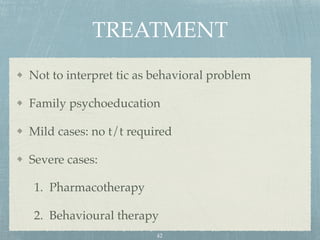
TREATMENT
Not to interpret tic as behavioral problem
Family psychoeducation
Mild cases: no t/t required
Severe cases:
1. Pharmacotherapy
2. Behavioural therapy
42
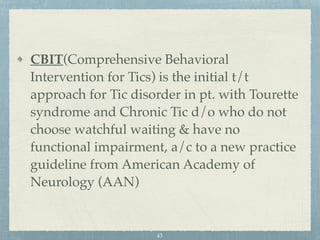
CBIT(Comprehensive Behavioral
Intervention for Tics) is the initial t/t
approach for Tic disorder in pt. with Tourette
syndrome and Chronic Tic d/o who do not
choose watchful waiting & have no
functional impairment, a/c to a new practice
guideline from American Academy of
Neurology (AAN)
43
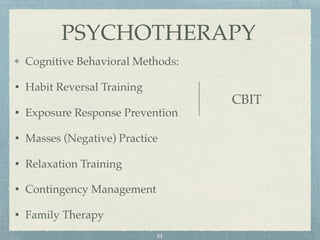
Cognitive Behavioral Methods:
• Habit Reversal Training
• Exposure Response Prevention
• Masses (Negative) Practice
• Relaxation Training
• Contingency Management
• Family Therapy
PSYCHOTHERAPY
44
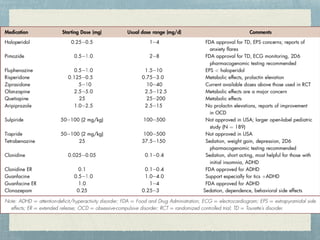
CBIT
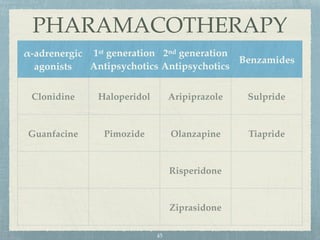
PHARAMACOTHERAPY
α-adrenergic
agonists
1st generation
Antipsychotics
2nd generation
Antipsychotics
Benzamides
Clonidine Haloperidol Aripiprazole Sulpride
Guanfacine Pimozide Olanzapine Tiapride
Risperidone
Ziprasidone
45
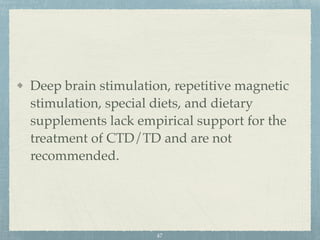
Deep brain stimulation, repetitive magnetic
stimulation, special diets, and dietary
supplements lack empirical support for the
treatment of CTD/TD and are not
recommended.
47
REFERENCES
Kaplan & Sadock’s Comprehensive Textbook Of Psychiatry
Kaplan & Sadock’s Synopsis Of Psychiatry
Tourette’s disorder and other tic disorders in DSM-5: a
comment Eur Child Adolesc Psychiatry. 2013 February; 20(2):
71–74
Practice Parameter for the Assessment and Treatment of
Children and Adolescents With Tic Disorders. Journal of the
American Academy of Child & Adolescent Psychiatry, volume
52 number 12 december 2013.
48
Thank You

Tic disorder by Dr. Keerat

  • 1.
    TIC DISORDER Dr. KeeratKaur Post-graduate psychiatry resident MGUMST, Jaipur
  • 2.
  • 3.
    INTRODUCTION Tics are definedas: • rapid, recurring • Motor movements (Motor Tics), OR • Vocalisations (Vocal Tics), • Non-rhythmic • involuntary/semivoluntary • sudden in onset 3
  • 4.
    They are complex,heterogenous, neurodevelopmental disorders that are a manifestation of interplay of genes & environment. Tics may change in frequency/anatomical location/number/complexity/severity over time. May even persist during sleep. 4
  • 5.
    FLUCTUATIONS IN COURSE Candecrease during: Can increase during: • Distraction • High concentration job • Cannabis use • Alcohol use • Intentional movements • Stress • Fear • Emotional trauma • Social Pressure • Joy • Tension 5
  • 6.
    HISTORY Jean-Marc Gaspard Itard 1825 1st clinicaldescription of Tourette syndrome Georges Gilles de la Tourette 1885 • Named & described Tourette syndrome & its co-morbid conditions • Coined the term ‘ Coprolalia’ Jean-Martin Charcot Identified disease as progressive & hereditary degenerative disorder 6
  • 7.
    Margaret Mahler 1940 Attributed toinfantilization / parentral overindulgence / sexual conflict Arthur & Elaine Shapiro 1960s-1970s 1st RCT using neuroleptic medications Over last 3 decades Tourette Syndrome Association (TSA) - promoting clinical awareness& research in its causes & t/t 7
  • 8.
    CLASSIFICATION Tics can beclassified as: 1. Simple • inv. 1 muscle/ ms group/sound • meaningless 2. Complex • slower, inv. Coordinated ms groups/ multiple sounds • More purposeful 8 3. Transient 4. Chronic • Tourette’s disorder (has both Motor + Vocal at the same time) • Persistent Motor/ Vocal Tic disorder
  • 9.
    Tics need tobe present for atleast 1 year For tics present for < 1 year - Provisional tic disorder 9
  • 10.
    SIMPLE MOTOR TICS SIMPLE VOCAL TICS COMPLEX MOTORTICS COMPLEX VOCAL TICS Clonic Tics (Brief jerky movt.) Throat clearing Touching objects Palilalia Dystonic Tics (Briefly sustained abnormal posture) Coughing Jumping Echolalia Tonic Tics (isometric contraction) Sniffing Rotating Coprolalia Echopraxia (Imitating others gestures) 10
  • 11.
    MOTOR TICS VOCALTICS Eye blinking Shoulder shrugging Head turning Blephrospasm Ocular deviations Bruxism Mouth opening Torticolis Shoulder rotation Tensing of abdominal ms Echopraxia Throat clearing Coughing Sniffing Echolalia Palilalia Coprolalia Simple Clonic tics Simple Dystonic tics Simple Tonic tic Complex Motor tic Simple Complex 11
  • 13.
    EPIDEMIOLOGY Provisional tic disorder(motor + vocal symptom) • Most common • Prevalence: 2-4% 3-4% are afflicted by Chronic tic disorder Males > Females (3-4 times) 13
  • 14.
    Tics may oftenpersist into adulthood, whereas Tic severity declines in adolescence. Tourette disorder • 1% Prevalence • Average age of onset: 6 years 14
  • 15.
    Tics generally occurfor the 1st time between the ages of 2-15 years However, peak age of onset: 6-8 years 15
  • 16.
    Comorbidity with Tics: 1. ADHD • Most frequent co-occuring condition • ADHD + Tourette disorder = 60-70% 2. OCD • OCD + Tourette disorder = 50% 3. Mood disorders 4. Anxiety disorder 16
  • 17.
    ETIOLOGY 1. Genetic Factors 2.Neurochemical & Neuroanatomical Factors 3. Immunological Factors 17
  • 18.
    Twin studies Bilinear modeof familial transmission First degree relatives of patients with Tic disorder are at risk to develop OCD Rare sequence variant in SLITRK1 on chromosome 13q31.1 (Abelson & colleagues) Functional mutation in the HDC gene encoding l- histidine decarboxylase (Ercan-Sencicek & colleagues) A. GENETIC FACTORS 18
  • 19.
    Involvement of cortico-striato-thalami-cortical (CSTC)pathways in frontal lobes & basal ganglia Neurotransmitters involved: 1. Dopamine 2. Serotonin 3. Endogenous opioids B. NEUROCHEMICAL & NEUROANATOMICAL FACTORS 19
  • 20.
    Pathophysiology includes: • Cortical& subcortical impairment • Striatal abnormalities • Disruption of temporo-limbic pathways of CSTC circuits 20
  • 21.
    Voluntary tic suppressioninvolves: • Deactivation of putamen & globus pallidus • Partial activation of prefrontal cortex & caudate nucleus Active suppression of tics requires: Activation of dorsal prefrontal circuits ’s activity in caudate nucleus Inhibiting activity in the putamen 21
  • 22.
    PEDIATRIC AUTOIMMUNE NEUROPSYCHIATRIC DISORDERSA/W STREPTOCOCCAL INFECTION (PANDAS) Post-infectious mechanism for the development of Tics + OCD Diagnostic Criteria for PANDAS: • OCD and/or Tic symptoms • Prepubertal onset • Episodic course • Explosive onset • Temporal relationship with GABHS infection( group A β-hemolytic streptococcus) • Neuropsychiatric symptoms 22
  • 23.
    CLINICAL FEATURES Initial ticsare in the face and neck and then they progress downwards The most commonly described tics affect the face & head, arms & hands, lower extremities, & GIT. The most frequent initial symptom is an eye-blink tic, followed by a head tic or a facial grimace. The complex tics appear many years later 23
  • 24.
    Prodromal symptoms- 1. irritability, 2.attention difficulties, 3. poor frustration tolerance (diagnosed as ADHD for which stimulants are started 25% end up with Tourette’s) Attention difficulties often precede the onset of tics, whereas obsessive-compulsive symptoms often occur after their onset 24
  • 25.
    TICS • Yale GlobalTic Severity Scale (YGTSS) • Abnormal Involuntary Movement Scale (AIMS) • Tic Symptom Self-Report ADHD • Swanson, Nolan, & Pelham-IV (SNAP-IV) • Abbreviated Conners Questionnaire OCD • Yale-Brown Obsessive Compulsive Scale (YBOCS) • Children’s YBOCS • National institute of Mental Health Global MOOD & ANXIETY DISORDERS • Children’s Depression Inventory (CDI) • Children’s Depression Rating Scale (CDRS) • Multidimensional Anxiety Scale for Children (MASC) GENERAL • Achenbach Child Behavior Checklist (CBCL) • Clinical Global Impressions Scale (CGI) 25
  • 26.
    Yale Global TicSeverity Scale: • 6-17 years of age • Divided into 3 parts- 1. Symptoms of motor & phonic tics, severity & age of onset 2. OCD symptoms, severity & Age pf onset 3. Environmental effects on symptoms 26
  • 27.
  • 28.
    Abnormal involuntary movementscale (AIMS) • 12 items • Rated on 5 point severity scale {0(none)-4(severe)} • Scoring: >2 - Tardive Dyskinesia 28
  • 29.
    DIAGNOSIS Detailed medical history Standardizedquestionnaires • Child Behaviour checklist • Strengths & Difficulties questionnaire Interviews • Yale Global Tic Severity Scale • Tourette’s Syndrome Severity Scale Parenteral/ Self Rating Scales • Yale Tourette syndrome Symptom List Physical & Neurological Examination EEG 29
  • 30.
    ICD-10 DSM-IV DSM-V F95.0Transient tic disorder 307.21 Transient Tic disorder 307.21 Provisional Tic dsiorder F95.1 Chronic Motor/ Vocal tic disorder 307.22 Chronic Motor/ Vocal Tic disorder 307.22 Persistent Motor/Vocal Tic disorder F95.2 Combined Vocal & multiple motor tic disorder (Gilles-de-la-Tourette syndrome) 307.23 Tourette’s disorder 307.23 Tourette’s disorder F95.8 Other Tic disorder 307.20 Tic disorder NOS 307.20 Other specified Tic disorder F95.9 Unspecified 307.20 Unspecified 30
  • 31.
  • 32.
    More precise definitionof motor & vocal tics Simplification of duration criteria for tic disorders Term ‘Transient Tic disorder’ ‘Provisional Tic disorder’ Removal of Tic disorder NOS Includes a specifier - Motor Tics only/ Vocal Tics only CHANGES IN DSM-V 32
  • 33.
  • 34.
    DIFFERENTIAL DIAGNOSIS 1) Abnormalmovements: • Myoclonus • Tremors • Chorea • Athetosis • Dystonia • Akathisia • Compulsive rituals 34
  • 35.
  • 36.
    2) Sydenham’s chorea 3)Post-streptococcal neurological complications: • choreiform, writhing & truncal movements 4) Huntington disease • Autosomal dominant d/o • Dementia • onset: 4th-5th decade 36
  • 37.
    5) Parkinson disease •Late onset • Flatened facies • Bradykinesia • Rigidity • ‘pill-rolling’ resting tremors • cog-wheeling 6) Wilson’s disease • Autosomal recessive d/o copper metabolism • Liver inv • Neurological symp: dementia, mood symp, psychosis • Asterixis (flapping tremors of hand) 37
  • 38.
    7) Structural disease Hemiballismus:sub-thalamic nucleus impairment Neuroacanthocytosis: • muscle weakness & atrophy • Cognitive loss • Chorea • Acanthocytosis • Facial tics 8) Neuroleptic- related dyskinesia • Tardive & withdrawal dyskinesias 38
  • 39.
    CORMORBID PSYCHIATRIC DISORDERS CORMORBID DISORDERS %OF CHILDREN WITH TIC DISORDER AFFECTED ADHD 40-60% OCD 40-70% Anxiety disorders 25-40% Mood symptoms 50% Sleep disorders 12-44% 39
  • 40.
    ADHD is diagnosedby developmentally inappropriate inattention &/or hyperactivity &impulsive behaviour Bidirectional relationship Tourette + ADHD: • Academic difficulties • Peer rejection • Family conflicts ADHD + TIC DISORDER • Disruptive behavior • Poor t/t adherence 40
  • 41.
    OCD is characterisedby • Obsessions- recurrent, intense, intrusive ideas, thoughts, impulses or images that cause anxiety or distress • Compulsions- repetitive behaviors or mental acts sought to prevent anxiety or distress caused by an obsession Bidirectional relationship If anxiety relief or prevention is the case, it is more likely a compulsion than tic. OCD + TIC DISORDER 41
  • 42.
    TREATMENT Not to interprettic as behavioral problem Family psychoeducation Mild cases: no t/t required Severe cases: 1. Pharmacotherapy 2. Behavioural therapy 42
  • 43.
    CBIT(Comprehensive Behavioral Intervention forTics) is the initial t/t approach for Tic disorder in pt. with Tourette syndrome and Chronic Tic d/o who do not choose watchful waiting & have no functional impairment, a/c to a new practice guideline from American Academy of Neurology (AAN) 43
  • 44.
    Cognitive Behavioral Methods: •Habit Reversal Training • Exposure Response Prevention • Masses (Negative) Practice • Relaxation Training • Contingency Management • Family Therapy PSYCHOTHERAPY 44 CBIT
  • 45.
    PHARAMACOTHERAPY α-adrenergic agonists 1st generation Antipsychotics 2nd generation Antipsychotics Benzamides ClonidineHaloperidol Aripiprazole Sulpride Guanfacine Pimozide Olanzapine Tiapride Risperidone Ziprasidone 45
  • 47.
    Deep brain stimulation,repetitive magnetic stimulation, special diets, and dietary supplements lack empirical support for the treatment of CTD/TD and are not recommended. 47
  • 48.
    REFERENCES Kaplan & Sadock’sComprehensive Textbook Of Psychiatry Kaplan & Sadock’s Synopsis Of Psychiatry Tourette’s disorder and other tic disorders in DSM-5: a comment Eur Child Adolesc Psychiatry. 2013 February; 20(2): 71–74 Practice Parameter for the Assessment and Treatment of Children and Adolescents With Tic Disorders. Journal of the American Academy of Child & Adolescent Psychiatry, volume 52 number 12 december 2013. 48
  • 49.