TIC DISORDER
Dr. Tabassum Fariha,
FCPS Part – II Trainee,
Department of Psychiatry,
Chattogram Medical College &
Hospital.
TIC DISORDER
A tic is a sudden, rapid, recurrent, non-rhythmic motor
movement or vocalization.
 Involve increase dopamine in basal ganglia.
TYPES
• F 95.2 Tourette's disorder
• F95.1 Persistent ( chronic) motor or vocal tic disorder
Specify if: with Motor tics only, with vocal tics only
• F95: Provisional tic disorder
• F 95.8 Other specified tic disorder
• F95.9 Unspecified tic disorder
TOURETTE’S DISORDER
• This condition was first described by Jean Itard in 1825 and subsequently
by George Gilles de la Tourette in 1885. It is the most common tic
disorder.
• It is defined by both motor and Vocal tics ( grunting, snarling and similar
ejaculation)
• Up to 1/3 exhibit coprolalia
• Around 10-40% exhibit echolalia or echopraxia.
• There may be stereotyped movement such as dancing and jumping.
TOURETTE’S DISORDER
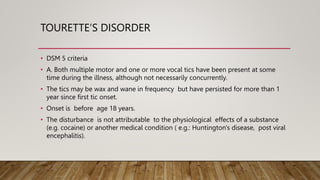
• DSM 5 criteria
• A. Both multiple motor and one or more vocal tics have been present at some
time during the illness, although not necessarily concurrently.
• The tics may be wax and wane in frequency but have persisted for more than 1
year since first tic onset.
• Onset is before age 18 years.
• The disturbance is not attributable to the physiological effects of a substance
(e.g. cocaine) or another medical condition ( e.g.: Huntington's disease, post viral
encephalitis).
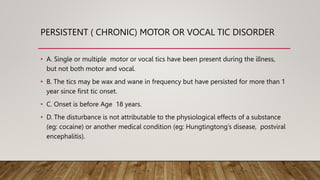
PERSISTENT ( CHRONIC) MOTOR OR VOCAL TIC DISORDER
• A. Single or multiple motor or vocal tics have been present during the illness,
but not both motor and vocal.
• B. The tics may be wax and wane in frequency but have persisted for more than 1
year since first tic onset.
• C. Onset is before Age 18 years.
• D. The disturbance is not attributable to the physiological effects of a substance
(eg: cocaine) or another medical condition (eg: Hungtingtong’s disease, postviral
encephalitis).
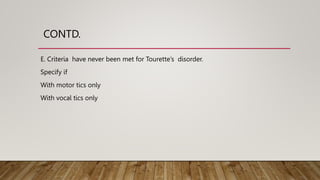
CONTD.
E. Criteria have never been met for Tourette’s disorder.
Specify if
With motor tics only
With vocal tics only
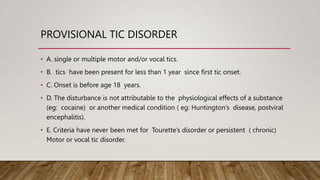
PROVISIONAL TIC DISORDER
• A. single or multiple motor and/or vocal tics.
• B. tics have been present for less than 1 year since first tic onset.
• C. Onset is before age 18 years.
• D. The disturbance is not attributable to the physiological effects of a substance
(eg: cocaine) or another medical condition ( eg: Huntington’s disease, postviral
encephalitis).
• E. Criteria have never been met for Tourette’s disorder or persistent ( chronic)
Motor or vocal tic disorder.
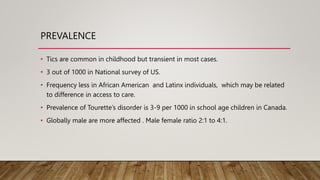
PREVALENCE
• Tics are common in childhood but transient in most cases.
• 3 out of 1000 in National survey of US.
• Frequency less in African American and Latinx individuals, which may be related
to difference in access to care.
• Prevalence of Tourette’s disorder is 3-9 per 1000 in school age children in Canada.
• Globally male are more affected . Male female ratio 2:1 to 4:1.
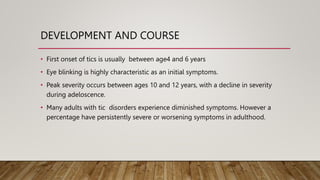
DEVELOPMENT AND COURSE
• First onset of tics is usually between age4 and 6 years
• Eye blinking is highly characteristic as an initial symptoms.
• Peak severity occurs between ages 10 and 12 years, with a decline in severity
during adeloscence.
• Many adults with tic disorders experience diminished symptoms. However a
percentage have persistently severe or worsening symptoms in adulthood.
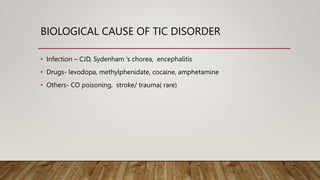
BIOLOGICAL CAUSE OF TIC DISORDER
• Infection – CJD, Sydenham ‘s chorea, encephalitis
• Drugs- levodopa, methylphenidate, cocaine, amphetamine
• Others- CO poisoning, stroke/ trauma( rare)
YALE GLOBAL TIC SEVERITY SCALE
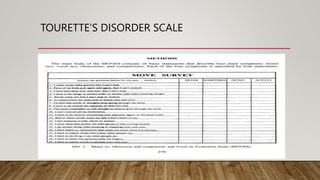
TOURETTE’S DISORDER SCALE
RISK AND PROGNOSTIC FACTORS
Environmental :
• Advanced paternal age
Pre and perinatal adverse events –
• Impaired fetal growth
• Maternal intra-partum fever
• Maternal smoking
• Severe maternal psychosocial
stress
• Preterm birth
• Breech presentation
• Cesarean delivery
GENETIC AND PHYSIOLOGICAL
• The hereditability of tic disorder is 70% -85%
• Chronic tic disorder have shared genetic varience with OCD, ADHD, ASD and
other neurodevelopmental disorder.
• Inviduals with tic disorder are at risk to develop an autoimmune disorder (eg:
Hashimoto’s thyroiditis) .
CO-MORBID CONDITIONS
• Pre-pubertal children with tic disorder are more likely to exhibit co – occurring
ADHD, OCD and separation anxiety disorder.
• Teenagers and adult are more vulnerable to developing mood and anxiety
disorders as well as substance use disorders.
COURSE MODIFIER'S
Tics
Increased by
anxiety,
excitement and
exhaustion
Improved
by calm,
focused
activities.
RISK OF SUICIDE IN TIC DISORDER
• Individuals with Tourette’s disorder or persistent (chronic)
motor or vocal tic disorder have a substantially increased
risk of suicide attempts ( odds ratio 3:86) and suicide
death (odds ratio 4:39),
• Persistence of tics after young adulthood and a prior
suicide attempt were the strong predictors of suicide
death.
RISK OF SUICIDE IN TIC DISORDER
• 1in10 youth with persistent motor or vocal tic disorder
has suicidal thoughts and/ or behaviors.
• Other predictors are – anxiety / depression, social
problems or withdrawal, aggression and internalizing
problems, tic severity, related impairment.
FUNCTIONAL CONSEQUENCES OF TIC DISORDER
• Many individuals with mild to moderate tic disorder experience no
distress or impairment in functioning and may even unware of
their tics.
• Individuals with severe symptoms generally have more impairment
in daily living.
• Co- occurring conditions like OCD, ADHD have greater impact on
functioning than the tics themselves.
DIFFERENTIAL DIAGNOSIS
1. Abnormal movements that may accompany other
medical conditions, including other movement
disorders.
2. Paroxysmal dyskinesia
3. Myoclonus
4. OCD
5. Functional tic disorder
CO-MORBIDITY
• ADHD
• OCD (orderliness, forbidden thoughts about religious, aggression,
sexual and related compulsions)
• Movement disorders (Sydenham ‘s chorea stereotypic movement
disorder)
• Other neurodevelopmental and psychiatric disorder( ASD, Specific
learning disorder)
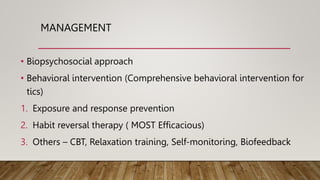
MANAGEMENT
• Biopsychosocial approach
• Behavioral intervention (Comprehensive behavioral intervention for
tics)
1. Exposure and response prevention
2. Habit reversal therapy ( MOST Efficacious)
3. Others – CBT, Relaxation training, Self-monitoring, Biofeedback
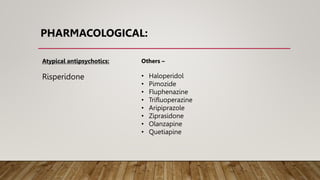
PHARMACOLOGICAL:
Atypical antipsychotics:
Risperidone
Others –
• Haloperidol
• Pimozide
• Fluphenazine
• Trifluoperazine
• Aripiprazole
• Ziprasidone
• Olanzapine
• Quetiapine
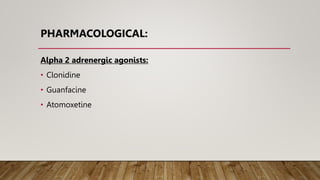
PHARMACOLOGICAL:
Alpha 2 adrenergic agonists:
• Clonidine
• Guanfacine
• Atomoxetine
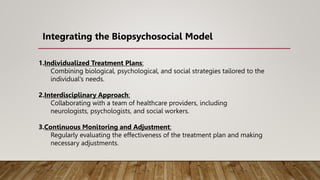
1.Individualized Treatment Plans:
Combining biological, psychological, and social strategies tailored to the
individual's needs.
2.Interdisciplinary Approach:
Collaborating with a team of healthcare providers, including
neurologists, psychologists, and social workers.
3.Continuous Monitoring and Adjustment:
Regularly evaluating the effectiveness of the treatment plan and making
necessary adjustments.
Integrating the Biopsychosocial Model
1.Initial Assessment:
Conduct a thorough assessment to understand the severity and impact
of tics.
2.Goal Setting:
Set realistic and achievable goals with the patient.
3.Regular Follow-ups:
Schedule regular check-ins to monitor progress and make adjustments.
4.Encourage Self-management:
Empower patients with tools and techniques to manage their tics
independently.
Practical Steps for Implementation
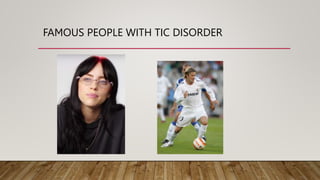
FAMOUS PEOPLE WITH TIC DISORDER
Thank
You!

Tic Disorder a comprehensive overview.pptx

  • 1.
    TIC DISORDER Dr. TabassumFariha, FCPS Part – II Trainee, Department of Psychiatry, Chattogram Medical College & Hospital.
  • 2.
    TIC DISORDER A ticis a sudden, rapid, recurrent, non-rhythmic motor movement or vocalization.  Involve increase dopamine in basal ganglia.
  • 3.
    TYPES • F 95.2Tourette's disorder • F95.1 Persistent ( chronic) motor or vocal tic disorder Specify if: with Motor tics only, with vocal tics only • F95: Provisional tic disorder • F 95.8 Other specified tic disorder • F95.9 Unspecified tic disorder
  • 4.
    TOURETTE’S DISORDER • Thiscondition was first described by Jean Itard in 1825 and subsequently by George Gilles de la Tourette in 1885. It is the most common tic disorder. • It is defined by both motor and Vocal tics ( grunting, snarling and similar ejaculation) • Up to 1/3 exhibit coprolalia • Around 10-40% exhibit echolalia or echopraxia. • There may be stereotyped movement such as dancing and jumping.
  • 5.
    TOURETTE’S DISORDER • DSM5 criteria • A. Both multiple motor and one or more vocal tics have been present at some time during the illness, although not necessarily concurrently. • The tics may be wax and wane in frequency but have persisted for more than 1 year since first tic onset. • Onset is before age 18 years. • The disturbance is not attributable to the physiological effects of a substance (e.g. cocaine) or another medical condition ( e.g.: Huntington's disease, post viral encephalitis).
  • 6.
    PERSISTENT ( CHRONIC)MOTOR OR VOCAL TIC DISORDER • A. Single or multiple motor or vocal tics have been present during the illness, but not both motor and vocal. • B. The tics may be wax and wane in frequency but have persisted for more than 1 year since first tic onset. • C. Onset is before Age 18 years. • D. The disturbance is not attributable to the physiological effects of a substance (eg: cocaine) or another medical condition (eg: Hungtingtong’s disease, postviral encephalitis).
  • 7.
    CONTD. E. Criteria havenever been met for Tourette’s disorder. Specify if With motor tics only With vocal tics only
  • 8.
    PROVISIONAL TIC DISORDER •A. single or multiple motor and/or vocal tics. • B. tics have been present for less than 1 year since first tic onset. • C. Onset is before age 18 years. • D. The disturbance is not attributable to the physiological effects of a substance (eg: cocaine) or another medical condition ( eg: Huntington’s disease, postviral encephalitis). • E. Criteria have never been met for Tourette’s disorder or persistent ( chronic) Motor or vocal tic disorder.
  • 9.
    PREVALENCE • Tics arecommon in childhood but transient in most cases. • 3 out of 1000 in National survey of US. • Frequency less in African American and Latinx individuals, which may be related to difference in access to care. • Prevalence of Tourette’s disorder is 3-9 per 1000 in school age children in Canada. • Globally male are more affected . Male female ratio 2:1 to 4:1.
  • 10.
    DEVELOPMENT AND COURSE •First onset of tics is usually between age4 and 6 years • Eye blinking is highly characteristic as an initial symptoms. • Peak severity occurs between ages 10 and 12 years, with a decline in severity during adeloscence. • Many adults with tic disorders experience diminished symptoms. However a percentage have persistently severe or worsening symptoms in adulthood.
  • 11.
    BIOLOGICAL CAUSE OFTIC DISORDER • Infection – CJD, Sydenham ‘s chorea, encephalitis • Drugs- levodopa, methylphenidate, cocaine, amphetamine • Others- CO poisoning, stroke/ trauma( rare)
  • 12.
    YALE GLOBAL TICSEVERITY SCALE
  • 16.
  • 17.
    RISK AND PROGNOSTICFACTORS Environmental : • Advanced paternal age Pre and perinatal adverse events – • Impaired fetal growth • Maternal intra-partum fever • Maternal smoking • Severe maternal psychosocial stress • Preterm birth • Breech presentation • Cesarean delivery
  • 18.
    GENETIC AND PHYSIOLOGICAL •The hereditability of tic disorder is 70% -85% • Chronic tic disorder have shared genetic varience with OCD, ADHD, ASD and other neurodevelopmental disorder. • Inviduals with tic disorder are at risk to develop an autoimmune disorder (eg: Hashimoto’s thyroiditis) .
  • 19.
    CO-MORBID CONDITIONS • Pre-pubertalchildren with tic disorder are more likely to exhibit co – occurring ADHD, OCD and separation anxiety disorder. • Teenagers and adult are more vulnerable to developing mood and anxiety disorders as well as substance use disorders.
  • 20.
    COURSE MODIFIER'S Tics Increased by anxiety, excitementand exhaustion Improved by calm, focused activities.
  • 21.
    RISK OF SUICIDEIN TIC DISORDER • Individuals with Tourette’s disorder or persistent (chronic) motor or vocal tic disorder have a substantially increased risk of suicide attempts ( odds ratio 3:86) and suicide death (odds ratio 4:39), • Persistence of tics after young adulthood and a prior suicide attempt were the strong predictors of suicide death.
  • 22.
    RISK OF SUICIDEIN TIC DISORDER • 1in10 youth with persistent motor or vocal tic disorder has suicidal thoughts and/ or behaviors. • Other predictors are – anxiety / depression, social problems or withdrawal, aggression and internalizing problems, tic severity, related impairment.
  • 23.
    FUNCTIONAL CONSEQUENCES OFTIC DISORDER • Many individuals with mild to moderate tic disorder experience no distress or impairment in functioning and may even unware of their tics. • Individuals with severe symptoms generally have more impairment in daily living. • Co- occurring conditions like OCD, ADHD have greater impact on functioning than the tics themselves.
  • 24.
    DIFFERENTIAL DIAGNOSIS 1. Abnormalmovements that may accompany other medical conditions, including other movement disorders. 2. Paroxysmal dyskinesia 3. Myoclonus 4. OCD 5. Functional tic disorder
  • 25.
    CO-MORBIDITY • ADHD • OCD(orderliness, forbidden thoughts about religious, aggression, sexual and related compulsions) • Movement disorders (Sydenham ‘s chorea stereotypic movement disorder) • Other neurodevelopmental and psychiatric disorder( ASD, Specific learning disorder)
  • 26.
    MANAGEMENT • Biopsychosocial approach •Behavioral intervention (Comprehensive behavioral intervention for tics) 1. Exposure and response prevention 2. Habit reversal therapy ( MOST Efficacious) 3. Others – CBT, Relaxation training, Self-monitoring, Biofeedback
  • 27.
    PHARMACOLOGICAL: Atypical antipsychotics: Risperidone Others – •Haloperidol • Pimozide • Fluphenazine • Trifluoperazine • Aripiprazole • Ziprasidone • Olanzapine • Quetiapine
  • 28.
    PHARMACOLOGICAL: Alpha 2 adrenergicagonists: • Clonidine • Guanfacine • Atomoxetine
  • 29.
    1.Individualized Treatment Plans: Combiningbiological, psychological, and social strategies tailored to the individual's needs. 2.Interdisciplinary Approach: Collaborating with a team of healthcare providers, including neurologists, psychologists, and social workers. 3.Continuous Monitoring and Adjustment: Regularly evaluating the effectiveness of the treatment plan and making necessary adjustments. Integrating the Biopsychosocial Model
  • 30.
    1.Initial Assessment: Conduct athorough assessment to understand the severity and impact of tics. 2.Goal Setting: Set realistic and achievable goals with the patient. 3.Regular Follow-ups: Schedule regular check-ins to monitor progress and make adjustments. 4.Encourage Self-management: Empower patients with tools and techniques to manage their tics independently. Practical Steps for Implementation
  • 31.
    FAMOUS PEOPLE WITHTIC DISORDER
  • 32.