REPUBLIC OF CAMEROON
****************
Peace – Work - Fatherland
************
REPUBLIQUE DU CAMEROUN
****************
Paix – Travail – Patrie
************
DEPARTMENT OF BIOCHEMISTRY
DEPARTEMENT DE BIOCHIMIE
Laboratory of Microbiology and Antimicrobial Substances (LAMAS)
University of Dschang
14 th of MARCH 2018
Universite de Dschang
Seminar 1
1
Presented by:
NANGWAT Claude
CM04-08SCI 1673
Option: Clinical Biochemistry
2
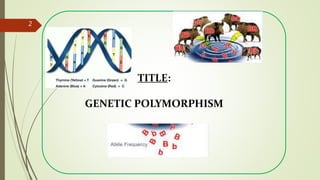
TITLE:
GENETIC POLYMORPHISM
3
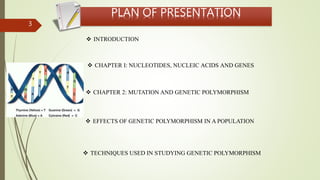
 CHAPTER I: NUCLEOTIDES, NUCLEIC ACIDS AND GENES
 INTRODUCTION
 CHAPTER 2: MUTATION AND GENETIC POLYMORPHISM
 TECHNIQUES USED IN STUDYING GENETIC POLYMORPHISM
 EFFECTS OF GENETIC POLYMORPHISM IN A POPULATION
PLAN OF PRESENTATION
4
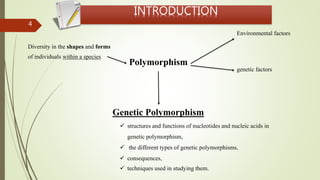
Polymorphism
Diversity in the shapes and forms
of individuals within a species
genetic factors
Environmental factors
Genetic Polymorphism
 structures and functions of nucleotides and nucleic acids in
genetic polymorphism,
 the different types of genetic polymorphisms,
 consequences,
 techniques used in studying them.
INTRODUCTION
5
CHAPTER I: NUCLEOTIDES, NUCLEIC ACIDS AND GENES
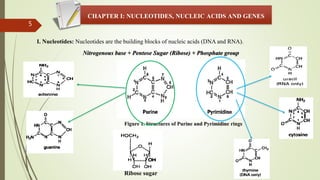
I. Nucleotides: Nucleotides are the building blocks of nucleic acids (DNA and RNA).
Figure 1. Structures of Purine and Pyrimidine rings
Nitrogenous base + Pentose Sugar (Ribose) + Phosphate group
Ribose sugar
6
CHAPTER I: NUCLEOTIDES, NUCLEIC ACIDS AND GENES
II. Nucleic acids
 Polynucleotides (long chains composed of nucleotide monomers) of high molecular
weights that are synthesized by living cells (Stenesh, 1989; Gajera et al., 2007).
 Occur as either DNA or RNA and may be either single-stranded or double stranded
(Stenesh, 1989).
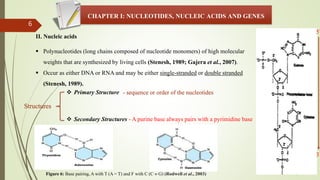
 Primary Structure - sequence or order of the nucleotides
 Secondary Structures
5’
3’
Figure 6: Base pairing, A with T (A = T) and F with C (C  G) (Rodwell et al., 2003)
Structures
- A purine base always pairs with a pyrimidine base
7
CHAPTER I: NUCLEOTIDES, NUCLEIC ACIDS AND GENES
III. Genes
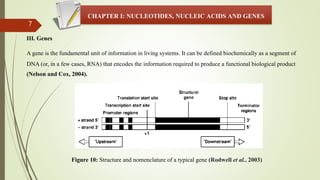
A gene is the fundamental unit of information in living systems. It can be defined biochemically as a segment of
DNA (or, in a few cases, RNA) that encodes the information required to produce a functional biological product
(Nelson and Cox, 2004).
Figure 10: Structure and nomenclature of a typical gene (Rodwell et al., 2003)
8
CHAPTER 2: MUTATION AND GENETIC POLYMORPHISM
Definition:
Genetic polymorphism is a term used in genetics to describe multiple forms of a single gene that exist in an
individual or among a group of individuals (Philips, 2016).
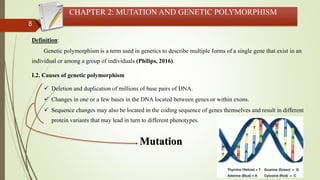
I.2. Causes of genetic polymorphism
 Deletion and duplication of millions of base pairs of DNA.
 Changes in one or a few bases in the DNA located between genes or within exons.
 Sequence changes may also be located in the coding sequence of genes themselves and result in different
protein variants that may lead in turn to different phenotypes.
Mutation
9
CHAPTER 2: MUTATION AND GENETIC POLYMORPHISM
1- Mutation
Definition:
A mutation is a permanent and transmissible change in DNA sequence.
In the living cell, DNA undergoes frequent chemical change, especially when it is being replicated (in S
phase of the eukaryotic cell cycle). Most of these changes are quickly repaired. Those that are not result in a
mutation. Thus, mutation is a failure of DNA repair.
It can be an insertion or deletion of genetic information, or an alteration in the original genetic information.
Mutations can either be harmless, helpful, or even hurtful. Sometimes, a mutation
may even cause dramatic changes in the physiology of an affected organism (Mico et al.,
2009).
10
CHAPTER 2: MUTATION AND GENETIC POLYMORPHISM
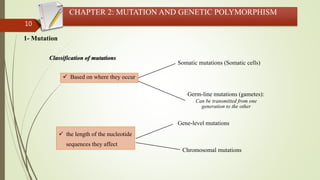
1- Mutation
 Based on where they occur
 the length of the nucleotide
sequences they affect
Classification of mutations
Somatic mutations (Somatic cells)
Germ-line mutations (gametes):
Can be transmitted from one
generation to the other
Gene-level mutations
Chromosomal mutations
11
CHAPTER 2: MUTATION AND GENETIC POLYMORPHISM
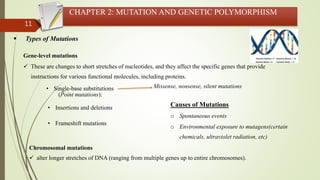
 Types of Mutations
Gene-level mutations
 These are changes to short stretches of nucleotides, and they affect the specific genes that provide
instructions for various functional molecules, including proteins.
Chromosomal mutations
 alter longer stretches of DNA (ranging from multiple genes up to entire chromosomes).
• Single-base substitutions
(Point mutations):
Missense, nonsense, silent mutations
• Insertions and deletions
• Frameshift mutations
Causes of Mutations
o Spontaneous events
o Environmental exposure to mutagens(certain
chemicals, ultraviolet radiation, etc)
12
CHAPTER 2: MUTATION AND GENETIC POLYMORPHISM
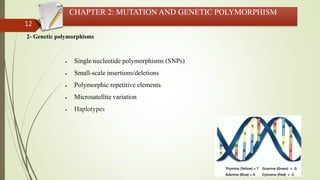
2- Genetic polymorphisms
 Single nucleotide polymorphisms (SNPs)
 Small-scale insertions/deletions
 Polymorphic repetitive elements
 Microsatellite variation
 Haplotypes
13
CHAPTER 2: MUTATION AND GENETIC POLYMORPHISM
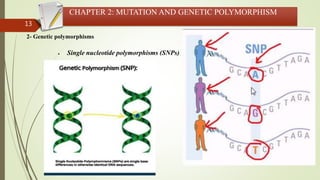
2- Genetic polymorphisms
 Single nucleotide polymorphisms (SNPs)
14
CHAPTER 2: MUTATION AND GENETIC POLYMORPHISM
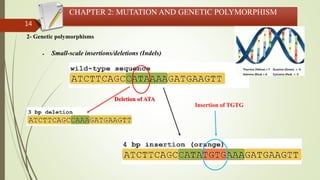
2- Genetic polymorphisms
 Small-scale insertions/deletions (Indels)
Deletion of ATA
Insertion of TGTG
15
CHAPTER 2: MUTATION AND GENETIC POLYMORPHISM
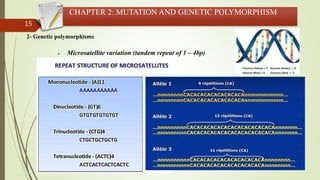
2- Genetic polymorphisms
 Microsatellite variation (tandem repeat of 1 – 4bp)
16
CHAPTER 2: MUTATION AND GENETIC POLYMORPHISM
2- Genetic polymorphisms
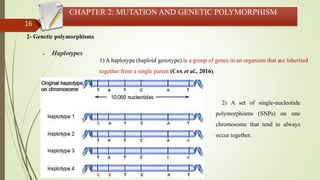
 Haplotypes
1) A haplotype (haploid genotype) is a group of genes in an organism that are inherited
together from a single parent (Cox et al., 2016).
2) A set of single-nucleotide
polymorphisms (SNPs) on one
chromosome that tend to always
occur together.
17
CHAPTER 2: MUTATION AND GENETIC POLYMORPHISM
2- Genetic polymorphisms
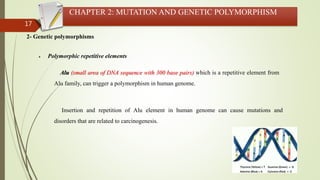
 Polymorphic repetitive elements
Alu (small area of DNA sequence with 300 base pairs) which is a repetitive element from
Alu family, can trigger a polymorphism in human genome.
Insertion and repetition of Alu element in human genome can cause mutations and
disorders that are related to carcinogenesis.
18
 May influence characteristics such as
height and hair colour,
 some do contribute to disease
susceptibility and can influence drug
responses.
What are the effects of Genetic Polymorphism
in a Population?
19
CHAPTER 2: MUTATION AND GENETIC POLYMORPHISM
2.1. Effects of Genetic Polymorphism in a Population
 Human blood groups
All the common blood types, such as the ABO blood group system, are genetic polymorphisms.
various phenotypes are more, or less, likely to suffer a variety of diseases.
For example, an individual's susceptibility to cholera (and other diarrheal
infections) is correlated with their blood type: those with type O blood are the most
susceptible, while those with type AB are the most resistant. Between these two
extremes are the A and B blood types, with type A being more resistant than type
B.
20
CHAPTER 2: MUTATION AND GENETIC POLYMORPHISM
2.1. Effects of Genetic Polymorphism in a Population
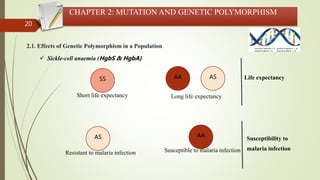
 Sickle-cell anaemia (HgbS & HgbA)
AAAS
Short life expectancy
SS
Resistant to malaria infection
AA AS
Susceptible to malaria infection
Long life expectancy
Life expectancy
Susceptibility to
malaria infection
21
V. TECHNIQUES USED IN STUDYING GENETIC POLYMORPHISM
1) DNA based markers
 Restriction Fragment Length Polymorphism (RFLP)
2) PCR based methods
 Randomly Amplified Polymorphic DNA (RAPD)
 Inter-simple sequence Repeat (ISSR)
 Simple Sequence Repeats (SSR) or microsatellites
 Amplified Fragment Length Polymorphisms (AFLP)
 Single nucleotide polymorphism SNP’s
 Array based platforms
 Diversity arrays technology (DArT)
 Restriction Site-Associated DNA (RAD)
 Single Feature Polymorphism (SFP)
 Internal Transcribed Spacer (ITS)
 Chloroplast DNA as source of genetic polymorphism
 Chloroplast Transfer RNAs (tRNAs)
 Chloroplast SSR
22
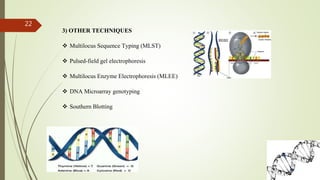
3) OTHER TECHNIQUES
 Multilocus Sequence Typing (MLST)
 Pulsed-field gel electrophoresis
 Multilocus Enzyme Electrophoresis (MLEE)
 DNA Microarray genotyping
 Southern Blotting
23
THANK YOU
FOR
YOUR
KEEN ATTENTION

Genetic polymorphism

  • 1.
    REPUBLIC OF CAMEROON **************** Peace– Work - Fatherland ************ REPUBLIQUE DU CAMEROUN **************** Paix – Travail – Patrie ************ DEPARTMENT OF BIOCHEMISTRY DEPARTEMENT DE BIOCHIMIE Laboratory of Microbiology and Antimicrobial Substances (LAMAS) University of Dschang 14 th of MARCH 2018 Universite de Dschang Seminar 1 1 Presented by: NANGWAT Claude CM04-08SCI 1673 Option: Clinical Biochemistry
  • 2.
  • 3.
    3  CHAPTER I:NUCLEOTIDES, NUCLEIC ACIDS AND GENES  INTRODUCTION  CHAPTER 2: MUTATION AND GENETIC POLYMORPHISM  TECHNIQUES USED IN STUDYING GENETIC POLYMORPHISM  EFFECTS OF GENETIC POLYMORPHISM IN A POPULATION PLAN OF PRESENTATION
  • 4.
    4 Polymorphism Diversity in theshapes and forms of individuals within a species genetic factors Environmental factors Genetic Polymorphism  structures and functions of nucleotides and nucleic acids in genetic polymorphism,  the different types of genetic polymorphisms,  consequences,  techniques used in studying them. INTRODUCTION
  • 5.
    5 CHAPTER I: NUCLEOTIDES,NUCLEIC ACIDS AND GENES I. Nucleotides: Nucleotides are the building blocks of nucleic acids (DNA and RNA). Figure 1. Structures of Purine and Pyrimidine rings Nitrogenous base + Pentose Sugar (Ribose) + Phosphate group Ribose sugar
  • 6.
    6 CHAPTER I: NUCLEOTIDES,NUCLEIC ACIDS AND GENES II. Nucleic acids  Polynucleotides (long chains composed of nucleotide monomers) of high molecular weights that are synthesized by living cells (Stenesh, 1989; Gajera et al., 2007).  Occur as either DNA or RNA and may be either single-stranded or double stranded (Stenesh, 1989).  Primary Structure - sequence or order of the nucleotides  Secondary Structures 5’ 3’ Figure 6: Base pairing, A with T (A = T) and F with C (C  G) (Rodwell et al., 2003) Structures - A purine base always pairs with a pyrimidine base
  • 7.
    7 CHAPTER I: NUCLEOTIDES,NUCLEIC ACIDS AND GENES III. Genes A gene is the fundamental unit of information in living systems. It can be defined biochemically as a segment of DNA (or, in a few cases, RNA) that encodes the information required to produce a functional biological product (Nelson and Cox, 2004). Figure 10: Structure and nomenclature of a typical gene (Rodwell et al., 2003)
  • 8.
    8 CHAPTER 2: MUTATIONAND GENETIC POLYMORPHISM Definition: Genetic polymorphism is a term used in genetics to describe multiple forms of a single gene that exist in an individual or among a group of individuals (Philips, 2016). I.2. Causes of genetic polymorphism  Deletion and duplication of millions of base pairs of DNA.  Changes in one or a few bases in the DNA located between genes or within exons.  Sequence changes may also be located in the coding sequence of genes themselves and result in different protein variants that may lead in turn to different phenotypes. Mutation
  • 9.
    9 CHAPTER 2: MUTATIONAND GENETIC POLYMORPHISM 1- Mutation Definition: A mutation is a permanent and transmissible change in DNA sequence. In the living cell, DNA undergoes frequent chemical change, especially when it is being replicated (in S phase of the eukaryotic cell cycle). Most of these changes are quickly repaired. Those that are not result in a mutation. Thus, mutation is a failure of DNA repair. It can be an insertion or deletion of genetic information, or an alteration in the original genetic information. Mutations can either be harmless, helpful, or even hurtful. Sometimes, a mutation may even cause dramatic changes in the physiology of an affected organism (Mico et al., 2009).
  • 10.
    10 CHAPTER 2: MUTATIONAND GENETIC POLYMORPHISM 1- Mutation  Based on where they occur  the length of the nucleotide sequences they affect Classification of mutations Somatic mutations (Somatic cells) Germ-line mutations (gametes): Can be transmitted from one generation to the other Gene-level mutations Chromosomal mutations
  • 11.
    11 CHAPTER 2: MUTATIONAND GENETIC POLYMORPHISM  Types of Mutations Gene-level mutations  These are changes to short stretches of nucleotides, and they affect the specific genes that provide instructions for various functional molecules, including proteins. Chromosomal mutations  alter longer stretches of DNA (ranging from multiple genes up to entire chromosomes). • Single-base substitutions (Point mutations): Missense, nonsense, silent mutations • Insertions and deletions • Frameshift mutations Causes of Mutations o Spontaneous events o Environmental exposure to mutagens(certain chemicals, ultraviolet radiation, etc)
  • 12.
    12 CHAPTER 2: MUTATIONAND GENETIC POLYMORPHISM 2- Genetic polymorphisms  Single nucleotide polymorphisms (SNPs)  Small-scale insertions/deletions  Polymorphic repetitive elements  Microsatellite variation  Haplotypes
  • 13.
    13 CHAPTER 2: MUTATIONAND GENETIC POLYMORPHISM 2- Genetic polymorphisms  Single nucleotide polymorphisms (SNPs)
  • 14.
    14 CHAPTER 2: MUTATIONAND GENETIC POLYMORPHISM 2- Genetic polymorphisms  Small-scale insertions/deletions (Indels) Deletion of ATA Insertion of TGTG
  • 15.
    15 CHAPTER 2: MUTATIONAND GENETIC POLYMORPHISM 2- Genetic polymorphisms  Microsatellite variation (tandem repeat of 1 – 4bp)
  • 16.
    16 CHAPTER 2: MUTATIONAND GENETIC POLYMORPHISM 2- Genetic polymorphisms  Haplotypes 1) A haplotype (haploid genotype) is a group of genes in an organism that are inherited together from a single parent (Cox et al., 2016). 2) A set of single-nucleotide polymorphisms (SNPs) on one chromosome that tend to always occur together.
  • 17.
    17 CHAPTER 2: MUTATIONAND GENETIC POLYMORPHISM 2- Genetic polymorphisms  Polymorphic repetitive elements Alu (small area of DNA sequence with 300 base pairs) which is a repetitive element from Alu family, can trigger a polymorphism in human genome. Insertion and repetition of Alu element in human genome can cause mutations and disorders that are related to carcinogenesis.
  • 18.
    18  May influencecharacteristics such as height and hair colour,  some do contribute to disease susceptibility and can influence drug responses. What are the effects of Genetic Polymorphism in a Population?
  • 19.
    19 CHAPTER 2: MUTATIONAND GENETIC POLYMORPHISM 2.1. Effects of Genetic Polymorphism in a Population  Human blood groups All the common blood types, such as the ABO blood group system, are genetic polymorphisms. various phenotypes are more, or less, likely to suffer a variety of diseases. For example, an individual's susceptibility to cholera (and other diarrheal infections) is correlated with their blood type: those with type O blood are the most susceptible, while those with type AB are the most resistant. Between these two extremes are the A and B blood types, with type A being more resistant than type B.
  • 20.
    20 CHAPTER 2: MUTATIONAND GENETIC POLYMORPHISM 2.1. Effects of Genetic Polymorphism in a Population  Sickle-cell anaemia (HgbS & HgbA) AAAS Short life expectancy SS Resistant to malaria infection AA AS Susceptible to malaria infection Long life expectancy Life expectancy Susceptibility to malaria infection
  • 21.
    21 V. TECHNIQUES USEDIN STUDYING GENETIC POLYMORPHISM 1) DNA based markers  Restriction Fragment Length Polymorphism (RFLP) 2) PCR based methods  Randomly Amplified Polymorphic DNA (RAPD)  Inter-simple sequence Repeat (ISSR)  Simple Sequence Repeats (SSR) or microsatellites  Amplified Fragment Length Polymorphisms (AFLP)  Single nucleotide polymorphism SNP’s  Array based platforms  Diversity arrays technology (DArT)  Restriction Site-Associated DNA (RAD)  Single Feature Polymorphism (SFP)  Internal Transcribed Spacer (ITS)  Chloroplast DNA as source of genetic polymorphism  Chloroplast Transfer RNAs (tRNAs)  Chloroplast SSR
  • 22.
    22 3) OTHER TECHNIQUES Multilocus Sequence Typing (MLST)  Pulsed-field gel electrophoresis  Multilocus Enzyme Electrophoresis (MLEE)  DNA Microarray genotyping  Southern Blotting
  • 23.