Presented by: Km. Manorama
M.Tech (BT)
 Terminology.
 Introduction.
 Causes.
 Types.
 Single nucleotide polymorphism.
 Uses and importance.
 Insertions and deletions.
 Microsatellite.
 Polymorphism in plasmodium falciparum.
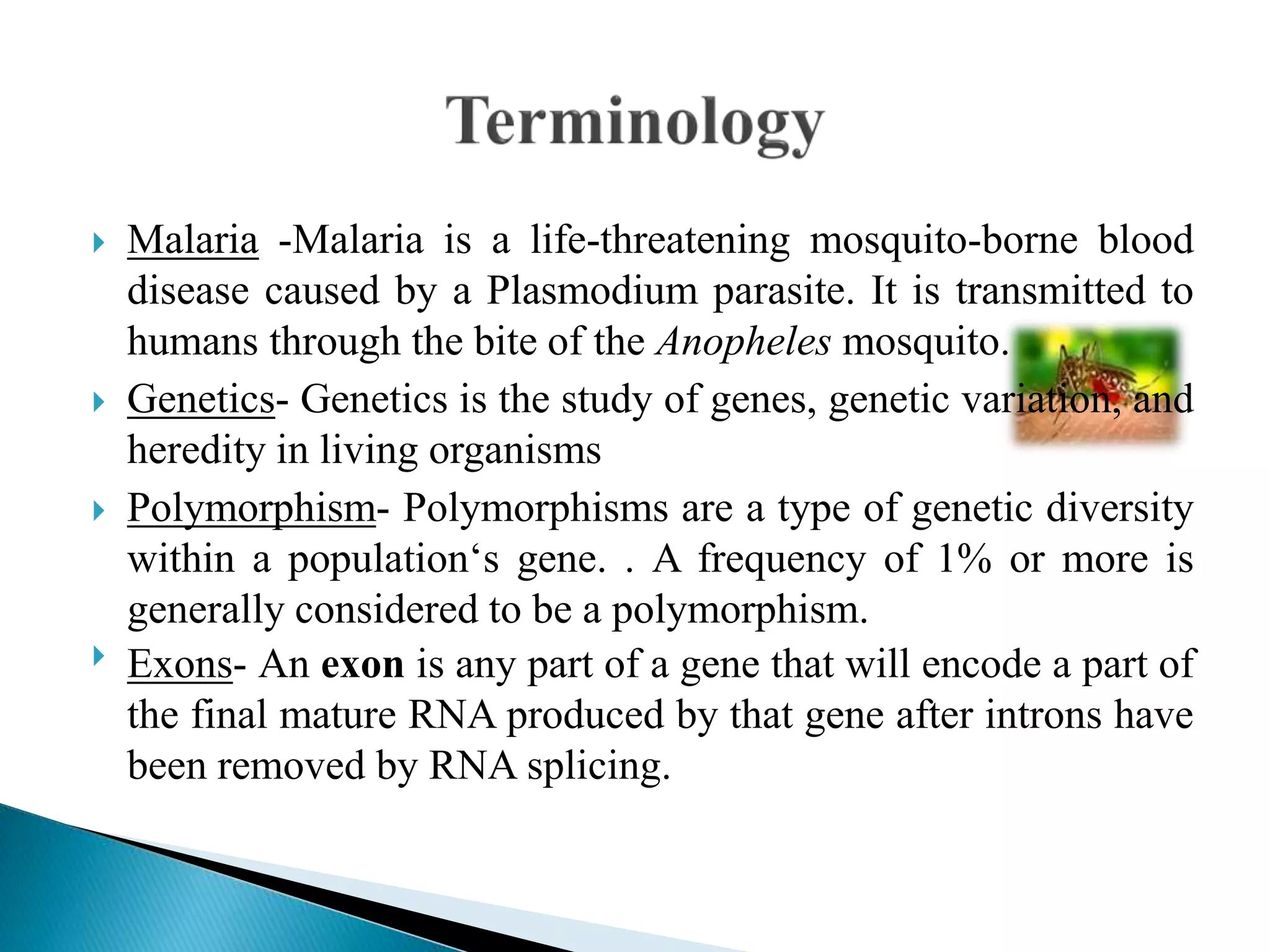
 Malaria -Malaria is a life-threatening mosquito-borne blood
disease caused by a Plasmodium parasite. It is transmitted to
humans through the bite of the Anopheles mosquito.
 Genetics- Genetics is the study of genes, genetic variation, and
heredity in living organisms
 Polymorphism- Polymorphisms are a type of genetic diversity
within a population‘s gene. . A frequency of 1% or more is
generally considered to be a polymorphism.
 Exons- An exon is any part of a gene that will encode a part of
the final mature RNA produced by that gene after introns have
been removed by RNA splicing.
 Locus- the physical location a gene occupies within a
chromosome or portion of genomic DNA.
 Allele: alternative forms of a gene that arise by mutation and
are found at the same place on a chromosome.
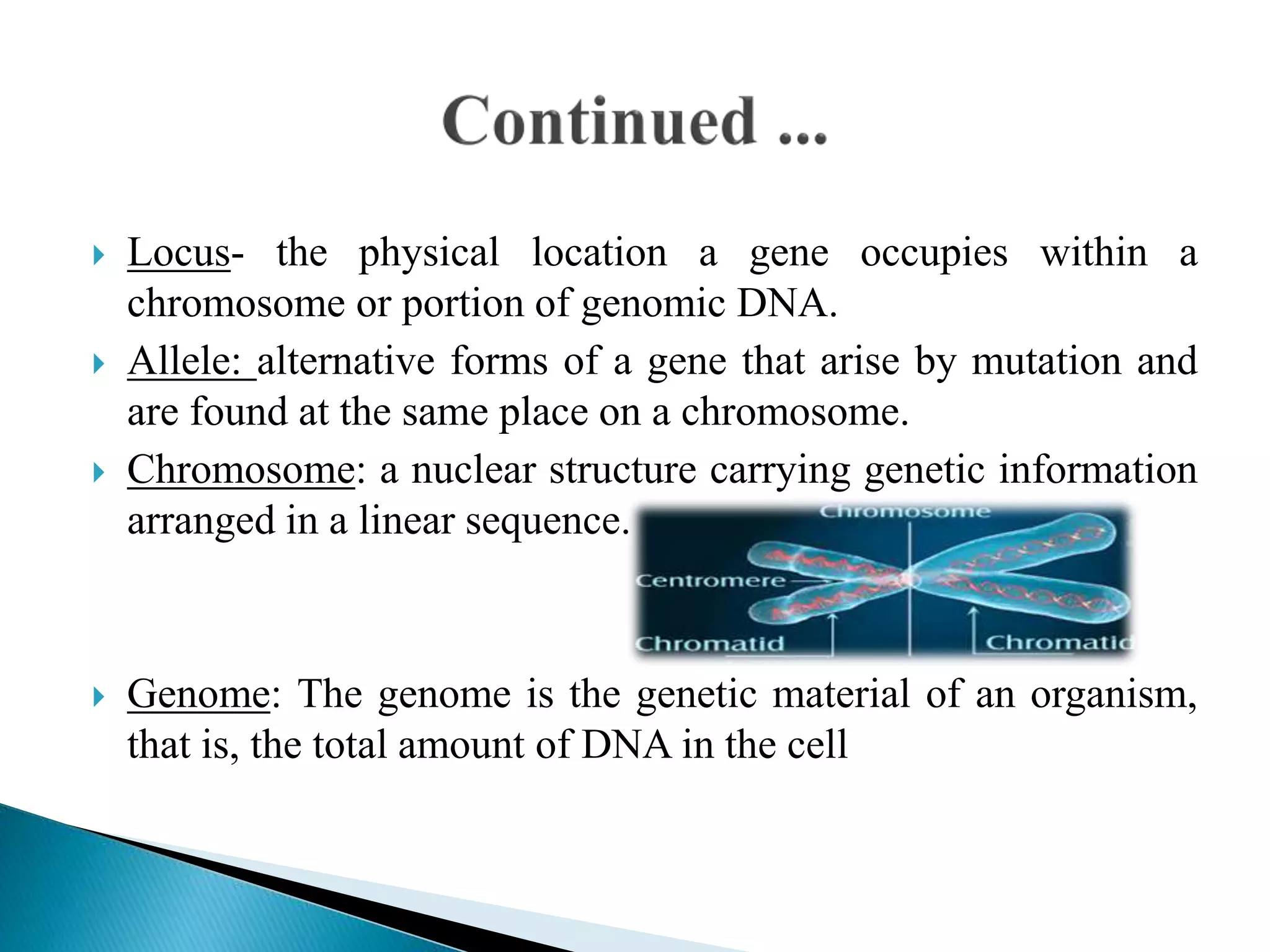
 Chromosome: a nuclear structure carrying genetic information
arranged in a linear sequence.
 Genome: The genome is the genetic material of an organism,
that is, the total amount of DNA in the cell
 A genetic polymorphism is the existence of two or more
variants - which may be allelic, phenotypic, chromosomal or
general DNA sequence variants - at significant frequencies in
a population. A frequency of 1% or more is generally
considered to be a polymorphism.
Poly =multiple , morph= forms
 Genetic polymorphisms are caused by duplications, deletions,
and a mutation of triplication of high quantity of DNA base
pairs sequences.
 Polymorphisms may occur due to changes inside introns or
changes in regions of one or multiple DNA bases that are
between genes.
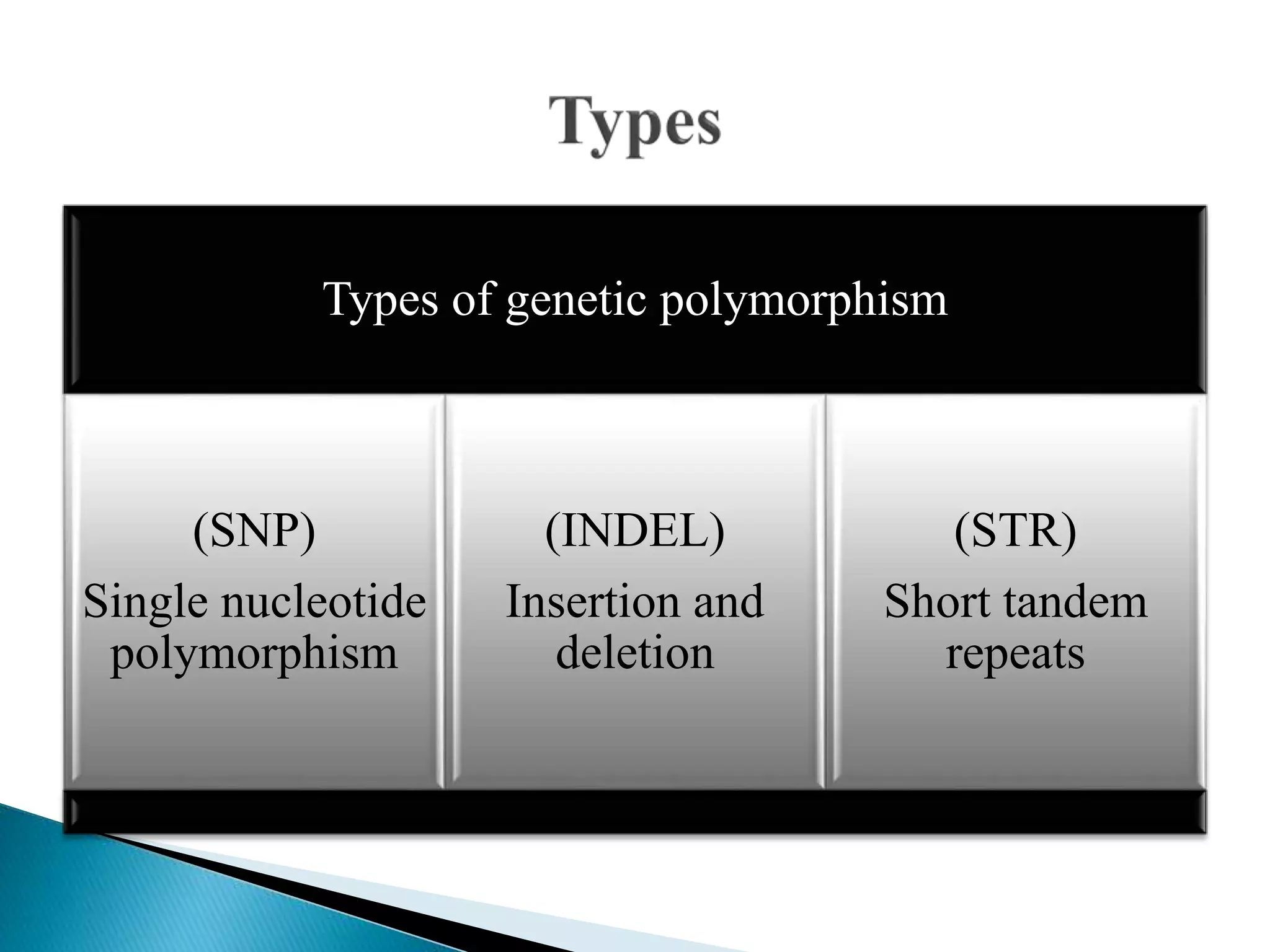
Types of genetic polymorphism
(SNP)
Single nucleotide
polymorphism
(INDEL)
Insertion and
deletion
(STR)
Short tandem
repeats
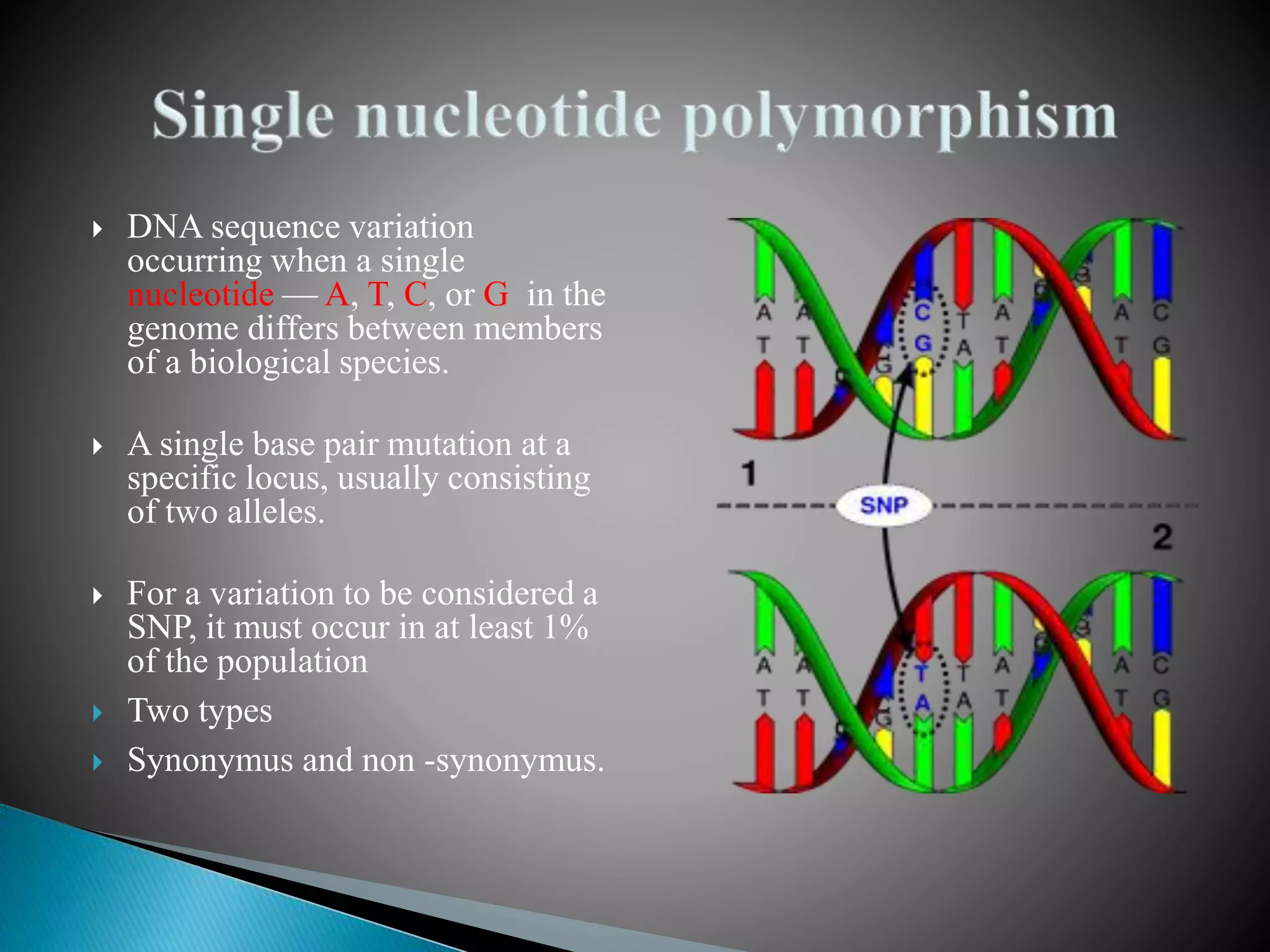
 DNA sequence variation
occurring when a single
nucleotide — A, T, C, or G in the
genome differs between members
of a biological species.
 A single base pair mutation at a
specific locus, usually consisting
of two alleles.
 For a variation to be considered a
SNP, it must occur in at least 1%
of the population
 Two types
 Synonymus and non -synonymus.
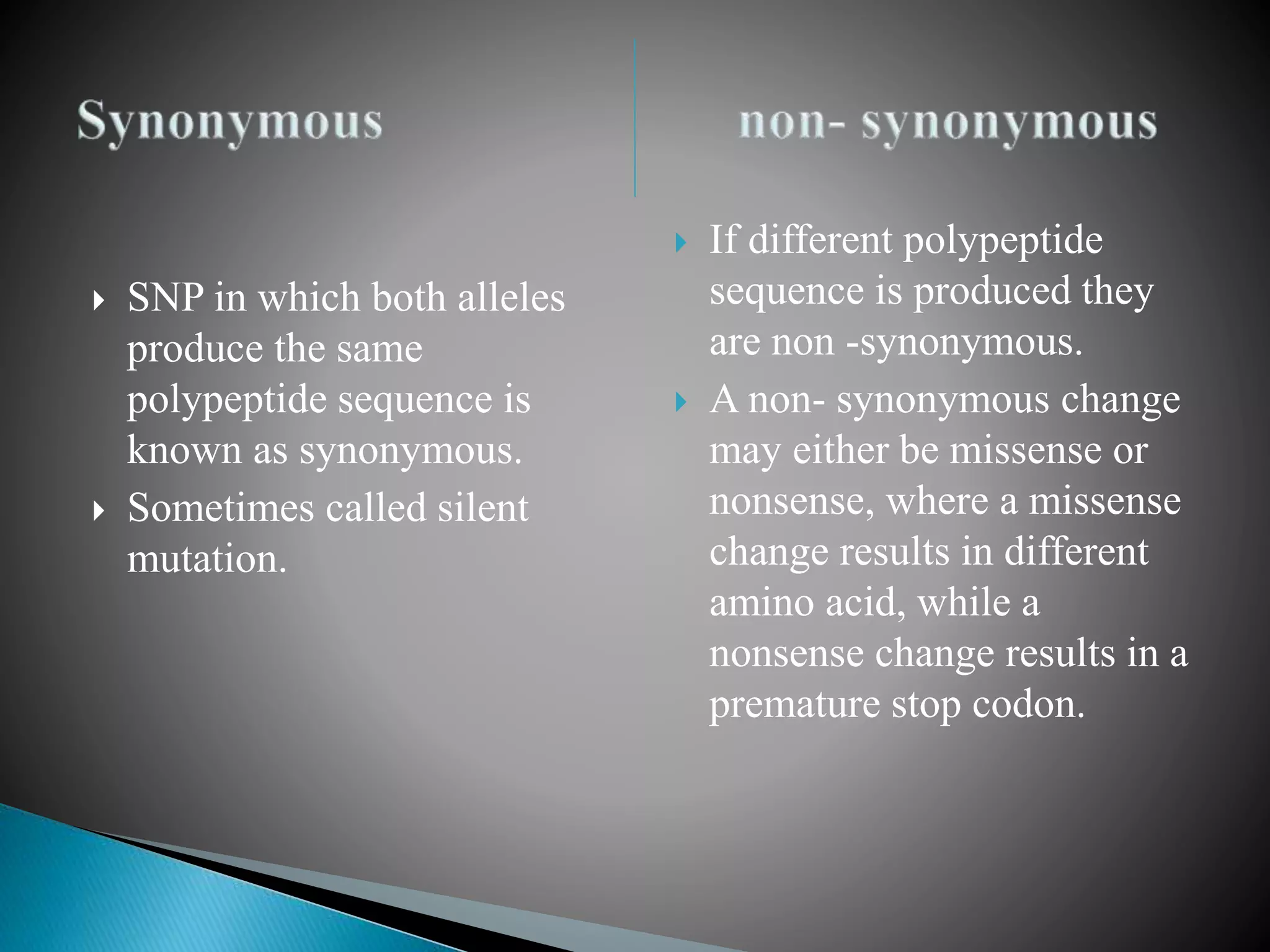
 SNP in which both alleles
produce the same
polypeptide sequence is
known as synonymous.
 Sometimes called silent
mutation.
 If different polypeptide
sequence is produced they
are non -synonymous.
 A non- synonymous change
may either be missense or
nonsense, where a missense
change results in different
amino acid, while a
nonsense change results in a
premature stop codon.
 Variations in the DNA sequences can affect how humans
develop diseases and respond to pathogens, chemicals, drugs,
vaccines, and other agents.
 Their greatest importance in biomedical research is for
comparing regions of the genome between with and without a
disease in genome.
 They are usually biallelic and thus easily assayed.
 SNP maps help to identify the multiple genes associated with
complex ailments such as cancer, diabetes, vascular disease,
and some forms of mental illness.
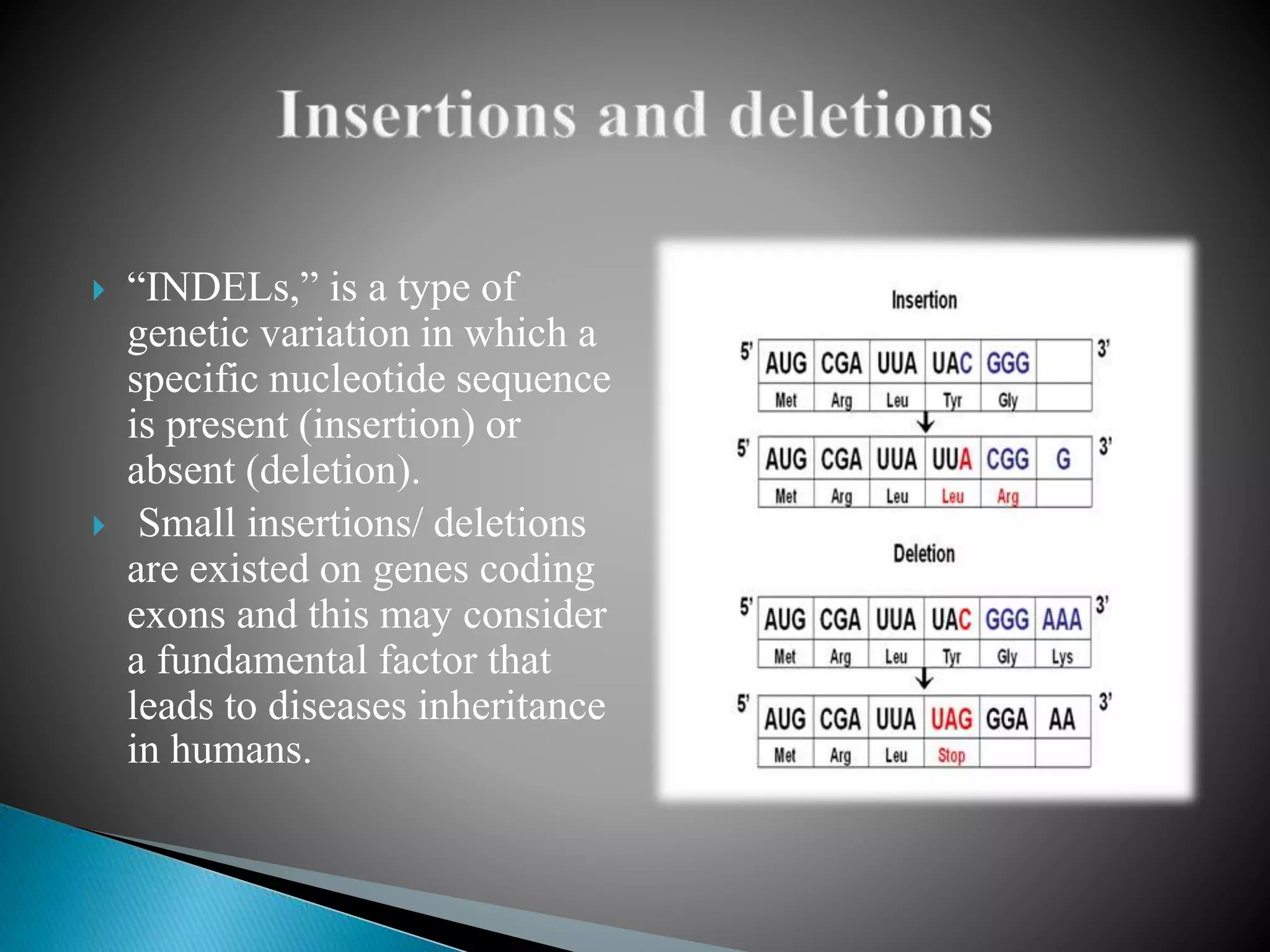
 “INDELs,” is a type of
genetic variation in which a
specific nucleotide sequence
is present (insertion) or
absent (deletion).
 Small insertions/ deletions
are existed on genes coding
exons and this may consider
a fundamental factor that
leads to diseases inheritance
in humans.
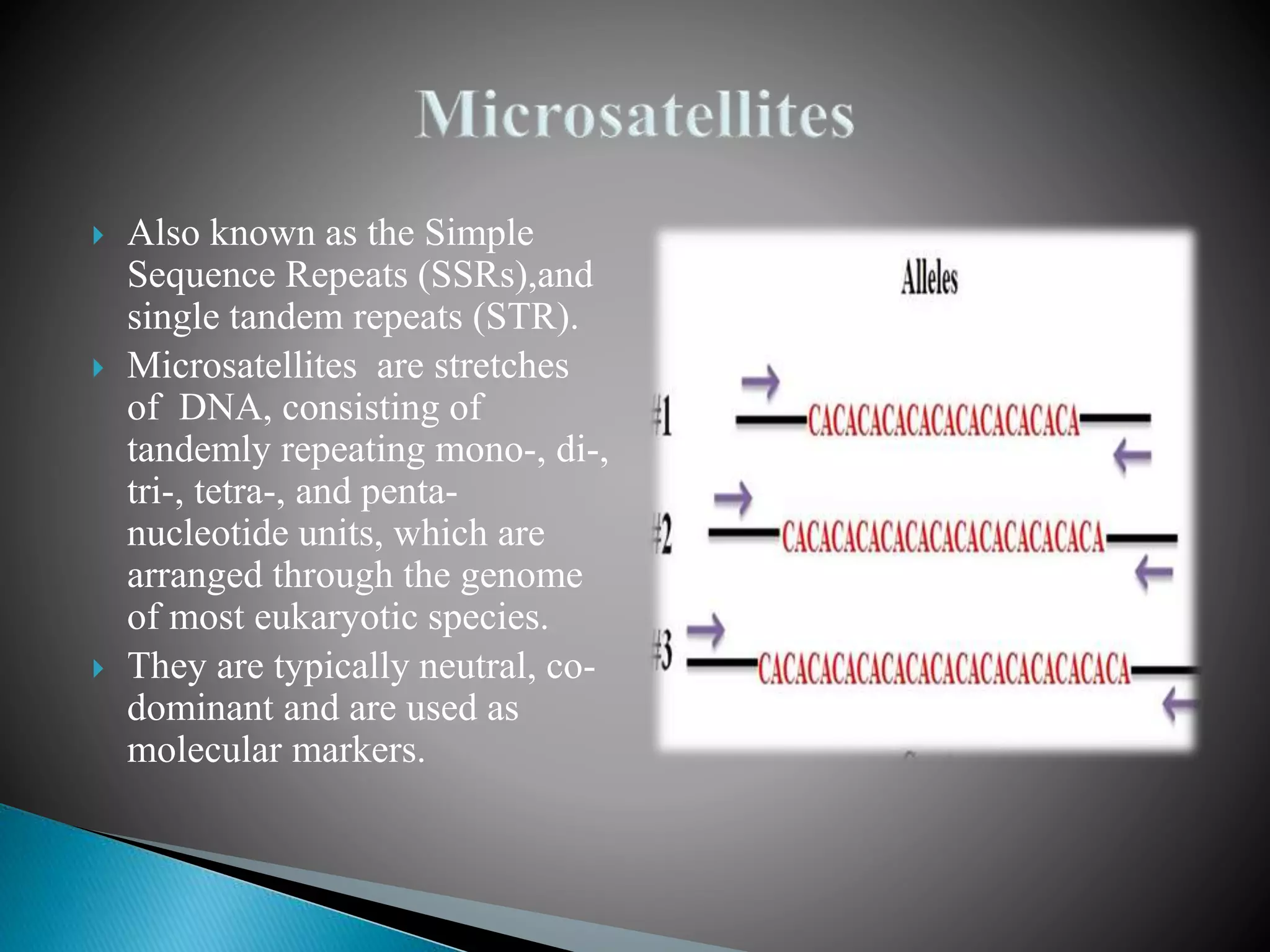
 Also known as the Simple
Sequence Repeats (SSRs),and
single tandem repeats (STR).
 Microsatellites are stretches
of DNA, consisting of
tandemly repeating mono-, di-,
tri-, tetra-, and penta-
nucleotide units, which are
arranged through the genome
of most eukaryotic species.
 They are typically neutral, co-
dominant and are used as
molecular markers.
 Plasmodium- In 1880
scientists discovered the
real cause of malaria was a
one-cell blood parasite or
protozoa called
Plasmodium.
 There are four species of
Plasmodium that infect
humans.
 P.falciparum, p.ovale,
p.vivax, p.malariae.
 Plasmodium falciparum -It
is the commonest species in
Africa and it accounts for
95 - 98% of all malaria
infections.
 It is responsible for severe
illness cerebral malaria and
other complications and
may cause death.
 The length of asexual cycle
is about 48 hours.
 The emergence and spread of Plasmodium
falciparum parasites resistant to anti-malarial drugs, such as
chloroquine(CQ), amodiaquine, pyrimethamine, and
sulfadoxine, have been shown various genetic alterations
associated with these drugs.
 Genes which is identified as potential candidates of drug
resistance are -
 P. falciparum multidrug resistance gene (Pfmdr1),
 CQ resistance transporter gene (Pfcrt),
 Dihydrofolate reductase (Pfdhfr),
 Dihydropteroate synthase (Pfdhps).
 The pfcrt is a 48kDa protein, made up of 424 amino acids.
 Locate on chromosome 7 and codes for CQ resistance
transporter protein.
 The exact physiological role of the transporter is not clear, but
it has been suggested that pfcrt transporter protein may be
responsible for efflux of alkaloids, amine compounds, amino
acids and peptides produced due to digestion of globin in the
vacuole.
 Till date, about 32 plausible mutations have been proposed, of
which about a few like M74I, N75E, K76T, H97Q, A220S,
Q271E,N326S, I356T, C350S and R371I .
 Among these, K76T mutation is the most prominent
 Located on chromosome 5 and codes for a P-glycoprotein
homologue-1 (Pgh1) and is responsible for pumping out the
xenobiotics from the cytosol.
 Four plausible single nucleotide polymorphisms in the
pfmdr-1 gene, i.e. N86Y, Y184F, N1042D, S1034C and
D1246Y
 Several other point mutations in Pfmdr-1 gene at positions
754, 1049, 3598, 3622 and 4234.
 Located on chromosome 4.
 pfdhfr is known target of pyrimethamine.
 Mutations are found on codon 16, 51,59,108,164.
 SNPs were determined -A16V, N51I, C59R, S108 N/T, and
I164L
 Located on chromosome 8 in P.falciparum, and on
chromosome 4 in p.vivax.
 pfdhps is known target of sulfadoxine.
 Mutations are found on codon 436,437,581 and 613.
 SNPs were determined-S436F/A, A437G, K540E, A581G and
A613S
Genetic polymorphism

Genetic polymorphism

  • 1.
    Presented by: Km.Manorama M.Tech (BT)
  • 2.
     Terminology.  Introduction. Causes.  Types.  Single nucleotide polymorphism.  Uses and importance.  Insertions and deletions.  Microsatellite.  Polymorphism in plasmodium falciparum.
  • 3.
     Malaria -Malariais a life-threatening mosquito-borne blood disease caused by a Plasmodium parasite. It is transmitted to humans through the bite of the Anopheles mosquito.  Genetics- Genetics is the study of genes, genetic variation, and heredity in living organisms  Polymorphism- Polymorphisms are a type of genetic diversity within a population‘s gene. . A frequency of 1% or more is generally considered to be a polymorphism.  Exons- An exon is any part of a gene that will encode a part of the final mature RNA produced by that gene after introns have been removed by RNA splicing.
  • 4.
     Locus- thephysical location a gene occupies within a chromosome or portion of genomic DNA.  Allele: alternative forms of a gene that arise by mutation and are found at the same place on a chromosome.  Chromosome: a nuclear structure carrying genetic information arranged in a linear sequence.  Genome: The genome is the genetic material of an organism, that is, the total amount of DNA in the cell
  • 5.
     A geneticpolymorphism is the existence of two or more variants - which may be allelic, phenotypic, chromosomal or general DNA sequence variants - at significant frequencies in a population. A frequency of 1% or more is generally considered to be a polymorphism. Poly =multiple , morph= forms
  • 6.
     Genetic polymorphismsare caused by duplications, deletions, and a mutation of triplication of high quantity of DNA base pairs sequences.  Polymorphisms may occur due to changes inside introns or changes in regions of one or multiple DNA bases that are between genes.
  • 7.
    Types of geneticpolymorphism (SNP) Single nucleotide polymorphism (INDEL) Insertion and deletion (STR) Short tandem repeats
  • 8.
     DNA sequencevariation occurring when a single nucleotide — A, T, C, or G in the genome differs between members of a biological species.  A single base pair mutation at a specific locus, usually consisting of two alleles.  For a variation to be considered a SNP, it must occur in at least 1% of the population  Two types  Synonymus and non -synonymus.
  • 9.
     SNP inwhich both alleles produce the same polypeptide sequence is known as synonymous.  Sometimes called silent mutation.  If different polypeptide sequence is produced they are non -synonymous.  A non- synonymous change may either be missense or nonsense, where a missense change results in different amino acid, while a nonsense change results in a premature stop codon.
  • 10.
     Variations inthe DNA sequences can affect how humans develop diseases and respond to pathogens, chemicals, drugs, vaccines, and other agents.  Their greatest importance in biomedical research is for comparing regions of the genome between with and without a disease in genome.  They are usually biallelic and thus easily assayed.  SNP maps help to identify the multiple genes associated with complex ailments such as cancer, diabetes, vascular disease, and some forms of mental illness.
  • 11.
     “INDELs,” isa type of genetic variation in which a specific nucleotide sequence is present (insertion) or absent (deletion).  Small insertions/ deletions are existed on genes coding exons and this may consider a fundamental factor that leads to diseases inheritance in humans.
  • 12.
     Also knownas the Simple Sequence Repeats (SSRs),and single tandem repeats (STR).  Microsatellites are stretches of DNA, consisting of tandemly repeating mono-, di-, tri-, tetra-, and penta- nucleotide units, which are arranged through the genome of most eukaryotic species.  They are typically neutral, co- dominant and are used as molecular markers.
  • 13.
     Plasmodium- In1880 scientists discovered the real cause of malaria was a one-cell blood parasite or protozoa called Plasmodium.  There are four species of Plasmodium that infect humans.  P.falciparum, p.ovale, p.vivax, p.malariae.  Plasmodium falciparum -It is the commonest species in Africa and it accounts for 95 - 98% of all malaria infections.  It is responsible for severe illness cerebral malaria and other complications and may cause death.  The length of asexual cycle is about 48 hours.
  • 14.
     The emergenceand spread of Plasmodium falciparum parasites resistant to anti-malarial drugs, such as chloroquine(CQ), amodiaquine, pyrimethamine, and sulfadoxine, have been shown various genetic alterations associated with these drugs.  Genes which is identified as potential candidates of drug resistance are -  P. falciparum multidrug resistance gene (Pfmdr1),  CQ resistance transporter gene (Pfcrt),  Dihydrofolate reductase (Pfdhfr),  Dihydropteroate synthase (Pfdhps).
  • 15.
     The pfcrtis a 48kDa protein, made up of 424 amino acids.  Locate on chromosome 7 and codes for CQ resistance transporter protein.  The exact physiological role of the transporter is not clear, but it has been suggested that pfcrt transporter protein may be responsible for efflux of alkaloids, amine compounds, amino acids and peptides produced due to digestion of globin in the vacuole.  Till date, about 32 plausible mutations have been proposed, of which about a few like M74I, N75E, K76T, H97Q, A220S, Q271E,N326S, I356T, C350S and R371I .  Among these, K76T mutation is the most prominent
  • 16.
     Located onchromosome 5 and codes for a P-glycoprotein homologue-1 (Pgh1) and is responsible for pumping out the xenobiotics from the cytosol.  Four plausible single nucleotide polymorphisms in the pfmdr-1 gene, i.e. N86Y, Y184F, N1042D, S1034C and D1246Y  Several other point mutations in Pfmdr-1 gene at positions 754, 1049, 3598, 3622 and 4234.
  • 17.
     Located onchromosome 4.  pfdhfr is known target of pyrimethamine.  Mutations are found on codon 16, 51,59,108,164.  SNPs were determined -A16V, N51I, C59R, S108 N/T, and I164L
  • 18.
     Located onchromosome 8 in P.falciparum, and on chromosome 4 in p.vivax.  pfdhps is known target of sulfadoxine.  Mutations are found on codon 436,437,581 and 613.  SNPs were determined-S436F/A, A437G, K540E, A581G and A613S