HUMAN GENOME VARIATION
By
SYEDA SADAF WAJAHAT
HUMAN GENOME VARIATION
■ Human genetic variations are the differences in DNA sequence within the
genome of individuals in populations.
■ Genetic variations in the human genome are of many types, including
single nucleotide substitutions; tandem repeats; insertions and deletions
(indels); copy number variations (CNVs); inversions and translocations.
■ These genetic variations span a spectrum of sizes from single nucleotides
to mega bases.
SINGLE NUCLEOTIDE POLYMORPHISM (SNP)
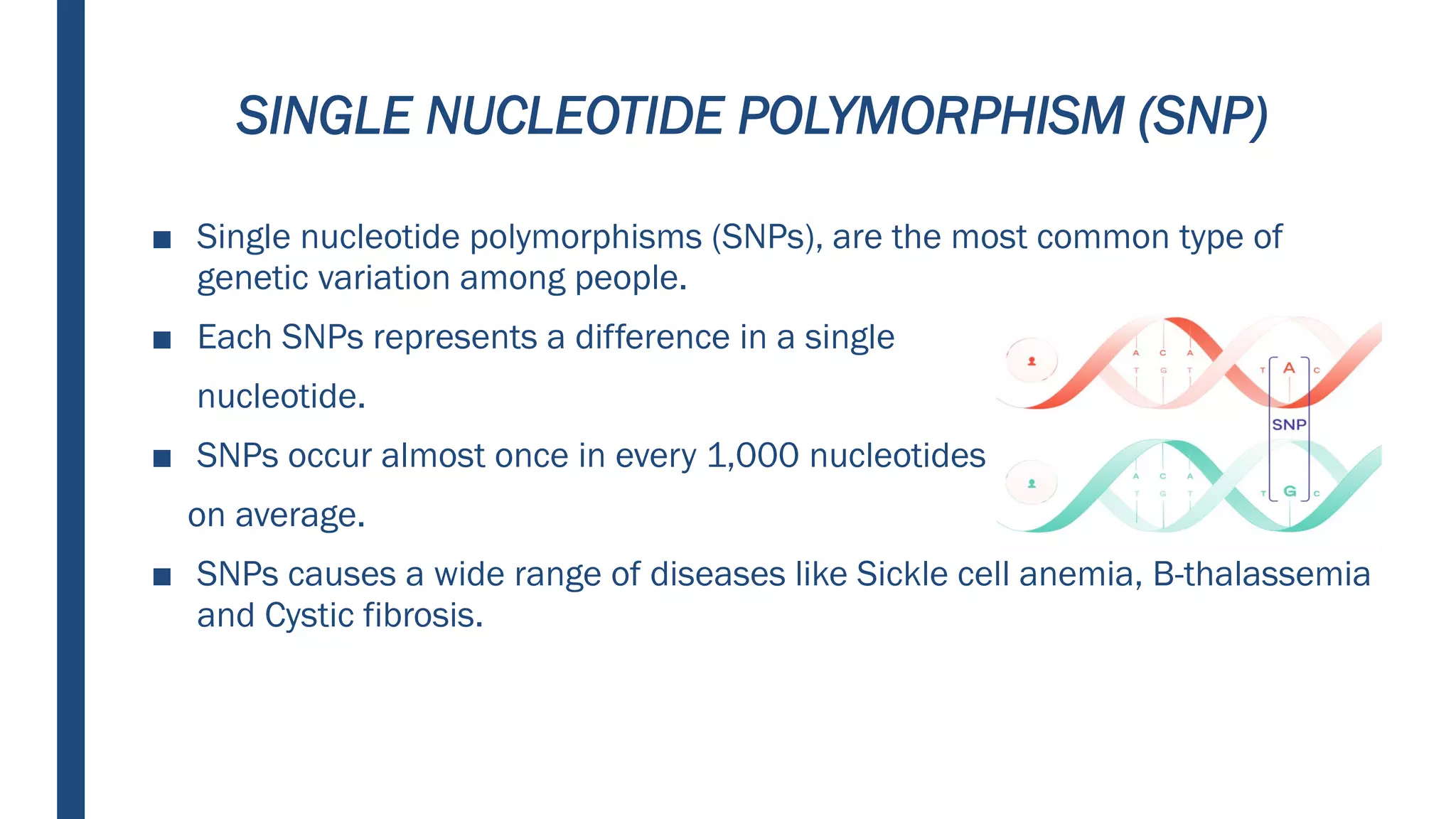
■ Single nucleotide polymorphisms (SNPs), are the most common type of
genetic variation among people.
■ Each SNPs represents a difference in a single
nucleotide.
■ SNPs occur almost once in every 1,000 nucleotides
on average.
■ SNPs causes a wide range of diseases like Sickle cell anemia, B-thalassemia
and Cystic fibrosis.
TANDEM REPEATS
■ Tandem repeats contain many copies of the same short sequence over
and over, so it is easy for the two strands of DNA to get misaligned in this
local region.
■ If the strands are mis paired, then DNA replicating enzymes can either
clip off some of the repeats or add extra repeats.
■ Examples: Huntington’s disease, Kennedy’s disease, Myotonic dystrophy.
INSERTIONS AND DELETIONS
■ An insertion changes the number of DNA bases in a gene by adding a
piece of DNA. As a result, the protein made by the gene may not function
properly.
■ A deletion changes the number of DNA bases by removing a piece of DNA.
The deleted DNA may alter the function of the resulting protein(s).
COPY NUMBER VARIATIONS (CNVs)
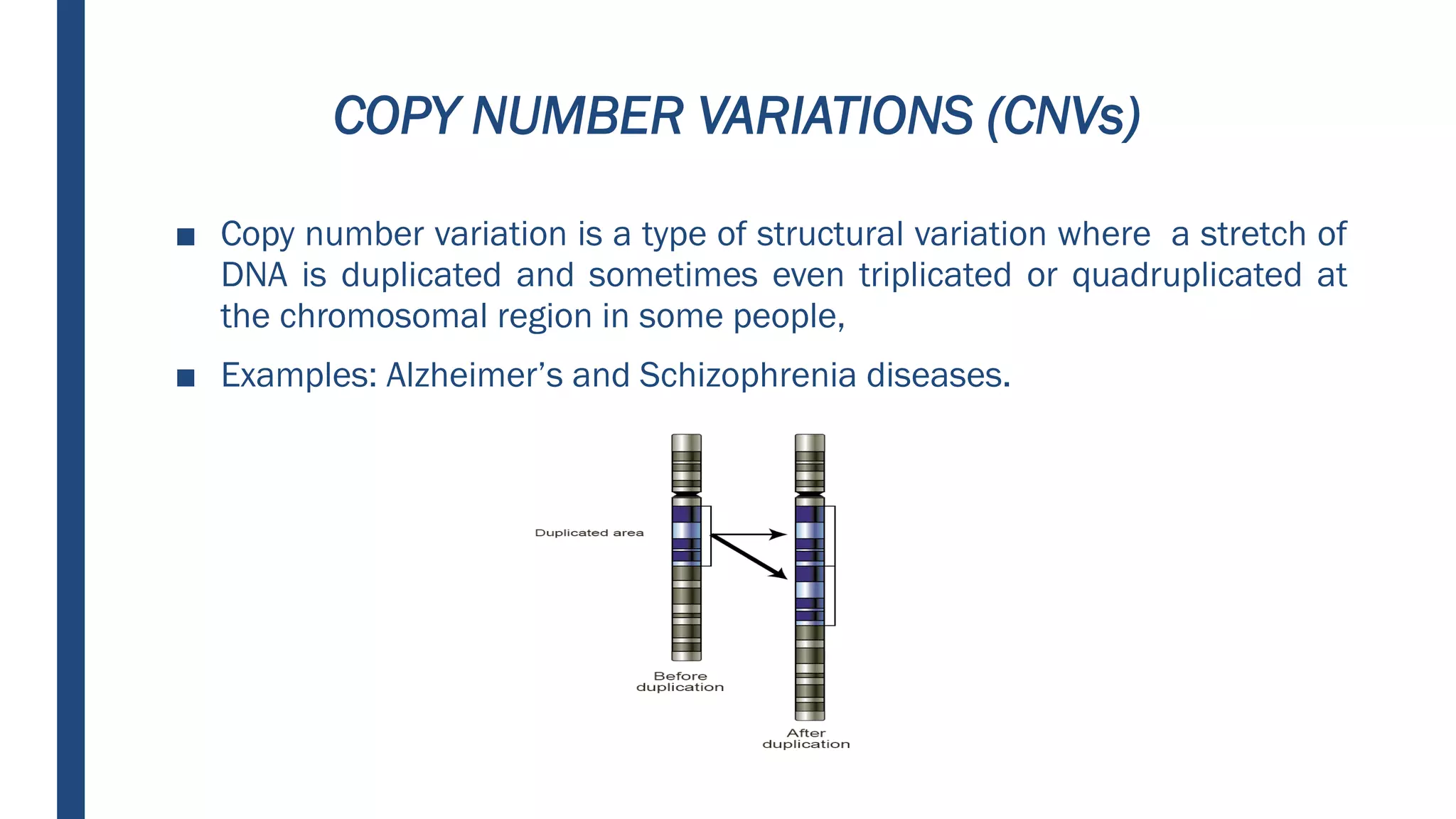
■ Copy number variation is a type of structural variation where a stretch of
DNA is duplicated and sometimes even triplicated or quadruplicated at
the chromosomal region in some people,
■ Examples: Alzheimer’s and Schizophrenia diseases.
INVERSION
■ An inversion involves the breakage of a chromosome in two places; the
resulting piece of DNA is reversed and re-inserted into the chromosome.
■ It has been associated with congenital anomalies, growth retardation,
infertility, recurrent pregnancy loss, and cancer.
TRANSLOCATION
■ A translocation occurs when a piece of one chromosome breaks off and
attaches to another chromosome.
■ It is of two types balanced translocation (no genetic
material is gain or loss) and unbalanced translocation
(there is a gain or loss of genetic material).
■ Examples: Cancers, Infertility, Down syndrome.
EFFECTS OF VARIANTS IN CODING REGIONS
■ If a variant falls within a coding region, it can be categorized as:
1. Synonymous/Silent mutation: Due to redundancies in the genetic code,
many nucleotide changes will not change the amino acid sequence, for
example a GCT to GCC change would still encode an alanine.
2. Nonsense mutation: These turn a coding codon, such as GGA glycine, to a
stop codon, e.g. TGA. This will result in a truncated protein.
3. Missense/Nonsynonymous mutation: This change results in a change in
amino acid, for example ACC threonine to AAC asparagine.
Human genome variation

Human genome variation

  • 1.
  • 2.
    HUMAN GENOME VARIATION ■Human genetic variations are the differences in DNA sequence within the genome of individuals in populations. ■ Genetic variations in the human genome are of many types, including single nucleotide substitutions; tandem repeats; insertions and deletions (indels); copy number variations (CNVs); inversions and translocations. ■ These genetic variations span a spectrum of sizes from single nucleotides to mega bases.
  • 3.
    SINGLE NUCLEOTIDE POLYMORPHISM(SNP) ■ Single nucleotide polymorphisms (SNPs), are the most common type of genetic variation among people. ■ Each SNPs represents a difference in a single nucleotide. ■ SNPs occur almost once in every 1,000 nucleotides on average. ■ SNPs causes a wide range of diseases like Sickle cell anemia, B-thalassemia and Cystic fibrosis.
  • 4.
    TANDEM REPEATS ■ Tandemrepeats contain many copies of the same short sequence over and over, so it is easy for the two strands of DNA to get misaligned in this local region. ■ If the strands are mis paired, then DNA replicating enzymes can either clip off some of the repeats or add extra repeats. ■ Examples: Huntington’s disease, Kennedy’s disease, Myotonic dystrophy.
  • 5.
    INSERTIONS AND DELETIONS ■An insertion changes the number of DNA bases in a gene by adding a piece of DNA. As a result, the protein made by the gene may not function properly. ■ A deletion changes the number of DNA bases by removing a piece of DNA. The deleted DNA may alter the function of the resulting protein(s).
  • 6.
    COPY NUMBER VARIATIONS(CNVs) ■ Copy number variation is a type of structural variation where a stretch of DNA is duplicated and sometimes even triplicated or quadruplicated at the chromosomal region in some people, ■ Examples: Alzheimer’s and Schizophrenia diseases.
  • 7.
    INVERSION ■ An inversioninvolves the breakage of a chromosome in two places; the resulting piece of DNA is reversed and re-inserted into the chromosome. ■ It has been associated with congenital anomalies, growth retardation, infertility, recurrent pregnancy loss, and cancer.
  • 8.
    TRANSLOCATION ■ A translocationoccurs when a piece of one chromosome breaks off and attaches to another chromosome. ■ It is of two types balanced translocation (no genetic material is gain or loss) and unbalanced translocation (there is a gain or loss of genetic material). ■ Examples: Cancers, Infertility, Down syndrome.
  • 9.
    EFFECTS OF VARIANTSIN CODING REGIONS ■ If a variant falls within a coding region, it can be categorized as: 1. Synonymous/Silent mutation: Due to redundancies in the genetic code, many nucleotide changes will not change the amino acid sequence, for example a GCT to GCC change would still encode an alanine. 2. Nonsense mutation: These turn a coding codon, such as GGA glycine, to a stop codon, e.g. TGA. This will result in a truncated protein. 3. Missense/Nonsynonymous mutation: This change results in a change in amino acid, for example ACC threonine to AAC asparagine.