SEMINAR ON
SURGE CURRENT PROTECTION USING
SUPERCONDUCTORS
Department of Electrical Engineering
Submitted to :-
Mr. Manish Trikha
Guided by :-
Mr. Saurabh Saxena
Submitted by :-
Chirag Agrawal
(1208221014)
Branch - EN
CONTENT
 INTRODUCTION
 WHAT IS SURGE CURRENT
 NEED OF SURGE CURRENT PROTECTION
 WHAT IS SUPERCONDUCTOR
 MEISSNER EFFECT
 TYPES OF SUPERCONDUCTOR
 SURGE CURRENT LIMITER
 OTHER METHODS FOR SURGE CURRENT PROTECTION
 ADVANTAGES
 FUTURE PLANS
 CONCLUSION
INTRODUCTION
 Modern power system are growing fast with more
generators, transformers and large network in the
system. Whenever a fault occurs there is a need for
the protection of these system.
 Here we’ll discuss the use of superconductor as
protective device for surge current protection.
Superconductors conduct electricity, offering zero
resistance below certain temperature. We study
different types of superconductor as surge current
limiter and their working.
WHAT IS SURGE CURRENT?
 The maximum instantaneous input current drawn by
an electrical device when first it is turned ON , is
defined as surge current.
 It is also known as inrush current or input surge
current or switch on surge.
 Inrush current can be as high as 100 times the
normal steady state current .
Surge current waveform
NEED OF SURGE CURRENT PROTECTION
 High inrush current can affect the electrical systems
by tripping fuses and circuit breakers unnecessarily.
 If inrush protection is not in place, relays and circuit
breakers must be rated higher than any possible
inrush current.
 Inrush Current can also cause pitted contacts on
switches and relays due to arcing of the contacts.
 This surge current can cause component damage
and/or failure within the equipment itself, blown
fuses, tripped circuit breakers .
WHAT IS SUPERCONDUCTOR ?
 Metallic elements, alloys or compounds that will conduct electricity
without resistance below a certain temperature, is called a
Superconductor.
 The dutch physicist ‘HEIKE KAMERLINGH ONNES’ of leiden
university was the first person to observe superconductivity in
mercury.
 Superconductivity is a phenomenon of exactly zero electrical
resistance that apply in certain materials when cooled below critical
temperature.
 Superconductors are extraordinary because they take no energy to
make current flow .So no energy is lost to friction to sustain the
current.
MEISSNER EFFECT
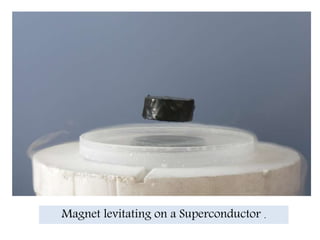
 The phenomenon of exclusion of magnetic flux or ejection of
lines of magnetic induction from the interior of bulk
superconductors, when they are cooled below the transition
temperature is called Meissner’s effect.
 Superconductors have electronic and magnetic
properties. That is, they have a negative
susceptibility, and acquire a polarization OPPOSITE
to an applied magnetic field. This is the reason that
superconducting materials and magnets repel one
another.
 If the temperature increases the sample will lose
its superconductivity and the magnet cannot float
on the superconductor.
Magnet levitating on a Superconductor .
TYPES OF SUPERCONDUCTOR
• Low temperature superconductor :- Those
whose critical temperature is below 77 k.
Example :- lead and mercury (common LTS),
Ti, V, Zr, Nb etc.
• High temperature superconductor :- Those
whose critical temperature is above 77 k.
Example :- YBCO, BSCCO etc.
SURGE CURRENT LIMITER
 A surge current limiter is a device which limit
prospective surge current when a instant high
current occurs at starting . Generally SCL are
superconductor SCL.
How does it works ?
Superconductor SPD or SCL prevents the
current from exceeding a given value.
It presents a negligible impedance for normal
current value.
It naturally and automatically inserts a high
impedance above a given current.
Superconductor SPD’s impedance disappears
automatically after the surge clearance and a
certain delay.
Process for protection from surge current
SUPERCONDUCTIVE SCL
(i) If current flow normally then ;
(ii) If surge current flows then ;
Inductive type SSCL
Cryostat - It creates the low temperatures for
superconductivity hold up.
The inductive type SSCLs works like
transformer with shorted superconducting
secondary winding. In normal operation the
primary winding resistance and leakage
inductance determine the impedance of the
limiter. If the surge occurs, the resistance of
the secondary winding is the superconductor
quenches. The value Rsc is transferred into the
primary side by the K2=(w1/w2)2 and the SCL
impedance increases.
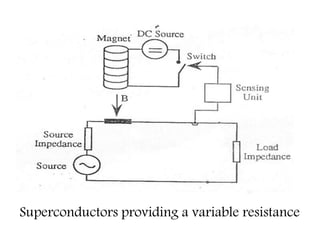
Superconductors providing a variable resistance
Superconductor as a variable resistor
Superconductors are strongly dependent on
direction of an applied external magnetic
field. The resistance of a superconductor can
change by several orders of magnitude by
applying a magnetic field.
Thus a superconductor varies it’s resistance in
the circuit.
WHY WE USE SUPERCONDUCTORS ?
The losses are reduced by using
superconductors.
The best conductivity is provided by
using superconductors.
These are the ideal conductors.
OTHER METHODS FOR SURGE
CURRENT PROTECTION
Are following :-
Resistors,
Thyristors,
Triacs,
Inductors,
NTC thermistor,
ADVANTAGES
Safety, reliability, and power quality.
Cost for C.B. and fuses can be reduced.
Life of transformers extended.
Reduced or eliminate wide area, blackouts.
Provide protection to T&D equipment.
FUTURE PLAN
TEPCO will develop a three-phase limiter over
the next three to four years and test it in the
grid within this century. The current plan is to
introduce solid state breakers for distribution
before installing superconductive FCL.
The true application for the superconducting
FCL is at transmission voltages of 500 kV.
CONCLUSION
 The purpose of this presentation was the study of
surge current protection using superconductors. The
Superconductor Fault Current Limiters offers efficient
advantages to power systems and opens up a major
application for superconducting materials.
REFERENCES
http://www.scribd.com/doc/115890153/surge-
current-protection-using-superconductors
http://jntuhome.com/surge-current-protection-
using-superconductors-seminardownload-full-
paper-eee-seminar-topics/
http://kguru.info/t-surge-current-protection-
using-superconductors-ppt--55999
http://en.wikipedia.org/wiki/Surge_protector
www.ecoflow.org/index.php?option=com_conten
t&id=51&ltemid=55
ANY QUERIES??
Surge current protection using superconductor ppt

Surge current protection using superconductor ppt

  • 1.
    SEMINAR ON SURGE CURRENTPROTECTION USING SUPERCONDUCTORS Department of Electrical Engineering Submitted to :- Mr. Manish Trikha Guided by :- Mr. Saurabh Saxena Submitted by :- Chirag Agrawal (1208221014) Branch - EN
  • 2.
    CONTENT  INTRODUCTION  WHATIS SURGE CURRENT  NEED OF SURGE CURRENT PROTECTION  WHAT IS SUPERCONDUCTOR  MEISSNER EFFECT  TYPES OF SUPERCONDUCTOR  SURGE CURRENT LIMITER  OTHER METHODS FOR SURGE CURRENT PROTECTION  ADVANTAGES  FUTURE PLANS  CONCLUSION
  • 3.
    INTRODUCTION  Modern powersystem are growing fast with more generators, transformers and large network in the system. Whenever a fault occurs there is a need for the protection of these system.  Here we’ll discuss the use of superconductor as protective device for surge current protection. Superconductors conduct electricity, offering zero resistance below certain temperature. We study different types of superconductor as surge current limiter and their working.
  • 4.
    WHAT IS SURGECURRENT?  The maximum instantaneous input current drawn by an electrical device when first it is turned ON , is defined as surge current.  It is also known as inrush current or input surge current or switch on surge.  Inrush current can be as high as 100 times the normal steady state current .
  • 5.
  • 6.
    NEED OF SURGECURRENT PROTECTION  High inrush current can affect the electrical systems by tripping fuses and circuit breakers unnecessarily.  If inrush protection is not in place, relays and circuit breakers must be rated higher than any possible inrush current.  Inrush Current can also cause pitted contacts on switches and relays due to arcing of the contacts.  This surge current can cause component damage and/or failure within the equipment itself, blown fuses, tripped circuit breakers .
  • 7.
    WHAT IS SUPERCONDUCTOR?  Metallic elements, alloys or compounds that will conduct electricity without resistance below a certain temperature, is called a Superconductor.  The dutch physicist ‘HEIKE KAMERLINGH ONNES’ of leiden university was the first person to observe superconductivity in mercury.  Superconductivity is a phenomenon of exactly zero electrical resistance that apply in certain materials when cooled below critical temperature.  Superconductors are extraordinary because they take no energy to make current flow .So no energy is lost to friction to sustain the current.
  • 8.
    MEISSNER EFFECT  Thephenomenon of exclusion of magnetic flux or ejection of lines of magnetic induction from the interior of bulk superconductors, when they are cooled below the transition temperature is called Meissner’s effect.
  • 9.
     Superconductors haveelectronic and magnetic properties. That is, they have a negative susceptibility, and acquire a polarization OPPOSITE to an applied magnetic field. This is the reason that superconducting materials and magnets repel one another.  If the temperature increases the sample will lose its superconductivity and the magnet cannot float on the superconductor.
  • 10.
    Magnet levitating ona Superconductor .
  • 11.
    TYPES OF SUPERCONDUCTOR •Low temperature superconductor :- Those whose critical temperature is below 77 k. Example :- lead and mercury (common LTS), Ti, V, Zr, Nb etc. • High temperature superconductor :- Those whose critical temperature is above 77 k. Example :- YBCO, BSCCO etc.
  • 12.
    SURGE CURRENT LIMITER A surge current limiter is a device which limit prospective surge current when a instant high current occurs at starting . Generally SCL are superconductor SCL.
  • 13.
    How does itworks ? Superconductor SPD or SCL prevents the current from exceeding a given value. It presents a negligible impedance for normal current value. It naturally and automatically inserts a high impedance above a given current. Superconductor SPD’s impedance disappears automatically after the surge clearance and a certain delay.
  • 14.
    Process for protectionfrom surge current
  • 15.
  • 16.
    (i) If currentflow normally then ; (ii) If surge current flows then ;
  • 17.
  • 18.
    Cryostat - Itcreates the low temperatures for superconductivity hold up. The inductive type SSCLs works like transformer with shorted superconducting secondary winding. In normal operation the primary winding resistance and leakage inductance determine the impedance of the limiter. If the surge occurs, the resistance of the secondary winding is the superconductor quenches. The value Rsc is transferred into the primary side by the K2=(w1/w2)2 and the SCL impedance increases.
  • 19.
    Superconductors providing avariable resistance
  • 20.
    Superconductor as avariable resistor Superconductors are strongly dependent on direction of an applied external magnetic field. The resistance of a superconductor can change by several orders of magnitude by applying a magnetic field. Thus a superconductor varies it’s resistance in the circuit.
  • 21.
    WHY WE USESUPERCONDUCTORS ? The losses are reduced by using superconductors. The best conductivity is provided by using superconductors. These are the ideal conductors.
  • 22.
    OTHER METHODS FORSURGE CURRENT PROTECTION Are following :- Resistors, Thyristors, Triacs, Inductors, NTC thermistor,
  • 23.
    ADVANTAGES Safety, reliability, andpower quality. Cost for C.B. and fuses can be reduced. Life of transformers extended. Reduced or eliminate wide area, blackouts. Provide protection to T&D equipment.
  • 24.
    FUTURE PLAN TEPCO willdevelop a three-phase limiter over the next three to four years and test it in the grid within this century. The current plan is to introduce solid state breakers for distribution before installing superconductive FCL. The true application for the superconducting FCL is at transmission voltages of 500 kV.
  • 25.
    CONCLUSION  The purposeof this presentation was the study of surge current protection using superconductors. The Superconductor Fault Current Limiters offers efficient advantages to power systems and opens up a major application for superconducting materials.
  • 26.
  • 27.