Analysis of
Grammatical Structure
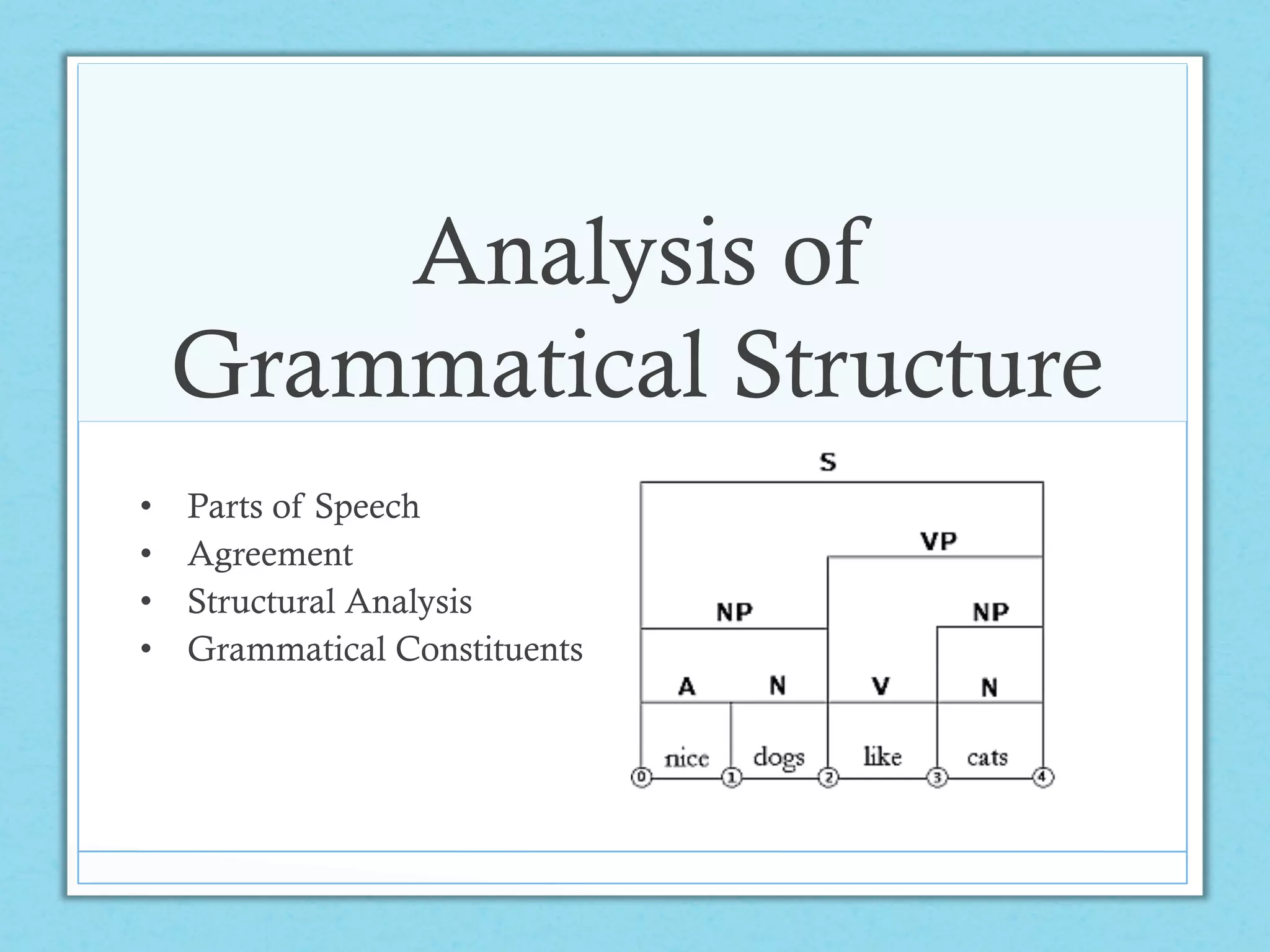
•  Parts of Speech
•  Agreement
•  Structural Analysis
•  Grammatical Constituents
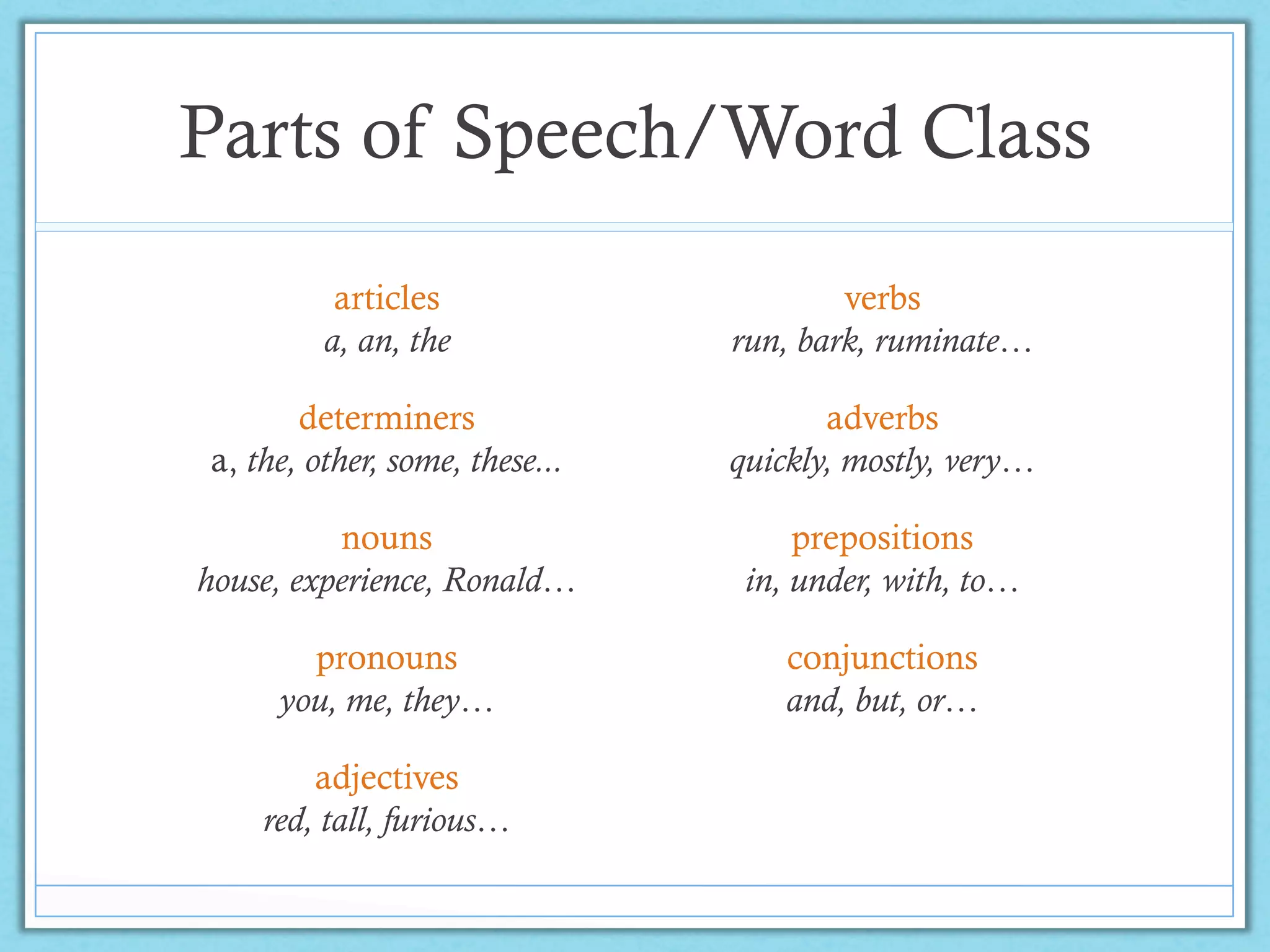
Parts of Speech/Word Class
articles
a, an, the
determiners
a, the, other, some, these...
nouns
house, experience, Ronald…
pronouns
you, me, they…
adjectives
red, tall, furious…
verbs
run, bark, ruminate…
adverbs
quickly, mostly, very…
prepositions
in, under, with, to…
conjunctions
and, but, or…
Agreement
The relationships between words are based on agreement.
Words have to agree in the following ways:
number singular/plural
person first/second/third person
tense past/present/future
gender natural (male/female)/grammatical
voice active/passive voice
Structural Analysis
Structural analysis helps to investigate the distribution of forms in
a language. For example: many English sentences follow and SVO
pattern:
Subject Verb Object
[The earthquake] [shook] [the house].
Different languages prefer different word order. Here is Japanese:
Subject Object Verb
[Masuda-ga] [tegami-o] [kakimasu]
Masuda letter write.
(Masude writes a letter)
Test Frames
Examples:
The_____________ gets wet when it rains.
_____________ melt in the summer heat.
Have you seen ___________.
The old building by the library ________________.
Ø  Forms that fit into the same test-frame likely belong to the same
grammatical category [noun/noun phrase/verb phrase/etc.]
Constituent Analysis
•  Small constituents (articles, nouns, etc) combine to form
larger constituents:
Ø  noun phrases
verb phrases
prepositional phrases
clauses
sentences
And speakers arrange these constituents according to the conventions
of the grammatical rules of the language they are speaking.
;{prescriptivism & descriptivism};
Ø  Prescriptive grammarians are interested in
formulating grammatical and usage rules that
should be followed by speakers of the language.
Ø  Descriptive linguists use structural analysis to
help them describe the structural rules as they are
applied by speakers of a language.
Constituency
How would you group the words in the following sentence?
Ø  The Danish captain sang salty shanties.
Constituency
How would you group the words in the following sentence?
Ø  The Danish captain sang salty shanties.
The Danish captain sang salty shanties.
Constituency
How would you group the words in the following sentence?
Ø  The Danish captain sang salty shanties.
The Danish captain sang salty shanties.
[S [subject (NP)] [Predicate (VP)]]
The Danish captain sang salty shanties
Constituency
How would you group the words in the following sentence?
Ø  The Danish captain sang salty shanties.
The Danish captain sang salty shanties.
[S [subject (NP)] [Predicate (VP)]]
The Danish captain sang salty shanties
[S [NP[Det] [Adj] [N]] [VP [[V] [NP[Adj] [N]]]]
The Danish captain Sang salty shanties.
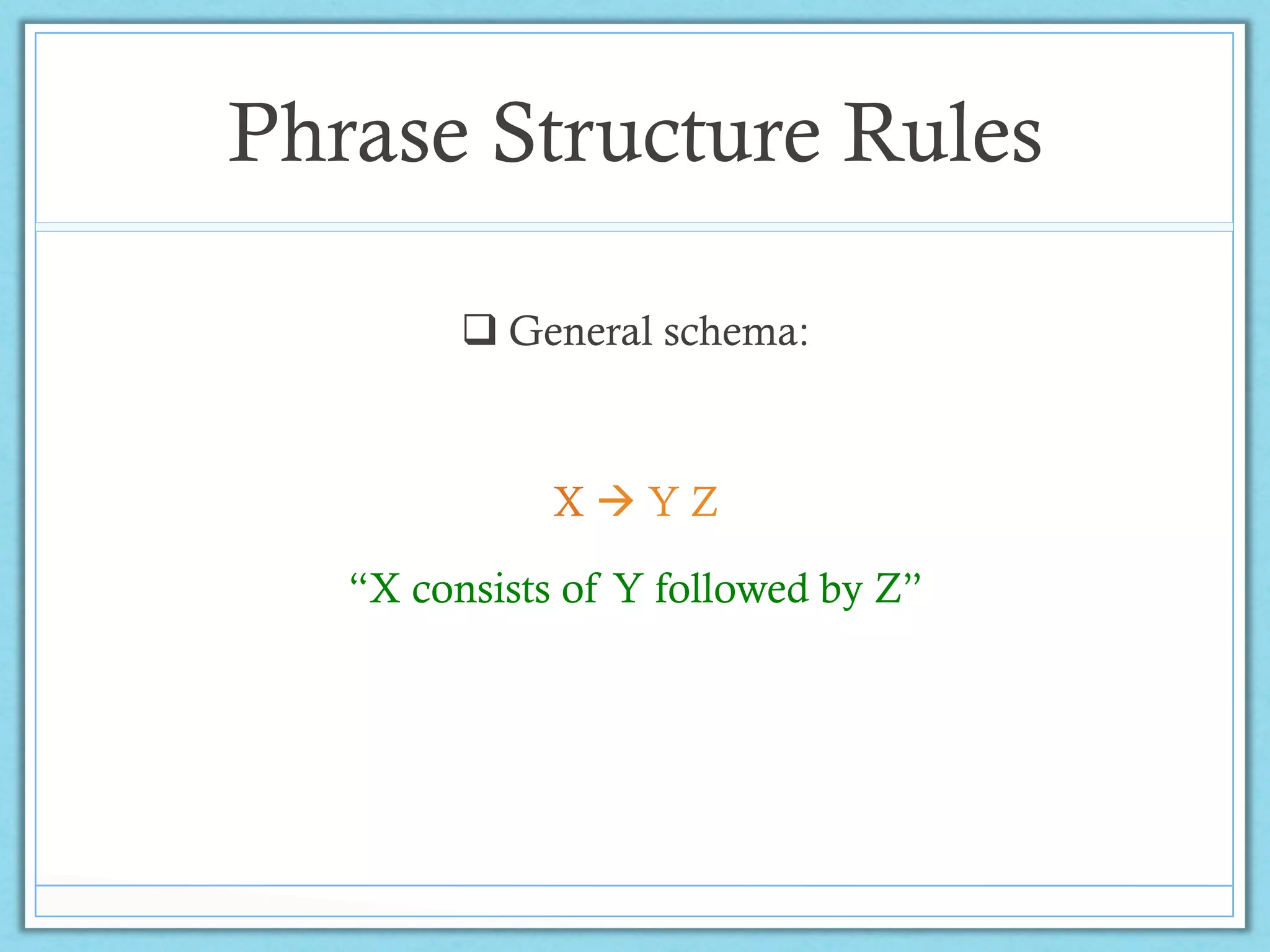
Phrase Structure Rules
q General schema:
X à Y Z
“X consists of Y followed by Z”
Phrase Structure Rules
Noun Phrase (NP)
•  John N
•  the boy Det N
•  a little boy Det Adj N
•  a boy in a bubble Det N PrepP
Phrase structure rule for NPs:
NP à (Det) (Adj) N (PrepP)
(where ‘()’ indicated optionality)
Phrase Structure Rules
Prepositional Phrase (PrepP)
•  in Moscow Prep N
•  to the store Prep det N
Phrase structure rule for PrepPs:
PrepP à Prep NP
Phrase Structure Rules
Verb Phrase (VP)
•  sang V
•  ate the cake V NP
•  ate the cake hungrily V NP Adv
•  sang a song in the shower V NP PrepP
•  drove into the lot slowly V PrepP Adv
Phrase structure rule for VPs:
VP à V (NP) (PrepP) (Advl)

Analysis of Grammatical Structure

  • 1.
    Analysis of Grammatical Structure • Parts of Speech •  Agreement •  Structural Analysis •  Grammatical Constituents
  • 2.
    Parts of Speech/WordClass articles a, an, the determiners a, the, other, some, these... nouns house, experience, Ronald… pronouns you, me, they… adjectives red, tall, furious… verbs run, bark, ruminate… adverbs quickly, mostly, very… prepositions in, under, with, to… conjunctions and, but, or…
  • 3.
    Agreement The relationships betweenwords are based on agreement. Words have to agree in the following ways: number singular/plural person first/second/third person tense past/present/future gender natural (male/female)/grammatical voice active/passive voice
  • 4.
    Structural Analysis Structural analysishelps to investigate the distribution of forms in a language. For example: many English sentences follow and SVO pattern: Subject Verb Object [The earthquake] [shook] [the house]. Different languages prefer different word order. Here is Japanese: Subject Object Verb [Masuda-ga] [tegami-o] [kakimasu] Masuda letter write. (Masude writes a letter)
  • 5.
    Test Frames Examples: The_____________ getswet when it rains. _____________ melt in the summer heat. Have you seen ___________. The old building by the library ________________. Ø  Forms that fit into the same test-frame likely belong to the same grammatical category [noun/noun phrase/verb phrase/etc.]
  • 6.
    Constituent Analysis •  Smallconstituents (articles, nouns, etc) combine to form larger constituents: Ø  noun phrases verb phrases prepositional phrases clauses sentences And speakers arrange these constituents according to the conventions of the grammatical rules of the language they are speaking.
  • 7.
    ;{prescriptivism & descriptivism}; Ø Prescriptive grammarians are interested in formulating grammatical and usage rules that should be followed by speakers of the language. Ø  Descriptive linguists use structural analysis to help them describe the structural rules as they are applied by speakers of a language.
  • 8.
    Constituency How would yougroup the words in the following sentence? Ø  The Danish captain sang salty shanties.
  • 9.
    Constituency How would yougroup the words in the following sentence? Ø  The Danish captain sang salty shanties. The Danish captain sang salty shanties.
  • 10.
    Constituency How would yougroup the words in the following sentence? Ø  The Danish captain sang salty shanties. The Danish captain sang salty shanties. [S [subject (NP)] [Predicate (VP)]] The Danish captain sang salty shanties
  • 11.
    Constituency How would yougroup the words in the following sentence? Ø  The Danish captain sang salty shanties. The Danish captain sang salty shanties. [S [subject (NP)] [Predicate (VP)]] The Danish captain sang salty shanties [S [NP[Det] [Adj] [N]] [VP [[V] [NP[Adj] [N]]]] The Danish captain Sang salty shanties.
  • 12.
    Phrase Structure Rules q Generalschema: X à Y Z “X consists of Y followed by Z”
  • 13.
    Phrase Structure Rules NounPhrase (NP) •  John N •  the boy Det N •  a little boy Det Adj N •  a boy in a bubble Det N PrepP Phrase structure rule for NPs: NP à (Det) (Adj) N (PrepP) (where ‘()’ indicated optionality)
  • 14.
    Phrase Structure Rules PrepositionalPhrase (PrepP) •  in Moscow Prep N •  to the store Prep det N Phrase structure rule for PrepPs: PrepP à Prep NP
  • 15.
    Phrase Structure Rules VerbPhrase (VP) •  sang V •  ate the cake V NP •  ate the cake hungrily V NP Adv •  sang a song in the shower V NP PrepP •  drove into the lot slowly V PrepP Adv Phrase structure rule for VPs: VP à V (NP) (PrepP) (Advl)