S yntax B asic  S entence  S tructure
I ntroduction O nly the basics C ommon sentence problems in written English I mprove writing
D efinition A  sentence is: ‘ a sequence of words whose first word starts with a capital letter and whose last word is followed by an end punctuation mark (period/full stop, question mark or exclamation mark)'
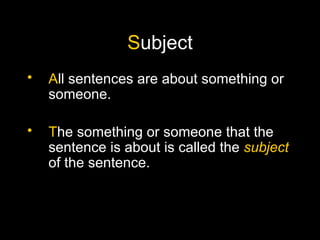
S ubject A ll sentences are about something or someone. T he something or someone that the sentence is about is called the  subject  of the sentence.
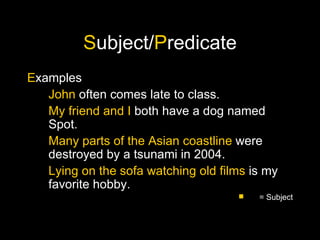
S ubject/ P redicate E xamples John  often comes late to class. My friend and I  both have a dog named Spot. Many parts of the Asian coastline  were destroyed by a tsunami in 2004. Lying on the sofa watching old films  is my favorite hobby. = Subject
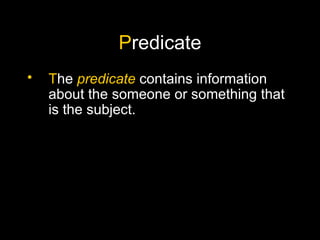
P redicate T he  predicate  contains information about the someone or something that is the subject.
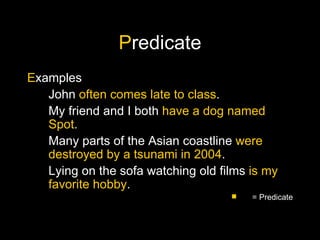
P redicate E xamples John  often comes late to class . My friend and I both  have a dog named Spot . Many parts of the Asian coastline  were destroyed by a tsunami in 2004 . Lying on the sofa watching old films  is my favorite hobby . = Predicate
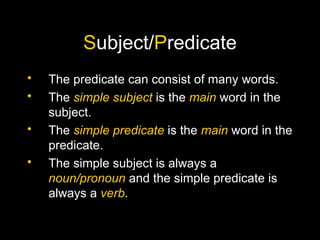
S ubject/ P redicate The predicate can consist of many words. The  simple subject  is the  main  word in the subject. The  simple predicate  is the  main  word in the predicate. The simple subject is always a  noun/pronoun  and the simple predicate is always a  verb .
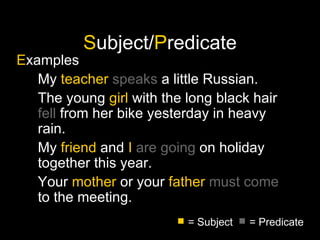
S ubject/ P redicate E xamples My  teacher   speaks  a little Russian. The young  girl  with the long black hair  fell  from her bike yesterday in heavy rain. My  friend  and  I   are going  on holiday together this year. Your  mother  or your  father   must come  to the meeting. = Predicate = Subject
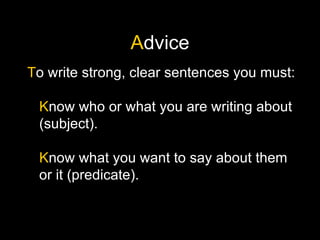
A dvice T o write strong, clear sentences you must: K now who or what you are writing about (subject).  K now what you want to say about them or it (predicate).
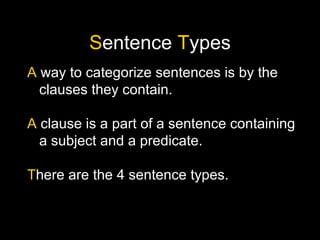
S entence  T ypes A  way to categorize sentences is by the clauses they contain. A  clause is a part of a sentence containing a subject and a predicate. T here are the 4 sentence types.
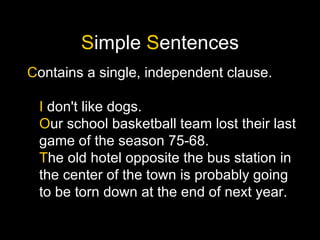
S imple  S entences C ontains a single, independent clause. I  don't like dogs. O ur school basketball team lost their last game of the season 75-68. T he old hotel opposite the bus station in the center of the town is probably going to be torn down at the end of next year.
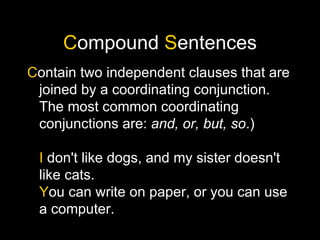
C ompound  S entences C ontain two independent clauses that are joined by a coordinating conjunction. The most common coordinating conjunctions are:  and, or, but, so .) I  don't like dogs, and my sister doesn't like cats. Y ou can write on paper, or you can use a computer.
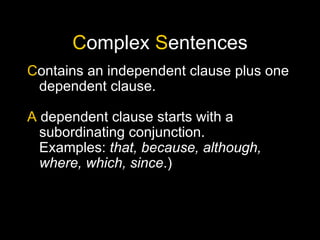
C omplex  S entences C ontains an independent clause plus one dependent clause.  A  dependent clause starts with a subordinating conjunction.  Examples:  that, because, although, where, which, since .)
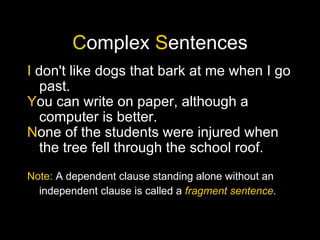
C omplex  S entences I  don't like dogs that bark at me when I go past. Y ou can write on paper, although a computer is better. N one of the students were injured when the tree fell through the school roof. Note:  A dependent clause standing alone without an independent clause is called a  fragment sentence .
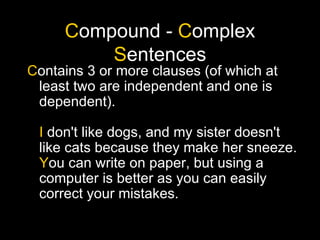
C ompound -  C omplex  S entences C ontains 3 or more clauses (of which at least two are independent and one is dependent). I  don't like dogs, and my sister doesn't like cats because they make her sneeze. Y ou can write on paper, but using a computer is better as you can easily correct your mistakes.
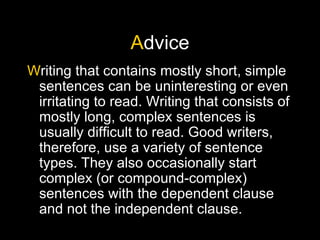
A dvice W riting that contains mostly short, simple sentences can be uninteresting or even irritating to read. Writing that consists of mostly long, complex sentences is usually difficult to read. Good writers, therefore, use a variety of sentence types. They also occasionally start complex (or compound-complex) sentences with the dependent clause and not the independent clause.
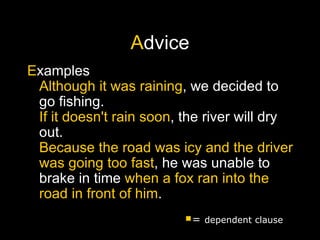
A dvice E xamples Although it was raining , we decided to go fishing. If it doesn't rain soon , the river will dry out. Because the road was icy and the driver was going too fast , he was unable to brake in time  when a fox ran into the road in front of him . =  dependent clause
N otes S entences can also be categorized according to their function. I ndependent clauses are also called  main  clauses. Dependent clauses are also called  subordinate  clauses.
Q uestions? For more slide presentations visit:

English Syntax - Basic Sentence Structure

  • 1.
    S yntax Basic S entence S tructure
  • 2.
    I ntroduction Only the basics C ommon sentence problems in written English I mprove writing
  • 3.
    D efinition A sentence is: ‘ a sequence of words whose first word starts with a capital letter and whose last word is followed by an end punctuation mark (period/full stop, question mark or exclamation mark)'
  • 4.
    S ubject All sentences are about something or someone. T he something or someone that the sentence is about is called the subject of the sentence.
  • 5.
    S ubject/ Predicate E xamples John often comes late to class. My friend and I both have a dog named Spot. Many parts of the Asian coastline were destroyed by a tsunami in 2004. Lying on the sofa watching old films is my favorite hobby. = Subject
  • 6.
    P redicate The predicate contains information about the someone or something that is the subject.
  • 7.
    P redicate Examples John often comes late to class . My friend and I both have a dog named Spot . Many parts of the Asian coastline were destroyed by a tsunami in 2004 . Lying on the sofa watching old films is my favorite hobby . = Predicate
  • 8.
    S ubject/ Predicate The predicate can consist of many words. The simple subject is the main word in the subject. The simple predicate is the main word in the predicate. The simple subject is always a noun/pronoun and the simple predicate is always a verb .
  • 9.
    S ubject/ Predicate E xamples My teacher speaks a little Russian. The young girl with the long black hair fell from her bike yesterday in heavy rain. My friend and I are going on holiday together this year. Your mother or your father must come to the meeting. = Predicate = Subject
  • 10.
    A dvice To write strong, clear sentences you must: K now who or what you are writing about (subject). K now what you want to say about them or it (predicate).
  • 11.
    S entence T ypes A way to categorize sentences is by the clauses they contain. A clause is a part of a sentence containing a subject and a predicate. T here are the 4 sentence types.
  • 12.
    S imple S entences C ontains a single, independent clause. I don't like dogs. O ur school basketball team lost their last game of the season 75-68. T he old hotel opposite the bus station in the center of the town is probably going to be torn down at the end of next year.
  • 13.
    C ompound S entences C ontain two independent clauses that are joined by a coordinating conjunction. The most common coordinating conjunctions are: and, or, but, so .) I don't like dogs, and my sister doesn't like cats. Y ou can write on paper, or you can use a computer.
  • 14.
    C omplex S entences C ontains an independent clause plus one dependent clause. A dependent clause starts with a subordinating conjunction. Examples: that, because, although, where, which, since .)
  • 15.
    C omplex S entences I don't like dogs that bark at me when I go past. Y ou can write on paper, although a computer is better. N one of the students were injured when the tree fell through the school roof. Note: A dependent clause standing alone without an independent clause is called a fragment sentence .
  • 16.
    C ompound - C omplex S entences C ontains 3 or more clauses (of which at least two are independent and one is dependent). I don't like dogs, and my sister doesn't like cats because they make her sneeze. Y ou can write on paper, but using a computer is better as you can easily correct your mistakes.
  • 17.
    A dvice Writing that contains mostly short, simple sentences can be uninteresting or even irritating to read. Writing that consists of mostly long, complex sentences is usually difficult to read. Good writers, therefore, use a variety of sentence types. They also occasionally start complex (or compound-complex) sentences with the dependent clause and not the independent clause.
  • 18.
    A dvice Examples Although it was raining , we decided to go fishing. If it doesn't rain soon , the river will dry out. Because the road was icy and the driver was going too fast , he was unable to brake in time when a fox ran into the road in front of him . = dependent clause
  • 19.
    N otes Sentences can also be categorized according to their function. I ndependent clauses are also called main clauses. Dependent clauses are also called subordinate clauses.
  • 20.
    Q uestions? Formore slide presentations visit: