IN

ES
SU NG 13
IS NI
0
II-2
ND AR ESTER
U LE
M
O
SE
GR AGE
CK U
BA NG CTICS I
LA H DIDA
L
NG
E

IS
THE MIRACLE OF LENGUAJE

Are we born with an innate capability to learn
languages?
Watch
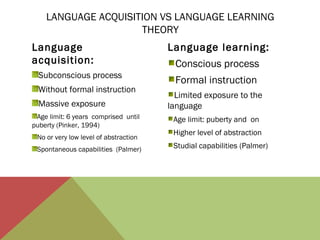
LANGUAGE ACQUISITION VS LANGUAGE LEARNING
THEORY
Language
acquisition:
Subconscious process
Without formal instruction
Massive exposure
Age limit: 6 years comprised until
puberty (Pinker, 1994)
No or very low level of abstraction
Spontaneous capabilities (Palmer)

Language learning:
Conscious process
Formal instruction
Limited exposure to the
language
Age limit: puberty and on
Higher level of abstraction
Studial capabilities (Palmer)
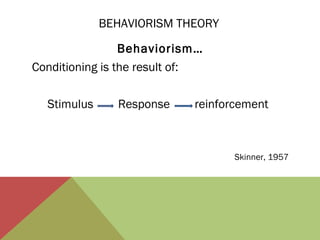
BEHAVIORISM THEORY
Behaviorism…
Conditioning is the result of:
Stimulus

Response

reinforcement

Skinner, 1957
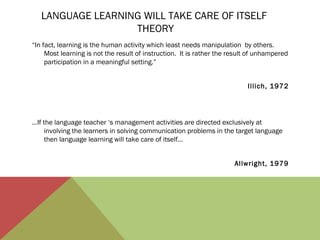
LANGUAGE LEARNING WILL TAKE CARE OF ITSELF
THEORY
“In fact, learning is the human activity which least needs manipulation by others.
Most learning is not the result of instruction. It is rather the result of unhampered
participation in a meaningful setting.”
Illich, 1972

…If the language teacher ‘s management activities are directed exclusively at
involving the learners in solving communication problems in the target language
then language learning will take care of itself…
Allwright, 1979
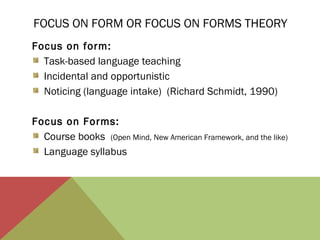
FOCUS ON FORM OR FOCUS ON FORMS THEORY
Focus on form:
Task-based language teaching
Incidental and opportunistic
Noticing (language intake) (Richard Schmidt, 1990)
Focus on Forms:
Course books (Open Mind, New American Framework, and the like)
Language syllabus
THE IMPORTANCE OF REPETITION
Repetition drills
Repetition of encounters with language with
lapses in between (noticing)
THINKING ABOUT LANGUAGE
Implicit teaching (Inductive approach)
Learner centered
Students take agency
Explicit teaching (Deductive approach)
Teacher centered
AROUSAL, AFFECT AND HUMANISTIC TEACHING
Affect:
Anxiety, fear, stress, anger or depression compromise learning. (alienations)

Student’s Affective filter (low/high) affects language acquisition

Humanistic:


Personal identity



Self-knowledge



Feelings



emotions

Stephen Krashen
WHEN YOU’RE READY
•

Teaching can promote acquisition: teaching one step close to the next form to be
acquired (Teachability Hypothesis) – Pienemann,1998

•

All learning is mediated by social interaction

•

Learning is assisted performance (scaffolding)

•

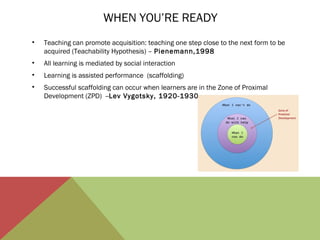
Successful scaffolding can occur when learners are in the Zone of Proximal
Development (ZPD) --Lev Vygotsky, 1920-1930
LANGUAGE PLAY
Can you mention some language games?
 Songs
 Jokes
 Rhymes
 Tongue twisters and the like
…Language play, when properly designed, may well
be extremely useful for student language
development…
Cook, 2000
THANK YOU!!!
STEPHEN KRASHEN

Background issues in language learning

  • 1.
    IN ES SU NG 13 ISNI 0 II-2 ND AR ESTER U LE M O SE GR AGE CK U BA NG CTICS I LA H DIDA L NG E IS
  • 2.
    THE MIRACLE OFLENGUAJE Are we born with an innate capability to learn languages? Watch
  • 3.
    LANGUAGE ACQUISITION VSLANGUAGE LEARNING THEORY Language acquisition: Subconscious process Without formal instruction Massive exposure Age limit: 6 years comprised until puberty (Pinker, 1994) No or very low level of abstraction Spontaneous capabilities (Palmer) Language learning: Conscious process Formal instruction Limited exposure to the language Age limit: puberty and on Higher level of abstraction Studial capabilities (Palmer)
  • 4.
    BEHAVIORISM THEORY Behaviorism… Conditioning isthe result of: Stimulus Response reinforcement Skinner, 1957
  • 5.
    LANGUAGE LEARNING WILLTAKE CARE OF ITSELF THEORY “In fact, learning is the human activity which least needs manipulation by others. Most learning is not the result of instruction. It is rather the result of unhampered participation in a meaningful setting.” Illich, 1972 …If the language teacher ‘s management activities are directed exclusively at involving the learners in solving communication problems in the target language then language learning will take care of itself… Allwright, 1979
  • 6.
    FOCUS ON FORMOR FOCUS ON FORMS THEORY Focus on form: Task-based language teaching Incidental and opportunistic Noticing (language intake) (Richard Schmidt, 1990) Focus on Forms: Course books (Open Mind, New American Framework, and the like) Language syllabus
  • 7.
    THE IMPORTANCE OFREPETITION Repetition drills Repetition of encounters with language with lapses in between (noticing)
  • 8.
    THINKING ABOUT LANGUAGE Implicitteaching (Inductive approach) Learner centered Students take agency Explicit teaching (Deductive approach) Teacher centered
  • 9.
    AROUSAL, AFFECT ANDHUMANISTIC TEACHING Affect: Anxiety, fear, stress, anger or depression compromise learning. (alienations) Student’s Affective filter (low/high) affects language acquisition Humanistic:  Personal identity  Self-knowledge  Feelings  emotions Stephen Krashen
  • 10.
    WHEN YOU’RE READY • Teachingcan promote acquisition: teaching one step close to the next form to be acquired (Teachability Hypothesis) – Pienemann,1998 • All learning is mediated by social interaction • Learning is assisted performance (scaffolding) • Successful scaffolding can occur when learners are in the Zone of Proximal Development (ZPD) --Lev Vygotsky, 1920-1930
  • 11.
    LANGUAGE PLAY Can youmention some language games?  Songs  Jokes  Rhymes  Tongue twisters and the like …Language play, when properly designed, may well be extremely useful for student language development… Cook, 2000
  • 12.

Editor's Notes

  • #2 {"3":"Subconscious Acquisition and Conscious Learning (Stephen Krashen; 1984)\nInput hypothesis: Comprehensible input (i + 1) \nRoughly - tuned input\nFinely – tuned input\n"}