by: Miss Florabel M. Biasong
 Abuyod National High
       School
       Teresa, Rizal
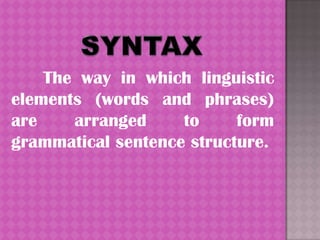
The way in which linguistic
elements (words and phrases)
are    arranged     to     form
grammatical sentence structure.
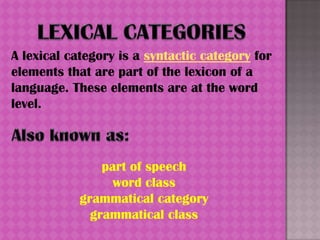
A lexical category is a syntactic category for
elements that are part of the lexicon of a
language. These elements are at the word
level.


                part of speech
                  word class
            grammatical category
              grammatical class
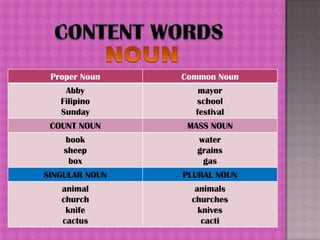
Proper Noun    Common Noun
    Abby           mayor
   Filipino       school
   Sunday         festival
 COUNT NOUN      MASS NOUN
    book           water
    sheep          grains
     box            gas
SINGULAR NOUN   PLURAL NOUN
   animal          animals
   church         churches
    knife           knives
   cactus            cacti
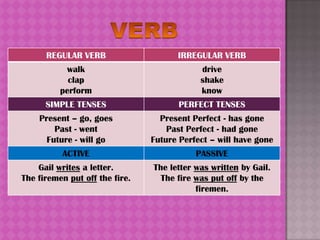
REGULAR VERB                    IRREGULAR VERB
           walk                             drive
            clap                            shake
          perform                           know
      SIMPLE TENSES                    PERFECT TENSES
    Present – go, goes            Present Perfect - has gone
        Past - went                 Past Perfect - had gone
      Future - will go          Future Perfect – will have gone
          ACTIVE                           PASSIVE
    Gail writes a letter.       The letter was written by Gail.
The firemen put off the fire.     The fire was put off by the
                                           firemen.
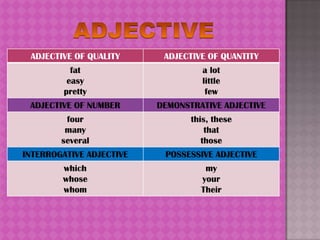
ADJECTIVE OF QUALITY      ADJECTIVE OF QUANTITY
           fat                      a lot
          easy                      little
         pretty                      few
 ADJECTIVE OF NUMBER      DEMONSTRATIVE ADJECTIVE
         four                    this, these
         many                        that
        several                     those
INTERROGATIVE ADJECTIVE    POSSESSIVE ADJECTIVE
        which                       my
        whose                      your
        whom                       Their
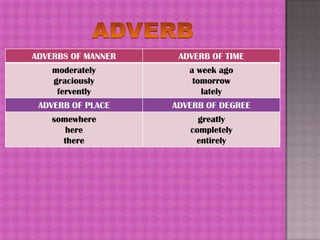
ADVERBS OF MANNER    ADVERB OF TIME
    moderately         a week ago
    graciously          tomorrow
     fervently            lately
 ADVERB OF PLACE    ADVERB OF DEGREE
    somewhere            greatly
       here            completely
      there             entirely
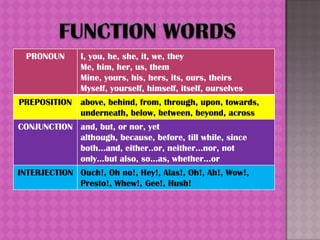
PRONOUN      I, you, he, she, it, we, they
               Me, him, her, us, them
               Mine, yours, his, hers, its, ours, theirs
               Myself, yourself, himself, itself, ourselves
PREPOSITION above, behind, from, through, upon, towards,
            underneath, below, between, beyond, across
CONJUNCTION and, but, or nor, yet
            although, because, before, till while, since
            both…and, either..or, neither…nor, not
            only…but also, so…as, whether…or
INTERJECTION Ouch!, Oh no!, Hey!, Alas!, Oh!, Ah!, Wow!,
             Presto!, Whew!, Gee!, Hush!
“Then you should say what you mean,” the March Hare went
on.

“I do,” Alice hastily replied, “at least—I mean what I say—the
same thing you know.”

“Not the same thing a bit!” Said the Hatter. “You might just
well say that „I see what I eat‟ is the same thing as „I eat what
I see‟!”

“You might just as well say,” added the March Hare „I like
what I get‟ is the same things as „I get what I like‟!”

“You just as well say,” added the Dormouse…that „I breathe
when I sleep‟ is the same thing as „I seep when I breathe‟!”

“It is the same thing with you,” said the Hatter.


                   from Alice’s Adventure in Wonderland
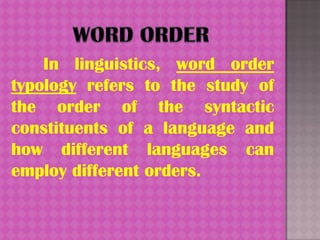
In linguistics, word order
typology refers to the study of
the order of the syntactic
constituents of a language and
how different languages can
employ different orders.
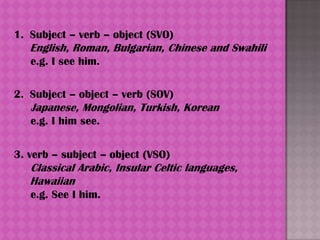
1. Subject – verb – object (SVO)
   English, Roman, Bulgarian, Chinese and Swahili
   e.g. I see him.

2. Subject – object – verb (SOV)
   Japanese, Mongolian, Turkish, Korean
   e.g. I him see.


3. verb – subject – object (VSO)
   Classical Arabic, Insular Celtic languages,
   Hawaiian
   e.g. See I him.
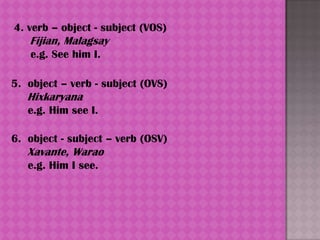
4. verb – object - subject (VOS)
   Fijian, Malagsay
   e.g. See him I.

5. object – verb - subject (OVS)
   Hixkaryana
   e.g. Him see I.

6. object - subject – verb (OSV)
   Xavante, Warao
   e.g. Him I see.
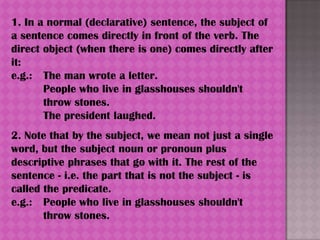
1. In a normal (declarative) sentence, the subject of
a sentence comes directly in front of the verb. The
direct object (when there is one) comes directly after
it:
e.g.: The man wrote a letter.
       People who live in glasshouses shouldn't
       throw stones.
       The president laughed.
2. Note that by the subject, we mean not just a single
word, but the subject noun or pronoun plus
descriptive phrases that go with it. The rest of the
sentence - i.e. the part that is not the subject - is
called the predicate.
e.g.: People who live in glasshouses shouldn't
       throw stones.
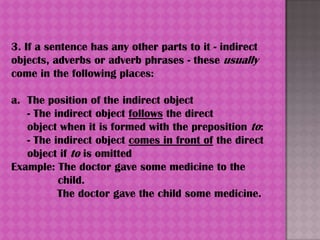
3. If a sentence has any other parts to it - indirect
objects, adverbs or adverb phrases - these usually
come in the following places:

a. The position of the indirect object
   - The indirect object follows the direct
   object when it is formed with the preposition to:
   - The indirect object comes in front of the direct
   object if to is omitted
Example: The doctor gave some medicine to the
          child.
          The doctor gave the child some medicine.
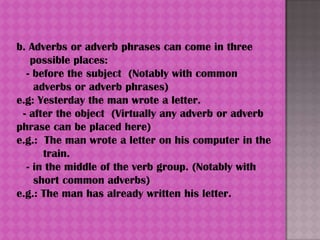
b. Adverbs or adverb phrases can come in three
   possible places:
  - before the subject (Notably with common
    adverbs or adverb phrases)
e.g: Yesterday the man wrote a letter.
 - after the object (Virtually any adverb or adverb
phrase can be placed here)
e.g.: The man wrote a letter on his computer in the
      train.
  - in the middle of the verb group. (Notably with
    short common adverbs)
e.g.: The man has already written his letter.
4. In standard English, nothing usually comes between the
subject and the verb, or between the verb and the object.
 There are a few exceptions. The most important of these
are adverbs of frequency and indirect objects without to.
e.g:    The man often wrote his mother a letter.
        I sometimes give my dog a bone.

If you always apply these few simple rules, you will not
make too many word order problems in English. The
examples above are deliberately simple - but the rules can
be applied even to complex sentences, with subordinate
and coordinated clauses.

The director, [who often told his staff (to
work harder),] never left the office before [he had checked
his e-mail.]
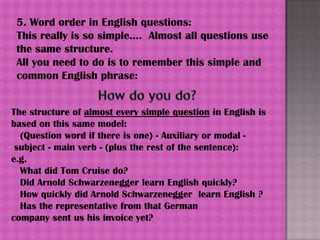
5. Word order in English questions:
 This really is so simple.... Almost all questions use
 the same structure.
 All you need to do is to remember this simple and
 common English phrase:


The structure of almost every simple question in English is
based on this same model:
  (Question word if there is one) - Auxiliary or modal -
 subject - main verb - (plus the rest of the sentence):
e.g.
  What did Tom Cruise do?
  Did Arnold Schwarzenegger learn English quickly?
  How quickly did Arnold Schwarzenegger learn English ?
  Has the representative from that German
company sent us his invoice yet?
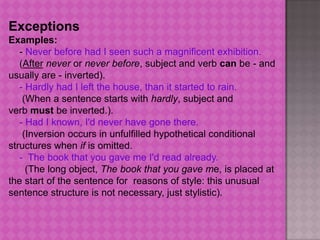
Exceptions
Examples:
   - Never before had I seen such a magnificent exhibition.
   (After never or never before, subject and verb can be - and
usually are - inverted).
   - Hardly had I left the house, than it started to rain.
    (When a sentence starts with hardly, subject and
verb must be inverted.).
   - Had I known, I'd never have gone there.
    (Inversion occurs in unfulfilled hypothetical conditional
structures when if is omitted.
   - The book that you gave me I'd read already.
     (The long object, The book that you gave me, is placed at
the start of the sentence for reasons of style: this unusual
sentence structure is not necessary, just stylistic).
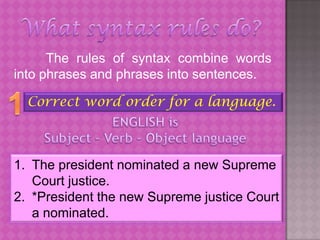
The rules of syntax combine words
into phrases and phrases into sentences.

  Correct word order for a language.


1. The president nominated a new Supreme
   Court justice.
2. *President the new Supreme justice Court
   a nominated.
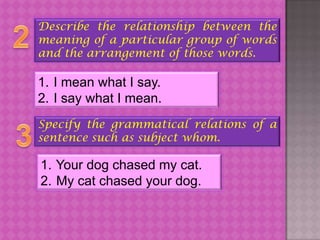
Describe the relationship between the
meaning of a particular group of words
and the arrangement of those words.

1. I mean what I say.
2. I say what I mean.
Specify the grammatical relations of a
sentence such as subject whom.

1. Your dog chased my cat.
2. My cat chased your dog.
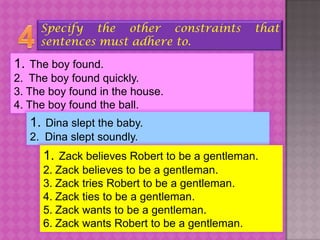
Specify the other constraints             that
     sentences must adhere to.

1. The boy found.
2. The boy found quickly.
3. The boy found in the house.
4. The boy found the ball.
   1. Dina slept the baby.
   2. Dina slept soundly.
     1. Zack believes Robert to be a gentleman.
     2. Zack believes to be a gentleman.
     3. Zack tries Robert to be a gentleman.
     4. Zack ties to be a gentleman.
     5. Zack wants to be a gentleman.
     6. Zack wants Robert to be a gentleman.
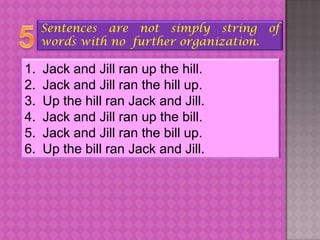
Sentences are not simply string of
     words with no further organization.

1.   Jack and Jill ran up the hill.
2.   Jack and Jill ran the hill up.
3.   Up the hill ran Jack and Jill.
4.   Jack and Jill ran up the bill.
5.   Jack and Jill ran the bill up.
6.   Up the bill ran Jack and Jill.
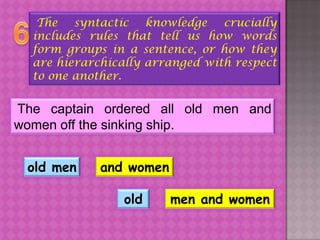
The syntactic knowledge crucially
  includes rules that tell us how words
  form groups in a sentence, or how they
  are hierarchically arranged with respect
  to one another.


The captain ordered all old men and
women off the sinking ship.


 old men     and women

                old      men and women
Syntax ppt..ms. biasong

Syntax ppt..ms. biasong

  • 1.
    by: Miss FlorabelM. Biasong Abuyod National High School Teresa, Rizal
  • 2.
    The way inwhich linguistic elements (words and phrases) are arranged to form grammatical sentence structure.
  • 3.
    A lexical categoryis a syntactic category for elements that are part of the lexicon of a language. These elements are at the word level. part of speech word class grammatical category grammatical class
  • 4.
    Proper Noun Common Noun Abby mayor Filipino school Sunday festival COUNT NOUN MASS NOUN book water sheep grains box gas SINGULAR NOUN PLURAL NOUN animal animals church churches knife knives cactus cacti
  • 5.
    REGULAR VERB IRREGULAR VERB walk drive clap shake perform know SIMPLE TENSES PERFECT TENSES Present – go, goes Present Perfect - has gone Past - went Past Perfect - had gone Future - will go Future Perfect – will have gone ACTIVE PASSIVE Gail writes a letter. The letter was written by Gail. The firemen put off the fire. The fire was put off by the firemen.
  • 6.
    ADJECTIVE OF QUALITY ADJECTIVE OF QUANTITY fat a lot easy little pretty few ADJECTIVE OF NUMBER DEMONSTRATIVE ADJECTIVE four this, these many that several those INTERROGATIVE ADJECTIVE POSSESSIVE ADJECTIVE which my whose your whom Their
  • 7.
    ADVERBS OF MANNER ADVERB OF TIME moderately a week ago graciously tomorrow fervently lately ADVERB OF PLACE ADVERB OF DEGREE somewhere greatly here completely there entirely
  • 8.
    PRONOUN I, you, he, she, it, we, they Me, him, her, us, them Mine, yours, his, hers, its, ours, theirs Myself, yourself, himself, itself, ourselves PREPOSITION above, behind, from, through, upon, towards, underneath, below, between, beyond, across CONJUNCTION and, but, or nor, yet although, because, before, till while, since both…and, either..or, neither…nor, not only…but also, so…as, whether…or INTERJECTION Ouch!, Oh no!, Hey!, Alas!, Oh!, Ah!, Wow!, Presto!, Whew!, Gee!, Hush!
  • 9.
    “Then you shouldsay what you mean,” the March Hare went on. “I do,” Alice hastily replied, “at least—I mean what I say—the same thing you know.” “Not the same thing a bit!” Said the Hatter. “You might just well say that „I see what I eat‟ is the same thing as „I eat what I see‟!” “You might just as well say,” added the March Hare „I like what I get‟ is the same things as „I get what I like‟!” “You just as well say,” added the Dormouse…that „I breathe when I sleep‟ is the same thing as „I seep when I breathe‟!” “It is the same thing with you,” said the Hatter. from Alice’s Adventure in Wonderland
  • 10.
    In linguistics, wordorder typology refers to the study of the order of the syntactic constituents of a language and how different languages can employ different orders.
  • 11.
    1. Subject –verb – object (SVO) English, Roman, Bulgarian, Chinese and Swahili e.g. I see him. 2. Subject – object – verb (SOV) Japanese, Mongolian, Turkish, Korean e.g. I him see. 3. verb – subject – object (VSO) Classical Arabic, Insular Celtic languages, Hawaiian e.g. See I him.
  • 12.
    4. verb –object - subject (VOS) Fijian, Malagsay e.g. See him I. 5. object – verb - subject (OVS) Hixkaryana e.g. Him see I. 6. object - subject – verb (OSV) Xavante, Warao e.g. Him I see.
  • 13.
    1. In anormal (declarative) sentence, the subject of a sentence comes directly in front of the verb. The direct object (when there is one) comes directly after it: e.g.: The man wrote a letter. People who live in glasshouses shouldn't throw stones. The president laughed. 2. Note that by the subject, we mean not just a single word, but the subject noun or pronoun plus descriptive phrases that go with it. The rest of the sentence - i.e. the part that is not the subject - is called the predicate. e.g.: People who live in glasshouses shouldn't throw stones.
  • 14.
    3. If asentence has any other parts to it - indirect objects, adverbs or adverb phrases - these usually come in the following places: a. The position of the indirect object - The indirect object follows the direct object when it is formed with the preposition to: - The indirect object comes in front of the direct object if to is omitted Example: The doctor gave some medicine to the child. The doctor gave the child some medicine.
  • 15.
    b. Adverbs oradverb phrases can come in three possible places: - before the subject (Notably with common adverbs or adverb phrases) e.g: Yesterday the man wrote a letter. - after the object (Virtually any adverb or adverb phrase can be placed here) e.g.: The man wrote a letter on his computer in the train. - in the middle of the verb group. (Notably with short common adverbs) e.g.: The man has already written his letter.
  • 16.
    4. In standardEnglish, nothing usually comes between the subject and the verb, or between the verb and the object. There are a few exceptions. The most important of these are adverbs of frequency and indirect objects without to. e.g: The man often wrote his mother a letter. I sometimes give my dog a bone. If you always apply these few simple rules, you will not make too many word order problems in English. The examples above are deliberately simple - but the rules can be applied even to complex sentences, with subordinate and coordinated clauses. The director, [who often told his staff (to work harder),] never left the office before [he had checked his e-mail.]
  • 17.
    5. Word orderin English questions: This really is so simple.... Almost all questions use the same structure. All you need to do is to remember this simple and common English phrase: The structure of almost every simple question in English is based on this same model: (Question word if there is one) - Auxiliary or modal - subject - main verb - (plus the rest of the sentence): e.g. What did Tom Cruise do? Did Arnold Schwarzenegger learn English quickly? How quickly did Arnold Schwarzenegger learn English ? Has the representative from that German company sent us his invoice yet?
  • 18.
    Exceptions Examples: - Never before had I seen such a magnificent exhibition. (After never or never before, subject and verb can be - and usually are - inverted). - Hardly had I left the house, than it started to rain. (When a sentence starts with hardly, subject and verb must be inverted.). - Had I known, I'd never have gone there. (Inversion occurs in unfulfilled hypothetical conditional structures when if is omitted. - The book that you gave me I'd read already. (The long object, The book that you gave me, is placed at the start of the sentence for reasons of style: this unusual sentence structure is not necessary, just stylistic).
  • 19.
    The rules ofsyntax combine words into phrases and phrases into sentences. Correct word order for a language. 1. The president nominated a new Supreme Court justice. 2. *President the new Supreme justice Court a nominated.
  • 20.
    Describe the relationshipbetween the meaning of a particular group of words and the arrangement of those words. 1. I mean what I say. 2. I say what I mean. Specify the grammatical relations of a sentence such as subject whom. 1. Your dog chased my cat. 2. My cat chased your dog.
  • 21.
    Specify the otherconstraints that sentences must adhere to. 1. The boy found. 2. The boy found quickly. 3. The boy found in the house. 4. The boy found the ball. 1. Dina slept the baby. 2. Dina slept soundly. 1. Zack believes Robert to be a gentleman. 2. Zack believes to be a gentleman. 3. Zack tries Robert to be a gentleman. 4. Zack ties to be a gentleman. 5. Zack wants to be a gentleman. 6. Zack wants Robert to be a gentleman.
  • 22.
    Sentences are notsimply string of words with no further organization. 1. Jack and Jill ran up the hill. 2. Jack and Jill ran the hill up. 3. Up the hill ran Jack and Jill. 4. Jack and Jill ran up the bill. 5. Jack and Jill ran the bill up. 6. Up the bill ran Jack and Jill.
  • 23.
    The syntactic knowledgecrucially includes rules that tell us how words form groups in a sentence, or how they are hierarchically arranged with respect to one another. The captain ordered all old men and women off the sinking ship. old men and women old men and women