Non-Invasive Ventilation
History
🠶 Initially negative pressure ventilators (Tank & cuirass
ventilators) were used for ventilating large number of
victims of polio during acute illness
Drinker-Shaw’s Iron Lung 1928
The copenhagen polio outbreak 1952
History
🠶 In 1981 Sullivan and colleague-continuous positive
airway pressure(CPAP) for obstructive sleep apnea (OSA)
🠶 BiPAPwas developed in mid 1990's
🠶 This was followed by improvements in the interface and
establishment of role of NIV in patients of COPD
Definition
🠶 Non-invasive ventilation is a technique of providing
ventilation without the use of an artificial airway
(endotracheal intubation or tracheostomy)
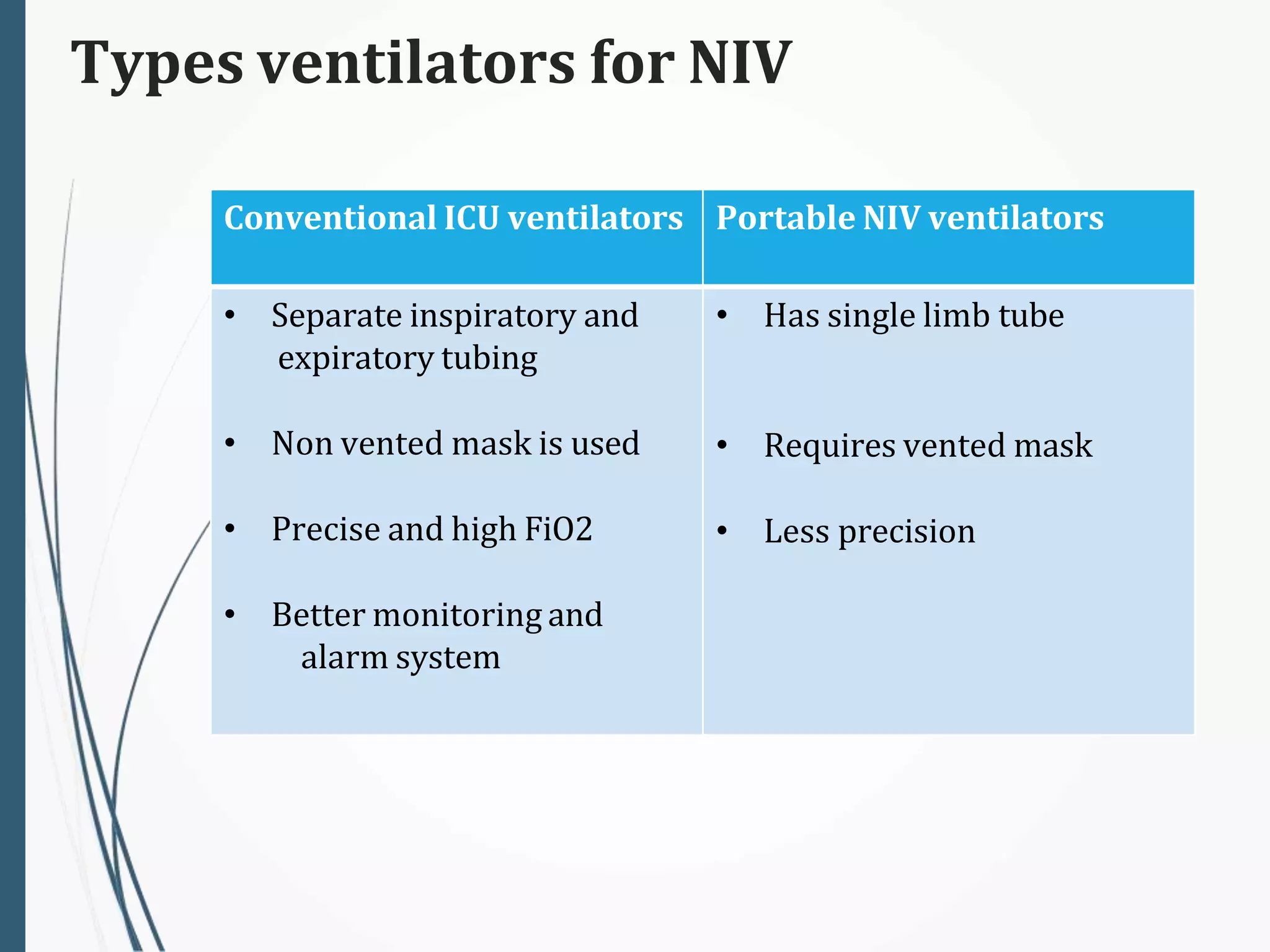
Types ventilators for NIV
Conventional ICU ventilators Portable NIV ventilators
• Separate inspiratory and
expiratory tubing
• Non vented mask is used
• Precise and high FiO2
• Better monitoring and
alarm system
• Has single limb tube
• Requires vented mask
• Less precision
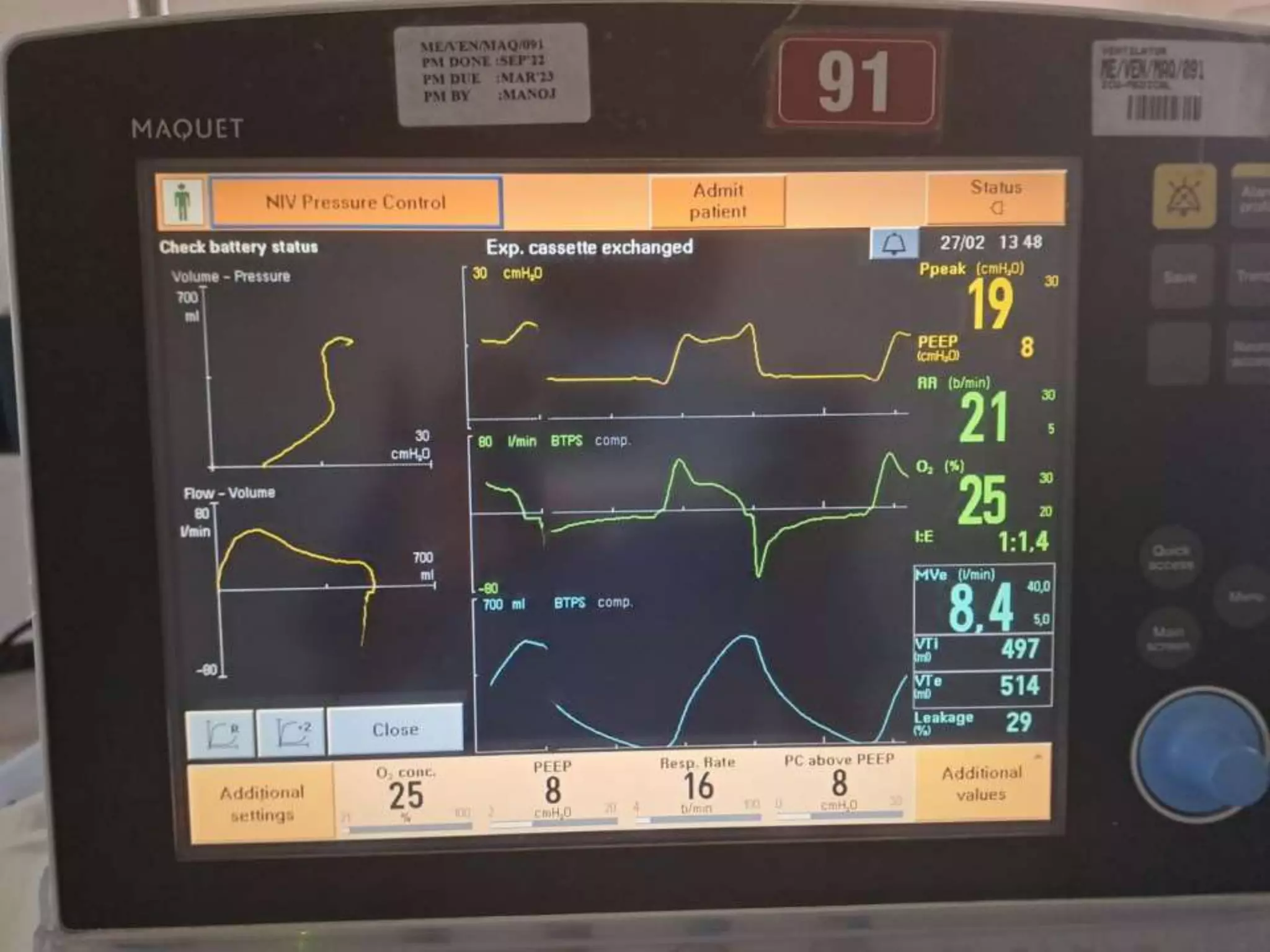
Basic settings and graphics
EPAP
IPAP
Trigger
Cycle
Inspiratory time
Back up ventilation
Types of breath
What causes the
breath to begin ?
TRIGGER:
Initiation of a
new breath
(start
inspiration)
MACHINE:
Time
PATIENT:
Flow
Pressure
Trigger
Cycle
CYCLE:
Change over from
inspiration to expiration
(end inspiration)
What causes the
breath to end ?
MACHINE:
Time
PATIENT:
Flow
Different Modes
1.Controlled or timed mode (T)
-No patient effort
-Machine provide full ventilator support
2.Assist control or spontaneous timed (S/T)
-Mainly provide support in response to patient effort
-Provide backup safety rate also
3)Assist or spontaneous mode (S)
-Provide ventilator support in response to breathing
effort only
-No backup rate
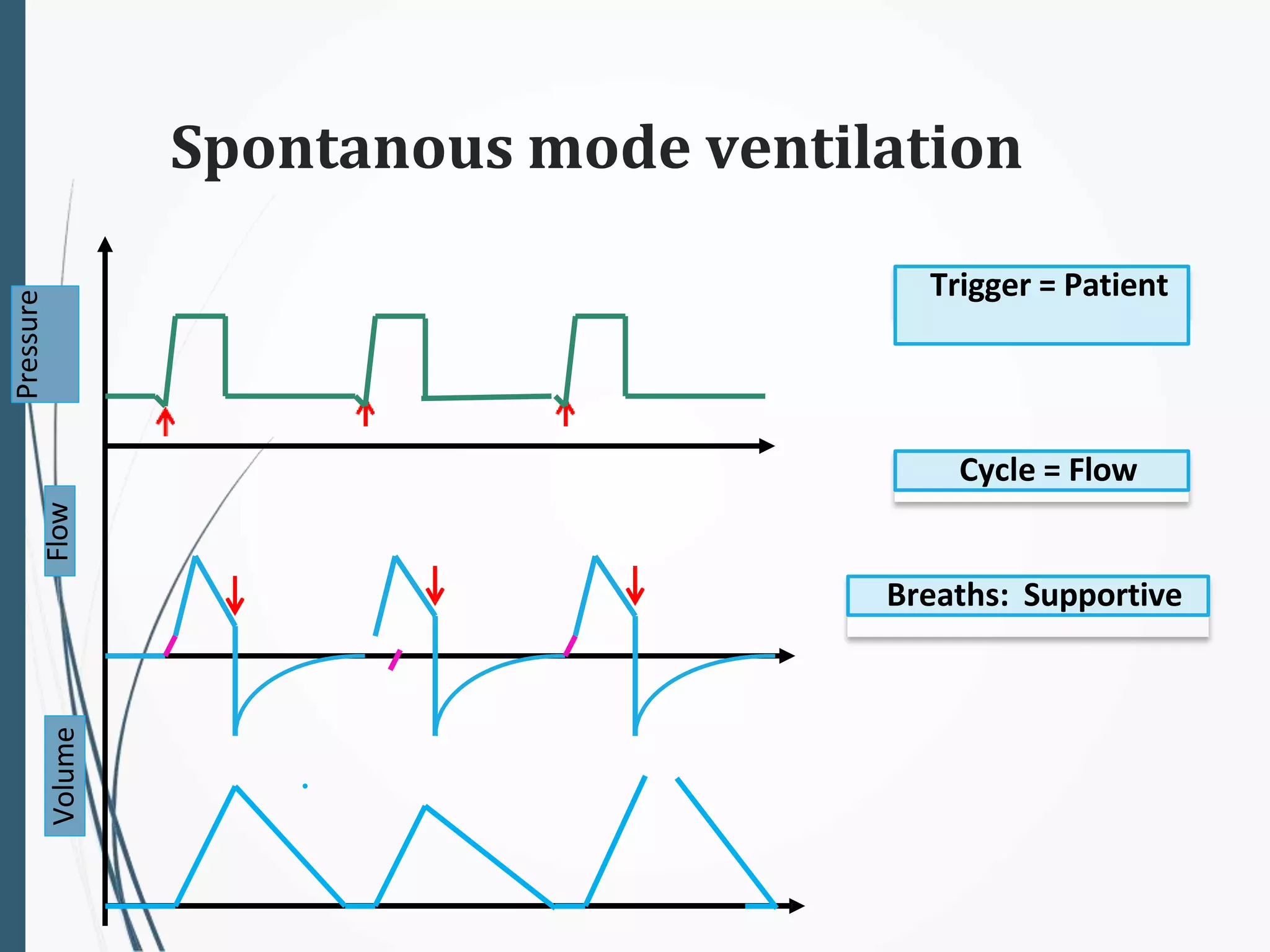
Pressure
Flow
Volume
Spontanous mode ventilation
Cycle = Flow
Trigger = Patient
Breaths: Supportive
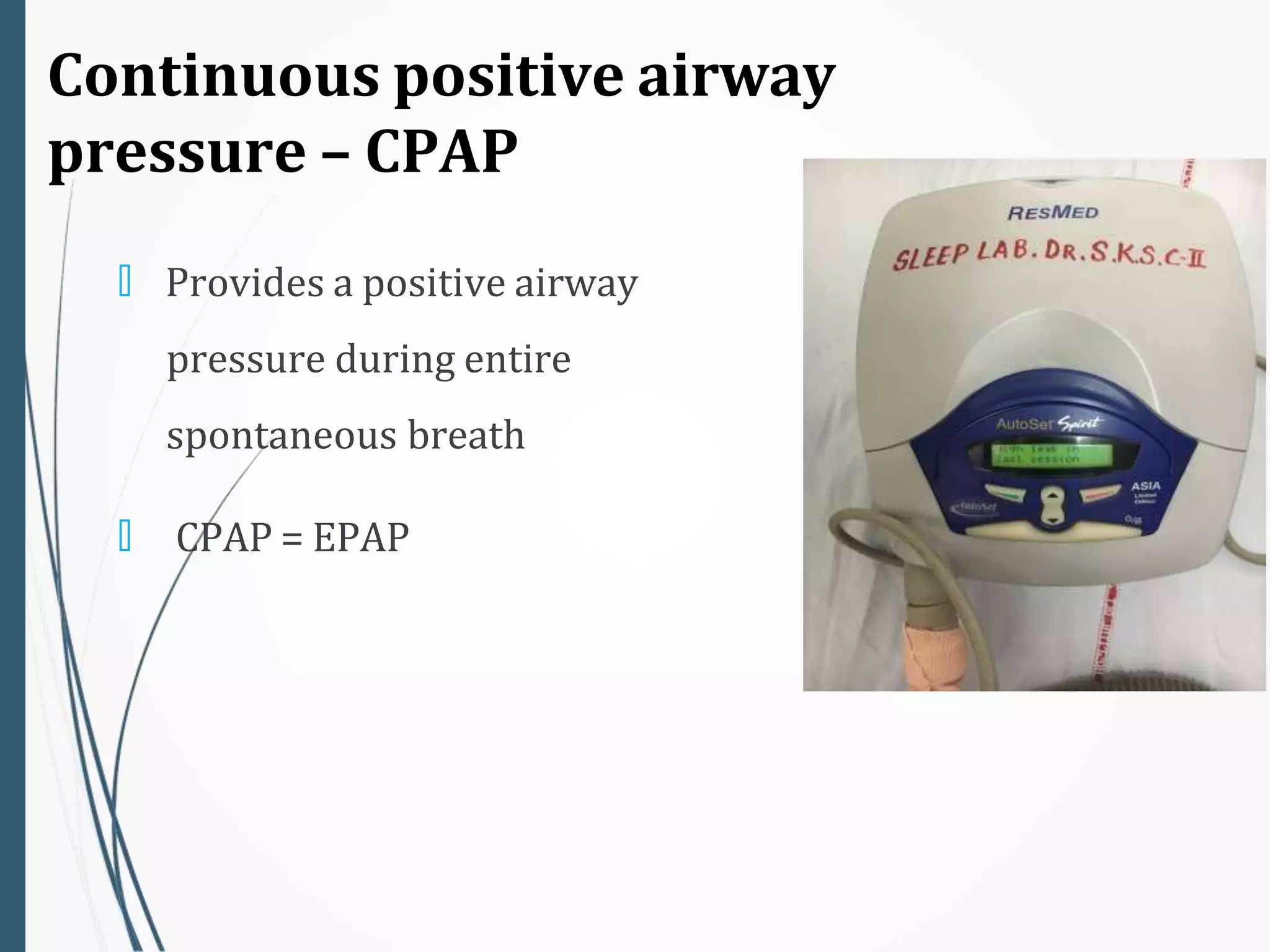
Continuous positive airway
pressure – CPAP
🠶 Provides a positive airway
pressure during entire
spontaneous breath
🠶 CPAP = EPAP
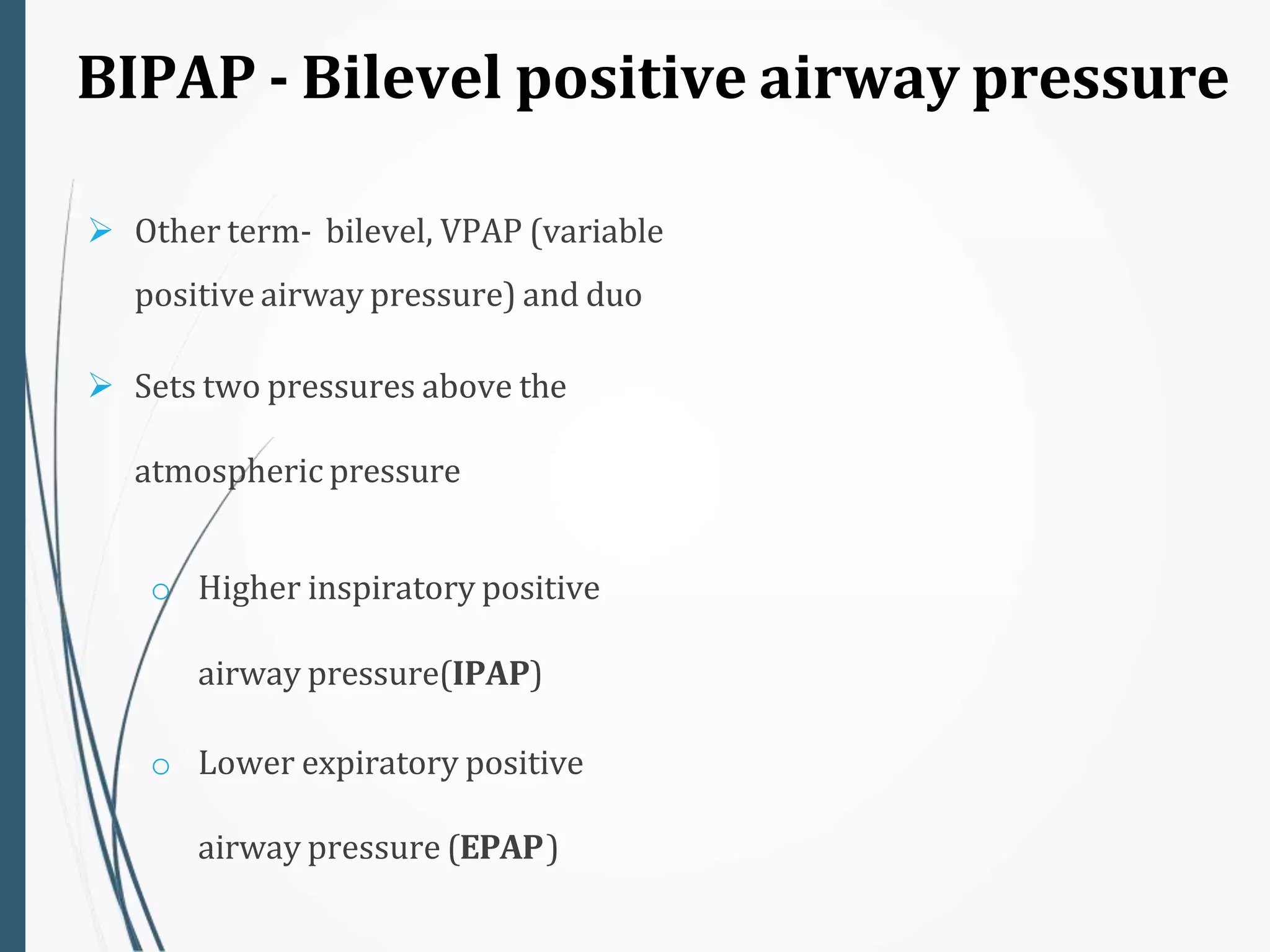
BIPAP - Bilevel positive airway pressure
 Other term- bilevel, VPAP (variable
positive airway pressure) and duo
 Sets two pressures above the
atmospheric pressure
o Higher inspiratory positive
airway pressure(IPAP)
o Lower expiratory positive
airway pressure (EPAP)
Pressure curve during BiPAP
+12
+6
+3
+3
0
-3
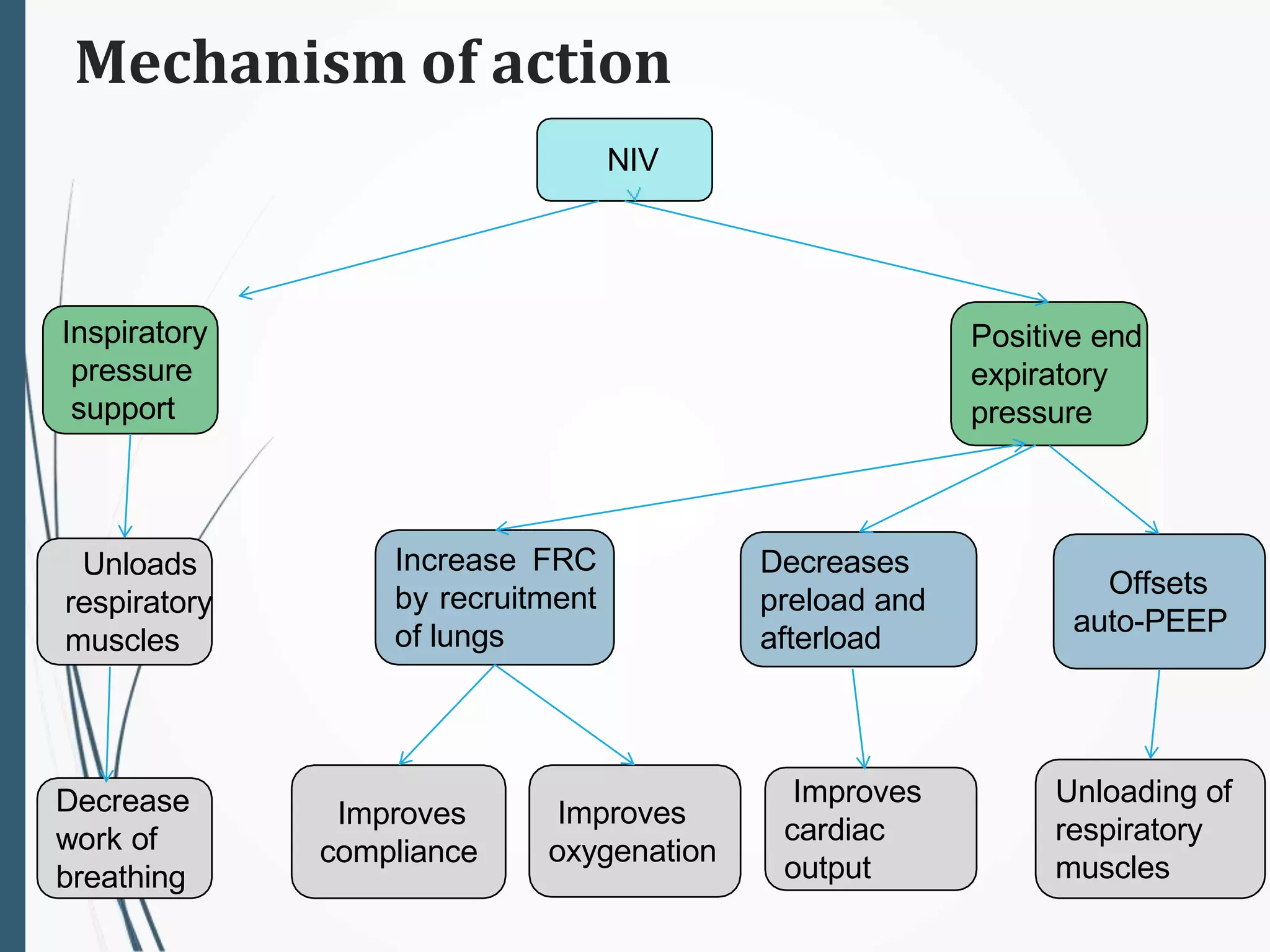
Mechanism of action
NIV
Positive end
expiratory
pressure
Unloads
respiratory
muscles
Decrease
work of
breathing
Increase FRC
by recruitment
of lungs
Decreases
preload and
afterload
Offsets
auto-PEEP
Improves
compliance
Improves
oxygenation
Unloading of
respiratory
muscles
Improves
cardiac
output
Inspiratory
pressure
support
Interfaces
🠶 Devices that connect ventilator and tubing to the face
🠶 Types
– Nasal mask
– Nasal pillow
– Oro-nasal mask
– Full face mask
– Helmet
Interfaces should be comfortable, offer a good seal,
minimize leak, and limit dead space
Nasal Masks
🠶 Covers only nose
🠶 Less claustrophobia and discomfort
– allow eating, conversation and
expectoration
🠶 Better tolerated than full face masks
🠶 Problem –air leakage through mouth
Nasal Pillows
🠶 Consists of two small cushions
fit under the nose
Nasal Pillows
Disadvantages
1.Air leaks
2.Nasal irritation
Advantages
1.Allows –
speaking
drinking
coughing
1.Absence of nasal
or facial skin damages
Vented oro-nasal mask
Non-vented oro-nasal mask
Full face mask
Full Face Masks
Advantages Disadvantages
1.Better control of mouth leaks 1. Difficulty in speaking and
coughing
1.Little cooperation required 2. High risk of aspiration
2.Better for mouth breather 3. Claustrophobia
NIV helmet
🠶 Covers the whole head and all or part of neck
🠶 No immediate contact with face
NIV helmet
Disadvantages
1. Rebreathing
2. Axillary skin
damage
Advantages
1. Minimum air leak
2. Little cooperation
required
1. Absence of nasal
or facial skin damage
Indications
Acute setting
🠶 AECOPD with type2 respiratory failure
🠶 Obesity hypoventilation syndrome with acute on chronic
type2 respiratory failure
🠶 Acute cardiogenic pulmonary edema
🠶 Immunocompromised with pneumonia
Indications
Acute setting
🠶 Mild ARDS under close monitoring
🠶 Post operative respiratory failure
🠶 Weaning
🠶 As palliative therapy
Indications
Chronic setting
🠶 Home NIV for COPD
🠶 OSA
🠶 Obesity hypoventilation syndrome
🠶 Neuromuscular disorder, chest wall deformity
Contraindications
🠶 Need for an emergent intubation
🠶 Hemodynamic instability, cardiorespiratory arrest
🠶 Inability to co-operate/protect airway/clear secretions
🠶 Severely impaired consciousness (GCS <10)
🠶 Non respiratory organ failure that is acutely life
threatening
🠶 Facial surgery /trauma
🠶 Prolonged MV anticipated
Monitoring
Subjective responses
 Bed side observation
 Ask about discomfort related to the mask or
airflow
Physiologic response
 ↓ RR, ↓ HR, BP, continuous ECG
 Level of consciousness
 ↓ accessory muscle activity and abdominal
paradox
 Monitor air leaks and Vt
Monitoring
Patient machine synchrony
 Chest wall movement, air leak
Gas exchange
 Continuous spo2 monitoring
 ABG after ½ to 1 hr of initiation and 1 hr after every
subsequent change in setting
 Every 4 hr till patient is stable
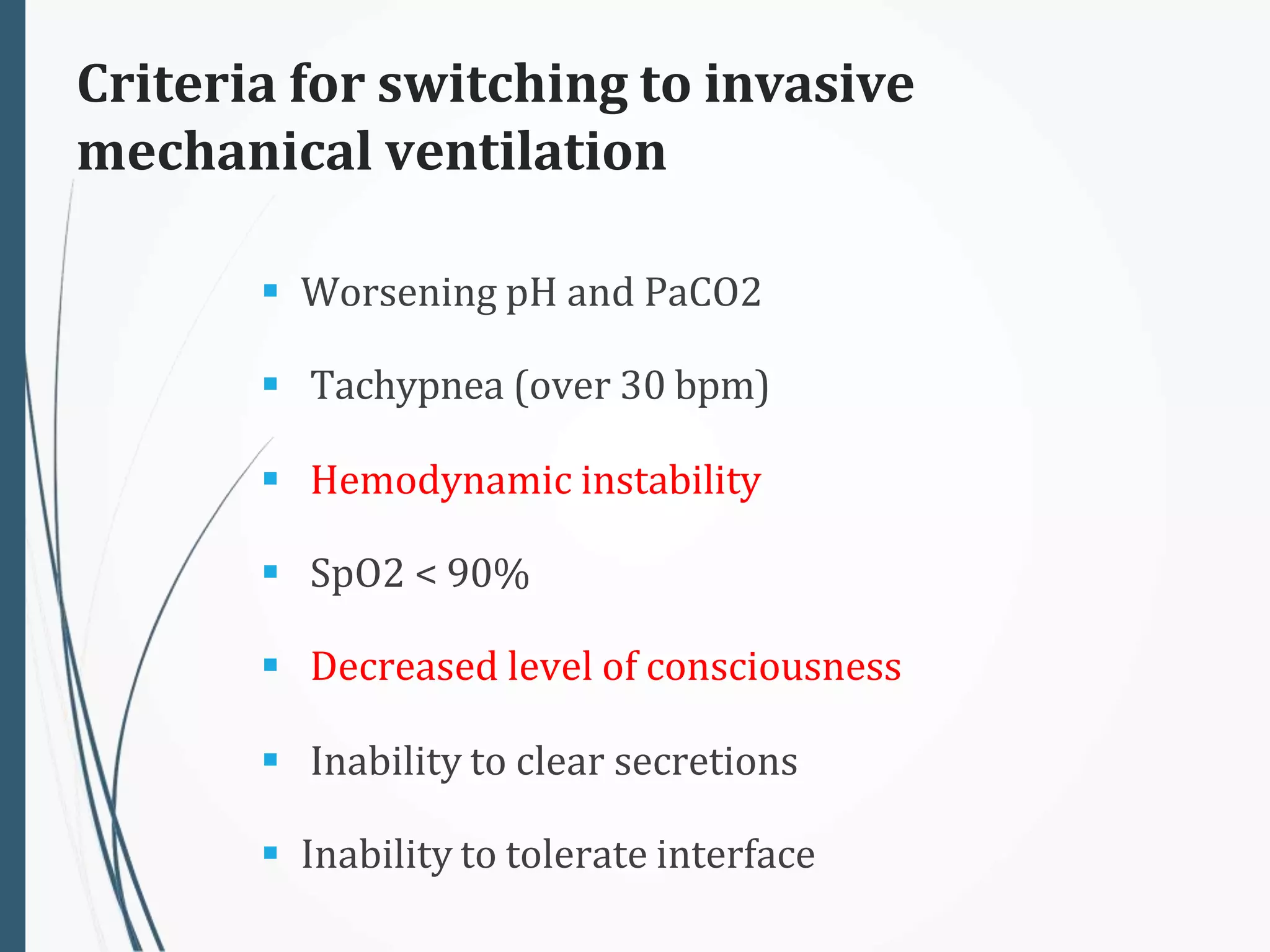
Criteria for switching to invasive
mechanical ventilation
 Worsening pH and PaCO2
 Tachypnea (over 30 bpm)
 Hemodynamic instability
 SpO2 < 90%
 Decreased level of consciousness
 Inability to clear secretions
 Inability to tolerate interface
Complications Corrective actions
• Mask discomfort
• Excessive leak around mask
• Pressure sores
• Check mask for correct size & fit
• Minimize headgear tension
• Change to different mask
• Use wound care dressing
Nasal or oral dryness • Add or increase humidification
• Irrigate nasal passage with saline
Aerophagia/gastric distention
• Use lowest effective pressure for
adequate Vt
• Use simethicone agents
Aspiration
• Make sure patient able to protect
airway
Mucus plugging
• Ensure adequate hydration
• Ensure adequate humidification
• Avoid excessive O2 flow(>20 l/min)
Hypotension
• Avoid excessive high PEEP
Sedation with NIV
🠶 Sedation should only be used with close monitoring
🠶 Infused sedative /anxiolytic only in ICU
🠶 Agitated /distressed on NIV
(iv morphine 2.5-5 mg (+/- benzodiazepine) may improve
tolerance of NIV)
NIV in COPD exacerbation
🠶 Respiratory acidosis (pH<7.35 &/or PaCO2 >45mmHg)
🠶 Severe dyspnea with clinical signs s/o respiratory muscle
fatigue
 Use of respiratory accessory muscles
 Paradoxical motion of abdomen
 Intercostal retraction
🠶 Persistent hypoxemia despite supplemental oxygen therapy
GOLD update2017
NIV in acute cardiogenic
pulmonary edema
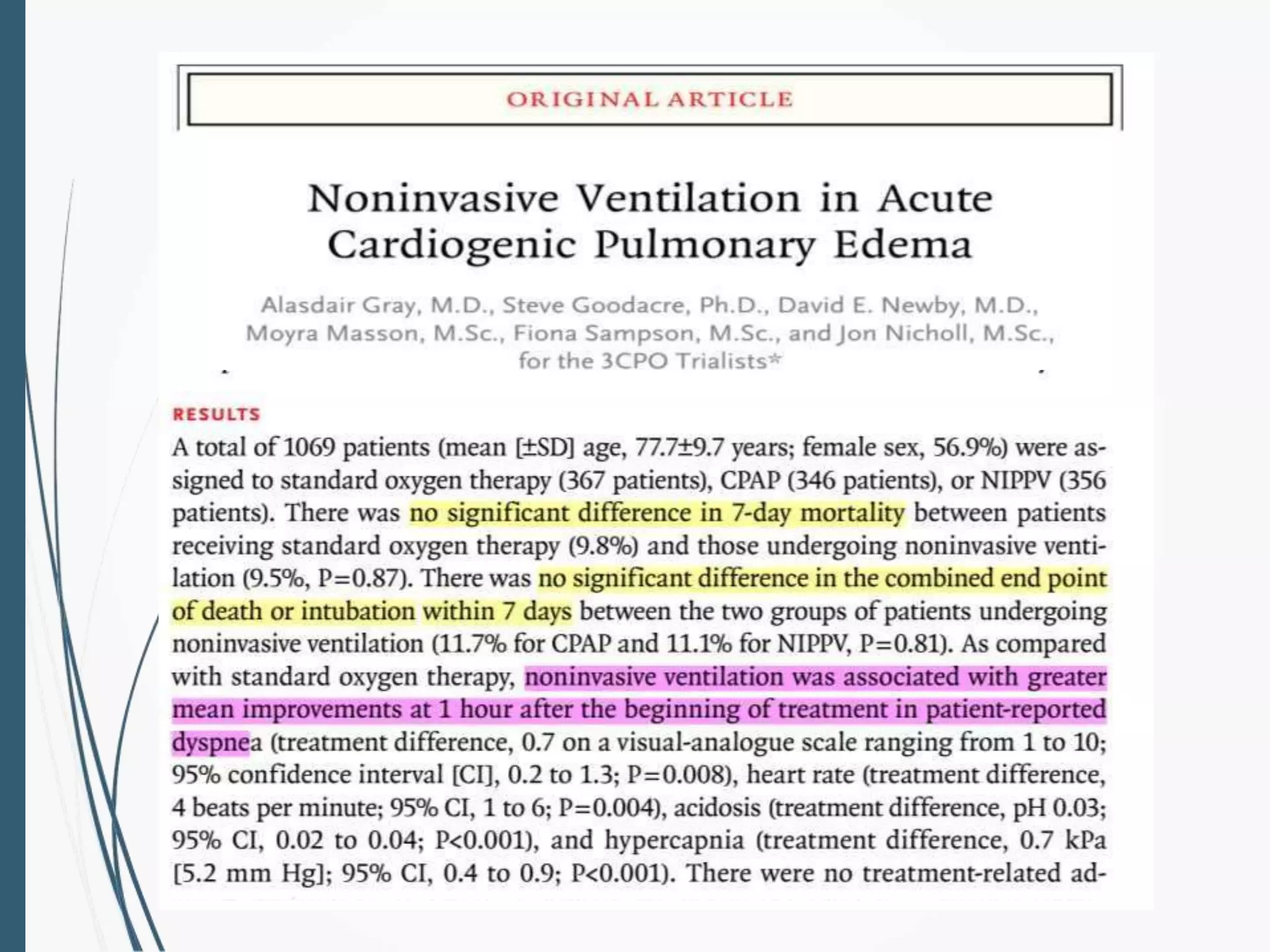
🠶 CPAP/BIPAP recommended in addition to standard
medical treatment in cases of cardiogenic pulmonary
edema. (Level 1)
🠶 CPAP & BIPAP equally effective in cardiogenic
pulmonary edema (Level I).
🠶 BIPAP is preferable in patients associated with
hypercapnic respiratory failure. (Level II)
Chronic respiratory failure (Obstructive
lung disease)
As chronic home NIV
🠶 Stable very severe COPD
🠶 Excessive daytime hypercapnia
🠶 Recent hospitalization
🠶 Concurrent OSA
GOLD update 2017
NIV in ARDS
🠶 NIV may be used with great caution in cases of Acute Lung
Injury and that too only in ICU (Level III)
🠶 Reserved for hemodynamically stable patient who can be
closely monitored in an ICU
NIV in CAP
🠶 NIV may be used in the ICU with caution in selected patients
with community acquired pneumonia particularly in those with
associated COPD (Level II)
Cystic fibrosis
• NIV may be helpful as rescue therapy to support acute
respiratory failure in cystic fibrosis, providing
a bridge to lung transplantation (Level II)
• Improvement in hypoxemia but not in hypercapnia
ILD
• NIV is not recommended for interstitial lung disease with acute
on chronic respiratory failure. (Level III)
NIV for weaning
🠶 Weaning in uncomplicated COPD who fail a trial of spontaneous
breathing. (Level II)
🠶 Not recommended postextubation respiratory failure in non-
COPD cases . It may, however, be used in COPD patients. (Level
III)
🠶 Routinely after extubation for reducing incidence of respiratory
failure and reintubation rate is not recommended. (Level II)
🠶 Can be recommended in after extubation who have a high risk of
developing respiratory failure and reintubation (age>65 yrs,
APACHE II>12 at the time of extubation, cardiac failure at time of
intubation). (Level I)
NIV in Asthma
GINA 2018 update
🠶 Evidence regarding the role of NIV in asthma is weak
🠶 If NIV is tried, the patient should be monitored
closely (Evidence D)
🠶 It should not be attempted in agitated patients, and
patients should not be sedated in order to receive NIV
(Evidence D)
Immunocompromised patients
Multiple RCTs support whenever possible, NIV should be
tried first in immunocompromised patients with hypoxemic
RF (Level 1)
Trauma
Can be recommended for hemodynamically stable
patients of chest trauma with flail chest (Level II)
Post- op RF
After lung resection or abdominal surgery (levelII)
Fitting Orofacial Mask
🠶 Landmarks
a) Below the lower lip with
mouth open
a) Corners of the mouth
b) Just below the junction of
nasal bone and cartilage
Sizes
S- Small (8-9cm)
M- Medium (9-10cm)
L- Large (10-11cm)
1
a
b
c
b
ERS/ATS 2017 guidelines
Clinical indication# Certainty of evidence¶ Recommendation
Prevention of hypercapnia in COPD
exacerbation
⊕⊕ Conditional recommendation against
Hypercapnia with COPD exacerbation ⊕⊕⊕⊕ Strong recommendation for
Cardiogenic pulmonary oedema ⊕⊕⊕ Strong recommendation for
Acute asthma exacerbation No recommendation made
Immunocompromised ⊕⊕⊕ Conditional recommendation for
De novo respiratory failure No recommendation made
Post-operative patients ⊕⊕⊕ Conditional recommendation for
Palliative care ⊕⊕⊕ Conditional recommendation for
Trauma ⊕⊕⊕ Conditional recommendation for
Pandemic viral illness No recommendation made
Post-extubation in high-risk patients
(prophylaxis)
⊕⊕ Conditional recommendation for
Post-extubation respiratory failure ⊕⊕ Conditional recommendation against
Weaning in hypercapnic patients ⊕⊕⊕ Conditional recommendation for
all in the setting of acute respiratory failure; ¶: certainty of effect estimates: ⊕⊕⊕⊕, high; ⊕⊕⊕,
moderate; ⊕⊕, low; ⊕, very low.
Non invasive ventilation .pptx

Non invasive ventilation .pptx

  • 1.
  • 2.
    History 🠶 Initially negativepressure ventilators (Tank & cuirass ventilators) were used for ventilating large number of victims of polio during acute illness Drinker-Shaw’s Iron Lung 1928
  • 3.
    The copenhagen poliooutbreak 1952
  • 4.
    History 🠶 In 1981Sullivan and colleague-continuous positive airway pressure(CPAP) for obstructive sleep apnea (OSA) 🠶 BiPAPwas developed in mid 1990's 🠶 This was followed by improvements in the interface and establishment of role of NIV in patients of COPD
  • 5.
    Definition 🠶 Non-invasive ventilationis a technique of providing ventilation without the use of an artificial airway (endotracheal intubation or tracheostomy)
  • 6.
    Types ventilators forNIV Conventional ICU ventilators Portable NIV ventilators • Separate inspiratory and expiratory tubing • Non vented mask is used • Precise and high FiO2 • Better monitoring and alarm system • Has single limb tube • Requires vented mask • Less precision
  • 7.
    Basic settings andgraphics EPAP IPAP Trigger Cycle Inspiratory time Back up ventilation Types of breath
  • 8.
    What causes the breathto begin ? TRIGGER: Initiation of a new breath (start inspiration) MACHINE: Time PATIENT: Flow Pressure Trigger
  • 9.
    Cycle CYCLE: Change over from inspirationto expiration (end inspiration) What causes the breath to end ? MACHINE: Time PATIENT: Flow
  • 10.
    Different Modes 1.Controlled ortimed mode (T) -No patient effort -Machine provide full ventilator support
  • 11.
    2.Assist control orspontaneous timed (S/T) -Mainly provide support in response to patient effort -Provide backup safety rate also
  • 16.
    3)Assist or spontaneousmode (S) -Provide ventilator support in response to breathing effort only -No backup rate
  • 17.
    Pressure Flow Volume Spontanous mode ventilation Cycle= Flow Trigger = Patient Breaths: Supportive
  • 18.
    Continuous positive airway pressure– CPAP 🠶 Provides a positive airway pressure during entire spontaneous breath 🠶 CPAP = EPAP
  • 19.
    BIPAP - Bilevelpositive airway pressure  Other term- bilevel, VPAP (variable positive airway pressure) and duo  Sets two pressures above the atmospheric pressure o Higher inspiratory positive airway pressure(IPAP) o Lower expiratory positive airway pressure (EPAP)
  • 20.
    Pressure curve duringBiPAP +12 +6 +3 +3 0 -3
  • 21.
    Mechanism of action NIV Positiveend expiratory pressure Unloads respiratory muscles Decrease work of breathing Increase FRC by recruitment of lungs Decreases preload and afterload Offsets auto-PEEP Improves compliance Improves oxygenation Unloading of respiratory muscles Improves cardiac output Inspiratory pressure support
  • 22.
    Interfaces 🠶 Devices thatconnect ventilator and tubing to the face 🠶 Types – Nasal mask – Nasal pillow – Oro-nasal mask – Full face mask – Helmet Interfaces should be comfortable, offer a good seal, minimize leak, and limit dead space
  • 23.
    Nasal Masks 🠶 Coversonly nose 🠶 Less claustrophobia and discomfort – allow eating, conversation and expectoration 🠶 Better tolerated than full face masks 🠶 Problem –air leakage through mouth
  • 24.
    Nasal Pillows 🠶 Consistsof two small cushions fit under the nose
  • 25.
    Nasal Pillows Disadvantages 1.Air leaks 2.Nasalirritation Advantages 1.Allows – speaking drinking coughing 1.Absence of nasal or facial skin damages
  • 26.
  • 27.
  • 28.
  • 29.
    Full Face Masks AdvantagesDisadvantages 1.Better control of mouth leaks 1. Difficulty in speaking and coughing 1.Little cooperation required 2. High risk of aspiration 2.Better for mouth breather 3. Claustrophobia
  • 30.
    NIV helmet 🠶 Coversthe whole head and all or part of neck 🠶 No immediate contact with face
  • 31.
    NIV helmet Disadvantages 1. Rebreathing 2.Axillary skin damage Advantages 1. Minimum air leak 2. Little cooperation required 1. Absence of nasal or facial skin damage
  • 32.
    Indications Acute setting 🠶 AECOPDwith type2 respiratory failure 🠶 Obesity hypoventilation syndrome with acute on chronic type2 respiratory failure 🠶 Acute cardiogenic pulmonary edema 🠶 Immunocompromised with pneumonia
  • 33.
    Indications Acute setting 🠶 MildARDS under close monitoring 🠶 Post operative respiratory failure 🠶 Weaning 🠶 As palliative therapy
  • 34.
    Indications Chronic setting 🠶 HomeNIV for COPD 🠶 OSA 🠶 Obesity hypoventilation syndrome 🠶 Neuromuscular disorder, chest wall deformity
  • 35.
    Contraindications 🠶 Need foran emergent intubation 🠶 Hemodynamic instability, cardiorespiratory arrest 🠶 Inability to co-operate/protect airway/clear secretions 🠶 Severely impaired consciousness (GCS <10) 🠶 Non respiratory organ failure that is acutely life threatening 🠶 Facial surgery /trauma 🠶 Prolonged MV anticipated
  • 36.
    Monitoring Subjective responses  Bedside observation  Ask about discomfort related to the mask or airflow Physiologic response  ↓ RR, ↓ HR, BP, continuous ECG  Level of consciousness  ↓ accessory muscle activity and abdominal paradox  Monitor air leaks and Vt
  • 37.
    Monitoring Patient machine synchrony Chest wall movement, air leak Gas exchange  Continuous spo2 monitoring  ABG after ½ to 1 hr of initiation and 1 hr after every subsequent change in setting  Every 4 hr till patient is stable
  • 38.
    Criteria for switchingto invasive mechanical ventilation  Worsening pH and PaCO2  Tachypnea (over 30 bpm)  Hemodynamic instability  SpO2 < 90%  Decreased level of consciousness  Inability to clear secretions  Inability to tolerate interface
  • 39.
    Complications Corrective actions •Mask discomfort • Excessive leak around mask • Pressure sores • Check mask for correct size & fit • Minimize headgear tension • Change to different mask • Use wound care dressing Nasal or oral dryness • Add or increase humidification • Irrigate nasal passage with saline Aerophagia/gastric distention • Use lowest effective pressure for adequate Vt • Use simethicone agents Aspiration • Make sure patient able to protect airway Mucus plugging • Ensure adequate hydration • Ensure adequate humidification • Avoid excessive O2 flow(>20 l/min) Hypotension • Avoid excessive high PEEP
  • 40.
    Sedation with NIV 🠶Sedation should only be used with close monitoring 🠶 Infused sedative /anxiolytic only in ICU 🠶 Agitated /distressed on NIV (iv morphine 2.5-5 mg (+/- benzodiazepine) may improve tolerance of NIV)
  • 41.
    NIV in COPDexacerbation 🠶 Respiratory acidosis (pH<7.35 &/or PaCO2 >45mmHg) 🠶 Severe dyspnea with clinical signs s/o respiratory muscle fatigue  Use of respiratory accessory muscles  Paradoxical motion of abdomen  Intercostal retraction 🠶 Persistent hypoxemia despite supplemental oxygen therapy GOLD update2017
  • 42.
    NIV in acutecardiogenic pulmonary edema 🠶 CPAP/BIPAP recommended in addition to standard medical treatment in cases of cardiogenic pulmonary edema. (Level 1) 🠶 CPAP & BIPAP equally effective in cardiogenic pulmonary edema (Level I). 🠶 BIPAP is preferable in patients associated with hypercapnic respiratory failure. (Level II)
  • 44.
    Chronic respiratory failure(Obstructive lung disease) As chronic home NIV 🠶 Stable very severe COPD 🠶 Excessive daytime hypercapnia 🠶 Recent hospitalization 🠶 Concurrent OSA GOLD update 2017
  • 45.
    NIV in ARDS 🠶NIV may be used with great caution in cases of Acute Lung Injury and that too only in ICU (Level III) 🠶 Reserved for hemodynamically stable patient who can be closely monitored in an ICU NIV in CAP 🠶 NIV may be used in the ICU with caution in selected patients with community acquired pneumonia particularly in those with associated COPD (Level II)
  • 46.
    Cystic fibrosis • NIVmay be helpful as rescue therapy to support acute respiratory failure in cystic fibrosis, providing a bridge to lung transplantation (Level II) • Improvement in hypoxemia but not in hypercapnia ILD • NIV is not recommended for interstitial lung disease with acute on chronic respiratory failure. (Level III)
  • 47.
    NIV for weaning 🠶Weaning in uncomplicated COPD who fail a trial of spontaneous breathing. (Level II) 🠶 Not recommended postextubation respiratory failure in non- COPD cases . It may, however, be used in COPD patients. (Level III) 🠶 Routinely after extubation for reducing incidence of respiratory failure and reintubation rate is not recommended. (Level II) 🠶 Can be recommended in after extubation who have a high risk of developing respiratory failure and reintubation (age>65 yrs, APACHE II>12 at the time of extubation, cardiac failure at time of intubation). (Level I)
  • 48.
    NIV in Asthma GINA2018 update 🠶 Evidence regarding the role of NIV in asthma is weak 🠶 If NIV is tried, the patient should be monitored closely (Evidence D) 🠶 It should not be attempted in agitated patients, and patients should not be sedated in order to receive NIV (Evidence D)
  • 49.
    Immunocompromised patients Multiple RCTssupport whenever possible, NIV should be tried first in immunocompromised patients with hypoxemic RF (Level 1) Trauma Can be recommended for hemodynamically stable patients of chest trauma with flail chest (Level II) Post- op RF After lung resection or abdominal surgery (levelII)
  • 50.
    Fitting Orofacial Mask 🠶Landmarks a) Below the lower lip with mouth open a) Corners of the mouth b) Just below the junction of nasal bone and cartilage Sizes S- Small (8-9cm) M- Medium (9-10cm) L- Large (10-11cm) 1 a b c b
  • 51.
    ERS/ATS 2017 guidelines Clinicalindication# Certainty of evidence¶ Recommendation Prevention of hypercapnia in COPD exacerbation ⊕⊕ Conditional recommendation against Hypercapnia with COPD exacerbation ⊕⊕⊕⊕ Strong recommendation for Cardiogenic pulmonary oedema ⊕⊕⊕ Strong recommendation for Acute asthma exacerbation No recommendation made Immunocompromised ⊕⊕⊕ Conditional recommendation for De novo respiratory failure No recommendation made Post-operative patients ⊕⊕⊕ Conditional recommendation for Palliative care ⊕⊕⊕ Conditional recommendation for Trauma ⊕⊕⊕ Conditional recommendation for Pandemic viral illness No recommendation made Post-extubation in high-risk patients (prophylaxis) ⊕⊕ Conditional recommendation for Post-extubation respiratory failure ⊕⊕ Conditional recommendation against Weaning in hypercapnic patients ⊕⊕⊕ Conditional recommendation for all in the setting of acute respiratory failure; ¶: certainty of effect estimates: ⊕⊕⊕⊕, high; ⊕⊕⊕, moderate; ⊕⊕, low; ⊕, very low.