RBC MORPHOLOGY
MSc)
)
Prepared By : A . Moghaddam
Hematology Supervisor at
Pars Hospital Lab
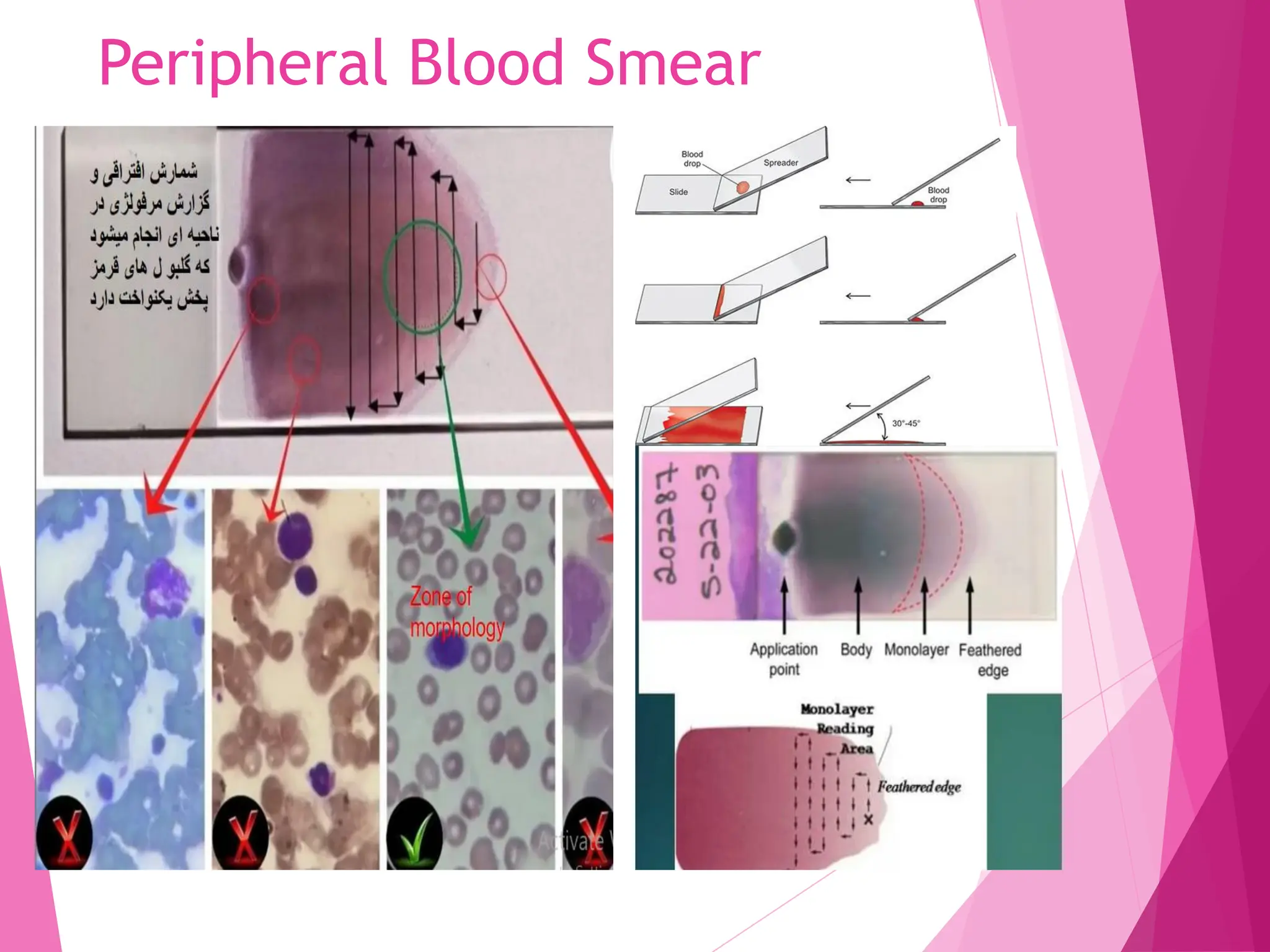
Peripheral Blood Smear
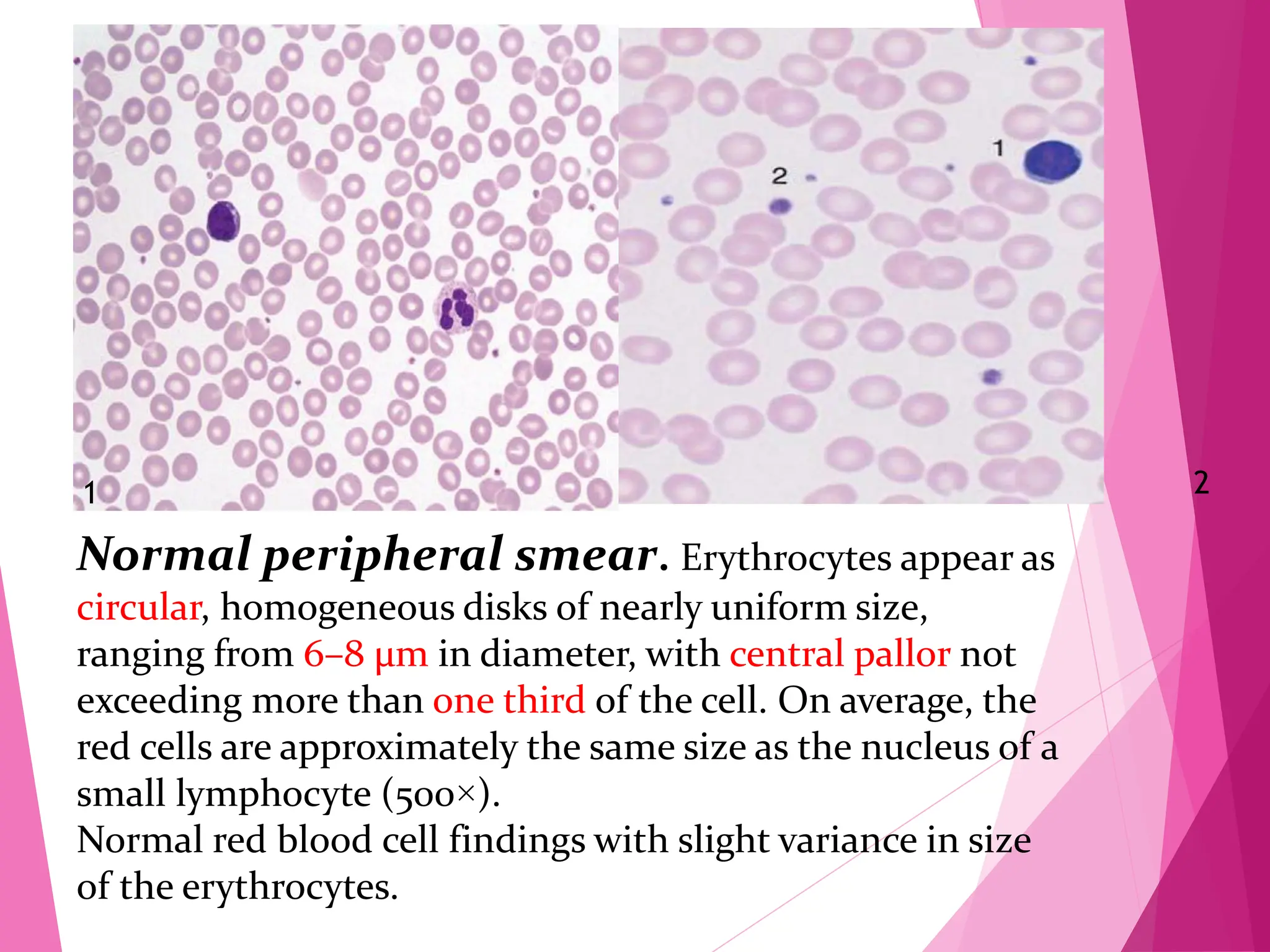
Normal peripheral smear. Erythrocytes appear as
circular, homogeneous disks of nearly uniform size,
ranging from 6–8 μm in diameter, with central pallor not
exceeding more than one third of the cell. On average, the
red cells are approximately the same size as the nucleus of a
small lymphocyte (500×).
Normal red blood cell findings with slight variance in size
of the erythrocytes.
2
1
RED BLOOD CELL
MORPHOLOGY
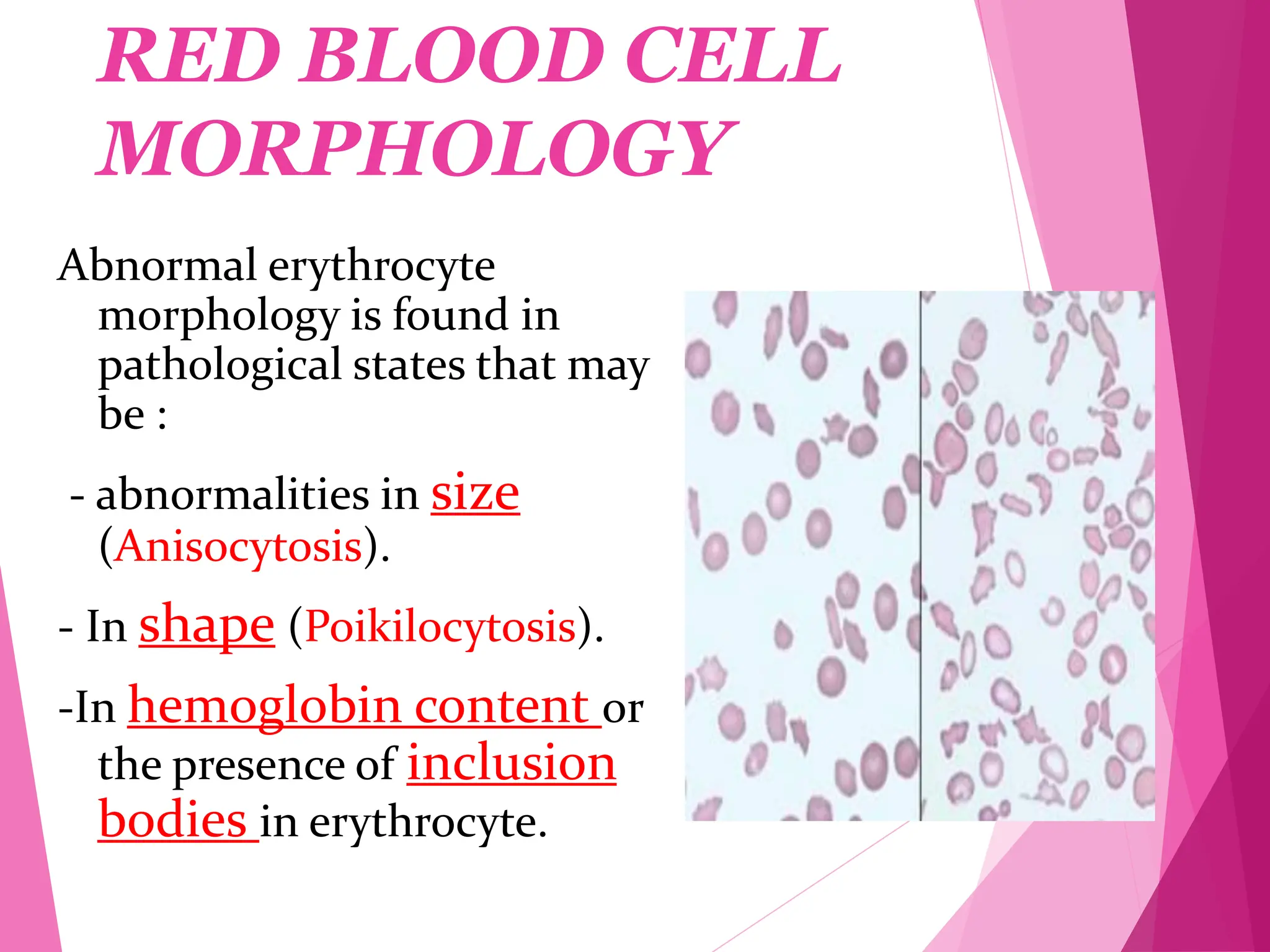
Abnormal erythrocyte
morphology is found in
pathological states that may
be :
- abnormalities in size
(Anisocytosis).
- In shape (Poikilocytosis).
-In hemoglobin content or
the presence of inclusion
bodies in erythrocyte.
RED BLOOD CELL
MORPHOLOGY
Normochromic:
A descriptive term applied to a red blood cell with a
normal concentration of hemoglobin.
Hypochromic:
A descriptive term applied to a red blood cell with a
decreased concentration of hemoglobin.
Normocytic:
A descriptive term applied to normal size of RBC
Macrocytic:
A descriptive term applied to a larger than normal
red blood cell.
Variation in erythrocyte size
(Anisocytosis)
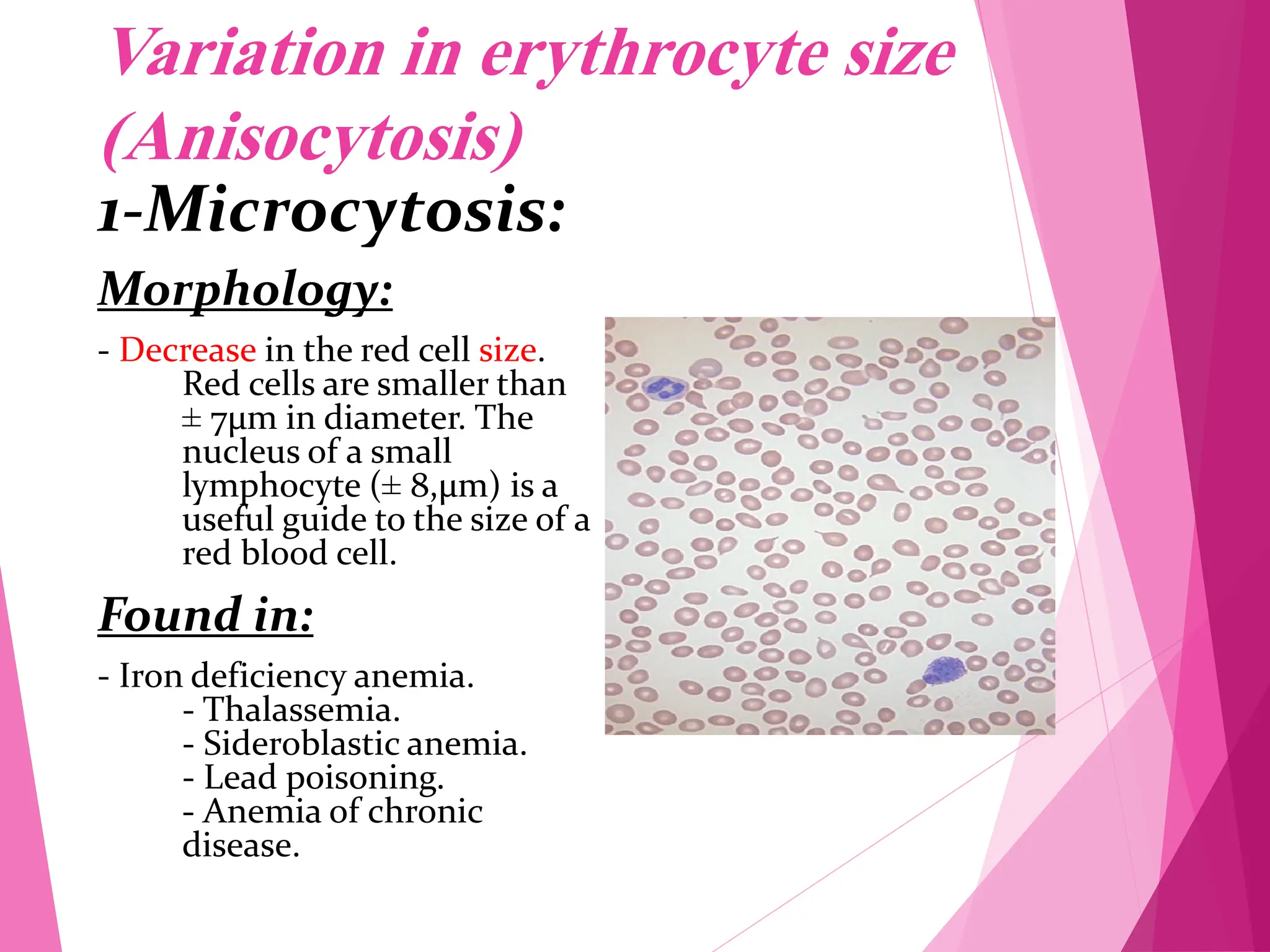
1-Microcytosis:
Morphology:
- Decrease in the red cell size.
Red cells are smaller than
± 7µm in diameter. The
nucleus of a small
lymphocyte (± 8,µm) is a
useful guide to the size of a
red blood cell.
Found in:
- Iron deficiency anemia.
- Thalassemia.
- Sideroblastic anemia.
- Lead poisoning.
- Anemia of chronic
disease.
Variation in erythrocyte size
(Anisocytosis)
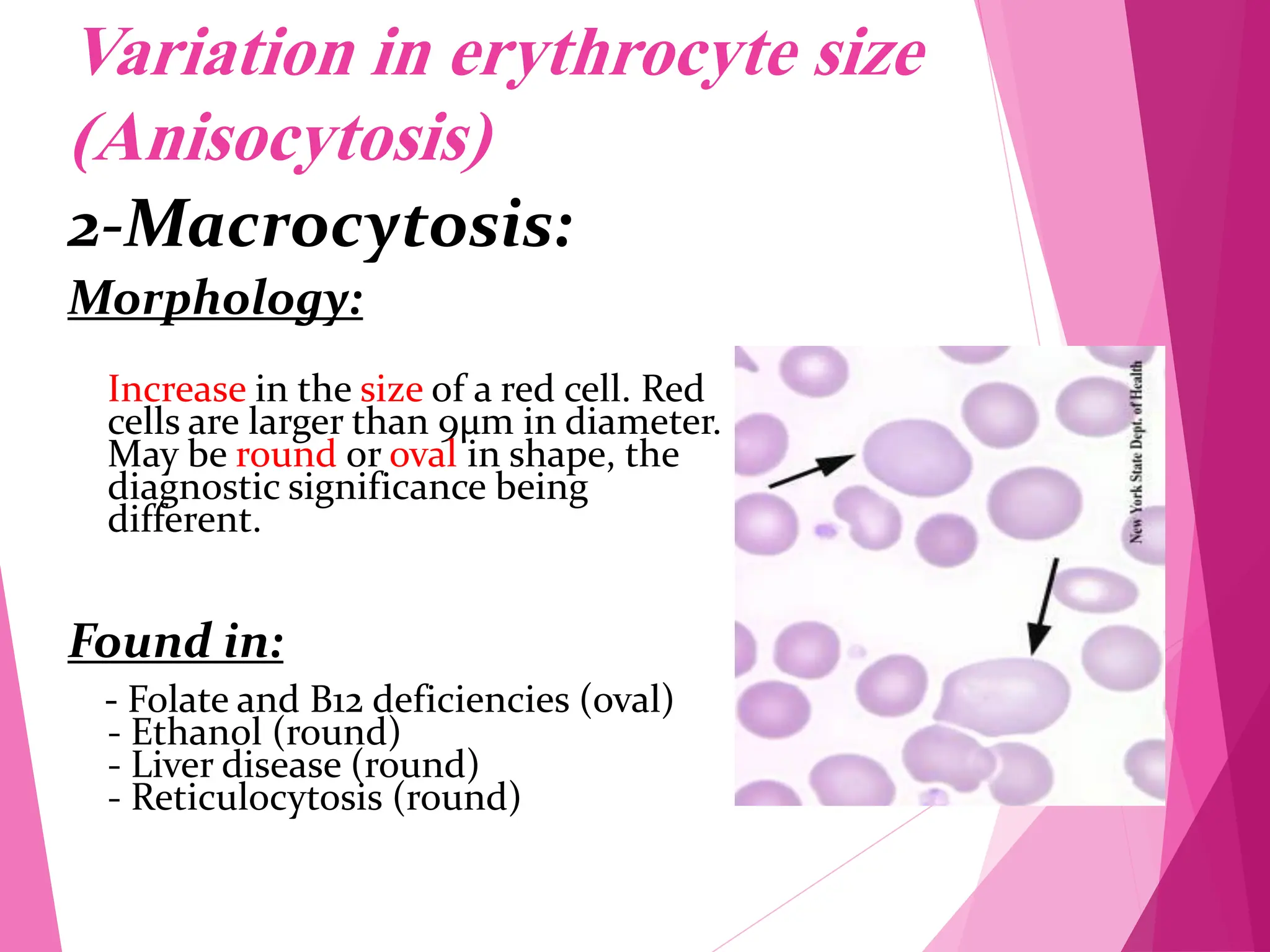
2-Macrocytosis:
Morphology:
Increase in the size of a red cell. Red
cells are larger than 9µm in diameter.
May be round or oval in shape, the
diagnostic significance being
different.
Found in:
- Folate and B12 deficiencies (oval)
- Ethanol (round)
- Liver disease (round)
- Reticulocytosis (round)
Variation in hemoglobin content
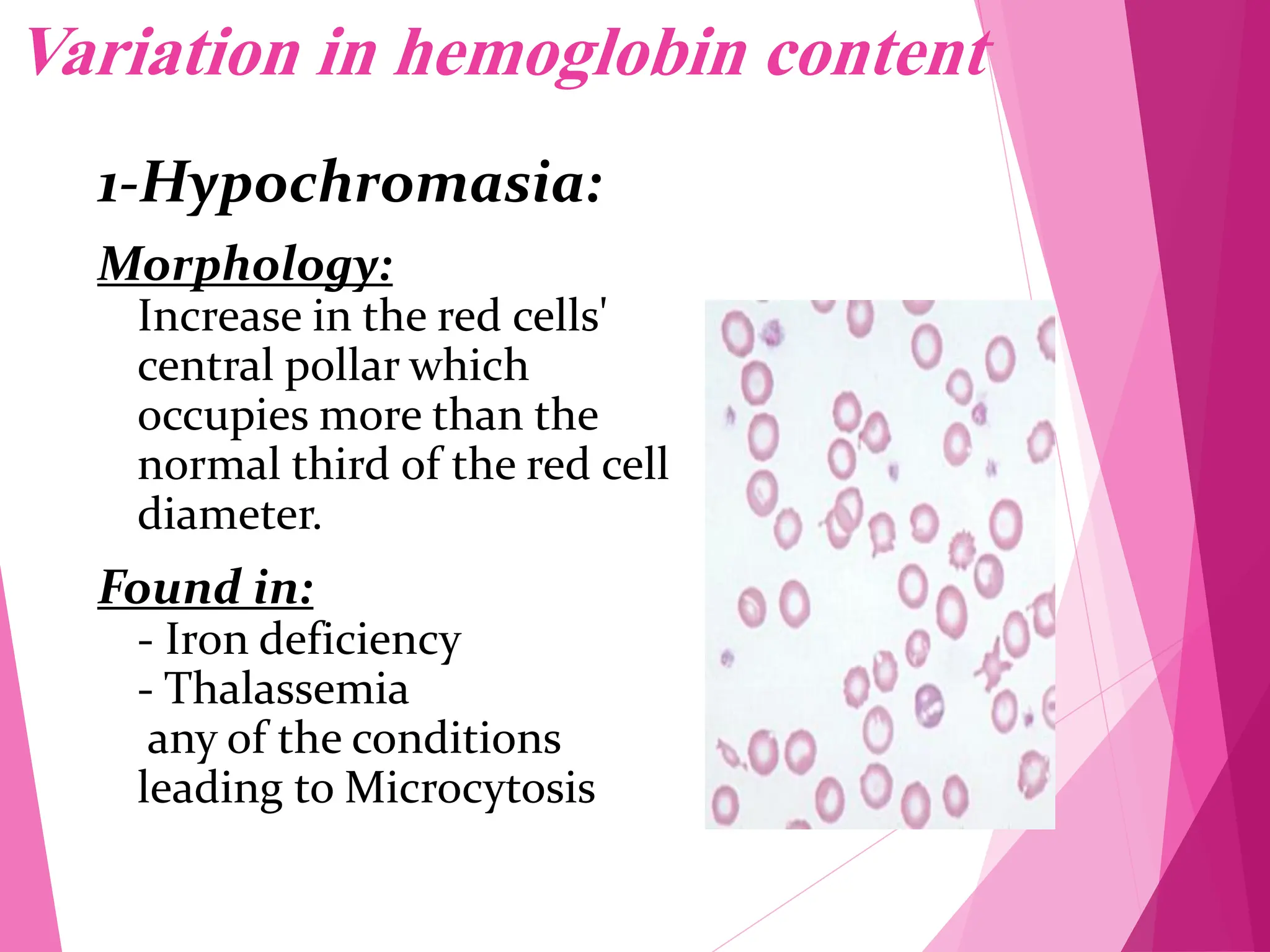
1-Hypochromasia:
Morphology:
Increase in the red cells'
central pollar which
occupies more than the
normal third of the red cell
diameter.
Found in:
- Iron deficiency
- Thalassemia
any of the conditions
leading to Microcytosis
Variation in hemoglobin content
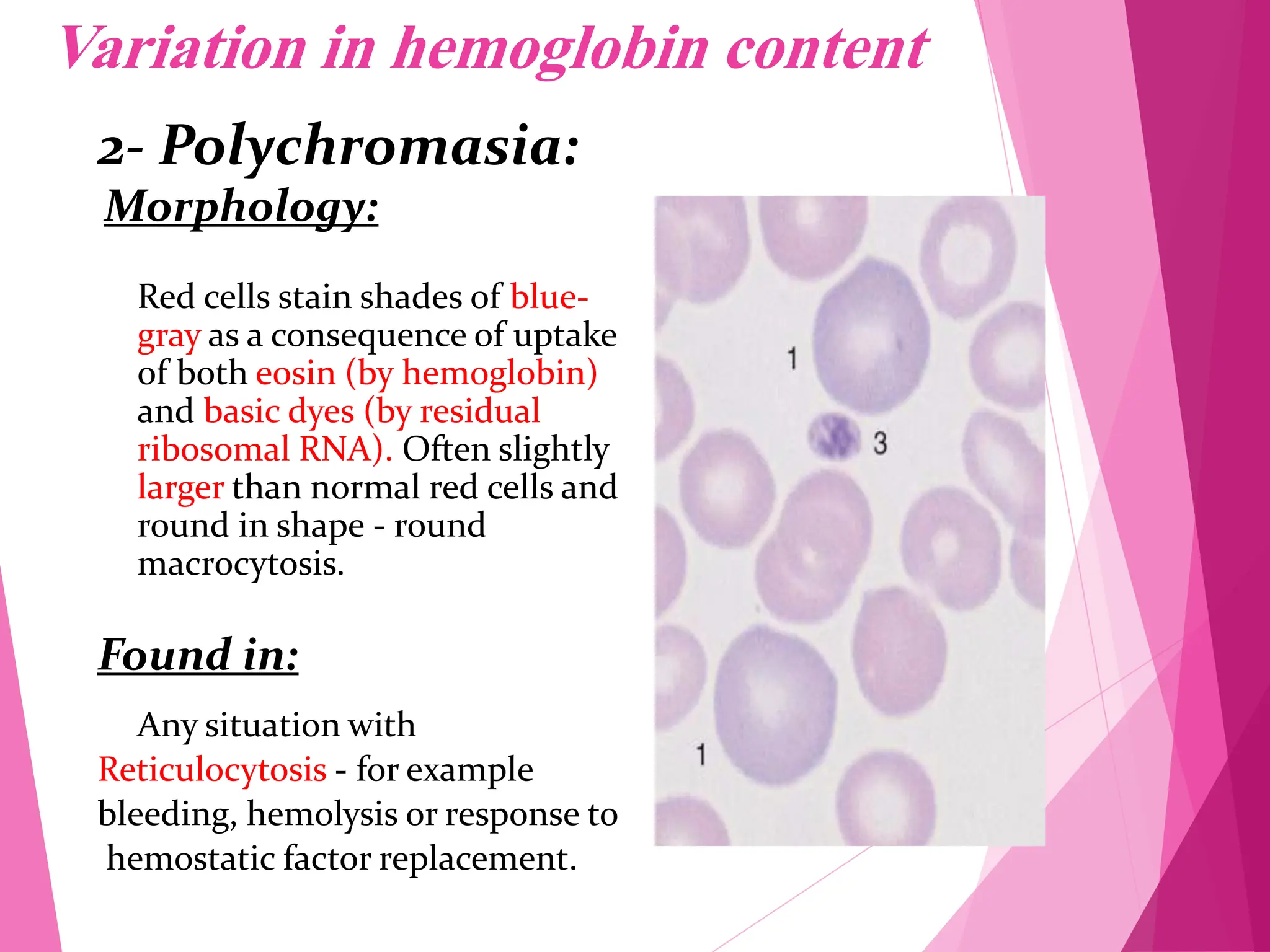
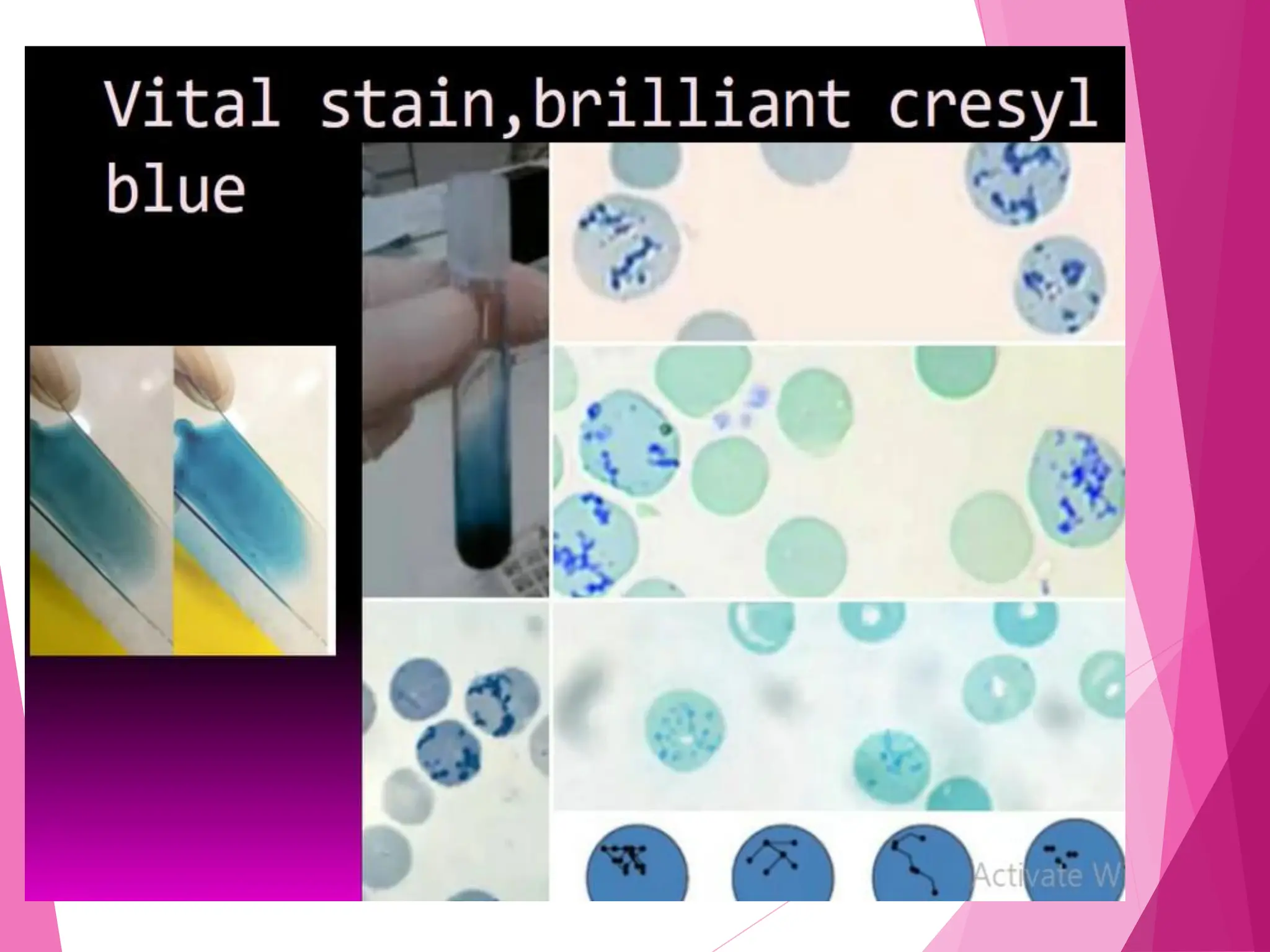
2- Polychromasia:
Morphology:
Red cells stain shades of blue-
gray as a consequence of uptake
of both eosin (by hemoglobin)
and basic dyes (by residual
ribosomal RNA). Often slightly
larger than normal red cells and
round in shape - round
macrocytosis.
Found in:
Any situation with
Reticulocytosis - for example
bleeding, hemolysis or response to
hemostatic factor replacement.
III- Variation of red cells shape
(Poikilocytosis)

of
shape
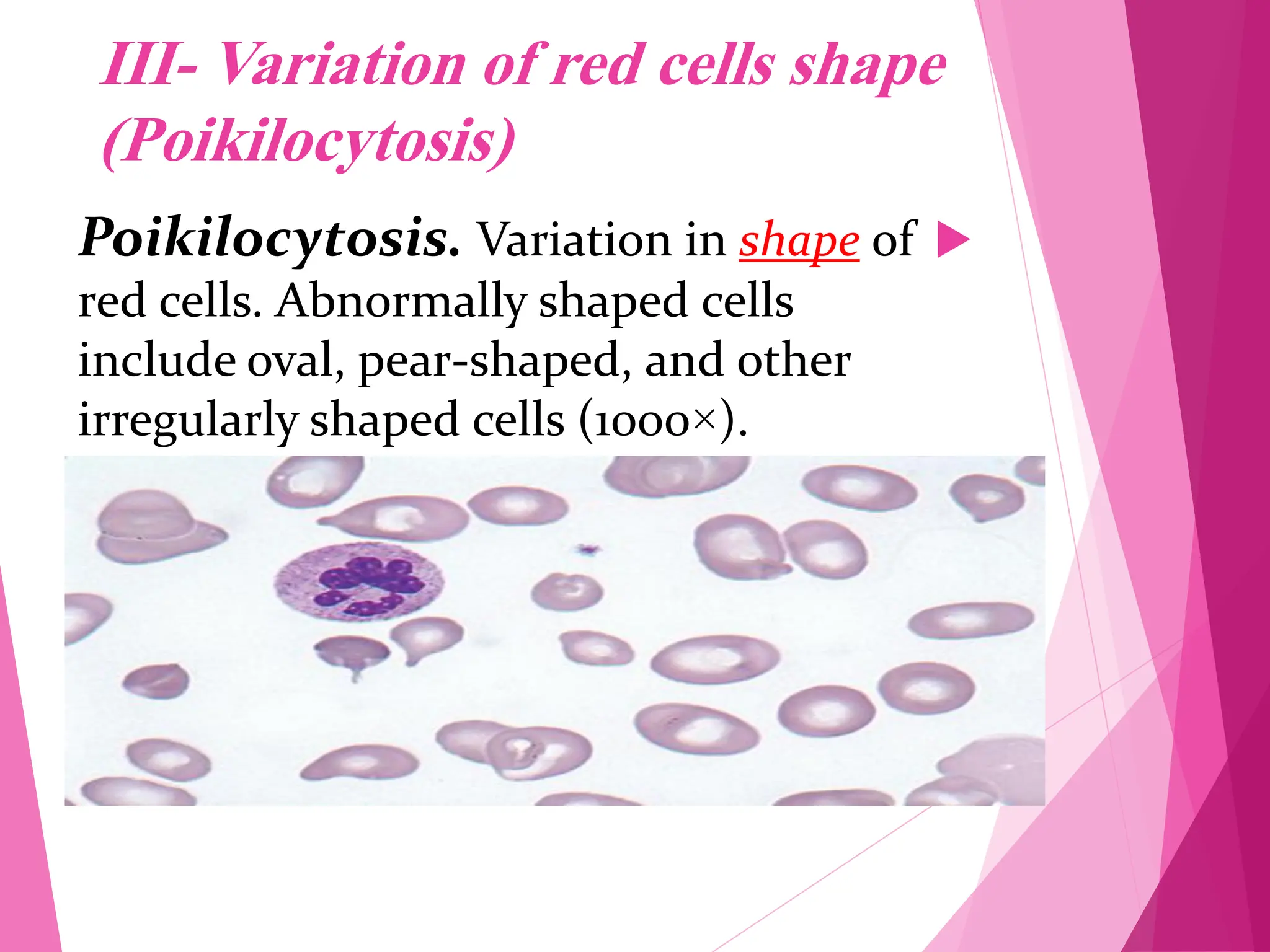
Variation in
Poikilocytosis.
red cells. Abnormally shaped cells
include oval, pear-shaped, and other
irregularly shaped cells (1000×).
III- Variation of red cells shape
(Poikilocytosis)
RBCs may have different
shapes:
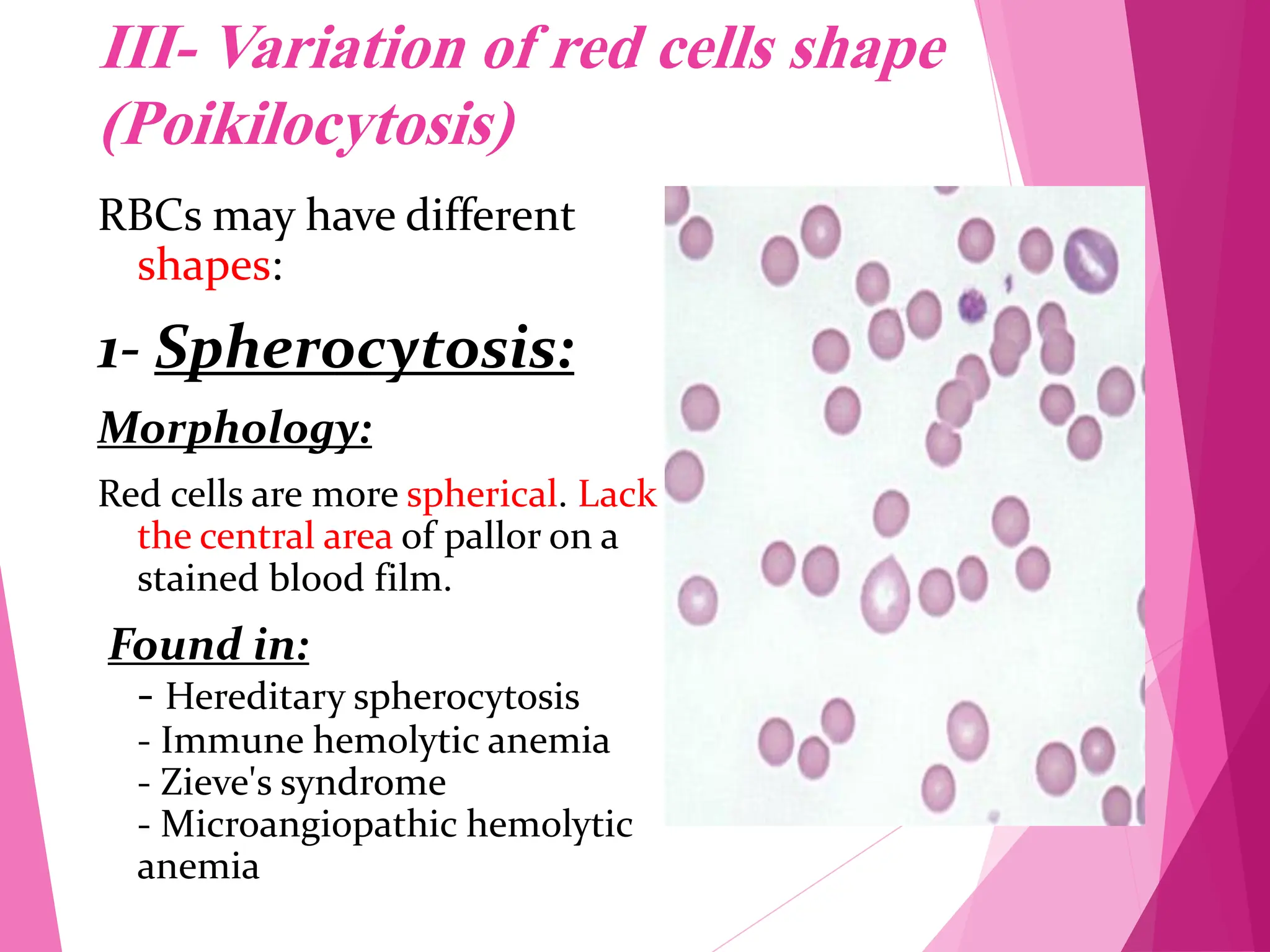
1- Spherocytosis:
Morphology:
Red cells are more spherical. Lack
the central area of pallor on a
stained blood film.
Found in:
- Hereditary spherocytosis
- Immune hemolytic anemia
- Zieve's syndrome
- Microangiopathic hemolytic
anemia
III- Variation of red cells shape
(Poikilocytosis)
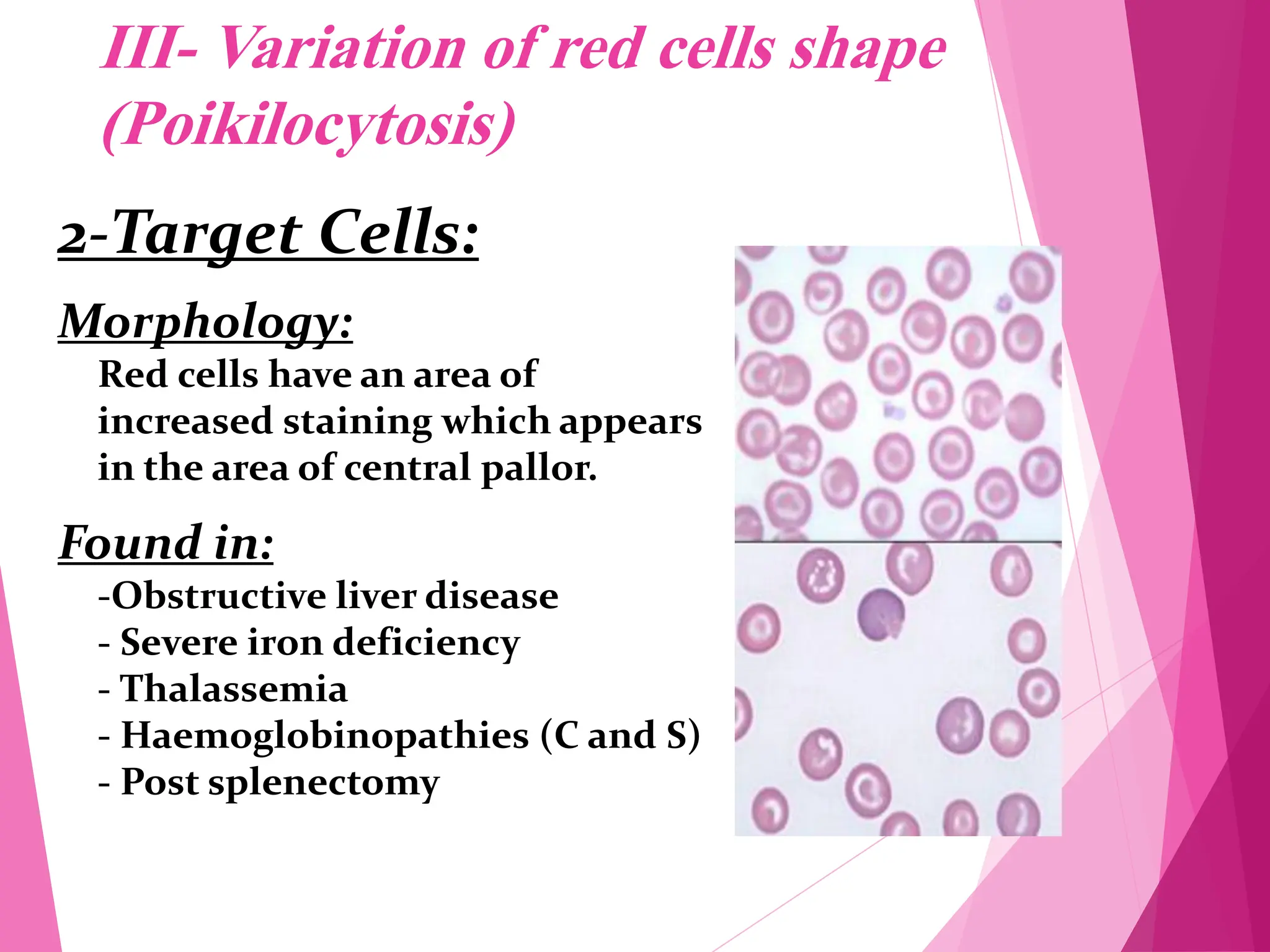
2-Target Cells:
Morphology:
Red cells have an area of
increased staining which appears
in the area of central pallor.
Found in:
-Obstructive liver disease
- Severe iron deficiency
- Thalassemia
- Haemoglobinopathies (C and S)
- Post splenectomy
III- Variation of red cells shape
(Poikilocytosis)
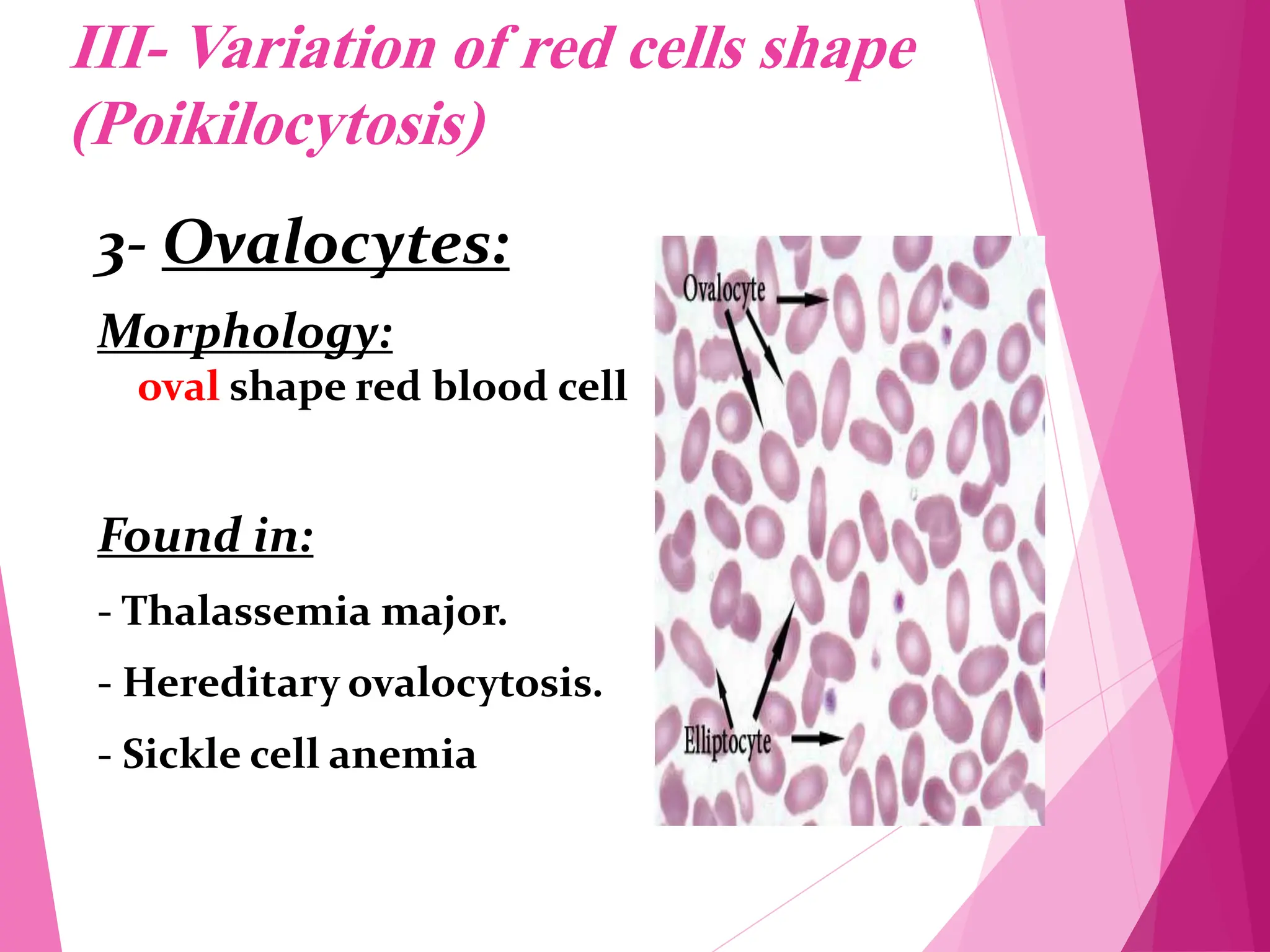
3- Ovalocytes:
Morphology:
oval shape red blood cell
Found in:
- Thalassemia major.
- Hereditary ovalocytosis.
- Sickle cell anemia
III- Variation of red cells shape
(Poikilocytosis)
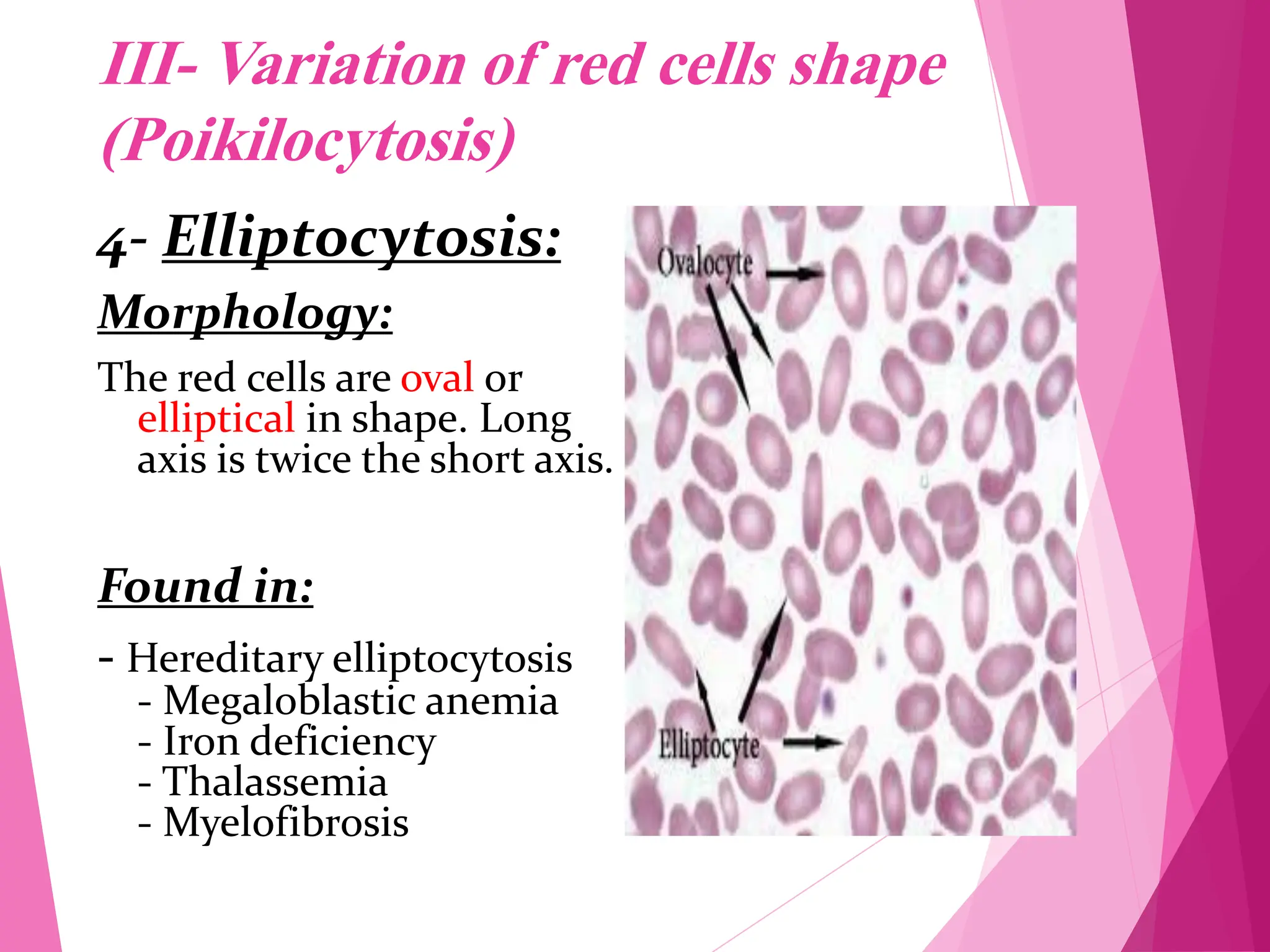
4- Elliptocytosis:
Morphology:
The red cells are oval or
elliptical in shape. Long
axis is twice the short axis.
Found in:
- Hereditary elliptocytosis
- Megaloblastic anemia
- Iron deficiency
- Thalassemia
- Myelofibrosis
Hereditary elliptocytosis. Most cells are
elliptocytes. They are seen in a normal person’s
blood, but usually account for less than 10% of
cells. They are also common in iron deficiency
anemia,myelofibrosis,megaloblastic anemia,
and sickle cell anemia (1000×).
III- Variation of red cells shape
(Poikilocytosis)
5- Tear Drop Cells:
Morphology:
Red cells shaped like a tear
drop or pear
Found in:
- Bone marrow fibrosis
- Megaloblastic anemia
- Iron deficiency
- Thalassemia
III- Variation of red cells shape
(Poikilocytosis)
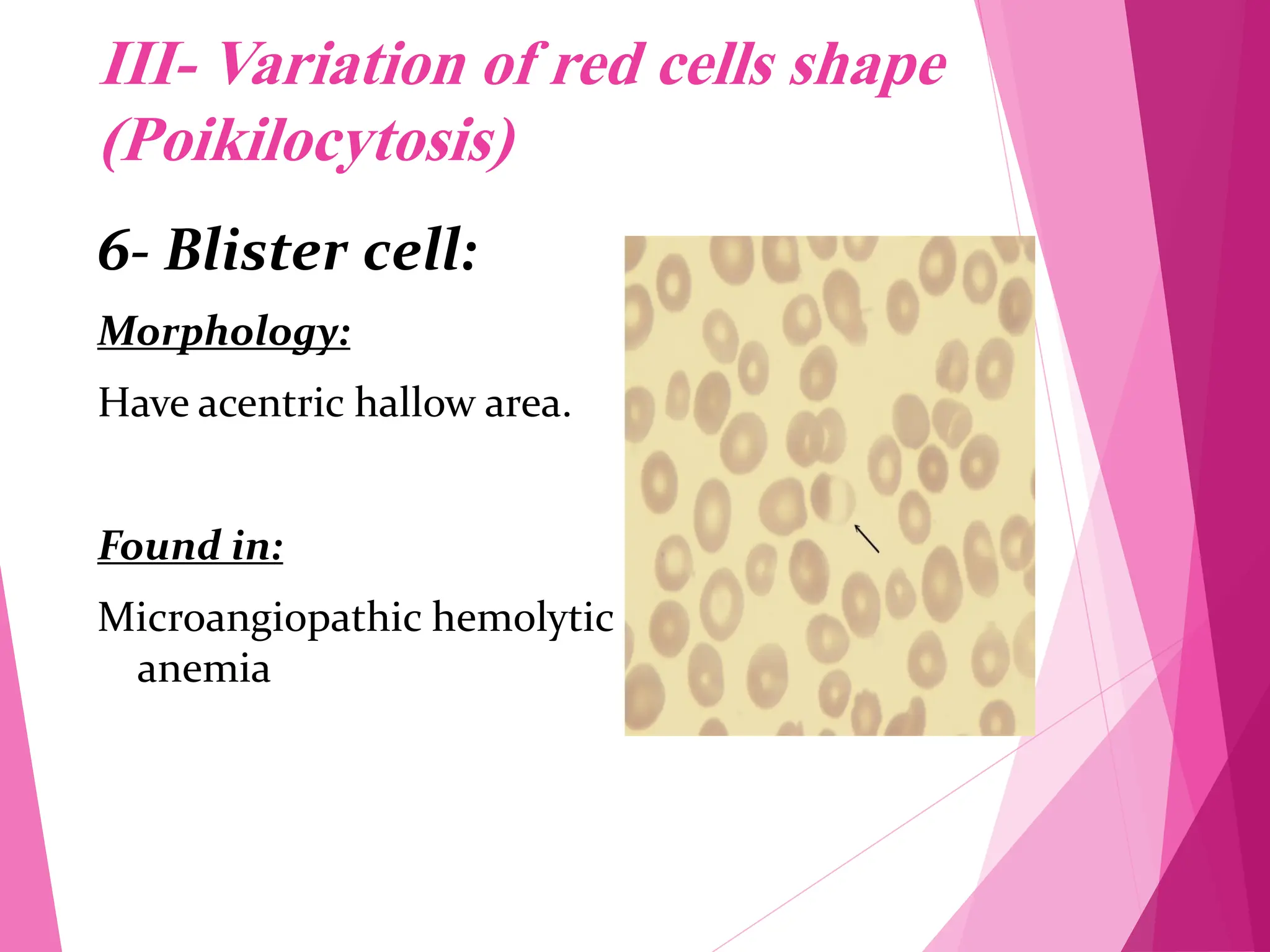
6- Blister cell:
Morphology:
Have acentric hallow area.
Found in:
Microangiopathic hemolytic
anemia
III- Variation of red cells shape
(Poikilocytosis)III- VARIATION
OF RED CELLS SHAPE
(POIKILOCYTOSIS)
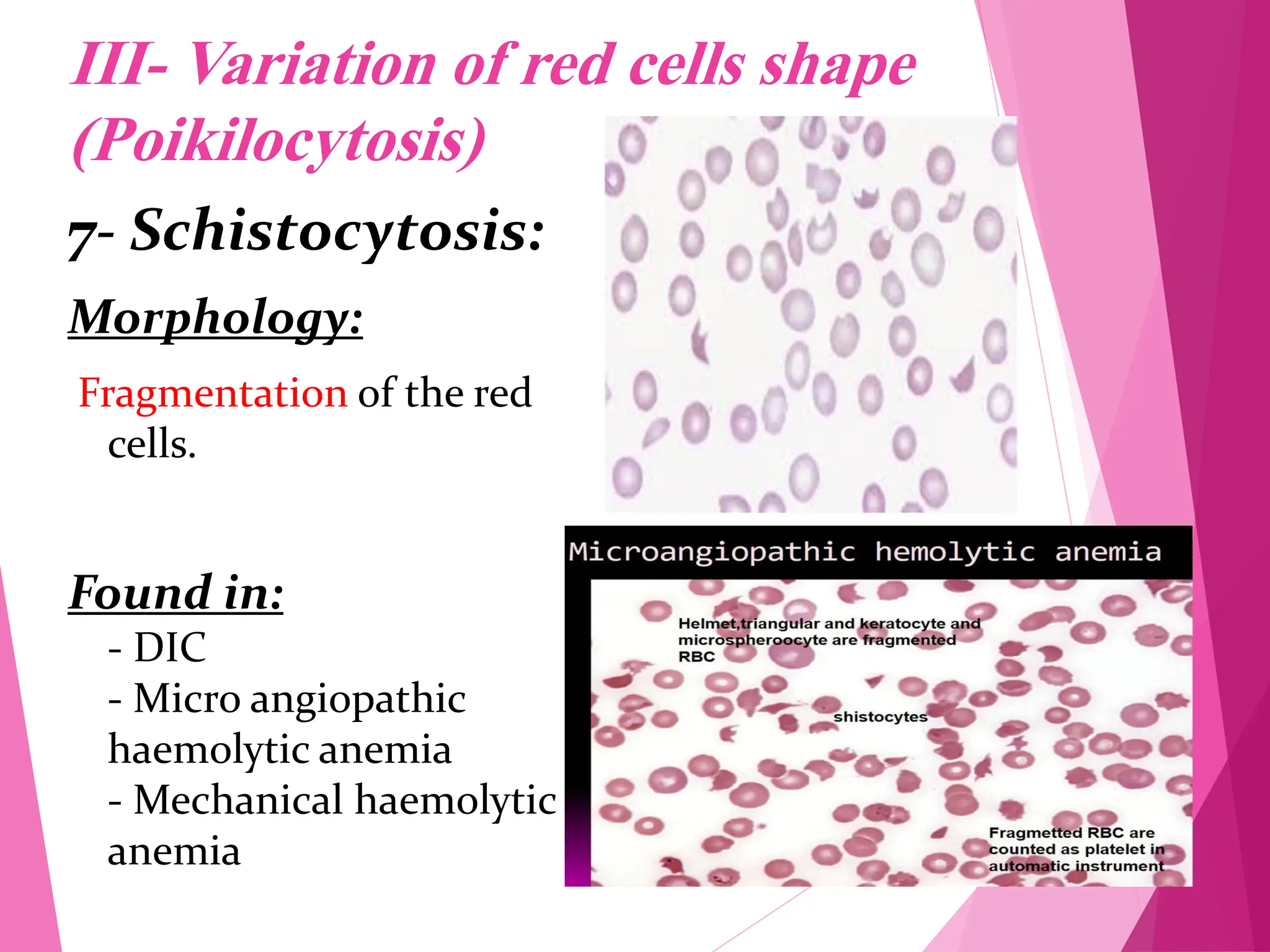
7- Schistocytosis:
Morphology:
Fragmentation of the red
cells.
Found in:
- DIC
- Micro angiopathic
haemolytic anemia
- Mechanical haemolytic
anemia
III- Variation of red cells shape
(Poikilocytosis)
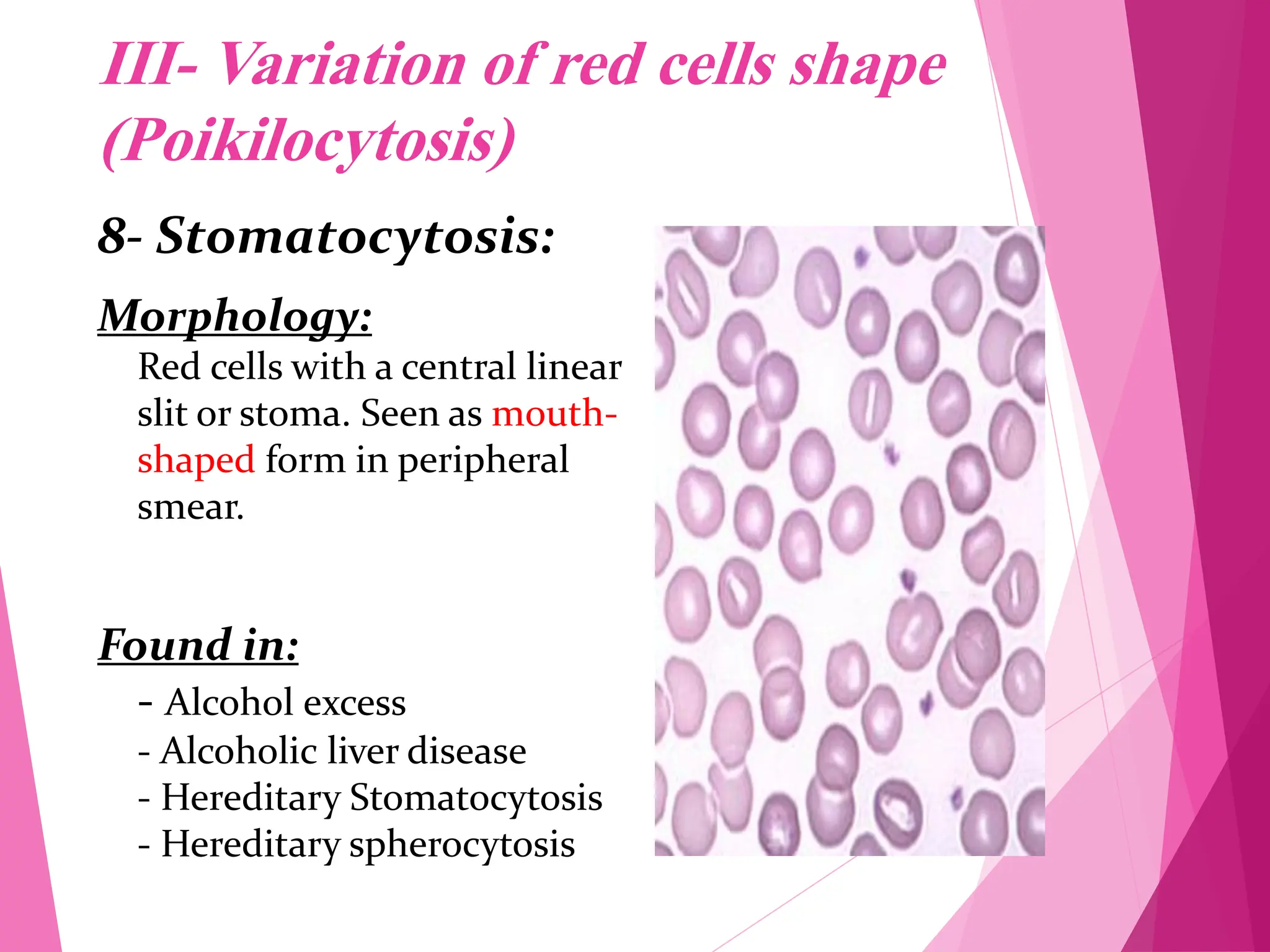
8- Stomatocytosis:
Morphology:
Red cells with a central linear
slit or stoma. Seen as mouth-
shaped form in peripheral
smear.
Found in:
- Alcohol excess
- Alcoholic liver disease
- Hereditary Stomatocytosis
- Hereditary spherocytosis
III- Variation of red cells shape
(Poikilocytosis)
9- Echinocyte
(crenation ) cell:
Morphology:
Red cell with uniformly
spaced, pointed projections
on their surface.
Found in:
- hemolytic anemia
- Uremia.
- Megaloblastic anemia
III- Variation of red cells
shape (Poikilocytosis)
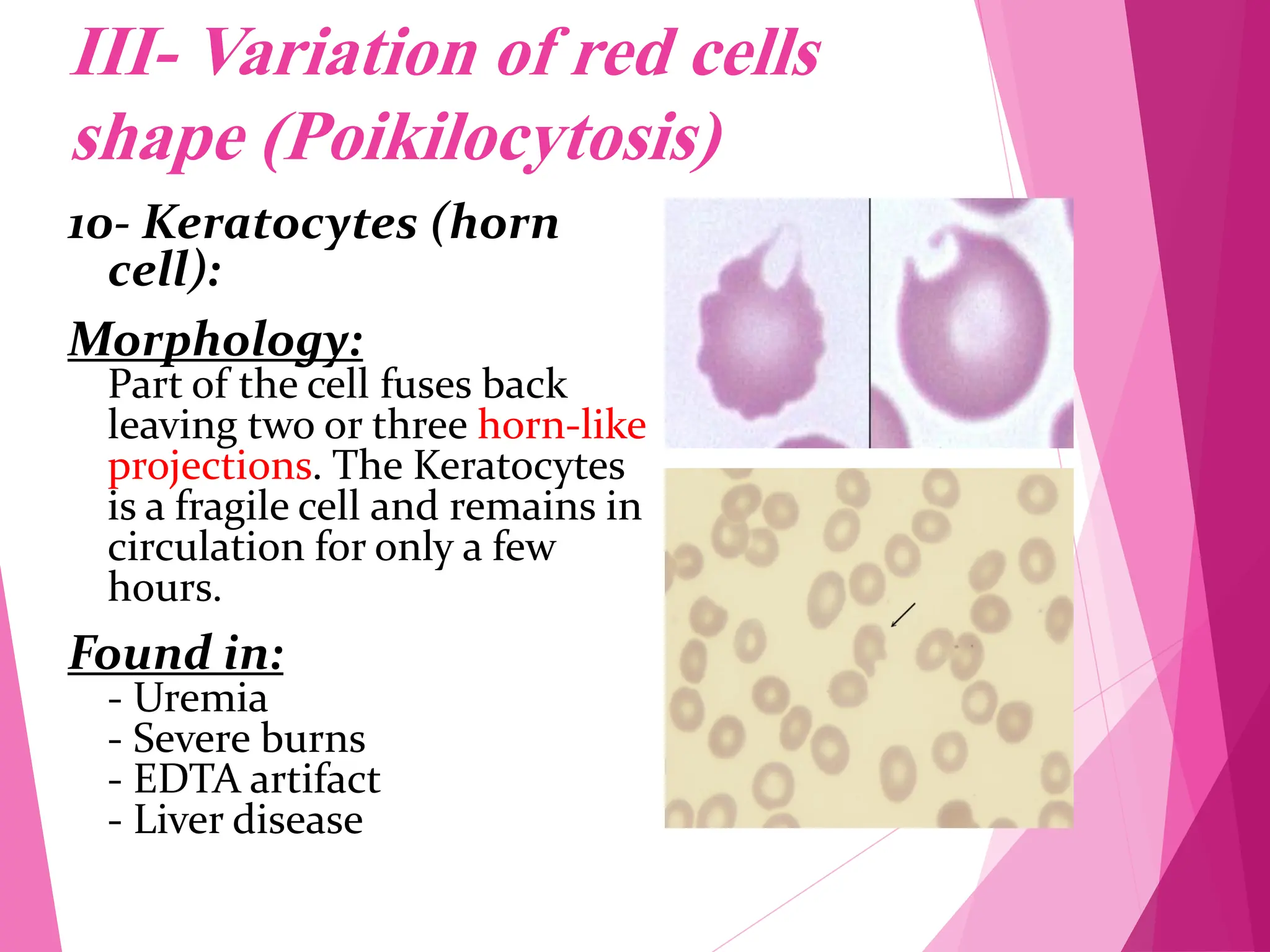
10- Keratocytes (horn
cell):
Morphology:
Part of the cell fuses back
leaving two or three horn-like
projections. The Keratocytes
is a fragile cell and remains in
circulation for only a few
hours.
Found in:
- Uremia
- Severe burns
- EDTA artifact
- Liver disease
III- Variation of red cells shape
(Poikilocytosis)
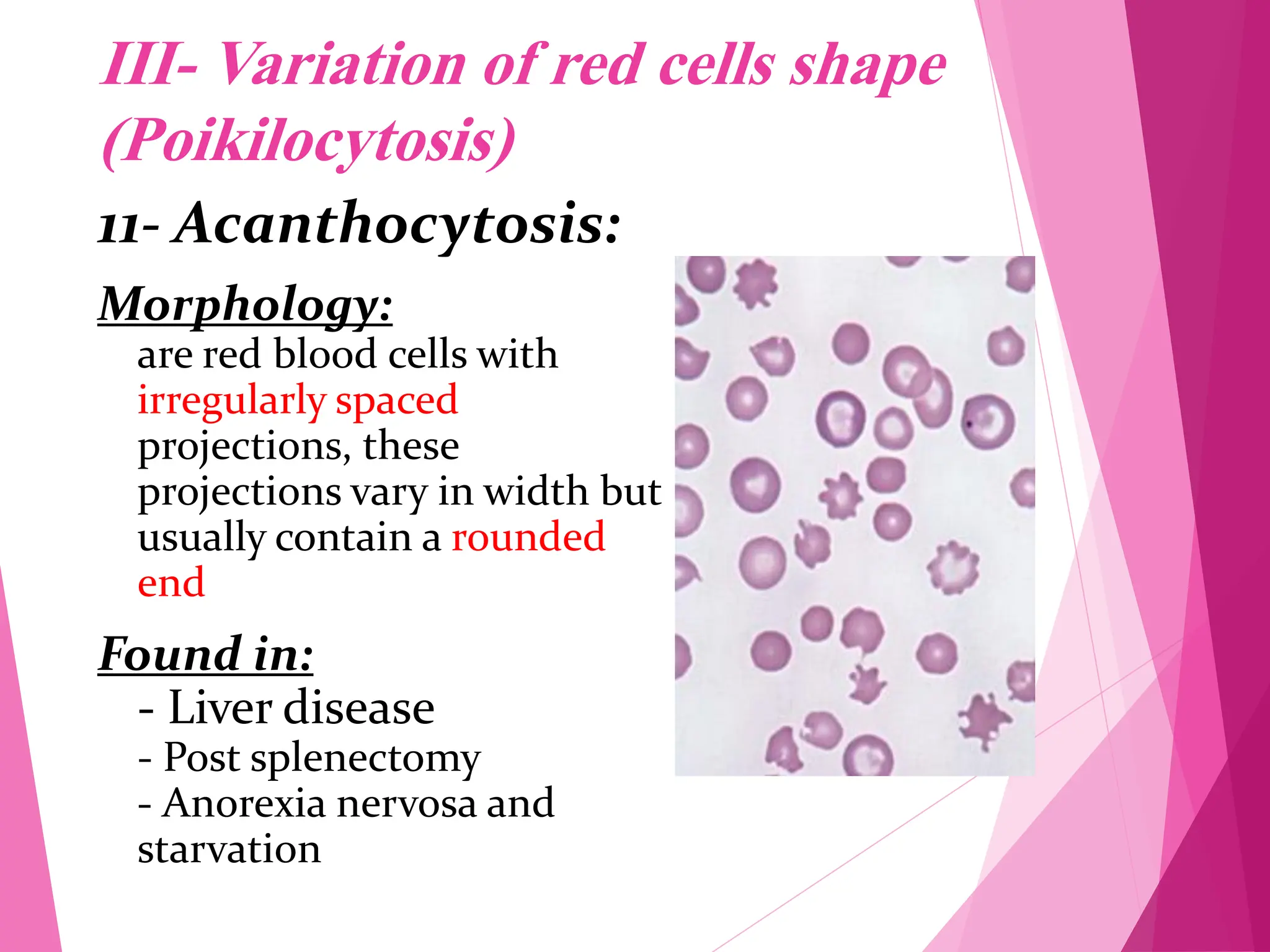
11- Acanthocytosis:
Morphology:
are red blood cells with
irregularly spaced
projections, these
projections vary in width but
usually contain a rounded
end
Found in:
- Liver disease
- Post splenectomy
- Anorexia nervosa and
starvation
III- Variation of red cells shape
(Poikilocytosis)
12- Sickle Cells:
Morphology:
Sickle shaped red cells
sickle cells are found only in
homozygous sickle cell
anemia,
Sickle cell test under
reduced oxygen tension:
almost all erythrocytes
appear as sickle cells in
the homozygous case
presented here.
Found in:
Hb-S disease
III- Variation of red cells shape
(Poikilocytosis)
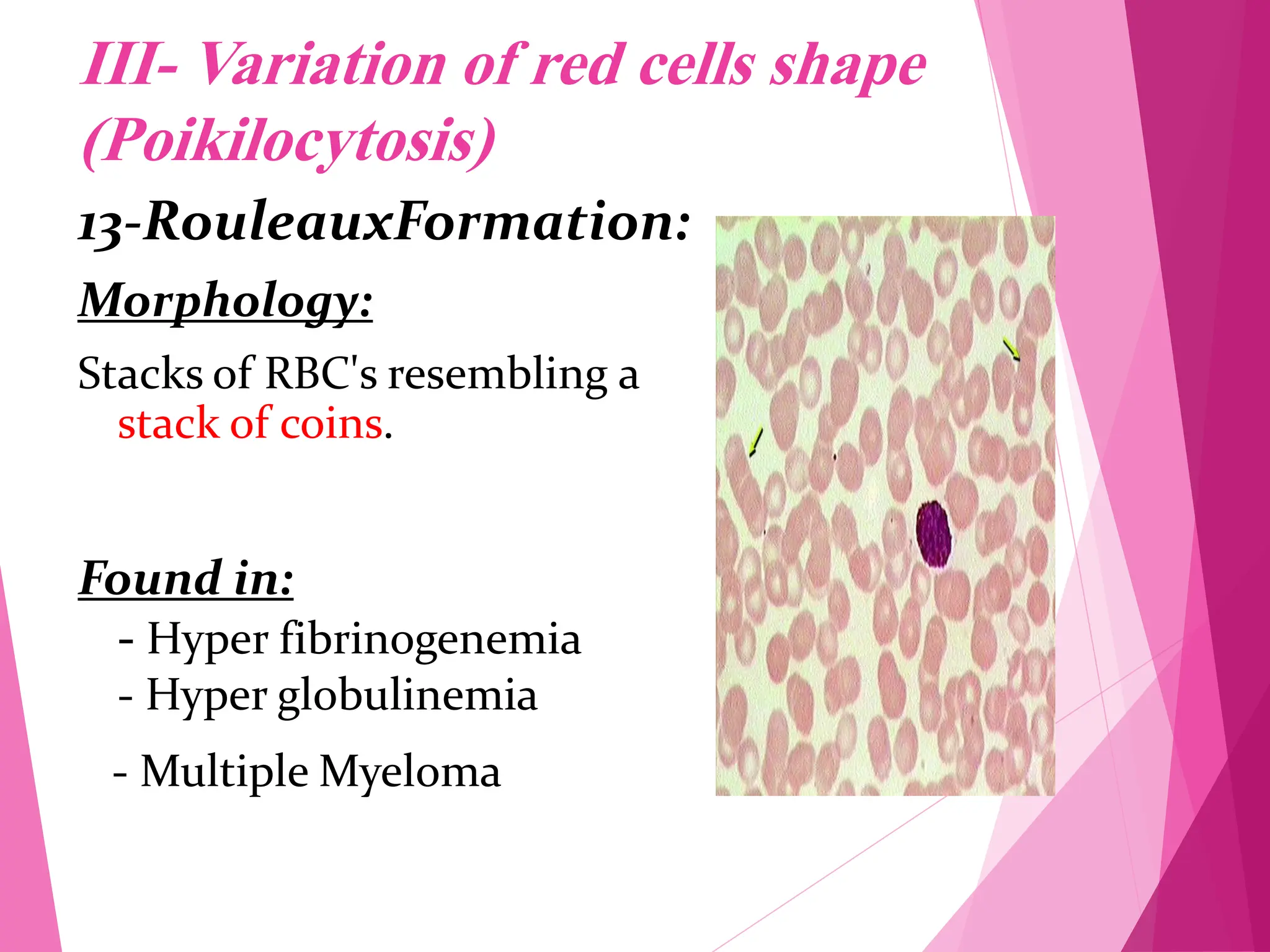
13-RouleauxFormation:
Morphology:
Stacks of RBC's resembling a
stack of coins.
Found in:
- Hyper fibrinogenemia
- Hyper globulinemia
- Multiple Myeloma
III- Variation of red cells shape
(Poikilocytosis)
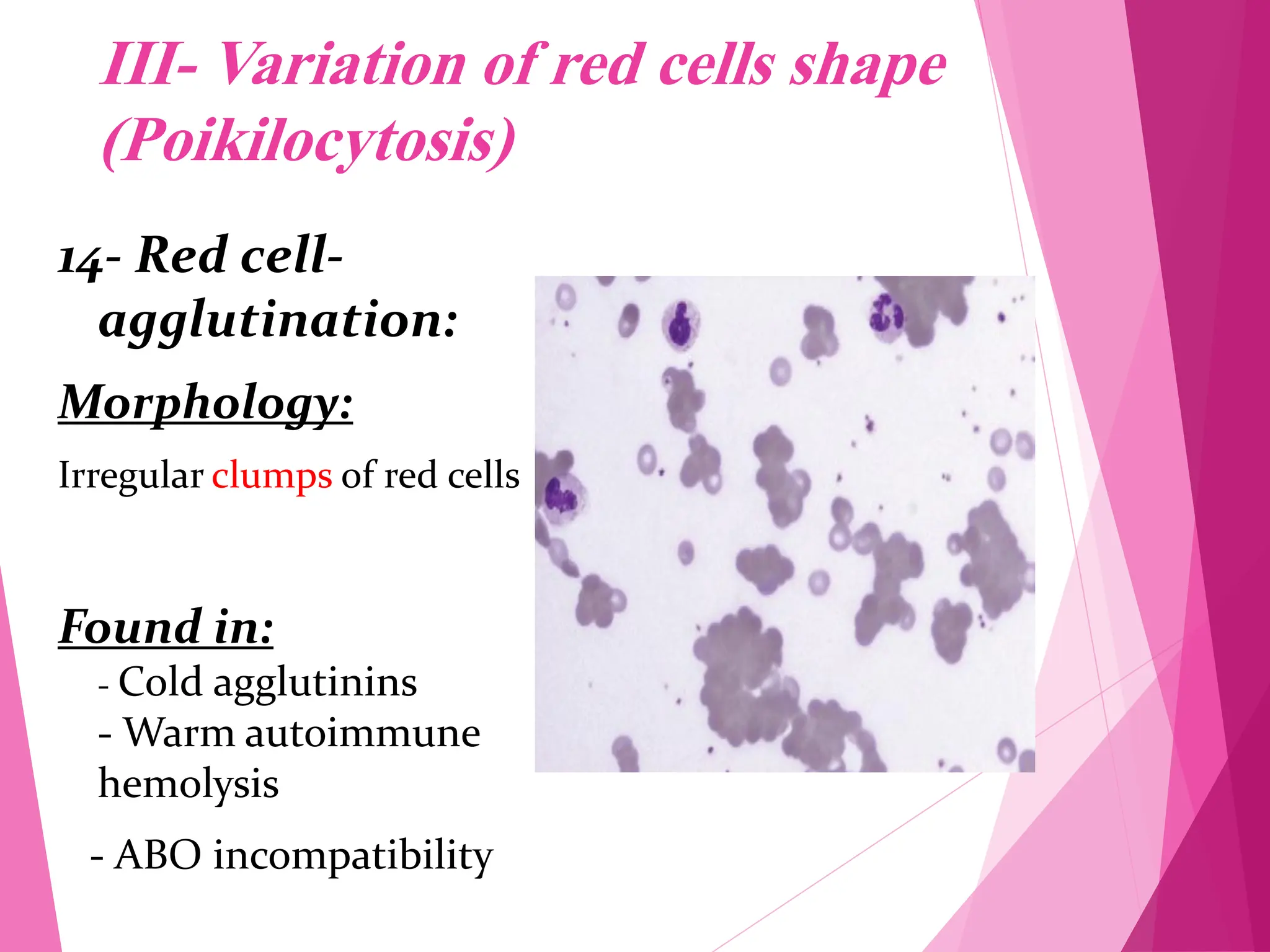
14- Red cell-
agglutination:
Morphology:
Irregular clumps of red cells
Found in:
- Cold agglutinins
- Warm autoimmune
hemolysis
- ABO incompatibility
III- Variation of red cells shape
(Poikilocytosis)
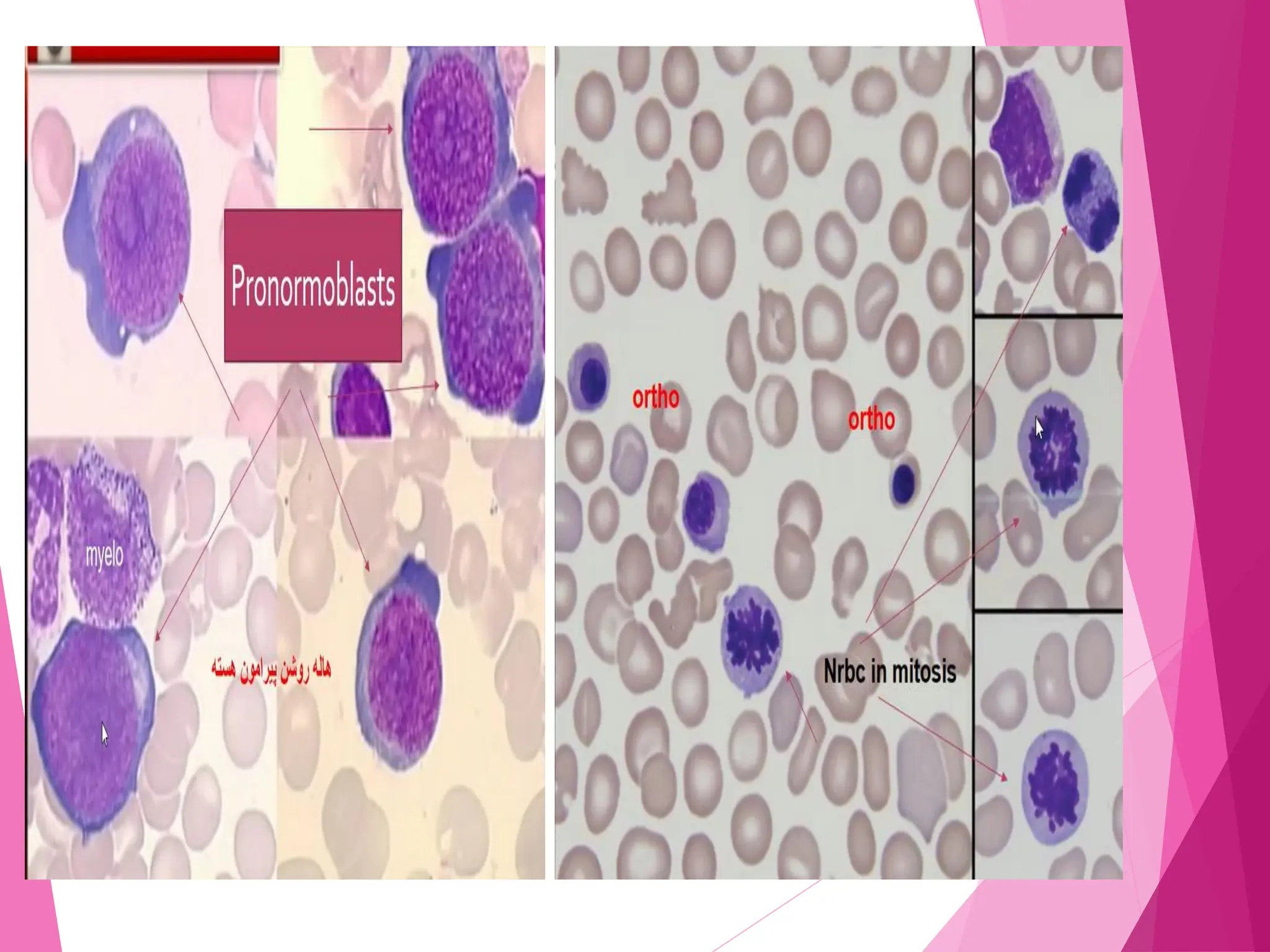
15- Nucleated red blood
cells.
These red blood cells are
released from the bone marrow
early into the blood stream,
due to the need for oxygen.
Normal red blood cells do not
contain a nucleus on a
peripheral smear.
Precursors of mature red cells,
normoblasts are usually
present only in the bone
marrow. Their presence in
blood is usually associated with
increased red cell production
or infiltrative bone marrow
disorders
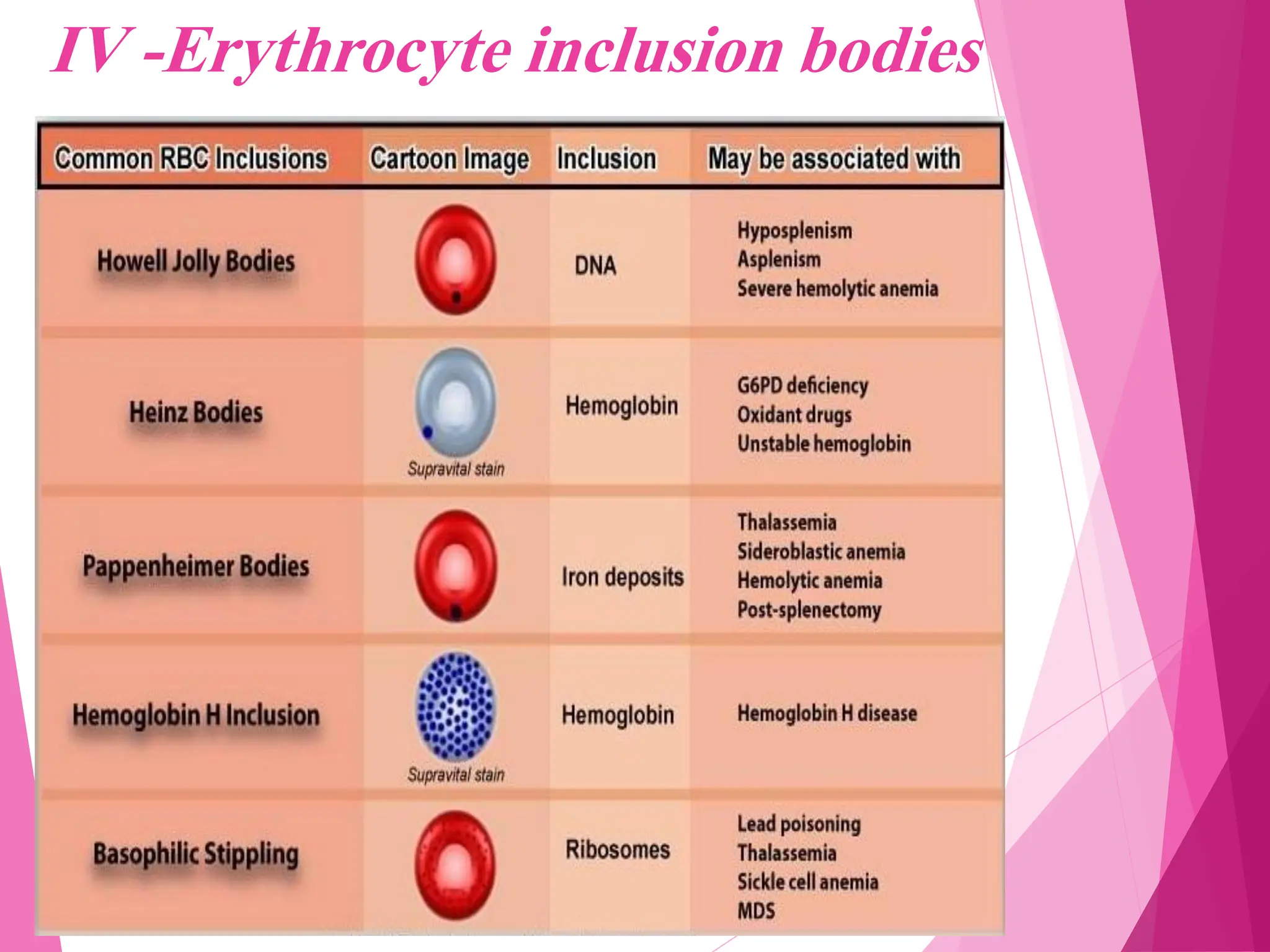
IV -Erythrocyte inclusion
bodies
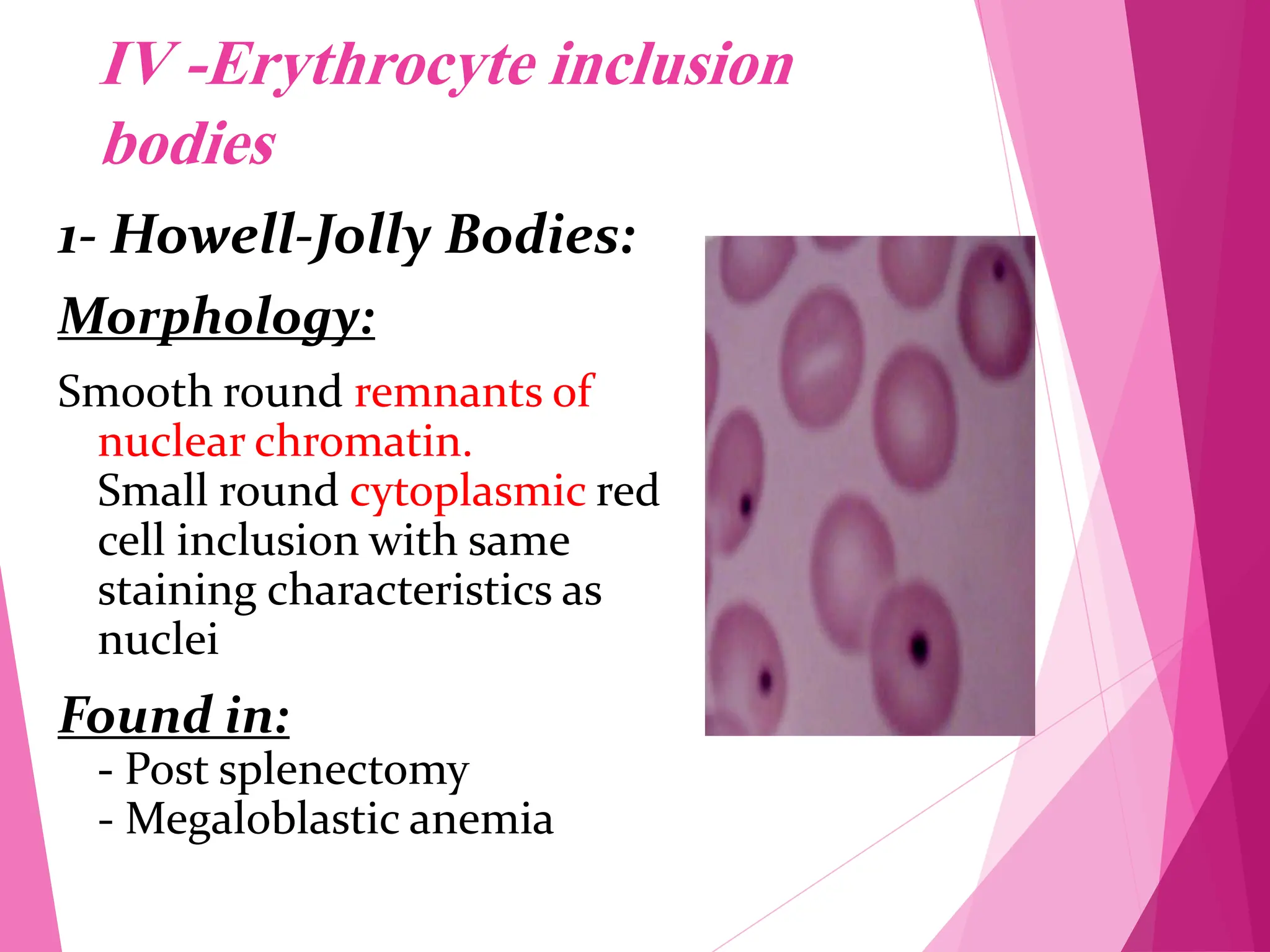
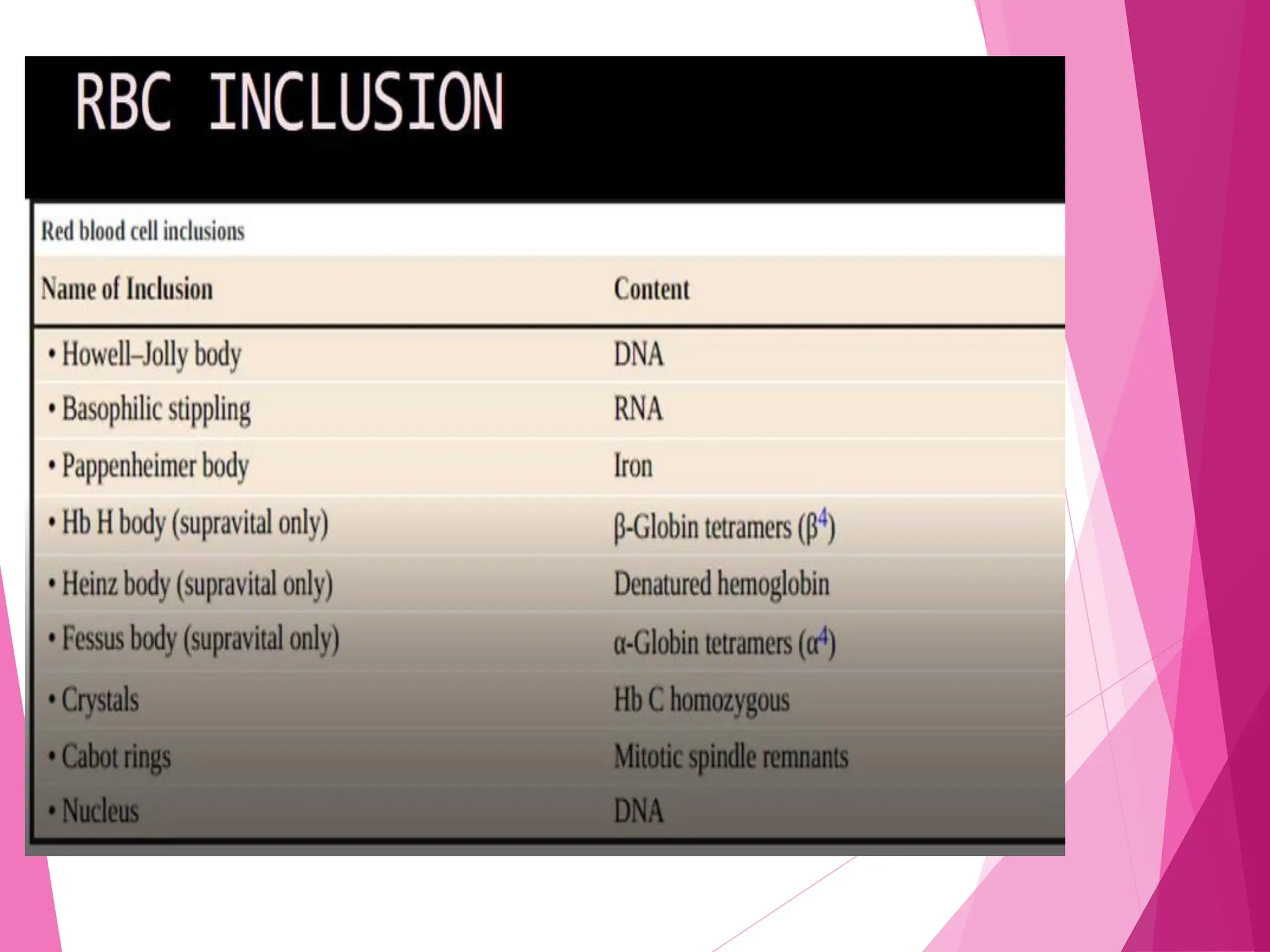
1- Howell-Jolly Bodies:
Morphology:
Smooth round remnants of
nuclear chromatin.
Small round cytoplasmic red
cell inclusion with same
staining characteristics as
nuclei
Found in:
- Post splenectomy
- Megaloblastic anemia
IV -Erythrocyte inclusion
bodies
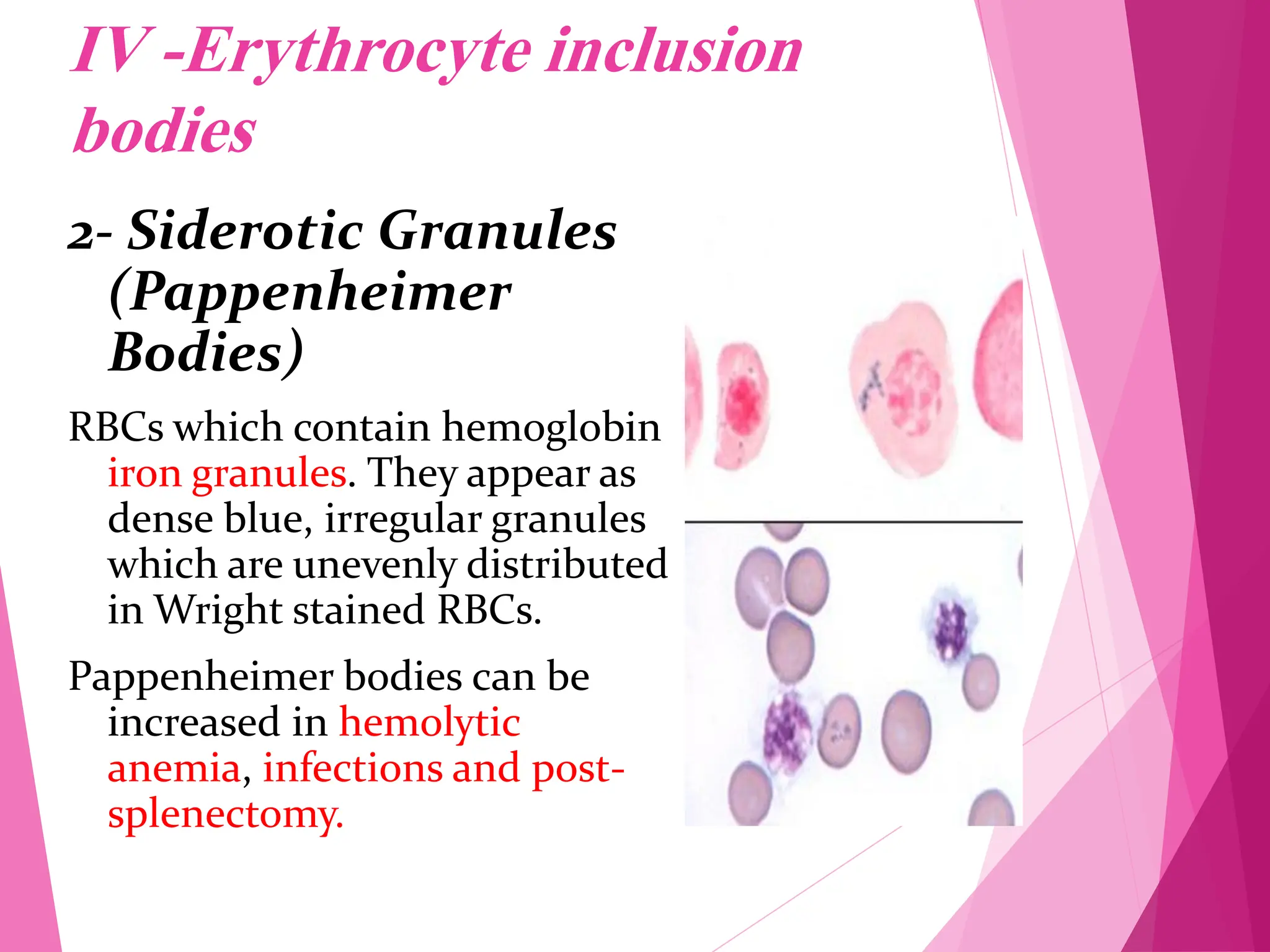
2- Siderotic Granules
(Pappenheimer
Bodies)
RBCs which contain hemoglobin
iron granules. They appear as
dense blue, irregular granules
which are unevenly distributed
in Wright stained RBCs.
Pappenheimer bodies can be
increased in hemolytic
anemia, infections and post-
splenectomy.
IV -Erythrocyte inclusion bodies
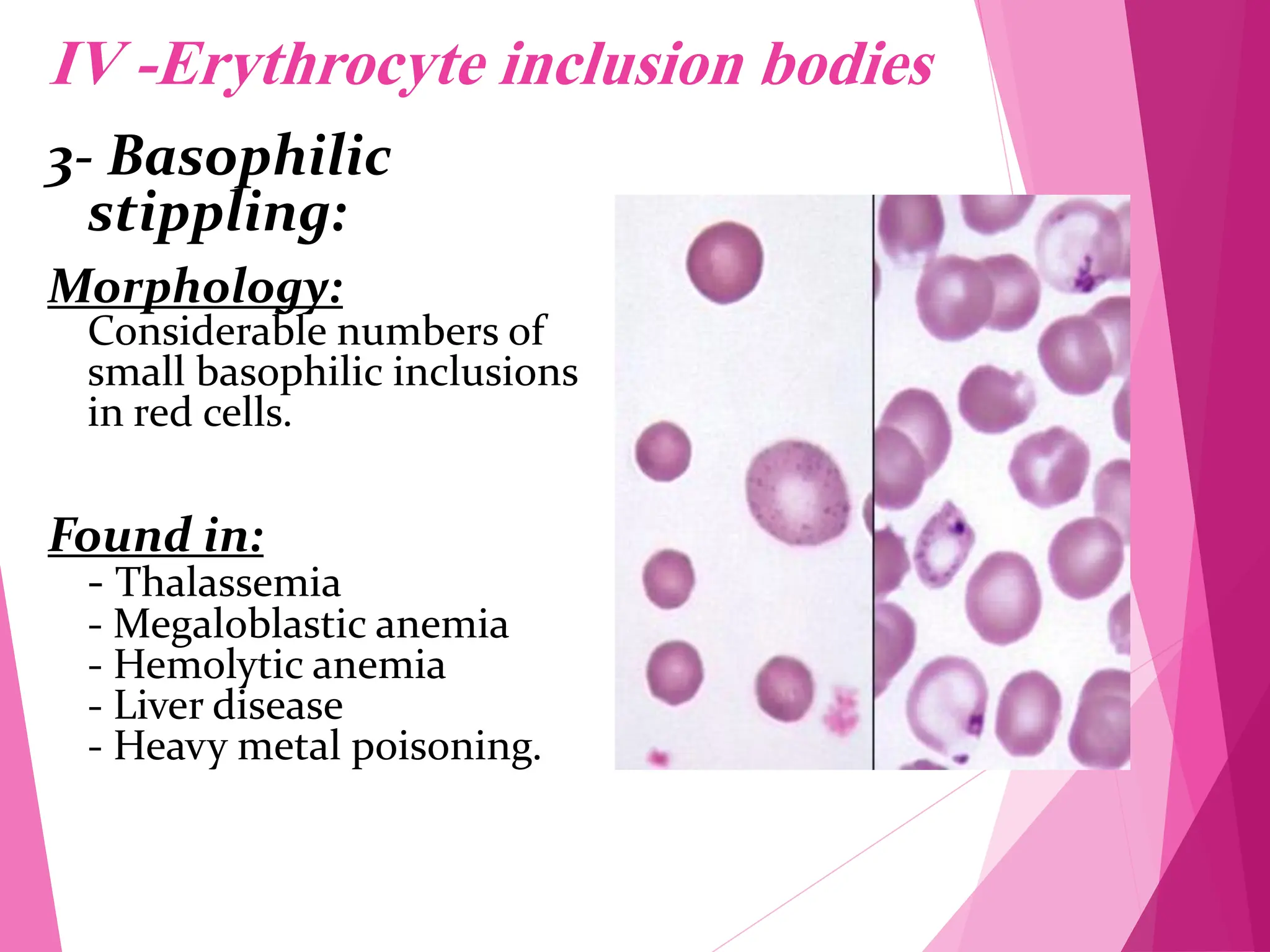
3- Basophilic
stippling:
Morphology:
Considerable numbers of
small basophilic inclusions
in red cells.
Found in:
- Thalassemia
- Megaloblastic anemia
- Hemolytic anemia
- Liver disease
- Heavy metal poisoning.
IV -Erythrocyte inclusion bodies
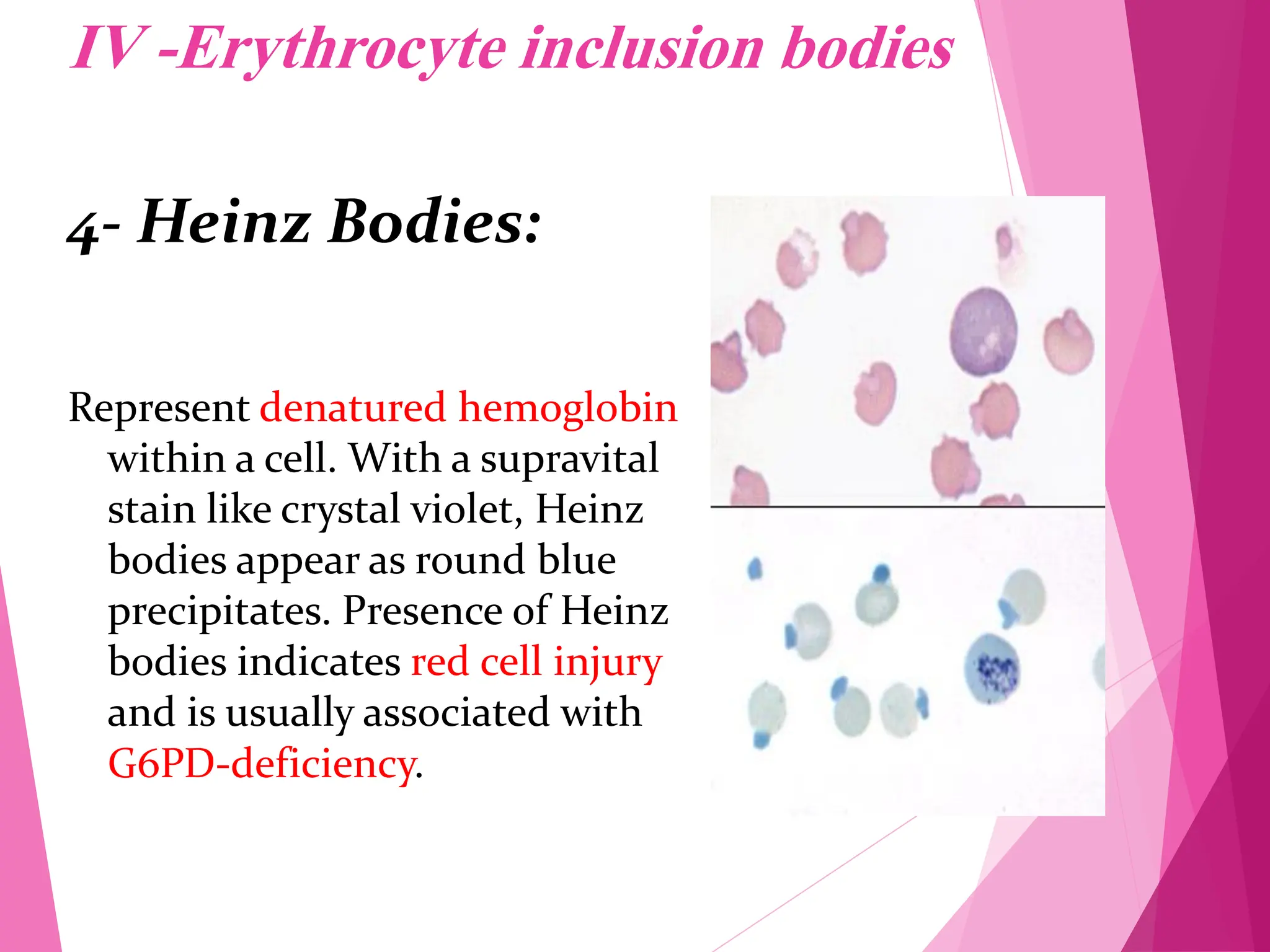
4- Heinz Bodies:
Represent denatured hemoglobin
within a cell. With a supravital
stain like crystal violet, Heinz
bodies appear as round blue
precipitates. Presence of Heinz
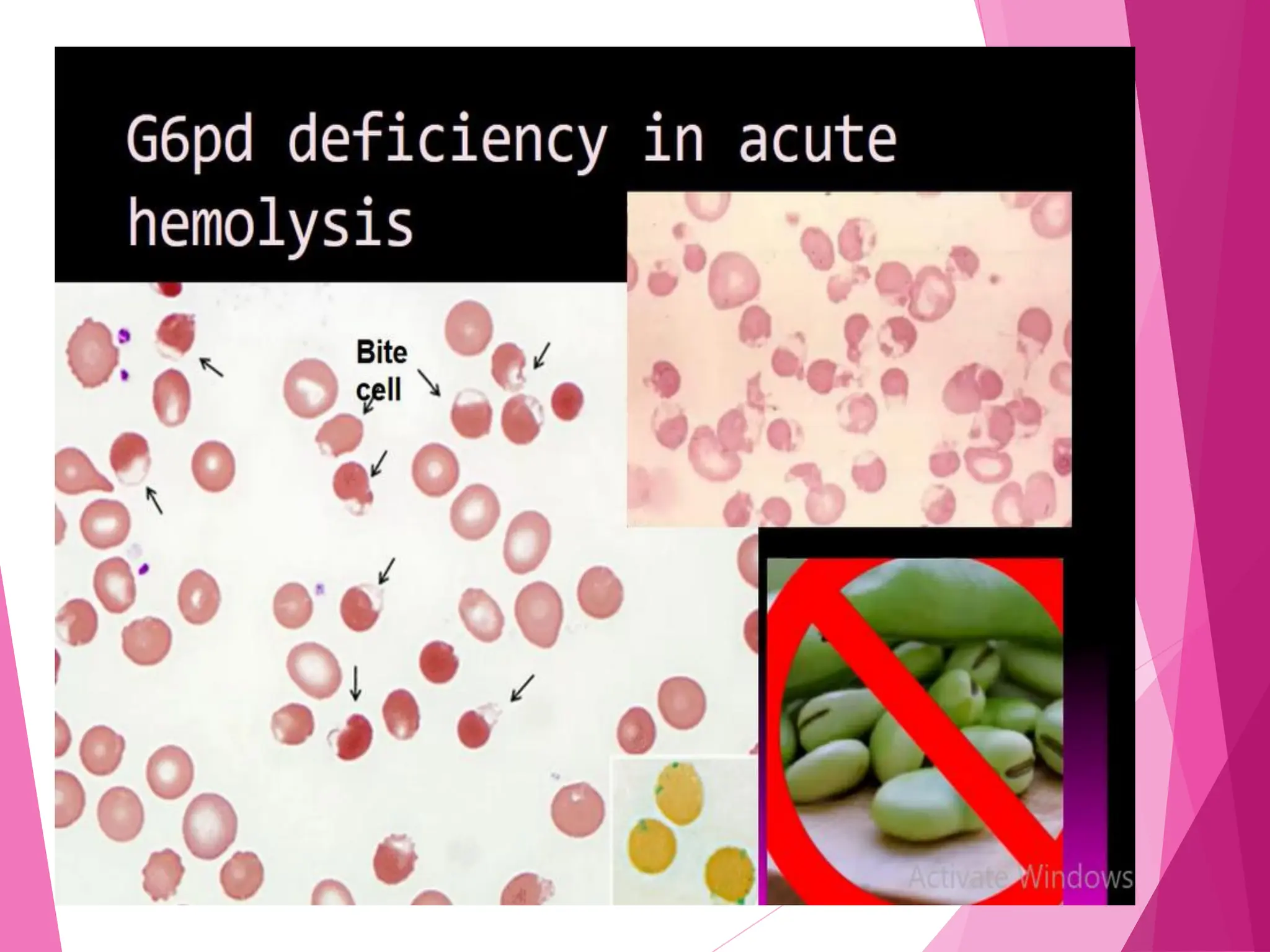
bodies indicates red cell injury
and is usually associated with
G6PD-deficiency.
IV -Erythrocyte inclusion
bodies
5- Cabot Rings:
Reddish-blue threadlike
rings in RBCs of severe
anemia's. These are
remnants of the nuclear
membrane and appear as
a ring or figure 8 pattern.
Very rare finding in
patients with
Megaloblastic anemia,
severe anemia's, lead
poisoning, and
dyserythropoiesis.
IV -Erythrocyte inclusion bodies
-ERYTHROCYTE INCLUSION
BODIES
6- Parasites of Red
Cell:
are protozoan parasites
which occur in many
species of birds and are the
cause of avian malaria.
Transmitted by
mosquitoes, infection with
Plasmodium can be a cause
of hemolytic anemia
RBCs Abnormal morphology
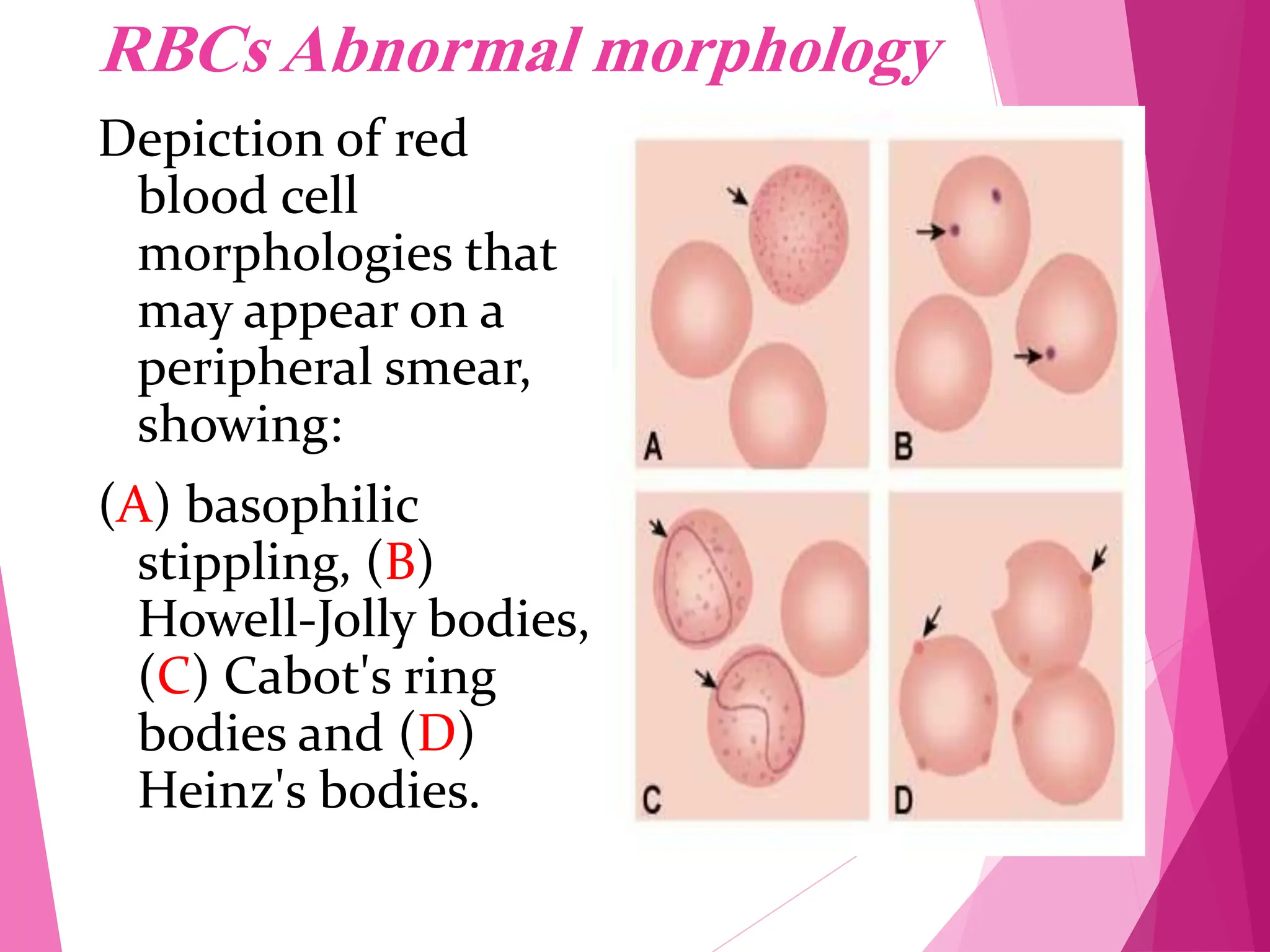
Depiction of red
blood cell
morphologies that
may appear on a
peripheral smear,
showing:
(A) basophilic
stippling, (B)
Howell-Jolly bodies,
(C) Cabot's ring
bodies and (D)
Heinz's bodies.
IV -Erythrocyte inclusion bodies
Dimorphic anemia. Anisocytosis
and anisochromia characterized by the
presence of microcytic hypochromic cells,
normocytic cells, and few macrocytes
(1000×).
Thermal injury. Tiny bits of
membrane (in excess of hemoglobin) are
removed from the red cell surface, leading
to formation of spherocytes (1000×).
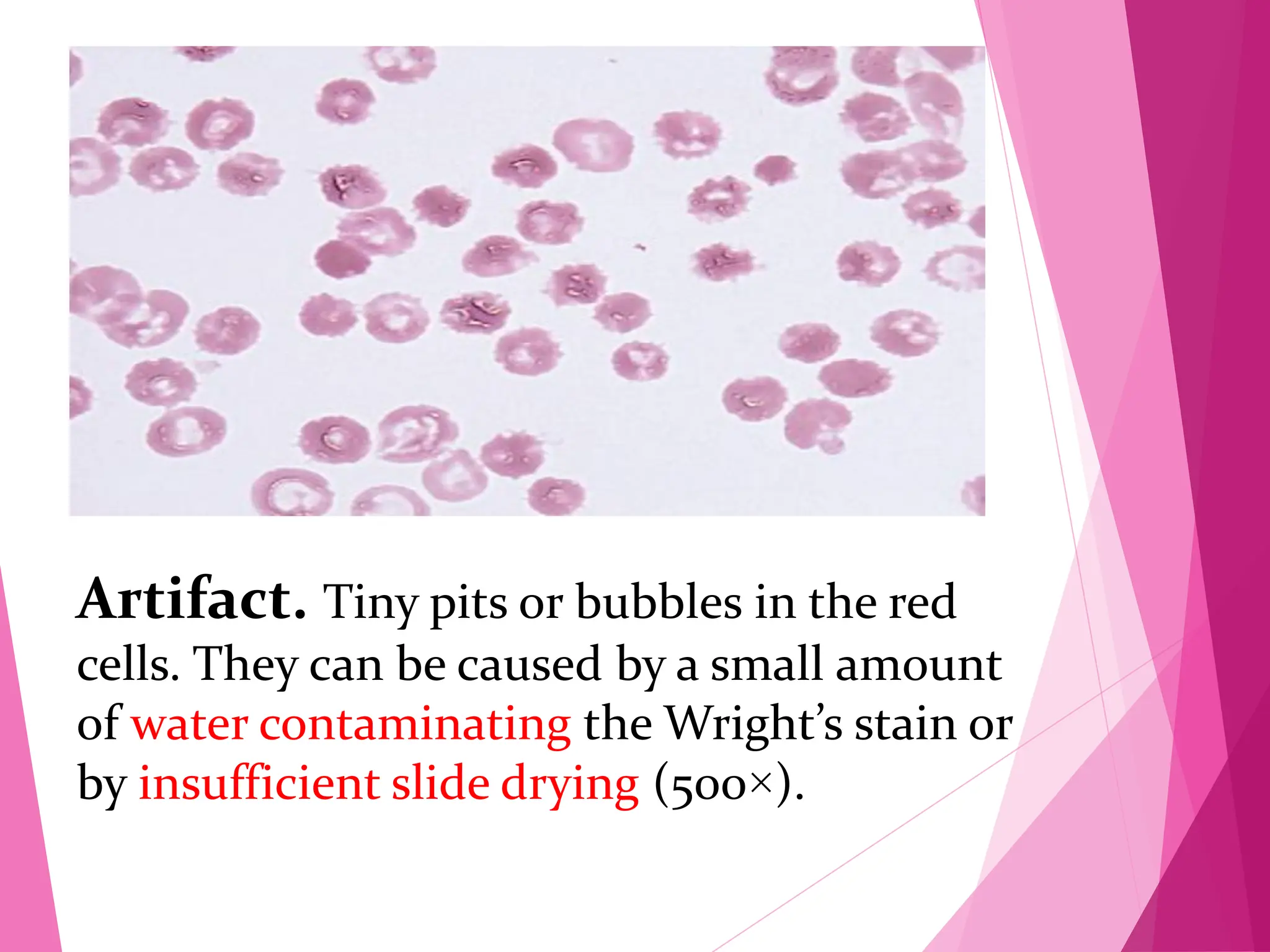
Artifact. Tiny pits or bubbles in the red
cells. They can be caused by a small amount
of water contaminating the Wright’s stain or
by insufficient slide drying (500×).
Rutzky Rules:
Rule1: Hb*3=HCT±2
Rule2: RBC*3.3=Hb±1.5
Rule3: RBC*9=HCT±3
Rule4: MCH*3=MCV±3
Estimated WBC Count
WBC/High-Power Field(*40)
4.0 - 7.0 * 109
/L
2 - 4
7.0 - 10.0 * 109
/L
4- 7
10.0 – 13.0 *109
/L
6-10
13.0-18.0 *109
/L
10-20
Wintrob Indexes
RBC Morphology.pdf
RBC Morphology.pdf
RBC Morphology.pdf
RBC Morphology.pdf

RBC Morphology.pdf

  • 1.
    RBC MORPHOLOGY MSc) ) Prepared By: A . Moghaddam Hematology Supervisor at Pars Hospital Lab
  • 2.
  • 7.
    Normal peripheral smear.Erythrocytes appear as circular, homogeneous disks of nearly uniform size, ranging from 6–8 μm in diameter, with central pallor not exceeding more than one third of the cell. On average, the red cells are approximately the same size as the nucleus of a small lymphocyte (500×). Normal red blood cell findings with slight variance in size of the erythrocytes. 2 1
  • 8.
    RED BLOOD CELL MORPHOLOGY Abnormalerythrocyte morphology is found in pathological states that may be : - abnormalities in size (Anisocytosis). - In shape (Poikilocytosis). -In hemoglobin content or the presence of inclusion bodies in erythrocyte.
  • 9.
    RED BLOOD CELL MORPHOLOGY Normochromic: Adescriptive term applied to a red blood cell with a normal concentration of hemoglobin. Hypochromic: A descriptive term applied to a red blood cell with a decreased concentration of hemoglobin. Normocytic: A descriptive term applied to normal size of RBC Macrocytic: A descriptive term applied to a larger than normal red blood cell.
  • 10.
    Variation in erythrocytesize (Anisocytosis) 1-Microcytosis: Morphology: - Decrease in the red cell size. Red cells are smaller than ± 7µm in diameter. The nucleus of a small lymphocyte (± 8,µm) is a useful guide to the size of a red blood cell. Found in: - Iron deficiency anemia. - Thalassemia. - Sideroblastic anemia. - Lead poisoning. - Anemia of chronic disease.
  • 11.
    Variation in erythrocytesize (Anisocytosis) 2-Macrocytosis: Morphology: Increase in the size of a red cell. Red cells are larger than 9µm in diameter. May be round or oval in shape, the diagnostic significance being different. Found in: - Folate and B12 deficiencies (oval) - Ethanol (round) - Liver disease (round) - Reticulocytosis (round)
  • 12.
    Variation in hemoglobincontent 1-Hypochromasia: Morphology: Increase in the red cells' central pollar which occupies more than the normal third of the red cell diameter. Found in: - Iron deficiency - Thalassemia any of the conditions leading to Microcytosis
  • 13.
    Variation in hemoglobincontent 2- Polychromasia: Morphology: Red cells stain shades of blue- gray as a consequence of uptake of both eosin (by hemoglobin) and basic dyes (by residual ribosomal RNA). Often slightly larger than normal red cells and round in shape - round macrocytosis. Found in: Any situation with Reticulocytosis - for example bleeding, hemolysis or response to hemostatic factor replacement.
  • 15.
    III- Variation ofred cells shape (Poikilocytosis)  of shape Variation in Poikilocytosis. red cells. Abnormally shaped cells include oval, pear-shaped, and other irregularly shaped cells (1000×).
  • 16.
    III- Variation ofred cells shape (Poikilocytosis) RBCs may have different shapes: 1- Spherocytosis: Morphology: Red cells are more spherical. Lack the central area of pallor on a stained blood film. Found in: - Hereditary spherocytosis - Immune hemolytic anemia - Zieve's syndrome - Microangiopathic hemolytic anemia
  • 17.
    III- Variation ofred cells shape (Poikilocytosis) 2-Target Cells: Morphology: Red cells have an area of increased staining which appears in the area of central pallor. Found in: -Obstructive liver disease - Severe iron deficiency - Thalassemia - Haemoglobinopathies (C and S) - Post splenectomy
  • 18.
    III- Variation ofred cells shape (Poikilocytosis) 3- Ovalocytes: Morphology: oval shape red blood cell Found in: - Thalassemia major. - Hereditary ovalocytosis. - Sickle cell anemia
  • 19.
    III- Variation ofred cells shape (Poikilocytosis) 4- Elliptocytosis: Morphology: The red cells are oval or elliptical in shape. Long axis is twice the short axis. Found in: - Hereditary elliptocytosis - Megaloblastic anemia - Iron deficiency - Thalassemia - Myelofibrosis
  • 20.
    Hereditary elliptocytosis. Mostcells are elliptocytes. They are seen in a normal person’s blood, but usually account for less than 10% of cells. They are also common in iron deficiency anemia,myelofibrosis,megaloblastic anemia, and sickle cell anemia (1000×).
  • 21.
    III- Variation ofred cells shape (Poikilocytosis) 5- Tear Drop Cells: Morphology: Red cells shaped like a tear drop or pear Found in: - Bone marrow fibrosis - Megaloblastic anemia - Iron deficiency - Thalassemia
  • 22.
    III- Variation ofred cells shape (Poikilocytosis) 6- Blister cell: Morphology: Have acentric hallow area. Found in: Microangiopathic hemolytic anemia
  • 23.
    III- Variation ofred cells shape (Poikilocytosis)III- VARIATION OF RED CELLS SHAPE (POIKILOCYTOSIS) 7- Schistocytosis: Morphology: Fragmentation of the red cells. Found in: - DIC - Micro angiopathic haemolytic anemia - Mechanical haemolytic anemia
  • 24.
    III- Variation ofred cells shape (Poikilocytosis) 8- Stomatocytosis: Morphology: Red cells with a central linear slit or stoma. Seen as mouth- shaped form in peripheral smear. Found in: - Alcohol excess - Alcoholic liver disease - Hereditary Stomatocytosis - Hereditary spherocytosis
  • 25.
    III- Variation ofred cells shape (Poikilocytosis) 9- Echinocyte (crenation ) cell: Morphology: Red cell with uniformly spaced, pointed projections on their surface. Found in: - hemolytic anemia - Uremia. - Megaloblastic anemia
  • 26.
    III- Variation ofred cells shape (Poikilocytosis) 10- Keratocytes (horn cell): Morphology: Part of the cell fuses back leaving two or three horn-like projections. The Keratocytes is a fragile cell and remains in circulation for only a few hours. Found in: - Uremia - Severe burns - EDTA artifact - Liver disease
  • 27.
    III- Variation ofred cells shape (Poikilocytosis) 11- Acanthocytosis: Morphology: are red blood cells with irregularly spaced projections, these projections vary in width but usually contain a rounded end Found in: - Liver disease - Post splenectomy - Anorexia nervosa and starvation
  • 28.
    III- Variation ofred cells shape (Poikilocytosis) 12- Sickle Cells: Morphology: Sickle shaped red cells sickle cells are found only in homozygous sickle cell anemia, Sickle cell test under reduced oxygen tension: almost all erythrocytes appear as sickle cells in the homozygous case presented here. Found in: Hb-S disease
  • 29.
    III- Variation ofred cells shape (Poikilocytosis) 13-RouleauxFormation: Morphology: Stacks of RBC's resembling a stack of coins. Found in: - Hyper fibrinogenemia - Hyper globulinemia - Multiple Myeloma
  • 30.
    III- Variation ofred cells shape (Poikilocytosis) 14- Red cell- agglutination: Morphology: Irregular clumps of red cells Found in: - Cold agglutinins - Warm autoimmune hemolysis - ABO incompatibility
  • 31.
    III- Variation ofred cells shape (Poikilocytosis) 15- Nucleated red blood cells. These red blood cells are released from the bone marrow early into the blood stream, due to the need for oxygen. Normal red blood cells do not contain a nucleus on a peripheral smear. Precursors of mature red cells, normoblasts are usually present only in the bone marrow. Their presence in blood is usually associated with increased red cell production or infiltrative bone marrow disorders
  • 32.
    IV -Erythrocyte inclusion bodies 1-Howell-Jolly Bodies: Morphology: Smooth round remnants of nuclear chromatin. Small round cytoplasmic red cell inclusion with same staining characteristics as nuclei Found in: - Post splenectomy - Megaloblastic anemia
  • 33.
    IV -Erythrocyte inclusion bodies 2-Siderotic Granules (Pappenheimer Bodies) RBCs which contain hemoglobin iron granules. They appear as dense blue, irregular granules which are unevenly distributed in Wright stained RBCs. Pappenheimer bodies can be increased in hemolytic anemia, infections and post- splenectomy.
  • 34.
    IV -Erythrocyte inclusionbodies 3- Basophilic stippling: Morphology: Considerable numbers of small basophilic inclusions in red cells. Found in: - Thalassemia - Megaloblastic anemia - Hemolytic anemia - Liver disease - Heavy metal poisoning.
  • 35.
    IV -Erythrocyte inclusionbodies 4- Heinz Bodies: Represent denatured hemoglobin within a cell. With a supravital stain like crystal violet, Heinz bodies appear as round blue precipitates. Presence of Heinz bodies indicates red cell injury and is usually associated with G6PD-deficiency.
  • 38.
    IV -Erythrocyte inclusion bodies 5-Cabot Rings: Reddish-blue threadlike rings in RBCs of severe anemia's. These are remnants of the nuclear membrane and appear as a ring or figure 8 pattern. Very rare finding in patients with Megaloblastic anemia, severe anemia's, lead poisoning, and dyserythropoiesis.
  • 39.
    IV -Erythrocyte inclusionbodies -ERYTHROCYTE INCLUSION BODIES 6- Parasites of Red Cell: are protozoan parasites which occur in many species of birds and are the cause of avian malaria. Transmitted by mosquitoes, infection with Plasmodium can be a cause of hemolytic anemia
  • 40.
    RBCs Abnormal morphology Depictionof red blood cell morphologies that may appear on a peripheral smear, showing: (A) basophilic stippling, (B) Howell-Jolly bodies, (C) Cabot's ring bodies and (D) Heinz's bodies.
  • 41.
  • 46.
    Dimorphic anemia. Anisocytosis andanisochromia characterized by the presence of microcytic hypochromic cells, normocytic cells, and few macrocytes (1000×).
  • 47.
    Thermal injury. Tinybits of membrane (in excess of hemoglobin) are removed from the red cell surface, leading to formation of spherocytes (1000×).
  • 48.
    Artifact. Tiny pitsor bubbles in the red cells. They can be caused by a small amount of water contaminating the Wright’s stain or by insufficient slide drying (500×).
  • 49.
    Rutzky Rules: Rule1: Hb*3=HCT±2 Rule2:RBC*3.3=Hb±1.5 Rule3: RBC*9=HCT±3 Rule4: MCH*3=MCV±3 Estimated WBC Count WBC/High-Power Field(*40) 4.0 - 7.0 * 109 /L 2 - 4 7.0 - 10.0 * 109 /L 4- 7 10.0 – 13.0 *109 /L 6-10 13.0-18.0 *109 /L 10-20
  • 50.