Manual CBC
Dr. Mohamed Shaheen
MBBCh, MSc, MD, IPCD, HHMD
Lecturer of Clinical Pathology- Al-Azhar University
Chief Infection Control team El-Hussien hospital
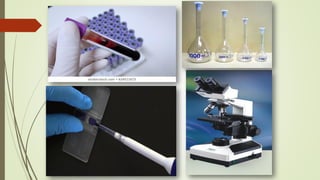
REAGENTS & EQUIPMENTS
1. Sample:
- EDTA whole blood sample.
- Fresh blood direct from patient.
2. Reagents:
- Platelets: Ammonium oxalate (1%).
- WBCs: Glacial acetic acid (2%).
- RBCs: Saline (0.9%).
3. Equipment's:
- Microscope.
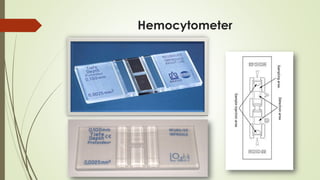
- Hemocytometer (improved Neubauer )+ its cover slide.
- Pipette [10ul, 20ul, 100-1000 variable].
- Petri dish lined with filter paper that has been moistened.
- Hand counter.
- Rack and tubes.
Hemocytometer
Chambers & Cover
Counting
Calculations
Hemocytometer
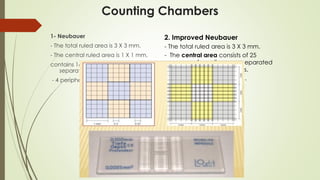
Counting Chambers
1- Neubauer
- The total ruled area is 3 X 3 mm.
- The central ruled area is 1 X 1 mm.
contains 16 groups of 16 small squares
separated by triple rulings.
- 4 peripheral large squares.
2. Improved Neubauer
- The total ruled area is 3 X 3 mm.
- The central area consists of 25
groups of small squares separated
by closely ruled triple lines.
- 4 peripheral large squares.
Mix & mix before any step
WBCs Counting
Sample Diluent
Steps Dilution
White blood cells (WBCs) count.
Sample:
1- EDTA blood Or
2- Directly from finger without anticoagulant.
3- Heparin is not suitable (clumping of leucocytes).
Diluent: Acetic acid 2 %.
2 ml acetic acid + 98 ml DW + 1drop of gentian violet or Leishman stain.
(helps reflection of cells under microscope)
Benefit of acetic acid (diluent):
 Lyse RBCs.
 Stains the WBC nuclei deep violet or black.
Dilution: 1: 20
- 20 µ blood +380 µ diluents.
- Mix and allow to stand for 5 min.
Steps:
1. Clean the Hemocytometer and cover and leave them to dry .
2. Adjust the microscope on low power (10X or 40X).
3. Adjust the Hemocytometer on the microscope.
4. Hemocytometer (improved Neubauer counting chamber):
4 large peripheral squares , each one→ 4X4 small squares.
Central large square → 5X5 small squares.
5. Adjust the microscope on central large square (25 small squares).
6. Remove the Hemocytometer and fill the 2 sides of the chamber by
pipette while covered with glass slide.
7. Put the hemocytometer on the microscope (adjusted before).
8. Count WBCs in the 4 peripheral large squares.
9. Cells on the border of the square are counted in L shaped manner.
Calculation:
‫الكبير‬ ‫مربع‬ ‫كل‬ ‫حجم‬
=
‫الطول‬
X
‫العرض‬
X
‫االرتفاع‬
0.1mm =0.1 ml X 1 ml X 1ml =
‫حجم‬ ‫اذا‬
4
‫مربعات‬
=
0.4 = 0.1ml X 4
- WBCs count =No.of cells counted in 4 squares X Dilution.
Volume of 4 squares
- WBCs count = (No. of cells counted ⁄ 0.4 ) X 20.
= No. of cells counted X 50.
- Variation of counted cell in 4 squares should not exceed (10-15) %.
Special cases:
1- Very high WBCs count >100000 e.g. CML,CLL: Dilute 1:200.
2- Low WBCs count < 3000: Dilute 1:10.
Examples:
Counted WBCs: 36+44+42+38
Calculation:
TLC = 160 / 0.4 X 20 =
TLC = No. of cells counted X 50.
TLC = 160 X 50 = 8,000 cells/ul
RBCs Counting
Sample Diluent
Steps Dilution
Calculation
Red Blood Cells (RBCs) count
Time-consuming & so imprecise [Obsolete]
Sample:
- EDTA blood or
- Directly from the patient finger.
Diluent:
- Saline (0.9%).
- Formal citrate (10 ml formalin +1 L of trisodium citrate).
Which is better formal citrate or saline ?
- Formal citrate is better than saline as you can prepare the dilution and leave
The sample without change in the shape of RBCs but if you use saline, you must examine the sample as soon as possible.
Dilution: 1:200
- 20 µl blood + 4 ml (= 4000ul) saline or formal citrate and mix well.
Steps:
1. Adjust the hemocytometer on the microscope as before.
2. Fill the hemocytometer with diluted blood.
3. Count in the same squares as platelets
‫األوسط‬ ‫ع‬‫المرب‬ ‫حجم‬
:
‫الحجم‬
=
25
‫صغي‬ ‫ع‬‫مرب‬
‫ي‬
‫ف‬ ‫العد‬ ‫يتم‬ ‫لكن‬
5
‫فقط‬ ‫مربعات‬
‫ي‬
‫الحقيق‬ ‫الحجم‬ ‫خمس‬ ‫ي‬
‫ف‬ ‫كان‬‫العد‬ ‫أن‬ ‫أي‬
=
0.2
‫اساسا‬ ‫االوسط‬ ‫ع‬‫المرب‬ ‫حجم‬ ‫و‬
=
0.1
‫خمسه‬ ‫حجم‬ ‫اذا‬
=
0.02
Calculation:
‫كله‬ ‫االوسط‬ ‫المربع‬ ‫حجم‬
=
‫الطول‬ X ‫العرض‬ X ‫االرتفاع‬
= 0.1
‫في‬ ‫العد‬ ‫ان‬ ‫بما‬
5
‫من‬ ‫مربعات‬
25
‫مربع‬
= 1/5
= 0.02 = [1/10 ml X 1/5]
RBCs count = No. of cells counted in 5 squares X Dilution.
Volume of 5 squares
RBCs count = (No. of cells counted ⁄ 0.02 ) X 200.
= Count X 10,000.
Platelets Counting
Sample Diluent
Steps Dilution
Calculation
Platelet count.
Sample:
- EDTA blood is preferred over direct finger sample due to platelets aggregate.
- If you take directly from the finger, the platelet will →↓ because platelets lost at the
site of the skin puncture.
- Insure that no clots because any clot will →↓ platelets.
Diluent: 1% aqueous ammonium oxalate.
Preparation: 1 gm ammonium oxalate dissolved in 100 cc distilled water.
Benefit of ammonium oxalate:
1- Lysis of RBCs.
2- Diluent
N.B:- Not more than 500 ml of NH4 oxalate should be made at a time
- Use clean glassware.
- The solution should be filtered and kept at 4C°.
- For use , small part is re-filtered &
- Discard if there is turbidity or fungal growth.
Dilution 1:20
- 20 µ blood + 380 µ diluent.
- Mix and allow to stand for 10-15 min.
Steps:
1. Adjust the hemocytometer as in WBCs count.
2. Fill the counting chamber with the diluted fluid.
3. Platelets need 20 min. to settle in hemocytometer.
4. Hemocytometer will be put in moist petri dish (to avoid dryness)
5. Filter paper soaked with water for 20 min at least.
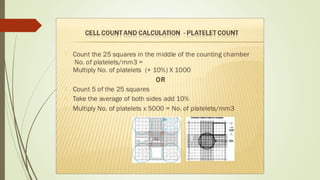
6. Count by low power in 5 small squares in the central large square.
7. Use fine adjustment to detect platelets as refractile particles.
Calculation:
‫كله‬ ‫األوسط‬ ‫المربع‬ ‫حجم‬
=
‫الطول‬
X
‫العرض‬
X
‫االرتفاع‬
=
0.1
‫في‬ ‫العد‬ ‫ان‬ ‫بما‬
5
‫من‬ ‫مربعات‬
25
‫مربع‬
=
1/5
=
0.02 = [0.1ml X (1/5)]
PLTs count =No.of cells counted in 5 squares X Dilution.
Volume of 5 squares
PLTs count = (No. of cells counted ⁄ 0.02 ) X 20.
= [40 + 42 + 40 + 38 + 36]
= Count X 1000 = 200 X 1000 =
= 200,000
• It is important to do blank count (fill the hemocytometer with diluent alone and
count what you think it is plts then subtract it from the test sample count.
• Do blood film and examine to compare with manual count made.
• Platelets should be counted manual and not automated in the following
conditions:
1. Marked anisocytosis: as IDA.
2. Many schistocytes: as thalassemia.(because fragmented RBCs are small
enough to be counted as platelets)→ false high plt count.
3. Many giant platelets e.g. Bernard Solier Syndrome because plts are large
enough to be counted as RBCs → false low plt count.
4. Many small platelets e.g Wiskot aldrich syndrome.
NOTES
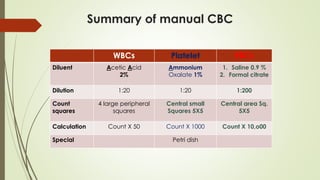
Summary of manual CBC
RBCs
Platelet
WBCs
1. Saline 0.9 %
2. Formal citrate
Ammonium
Oxalate 1%
Acetic Acid
2%
Diluent
1:200
1:20
1:20
Dilution
Central area Sq.
5X5
Central small
Squares 5X5
4 large peripheral
squares
Count
squares
Count X 10,o00
Count X 1000
Count X 50
Calculation
Petri dish
Special
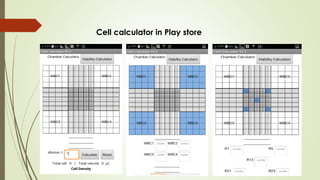
Cell calculator in Play store
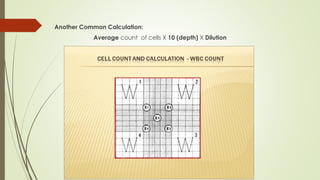
Another Common Calculation:
Average count of cells X 10 (depth) X Dilution
Precautions & Limitations
Practical Hematology l 01 Manual CBC.pdf

Practical Hematology l 01 Manual CBC.pdf

  • 1.
    Manual CBC Dr. MohamedShaheen MBBCh, MSc, MD, IPCD, HHMD Lecturer of Clinical Pathology- Al-Azhar University Chief Infection Control team El-Hussien hospital
  • 2.
    REAGENTS & EQUIPMENTS 1.Sample: - EDTA whole blood sample. - Fresh blood direct from patient. 2. Reagents: - Platelets: Ammonium oxalate (1%). - WBCs: Glacial acetic acid (2%). - RBCs: Saline (0.9%). 3. Equipment's: - Microscope. - Hemocytometer (improved Neubauer )+ its cover slide. - Pipette [10ul, 20ul, 100-1000 variable]. - Petri dish lined with filter paper that has been moistened. - Hand counter. - Rack and tubes.
  • 4.
  • 5.
  • 6.
    Counting Chambers 1- Neubauer -The total ruled area is 3 X 3 mm. - The central ruled area is 1 X 1 mm. contains 16 groups of 16 small squares separated by triple rulings. - 4 peripheral large squares. 2. Improved Neubauer - The total ruled area is 3 X 3 mm. - The central area consists of 25 groups of small squares separated by closely ruled triple lines. - 4 peripheral large squares.
  • 8.
    Mix & mixbefore any step
  • 9.
  • 10.
    White blood cells(WBCs) count. Sample: 1- EDTA blood Or 2- Directly from finger without anticoagulant. 3- Heparin is not suitable (clumping of leucocytes). Diluent: Acetic acid 2 %. 2 ml acetic acid + 98 ml DW + 1drop of gentian violet or Leishman stain. (helps reflection of cells under microscope) Benefit of acetic acid (diluent):  Lyse RBCs.  Stains the WBC nuclei deep violet or black.
  • 11.
    Dilution: 1: 20 -20 µ blood +380 µ diluents. - Mix and allow to stand for 5 min. Steps: 1. Clean the Hemocytometer and cover and leave them to dry . 2. Adjust the microscope on low power (10X or 40X). 3. Adjust the Hemocytometer on the microscope. 4. Hemocytometer (improved Neubauer counting chamber): 4 large peripheral squares , each one→ 4X4 small squares. Central large square → 5X5 small squares. 5. Adjust the microscope on central large square (25 small squares). 6. Remove the Hemocytometer and fill the 2 sides of the chamber by pipette while covered with glass slide. 7. Put the hemocytometer on the microscope (adjusted before). 8. Count WBCs in the 4 peripheral large squares. 9. Cells on the border of the square are counted in L shaped manner.
  • 13.
    Calculation: ‫الكبير‬ ‫مربع‬ ‫كل‬‫حجم‬ = ‫الطول‬ X ‫العرض‬ X ‫االرتفاع‬ 0.1mm =0.1 ml X 1 ml X 1ml = ‫حجم‬ ‫اذا‬ 4 ‫مربعات‬ = 0.4 = 0.1ml X 4 - WBCs count =No.of cells counted in 4 squares X Dilution. Volume of 4 squares - WBCs count = (No. of cells counted ⁄ 0.4 ) X 20. = No. of cells counted X 50. - Variation of counted cell in 4 squares should not exceed (10-15) %. Special cases: 1- Very high WBCs count >100000 e.g. CML,CLL: Dilute 1:200. 2- Low WBCs count < 3000: Dilute 1:10.
  • 14.
    Examples: Counted WBCs: 36+44+42+38 Calculation: TLC= 160 / 0.4 X 20 = TLC = No. of cells counted X 50. TLC = 160 X 50 = 8,000 cells/ul
  • 15.
  • 16.
    Red Blood Cells(RBCs) count Time-consuming & so imprecise [Obsolete] Sample: - EDTA blood or - Directly from the patient finger. Diluent: - Saline (0.9%). - Formal citrate (10 ml formalin +1 L of trisodium citrate). Which is better formal citrate or saline ? - Formal citrate is better than saline as you can prepare the dilution and leave The sample without change in the shape of RBCs but if you use saline, you must examine the sample as soon as possible. Dilution: 1:200 - 20 µl blood + 4 ml (= 4000ul) saline or formal citrate and mix well. Steps: 1. Adjust the hemocytometer on the microscope as before. 2. Fill the hemocytometer with diluted blood. 3. Count in the same squares as platelets
  • 17.
    ‫األوسط‬ ‫ع‬‫المرب‬ ‫حجم‬ : ‫الحجم‬ = 25 ‫صغي‬‫ع‬‫مرب‬ ‫ي‬ ‫ف‬ ‫العد‬ ‫يتم‬ ‫لكن‬ 5 ‫فقط‬ ‫مربعات‬ ‫ي‬ ‫الحقيق‬ ‫الحجم‬ ‫خمس‬ ‫ي‬ ‫ف‬ ‫كان‬‫العد‬ ‫أن‬ ‫أي‬ = 0.2 ‫اساسا‬ ‫االوسط‬ ‫ع‬‫المرب‬ ‫حجم‬ ‫و‬ = 0.1 ‫خمسه‬ ‫حجم‬ ‫اذا‬ = 0.02
  • 18.
    Calculation: ‫كله‬ ‫االوسط‬ ‫المربع‬‫حجم‬ = ‫الطول‬ X ‫العرض‬ X ‫االرتفاع‬ = 0.1 ‫في‬ ‫العد‬ ‫ان‬ ‫بما‬ 5 ‫من‬ ‫مربعات‬ 25 ‫مربع‬ = 1/5 = 0.02 = [1/10 ml X 1/5] RBCs count = No. of cells counted in 5 squares X Dilution. Volume of 5 squares RBCs count = (No. of cells counted ⁄ 0.02 ) X 200. = Count X 10,000.
  • 19.
  • 20.
    Platelet count. Sample: - EDTAblood is preferred over direct finger sample due to platelets aggregate. - If you take directly from the finger, the platelet will →↓ because platelets lost at the site of the skin puncture. - Insure that no clots because any clot will →↓ platelets. Diluent: 1% aqueous ammonium oxalate. Preparation: 1 gm ammonium oxalate dissolved in 100 cc distilled water. Benefit of ammonium oxalate: 1- Lysis of RBCs. 2- Diluent N.B:- Not more than 500 ml of NH4 oxalate should be made at a time - Use clean glassware. - The solution should be filtered and kept at 4C°. - For use , small part is re-filtered & - Discard if there is turbidity or fungal growth.
  • 21.
    Dilution 1:20 - 20µ blood + 380 µ diluent. - Mix and allow to stand for 10-15 min. Steps: 1. Adjust the hemocytometer as in WBCs count. 2. Fill the counting chamber with the diluted fluid. 3. Platelets need 20 min. to settle in hemocytometer. 4. Hemocytometer will be put in moist petri dish (to avoid dryness) 5. Filter paper soaked with water for 20 min at least. 6. Count by low power in 5 small squares in the central large square. 7. Use fine adjustment to detect platelets as refractile particles.
  • 23.
    Calculation: ‫كله‬ ‫األوسط‬ ‫المربع‬‫حجم‬ = ‫الطول‬ X ‫العرض‬ X ‫االرتفاع‬ = 0.1 ‫في‬ ‫العد‬ ‫ان‬ ‫بما‬ 5 ‫من‬ ‫مربعات‬ 25 ‫مربع‬ = 1/5 = 0.02 = [0.1ml X (1/5)] PLTs count =No.of cells counted in 5 squares X Dilution. Volume of 5 squares PLTs count = (No. of cells counted ⁄ 0.02 ) X 20. = [40 + 42 + 40 + 38 + 36] = Count X 1000 = 200 X 1000 = = 200,000
  • 24.
    • It isimportant to do blank count (fill the hemocytometer with diluent alone and count what you think it is plts then subtract it from the test sample count. • Do blood film and examine to compare with manual count made. • Platelets should be counted manual and not automated in the following conditions: 1. Marked anisocytosis: as IDA. 2. Many schistocytes: as thalassemia.(because fragmented RBCs are small enough to be counted as platelets)→ false high plt count. 3. Many giant platelets e.g. Bernard Solier Syndrome because plts are large enough to be counted as RBCs → false low plt count. 4. Many small platelets e.g Wiskot aldrich syndrome. NOTES
  • 25.
    Summary of manualCBC RBCs Platelet WBCs 1. Saline 0.9 % 2. Formal citrate Ammonium Oxalate 1% Acetic Acid 2% Diluent 1:200 1:20 1:20 Dilution Central area Sq. 5X5 Central small Squares 5X5 4 large peripheral squares Count squares Count X 10,o00 Count X 1000 Count X 50 Calculation Petri dish Special
  • 26.
  • 27.
    Another Common Calculation: Averagecount of cells X 10 (depth) X Dilution
  • 30.