Downloaded 583 times
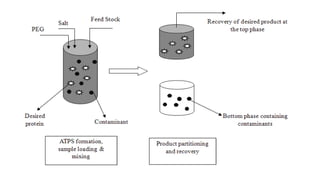
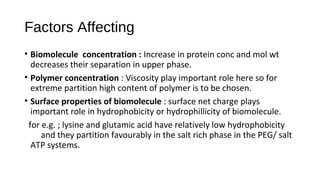

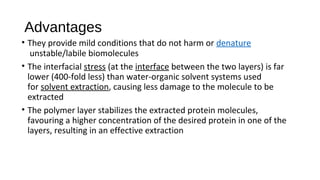


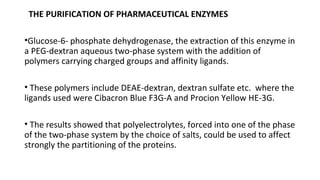



The document discusses aqueous two-phase extraction (ATP), a separation method used in downstream protein processing. ATP uses the partitioning of proteins between two immiscible aqueous phases formed by mixing polymers like PEG and dextran, or polymers and salts. Several factors affect partitioning, including biomolecule properties, polymer/salt concentrations, pH, and temperature. ATP has advantages over organic solvent extraction as it is milder and lowers interfacial stress on proteins. The document outlines applications of ATP in purifying pharmaceutical proteins, antibodies, enzymes, antibiotics, amino acids, and other compounds. It also summarizes a research paper on using ATP to purify lipase from rice bran.


