SEMINAR 
ON 
UPSTREAM & DOWNSTREAM PROCESSING OF 
ANTIBIOTICS,HORMONES,VACCINES. 
SUBMITTED 
BY 
K.ANIL KUMAR 
HT.NO-2565-13-889-009 
(M.pharm 1st yr. IP) 
UNDER THE GUIDANCE 
OF 
Dr.BASU VENKATESWARA REDDY 
M.pharm, Ph.D. 
DEP. OF PHARMACEUTICS 
St. Pauls College of Pharmacy 
St Paul's college of pharmacy 1
TOPIC-UPSTREAM & DOWNSTREAM PROCESSING OF 
ANTIBIOTICS,HORMONES,VACCINES 
CONTENTS: 
• Definitions 
• Stages and steps 
• Up stream process 
• Fermentation 
• Down stream process 
• Penicillin 
• References 
St Paul's college of pharmacy 2
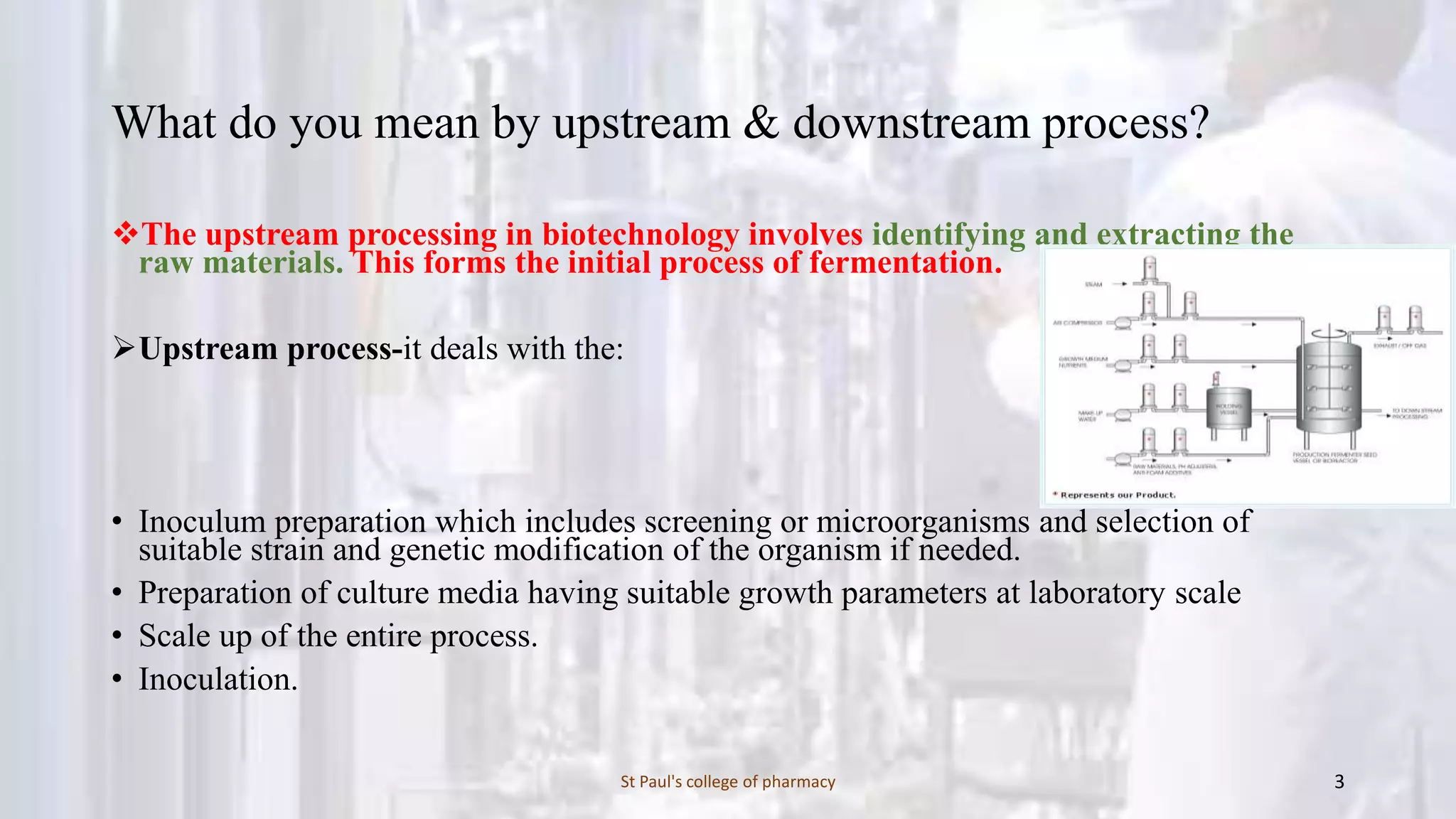
What do you mean by upstream & downstream process? 
The upstream processing in biotechnology involves identifying and extracting the 
raw materials. This forms the initial process of fermentation. 
Upstream process-it deals with the: 
• Inoculum preparation which includes screening or microorganisms and selection of 
suitable strain and genetic modification of the organism if needed. 
• Preparation of culture media having suitable growth parameters at laboratory scale 
• Scale up of the entire process. 
• Inoculation. 
St Paul's college of pharmacy 3
Downstream process- 
When the products are subjected to a series of processes including separation and 
purification which are collectively known as Downstream processing. 
It is also known as product recovery. 
Materials –upstream-finished products 
The downstream processing deals with: 
• Solid-liquid separation 
• Release of intracellular products 
• Concentration 
• Purification 
• Formulation 
St Paul's college of pharmacy 4
Upstream & downstream process of 
Antibiotics 
Hormones 
Vaccines 
St Paul's college of pharmacy 5
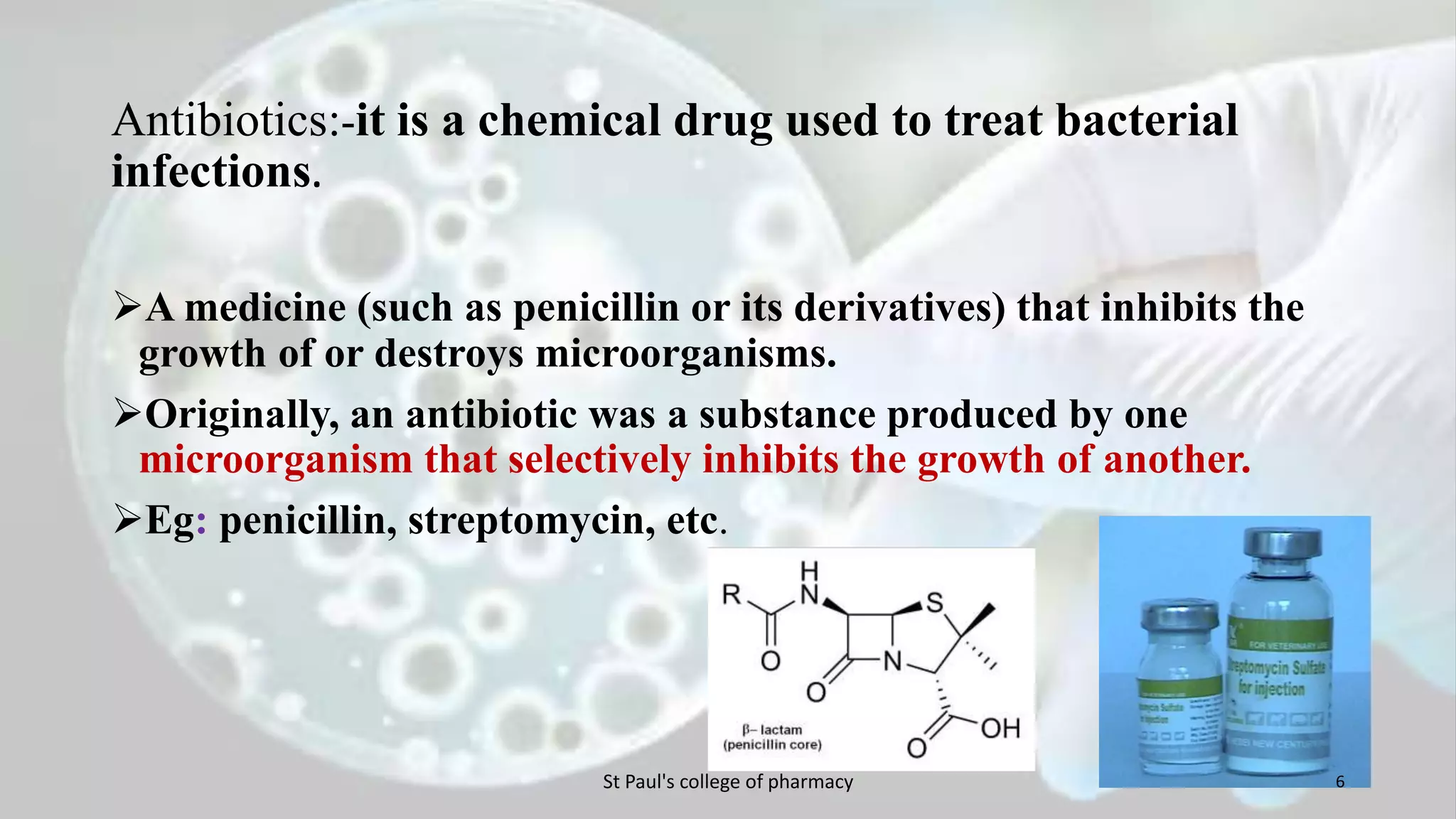
Antibiotics:-it is a chemical drug used to treat bacterial 
infections. 
A medicine (such as penicillin or its derivatives) that inhibits the 
growth of or destroys microorganisms. 
Originally, an antibiotic was a substance produced by one 
microorganism that selectively inhibits the growth of another. 
Eg: penicillin, streptomycin, etc. 
St Paul's college of pharmacy 6
St Paul's college of pharmacy 7
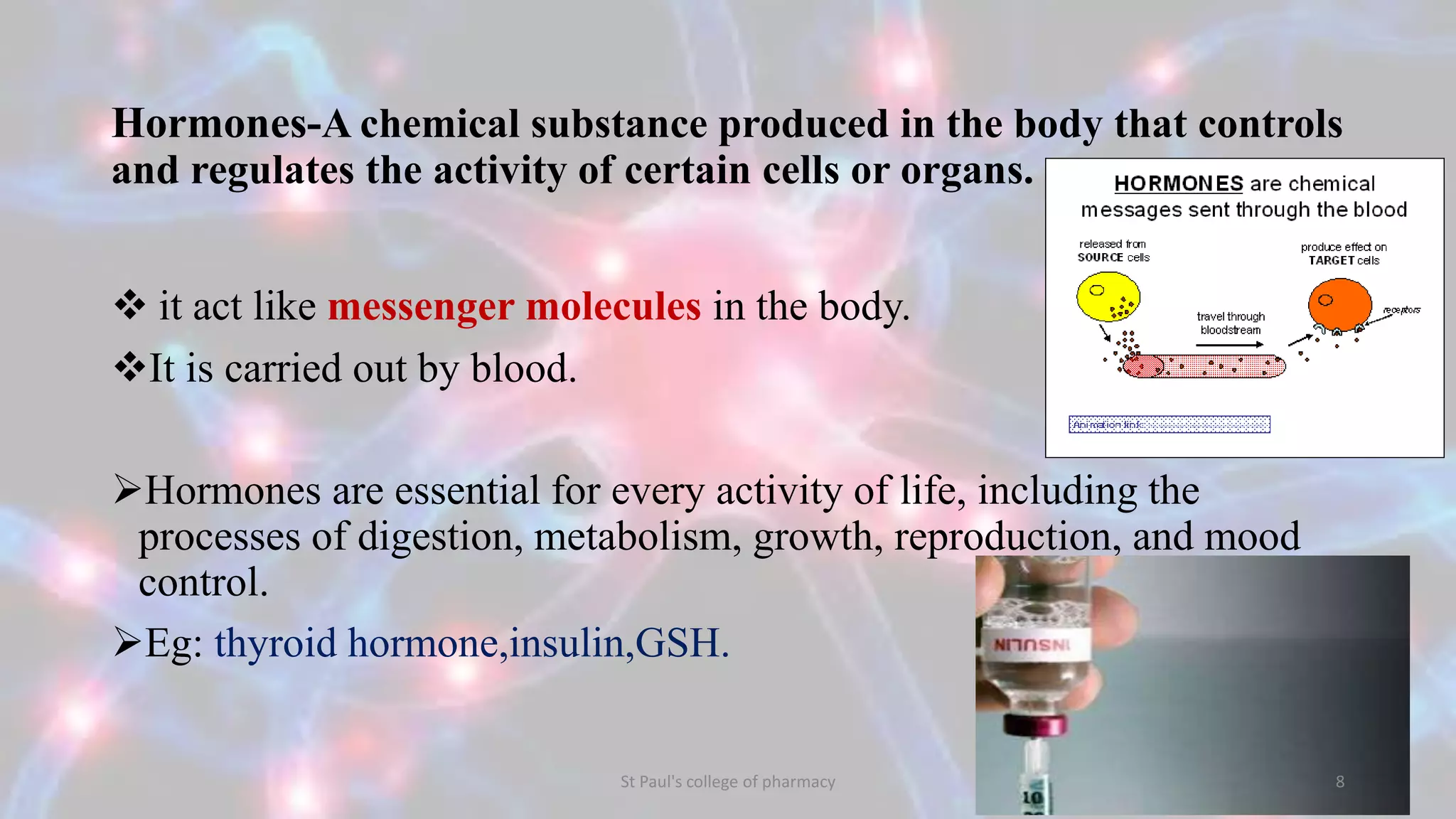
Hormones-A chemical substance produced in the body that controls 
and regulates the activity of certain cells or organs. 
 it act like messenger molecules in the body. 
It is carried out by blood. 
Hormones are essential for every activity of life, including the 
processes of digestion, metabolism, growth, reproduction, and mood 
control. 
Eg: thyroid hormone,insulin,GSH. 
St Paul's college of pharmacy 8
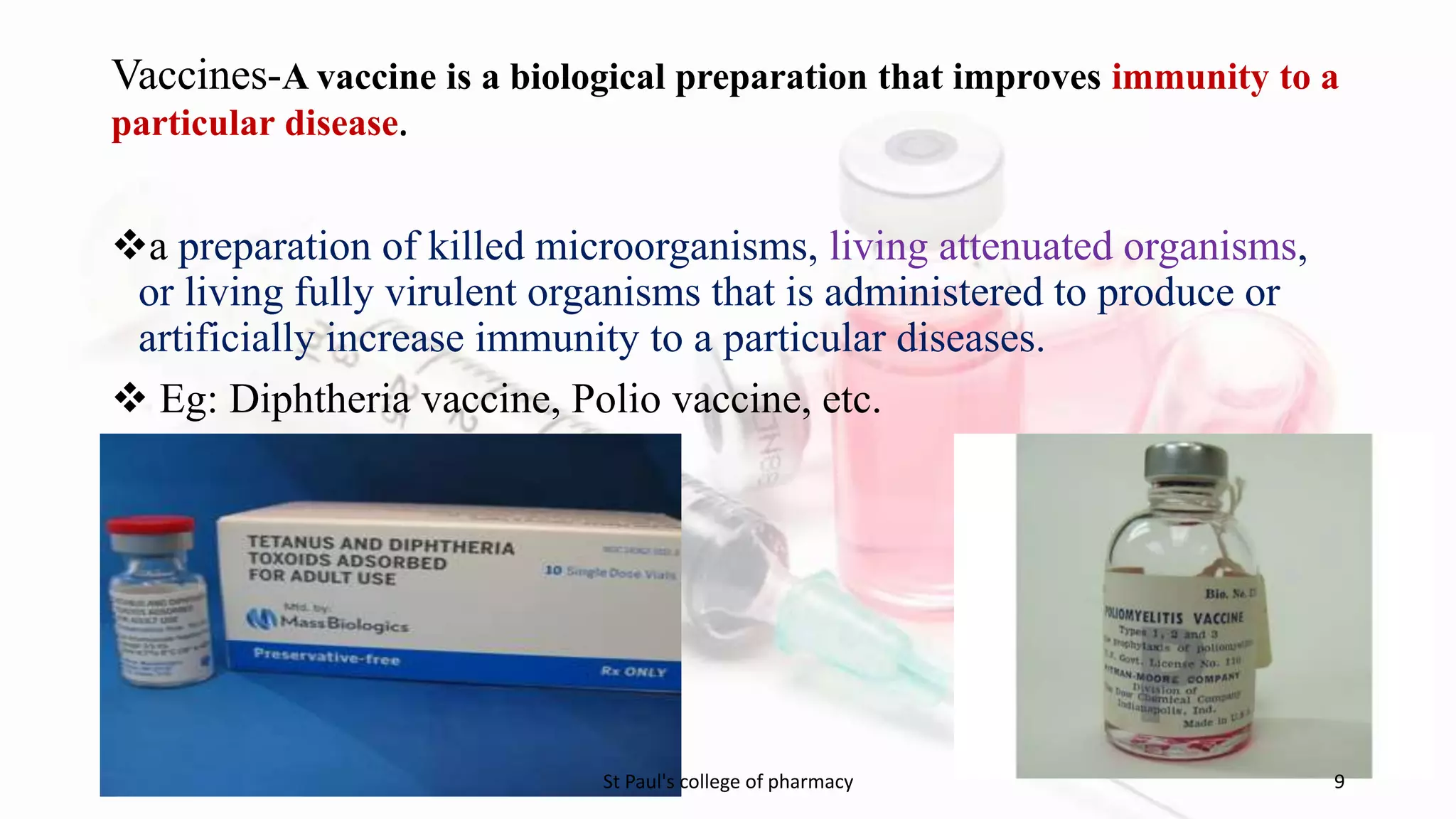
Vaccines-A vaccine is a biological preparation that improves immunity to a 
particular disease. 
a preparation of killed microorganisms, living attenuated organisms, 
or living fully virulent organisms that is administered to produce or 
artificially increase immunity to a particular diseases. 
 Eg: Diphtheria vaccine, Polio vaccine, etc. 
St Paul's college of pharmacy 9
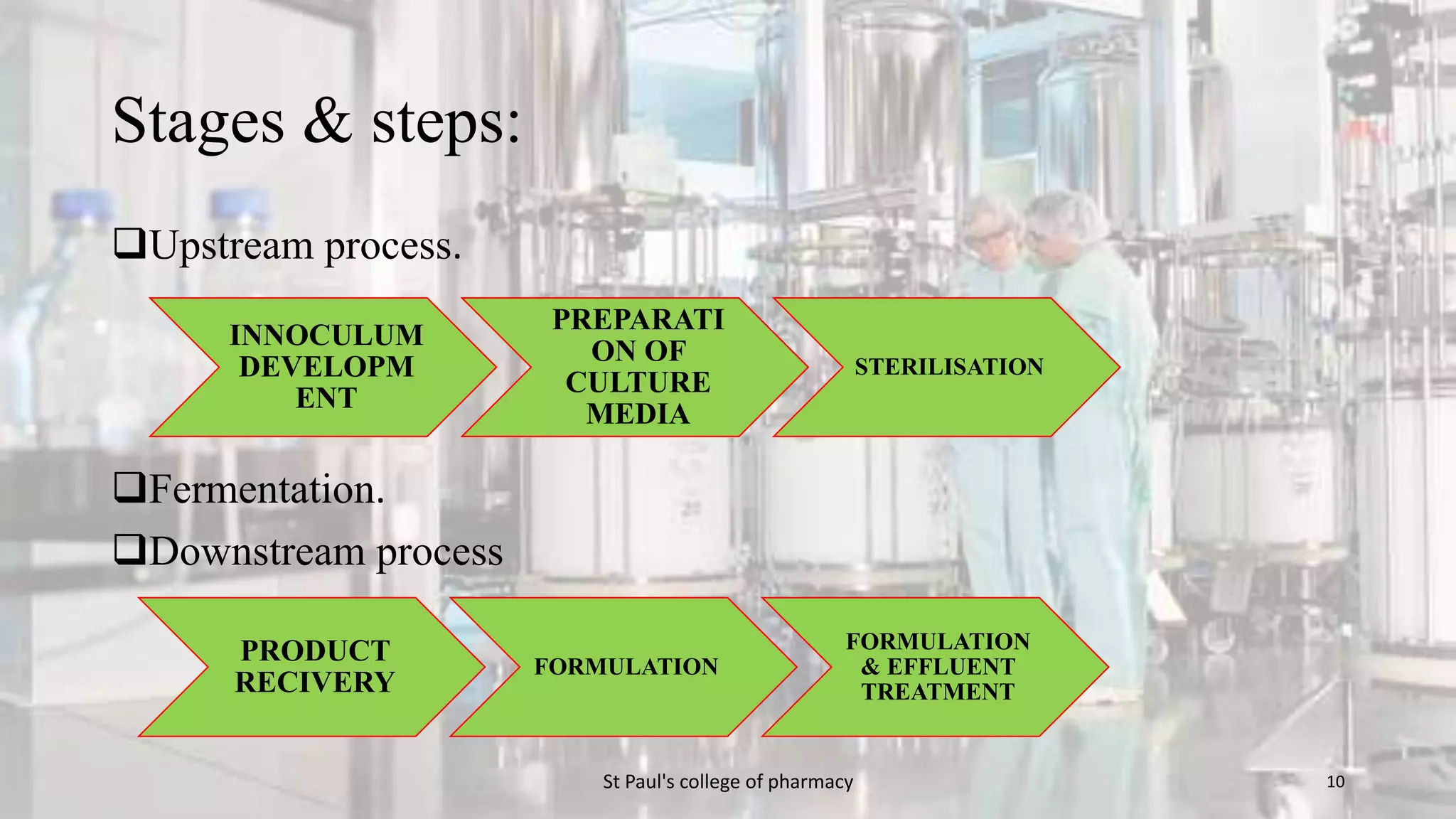
Stages & steps: 
Upstream process. 
INNOCULUM 
DEVELOPM 
ENT 
Fermentation. 
Downstream process 
PREPARATI 
ON OF 
CULTURE 
MEDIA 
STERILISATION 
PRODUCT 
RECIVERY 
FORMULATION 
FORMULATION 
& EFFLUENT 
TREATMENT 
St Paul's college of pharmacy 10
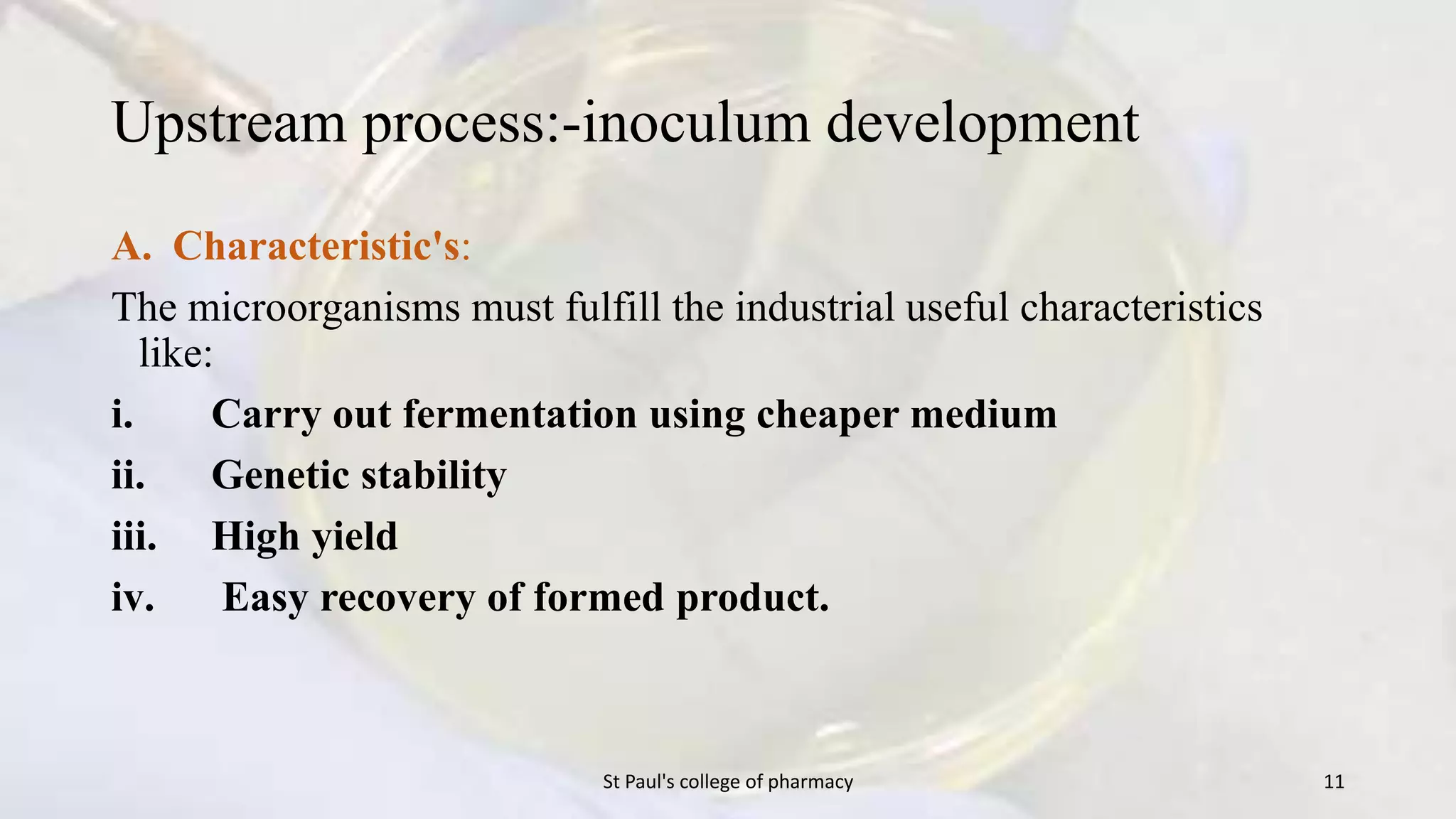
Upstream process:-inoculum development 
A. Characteristic's: 
The microorganisms must fulfill the industrial useful characteristics 
like: 
i. Carry out fermentation using cheaper medium 
ii. Genetic stability 
iii. High yield 
iv. Easy recovery of formed product. 
St Paul's college of pharmacy 11
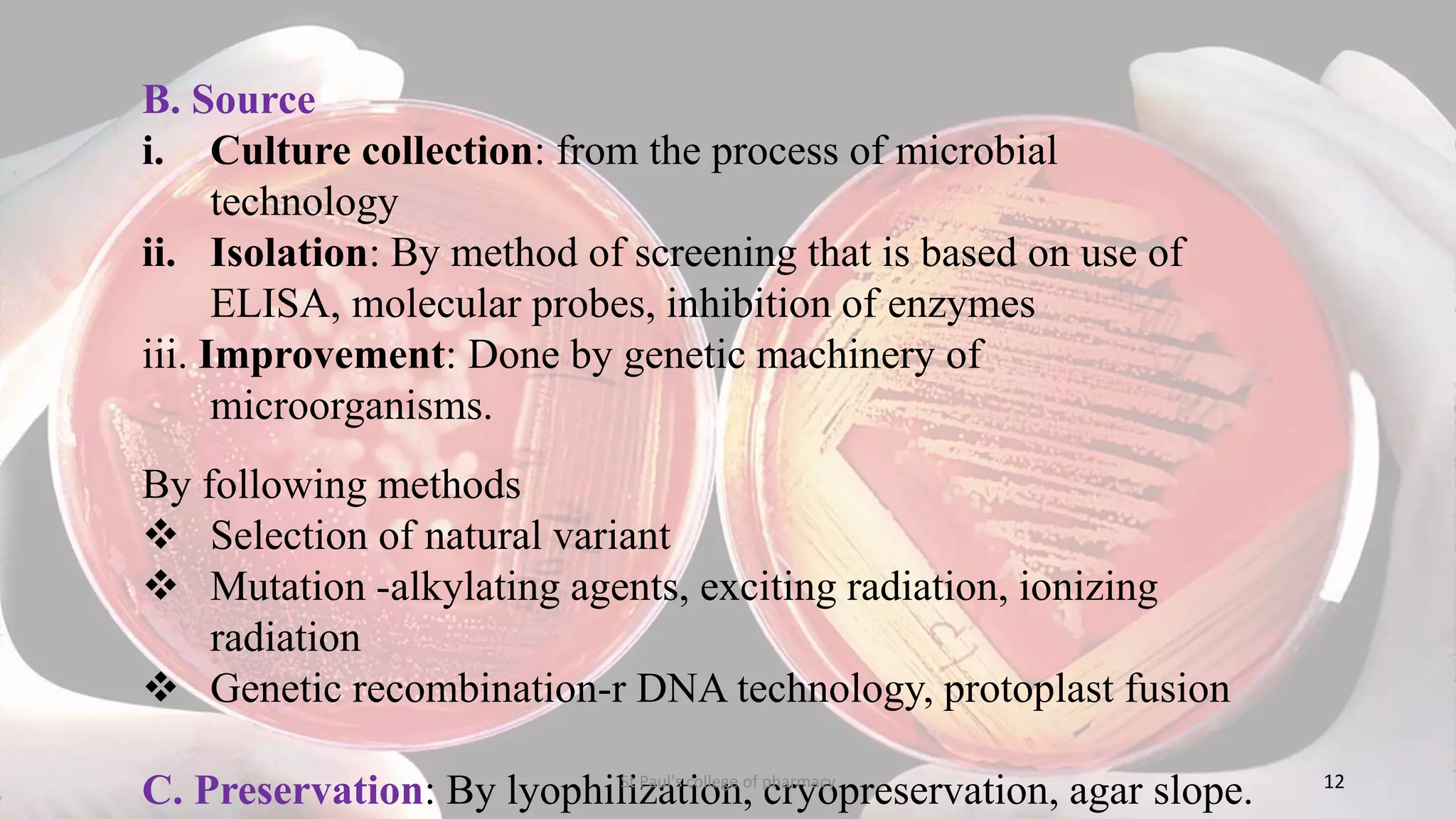
B. Source 
i. Culture collection: from the process of microbial 
technology 
ii. Isolation: By method of screening that is based on use of 
ELISA, molecular probes, inhibition of enzymes 
iii. Improvement: Done by genetic machinery of 
microorganisms. 
By following methods 
 Selection of natural variant 
 Mutation -alkylating agents, exciting radiation, ionizing 
radiation 
 Genetic recombination-r DNA technology, protoplast fusion 
C. Preservation: By lyophilization, cryopreservation, agar slope. St Paul's college of pharmacy 12
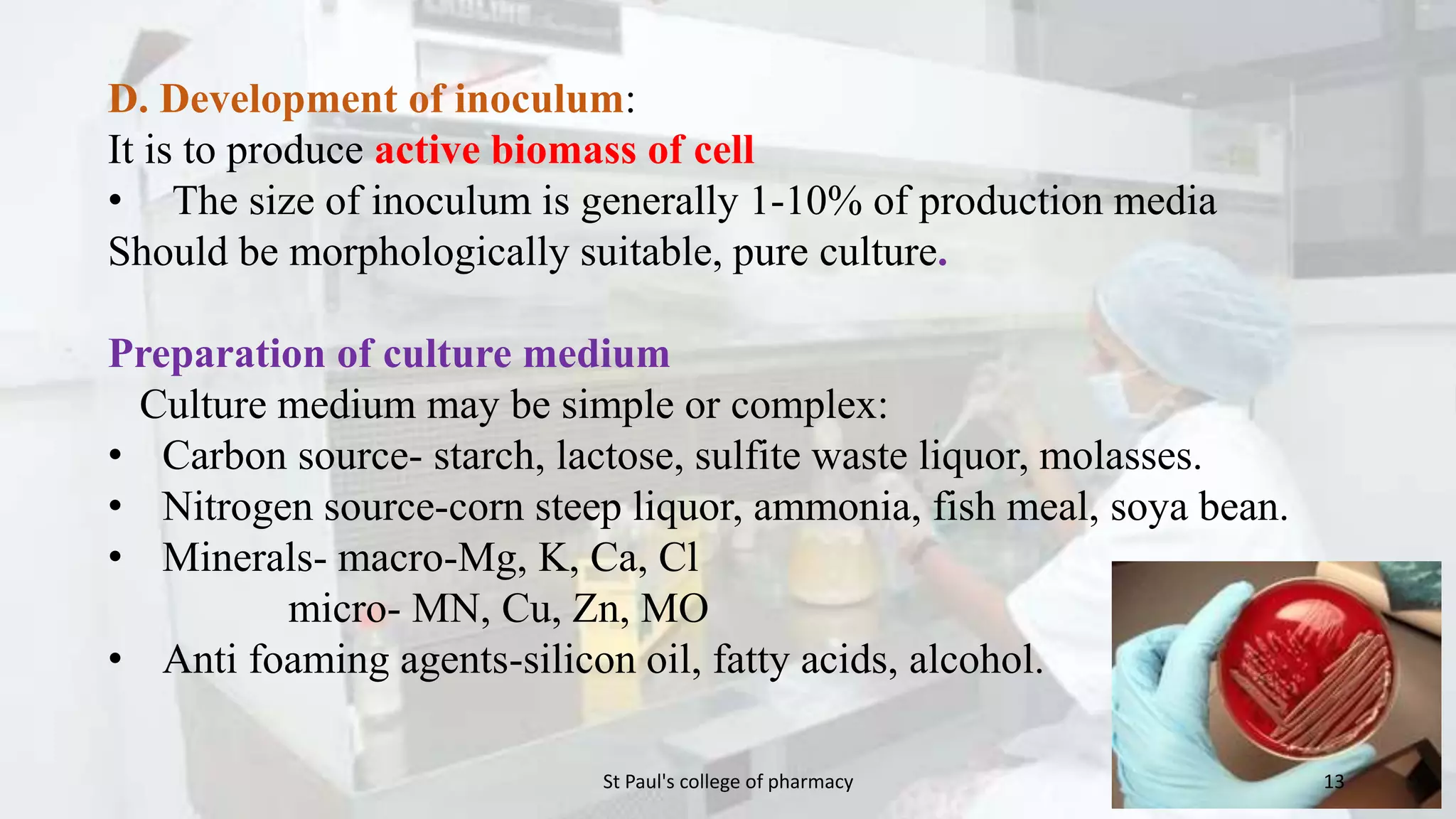
D. Development of inoculum: 
It is to produce active biomass of cell 
• The size of inoculum is generally 1-10% of production media 
Should be morphologically suitable, pure culture. 
Preparation of culture medium 
Culture medium may be simple or complex: 
• Carbon source- starch, lactose, sulfite waste liquor, molasses. 
• Nitrogen source-corn steep liquor, ammonia, fish meal, soya bean. 
• Minerals- macro-Mg, K, Ca, Cl 
micro- MN, Cu, Zn, MO 
• Anti foaming agents-silicon oil, fatty acids, alcohol. 
St Paul's college of pharmacy 13
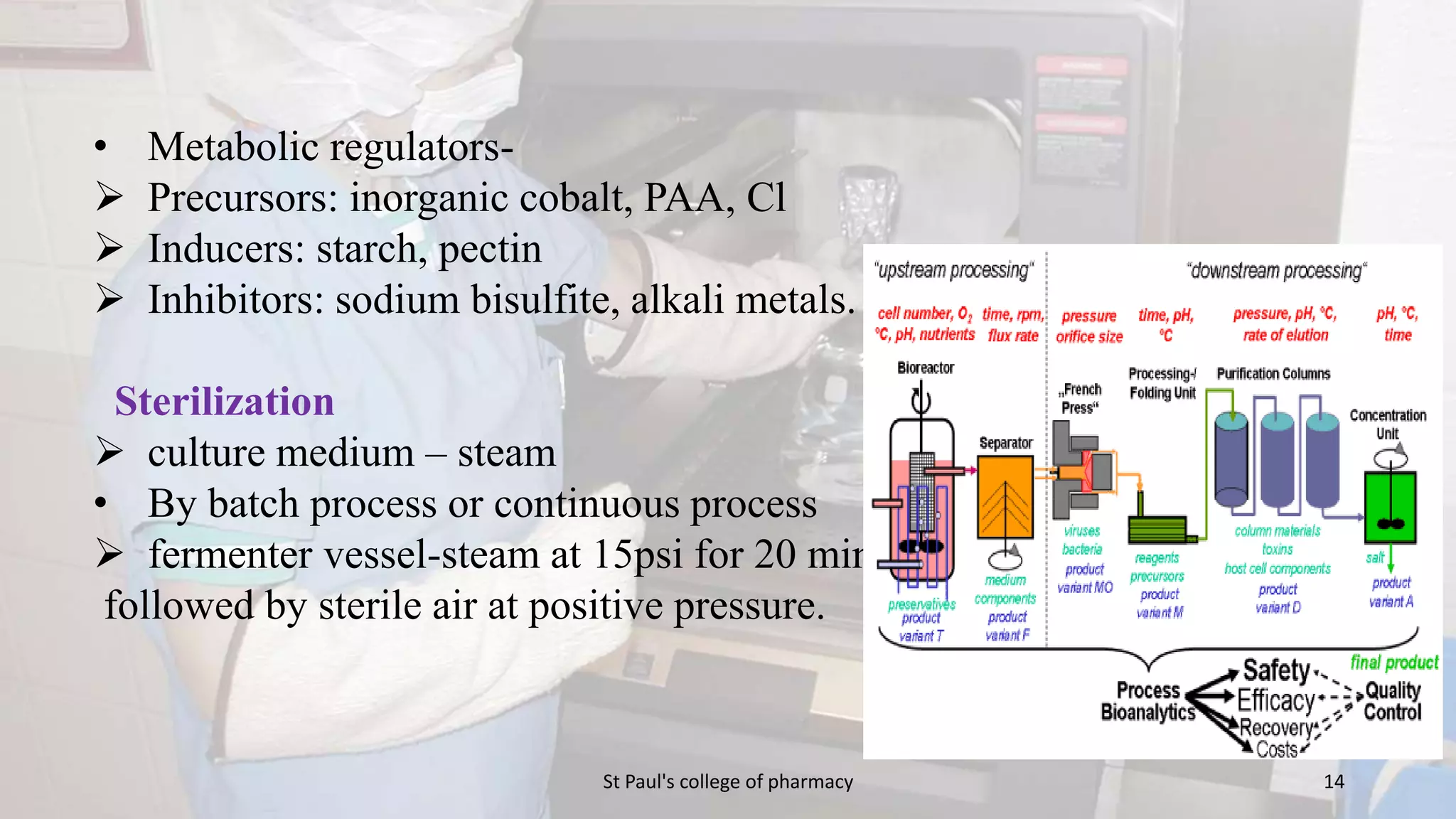
• Metabolic regulators- 
 Precursors: inorganic cobalt, PAA, Cl 
 Inducers: starch, pectin 
 Inhibitors: sodium bisulfite, alkali metals. 
Sterilization 
 culture medium – steam 
• By batch process or continuous process 
 fermenter vessel-steam at 15psi for 20 min 
followed by sterile air at positive pressure. 
St Paul's college of pharmacy 14
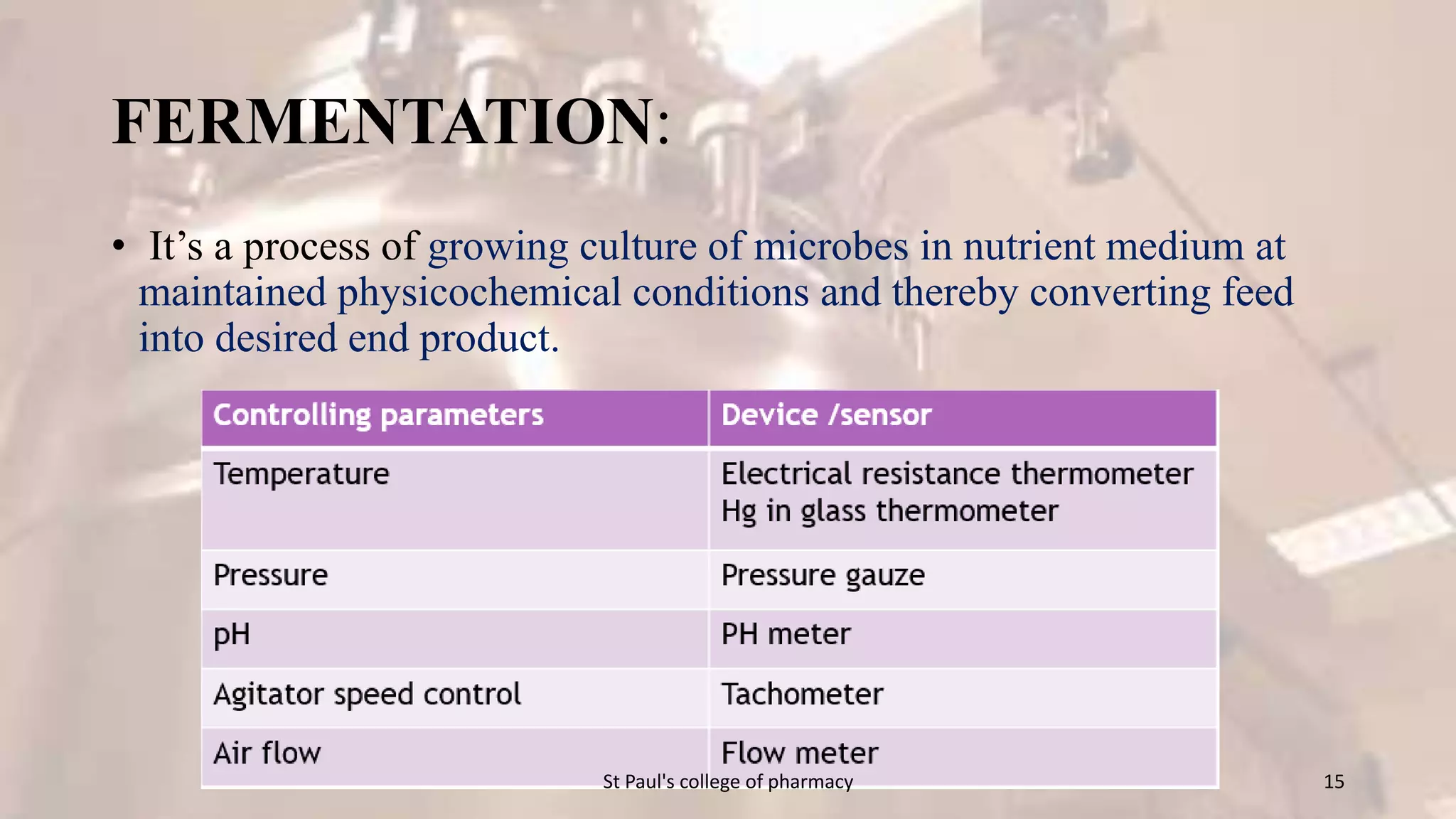
FERMENTATION: 
• It’s a process of growing culture of microbes in nutrient medium at 
maintained physicochemical conditions and thereby converting feed 
into desired end product. 
St Paul's college of pharmacy 15
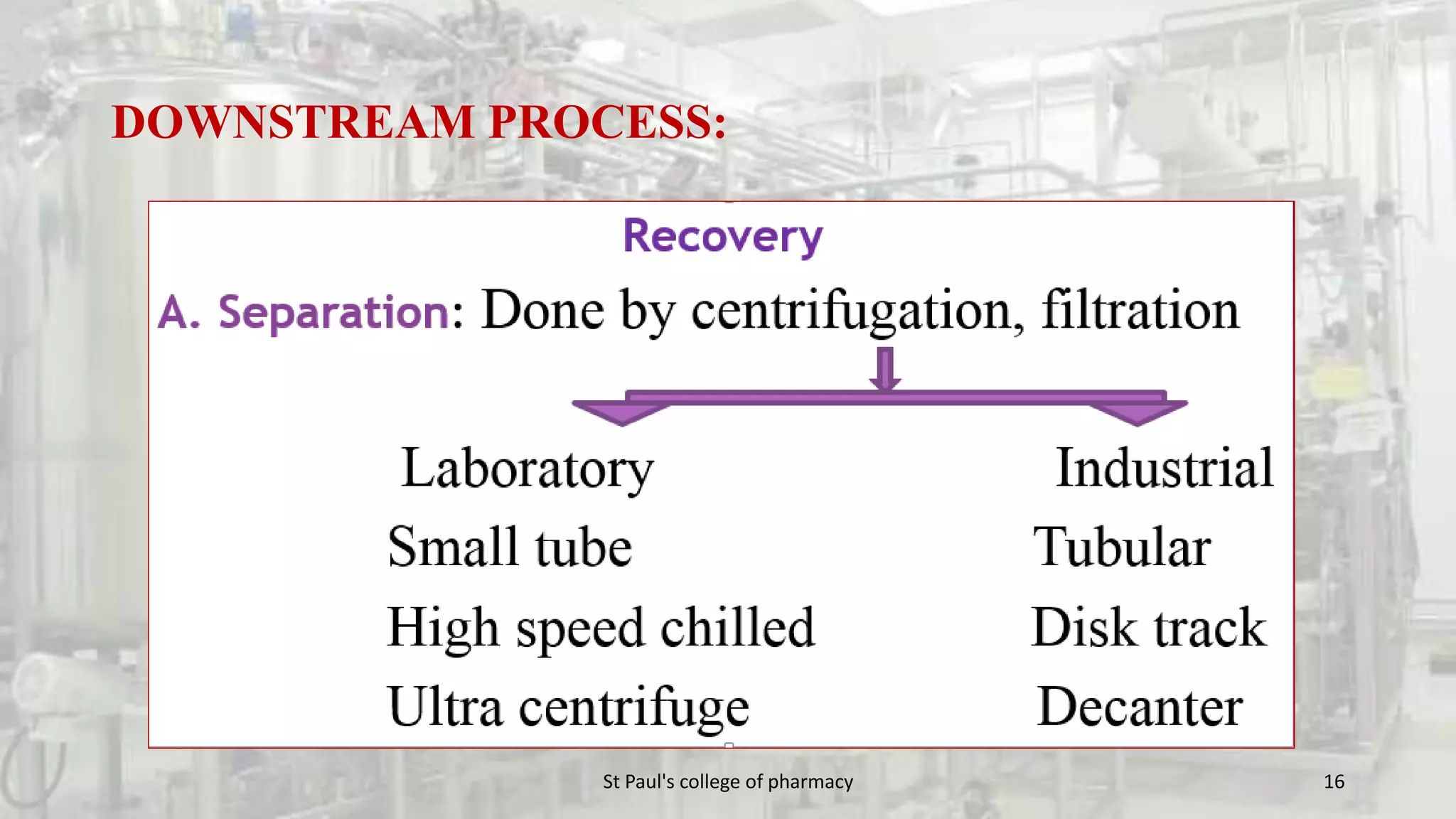
DOWNSTREAM PROCESS: 
St Paul's college of pharmacy 16
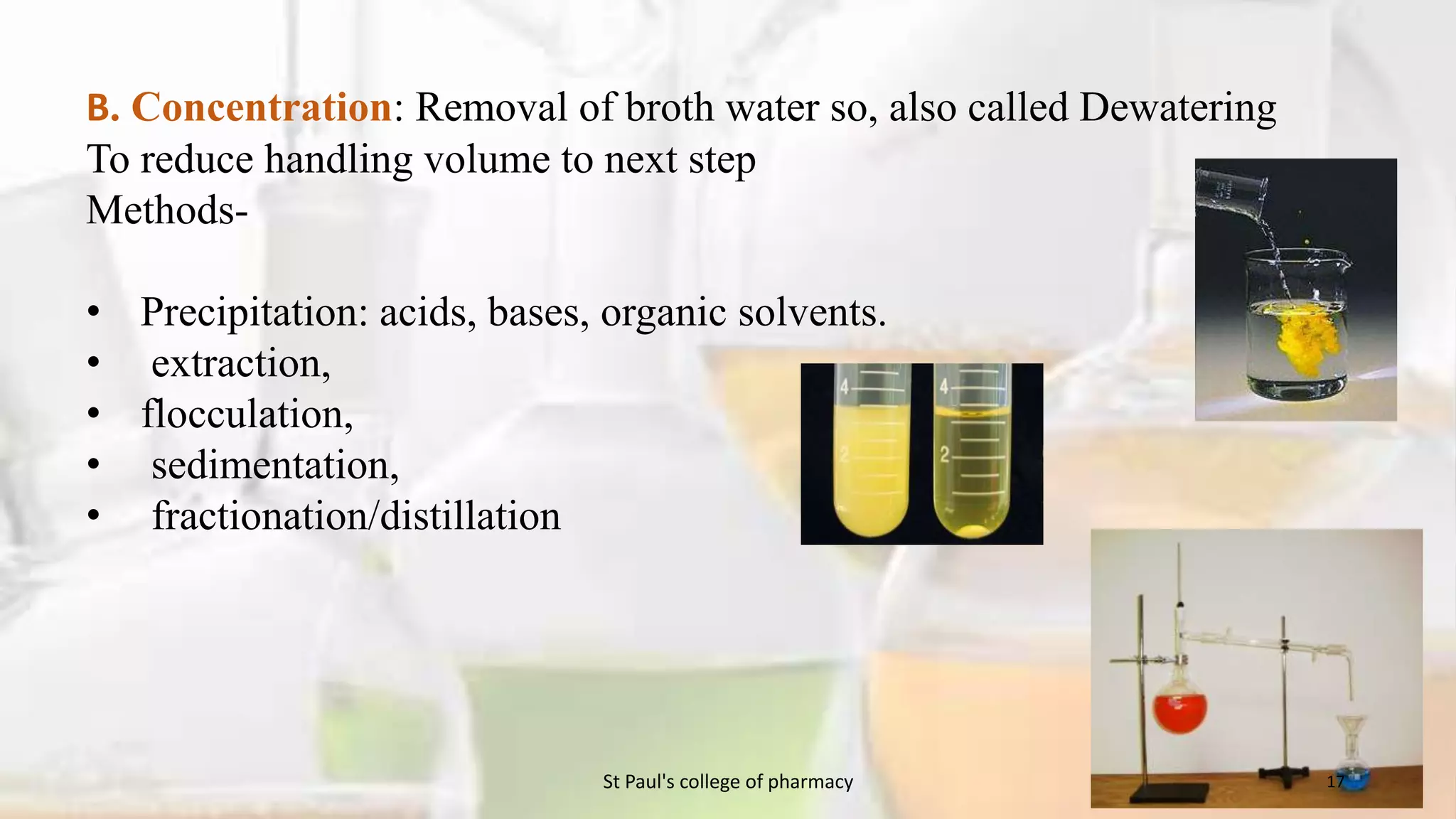
B. Concentration: Removal of broth water so, also called Dewatering 
To reduce handling volume to next step 
Methods- 
• Precipitation: acids, bases, organic solvents. 
• extraction, 
• flocculation, 
• sedimentation, 
• fractionation/distillation 
St Paul's college of pharmacy 17
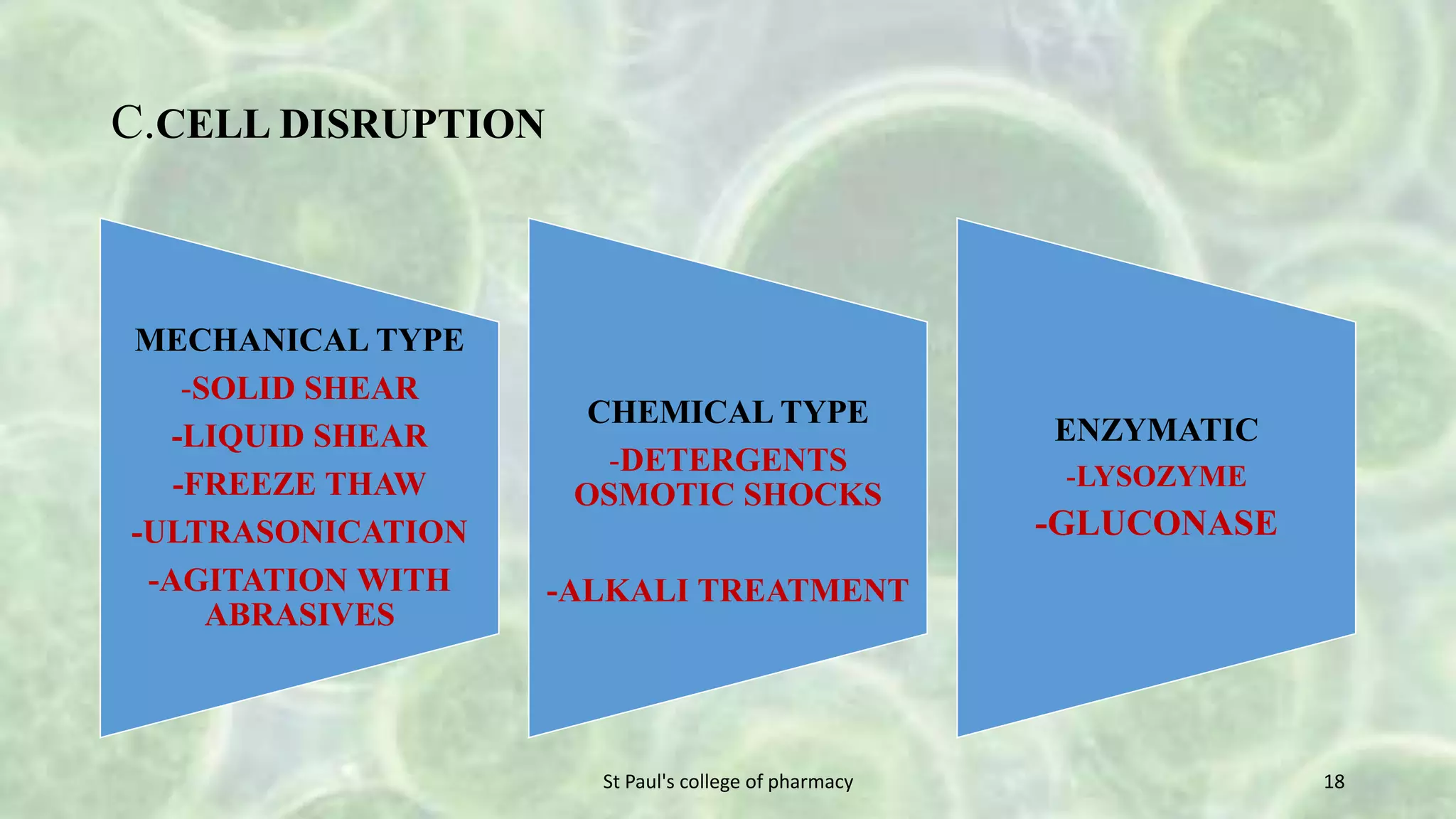
C.CELL DISRUPTION 
MECHANICAL TYPE 
-SOLID SHEAR 
-LIQUID SHEAR 
-FREEZE THAW 
-ULTRASONICATION 
-AGITATION WITH 
ABRASIVES 
CHEMICAL TYPE 
-DETERGENTS 
OSMOTIC SHOCKS 
-ALKALI TREATMENT 
ENZYMATIC 
-LYSOZYME 
-GLUCONASE 
St Paul's college of pharmacy 18
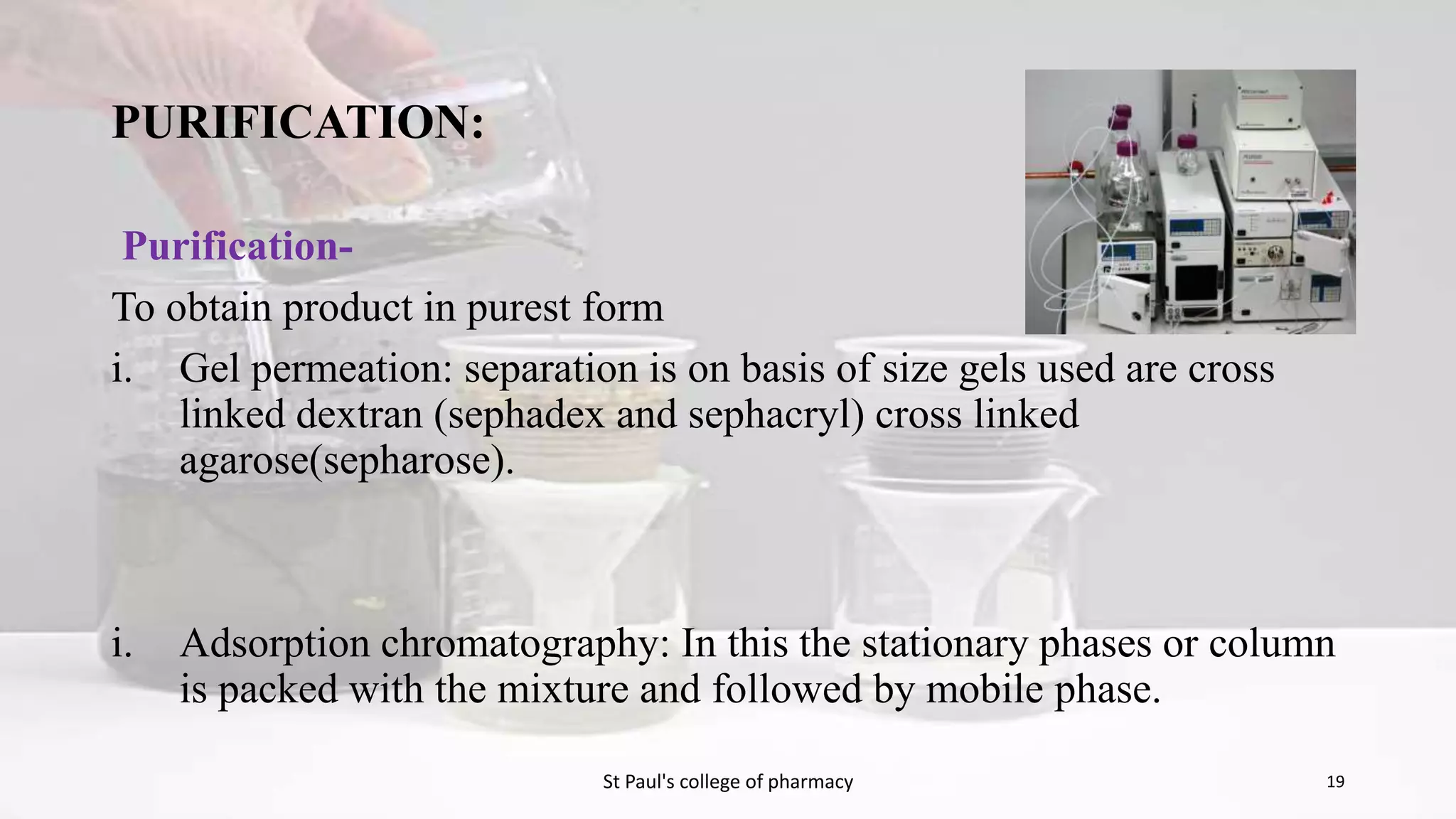
PURIFICATION: 
Purification- 
To obtain product in purest form 
i. Gel permeation: separation is on basis of size gels used are cross 
linked dextran (sephadex and sephacryl) cross linked 
agarose(sepharose). 
i. Adsorption chromatography: In this the stationary phases or column 
is packed with the mixture and followed by mobile phase. 
St Paul's college of pharmacy 19
FORMULATION AND EFFLUENT TREATMENT 
As solution, suspension, dry powders stabilizers are added. 
Eg-ammonium sulphate, sorbitol, glycerol, PEG. 
Methods for effluent treatment-a) 
Physical:- sedimentation, incineration of solid waste 
b) Chemical:- coagulation 
c) Microbiological:- bio filtration, oxidation by microbes. 
St Paul's college of pharmacy 20
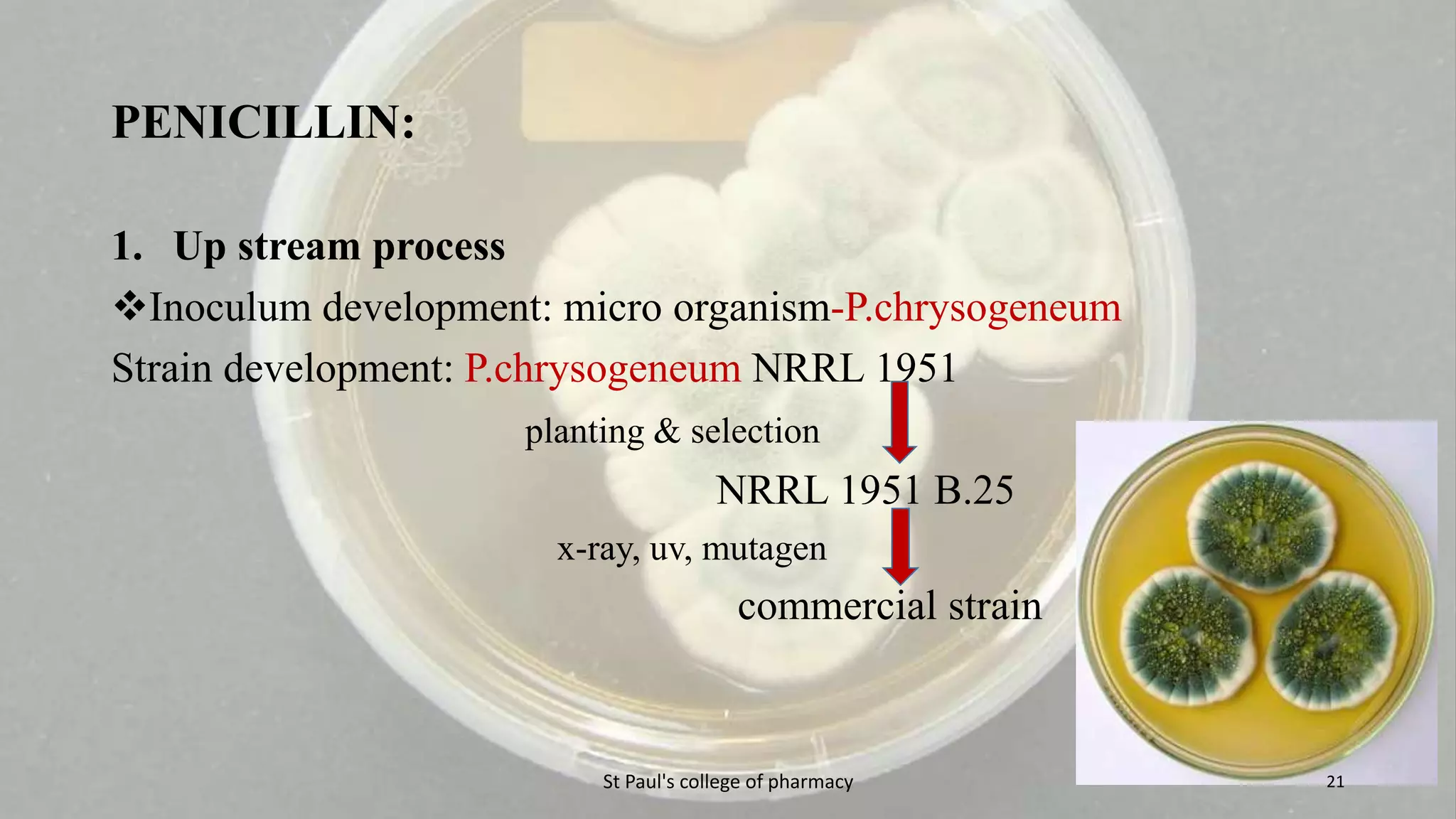
PENICILLIN: 
1. Up stream process 
Inoculum development: micro organism-P.chrysogeneum 
Strain development: P.chrysogeneum NRRL 1951 
planting & selection 
NRRL 1951 B.25 
x-ray, uv, mutagen 
commercial strain 
St Paul's college of pharmacy 21
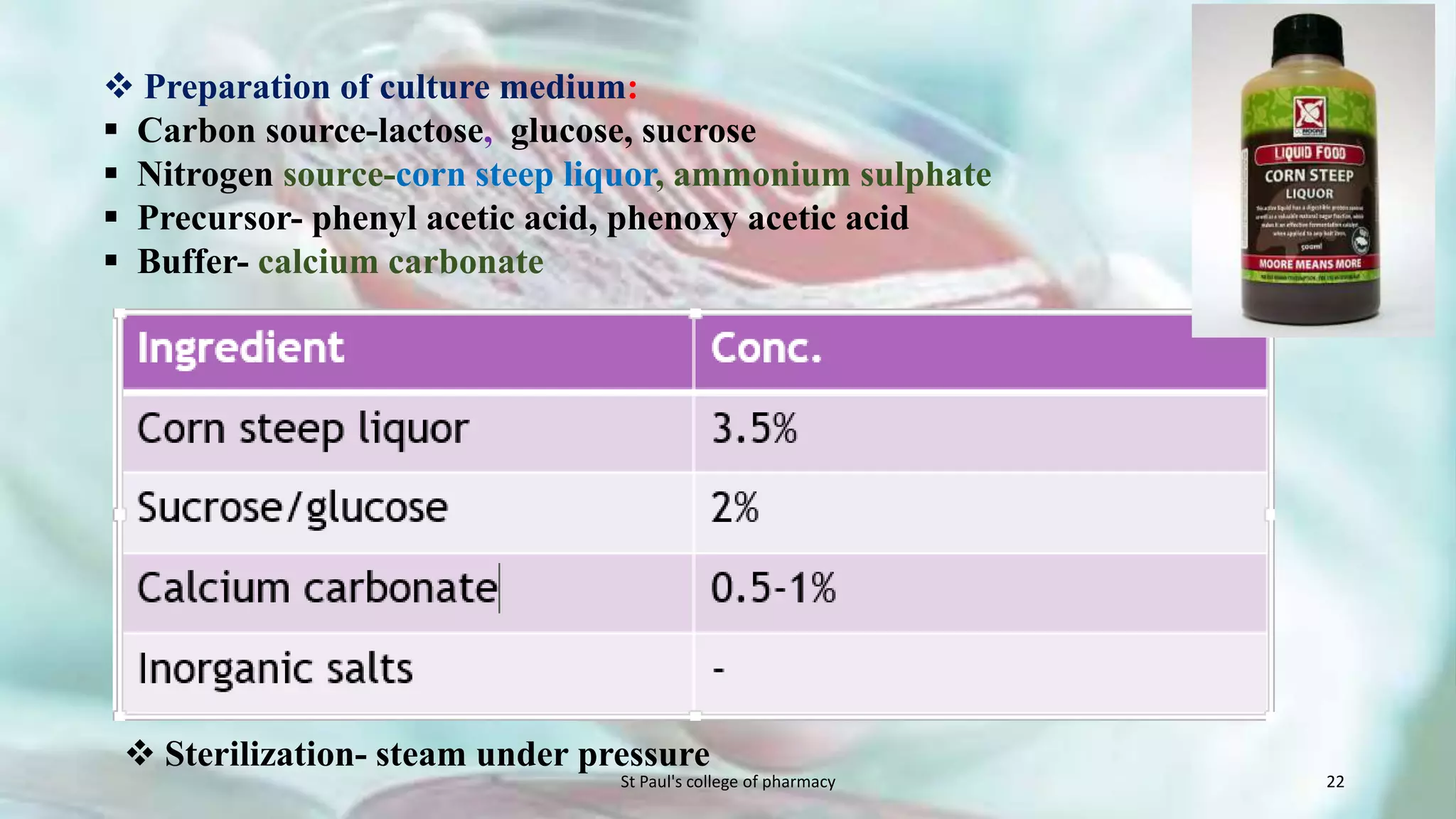
 Preparation of culture medium: 
 Carbon source-lactose, glucose, sucrose 
 Nitrogen source-corn steep liquor, ammonium sulphate 
 Precursor- phenyl acetic acid, phenoxy acetic acid 
 Buffer- calcium carbonate 
 Sterilization- steam under pressure 
St Paul's college of pharmacy 22
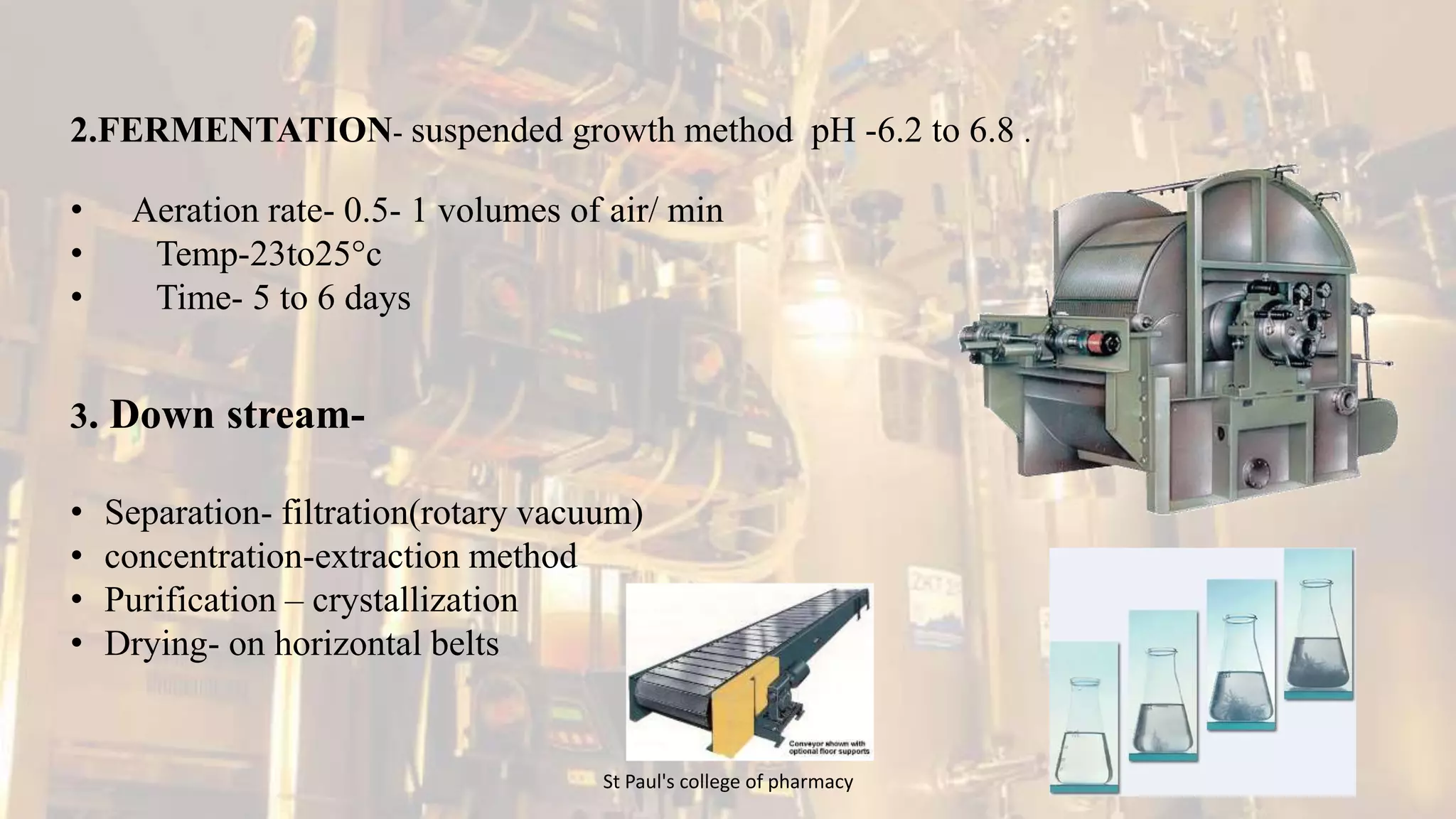
2.FERMENTATION- suspended growth method pH -6.2 to 6.8 . 
• Aeration rate- 0.5- 1 volumes of air/ min 
• Temp-23to25°c 
• Time- 5 to 6 days 
3. Down stream- 
• Separation- filtration(rotary vacuum) 
• concentration-extraction method 
• Purification – crystallization 
• Drying- on horizontal belts 
St Paul's college of pharmacy 23
CONCLUSION 
• This is a type of sequence process, that are involved in extraction, 
separation & purification to get a desired product. 
• Upstream & downstream process ensures the efficiency of finished 
product. 
• By upstream & downstream process a fine biopharmaceutical 
products are obtained by using of some microbial organisms 
through different steps involved in it. 
St Paul's college of pharmacy 24
REFERENCE:- 
 Formulations in pharmaceutical biotechnology Roshan Issarani, 
B.P.Nagori, Pharma book syndicate,2007, pgno:105-138 
 Pharmaceutical microbiology and biotechnology, Chanrakant R. 
Kokare, Nirali Prakashan, Aug ust2005,pgno: 24.1-24.24 
 Biotechnology and fermentation process, john I. D'Souza, Suresh G. 
Killdeer, Nirali Prakashan, October 2004, pgno:3.1-3.43 
 Principles of fermentation technology,P.F.Stanbury, A.Whitaker, 
S.J.Hall, Elsevier science, second edition, 2006pgno:302-304 
St Paul's college of pharmacy 25
St Paul's college of pharmacy 26

upstream & downstream process of antibiotics

  • 1.
    SEMINAR ON UPSTREAM& DOWNSTREAM PROCESSING OF ANTIBIOTICS,HORMONES,VACCINES. SUBMITTED BY K.ANIL KUMAR HT.NO-2565-13-889-009 (M.pharm 1st yr. IP) UNDER THE GUIDANCE OF Dr.BASU VENKATESWARA REDDY M.pharm, Ph.D. DEP. OF PHARMACEUTICS St. Pauls College of Pharmacy St Paul's college of pharmacy 1
  • 2.
    TOPIC-UPSTREAM & DOWNSTREAMPROCESSING OF ANTIBIOTICS,HORMONES,VACCINES CONTENTS: • Definitions • Stages and steps • Up stream process • Fermentation • Down stream process • Penicillin • References St Paul's college of pharmacy 2
  • 3.
    What do youmean by upstream & downstream process? The upstream processing in biotechnology involves identifying and extracting the raw materials. This forms the initial process of fermentation. Upstream process-it deals with the: • Inoculum preparation which includes screening or microorganisms and selection of suitable strain and genetic modification of the organism if needed. • Preparation of culture media having suitable growth parameters at laboratory scale • Scale up of the entire process. • Inoculation. St Paul's college of pharmacy 3
  • 4.
    Downstream process- Whenthe products are subjected to a series of processes including separation and purification which are collectively known as Downstream processing. It is also known as product recovery. Materials –upstream-finished products The downstream processing deals with: • Solid-liquid separation • Release of intracellular products • Concentration • Purification • Formulation St Paul's college of pharmacy 4
  • 5.
    Upstream & downstreamprocess of Antibiotics Hormones Vaccines St Paul's college of pharmacy 5
  • 6.
    Antibiotics:-it is achemical drug used to treat bacterial infections. A medicine (such as penicillin or its derivatives) that inhibits the growth of or destroys microorganisms. Originally, an antibiotic was a substance produced by one microorganism that selectively inhibits the growth of another. Eg: penicillin, streptomycin, etc. St Paul's college of pharmacy 6
  • 7.
    St Paul's collegeof pharmacy 7
  • 8.
    Hormones-A chemical substanceproduced in the body that controls and regulates the activity of certain cells or organs.  it act like messenger molecules in the body. It is carried out by blood. Hormones are essential for every activity of life, including the processes of digestion, metabolism, growth, reproduction, and mood control. Eg: thyroid hormone,insulin,GSH. St Paul's college of pharmacy 8
  • 9.
    Vaccines-A vaccine isa biological preparation that improves immunity to a particular disease. a preparation of killed microorganisms, living attenuated organisms, or living fully virulent organisms that is administered to produce or artificially increase immunity to a particular diseases.  Eg: Diphtheria vaccine, Polio vaccine, etc. St Paul's college of pharmacy 9
  • 10.
    Stages & steps: Upstream process. INNOCULUM DEVELOPM ENT Fermentation. Downstream process PREPARATI ON OF CULTURE MEDIA STERILISATION PRODUCT RECIVERY FORMULATION FORMULATION & EFFLUENT TREATMENT St Paul's college of pharmacy 10
  • 11.
    Upstream process:-inoculum development A. Characteristic's: The microorganisms must fulfill the industrial useful characteristics like: i. Carry out fermentation using cheaper medium ii. Genetic stability iii. High yield iv. Easy recovery of formed product. St Paul's college of pharmacy 11
  • 12.
    B. Source i.Culture collection: from the process of microbial technology ii. Isolation: By method of screening that is based on use of ELISA, molecular probes, inhibition of enzymes iii. Improvement: Done by genetic machinery of microorganisms. By following methods  Selection of natural variant  Mutation -alkylating agents, exciting radiation, ionizing radiation  Genetic recombination-r DNA technology, protoplast fusion C. Preservation: By lyophilization, cryopreservation, agar slope. St Paul's college of pharmacy 12
  • 13.
    D. Development ofinoculum: It is to produce active biomass of cell • The size of inoculum is generally 1-10% of production media Should be morphologically suitable, pure culture. Preparation of culture medium Culture medium may be simple or complex: • Carbon source- starch, lactose, sulfite waste liquor, molasses. • Nitrogen source-corn steep liquor, ammonia, fish meal, soya bean. • Minerals- macro-Mg, K, Ca, Cl micro- MN, Cu, Zn, MO • Anti foaming agents-silicon oil, fatty acids, alcohol. St Paul's college of pharmacy 13
  • 14.
    • Metabolic regulators-  Precursors: inorganic cobalt, PAA, Cl  Inducers: starch, pectin  Inhibitors: sodium bisulfite, alkali metals. Sterilization  culture medium – steam • By batch process or continuous process  fermenter vessel-steam at 15psi for 20 min followed by sterile air at positive pressure. St Paul's college of pharmacy 14
  • 15.
    FERMENTATION: • It’sa process of growing culture of microbes in nutrient medium at maintained physicochemical conditions and thereby converting feed into desired end product. St Paul's college of pharmacy 15
  • 16.
    DOWNSTREAM PROCESS: StPaul's college of pharmacy 16
  • 17.
    B. Concentration: Removalof broth water so, also called Dewatering To reduce handling volume to next step Methods- • Precipitation: acids, bases, organic solvents. • extraction, • flocculation, • sedimentation, • fractionation/distillation St Paul's college of pharmacy 17
  • 18.
    C.CELL DISRUPTION MECHANICALTYPE -SOLID SHEAR -LIQUID SHEAR -FREEZE THAW -ULTRASONICATION -AGITATION WITH ABRASIVES CHEMICAL TYPE -DETERGENTS OSMOTIC SHOCKS -ALKALI TREATMENT ENZYMATIC -LYSOZYME -GLUCONASE St Paul's college of pharmacy 18
  • 19.
    PURIFICATION: Purification- Toobtain product in purest form i. Gel permeation: separation is on basis of size gels used are cross linked dextran (sephadex and sephacryl) cross linked agarose(sepharose). i. Adsorption chromatography: In this the stationary phases or column is packed with the mixture and followed by mobile phase. St Paul's college of pharmacy 19
  • 20.
    FORMULATION AND EFFLUENTTREATMENT As solution, suspension, dry powders stabilizers are added. Eg-ammonium sulphate, sorbitol, glycerol, PEG. Methods for effluent treatment-a) Physical:- sedimentation, incineration of solid waste b) Chemical:- coagulation c) Microbiological:- bio filtration, oxidation by microbes. St Paul's college of pharmacy 20
  • 21.
    PENICILLIN: 1. Upstream process Inoculum development: micro organism-P.chrysogeneum Strain development: P.chrysogeneum NRRL 1951 planting & selection NRRL 1951 B.25 x-ray, uv, mutagen commercial strain St Paul's college of pharmacy 21
  • 22.
     Preparation ofculture medium:  Carbon source-lactose, glucose, sucrose  Nitrogen source-corn steep liquor, ammonium sulphate  Precursor- phenyl acetic acid, phenoxy acetic acid  Buffer- calcium carbonate  Sterilization- steam under pressure St Paul's college of pharmacy 22
  • 23.
    2.FERMENTATION- suspended growthmethod pH -6.2 to 6.8 . • Aeration rate- 0.5- 1 volumes of air/ min • Temp-23to25°c • Time- 5 to 6 days 3. Down stream- • Separation- filtration(rotary vacuum) • concentration-extraction method • Purification – crystallization • Drying- on horizontal belts St Paul's college of pharmacy 23
  • 24.
    CONCLUSION • Thisis a type of sequence process, that are involved in extraction, separation & purification to get a desired product. • Upstream & downstream process ensures the efficiency of finished product. • By upstream & downstream process a fine biopharmaceutical products are obtained by using of some microbial organisms through different steps involved in it. St Paul's college of pharmacy 24
  • 25.
    REFERENCE:-  Formulationsin pharmaceutical biotechnology Roshan Issarani, B.P.Nagori, Pharma book syndicate,2007, pgno:105-138  Pharmaceutical microbiology and biotechnology, Chanrakant R. Kokare, Nirali Prakashan, Aug ust2005,pgno: 24.1-24.24  Biotechnology and fermentation process, john I. D'Souza, Suresh G. Killdeer, Nirali Prakashan, October 2004, pgno:3.1-3.43  Principles of fermentation technology,P.F.Stanbury, A.Whitaker, S.J.Hall, Elsevier science, second edition, 2006pgno:302-304 St Paul's college of pharmacy 25
  • 26.
    St Paul's collegeof pharmacy 26