Agarose Gel
Electrophoresis
PRESENTED BY:-
AVINASH SHARMA
PALB-3235
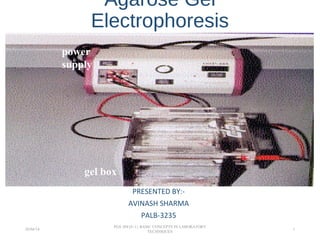
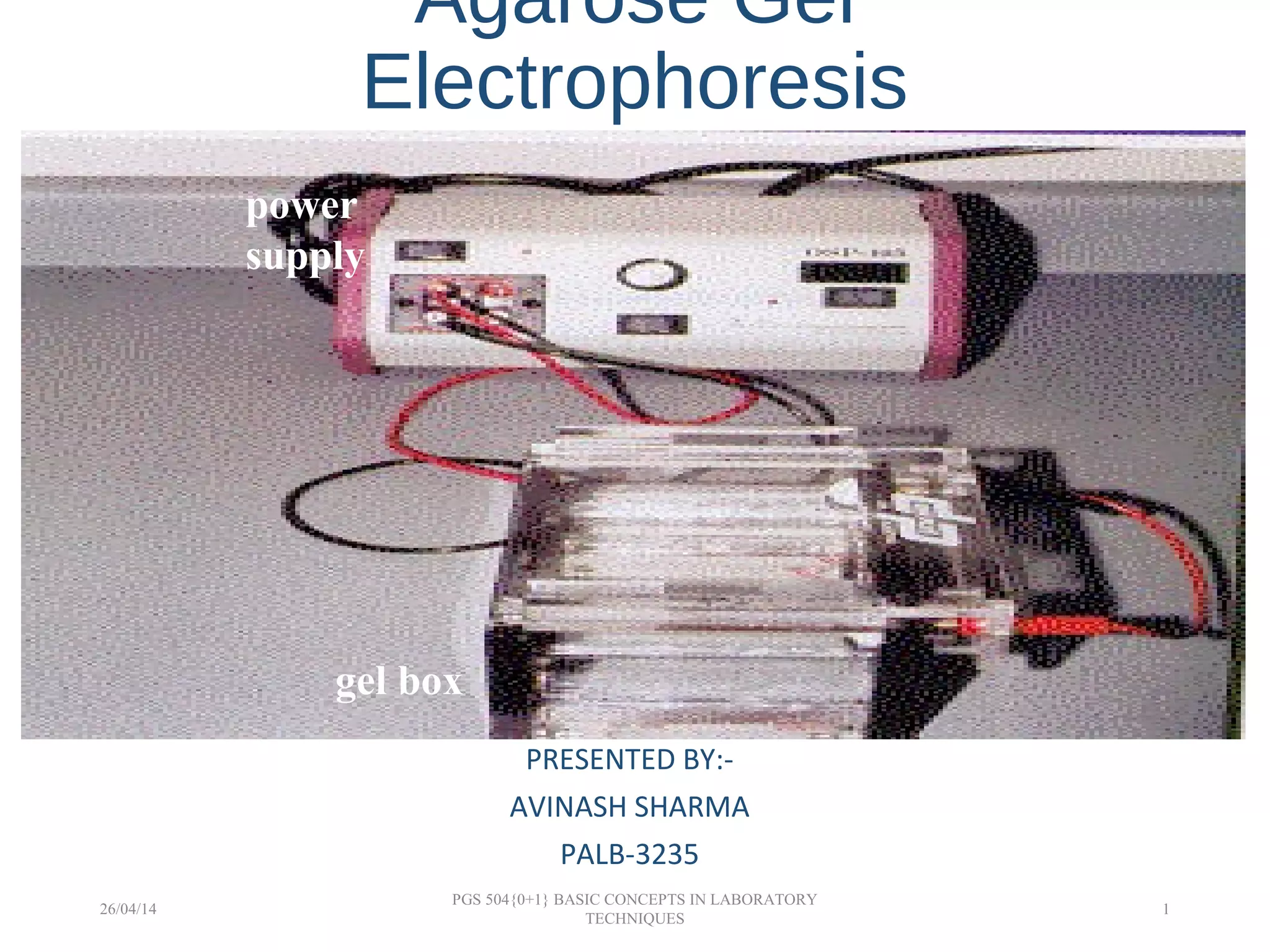
power
supply
gel box
26/04/14
PGS 504{0+1} BASIC CONCEPTS IN LABORATORY
TECHNIQUES
1
Contents:-
Definition of agarose gel electophoresis
Procedure of agarose gel electrophoresis
Application of gel electrophoresis
Problem in agarose gel electrophoresis
26/04/14
PGS 504{0+1} BASIC CONCEPTS IN LABORATORY
TECHNIQUES
2
What is agarose?
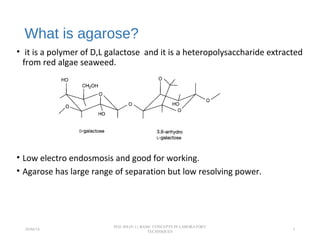
• it is a polymer of D,L galactose and it is a heteropolysaccharide extracted
from red algae seaweed.
• Low electro endosmosis and good for working.
• Agarose has large range of separation but low resolving power.
26/04/14
PGS 504{0+1} BASIC CONCEPTS IN LABORATORY
TECHNIQUES
3
Agarose Gel Electrophoresis
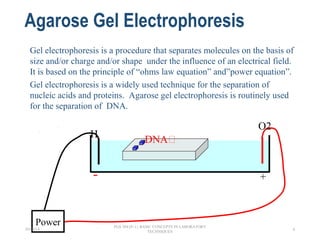
Gel electrophoresis is a procedure that separates molecules on the basis of
size and/or charge and/or shape under the influence of an electrical field.
It is based on the principle of “ohms law equation” and”power equation”.
Gel electrophoresis is a widely used technique for the separation of
nucleic acids and proteins. Agarose gel electrophoresis is routinely used
for the separation of DNA.
e will be using agarose gel electrophoresis to
determine the presence and size of PCR
products. +-
Power
DNA
H
O2
+
26/04/14
PGS 504{0+1} BASIC CONCEPTS IN LABORATORY
TECHNIQUES
4
Procedures of agarose gel electrophoresis:-
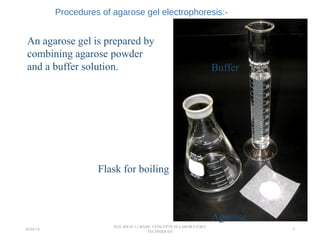
An agarose gel is prepared by
combining agarose powder
and a buffer solution.
Agarose
Buffer
Flask for boiling
26/04/14
PGS 504{0+1} BASIC CONCEPTS IN LABORATORY
TECHNIQUES
5
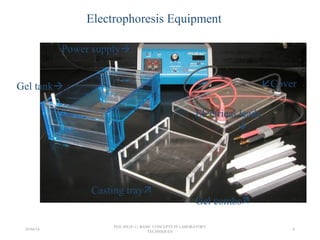
Casting tray
Gel combs
Power supply
Gel tank Cover
Electrical leads

Electrophoresis Equipment
26/04/14
PGS 504{0+1} BASIC CONCEPTS IN LABORATORY
TECHNIQUES
6
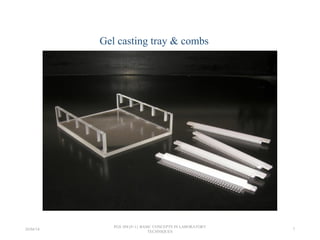
Gel casting tray & combs
26/04/14
PGS 504{0+1} BASIC CONCEPTS IN LABORATORY
TECHNIQUES
7
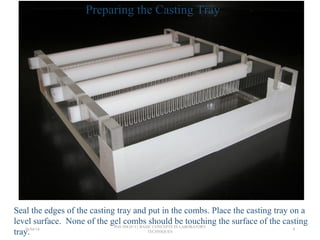
Seal the edges of the casting tray and put in the combs. Place the casting tray on a
level surface. None of the gel combs should be touching the surface of the casting
tray.
Preparing the Casting Tray
26/04/14
PGS 504{0+1} BASIC CONCEPTS IN LABORATORY
TECHNIQUES
8
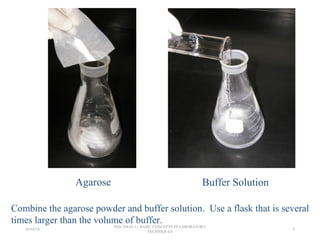
Agarose Buffer Solution
Combine the agarose powder and buffer solution. Use a flask that is several
times larger than the volume of buffer.
26/04/14
PGS 504{0+1} BASIC CONCEPTS IN LABORATORY
TECHNIQUES
9
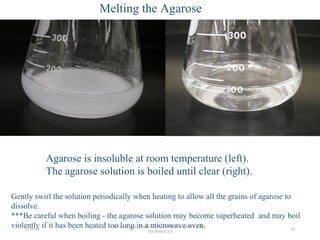
Agarose is insoluble at room temperature (left).
The agarose solution is boiled until clear (right).
Gently swirl the solution periodically when heating to allow all the grains of agarose to
dissolve.
***Be careful when boiling - the agarose solution may become superheated and may boil
violently if it has been heated too long in a microwave oven.
Melting the Agarose
26/04/14
PGS 504{0+1} BASIC CONCEPTS IN LABORATORY
TECHNIQUES
10
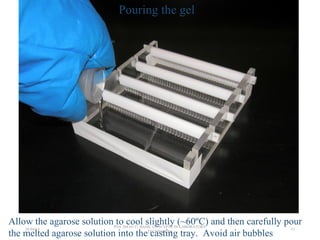
Allow the agarose solution to cool slightly (~60ºC) and then carefully pour
the melted agarose solution into the casting tray. Avoid air bubbles.
Pouring the gel
26/04/14
PGS 504{0+1} BASIC CONCEPTS IN LABORATORY
TECHNIQUES
11
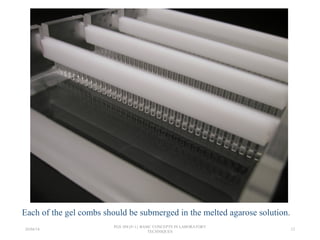
Each of the gel combs should be submerged in the melted agarose solution.
26/04/14
PGS 504{0+1} BASIC CONCEPTS IN LABORATORY
TECHNIQUES
12
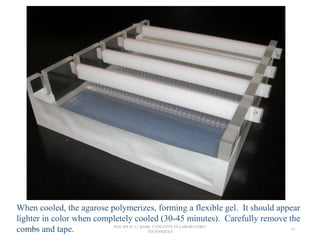
When cooled, the agarose polymerizes, forming a flexible gel. It should appear
lighter in color when completely cooled (30-45 minutes). Carefully remove the
combs and tape.26/04/14
PGS 504{0+1} BASIC CONCEPTS IN LABORATORY
TECHNIQUES
13
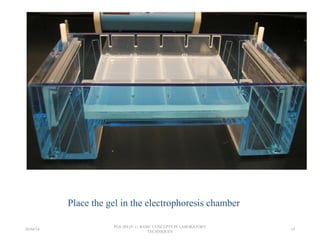
Place the gel in the electrophoresis chamber.
26/04/14
PGS 504{0+1} BASIC CONCEPTS IN LABORATORY
TECHNIQUES
14
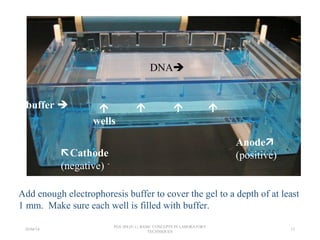
buffer 
Add enough electrophoresis buffer to cover the gel to a depth of at least
1 mm. Make sure each well is filled with buffer.
Cathode
(negative)
Anode
(positive)

wells
  
DNA
26/04/14
PGS 504{0+1} BASIC CONCEPTS IN LABORATORY
TECHNIQUES
15
Loading Buffer: 
• Bromophenol Blue (for color)
• Glycerol (for weight)
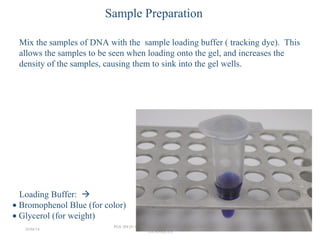
Sample Preparation
Mix the samples of DNA with the sample loading buffer ( tracking dye). This
allows the samples to be seen when loading onto the gel, and increases the
density of the samples, causing them to sink into the gel wells.
26/04/14
PGS 504{0+1} BASIC CONCEPTS IN LABORATORY
TECHNIQUES
16
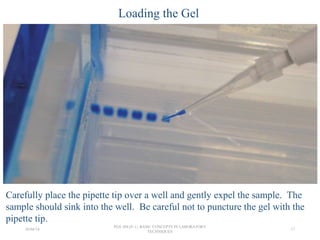
Loading the Gel
Carefully place the pipette tip over a well and gently expel the sample. The
sample should sink into the well. Be careful not to puncture the gel with the
pipette tip.
26/04/14
PGS 504{0+1} BASIC CONCEPTS IN LABORATORY
TECHNIQUES
17
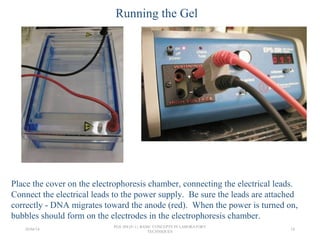
Place the cover on the electrophoresis chamber, connecting the electrical leads.
Connect the electrical leads to the power supply. Be sure the leads are attached
correctly - DNA migrates toward the anode (red). When the power is turned on,
bubbles should form on the electrodes in the electrophoresis chamber.
Running the Gel
26/04/14
PGS 504{0+1} BASIC CONCEPTS IN LABORATORY
TECHNIQUES
18
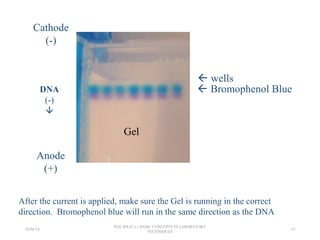
 wells
 Bromophenol Blue
Cathode
(-)
Anode
(+)
Gel
After the current is applied, make sure the Gel is running in the correct
direction. Bromophenol blue will run in the same direction as the DNA.
DNA
(-)

26/04/14
PGS 504{0+1} BASIC CONCEPTS IN LABORATORY
TECHNIQUES
19
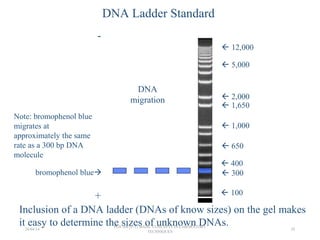
 100
 200
 300
 1,650
 1,000
 500
 850
 650
 400
 12,000 bp
 5,000
 2,000
DNA Ladder Standard
Inclusion of a DNA ladder (DNAs of know sizes) on the gel makes
it easy to determine the sizes of unknown DNAs.
-
+
DNA
migration
bromophenol blue
Note: bromophenol blue
migrates at
approximately the same
rate as a 300 bp DNA
molecule
26/04/14
PGS 504{0+1} BASIC CONCEPTS IN LABORATORY
TECHNIQUES
20
Staining the Gel
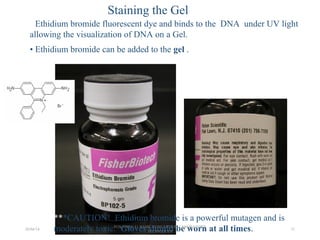
***CAUTION! Ethidium bromide is a powerful mutagen and is
moderately toxic. Gloves should be worn at all times.
• Ethidium bromide fluorescent dye and binds to the DNA under UV light
allowing the visualization of DNA on a Gel.
• Ethidium bromide can be added to the gel .
26/04/14
PGS 504{0+1} BASIC CONCEPTS IN LABORATORY
TECHNIQUES
21
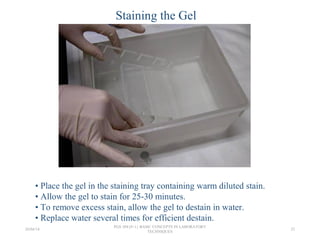
Staining the Gel
• Place the gel in the staining tray containing warm diluted stain.
• Allow the gel to stain for 25-30 minutes.
• To remove excess stain, allow the gel to destain in water.
• Replace water several times for efficient destain.
26/04/14
PGS 504{0+1} BASIC CONCEPTS IN LABORATORY
TECHNIQUES
22
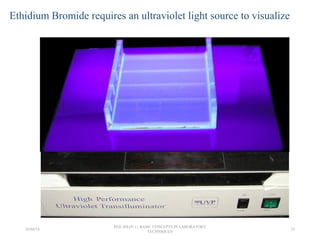
Ethidium Bromide requires an ultraviolet light source to visualize
26/04/14
PGS 504{0+1} BASIC CONCEPTS IN LABORATORY
TECHNIQUES
23
Factors affecting the DNA in gel
elctrophoresis:-
• Agarose concentration:-
↑ conc. Of agarose then migration larger fragments of dna and vice versa so for
larger fragments of dna agarose conc.=0.7% and smaller fragments of dna
agarose conc.=1.5%.
• Voltage:-
Voltage increases then migration of larger fragments of dna will be more than
the smaller dna.so voltage should not be more than 5volts/cm.
• Electrophoresis buffer:-
TAE and TBE buffers are used in the gel electrophoresis because it establish
the pH8.0 and provide ions for the migration of dna and ionic strength are
different.
• Effects of ethidium bromide:-
It is a carcinogenic mutagen and fluorescent dye which are used in the
visualizing the dna when agarose gel are placed in the UV transilluminator
then dye are free in the gel then dye binds with dna then it produce
orange light for visualizing the dna.
26/04/14
PGS 504{0+1} BASIC CONCEPTS IN LABORATORY
TECHNIQUES
24
Application of electrophoresis
• To separate fragments from each other
• To determine the sizes of fragments
• To determine the presence or amount of DNA
• To analyze restriction digestion products prior to southern transfer or
of RNA prior to northern transfer.
• Analysis of PCR product.
26/04/14
PGS 504{0+1} BASIC CONCEPTS IN LABORATORY
TECHNIQUES
25
Proplems in agarose gel electrophoresis:-
• Smearing
•voltage too high for large fragments
•too much DNA
• Gel melts
•voltage too high
•ionic strength too low
• Poor resolution
•wrong [agarose]
•small bands are fuzzy – the gel run may have been too long at too low
a voltage, allowing diffusion of the DNA and broadening of the band
26/04/14
PGS 504{0+1} BASIC CONCEPTS IN LABORATORY
TECHNIQUES
26
26/04/14
PGS 504{0+1} BASIC CONCEPTS IN LABORATORY
TECHNIQUES
27
Thank you for your attention

A. gel electrophoresis

  • 1.
    Agarose Gel Electrophoresis PRESENTED BY:- AVINASHSHARMA PALB-3235 power supply gel box 26/04/14 PGS 504{0+1} BASIC CONCEPTS IN LABORATORY TECHNIQUES 1
  • 2.
    Contents:- Definition of agarosegel electophoresis Procedure of agarose gel electrophoresis Application of gel electrophoresis Problem in agarose gel electrophoresis 26/04/14 PGS 504{0+1} BASIC CONCEPTS IN LABORATORY TECHNIQUES 2
  • 3.
    What is agarose? •it is a polymer of D,L galactose and it is a heteropolysaccharide extracted from red algae seaweed. • Low electro endosmosis and good for working. • Agarose has large range of separation but low resolving power. 26/04/14 PGS 504{0+1} BASIC CONCEPTS IN LABORATORY TECHNIQUES 3
  • 4.
    Agarose Gel Electrophoresis Gelelectrophoresis is a procedure that separates molecules on the basis of size and/or charge and/or shape under the influence of an electrical field. It is based on the principle of “ohms law equation” and”power equation”. Gel electrophoresis is a widely used technique for the separation of nucleic acids and proteins. Agarose gel electrophoresis is routinely used for the separation of DNA. e will be using agarose gel electrophoresis to determine the presence and size of PCR products. +- Power DNA H O2 + 26/04/14 PGS 504{0+1} BASIC CONCEPTS IN LABORATORY TECHNIQUES 4
  • 5.
    Procedures of agarosegel electrophoresis:- An agarose gel is prepared by combining agarose powder and a buffer solution. Agarose Buffer Flask for boiling 26/04/14 PGS 504{0+1} BASIC CONCEPTS IN LABORATORY TECHNIQUES 5
  • 6.
    Casting tray Gel combs Powersupply Gel tank Cover Electrical leads  Electrophoresis Equipment 26/04/14 PGS 504{0+1} BASIC CONCEPTS IN LABORATORY TECHNIQUES 6
  • 7.
    Gel casting tray& combs 26/04/14 PGS 504{0+1} BASIC CONCEPTS IN LABORATORY TECHNIQUES 7
  • 8.
    Seal the edgesof the casting tray and put in the combs. Place the casting tray on a level surface. None of the gel combs should be touching the surface of the casting tray. Preparing the Casting Tray 26/04/14 PGS 504{0+1} BASIC CONCEPTS IN LABORATORY TECHNIQUES 8
  • 9.
    Agarose Buffer Solution Combinethe agarose powder and buffer solution. Use a flask that is several times larger than the volume of buffer. 26/04/14 PGS 504{0+1} BASIC CONCEPTS IN LABORATORY TECHNIQUES 9
  • 10.
    Agarose is insolubleat room temperature (left). The agarose solution is boiled until clear (right). Gently swirl the solution periodically when heating to allow all the grains of agarose to dissolve. ***Be careful when boiling - the agarose solution may become superheated and may boil violently if it has been heated too long in a microwave oven. Melting the Agarose 26/04/14 PGS 504{0+1} BASIC CONCEPTS IN LABORATORY TECHNIQUES 10
  • 11.
    Allow the agarosesolution to cool slightly (~60ºC) and then carefully pour the melted agarose solution into the casting tray. Avoid air bubbles. Pouring the gel 26/04/14 PGS 504{0+1} BASIC CONCEPTS IN LABORATORY TECHNIQUES 11
  • 12.
    Each of thegel combs should be submerged in the melted agarose solution. 26/04/14 PGS 504{0+1} BASIC CONCEPTS IN LABORATORY TECHNIQUES 12
  • 13.
    When cooled, theagarose polymerizes, forming a flexible gel. It should appear lighter in color when completely cooled (30-45 minutes). Carefully remove the combs and tape.26/04/14 PGS 504{0+1} BASIC CONCEPTS IN LABORATORY TECHNIQUES 13
  • 14.
    Place the gelin the electrophoresis chamber. 26/04/14 PGS 504{0+1} BASIC CONCEPTS IN LABORATORY TECHNIQUES 14
  • 15.
    buffer  Add enoughelectrophoresis buffer to cover the gel to a depth of at least 1 mm. Make sure each well is filled with buffer. Cathode (negative) Anode (positive)  wells    DNA 26/04/14 PGS 504{0+1} BASIC CONCEPTS IN LABORATORY TECHNIQUES 15
  • 16.
    Loading Buffer:  •Bromophenol Blue (for color) • Glycerol (for weight) Sample Preparation Mix the samples of DNA with the sample loading buffer ( tracking dye). This allows the samples to be seen when loading onto the gel, and increases the density of the samples, causing them to sink into the gel wells. 26/04/14 PGS 504{0+1} BASIC CONCEPTS IN LABORATORY TECHNIQUES 16
  • 17.
    Loading the Gel Carefullyplace the pipette tip over a well and gently expel the sample. The sample should sink into the well. Be careful not to puncture the gel with the pipette tip. 26/04/14 PGS 504{0+1} BASIC CONCEPTS IN LABORATORY TECHNIQUES 17
  • 18.
    Place the coveron the electrophoresis chamber, connecting the electrical leads. Connect the electrical leads to the power supply. Be sure the leads are attached correctly - DNA migrates toward the anode (red). When the power is turned on, bubbles should form on the electrodes in the electrophoresis chamber. Running the Gel 26/04/14 PGS 504{0+1} BASIC CONCEPTS IN LABORATORY TECHNIQUES 18
  • 19.
     wells  BromophenolBlue Cathode (-) Anode (+) Gel After the current is applied, make sure the Gel is running in the correct direction. Bromophenol blue will run in the same direction as the DNA. DNA (-)  26/04/14 PGS 504{0+1} BASIC CONCEPTS IN LABORATORY TECHNIQUES 19
  • 20.
     100  200 300  1,650  1,000  500  850  650  400  12,000 bp  5,000  2,000 DNA Ladder Standard Inclusion of a DNA ladder (DNAs of know sizes) on the gel makes it easy to determine the sizes of unknown DNAs. - + DNA migration bromophenol blue Note: bromophenol blue migrates at approximately the same rate as a 300 bp DNA molecule 26/04/14 PGS 504{0+1} BASIC CONCEPTS IN LABORATORY TECHNIQUES 20
  • 21.
    Staining the Gel ***CAUTION!Ethidium bromide is a powerful mutagen and is moderately toxic. Gloves should be worn at all times. • Ethidium bromide fluorescent dye and binds to the DNA under UV light allowing the visualization of DNA on a Gel. • Ethidium bromide can be added to the gel . 26/04/14 PGS 504{0+1} BASIC CONCEPTS IN LABORATORY TECHNIQUES 21
  • 22.
    Staining the Gel •Place the gel in the staining tray containing warm diluted stain. • Allow the gel to stain for 25-30 minutes. • To remove excess stain, allow the gel to destain in water. • Replace water several times for efficient destain. 26/04/14 PGS 504{0+1} BASIC CONCEPTS IN LABORATORY TECHNIQUES 22
  • 23.
    Ethidium Bromide requiresan ultraviolet light source to visualize 26/04/14 PGS 504{0+1} BASIC CONCEPTS IN LABORATORY TECHNIQUES 23
  • 24.
    Factors affecting theDNA in gel elctrophoresis:- • Agarose concentration:- ↑ conc. Of agarose then migration larger fragments of dna and vice versa so for larger fragments of dna agarose conc.=0.7% and smaller fragments of dna agarose conc.=1.5%. • Voltage:- Voltage increases then migration of larger fragments of dna will be more than the smaller dna.so voltage should not be more than 5volts/cm. • Electrophoresis buffer:- TAE and TBE buffers are used in the gel electrophoresis because it establish the pH8.0 and provide ions for the migration of dna and ionic strength are different. • Effects of ethidium bromide:- It is a carcinogenic mutagen and fluorescent dye which are used in the visualizing the dna when agarose gel are placed in the UV transilluminator then dye are free in the gel then dye binds with dna then it produce orange light for visualizing the dna. 26/04/14 PGS 504{0+1} BASIC CONCEPTS IN LABORATORY TECHNIQUES 24
  • 25.
    Application of electrophoresis •To separate fragments from each other • To determine the sizes of fragments • To determine the presence or amount of DNA • To analyze restriction digestion products prior to southern transfer or of RNA prior to northern transfer. • Analysis of PCR product. 26/04/14 PGS 504{0+1} BASIC CONCEPTS IN LABORATORY TECHNIQUES 25
  • 26.
    Proplems in agarosegel electrophoresis:- • Smearing •voltage too high for large fragments •too much DNA • Gel melts •voltage too high •ionic strength too low • Poor resolution •wrong [agarose] •small bands are fuzzy – the gel run may have been too long at too low a voltage, allowing diffusion of the DNA and broadening of the band 26/04/14 PGS 504{0+1} BASIC CONCEPTS IN LABORATORY TECHNIQUES 26
  • 27.
    26/04/14 PGS 504{0+1} BASICCONCEPTS IN LABORATORY TECHNIQUES 27 Thank you for your attention