5: More Interest Formulas
(continued…)
Dr. Mohsin Siddique
Assistant Professor
msiddique@sharjah.ac.ae
Ext: 29431
Date: 28/10/2014
Engineering Economics
University of Sharjah
Dept. of Civil and Env. Engg.
2
Part I
Outcome of Today’s Lecture
3
After completing this lecture…
The students should be able to:
Understand geometric series compound interest formulas
More interest Formulas
4
Uniform Series
Arithmetic Gradient
Geometric Gradient
Nominal and Effective Interest
Continuous Compounding
Geometric Gradient Series
5
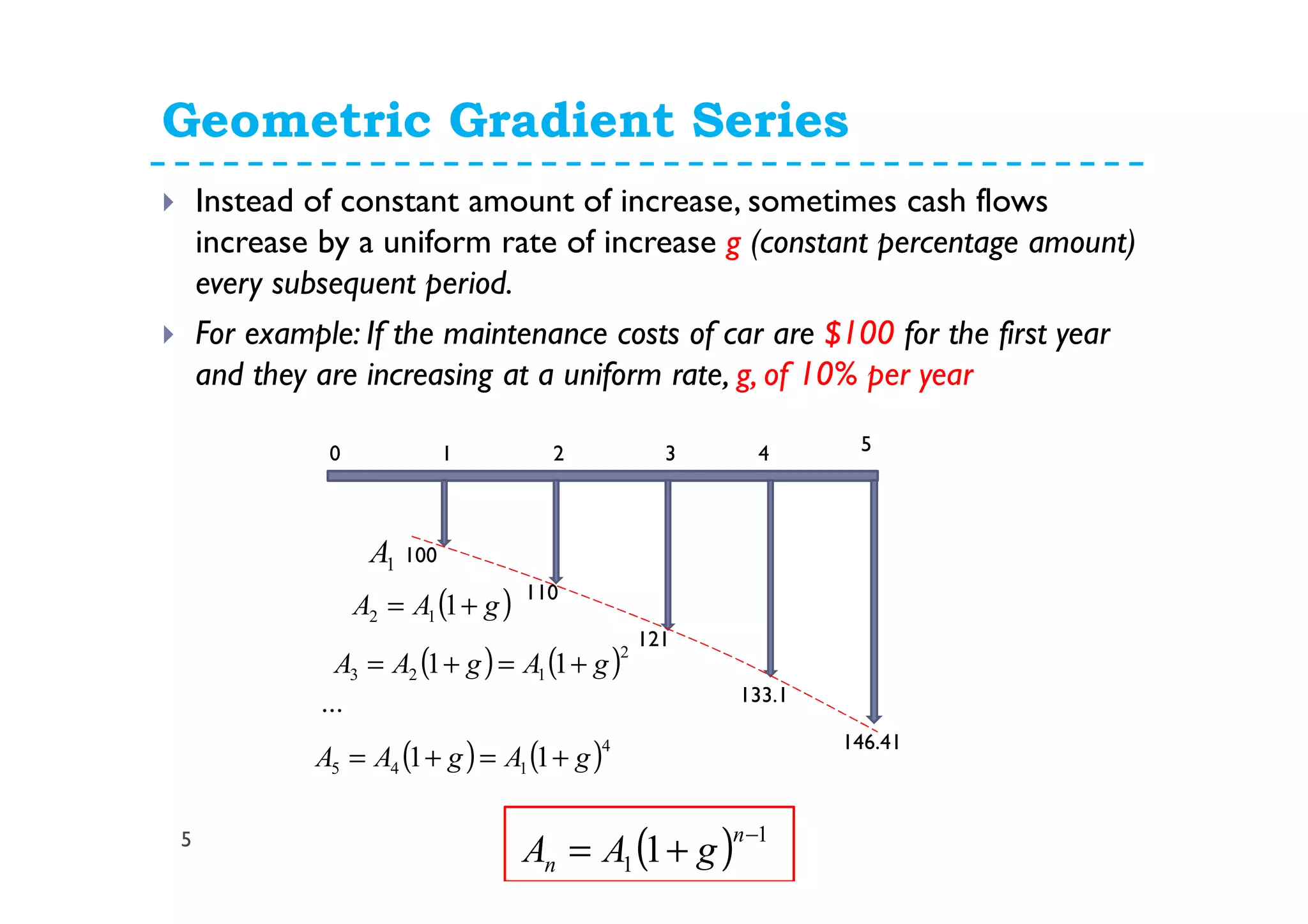
Instead of constant amount of increase, sometimes cash flows
increase by a uniform rate of increase g (constant percentage amount)
every subsequent period.
For example: If the maintenance costs of car are $100 for the first year
and they are increasing at a uniform rate, g, of 10% per year
100
110
121
133.1
146.41
1A
( )gAA += 112
( ) ( )2
123 11 gAgAA +=+=
10 2 3 4 5
( ) ( )4
145 11 gAgAA +=+=
( ) 1
1 1
−
+=
n
n gAA
...
Geometric Gradient Series
6
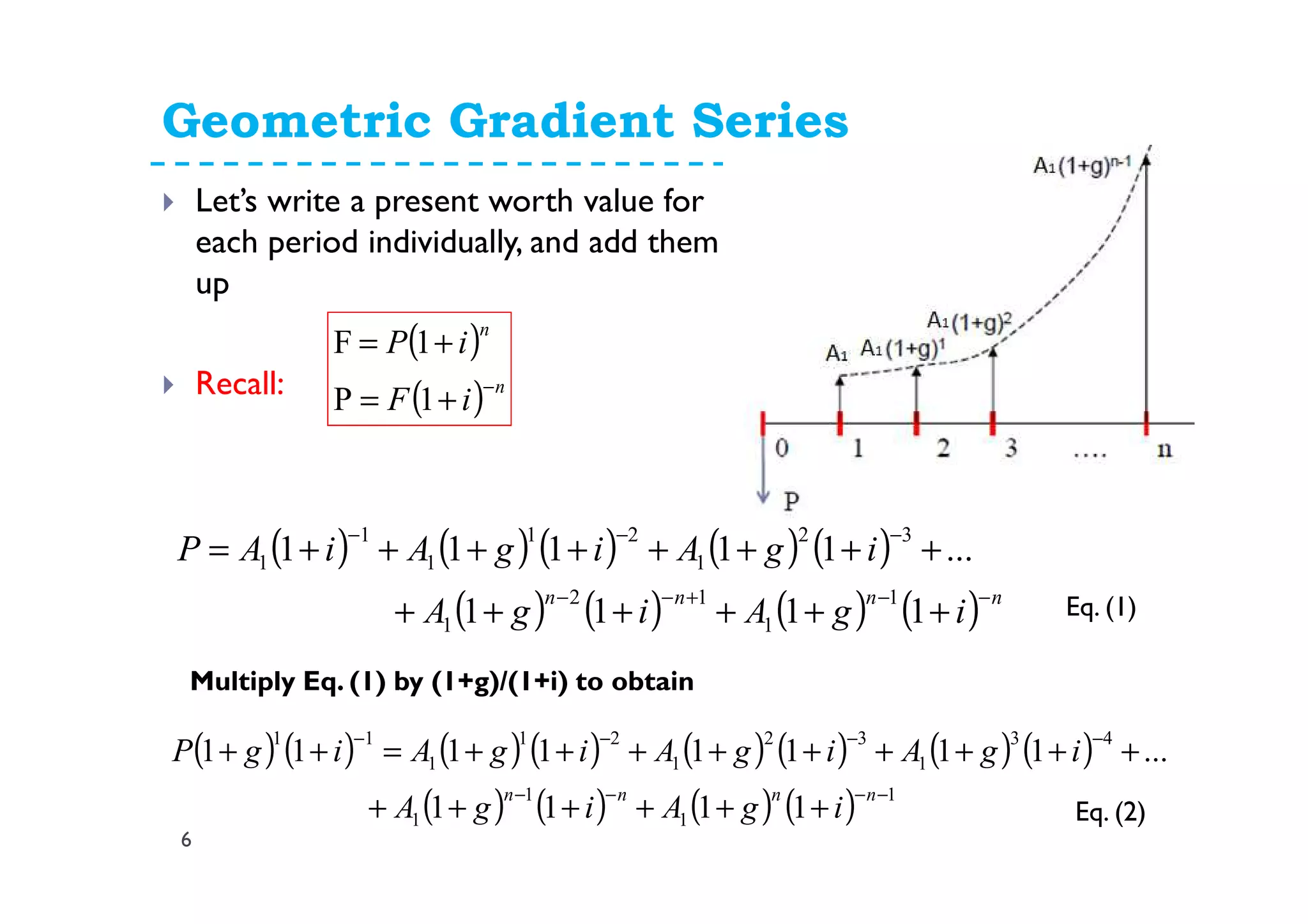
Let’s write a present worth value for
each period individually, and add them
up
Recall:
( ) ( ) ( ) ( ) ( )
( ) ( ) ( ) ( ) nnnn
igAigA
igAigAiAP
−−+−−
−−−
++++++
++++++++=
1111
...11111
1
1
12
1
32
1
21
1
1
1
Eq. (1)
( )
( ) n
n
iF
iP
−
+=
+=
1P
1F
Multiply Eq. (1) by (1+g)/(1+i) to obtain
( ) ( ) ( ) ( ) ( ) ( ) ( ) ( )
( ) ( ) ( ) ( ) 1
1
1
1
43
1
32
1
21
1
11
1111
...11111111
−−−−
−−−−
++++++
+++++++++=++
nnnn
igAigA
igAigAigAigP
Eq. (2)
Geometric Gradient Series
7
Subtract Equation (2) from Equation (1) to yield
( ) ( ) ( ) ( ) ( )
( ) ( ) ( ) ( )
( ) ( ) ( )[ ]
( ) ( )
( ) 





−−+
++−
=
++−=−−+
++−=+−+
++−+=++−
−
−
−
−−−−
gi
ig
AP
igAgiP
igAAgPiP
igAiAigPP
nn
nn
nn
nn
11
111
11111
1111
11111
1
1
11
1
1
1
1
1
11
-
Eq. (3)
Eq. (4)Where gi ≠
Where is called geometric series
present worth factor and has notation
( ) ( )
( ) 





−−+
++−
−
gi
ig
nn
11
111
( )nigAP ,,,/
( ) ( ) ( ) ( ) ( )
( ) ( ) ( ) ( ) nnnn
igAigA
igAigAiAP
−−+−−
−−−
++++++
++++++++=
1111
...11111
1
1
12
1
32
1
21
1
1
1
( ) ( ) ( ) ( ) ( ) ( ) ( ) ( )
( ) ( ) ( ) ( ) 1
1
1
1
43
1
32
1
21
1
11
1111
...11111111
−−−−
−−−−
++++++
+++++++++=++
nnnn
igAigA
igAigAigAigP
Geometric Gradient Series
8
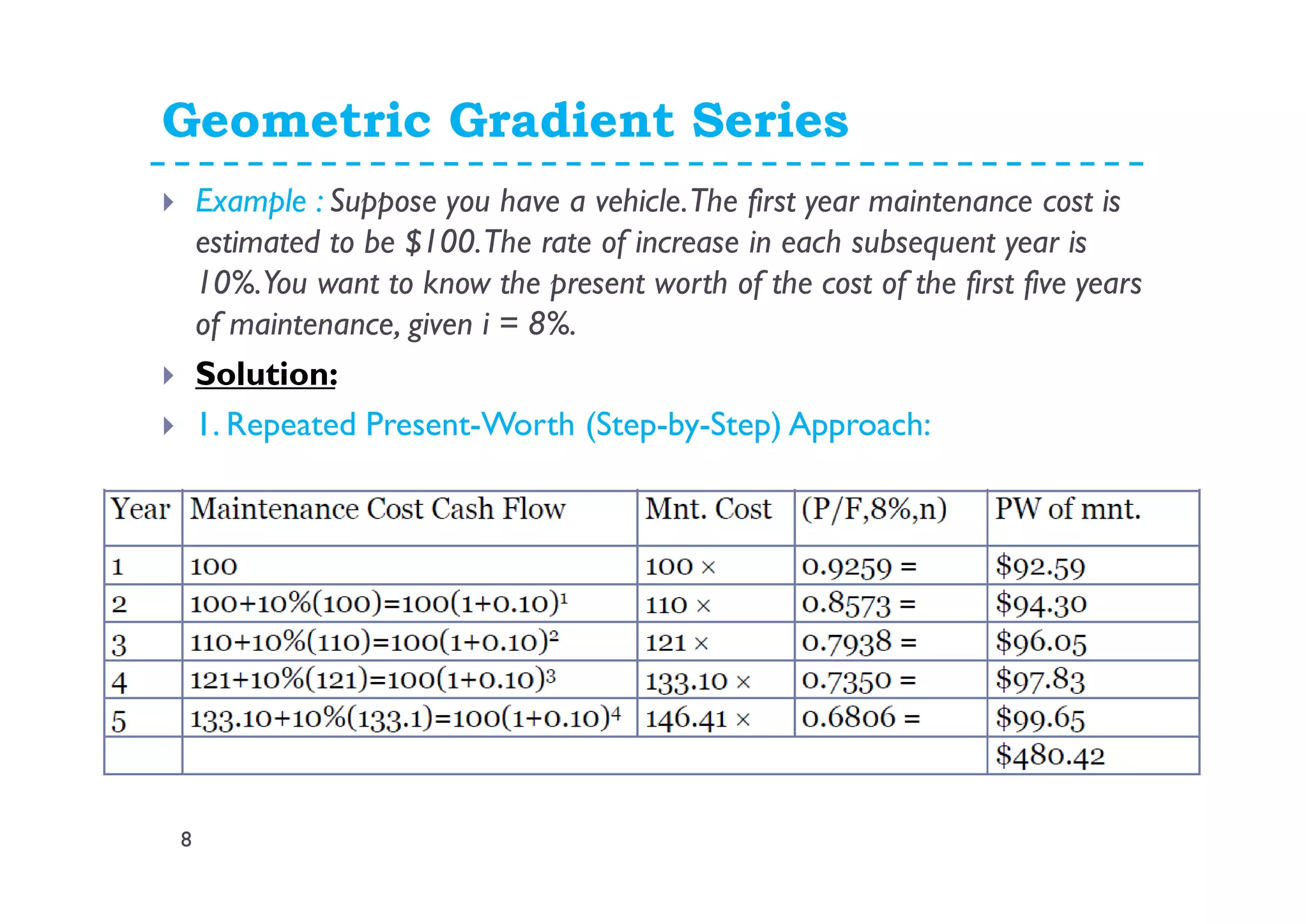
Example : Suppose you have a vehicle.The first year maintenance cost is
estimated to be $100.The rate of increase in each subsequent year is
10%.You want to know the present worth of the cost of the first five years
of maintenance, given i = 8%.
Solution:
1. Repeated Present-Worth (Step-by-Step) Approach:
Geometric Gradient Series
9
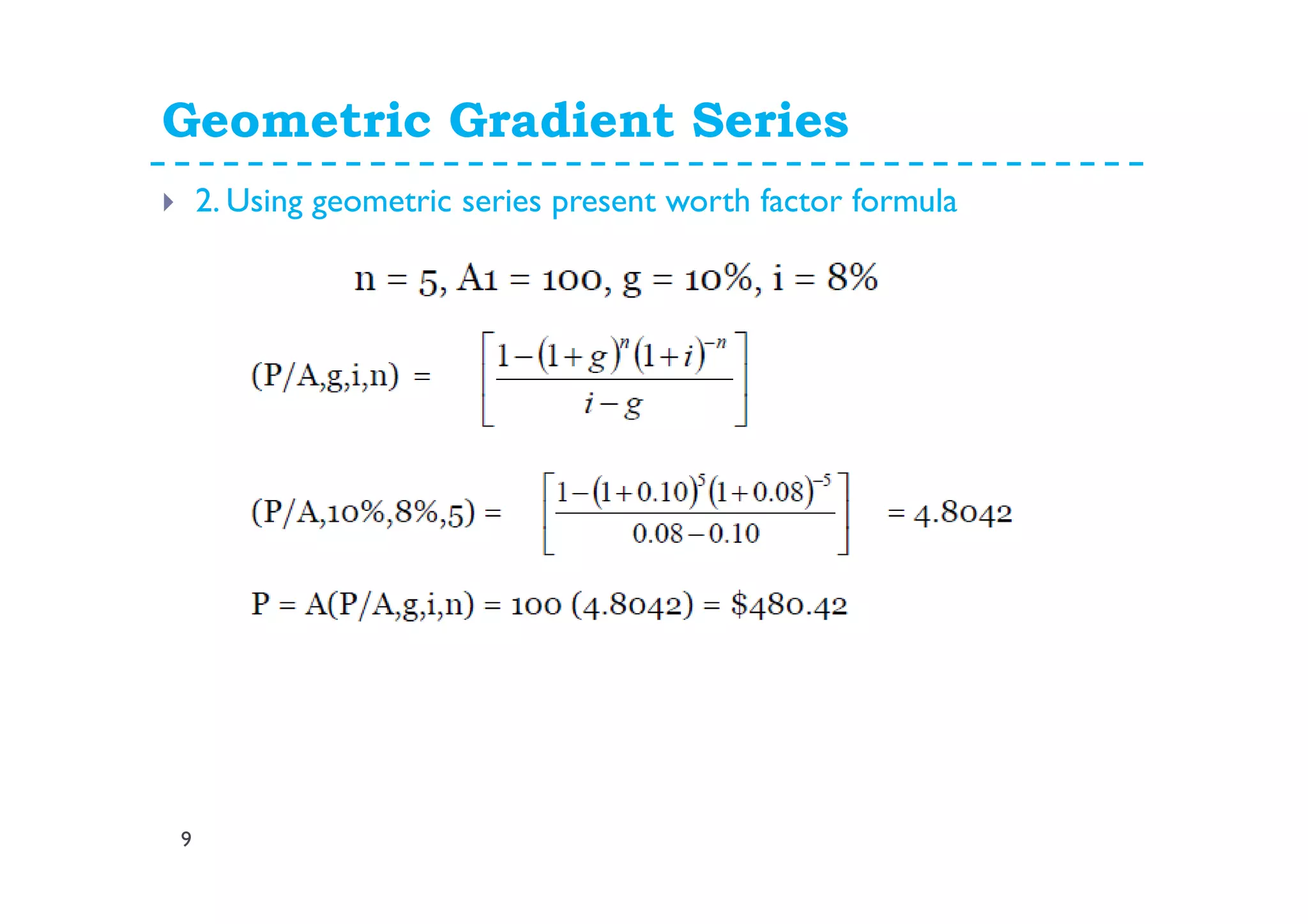
2. Using geometric series present worth factor formula
Multiple Compounding
10
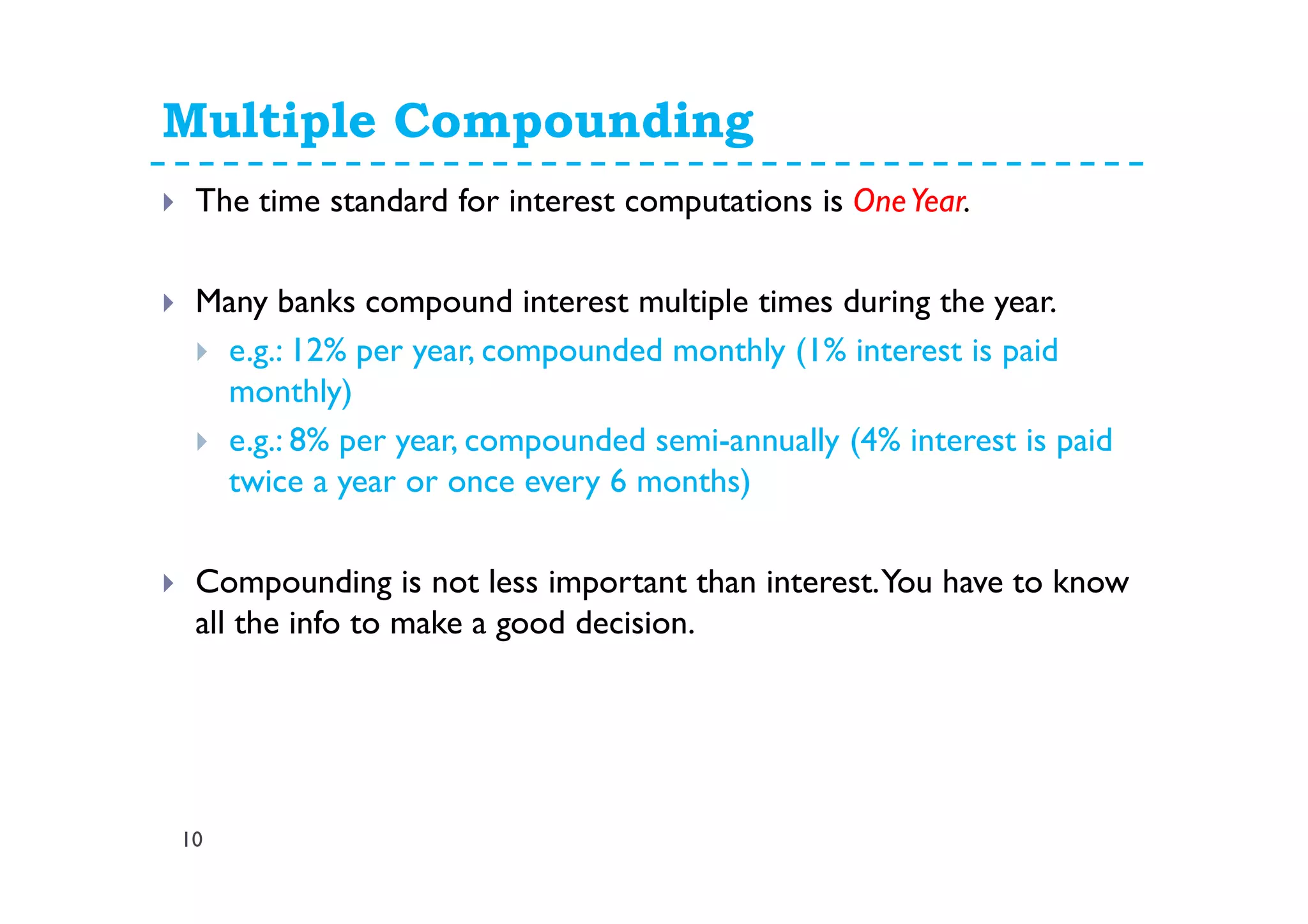
The time standard for interest computations is OneYear.
Many banks compound interest multiple times during the year.
e.g.: 12% per year, compounded monthly (1% interest is paid
monthly)
e.g.: 8% per year, compounded semi-annually (4% interest is paid
twice a year or once every 6 months)
Compounding is not less important than interest.You have to know
all the info to make a good decision.
Multiple Compounding
11
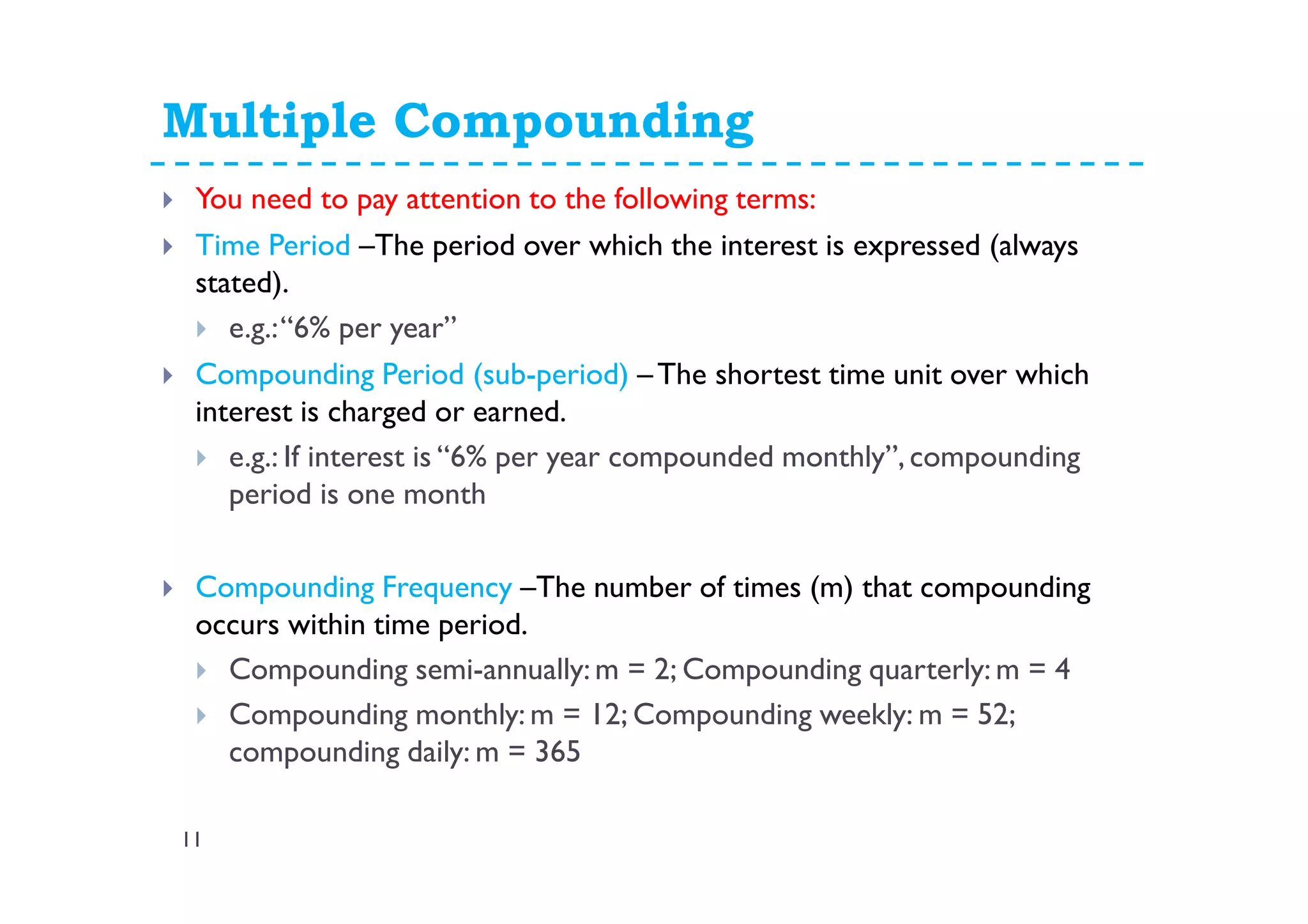
You need to pay attention to the following terms:
Time Period –The period over which the interest is expressed (always
stated).
e.g.:“6% per year”
Compounding Period (sub-period) –The shortest time unit over which
interest is charged or earned.
e.g.: If interest is “6% per year compounded monthly”, compounding
period is one month
Compounding Frequency –The number of times (m) that compounding
occurs within time period.
Compounding semi-annually: m = 2; Compounding quarterly: m = 4
Compounding monthly: m = 12; Compounding weekly: m = 52;
compounding daily: m = 365
Nominal and Effective Interest Rate
12
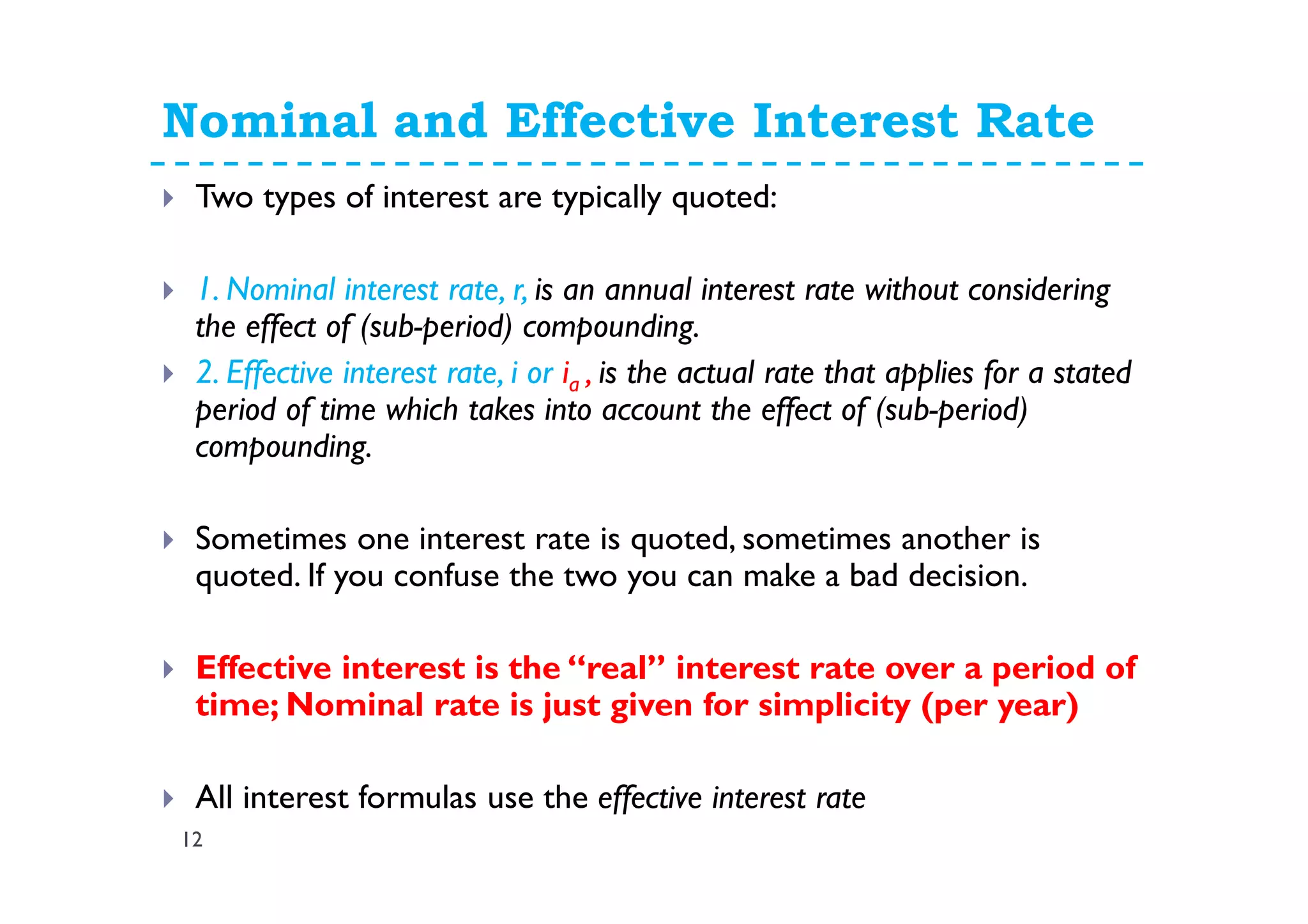
Two types of interest are typically quoted:
1. Nominal interest rate, r, is an annual interest rate without considering
the effect of (sub-period) compounding.
2. Effective interest rate, i or ia , is the actual rate that applies for a stated
period of time which takes into account the effect of (sub-period)
compounding.
Sometimes one interest rate is quoted, sometimes another is
quoted. If you confuse the two you can make a bad decision.
Effective interest is the “real” interest rate over a period of
time; Nominal rate is just given for simplicity (per year)
All interest formulas use the effective interest rate
Nominal and Effective Interest Rate
13
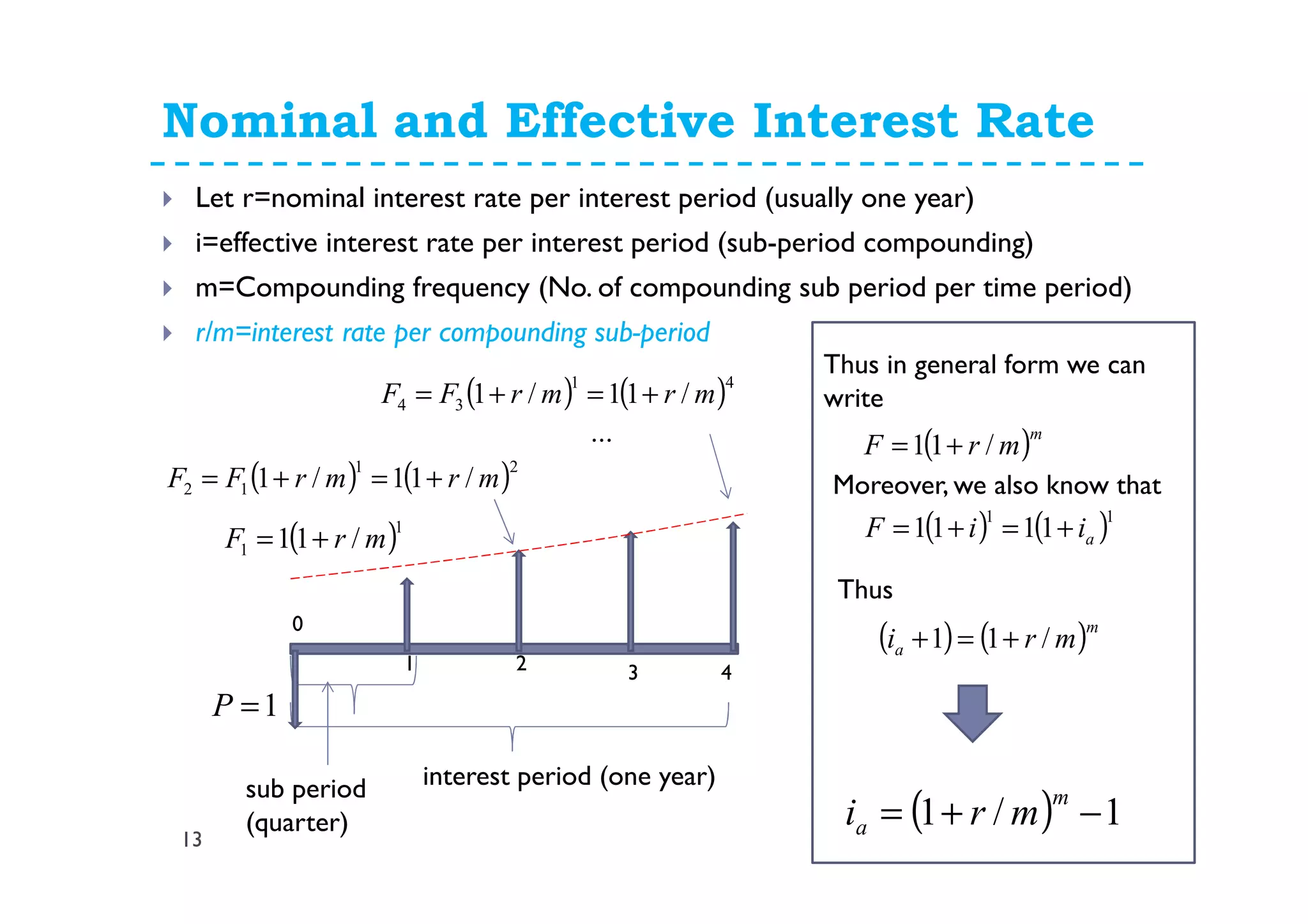
Let r=nominal interest rate per interest period (usually one year)
i=effective interest rate per interest period (sub-period compounding)
m=Compounding frequency (No. of compounding sub period per time period)
r/m=interest rate per compounding sub-period
1=P
( )1
1 /11 mrF +=
( ) ( )21
12 /11/1 mrmrFF +=+=
1
0
2 3 4
( ) ( )41
34 /11/1 mrmrFF +=+=
...
interest period (one year)sub period
(quarter)
( )m
mrF /11 +=
( ) ( )11
1111 aiiF +=+=
( ) 1/1 −+=
m
a mri
( ) ( )m
a mri /11 +=+
Thus in general form we can
write
Moreover, we also know that
Thus
Nominal and Effective Interest Rate
14
Example:
Given an interest rate of 12% per year, compounded quarterly:
Nominal rate=r = 12%
Compounding frequency=m=4
Effective (Actual) rate =r/m= 12%/4 = 3% per quarter
Effective rate per year = [1+(0.12/4)]4-1= 0.1255=12.55%
Investing $1 at 3% per quarter is equivalent to investing $1 at 12.55%
annually
Nominal and Effective Interest Rate
15
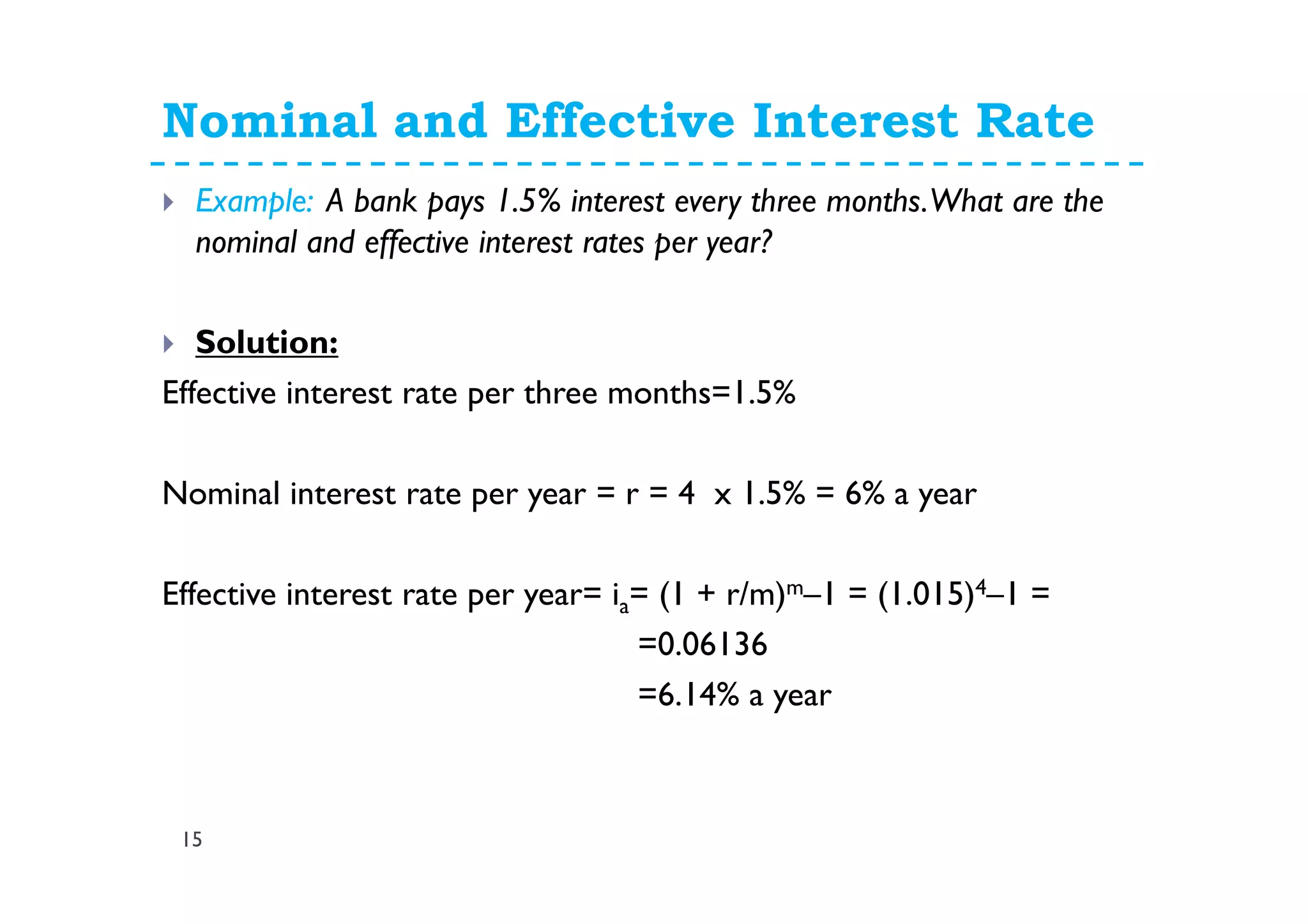
Example: A bank pays 1.5% interest every three months.What are the
nominal and effective interest rates per year?
Solution:
Effective interest rate per three months=1.5%
Nominal interest rate per year = r = 4 x 1.5% = 6% a year
Effective interest rate per year= ia= (1 + r/m)m–1 = (1.015)4–1 =
=0.06136
=6.14% a year
Nominal and Effective Interest Rate
16
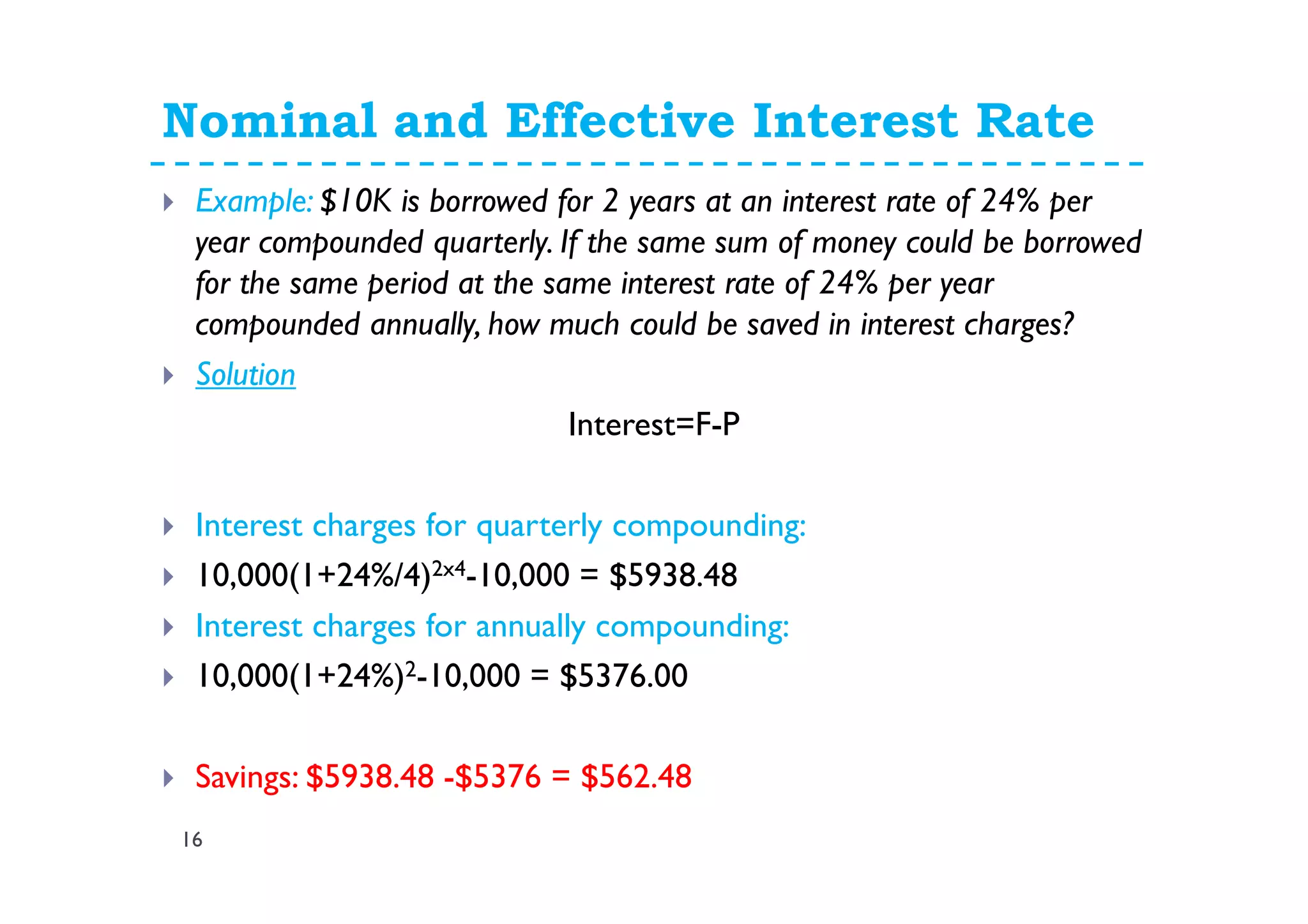
Example: $10K is borrowed for 2 years at an interest rate of 24% per
year compounded quarterly. If the same sum of money could be borrowed
for the same period at the same interest rate of 24% per year
compounded annually, how much could be saved in interest charges?
Solution
Interest=F-P
Interest charges for quarterly compounding:
10,000(1+24%/4)2x4-10,000 = $5938.48
Interest charges for annually compounding:
10,000(1+24%)2-10,000 = $5376.00
Savings: $5938.48 -$5376 = $562.48
Nominal and Effective Interest Rate
17
Example 4-15: A loan shark lends money on the following terms.“If I
give you $50 on Monday, then you give back $60 the following Monday.”
Solution
1.What is the nominal rate, r ?
The loan shark charges i= 20% a week:
60 = 50 (1+i) [Note we have solved 60 = 50(F/P,i,1) for i]
i= 0.2
We know m = 52, so r = 52 x i= 10.4, or 1,040% a year
2.What is the effective rate, ia?
ia= (1 + r/m)m–1 = (1+10.4/52)52–1 =13,104
This means about 1,310,400 % a year !!!!
Nominal and Effective Interest Rate
18
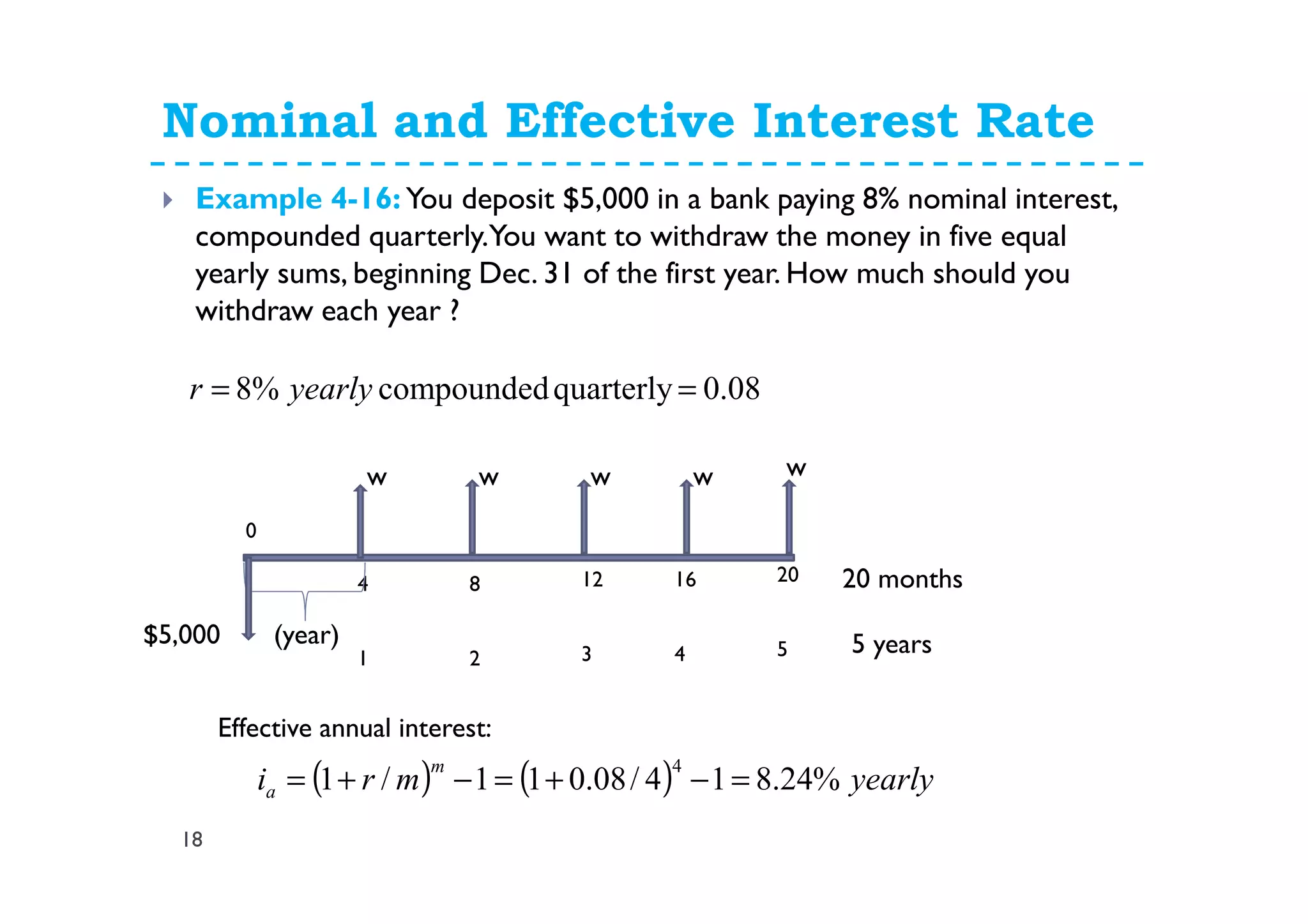
Example 4-16: You deposit $5,000 in a bank paying 8% nominal interest,
compounded quarterly.You want to withdraw the money in five equal
yearly sums, beginning Dec. 31 of the first year. How much should you
withdraw each year ?
08.0quarterlycompounded%8 == yearlyr
4
0
8 12 16
(year)
w w w w w
20 20 months
1 2 3 4 5 5 years
( ) ( ) yearlymri
m
a %24.814/08.011/1
4
=−+=−+=
$5,000
Effective annual interest:
Nominal and Effective Interest Rate
19
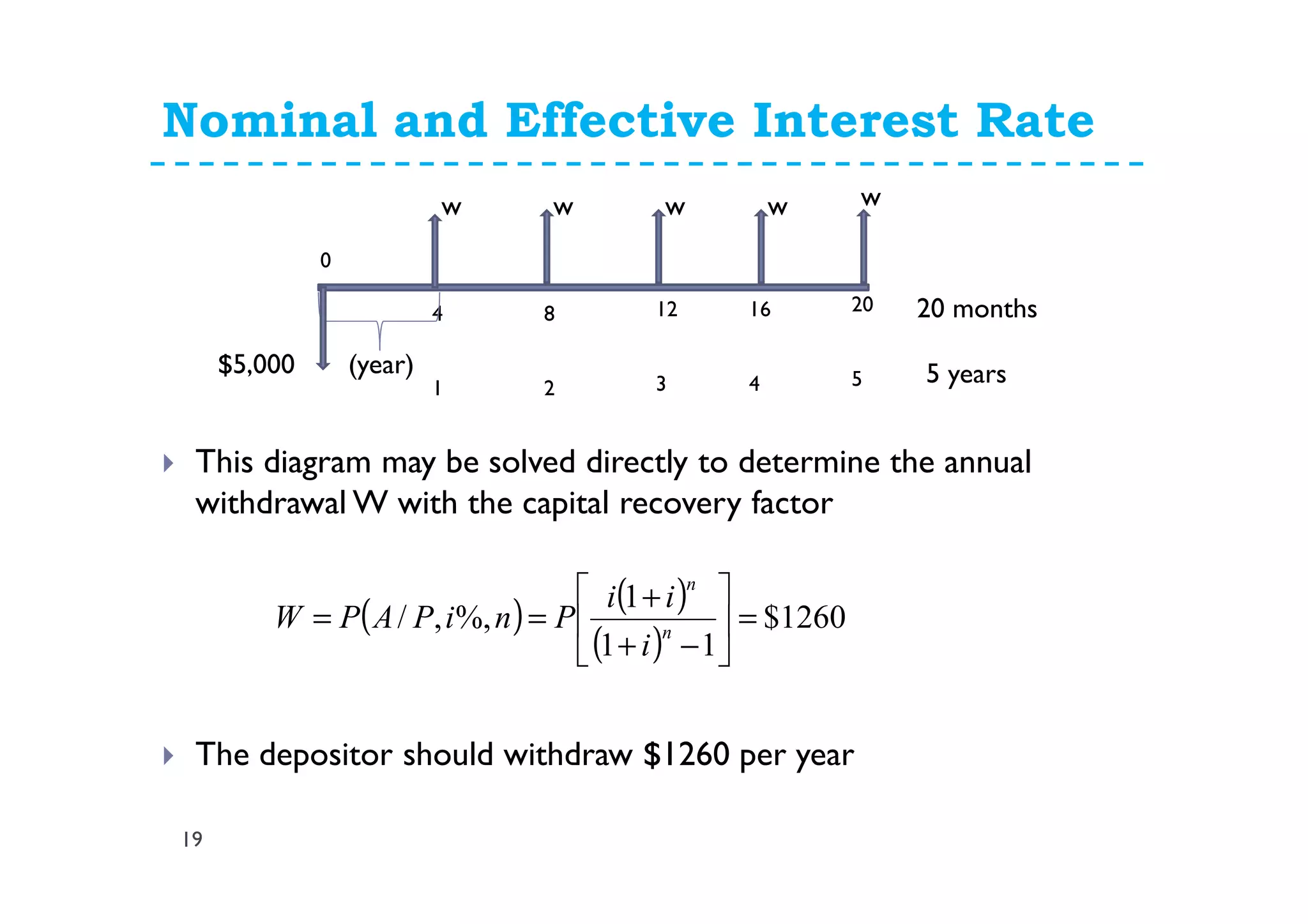
This diagram may be solved directly to determine the annual
withdrawal W with the capital recovery factor
The depositor should withdraw $1260 per year
4
0
8 12 16
(year)
w w w w w
20 20 months
1 2 3 4 5 5 years$5,000
( ) ( )
( )
1260$
11
1
%,,/ =





−+
+
== n
n
i
ii
PniPAPW
Continuous Compounding
20
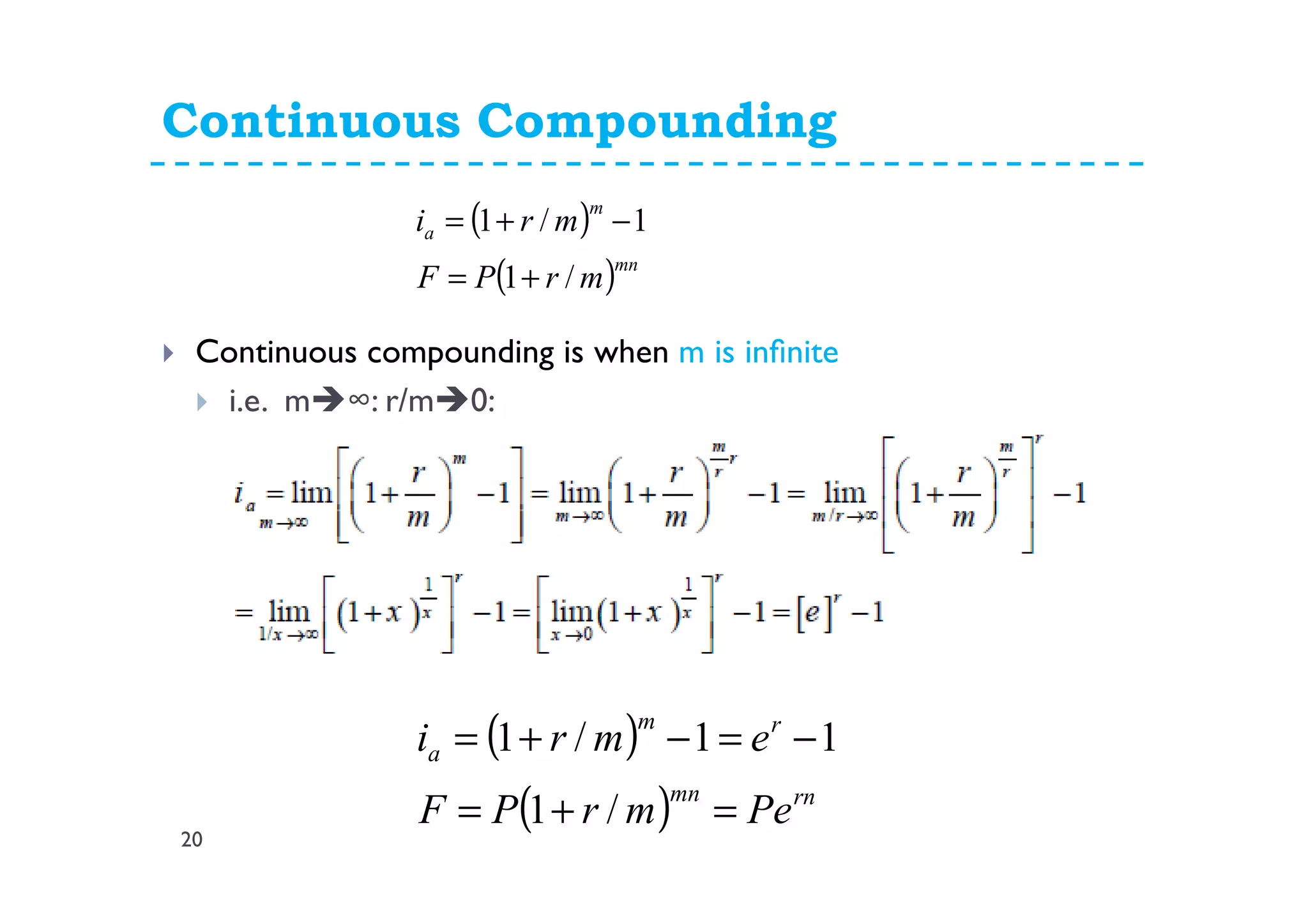
Continuous compounding is when m is infinite
i.e. m ∞: r/m 0:
( )
( )mn
m
a
mrPF
mri
/1
1/1
+=
−+=
( )
( ) rnmn
rm
a
PemrPF
emri
=+=
−=−+=
/1
11/1
Continuous Compounding
21
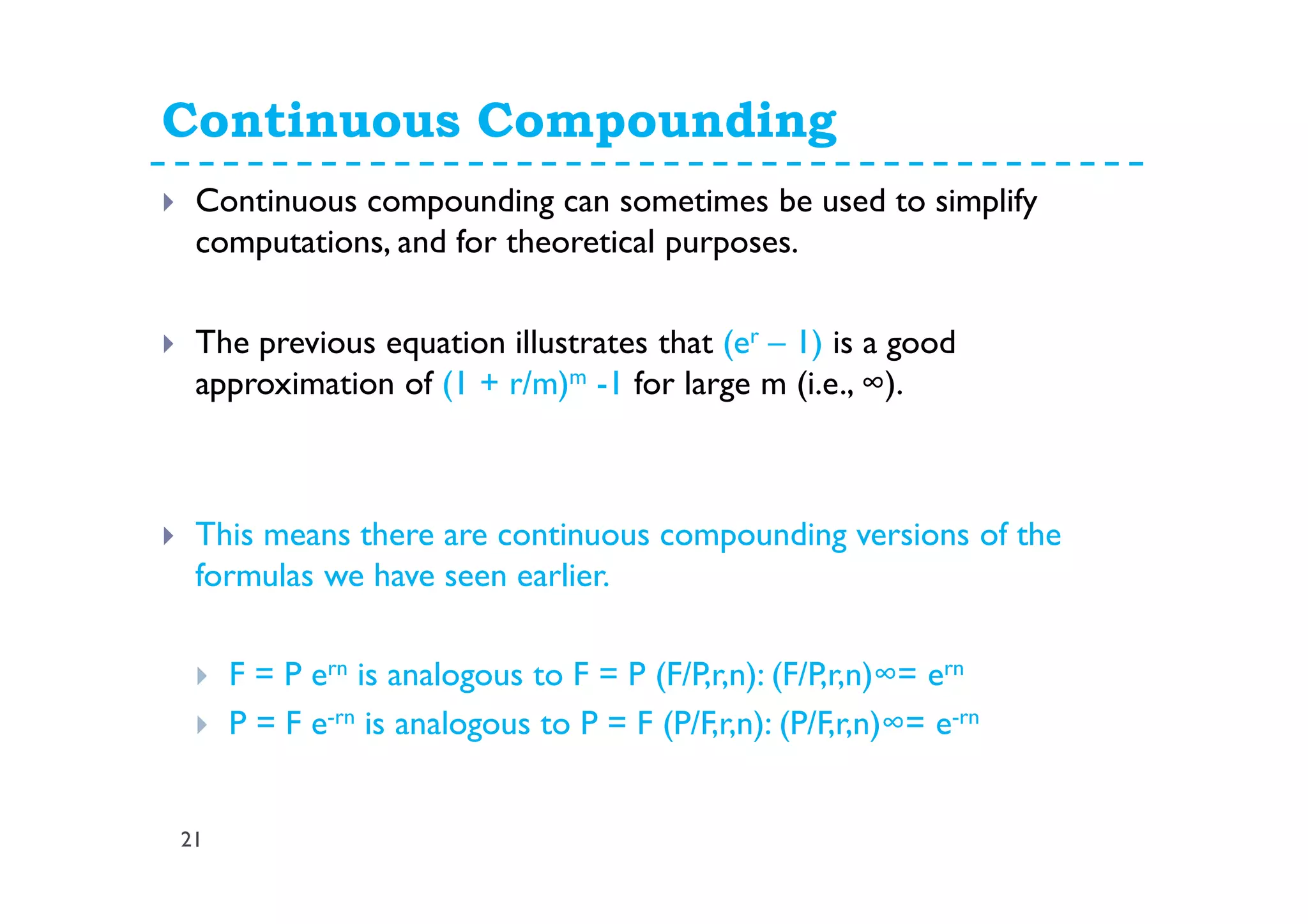
Continuous compounding can sometimes be used to simplify
computations, and for theoretical purposes.
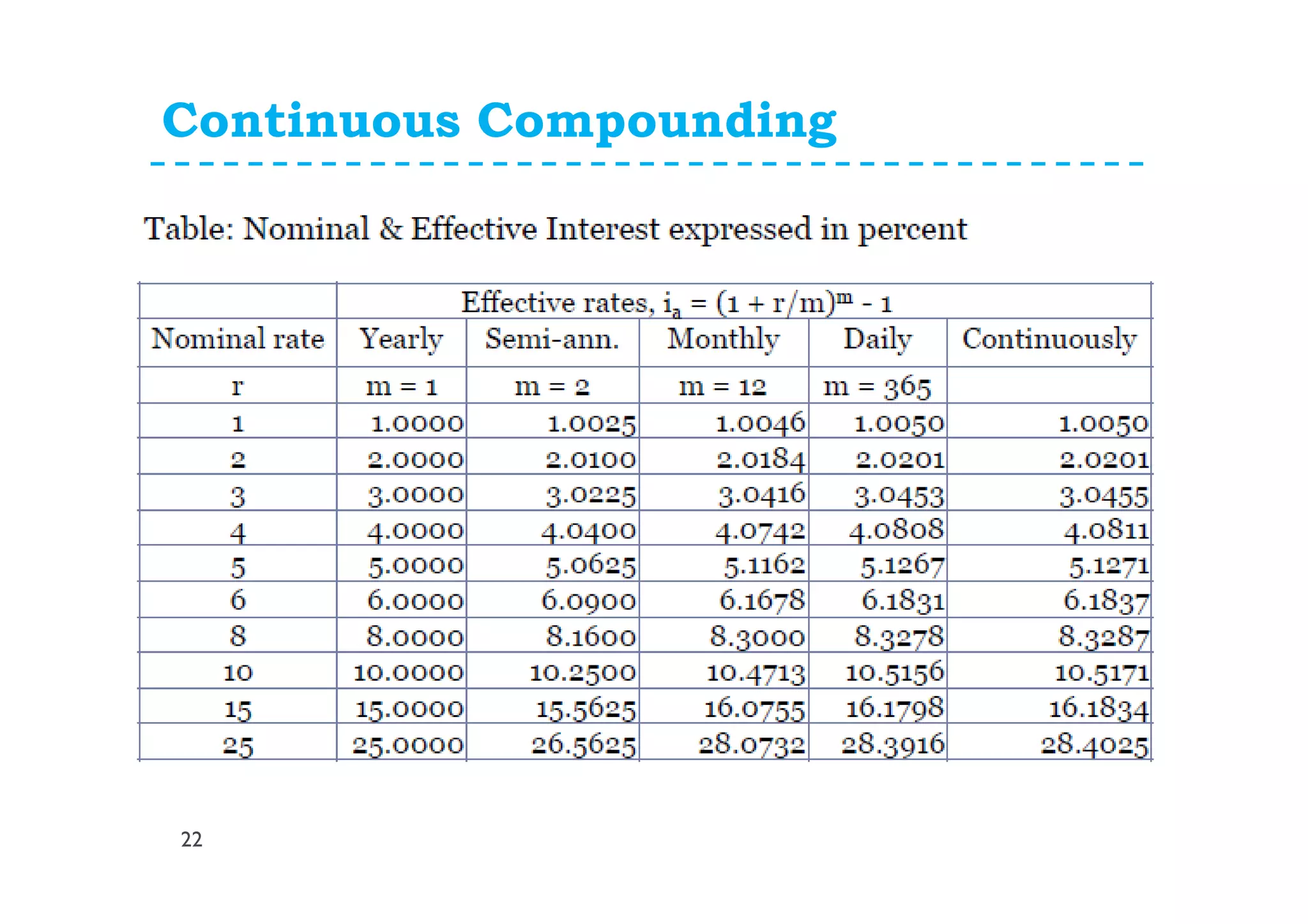
The previous equation illustrates that (er – 1) is a good
approximation of (1 + r/m)m -1 for large m (i.e., ∞).
This means there are continuous compounding versions of the
formulas we have seen earlier.
F = P ern is analogous to F = P (F/P,r,n): (F/P,r,n)∞= ern
P = F e-rn is analogous to P = F (P/F,r,n): (P/F,r,n)∞= e-rn
Continuous Compounding
22
23
ThankYou
Feel Free to Contact
msiddique@sharjah.ac.ae
Tel. +971 6 5050943 (Ext. 2943)

5. more interest formula (part ii)

  • 1.
    5: More InterestFormulas (continued…) Dr. Mohsin Siddique Assistant Professor msiddique@sharjah.ac.ae Ext: 29431 Date: 28/10/2014 Engineering Economics University of Sharjah Dept. of Civil and Env. Engg.
  • 2.
  • 3.
    Outcome of Today’sLecture 3 After completing this lecture… The students should be able to: Understand geometric series compound interest formulas
  • 4.
    More interest Formulas 4 UniformSeries Arithmetic Gradient Geometric Gradient Nominal and Effective Interest Continuous Compounding
  • 5.
    Geometric Gradient Series 5 Insteadof constant amount of increase, sometimes cash flows increase by a uniform rate of increase g (constant percentage amount) every subsequent period. For example: If the maintenance costs of car are $100 for the first year and they are increasing at a uniform rate, g, of 10% per year 100 110 121 133.1 146.41 1A ( )gAA += 112 ( ) ( )2 123 11 gAgAA +=+= 10 2 3 4 5 ( ) ( )4 145 11 gAgAA +=+= ( ) 1 1 1 − += n n gAA ...
  • 6.
    Geometric Gradient Series 6 Let’swrite a present worth value for each period individually, and add them up Recall: ( ) ( ) ( ) ( ) ( ) ( ) ( ) ( ) ( ) nnnn igAigA igAigAiAP −−+−− −−− ++++++ ++++++++= 1111 ...11111 1 1 12 1 32 1 21 1 1 1 Eq. (1) ( ) ( ) n n iF iP − += += 1P 1F Multiply Eq. (1) by (1+g)/(1+i) to obtain ( ) ( ) ( ) ( ) ( ) ( ) ( ) ( ) ( ) ( ) ( ) ( ) 1 1 1 1 43 1 32 1 21 1 11 1111 ...11111111 −−−− −−−− ++++++ +++++++++=++ nnnn igAigA igAigAigAigP Eq. (2)
  • 7.
    Geometric Gradient Series 7 SubtractEquation (2) from Equation (1) to yield ( ) ( ) ( ) ( ) ( ) ( ) ( ) ( ) ( ) ( ) ( ) ( )[ ] ( ) ( ) ( )       −−+ ++− = ++−=−−+ ++−=+−+ ++−+=++− − − − −−−− gi ig AP igAgiP igAAgPiP igAiAigPP nn nn nn nn 11 111 11111 1111 11111 1 1 11 1 1 1 1 1 11 - Eq. (3) Eq. (4)Where gi ≠ Where is called geometric series present worth factor and has notation ( ) ( ) ( )       −−+ ++− − gi ig nn 11 111 ( )nigAP ,,,/ ( ) ( ) ( ) ( ) ( ) ( ) ( ) ( ) ( ) nnnn igAigA igAigAiAP −−+−− −−− ++++++ ++++++++= 1111 ...11111 1 1 12 1 32 1 21 1 1 1 ( ) ( ) ( ) ( ) ( ) ( ) ( ) ( ) ( ) ( ) ( ) ( ) 1 1 1 1 43 1 32 1 21 1 11 1111 ...11111111 −−−− −−−− ++++++ +++++++++=++ nnnn igAigA igAigAigAigP
  • 8.
    Geometric Gradient Series 8 Example: Suppose you have a vehicle.The first year maintenance cost is estimated to be $100.The rate of increase in each subsequent year is 10%.You want to know the present worth of the cost of the first five years of maintenance, given i = 8%. Solution: 1. Repeated Present-Worth (Step-by-Step) Approach:
  • 9.
    Geometric Gradient Series 9 2.Using geometric series present worth factor formula
  • 10.
    Multiple Compounding 10 The timestandard for interest computations is OneYear. Many banks compound interest multiple times during the year. e.g.: 12% per year, compounded monthly (1% interest is paid monthly) e.g.: 8% per year, compounded semi-annually (4% interest is paid twice a year or once every 6 months) Compounding is not less important than interest.You have to know all the info to make a good decision.
  • 11.
    Multiple Compounding 11 You needto pay attention to the following terms: Time Period –The period over which the interest is expressed (always stated). e.g.:“6% per year” Compounding Period (sub-period) –The shortest time unit over which interest is charged or earned. e.g.: If interest is “6% per year compounded monthly”, compounding period is one month Compounding Frequency –The number of times (m) that compounding occurs within time period. Compounding semi-annually: m = 2; Compounding quarterly: m = 4 Compounding monthly: m = 12; Compounding weekly: m = 52; compounding daily: m = 365
  • 12.
    Nominal and EffectiveInterest Rate 12 Two types of interest are typically quoted: 1. Nominal interest rate, r, is an annual interest rate without considering the effect of (sub-period) compounding. 2. Effective interest rate, i or ia , is the actual rate that applies for a stated period of time which takes into account the effect of (sub-period) compounding. Sometimes one interest rate is quoted, sometimes another is quoted. If you confuse the two you can make a bad decision. Effective interest is the “real” interest rate over a period of time; Nominal rate is just given for simplicity (per year) All interest formulas use the effective interest rate
  • 13.
    Nominal and EffectiveInterest Rate 13 Let r=nominal interest rate per interest period (usually one year) i=effective interest rate per interest period (sub-period compounding) m=Compounding frequency (No. of compounding sub period per time period) r/m=interest rate per compounding sub-period 1=P ( )1 1 /11 mrF += ( ) ( )21 12 /11/1 mrmrFF +=+= 1 0 2 3 4 ( ) ( )41 34 /11/1 mrmrFF +=+= ... interest period (one year)sub period (quarter) ( )m mrF /11 += ( ) ( )11 1111 aiiF +=+= ( ) 1/1 −+= m a mri ( ) ( )m a mri /11 +=+ Thus in general form we can write Moreover, we also know that Thus
  • 14.
    Nominal and EffectiveInterest Rate 14 Example: Given an interest rate of 12% per year, compounded quarterly: Nominal rate=r = 12% Compounding frequency=m=4 Effective (Actual) rate =r/m= 12%/4 = 3% per quarter Effective rate per year = [1+(0.12/4)]4-1= 0.1255=12.55% Investing $1 at 3% per quarter is equivalent to investing $1 at 12.55% annually
  • 15.
    Nominal and EffectiveInterest Rate 15 Example: A bank pays 1.5% interest every three months.What are the nominal and effective interest rates per year? Solution: Effective interest rate per three months=1.5% Nominal interest rate per year = r = 4 x 1.5% = 6% a year Effective interest rate per year= ia= (1 + r/m)m–1 = (1.015)4–1 = =0.06136 =6.14% a year
  • 16.
    Nominal and EffectiveInterest Rate 16 Example: $10K is borrowed for 2 years at an interest rate of 24% per year compounded quarterly. If the same sum of money could be borrowed for the same period at the same interest rate of 24% per year compounded annually, how much could be saved in interest charges? Solution Interest=F-P Interest charges for quarterly compounding: 10,000(1+24%/4)2x4-10,000 = $5938.48 Interest charges for annually compounding: 10,000(1+24%)2-10,000 = $5376.00 Savings: $5938.48 -$5376 = $562.48
  • 17.
    Nominal and EffectiveInterest Rate 17 Example 4-15: A loan shark lends money on the following terms.“If I give you $50 on Monday, then you give back $60 the following Monday.” Solution 1.What is the nominal rate, r ? The loan shark charges i= 20% a week: 60 = 50 (1+i) [Note we have solved 60 = 50(F/P,i,1) for i] i= 0.2 We know m = 52, so r = 52 x i= 10.4, or 1,040% a year 2.What is the effective rate, ia? ia= (1 + r/m)m–1 = (1+10.4/52)52–1 =13,104 This means about 1,310,400 % a year !!!!
  • 18.
    Nominal and EffectiveInterest Rate 18 Example 4-16: You deposit $5,000 in a bank paying 8% nominal interest, compounded quarterly.You want to withdraw the money in five equal yearly sums, beginning Dec. 31 of the first year. How much should you withdraw each year ? 08.0quarterlycompounded%8 == yearlyr 4 0 8 12 16 (year) w w w w w 20 20 months 1 2 3 4 5 5 years ( ) ( ) yearlymri m a %24.814/08.011/1 4 =−+=−+= $5,000 Effective annual interest:
  • 19.
    Nominal and EffectiveInterest Rate 19 This diagram may be solved directly to determine the annual withdrawal W with the capital recovery factor The depositor should withdraw $1260 per year 4 0 8 12 16 (year) w w w w w 20 20 months 1 2 3 4 5 5 years$5,000 ( ) ( ) ( ) 1260$ 11 1 %,,/ =      −+ + == n n i ii PniPAPW
  • 20.
    Continuous Compounding 20 Continuous compoundingis when m is infinite i.e. m ∞: r/m 0: ( ) ( )mn m a mrPF mri /1 1/1 += −+= ( ) ( ) rnmn rm a PemrPF emri =+= −=−+= /1 11/1
  • 21.
    Continuous Compounding 21 Continuous compoundingcan sometimes be used to simplify computations, and for theoretical purposes. The previous equation illustrates that (er – 1) is a good approximation of (1 + r/m)m -1 for large m (i.e., ∞). This means there are continuous compounding versions of the formulas we have seen earlier. F = P ern is analogous to F = P (F/P,r,n): (F/P,r,n)∞= ern P = F e-rn is analogous to P = F (P/F,r,n): (P/F,r,n)∞= e-rn
  • 22.
  • 23.
    23 ThankYou Feel Free toContact msiddique@sharjah.ac.ae Tel. +971 6 5050943 (Ext. 2943)