EGN 3203 Engineering Economics
LO 2 – b
Capital Investment Problems &
Cash Flow
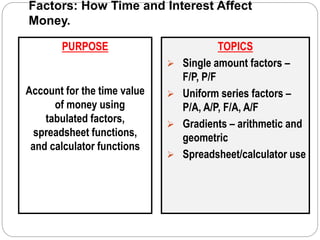
Factors: How Time and Interest Affect
Money.
PURPOSE
Account for the time value
of money using
tabulated factors,
spreadsheet functions,
and calculator functions
TOPICS
 Single amount factors –
F/P, P/F
 Uniform series factors –
P/A, A/P, F/A, A/F
 Gradients – arithmetic and
geometric
 Spreadsheet/calculator use
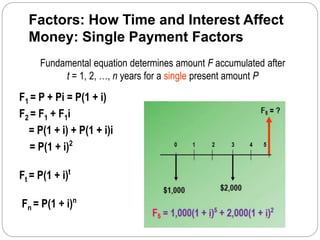
Fundamental equation determines amount F accumulated after
t = 1, 2, …, n years for a single present amount P
F1 = P + Pi = P(1 + i)
F2 = F1 + F1i
= P(1 + i) + P(1 + i)i
= P(1 + i)2
Ft = P(1 + i)t
Fn = P(1 + i)n
Factors: How Time and Interest Affect
Money: Single Payment Factors
Factors: How Time and Interest Affect
Money: Single Payment Factors
Find F, given P
Formula: F = P(1 + i)n
Notation: F=P(F/P,i%,n)
(1+i)n
= single-payment compound
amount factor
Spreadsheet: = FV(i%,n,,P)
Calculator: FV(i,n,A,P)
Find P, given F
Formula: P = F[1/(1 + i)n
]
Notation: P=F(P/F,i%,n)
1/(1+i)n
= single-payment present
worth factor
Spreadsheet: = PV(i%,n,,F)
Calculator: PV(i,n,A,F)
Find F, given P
Formula: F = P(1 + i)n
Notation: F=P(F/P,i%,n)
(1+i)n
= single-payment compound
amount factor
Spreadsheet: = FV(i%,n,,P)
Calculator: FV(i,n,A,P)
Find P, given F
Formula: P = F[1/(1 + i)n
]
Notation: P=F(P/F,i%,n)
1/(1+i)n
= single-payment present
worth factor
Spreadsheet: = PV(i%,n,,F)
Calculator: PV(i,n,A,F)
Factors: How Time and Interest Affect
Money: Single Payment Factors
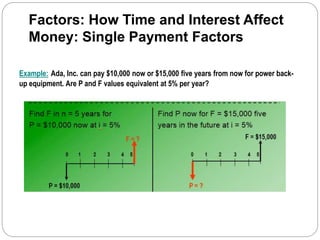
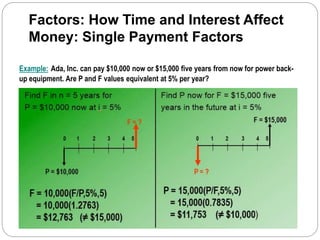
Example: Ada, Inc. can pay $10,000 now or $15,000 five years from now for power back-
up equipment. Are P and F values equivalent at 5% per year?
Factors: How Time and Interest Affect
Money: Single Payment Factors
Example: Ada, Inc. can pay $10,000 now or $15,000 five years from now for power back-
up equipment. Are P and F values equivalent at 5% per year?
Factors: How Time and Interest Affect
Money: Single Payment Factors
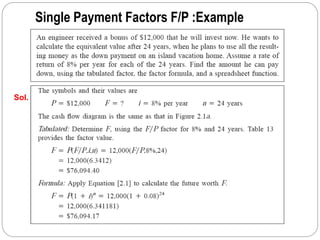
Single Payment Factors F/P :Example
Sol.
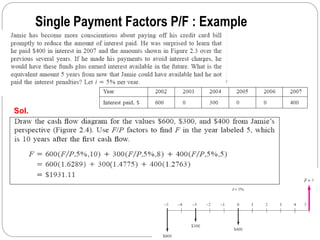
Single Payment Factors P/F : Example
Sol.
 Notes
UNIFORM SERIES FORMULAS
(A/F, F/A) (P/A, A/P )
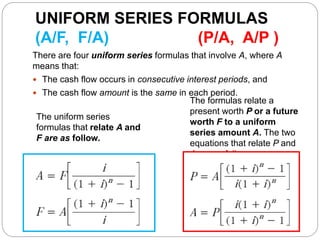
There are four uniform series formulas that involve A, where A
means that:
 The cash flow occurs in consecutive interest periods, and
 The cash flow amount is the same in each period.
The formulas relate a
present worth P or a future
worth F to a uniform
series amount A. The two
equations that relate P and
A are as follows.
The uniform series
formulas that relate A and
F are as follow.
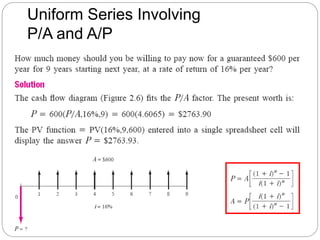
Uniform Series Involving
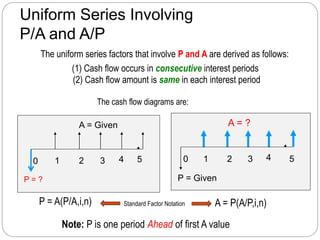
P/A and A/P
0 1 2 3 4 5
A = ?
P = Given
The cash flow diagrams are:
Standard Factor NotationP = A(P/A,i,n) A = P(A/P,i,n)
Note: P is one period Ahead of first A value
(1) Cash flow occurs in consecutive interest periods
The uniform series factors that involve P and A are derived as follows:
(2) Cash flow amount is same in each interest period
0 1 2 3 4 5
A = Given
P = ?
Example: Uniform Series Involving P/A
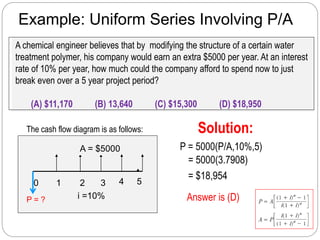
A chemical engineer believes that by modifying the structure of a certain water
treatment polymer, his company would earn an extra $5000 per year. At an interest
rate of 10% per year, how much could the company afford to spend now to just
break even over a 5 year project period?
(A) $11,170 (B) 13,640 (C) $15,300 (D) $18,950
The cash flow diagram is as follows:
P = 5000(P/A,10%,5)
= 5000(3.7908)
= $18,954
Answer is (D)
0 1 2 3 4 5
A = $5000
P = ? i =10%
Solution:
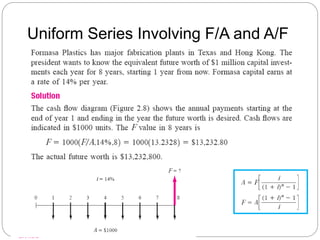
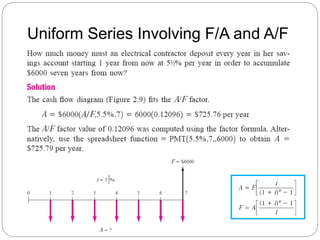
Uniform Series Involving F/A and A/F
© 2012 by McGraw-Hill, New York, N.Y All Rights Reserved
2-14
(1) Cash flow occurs in consecutive interest periods
The uniform series factors that involve F and A are derived as follows:
(2) Last cash flow occurs in same period as F
0 1 2 3 4 5
F = ?
A = Given
0 1 2 3 4 5
F = Given
A = ?
Note: F takes place in the same period as last A
Cash flow diagrams are:
Standard Factor NotationF = A(F/A,i,n) A = F(A/F,i,n)
Example: Uniform Series Involving
F/A
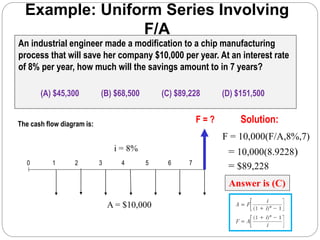
An industrial engineer made a modification to a chip manufacturing
process that will save her company $10,000 per year. At an interest rate
of 8% per year, how much will the savings amount to in 7 years?
(A) $45,300 (B) $68,500 (C) $89,228 (D) $151,500
The cash flow diagram is:
A = $10,000
F = ?
i = 8%
0 1 2 3 4 5 6 7
Solution:
F = 10,000(F/A,8%,7)
= 10,000(8.9228)
= $89,228
Answer is (C)
Uniform Series Involving
P/A and A/P
Uniform Series Involving F/A and A/F
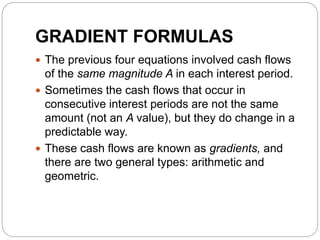
GRADIENT FORMULAS
 The previous four equations involved cash flows
of the same magnitude A in each interest period.
 Sometimes the cash flows that occur in
consecutive interest periods are not the same
amount (not an A value), but they do change in a
predictable way.
 These cash flows are known as gradients, and
there are two general types: arithmetic and
geometric.
© 2012 by McGraw-Hill, New York, N.Y All Rights Reserved
2-20
Arithmetic Gradients
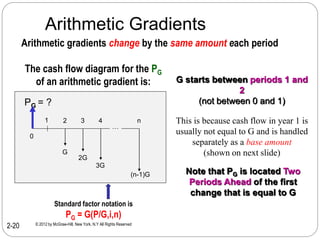
Arithmetic gradients change by the same amount each period
The cash flow diagram for the PG
of an arithmetic gradient is:
0
1 2 3 n
G
2G
4
3G
(n-1)G
PG = ?
G starts between periods 1 and
2
(not between 0 and 1)
This is because cash flow in year 1 is
usually not equal to G and is handled
separately as a base amount
(shown on next slide)
Note that PG is located Two
Periods Ahead of the first
change that is equal to G
Standard factor notation is
PG = G(P/G,i,n)
© 2012 by McGraw-Hill, New York, N.Y All Rights Reserved
2-21
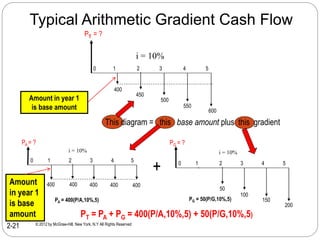
Typical Arithmetic Gradient Cash Flow
PT = ?
i = 10%
0 1 2 3 4 5
400
450
500
550
600
PA = ?
i = 10%
0 1 2 3 4 5
400 400 400 400 400
PG = ?
i = 10%
0 1 2 3 4 5
50
100
150
200
+
This diagram = this base amount plus this gradient
PA = 400(P/A,10%,5) PG = 50(P/G,10%,5)
PT = PA + PG = 400(P/A,10%,5) + 50(P/G,10%,5)
Amount
in year 1
is base
amount
Amount in year 1
is base amount
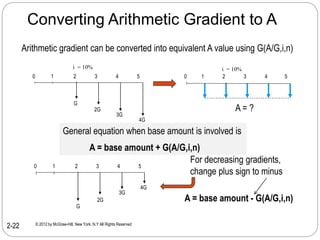
Converting Arithmetic Gradient to A
© 2012 by McGraw-Hill, New York, N.Y All Rights Reserved
2-22
i = 10%
0 1 2 3 4 5
G
2G
3G
4G
i = 10%
0 1 2 3 4 5
A = ?
Arithmetic gradient can be converted into equivalent A value using G(A/G,i,n)
General equation when base amount is involved is
A = base amount + G(A/G,i,n)
0 1 2 3 4 5
G
2G
3G
4G
For decreasing gradients,
change plus sign to minus
A = base amount - G(A/G,i,n)
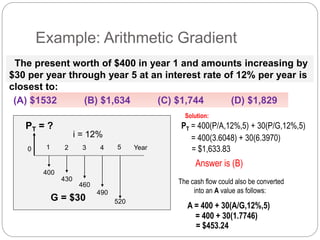
Example: Arithmetic Gradient
The present worth of $400 in year 1 and amounts increasing by
$30 per year through year 5 at an interest rate of 12% per year is
closest to:
(A) $1532 (B) $1,634 (C) $1,744 (D) $1,829
0 1 2 3 Year
430
460
4
490
520
PT = ?
5
400
i = 12%
G = $30
= 400(3.6048) + 30(6.3970)
= $1,633.83
Answer is (B)
PT = 400(P/A,12%,5) + 30(P/G,12%,5)
The cash flow could also be converted
into an A value as follows:
A = 400 + 30(A/G,12%,5)
= 400 + 30(1.7746)
= $453.24
Solution:
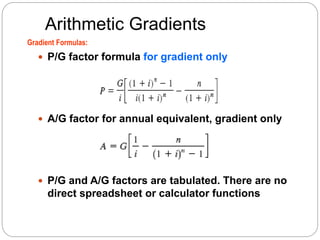
 P/G factor formula for gradient only
 A/G factor for annual equivalent, gradient only
 P/G and A/G factors are tabulated. There are no
direct spreadsheet or calculator functions
Gradient Formulas:
Arithmetic Gradients
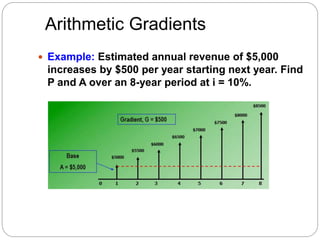
 Example: Estimated annual revenue of $5,000
increases by $500 per year starting next year. Find
P and A over an 8-year period at i = 10%.
Arithmetic Gradients
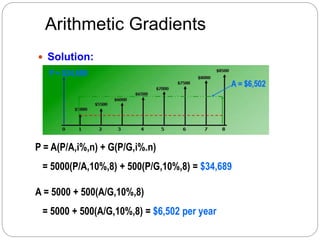
 Solution:
P = A(P/A,i%,n) + G(P/G,i%.n)
= 5000(P/A,10%,8) + 500(P/G,10%,8) = $34,689
A = 5000 + 500(A/G,10%,8)
= 5000 + 500(A/G,10%,8) = $6,502 per year
Arithmetic Gradients
Geometric Gradients
Geometric gradients change by the same percentage each period
0
1 2 3 n
A1
A 1(1+g)1
4
A 1(1+g)2
A 1(1+g)n-1
Pg = ?
There are no tables for geometric factors
Use following equation for g ≠ i:
Pg = A1{1- [(1+g)/(1+i)]n}/(i-g)
where: A1 = cash flow in period 1
g = rate of increase
If g = i, Pg = A1n/(1+i)
Note: If g is negative, change signs in front of both g values
Cash flow diagram for present worth
of geometric gradient
Note: g starts between
periods 1 and 2
Example: Geometric Gradient
Find the present worth of $1,000 in year 1 and amounts
increasing by 7% per year through year 10. Use an
interest rate of 12% per year.
(a) $5,670 (b) $7,333 (c) $12,670 (d) $13,550
0
1 2 3 10
1000
1070
4
1145
1838
Pg = ? Solution:
Pg = 1000[1-(1+0.07/1+0.12)10]/(0.12-0.07)
= $7,333
Answer is (b)
g = 7%
i = 12%
To find A, multiply Pg by (A/P,12%,10)
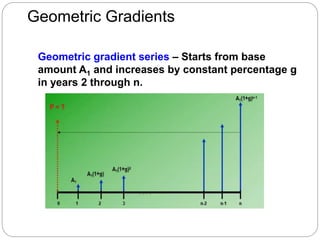
Geometric gradient series – Starts from base
amount A1 and increases by constant percentage g
in years 2 through n.
Geometric Gradients
Geometric gradient series
Gradient Formulas:
 Present worth – No
tabulated factors
 This is P for all cash
flows, including A1
 Term in brackets is
(P/A,g,i%,n) factor
 When g = i, relation
reduces to
P = A1[n/(1+i)]
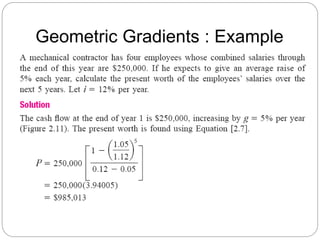
Example: Payroll totals
$250,000 this year;
expected to grow at 5%
per year through year 5.
Find P at i = 12%.
Year 1: $250,000
Year 5: 250,000(1.05)4
= 303,876
= 250,000(3.94005)
= $985,013
Geometric Gradients
Geometric Gradients : Example
Notes

Lo 2 b factors

  • 1.
    EGN 3203 EngineeringEconomics LO 2 – b Capital Investment Problems & Cash Flow
  • 2.
    Factors: How Timeand Interest Affect Money. PURPOSE Account for the time value of money using tabulated factors, spreadsheet functions, and calculator functions TOPICS  Single amount factors – F/P, P/F  Uniform series factors – P/A, A/P, F/A, A/F  Gradients – arithmetic and geometric  Spreadsheet/calculator use
  • 3.
    Fundamental equation determinesamount F accumulated after t = 1, 2, …, n years for a single present amount P F1 = P + Pi = P(1 + i) F2 = F1 + F1i = P(1 + i) + P(1 + i)i = P(1 + i)2 Ft = P(1 + i)t Fn = P(1 + i)n Factors: How Time and Interest Affect Money: Single Payment Factors
  • 4.
    Factors: How Timeand Interest Affect Money: Single Payment Factors Find F, given P Formula: F = P(1 + i)n Notation: F=P(F/P,i%,n) (1+i)n = single-payment compound amount factor Spreadsheet: = FV(i%,n,,P) Calculator: FV(i,n,A,P) Find P, given F Formula: P = F[1/(1 + i)n ] Notation: P=F(P/F,i%,n) 1/(1+i)n = single-payment present worth factor Spreadsheet: = PV(i%,n,,F) Calculator: PV(i,n,A,F)
  • 5.
    Find F, givenP Formula: F = P(1 + i)n Notation: F=P(F/P,i%,n) (1+i)n = single-payment compound amount factor Spreadsheet: = FV(i%,n,,P) Calculator: FV(i,n,A,P) Find P, given F Formula: P = F[1/(1 + i)n ] Notation: P=F(P/F,i%,n) 1/(1+i)n = single-payment present worth factor Spreadsheet: = PV(i%,n,,F) Calculator: PV(i,n,A,F) Factors: How Time and Interest Affect Money: Single Payment Factors
  • 6.
    Example: Ada, Inc.can pay $10,000 now or $15,000 five years from now for power back- up equipment. Are P and F values equivalent at 5% per year? Factors: How Time and Interest Affect Money: Single Payment Factors
  • 7.
    Example: Ada, Inc.can pay $10,000 now or $15,000 five years from now for power back- up equipment. Are P and F values equivalent at 5% per year? Factors: How Time and Interest Affect Money: Single Payment Factors
  • 8.
    Single Payment FactorsF/P :Example Sol.
  • 9.
    Single Payment FactorsP/F : Example Sol.
  • 10.
  • 11.
    UNIFORM SERIES FORMULAS (A/F,F/A) (P/A, A/P ) There are four uniform series formulas that involve A, where A means that:  The cash flow occurs in consecutive interest periods, and  The cash flow amount is the same in each period. The formulas relate a present worth P or a future worth F to a uniform series amount A. The two equations that relate P and A are as follows. The uniform series formulas that relate A and F are as follow.
  • 12.
    Uniform Series Involving P/Aand A/P 0 1 2 3 4 5 A = ? P = Given The cash flow diagrams are: Standard Factor NotationP = A(P/A,i,n) A = P(A/P,i,n) Note: P is one period Ahead of first A value (1) Cash flow occurs in consecutive interest periods The uniform series factors that involve P and A are derived as follows: (2) Cash flow amount is same in each interest period 0 1 2 3 4 5 A = Given P = ?
  • 13.
    Example: Uniform SeriesInvolving P/A A chemical engineer believes that by modifying the structure of a certain water treatment polymer, his company would earn an extra $5000 per year. At an interest rate of 10% per year, how much could the company afford to spend now to just break even over a 5 year project period? (A) $11,170 (B) 13,640 (C) $15,300 (D) $18,950 The cash flow diagram is as follows: P = 5000(P/A,10%,5) = 5000(3.7908) = $18,954 Answer is (D) 0 1 2 3 4 5 A = $5000 P = ? i =10% Solution:
  • 14.
    Uniform Series InvolvingF/A and A/F © 2012 by McGraw-Hill, New York, N.Y All Rights Reserved 2-14 (1) Cash flow occurs in consecutive interest periods The uniform series factors that involve F and A are derived as follows: (2) Last cash flow occurs in same period as F 0 1 2 3 4 5 F = ? A = Given 0 1 2 3 4 5 F = Given A = ? Note: F takes place in the same period as last A Cash flow diagrams are: Standard Factor NotationF = A(F/A,i,n) A = F(A/F,i,n)
  • 15.
    Example: Uniform SeriesInvolving F/A An industrial engineer made a modification to a chip manufacturing process that will save her company $10,000 per year. At an interest rate of 8% per year, how much will the savings amount to in 7 years? (A) $45,300 (B) $68,500 (C) $89,228 (D) $151,500 The cash flow diagram is: A = $10,000 F = ? i = 8% 0 1 2 3 4 5 6 7 Solution: F = 10,000(F/A,8%,7) = 10,000(8.9228) = $89,228 Answer is (C)
  • 16.
  • 17.
  • 18.
  • 19.
    GRADIENT FORMULAS  Theprevious four equations involved cash flows of the same magnitude A in each interest period.  Sometimes the cash flows that occur in consecutive interest periods are not the same amount (not an A value), but they do change in a predictable way.  These cash flows are known as gradients, and there are two general types: arithmetic and geometric.
  • 20.
    © 2012 byMcGraw-Hill, New York, N.Y All Rights Reserved 2-20 Arithmetic Gradients Arithmetic gradients change by the same amount each period The cash flow diagram for the PG of an arithmetic gradient is: 0 1 2 3 n G 2G 4 3G (n-1)G PG = ? G starts between periods 1 and 2 (not between 0 and 1) This is because cash flow in year 1 is usually not equal to G and is handled separately as a base amount (shown on next slide) Note that PG is located Two Periods Ahead of the first change that is equal to G Standard factor notation is PG = G(P/G,i,n)
  • 21.
    © 2012 byMcGraw-Hill, New York, N.Y All Rights Reserved 2-21 Typical Arithmetic Gradient Cash Flow PT = ? i = 10% 0 1 2 3 4 5 400 450 500 550 600 PA = ? i = 10% 0 1 2 3 4 5 400 400 400 400 400 PG = ? i = 10% 0 1 2 3 4 5 50 100 150 200 + This diagram = this base amount plus this gradient PA = 400(P/A,10%,5) PG = 50(P/G,10%,5) PT = PA + PG = 400(P/A,10%,5) + 50(P/G,10%,5) Amount in year 1 is base amount Amount in year 1 is base amount
  • 22.
    Converting Arithmetic Gradientto A © 2012 by McGraw-Hill, New York, N.Y All Rights Reserved 2-22 i = 10% 0 1 2 3 4 5 G 2G 3G 4G i = 10% 0 1 2 3 4 5 A = ? Arithmetic gradient can be converted into equivalent A value using G(A/G,i,n) General equation when base amount is involved is A = base amount + G(A/G,i,n) 0 1 2 3 4 5 G 2G 3G 4G For decreasing gradients, change plus sign to minus A = base amount - G(A/G,i,n)
  • 23.
    Example: Arithmetic Gradient Thepresent worth of $400 in year 1 and amounts increasing by $30 per year through year 5 at an interest rate of 12% per year is closest to: (A) $1532 (B) $1,634 (C) $1,744 (D) $1,829 0 1 2 3 Year 430 460 4 490 520 PT = ? 5 400 i = 12% G = $30 = 400(3.6048) + 30(6.3970) = $1,633.83 Answer is (B) PT = 400(P/A,12%,5) + 30(P/G,12%,5) The cash flow could also be converted into an A value as follows: A = 400 + 30(A/G,12%,5) = 400 + 30(1.7746) = $453.24 Solution:
  • 24.
     P/G factorformula for gradient only  A/G factor for annual equivalent, gradient only  P/G and A/G factors are tabulated. There are no direct spreadsheet or calculator functions Gradient Formulas: Arithmetic Gradients
  • 25.
     Example: Estimatedannual revenue of $5,000 increases by $500 per year starting next year. Find P and A over an 8-year period at i = 10%. Arithmetic Gradients
  • 26.
     Solution: P =A(P/A,i%,n) + G(P/G,i%.n) = 5000(P/A,10%,8) + 500(P/G,10%,8) = $34,689 A = 5000 + 500(A/G,10%,8) = 5000 + 500(A/G,10%,8) = $6,502 per year Arithmetic Gradients
  • 27.
  • 28.
    Geometric Gradients Geometric gradientschange by the same percentage each period 0 1 2 3 n A1 A 1(1+g)1 4 A 1(1+g)2 A 1(1+g)n-1 Pg = ? There are no tables for geometric factors Use following equation for g ≠ i: Pg = A1{1- [(1+g)/(1+i)]n}/(i-g) where: A1 = cash flow in period 1 g = rate of increase If g = i, Pg = A1n/(1+i) Note: If g is negative, change signs in front of both g values Cash flow diagram for present worth of geometric gradient Note: g starts between periods 1 and 2
  • 29.
    Example: Geometric Gradient Findthe present worth of $1,000 in year 1 and amounts increasing by 7% per year through year 10. Use an interest rate of 12% per year. (a) $5,670 (b) $7,333 (c) $12,670 (d) $13,550 0 1 2 3 10 1000 1070 4 1145 1838 Pg = ? Solution: Pg = 1000[1-(1+0.07/1+0.12)10]/(0.12-0.07) = $7,333 Answer is (b) g = 7% i = 12% To find A, multiply Pg by (A/P,12%,10)
  • 30.
    Geometric gradient series– Starts from base amount A1 and increases by constant percentage g in years 2 through n. Geometric Gradients
  • 31.
    Geometric gradient series GradientFormulas:  Present worth – No tabulated factors  This is P for all cash flows, including A1  Term in brackets is (P/A,g,i%,n) factor  When g = i, relation reduces to P = A1[n/(1+i)] Example: Payroll totals $250,000 this year; expected to grow at 5% per year through year 5. Find P at i = 12%. Year 1: $250,000 Year 5: 250,000(1.05)4 = 303,876 = 250,000(3.94005) = $985,013 Geometric Gradients
  • 32.
  • 33.