1
Nominal and Effective Interest
Rates and Continuous
Compounding
Chapter 4Chapter 4
08/07/14 1
2
Items Covered in this ChapterItems Covered in this Chapter
Nominal and Effective Interest Rates
Continuous Compounding
Equivalence calculations for payment
periods equal to or longer than the
compounding period.
Equivalence calculations for payment
periods shorter than the compounding
period.
08/07/14 2
3
Nominal Versus Effective Interest Rates
Nominal Interest Rate: Interest rate
quoted based on an annual period
Effective Interest Rate:
Actual interest earned or paid in a year
or some other time period
4
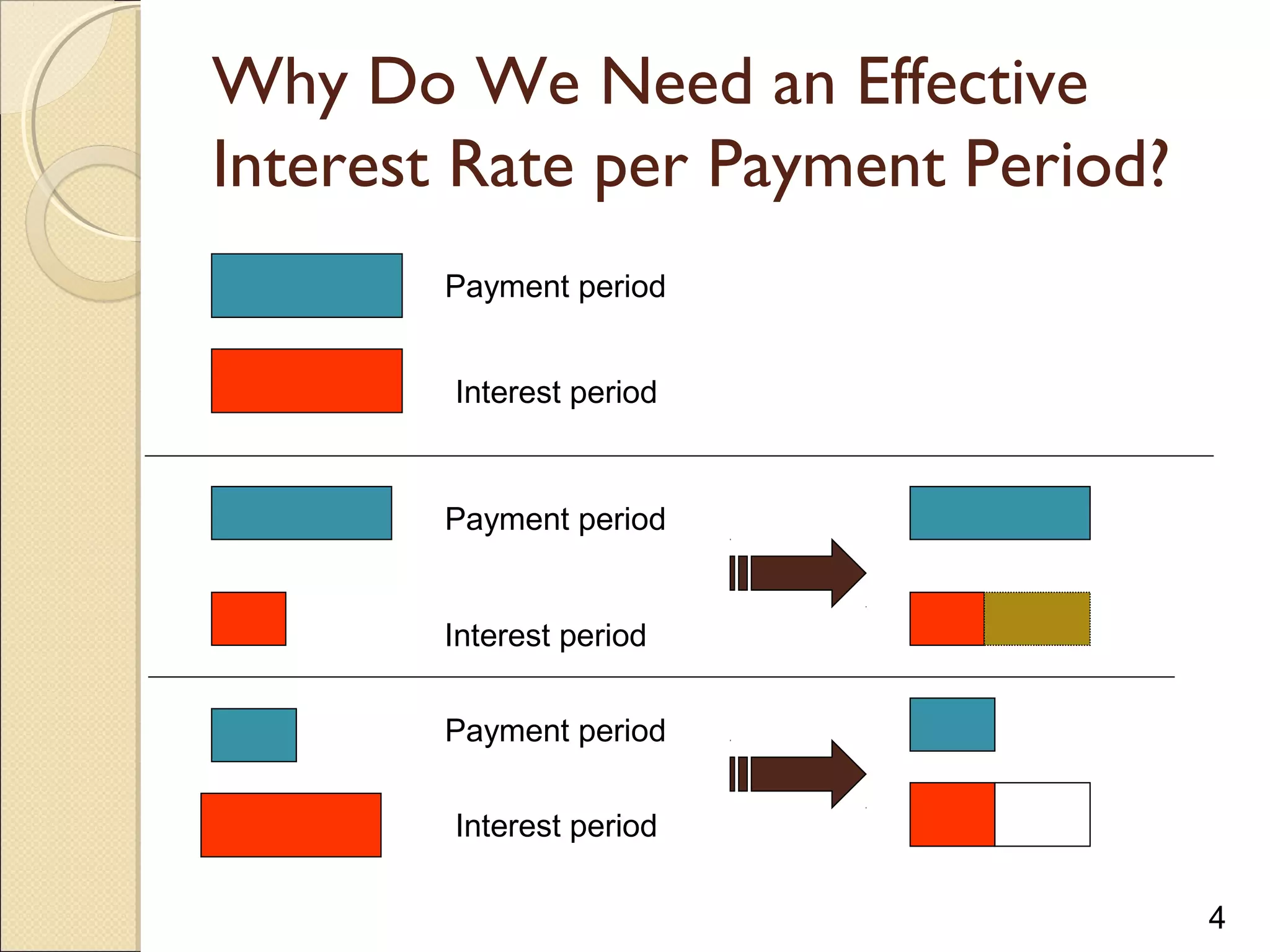
Why Do We Need an Effective
Interest Rate per Payment Period?
Payment period
Interest period
Payment period
Interest period
Payment period
Interest period
5
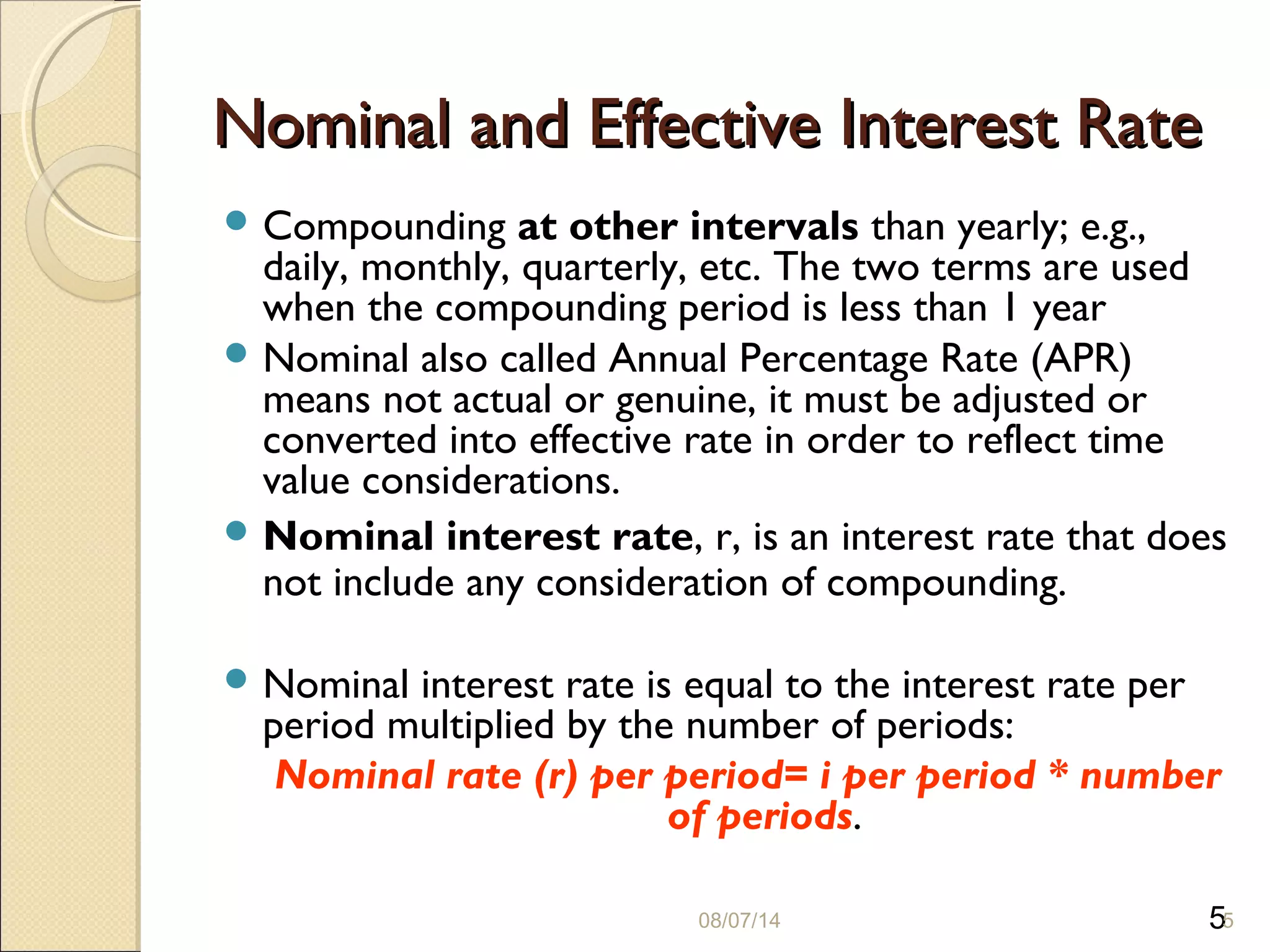
Nominal and Effective Interest RateNominal and Effective Interest Rate
 Compounding at other intervals than yearly; e.g.,
daily, monthly, quarterly, etc. The two terms are used
when the compounding period is less than 1 year
 Nominal also called Annual Percentage Rate (APR)
means not actual or genuine, it must be adjusted or
converted into effective rate in order to reflect time
value considerations.
 Nominal interest rate, r, is an interest rate that does
not include any consideration of compounding.
 Nominal interest rate is equal to the interest rate per
period multiplied by the number of periods:
Nominal rate (r) per period= i per period * number
of periods.
08/07/14 5
6
Nominal and Effective Interest Rate (cont.)Nominal and Effective Interest Rate (cont.)
 A nominal rate can be found for any time period longer than
the originally stated period.
 A nominal rate of 1.5%per month is expressed as a nominal
4.5% per quarter, or 9% per semiannual period, or 18% per
year, or 36% per two years, etc.
 Effective interest rate is the actual rate that applies for a
stated period of time. The compounding of interest during
the time period of the corresponding nominal rate is
accounted for by the effective interest rate.
 An effective rate has the compounding frequency attached
to the nominal rate statement.
 Only effective interest rates can be used in the time value
equations or formulas.
08/07/14
6
7
Nominal and Effective Interest Rate (cont.)Nominal and Effective Interest Rate (cont.)
 Time period-the period over which the interest is expressed.
This is the t in the statement of r% per time period t, for
example, 1 % per month. The time unit of 1 year is by far the
most common. It is assumed when not stated otherwise.
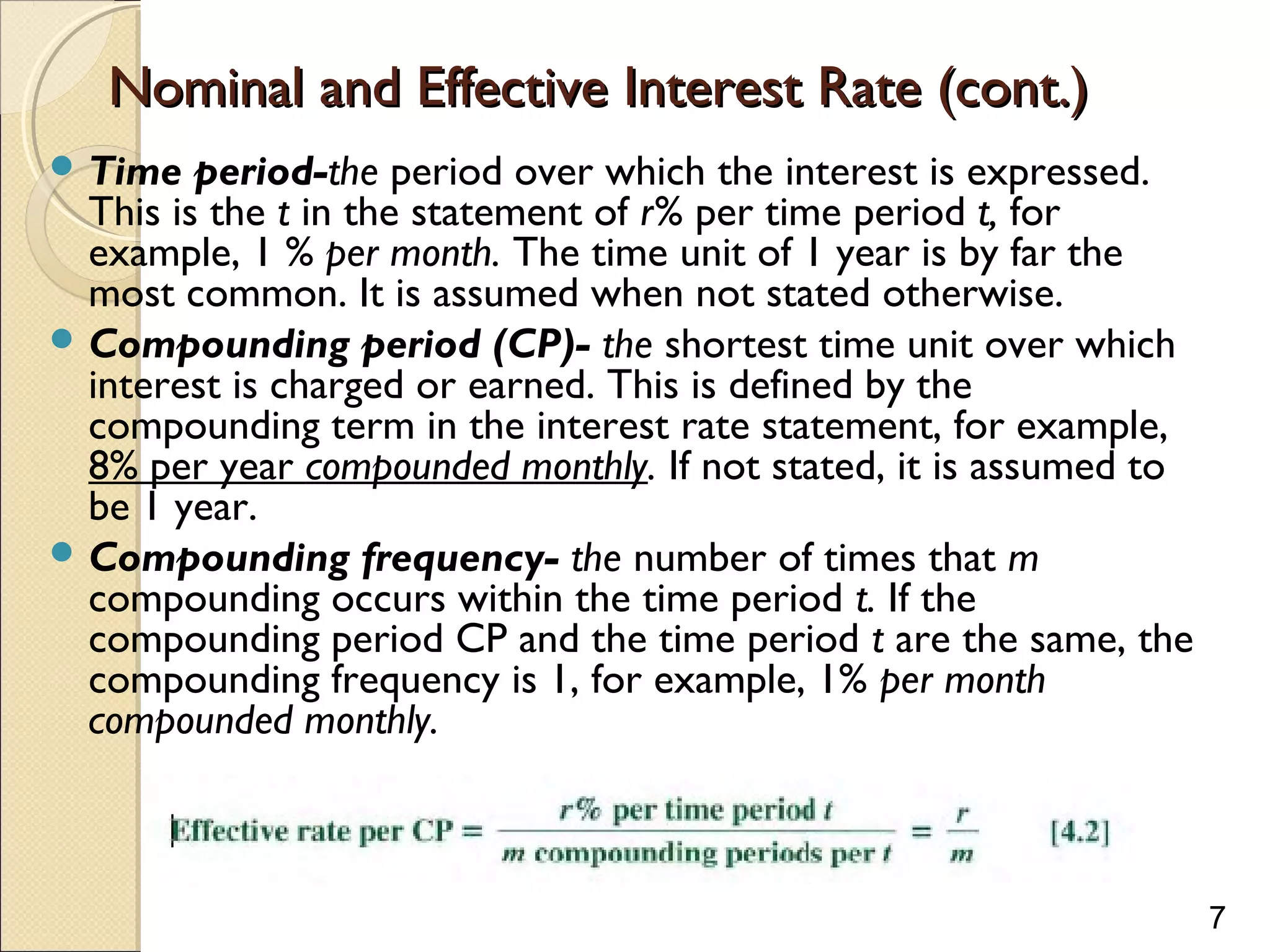
 Compounding period (CP)- the shortest time unit over which
interest is charged or earned. This is defined by the
compounding term in the interest rate statement, for example,
8% per year compounded monthly. If not stated, it is assumed to
be 1 year.
 Compounding frequency- the number of times that m
compounding occurs within the time period t. If the
compounding period CP and the time period t are the same, the
compounding frequency is 1, for example, 1% per month
compounded monthly.
8
Nominal and Effective Interest Rate-ExampleNominal and Effective Interest Rate-Example
Consider the rate 8% per year, compounded
monthly. It has a time period t of 1 year, a
compounding period CP of 1 month, and a
compounding frequency m of 12 times per
year.
A rate of 6% per year, compounded weekly,
has t = 1 year, CP = 1 week, and m = 52,
based on the standard of 52 weeks per year.
9
Nominal and Effective Interest Rate-ExampleNominal and Effective Interest Rate-Example
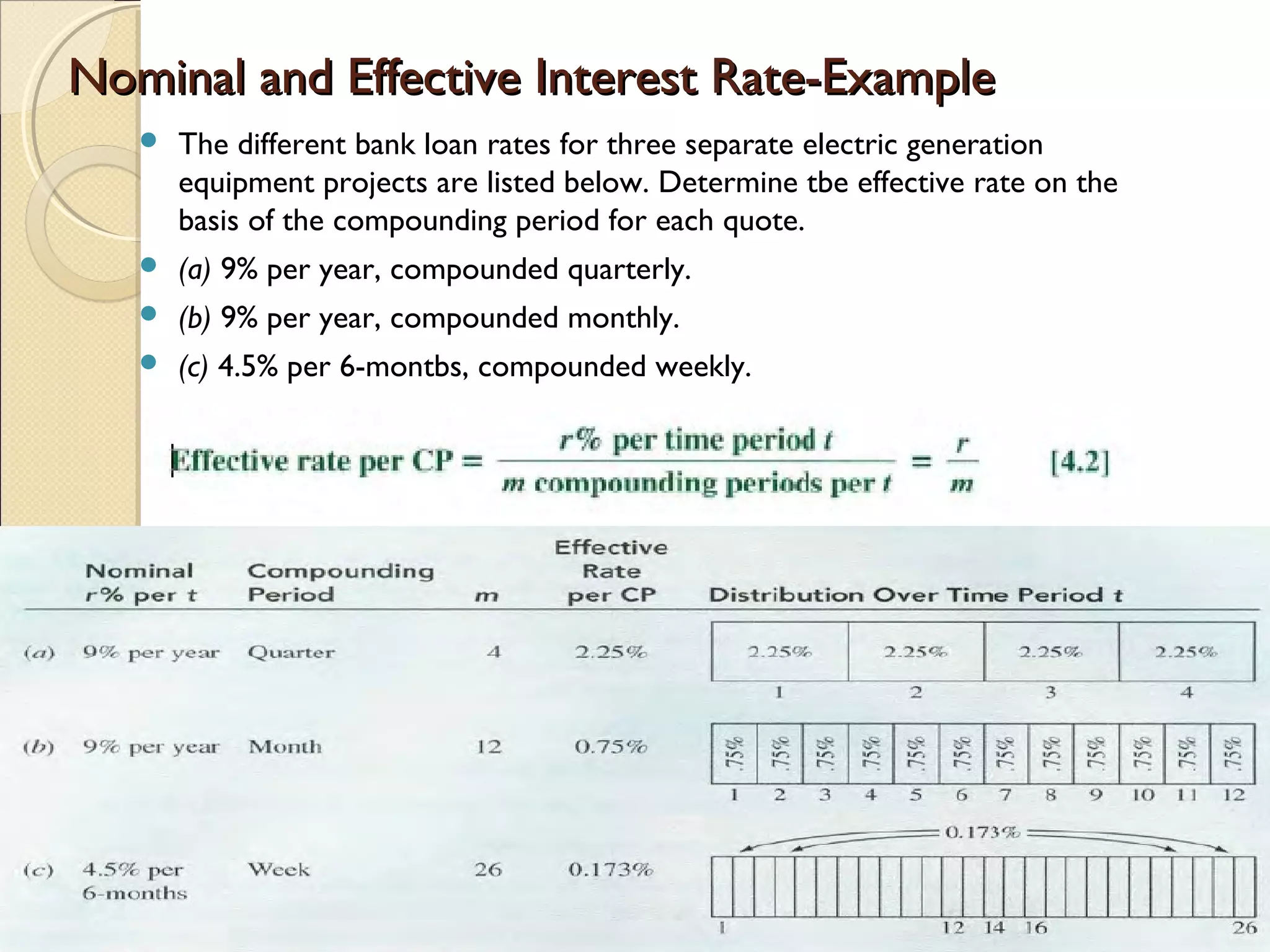
 The different bank loan rates for three separate electric generation
equipment projects are listed below. Determine tbe effective rate on the
basis of the compounding period for each quote.
 (a) 9% per year, compounded quarterly.
 (b) 9% per year, compounded monthly.
 (c) 4.5% per 6-montbs, compounded weekly.
10
Effective interest Rates for Any PeriodEffective interest Rates for Any Period
Effective i =[1+ r/m]m
– 1
◦ i: effective interest rate per year (or certain period)
◦ m: number of compounding periods per payment period
◦ r: nominal interest rate per payment periods
it is possible to take a nominal rate (r% per
year or any other time period) and convert it
to an effective rate i for any time basis, the
most common of which will be the PP time
period.
08/07/14 10
11
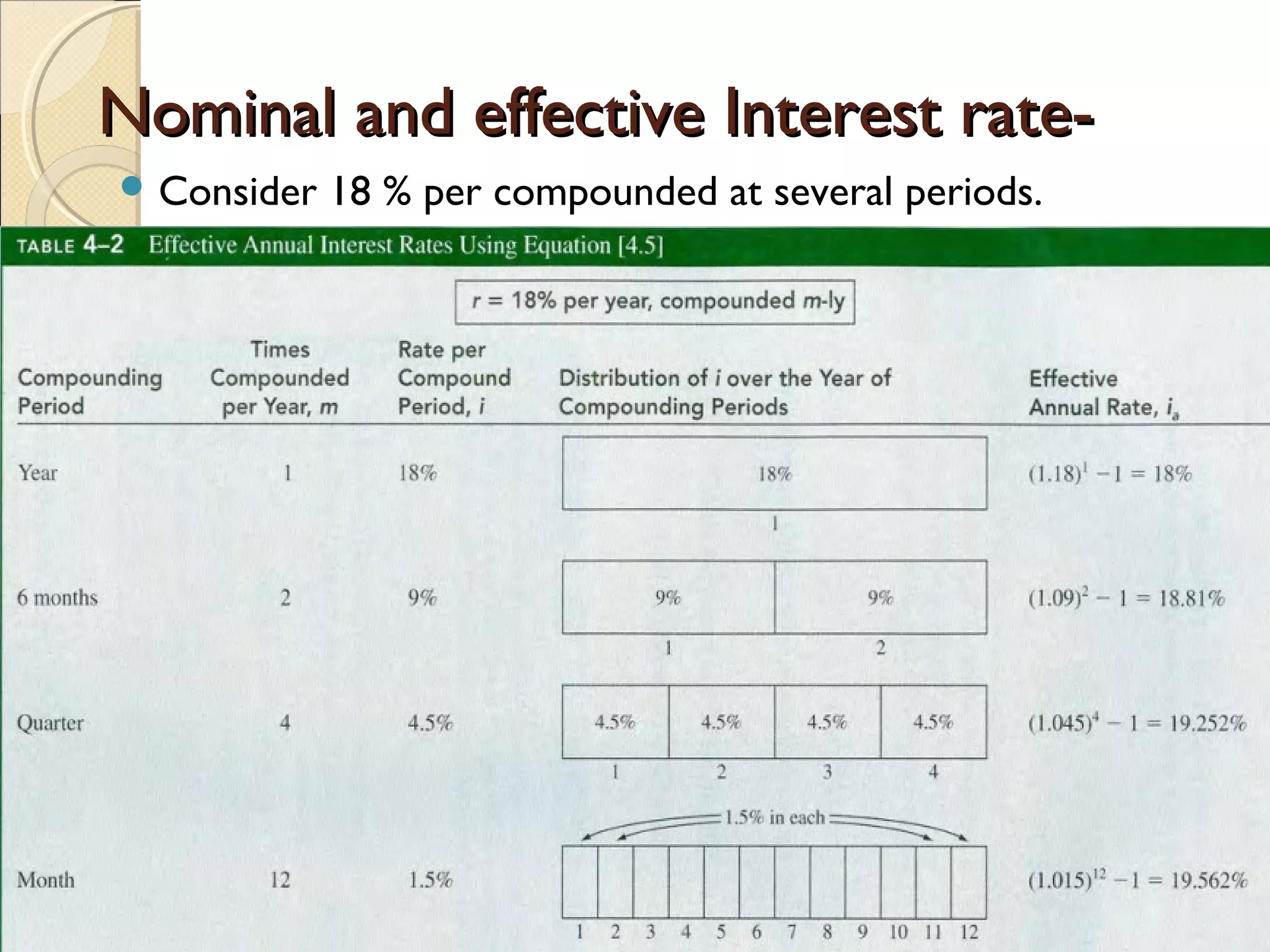
Nominal and effective Interest rate-Nominal and effective Interest rate-
 Consider 18 % per compounded at several periods.
08/07/14 11
12
ExamplesExamples
1) Nominal rate of 18% compounded yearly
with time interval of one year (m=1)
i=[1+0.18/1]1
– 1=18% per year
2) Nominal rate of 18% compounded semi-
annual with a time interval of one year
i=[1+0.18/2]2
– 1= 18.81% per year
3) Nominal rate of 18% compounded quarterly
with a time interval of 1 year i=[1+0.18/4]4
-1= 19.252% per 1 year
08/07/14 12
13
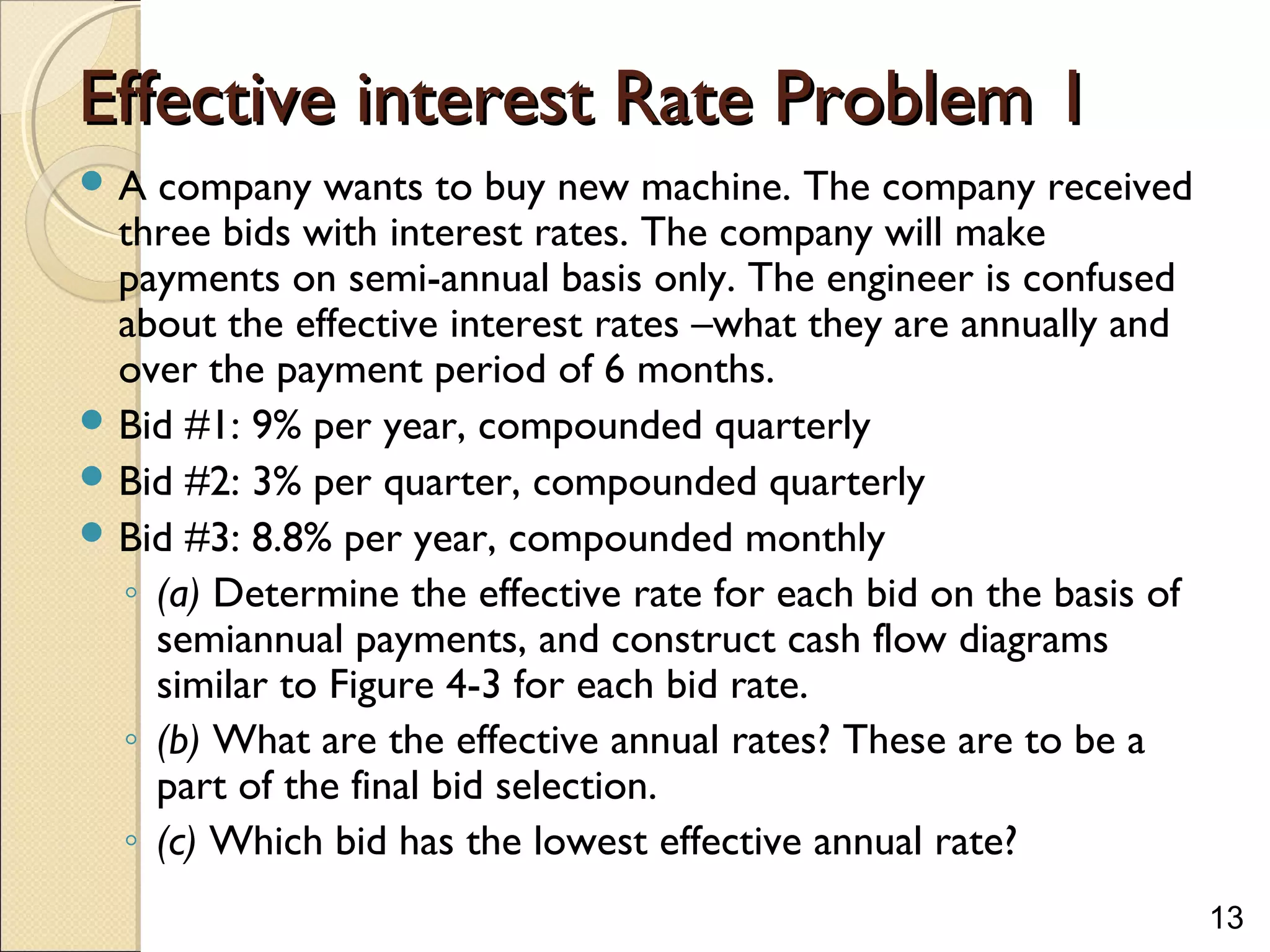
Effective interest Rate Problem 1Effective interest Rate Problem 1
 A company wants to buy new machine. The company received
three bids with interest rates. The company will make
payments on semi-annual basis only. The engineer is confused
about the effective interest rates –what they are annually and
over the payment period of 6 months.
 Bid #1: 9% per year, compounded quarterly
 Bid #2: 3% per quarter, compounded quarterly
 Bid #3: 8.8% per year, compounded monthly
◦ (a) Determine the effective rate for each bid on the basis of
semiannual payments, and construct cash flow diagrams
similar to Figure 4-3 for each bid rate.
◦ (b) What are the effective annual rates? These are to be a
part of the final bid selection.
◦ (c) Which bid has the lowest effective annual rate?
14
15
16
Effective Interest Rate Problem 2Effective Interest Rate Problem 2
 The interest rate on a credit card is 1% per month. Calculate
the effective annual interest rate and use the interest factor
tables to find the corresponding P/F factor for n=8years?
1) 1% is an effective interest rate (Not nominal!!!!)
 Nominal rate = 0.01per month*12months/year
= 0.12
 i=[1+0.12/12]12
-1= 0.1268 = 12.68%
2) P/F = 1/ [1+0.1268]8
= 0.3848
3) by interpolation:
◦ 12% 0.4039
◦ 12.68% P/F
◦ 14% 0.3506
(P/F, 12.68%, 8) = 0.4039-0.0181= 0.3858
08/07/14 16
17
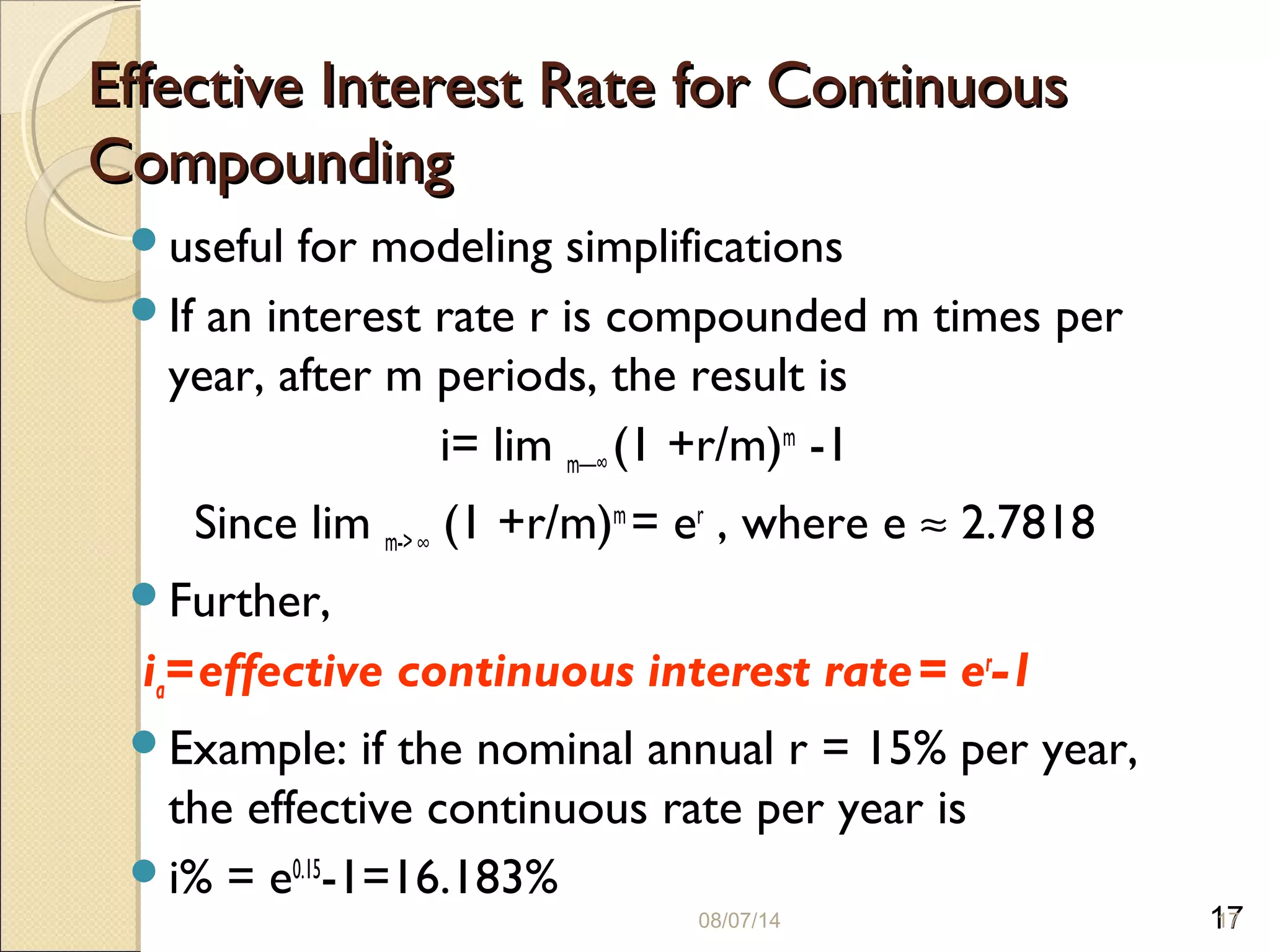
Effective Interest Rate for ContinuousEffective Interest Rate for Continuous
CompoundingCompounding
useful for modeling simplifications
If an interest rate r is compounded m times per
year, after m periods, the result is
i= lim m—∞ (1 +r/m)m
-1
Since lim m-> ∞ (1 +r/m)m
= er
, where e ≈ 2.7818
Further,
ia=effective continuous interest rate= er
-1
Example: if the nominal annual r = 15% per year,
the effective continuous rate per year is
i% = e0.15
-1=16.183%
08/07/14 17
18
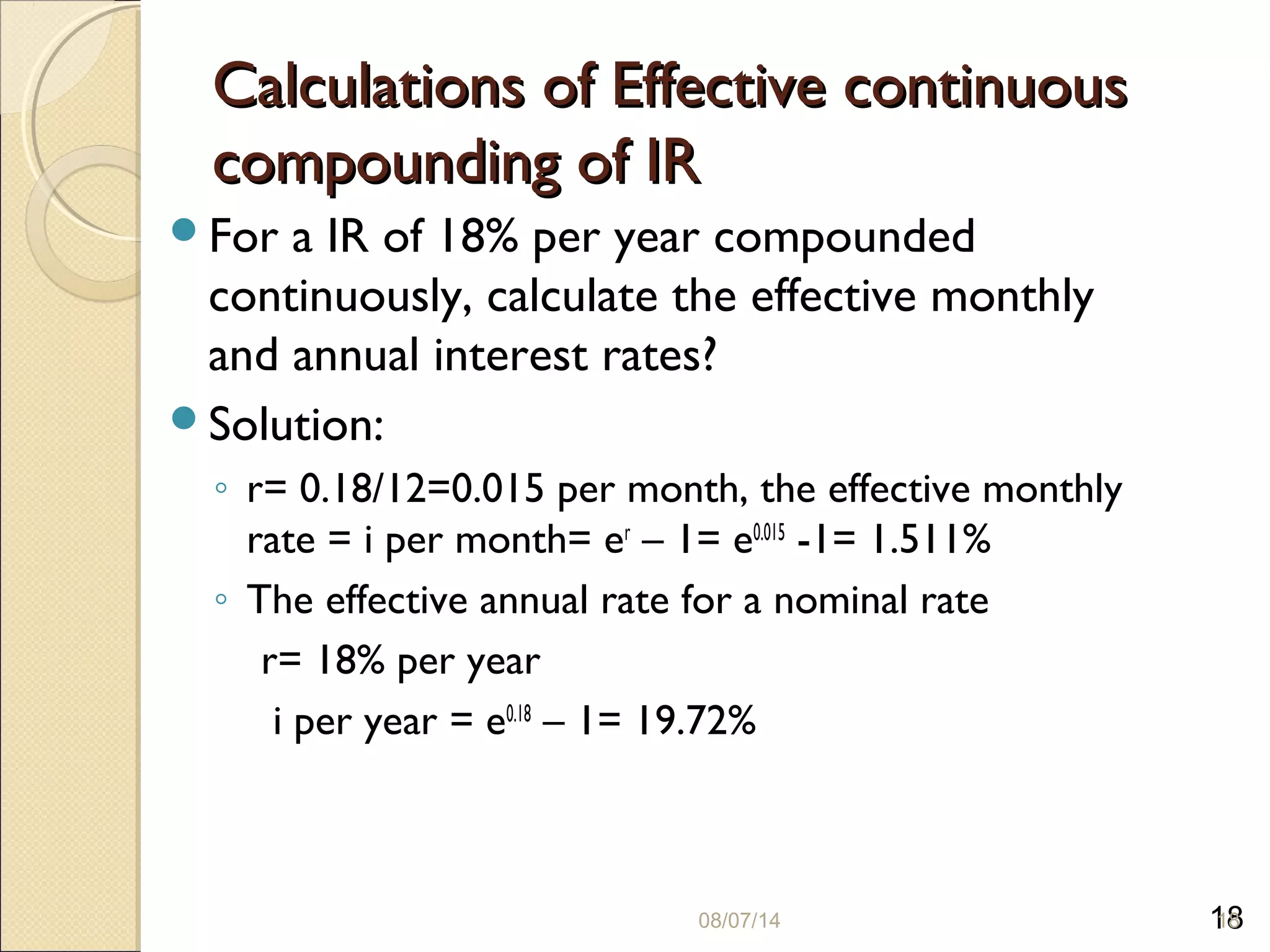
Calculations of Effective continuousCalculations of Effective continuous
compounding of IRcompounding of IR
For a IR of 18% per year compounded
continuously, calculate the effective monthly
and annual interest rates?
Solution:
◦ r= 0.18/12=0.015 per month, the effective monthly
rate = i per month= er
– 1= e0.015
-1= 1.511%
◦ The effective annual rate for a nominal rate
r= 18% per year
i per year = e0.18
– 1= 19.72%
08/07/14 18
19
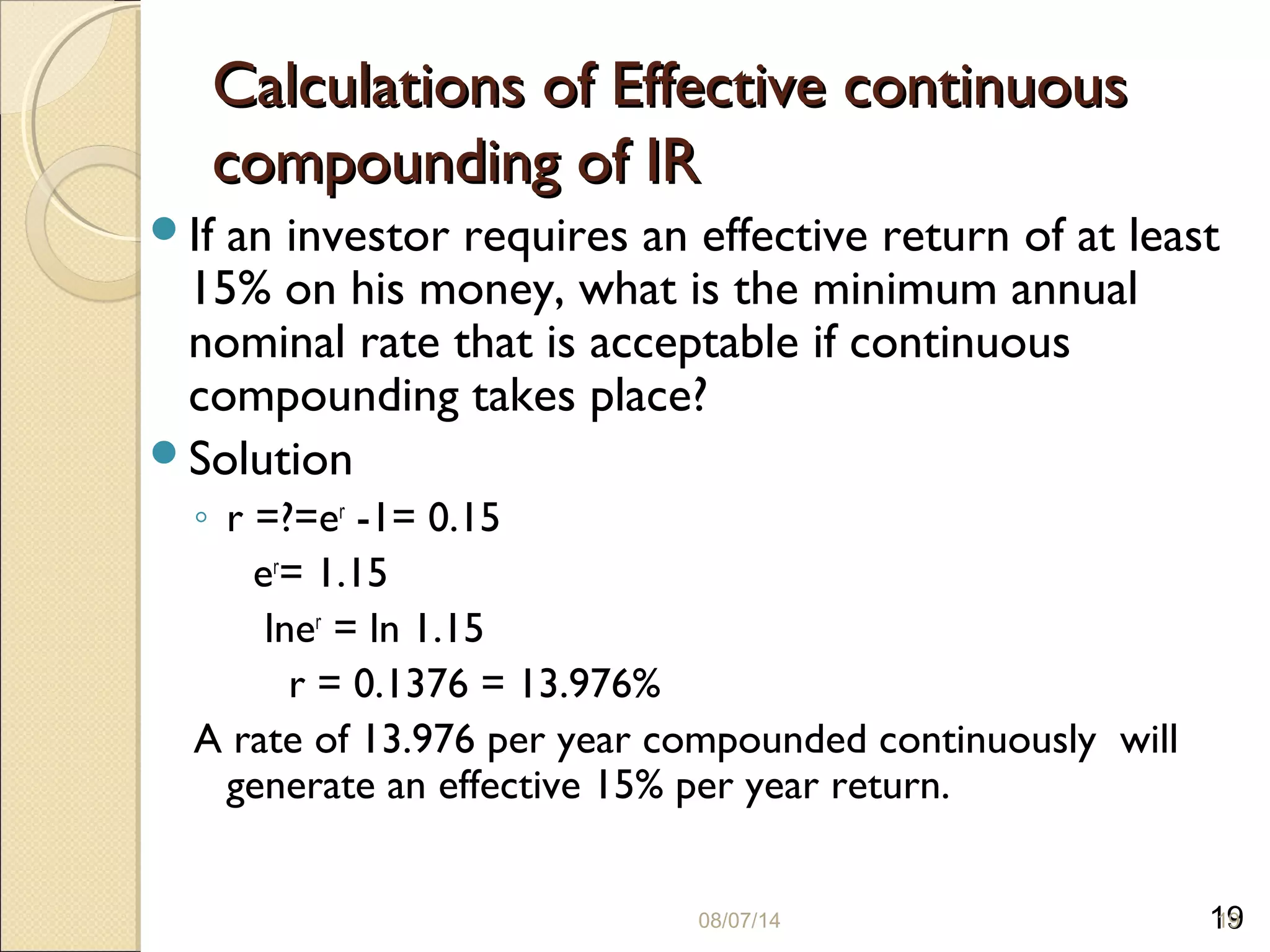
Calculations of Effective continuousCalculations of Effective continuous
compounding of IRcompounding of IR
If an investor requires an effective return of at least
15% on his money, what is the minimum annual
nominal rate that is acceptable if continuous
compounding takes place?
Solution
◦ r =?=er
-1= 0.15
er
= 1.15
lner
= ln 1.15
r = 0.1376 = 13.976%
A rate of 13.976 per year compounded continuously will
generate an effective 15% per year return.
08/07/14 19
20
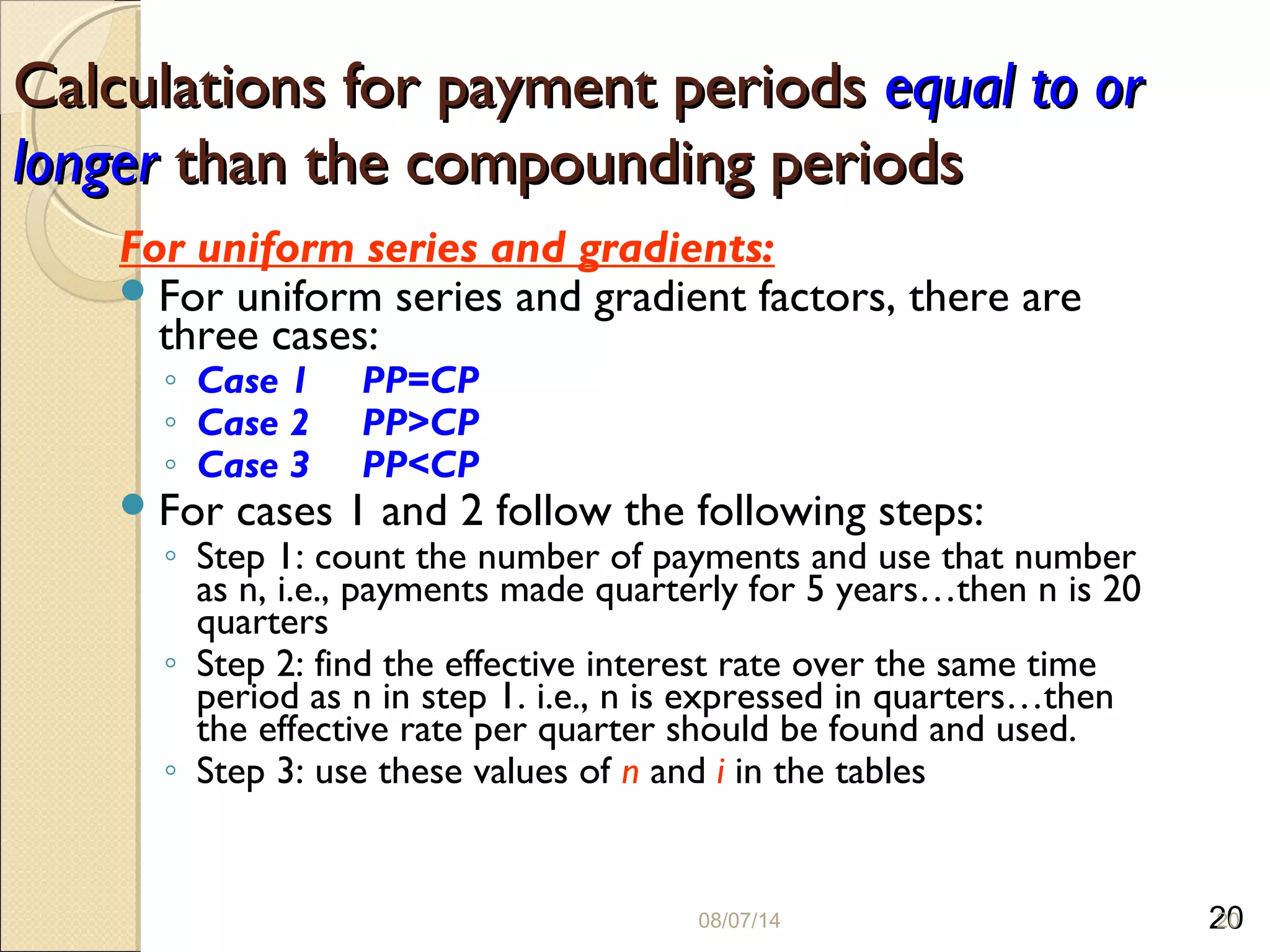
Calculations for payment periodsCalculations for payment periods equal to orequal to or
longerlonger than the compounding periodsthan the compounding periods
For uniform series and gradients:
For uniform series and gradient factors, there are
three cases:
◦ Case 1 PP=CP
◦ Case 2 PP>CP
◦ Case 3 PP<CP
For cases 1 and 2 follow the following steps:
◦ Step 1: count the number of payments and use that number
as n, i.e., payments made quarterly for 5 years…then n is 20
quarters
◦ Step 2: find the effective interest rate over the same time
period as n in step 1. i.e., n is expressed in quarters…then
the effective rate per quarter should be found and used.
◦ Step 3: use these values of n and i in the tables
08/07/14 20
21
Calculations for payment periodsCalculations for payment periods equal to orequal to or
longerlonger than the compounding periods (Sec 4.6)than the compounding periods (Sec 4.6)
For single payment factors:
if the compounding period (CP) and payment period
(PP) do not agree (coincide) then interest tables
cannot be used until appropriate corrections are
made.
For Single payment factors:
◦ An effective rate must be used for i
◦ The units on n must be the same as those on i
◦ If the IR is per X, then n should be in terms of X
08/07/14 21
22
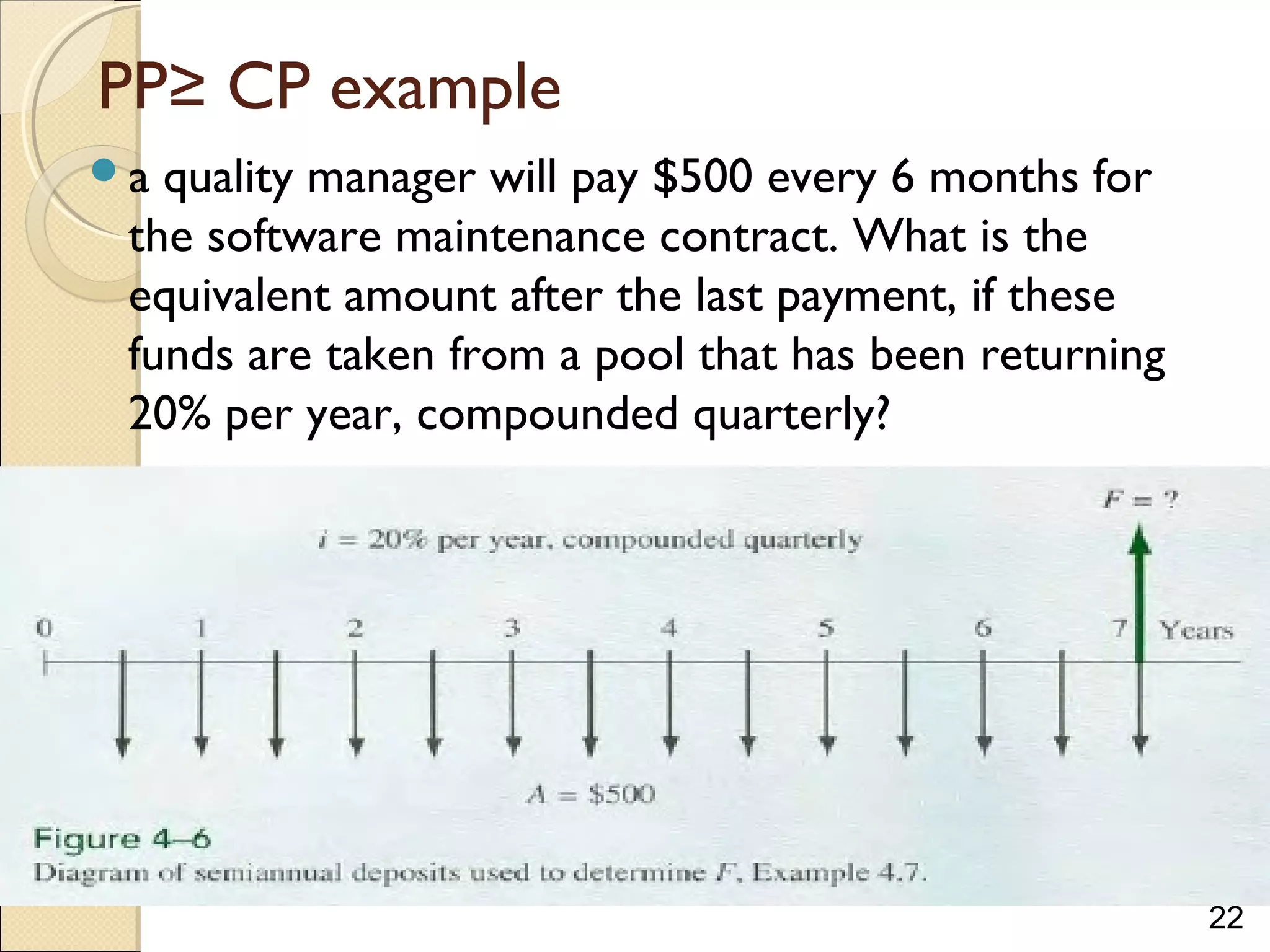
PP≥ CP example
a quality manager will pay $500 every 6 months for
the software maintenance contract. What is the
equivalent amount after the last payment, if these
funds are taken from a pool that has been returning
20% per year, compounded quarterly?
23
PP≥ CP example –cont.
 PP= 6 months, CP is quarterly = 3 months, so PP > CP.
 based on PP (every 6 months), r=20% per year is converted to
semi-annual, r = 0.20/2=0.10,
 m based on r = 6/3=2
 Use Equation (4.8) with r = 0.10 per 6-month period and 2 CP
periods per semiannual period.
 Effective i semi-annual =[1+ r/m]m
– 1= [1+0.10/2]2
-1=10.25%
 Total number of semi-annual payments = 7 yrs*2 = 14
 F=A(F/A,10.25%,14)= 500(28,4891)=14,244.50
24
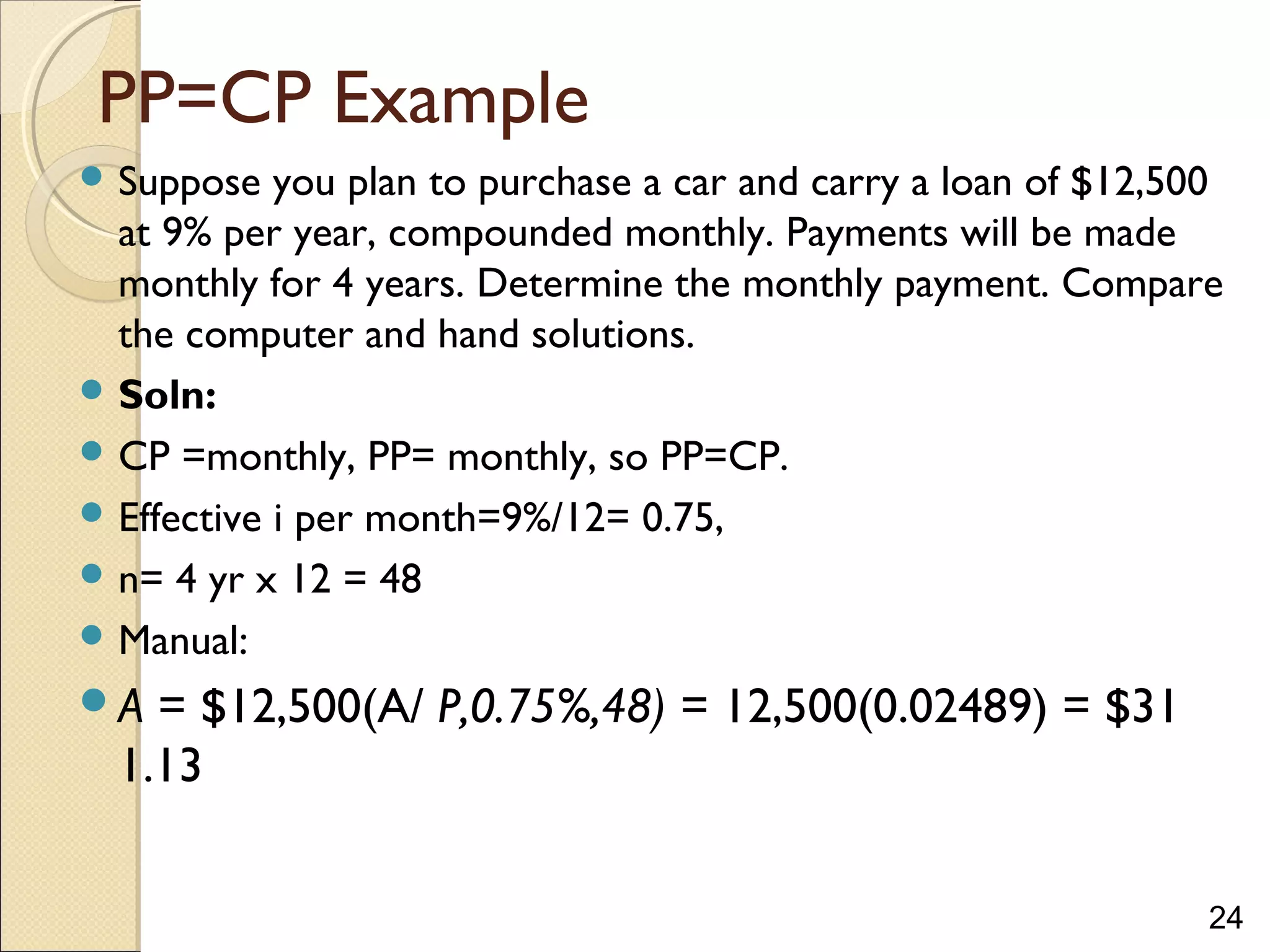
PP=CP Example
 Suppose you plan to purchase a car and carry a loan of $12,500
at 9% per year, compounded monthly. Payments will be made
monthly for 4 years. Determine the monthly payment. Compare
the computer and hand solutions.
 Soln:
 CP =monthly, PP= monthly, so PP=CP.
 Effective i per month=9%/12= 0.75,
 n= 4 yr x 12 = 48
 Manual:
A = $12,500(A/ P,0.75%,48) = 12,500(0.02489) = $31
1.13
25
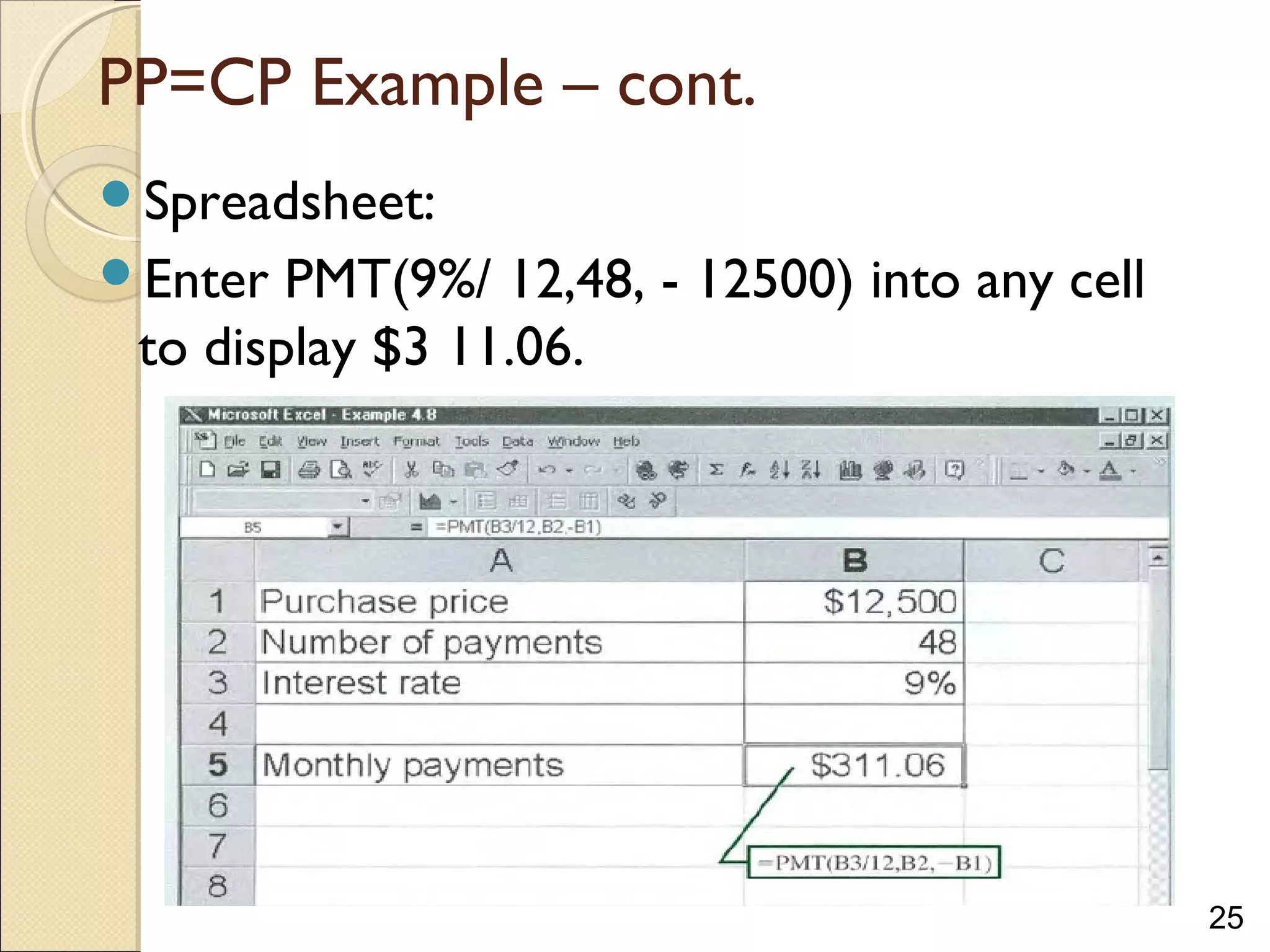
PP=CP Example – cont.
Spreadsheet:
Enter PMT(9%/ 12,48, - 12500) into any cell
to display $3 11.06.
26
Calculations for payment periodsCalculations for payment periods ShorterShorter thanthan
the compounding periodsthe compounding periods
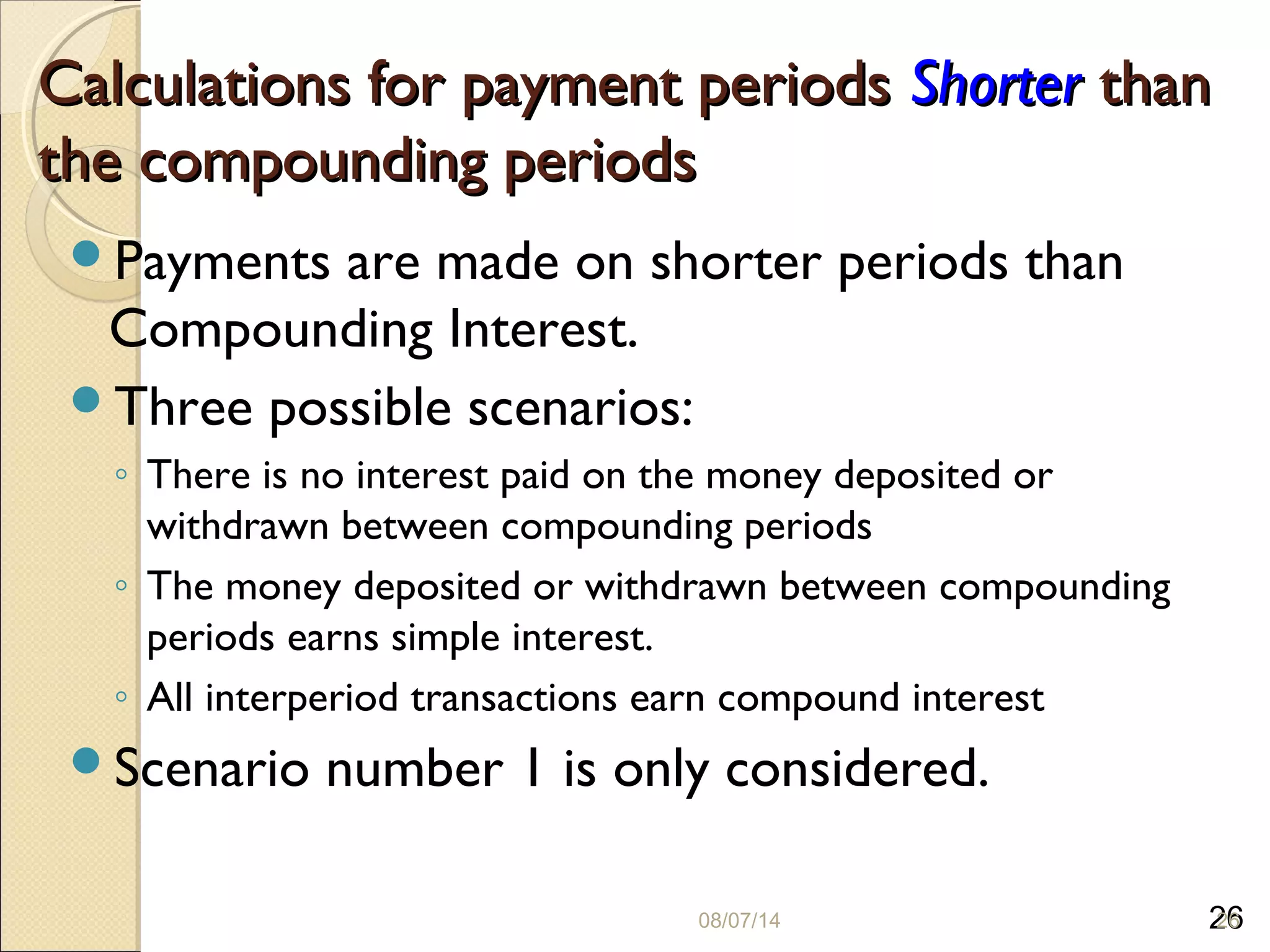
Payments are made on shorter periods than
Compounding Interest.
Three possible scenarios:
◦ There is no interest paid on the money deposited or
withdrawn between compounding periods
◦ The money deposited or withdrawn between compounding
periods earns simple interest.
◦ All interperiod transactions earn compound interest
Scenario number 1 is only considered.
08/07/14 26
2708/07/14 27
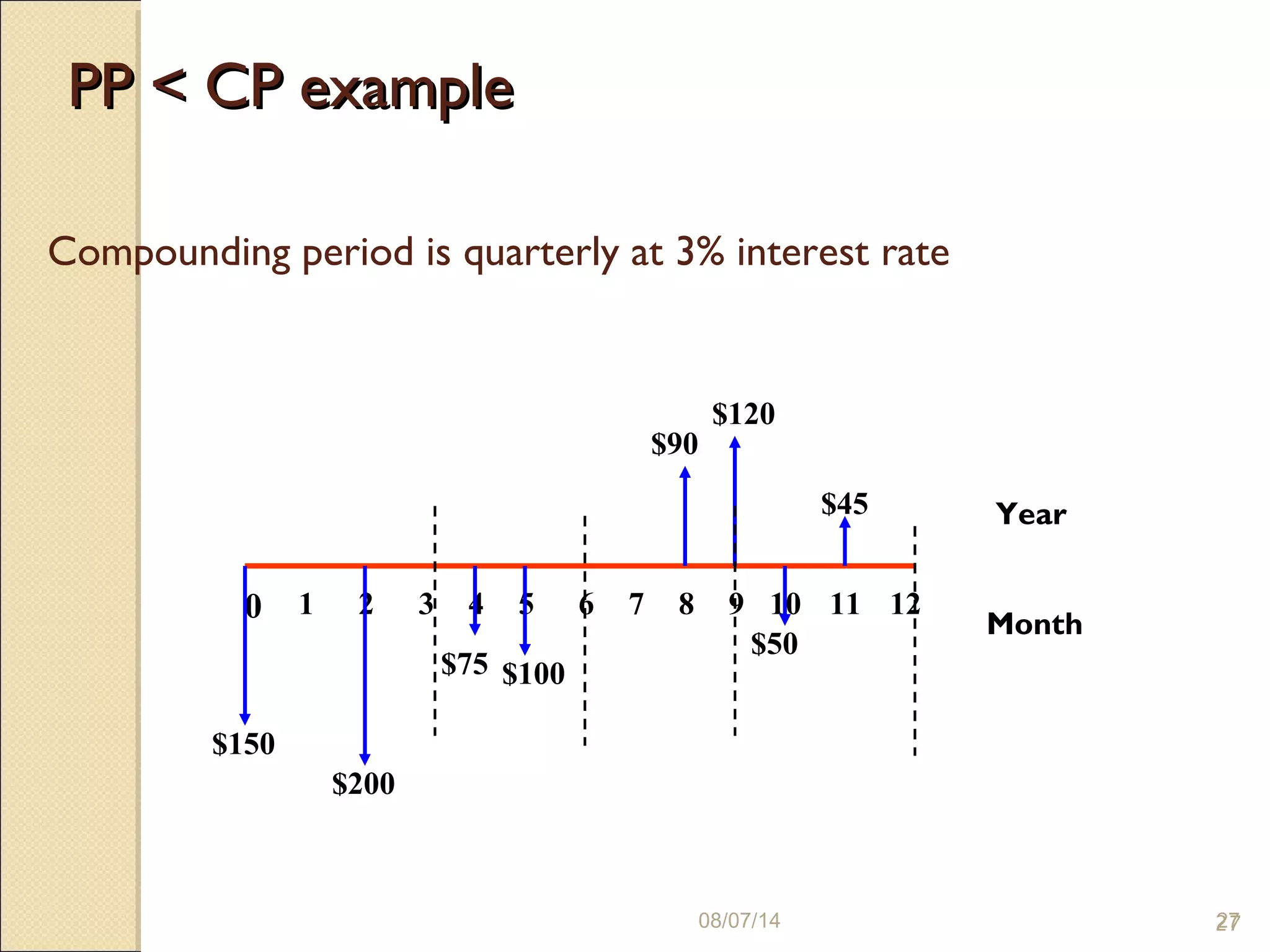
0 1 2 1211109876543
Year
Month
$150
$200
$75 $100
$90
$120
$50
$45
Compounding period is quarterly at 3% interest rate
PP < CP examplePP < CP example
2808/07/14 28
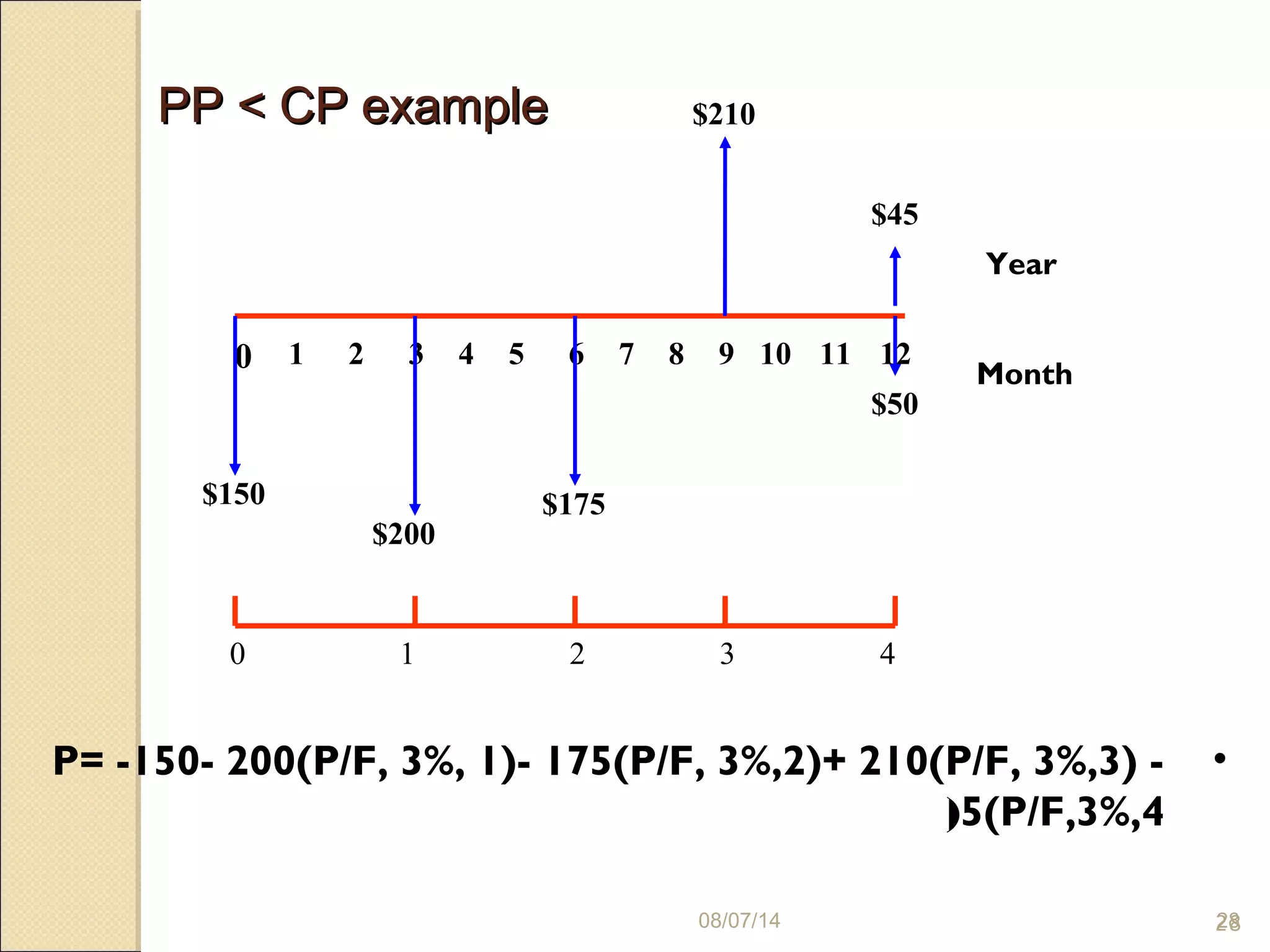
•P= -150- 200(P/F, 3%, 1)- 175(P/F, 3%,2)+ 210(P/F, 3%,3) -
5(P/F,3%,4(
0 1 2 1211109876543
Year
Month
$150
$200
$175
$210
$50
1 2 3 40
$45
PP < CP examplePP < CP example
29
Non-standard Annuities and GradientsNon-standard Annuities and Gradients
 Treat each cash flow individually
 Convert the non-standard annuity or gradient to standard form by
changing the compounding period
 Convert the non-standard annuity to standard by finding an equal
standard annuity for the compounding period
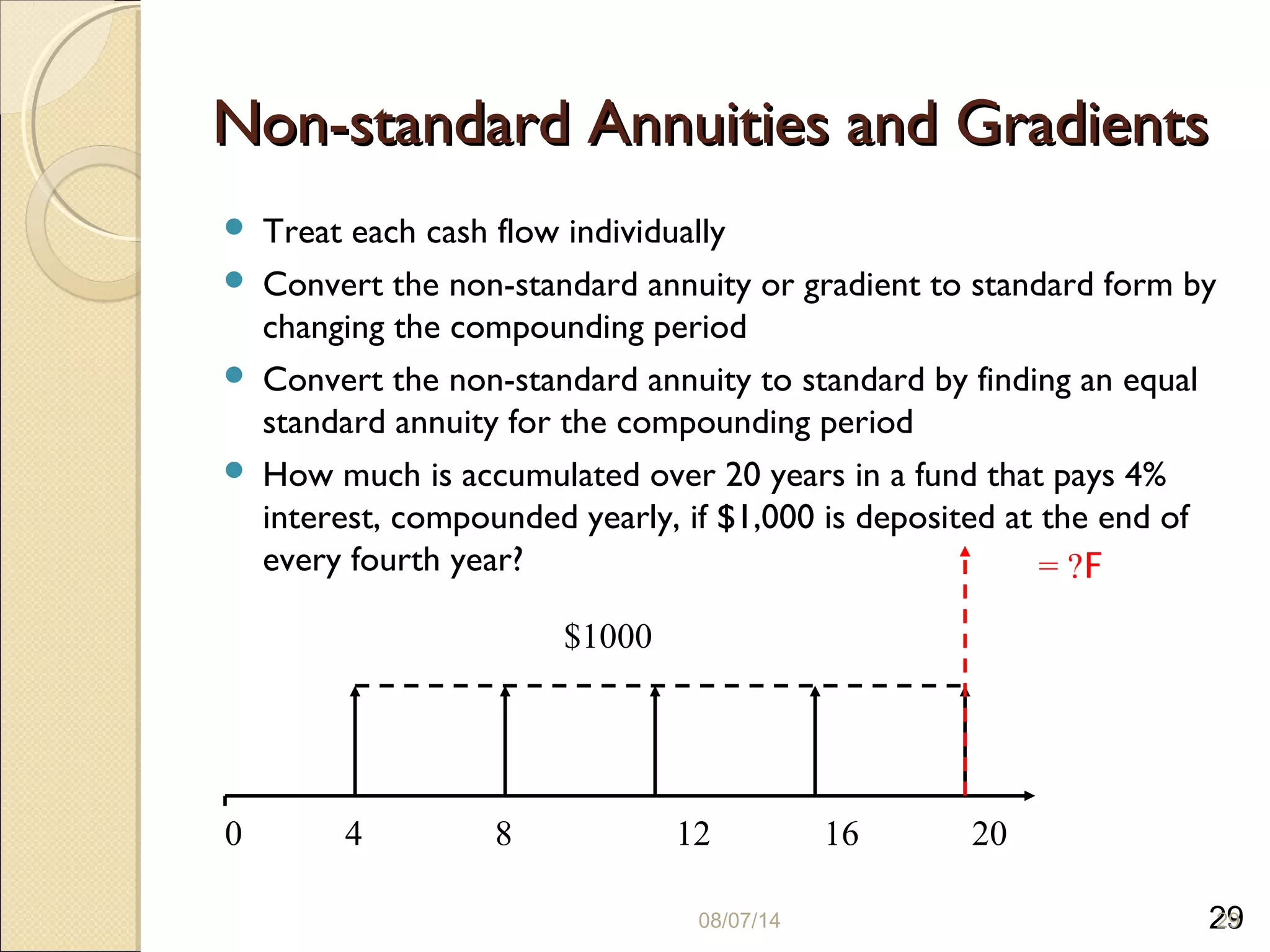
 How much is accumulated over 20 years in a fund that pays 4%
interest, compounded yearly, if $1,000 is deposited at the end of
every fourth year?
08/07/14 29
0 4 8 12 16 20
$1000
F= ?
30
Non-standard Annuities and Gradients-Non-standard Annuities and Gradients-
ExamplesExamples
 Method 1: consider each cash flows separately
F = 1000 (F/P,4%,16) + 1000 (F/P,4%,12) + 1000
(F/P,4%,8) + 1000 (F/P,4%,4) + 1000 = $7013
 Method 2: convert the compounding period from
annual to every four years
ie = (1+0.04)4
-1 = 16.99%
F = 1000 (F/A, 16.99%, 5) = $7013
 Method 3: convert the annuity to an equivalent
yearly annuity
A = 1000(A/F,4%,4) = $235.49
F = 235.49 (F/A,4%,20) = $7012
08/07/14 30

Ch4 nom&effective ir_rev2

  • 1.
    1 Nominal and EffectiveInterest Rates and Continuous Compounding Chapter 4Chapter 4 08/07/14 1
  • 2.
    2 Items Covered inthis ChapterItems Covered in this Chapter Nominal and Effective Interest Rates Continuous Compounding Equivalence calculations for payment periods equal to or longer than the compounding period. Equivalence calculations for payment periods shorter than the compounding period. 08/07/14 2
  • 3.
    3 Nominal Versus EffectiveInterest Rates Nominal Interest Rate: Interest rate quoted based on an annual period Effective Interest Rate: Actual interest earned or paid in a year or some other time period
  • 4.
    4 Why Do WeNeed an Effective Interest Rate per Payment Period? Payment period Interest period Payment period Interest period Payment period Interest period
  • 5.
    5 Nominal and EffectiveInterest RateNominal and Effective Interest Rate  Compounding at other intervals than yearly; e.g., daily, monthly, quarterly, etc. The two terms are used when the compounding period is less than 1 year  Nominal also called Annual Percentage Rate (APR) means not actual or genuine, it must be adjusted or converted into effective rate in order to reflect time value considerations.  Nominal interest rate, r, is an interest rate that does not include any consideration of compounding.  Nominal interest rate is equal to the interest rate per period multiplied by the number of periods: Nominal rate (r) per period= i per period * number of periods. 08/07/14 5
  • 6.
    6 Nominal and EffectiveInterest Rate (cont.)Nominal and Effective Interest Rate (cont.)  A nominal rate can be found for any time period longer than the originally stated period.  A nominal rate of 1.5%per month is expressed as a nominal 4.5% per quarter, or 9% per semiannual period, or 18% per year, or 36% per two years, etc.  Effective interest rate is the actual rate that applies for a stated period of time. The compounding of interest during the time period of the corresponding nominal rate is accounted for by the effective interest rate.  An effective rate has the compounding frequency attached to the nominal rate statement.  Only effective interest rates can be used in the time value equations or formulas. 08/07/14 6
  • 7.
    7 Nominal and EffectiveInterest Rate (cont.)Nominal and Effective Interest Rate (cont.)  Time period-the period over which the interest is expressed. This is the t in the statement of r% per time period t, for example, 1 % per month. The time unit of 1 year is by far the most common. It is assumed when not stated otherwise.  Compounding period (CP)- the shortest time unit over which interest is charged or earned. This is defined by the compounding term in the interest rate statement, for example, 8% per year compounded monthly. If not stated, it is assumed to be 1 year.  Compounding frequency- the number of times that m compounding occurs within the time period t. If the compounding period CP and the time period t are the same, the compounding frequency is 1, for example, 1% per month compounded monthly.
  • 8.
    8 Nominal and EffectiveInterest Rate-ExampleNominal and Effective Interest Rate-Example Consider the rate 8% per year, compounded monthly. It has a time period t of 1 year, a compounding period CP of 1 month, and a compounding frequency m of 12 times per year. A rate of 6% per year, compounded weekly, has t = 1 year, CP = 1 week, and m = 52, based on the standard of 52 weeks per year.
  • 9.
    9 Nominal and EffectiveInterest Rate-ExampleNominal and Effective Interest Rate-Example  The different bank loan rates for three separate electric generation equipment projects are listed below. Determine tbe effective rate on the basis of the compounding period for each quote.  (a) 9% per year, compounded quarterly.  (b) 9% per year, compounded monthly.  (c) 4.5% per 6-montbs, compounded weekly.
  • 10.
    10 Effective interest Ratesfor Any PeriodEffective interest Rates for Any Period Effective i =[1+ r/m]m – 1 ◦ i: effective interest rate per year (or certain period) ◦ m: number of compounding periods per payment period ◦ r: nominal interest rate per payment periods it is possible to take a nominal rate (r% per year or any other time period) and convert it to an effective rate i for any time basis, the most common of which will be the PP time period. 08/07/14 10
  • 11.
    11 Nominal and effectiveInterest rate-Nominal and effective Interest rate-  Consider 18 % per compounded at several periods. 08/07/14 11
  • 12.
    12 ExamplesExamples 1) Nominal rateof 18% compounded yearly with time interval of one year (m=1) i=[1+0.18/1]1 – 1=18% per year 2) Nominal rate of 18% compounded semi- annual with a time interval of one year i=[1+0.18/2]2 – 1= 18.81% per year 3) Nominal rate of 18% compounded quarterly with a time interval of 1 year i=[1+0.18/4]4 -1= 19.252% per 1 year 08/07/14 12
  • 13.
    13 Effective interest RateProblem 1Effective interest Rate Problem 1  A company wants to buy new machine. The company received three bids with interest rates. The company will make payments on semi-annual basis only. The engineer is confused about the effective interest rates –what they are annually and over the payment period of 6 months.  Bid #1: 9% per year, compounded quarterly  Bid #2: 3% per quarter, compounded quarterly  Bid #3: 8.8% per year, compounded monthly ◦ (a) Determine the effective rate for each bid on the basis of semiannual payments, and construct cash flow diagrams similar to Figure 4-3 for each bid rate. ◦ (b) What are the effective annual rates? These are to be a part of the final bid selection. ◦ (c) Which bid has the lowest effective annual rate?
  • 14.
  • 15.
  • 16.
    16 Effective Interest RateProblem 2Effective Interest Rate Problem 2  The interest rate on a credit card is 1% per month. Calculate the effective annual interest rate and use the interest factor tables to find the corresponding P/F factor for n=8years? 1) 1% is an effective interest rate (Not nominal!!!!)  Nominal rate = 0.01per month*12months/year = 0.12  i=[1+0.12/12]12 -1= 0.1268 = 12.68% 2) P/F = 1/ [1+0.1268]8 = 0.3848 3) by interpolation: ◦ 12% 0.4039 ◦ 12.68% P/F ◦ 14% 0.3506 (P/F, 12.68%, 8) = 0.4039-0.0181= 0.3858 08/07/14 16
  • 17.
    17 Effective Interest Ratefor ContinuousEffective Interest Rate for Continuous CompoundingCompounding useful for modeling simplifications If an interest rate r is compounded m times per year, after m periods, the result is i= lim m—∞ (1 +r/m)m -1 Since lim m-> ∞ (1 +r/m)m = er , where e ≈ 2.7818 Further, ia=effective continuous interest rate= er -1 Example: if the nominal annual r = 15% per year, the effective continuous rate per year is i% = e0.15 -1=16.183% 08/07/14 17
  • 18.
    18 Calculations of EffectivecontinuousCalculations of Effective continuous compounding of IRcompounding of IR For a IR of 18% per year compounded continuously, calculate the effective monthly and annual interest rates? Solution: ◦ r= 0.18/12=0.015 per month, the effective monthly rate = i per month= er – 1= e0.015 -1= 1.511% ◦ The effective annual rate for a nominal rate r= 18% per year i per year = e0.18 – 1= 19.72% 08/07/14 18
  • 19.
    19 Calculations of EffectivecontinuousCalculations of Effective continuous compounding of IRcompounding of IR If an investor requires an effective return of at least 15% on his money, what is the minimum annual nominal rate that is acceptable if continuous compounding takes place? Solution ◦ r =?=er -1= 0.15 er = 1.15 lner = ln 1.15 r = 0.1376 = 13.976% A rate of 13.976 per year compounded continuously will generate an effective 15% per year return. 08/07/14 19
  • 20.
    20 Calculations for paymentperiodsCalculations for payment periods equal to orequal to or longerlonger than the compounding periodsthan the compounding periods For uniform series and gradients: For uniform series and gradient factors, there are three cases: ◦ Case 1 PP=CP ◦ Case 2 PP>CP ◦ Case 3 PP<CP For cases 1 and 2 follow the following steps: ◦ Step 1: count the number of payments and use that number as n, i.e., payments made quarterly for 5 years…then n is 20 quarters ◦ Step 2: find the effective interest rate over the same time period as n in step 1. i.e., n is expressed in quarters…then the effective rate per quarter should be found and used. ◦ Step 3: use these values of n and i in the tables 08/07/14 20
  • 21.
    21 Calculations for paymentperiodsCalculations for payment periods equal to orequal to or longerlonger than the compounding periods (Sec 4.6)than the compounding periods (Sec 4.6) For single payment factors: if the compounding period (CP) and payment period (PP) do not agree (coincide) then interest tables cannot be used until appropriate corrections are made. For Single payment factors: ◦ An effective rate must be used for i ◦ The units on n must be the same as those on i ◦ If the IR is per X, then n should be in terms of X 08/07/14 21
  • 22.
    22 PP≥ CP example aquality manager will pay $500 every 6 months for the software maintenance contract. What is the equivalent amount after the last payment, if these funds are taken from a pool that has been returning 20% per year, compounded quarterly?
  • 23.
    23 PP≥ CP example–cont.  PP= 6 months, CP is quarterly = 3 months, so PP > CP.  based on PP (every 6 months), r=20% per year is converted to semi-annual, r = 0.20/2=0.10,  m based on r = 6/3=2  Use Equation (4.8) with r = 0.10 per 6-month period and 2 CP periods per semiannual period.  Effective i semi-annual =[1+ r/m]m – 1= [1+0.10/2]2 -1=10.25%  Total number of semi-annual payments = 7 yrs*2 = 14  F=A(F/A,10.25%,14)= 500(28,4891)=14,244.50
  • 24.
    24 PP=CP Example  Supposeyou plan to purchase a car and carry a loan of $12,500 at 9% per year, compounded monthly. Payments will be made monthly for 4 years. Determine the monthly payment. Compare the computer and hand solutions.  Soln:  CP =monthly, PP= monthly, so PP=CP.  Effective i per month=9%/12= 0.75,  n= 4 yr x 12 = 48  Manual: A = $12,500(A/ P,0.75%,48) = 12,500(0.02489) = $31 1.13
  • 25.
    25 PP=CP Example –cont. Spreadsheet: Enter PMT(9%/ 12,48, - 12500) into any cell to display $3 11.06.
  • 26.
    26 Calculations for paymentperiodsCalculations for payment periods ShorterShorter thanthan the compounding periodsthe compounding periods Payments are made on shorter periods than Compounding Interest. Three possible scenarios: ◦ There is no interest paid on the money deposited or withdrawn between compounding periods ◦ The money deposited or withdrawn between compounding periods earns simple interest. ◦ All interperiod transactions earn compound interest Scenario number 1 is only considered. 08/07/14 26
  • 27.
    2708/07/14 27 0 12 1211109876543 Year Month $150 $200 $75 $100 $90 $120 $50 $45 Compounding period is quarterly at 3% interest rate PP < CP examplePP < CP example
  • 28.
    2808/07/14 28 •P= -150-200(P/F, 3%, 1)- 175(P/F, 3%,2)+ 210(P/F, 3%,3) - 5(P/F,3%,4( 0 1 2 1211109876543 Year Month $150 $200 $175 $210 $50 1 2 3 40 $45 PP < CP examplePP < CP example
  • 29.
    29 Non-standard Annuities andGradientsNon-standard Annuities and Gradients  Treat each cash flow individually  Convert the non-standard annuity or gradient to standard form by changing the compounding period  Convert the non-standard annuity to standard by finding an equal standard annuity for the compounding period  How much is accumulated over 20 years in a fund that pays 4% interest, compounded yearly, if $1,000 is deposited at the end of every fourth year? 08/07/14 29 0 4 8 12 16 20 $1000 F= ?
  • 30.
    30 Non-standard Annuities andGradients-Non-standard Annuities and Gradients- ExamplesExamples  Method 1: consider each cash flows separately F = 1000 (F/P,4%,16) + 1000 (F/P,4%,12) + 1000 (F/P,4%,8) + 1000 (F/P,4%,4) + 1000 = $7013  Method 2: convert the compounding period from annual to every four years ie = (1+0.04)4 -1 = 16.99% F = 1000 (F/A, 16.99%, 5) = $7013  Method 3: convert the annuity to an equivalent yearly annuity A = 1000(A/F,4%,4) = $235.49 F = 235.49 (F/A,4%,20) = $7012 08/07/14 30