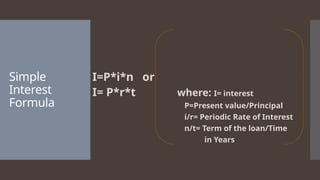
What is
Interest?
Interest isdefined as the cost of borrowing
money. It can also be the rate paid for money
on deposit, as in the case of a certificate of
deposit.
This extra amount is called the “INTEREST”
The original amount borrowed is known as the
“PRINCIPAL” or “CAPITAL” in different
situations.
The sum of both Principal and the interest is
known as “AMOUNT”
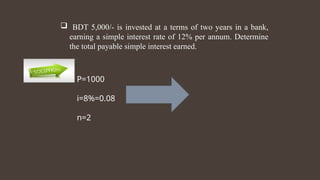
BDT 5,000/-is invested at a terms of two years in a bank,
earning a simple interest rate of 12% per annum. Determine
the total payable simple interest earned.
P=1000
i=8%=0.08
n=2
8.
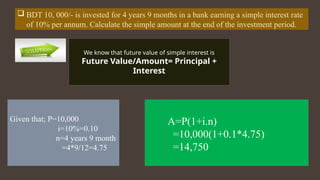
BDT 10,000/- is invested for 4 years 9 months in a bank earning a simple interest rate
of 10% per annum. Calculate the simple amount at the end of the investment period.
Given that; P=10,000
i=10%=0.10
n=4 years 9 month
=4*9/12=4.75
We know that future value of simple interest is
Future Value/Amount= Principal +
Interest
A=P(1+i.n)
=10,000(1+0.1*4.75)
=14,750
9.
What is “CompoundInterest”
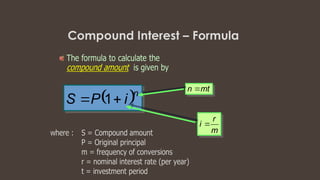
Compound interest is interest calculated on the initial principal and also on
the accumulated interest of previous periods of a deposit or loan.
Compound interest can be thought of as “interest on interest,”
Compound interest make a deposit or loan grow at a faster rate than simple
interest.
10.
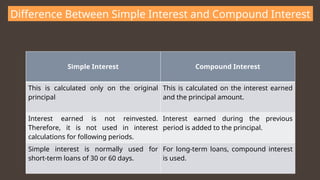
Difference Between SimpleInterest and Compound Interest
Simple Interest Compound Interest
This is calculated only on the original
principal
This is calculated on the interest earned
and the principal amount.
Interest earned is not reinvested.
Therefore, it is not used in interest
calculations for following periods.
Interest earned during the previous
period is added to the principal.
Simple interest is normally used for
short-term loans of 30 or 60 days.
For long-term loans, compound interest
is used.
11.
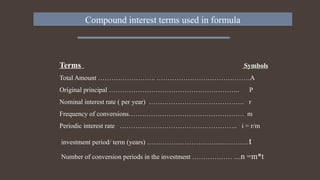
Compound interest termsused in formula
Terms Symbols
Total Amount …………………….. ……………………………………A
Original principal ………………………………………………….. P
Nominal interest rate ( per year) ……………………………………. r
Frequency of conversions……………………………………………. m
Periodic interest rate …………………………………………….. i = r/m
investment period/ term (years) …………………………….…………t
Number of conversion periods in the investment ……………… ....n =m*t
12.
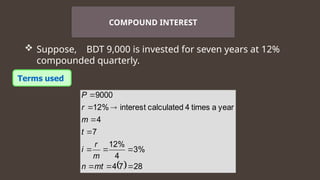
Suppose, BDT9,000 is invested for seven years at 12%
compounded quarterly.
COMPOUND INTEREST
28
7
4
%
3
4
%
12
7
4
year
a
times
4
calculated
interest
%
12
9000
mt
n
m
r
i
t
m
r
P
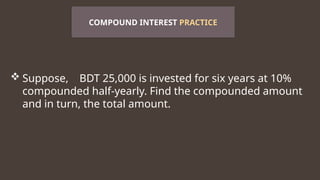
Suppose, BDT25,000 is invested for six years at 10%
compounded half-yearly. Find the compounded amount
and in turn, the total amount.
COMPOUND INTEREST PRACTICE
15.
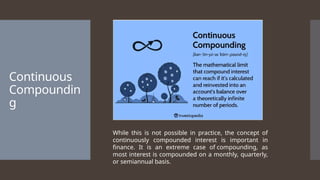
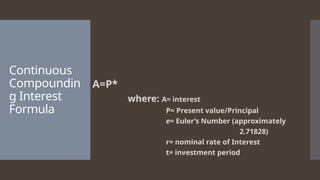
Continuous
Compoundin
g
While this isnot possible in practice, the concept of
continuously compounded interest is important in
finance. It is an extreme case of compounding, as
most interest is compounded on a monthly, quarterly,
or semiannual basis.
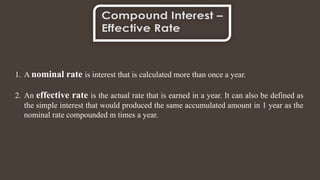
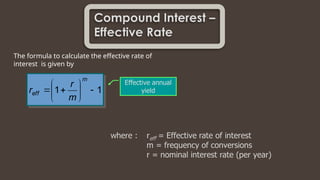
1. A nominalrate is interest that is calculated more than once a year.
2. An effective rate is the actual rate that is earned in a year. It can also be defined as
the simple interest that would produced the same accumulated amount in 1 year as the
nominal rate compounded m times a year.
18.
The formula tocalculate the effective rate of
interest is given by
1
1
m
eff
m
r
r
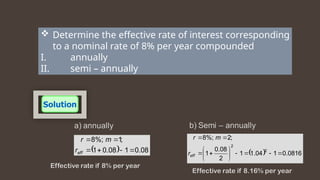
19.
Determine theeffective rate of interest corresponding
to a nominal rate of 8% per year compounded
I. annually
II. semi – annually
08
.
0
1
08
.
0
1
;
1
%;
8
eff
r
m
r
0816
.
0
1
04
.
1
1
2
08
.
0
1
;
2
%;
8
2
2
eff
r
m
r
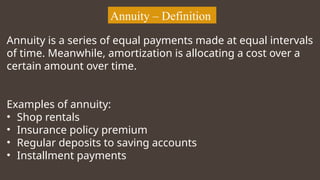
20.
Annuity – Definition
Annuityis a series of equal payments made at equal intervals
of time. Meanwhile, amortization is allocating a cost over a
certain amount over time.
Examples of annuity:
• Shop rentals
• Insurance policy premium
• Regular deposits to saving accounts
• Installment payments
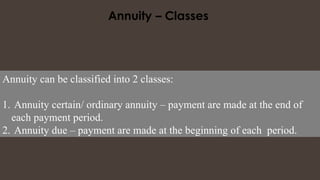
21.
Annuity can beclassified into 2 classes:
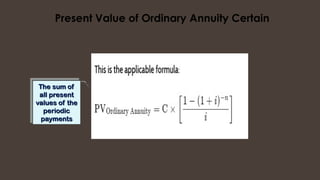
1. Annuity certain/ ordinary annuity – payment are made at the end of
each payment period.
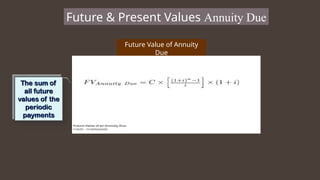
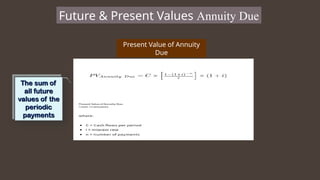
2. Annuity due – payment are made at the beginning of each period.
22.
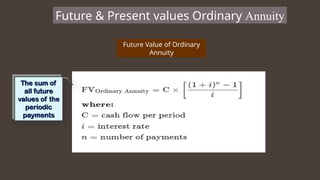
Future & Presentvalues Ordinary Annuity
Future Value of Ordinary
Annuity
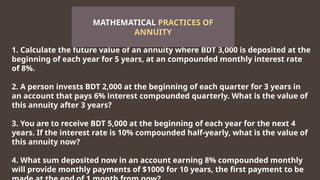
1. Calculate thefuture value of an annuity where BDT 3,000 is deposited at the
beginning of each year for 5 years, at an compounded monthly interest rate
of 8%.
2. A person invests BDT 2,000 at the beginning of each quarter for 3 years in
an account that pays 6% interest compounded quarterly. What is the value of
this annuity after 3 years?
3. You are to receive BDT 5,000 at the beginning of each year for the next 4
years. If the interest rate is 10% compounded half-yearly, what is the value of
this annuity now?
4. What sum deposited now in an account earning 8% compounded monthly
will provide monthly payments of $1000 for 10 years, the first payment to be
MATHEMATICAL PRACTICES OF
ANNUITY
27.
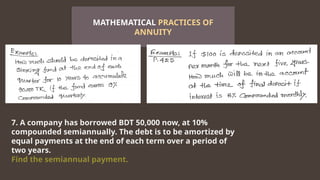
7. A companyhas borrowed BDT 50,000 now, at 10%
compounded semiannually. The debt is to be amortized by
equal payments at the end of each term over a period of
two years.
Find the semiannual payment.
MATHEMATICAL PRACTICES OF
ANNUITY