EGR 312 – Spring ‘05 1
Arithmetic Gradient Factors (P/G, A/G)
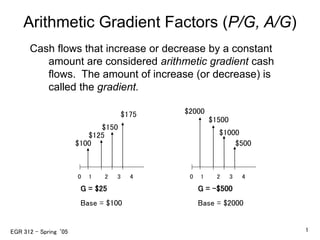
Cash flows that increase or decrease by a constant
amount are considered arithmetic gradient cash
flows. The amount of increase (or decrease) is
called the gradient.
$100
$125
$150
$175
G = $25
Base = $100
0 1 2 3 4
$2000
$1500
$1000
$500
G = -$500
Base = $2000
0 1 2 3 4
EGR 312 – Spring ‘05 2
Arithmetic Gradient Factors (P/G, A/G)
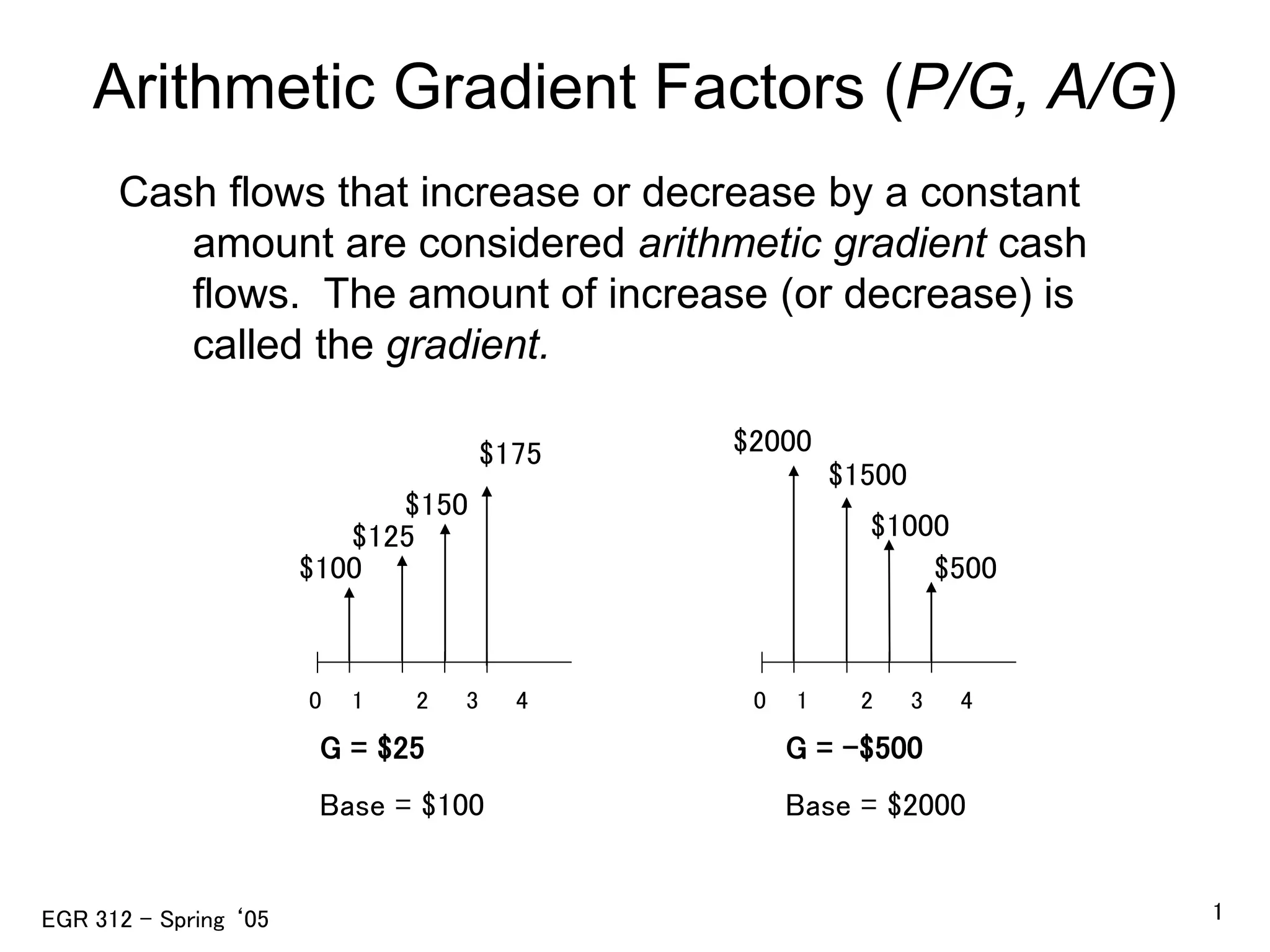
Equivalent cash flows:
 +
Note: the gradient series by
convention starts in year 2.
$100
$125
$150
$175
G = $25
Base = $100
0 1 2 3 4 0 1 2 3 4
$100
0 1 2 3 4
$25
$50
$75
EGR 312 – Spring ‘05 3
Arithmetic Gradient Factors (P/G, A/G)
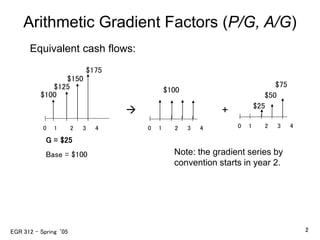
To find P for a gradient cash flow that starts at the end
of year 2 and end at year n:
or P = G(P/G,i,n)
where (P/G,i,n) =
0 1 2 3 …
n
G
2G
nG
P











 n
n
n
i
n
i
i
i
i
G
P
)
1
(
)
1
(
1
)
1
(











n
n
n
i
n
i
i
i
i )
1
(
)
1
(
1
)
1
(
1
Problems
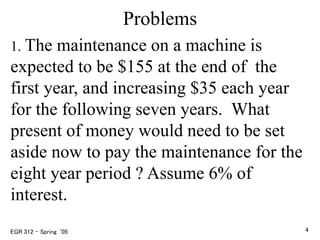
1. The maintenance on a machine is
expected to be $155 at the end of the
first year, and increasing $35 each year
for the following seven years. What
present of money would need to be set
aside now to pay the maintenance for the
eight year period ? Assume 6% of
interest.
EGR 312 – Spring ‘05 4
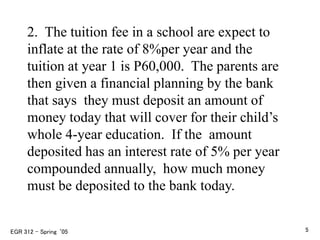
2. The tuition fee in a school are expect to
inflate at the rate of 8%per year and the
tuition at year 1 is P60,000. The parents are
then given a financial planning by the bank
that says they must deposit an amount of
money today that will cover for their child’s
whole 4-year education. If the amount
deposited has an interest rate of 5% per year
compounded annually, how much money
must be deposited to the bank today.
EGR 312 – Spring ‘05 5
EGR 312 – Spring ‘05 6
Arithmetic Gradient Factors (P/G, A/G)
To find P for the arithmetic gradient cash flow:
 +
P = $100(P/A,i,4) + $25(P/G,i,4)
$155
$125
$150
$175
0 1 2 3 4 0 1 2 3 4
$155
0 1 2 3 4
$35
$70
$105
EGR 312 – Spring ‘05 7
Arithmetic Gradient Factors (P/G, A/G)
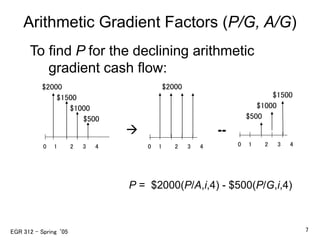
To find P for the declining arithmetic
gradient cash flow:
 --
P = $2000(P/A,i,4) - $500(P/G,i,4)
$2000
$1500
$1000
$500
0 1 2 3 4 0 1 2 3 4
$2000
0 1 2 3 4
$500
$1000
$1500
EGR 312 – Spring ‘05 8
Arithmetic Gradient Factors (P/G, A/G)
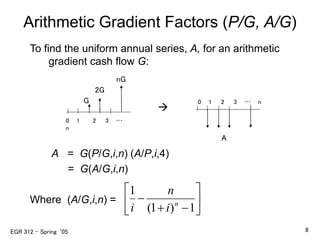
To find the uniform annual series, A, for an arithmetic
gradient cash flow G:

A = G(P/G,i,n) (A/P,i,4)
= G(A/G,i,n)
Where (A/G,i,n) =
0 1 2 3 …
n
G
2G
nG
0 1 2 3 … n
A









1
)
1
(
1
n
i
n
i
EGR 312 – Spring ‘05 9
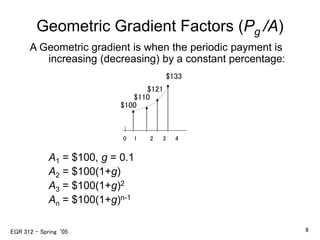
Geometric Gradient Factors (Pg /A)
A Geometric gradient is when the periodic payment is
increasing (decreasing) by a constant percentage:
A1 = $100, g = 0.1
A2 = $100(1+g)
A3 = $100(1+g)2
An = $100(1+g)n-1
$100
$110
$121
$133
0 1 2 3 4
EGR 312 – Spring ‘05 10
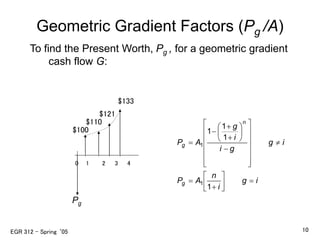
Geometric Gradient Factors (Pg /A)
To find the Present Worth, Pg , for a geometric gradient
cash flow G:
Pg
$100
$110
$121
$133
0 1 2 3 4
i
g
i
n
A
P
i
g
g
i
i
g
A
P
g
n
g



































1
1
1
1
1
1
EGR 312 – Spring ‘05 11
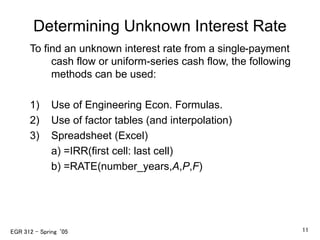
Determining Unknown Interest Rate
To find an unknown interest rate from a single-payment
cash flow or uniform-series cash flow, the following
methods can be used:
1) Use of Engineering Econ. Formulas.
2) Use of factor tables (and interpolation)
3) Spreadsheet (Excel)
a) =IRR(first cell: last cell)
b) =RATE(number_years,A,P,F)
EGR 312 – Spring ‘05 12
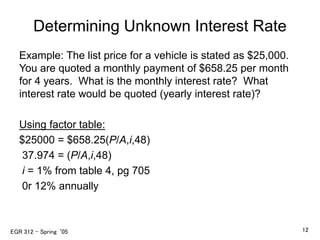
Determining Unknown Interest Rate
Example: The list price for a vehicle is stated as $25,000.
You are quoted a monthly payment of $658.25 per month
for 4 years. What is the monthly interest rate? What
interest rate would be quoted (yearly interest rate)?
Using factor table:
$25000 = $658.25(P/A,i,48)
37.974 = (P/A,i,48)
i = 1% from table 4, pg 705
0r 12% annually
EGR 312 – Spring ‘05 13
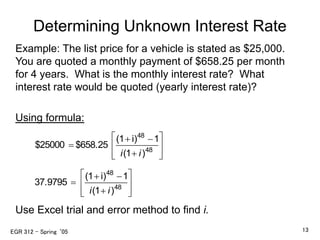
Determining Unknown Interest Rate
Example: The list price for a vehicle is stated as $25,000.
You are quoted a monthly payment of $658.25 per month
for 4 years. What is the monthly interest rate? What
interest rate would be quoted (yearly interest rate)?
Using formula:
Use Excel trial and error method to find i.











 48
48
)
1
(
1
i)
(1
$658.25
$25000
i
i











 48
48
)
1
(
1
i)
(1
37.9795
i
i
EGR 312 – Spring ‘05 14
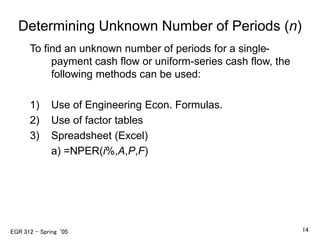
Determining Unknown Number of Periods (n)
To find an unknown number of periods for a single-
payment cash flow or uniform-series cash flow, the
following methods can be used:
1) Use of Engineering Econ. Formulas.
2) Use of factor tables
3) Spreadsheet (Excel)
a) =NPER(i%,A,P,F)
EGR 312 – Spring ‘05 15
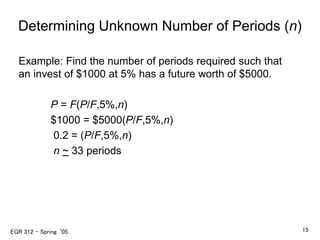
Determining Unknown Number of Periods (n)
Example: Find the number of periods required such that
an invest of $1000 at 5% has a future worth of $5000.
P = F(P/F,5%,n)
$1000 = $5000(P/F,5%,n)
0.2 = (P/F,5%,n)
n ~ 33 periods

Arithmetic gradient.ppt

  • 1.
    EGR 312 –Spring ‘05 1 Arithmetic Gradient Factors (P/G, A/G) Cash flows that increase or decrease by a constant amount are considered arithmetic gradient cash flows. The amount of increase (or decrease) is called the gradient. $100 $125 $150 $175 G = $25 Base = $100 0 1 2 3 4 $2000 $1500 $1000 $500 G = -$500 Base = $2000 0 1 2 3 4
  • 2.
    EGR 312 –Spring ‘05 2 Arithmetic Gradient Factors (P/G, A/G) Equivalent cash flows:  + Note: the gradient series by convention starts in year 2. $100 $125 $150 $175 G = $25 Base = $100 0 1 2 3 4 0 1 2 3 4 $100 0 1 2 3 4 $25 $50 $75
  • 3.
    EGR 312 –Spring ‘05 3 Arithmetic Gradient Factors (P/G, A/G) To find P for a gradient cash flow that starts at the end of year 2 and end at year n: or P = G(P/G,i,n) where (P/G,i,n) = 0 1 2 3 … n G 2G nG P             n n n i n i i i i G P ) 1 ( ) 1 ( 1 ) 1 (            n n n i n i i i i ) 1 ( ) 1 ( 1 ) 1 ( 1
  • 4.
    Problems 1. The maintenanceon a machine is expected to be $155 at the end of the first year, and increasing $35 each year for the following seven years. What present of money would need to be set aside now to pay the maintenance for the eight year period ? Assume 6% of interest. EGR 312 – Spring ‘05 4
  • 5.
    2. The tuitionfee in a school are expect to inflate at the rate of 8%per year and the tuition at year 1 is P60,000. The parents are then given a financial planning by the bank that says they must deposit an amount of money today that will cover for their child’s whole 4-year education. If the amount deposited has an interest rate of 5% per year compounded annually, how much money must be deposited to the bank today. EGR 312 – Spring ‘05 5
  • 6.
    EGR 312 –Spring ‘05 6 Arithmetic Gradient Factors (P/G, A/G) To find P for the arithmetic gradient cash flow:  + P = $100(P/A,i,4) + $25(P/G,i,4) $155 $125 $150 $175 0 1 2 3 4 0 1 2 3 4 $155 0 1 2 3 4 $35 $70 $105
  • 7.
    EGR 312 –Spring ‘05 7 Arithmetic Gradient Factors (P/G, A/G) To find P for the declining arithmetic gradient cash flow:  -- P = $2000(P/A,i,4) - $500(P/G,i,4) $2000 $1500 $1000 $500 0 1 2 3 4 0 1 2 3 4 $2000 0 1 2 3 4 $500 $1000 $1500
  • 8.
    EGR 312 –Spring ‘05 8 Arithmetic Gradient Factors (P/G, A/G) To find the uniform annual series, A, for an arithmetic gradient cash flow G:  A = G(P/G,i,n) (A/P,i,4) = G(A/G,i,n) Where (A/G,i,n) = 0 1 2 3 … n G 2G nG 0 1 2 3 … n A          1 ) 1 ( 1 n i n i
  • 9.
    EGR 312 –Spring ‘05 9 Geometric Gradient Factors (Pg /A) A Geometric gradient is when the periodic payment is increasing (decreasing) by a constant percentage: A1 = $100, g = 0.1 A2 = $100(1+g) A3 = $100(1+g)2 An = $100(1+g)n-1 $100 $110 $121 $133 0 1 2 3 4
  • 10.
    EGR 312 –Spring ‘05 10 Geometric Gradient Factors (Pg /A) To find the Present Worth, Pg , for a geometric gradient cash flow G: Pg $100 $110 $121 $133 0 1 2 3 4 i g i n A P i g g i i g A P g n g                                    1 1 1 1 1 1
  • 11.
    EGR 312 –Spring ‘05 11 Determining Unknown Interest Rate To find an unknown interest rate from a single-payment cash flow or uniform-series cash flow, the following methods can be used: 1) Use of Engineering Econ. Formulas. 2) Use of factor tables (and interpolation) 3) Spreadsheet (Excel) a) =IRR(first cell: last cell) b) =RATE(number_years,A,P,F)
  • 12.
    EGR 312 –Spring ‘05 12 Determining Unknown Interest Rate Example: The list price for a vehicle is stated as $25,000. You are quoted a monthly payment of $658.25 per month for 4 years. What is the monthly interest rate? What interest rate would be quoted (yearly interest rate)? Using factor table: $25000 = $658.25(P/A,i,48) 37.974 = (P/A,i,48) i = 1% from table 4, pg 705 0r 12% annually
  • 13.
    EGR 312 –Spring ‘05 13 Determining Unknown Interest Rate Example: The list price for a vehicle is stated as $25,000. You are quoted a monthly payment of $658.25 per month for 4 years. What is the monthly interest rate? What interest rate would be quoted (yearly interest rate)? Using formula: Use Excel trial and error method to find i.             48 48 ) 1 ( 1 i) (1 $658.25 $25000 i i             48 48 ) 1 ( 1 i) (1 37.9795 i i
  • 14.
    EGR 312 –Spring ‘05 14 Determining Unknown Number of Periods (n) To find an unknown number of periods for a single- payment cash flow or uniform-series cash flow, the following methods can be used: 1) Use of Engineering Econ. Formulas. 2) Use of factor tables 3) Spreadsheet (Excel) a) =NPER(i%,A,P,F)
  • 15.
    EGR 312 –Spring ‘05 15 Determining Unknown Number of Periods (n) Example: Find the number of periods required such that an invest of $1000 at 5% has a future worth of $5000. P = F(P/F,5%,n) $1000 = $5000(P/F,5%,n) 0.2 = (P/F,5%,n) n ~ 33 periods