Modal Verbs Carmen Torres
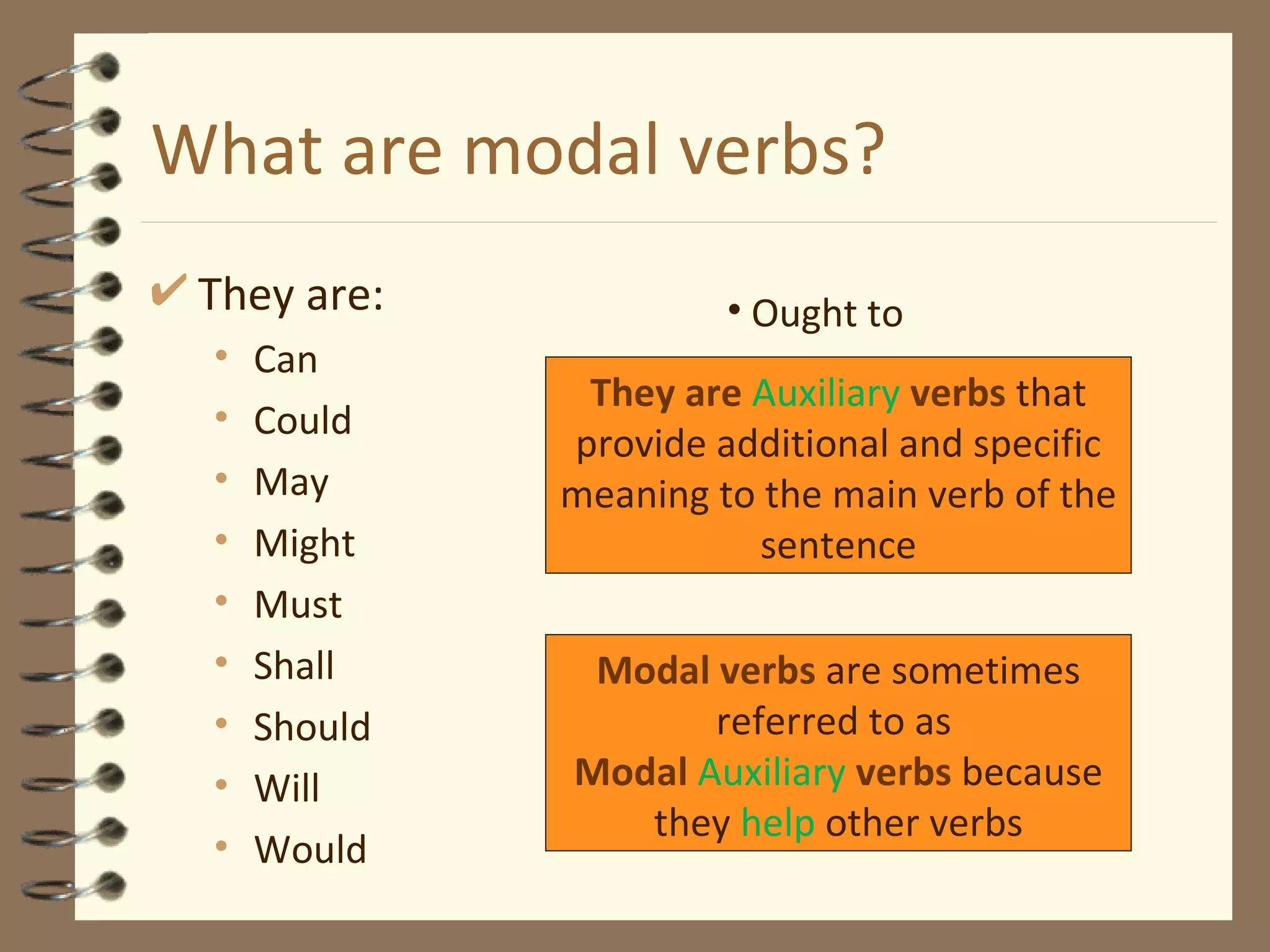
What are modal verbs? They are: Can Could May Might Must Shall Should Will Would Ought   to Modal verbs  are sometimes referred to as  Modal   Auxiliary   verbs  because they  help  other verbs They are  Auxiliary   verbs  that provide additional and specific meaning to the main verb of the sentence
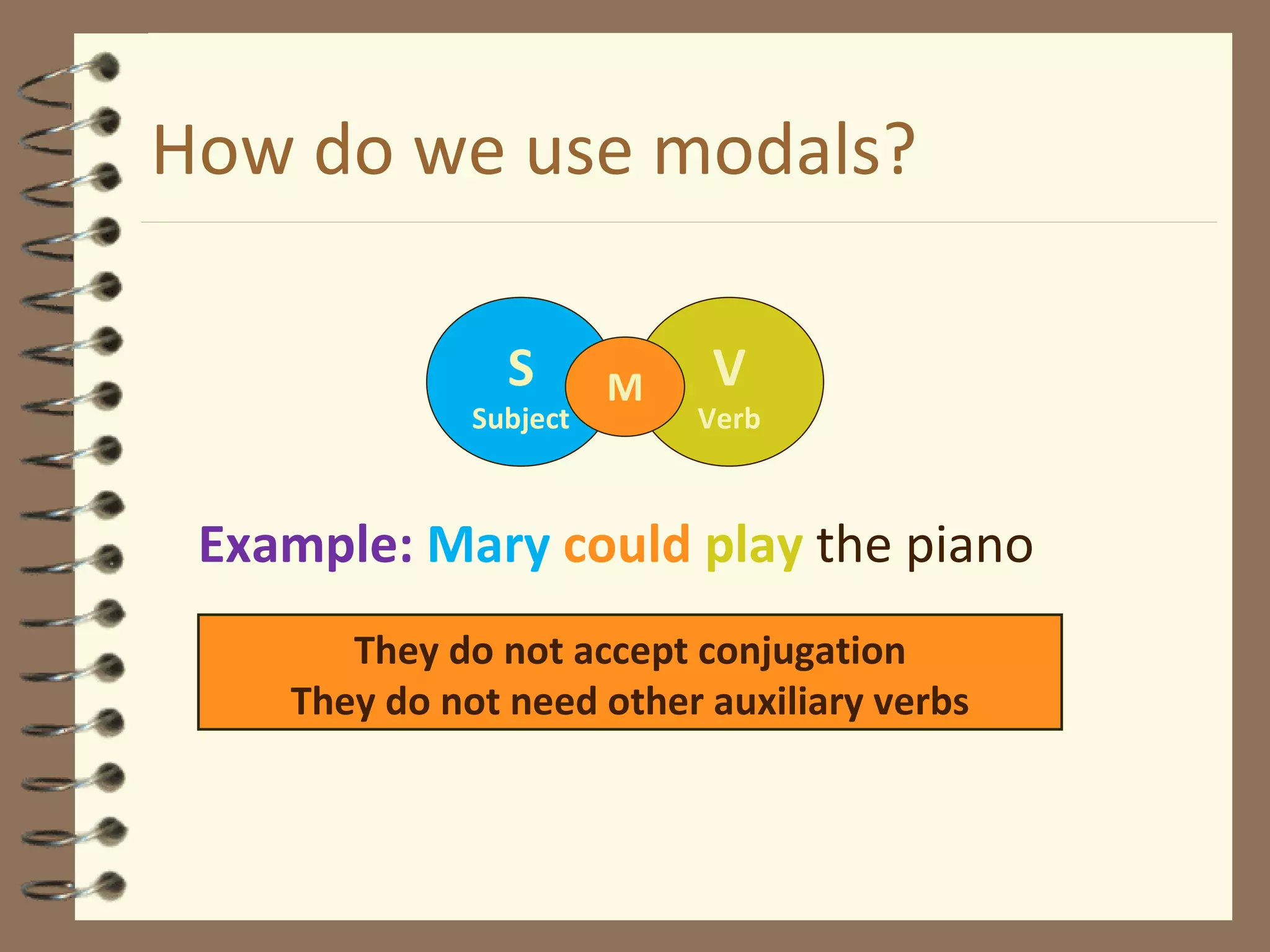
How do we use modals? Example:  Mary   could   play   the piano  They do not accept conjugation They do not need other auxiliary verbs S Subject V Verb M
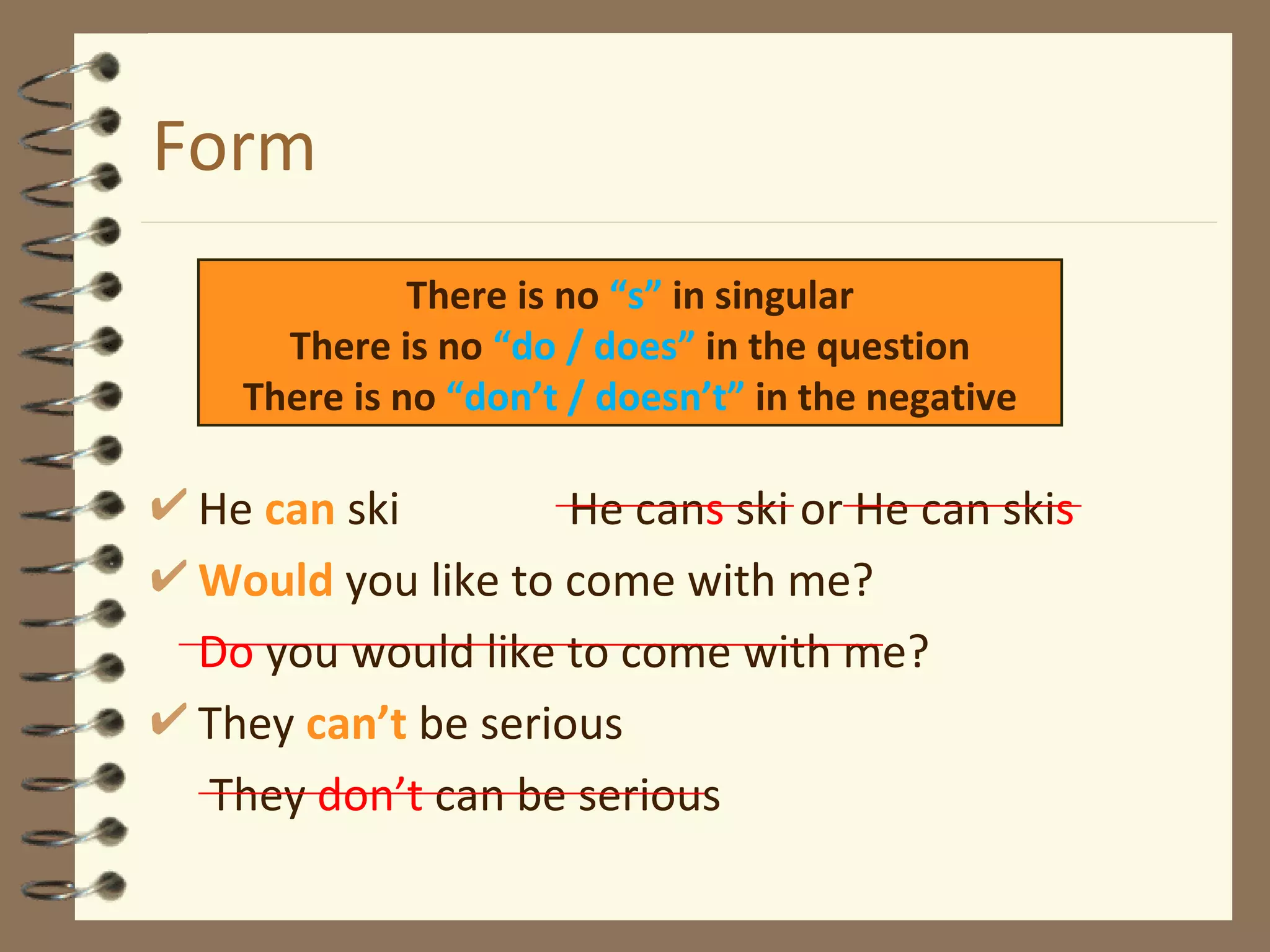
Form He  can  ski  He can s  ski or He can ski s Would   you like to come with me? Do  you would like to come with me? They  can’t  be serious   They  don’t  can be serious There is no  “s”  in singular There is no  “do / does”  in the question There is no  “don’t / doesn’t”  in the negative
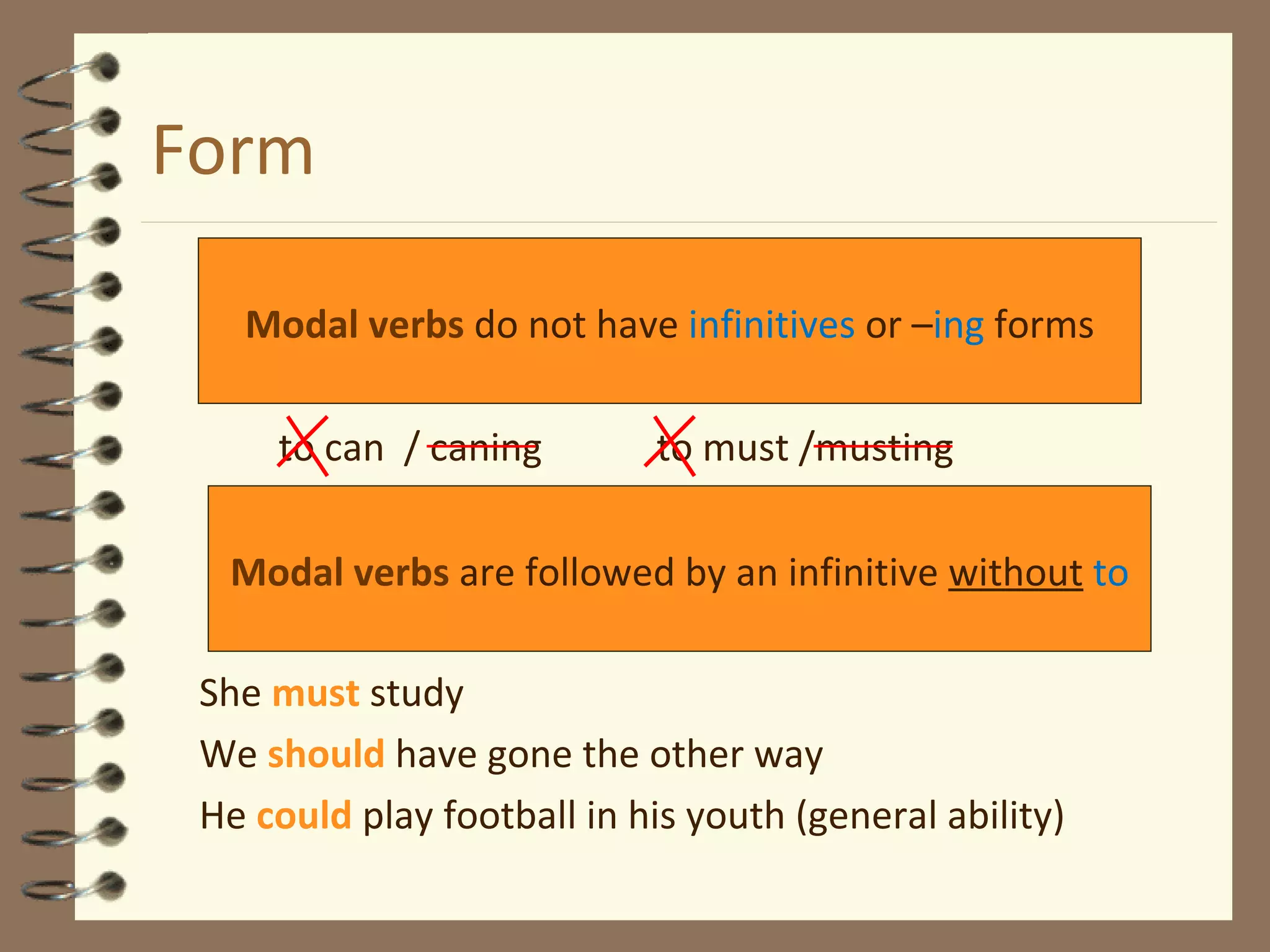
Form to can  / caning  to must /musting She  must  study We  should  have gone the other way He  could   play   football  in  his   youth  (general  ability ) Modal verbs  do not have  infinitives  or – ing  forms Modal verbs  are followed by an infinitive  without   to
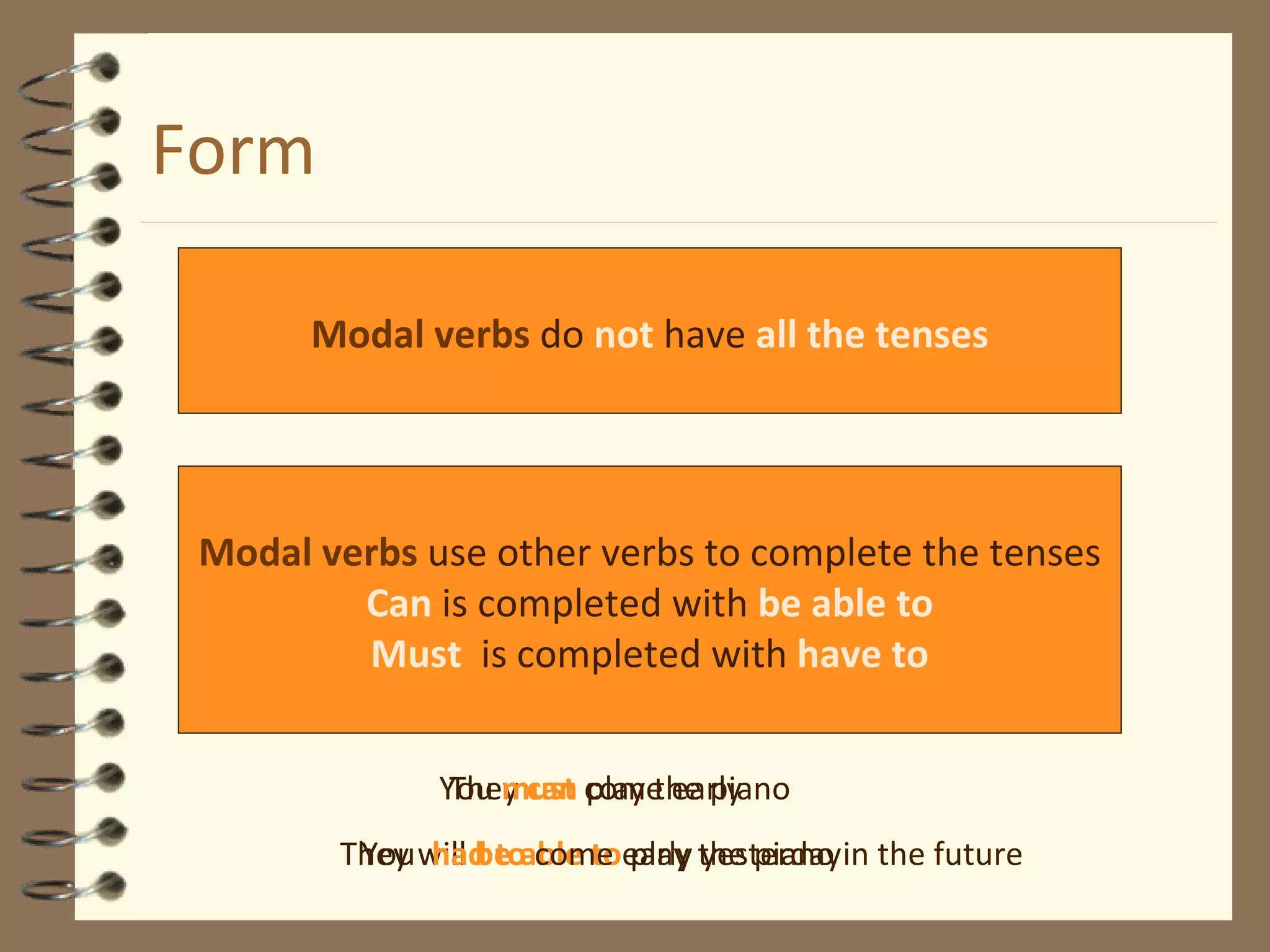
Form Modal verbs  do  not  have  all the tenses Modal verbs  use other verbs to complete the tenses Can  is completed with  be able to Must   is completed with   have to They  can  play the piano They will  be able to  play the piano in the future You  must  come early You  had to  come early yesterday
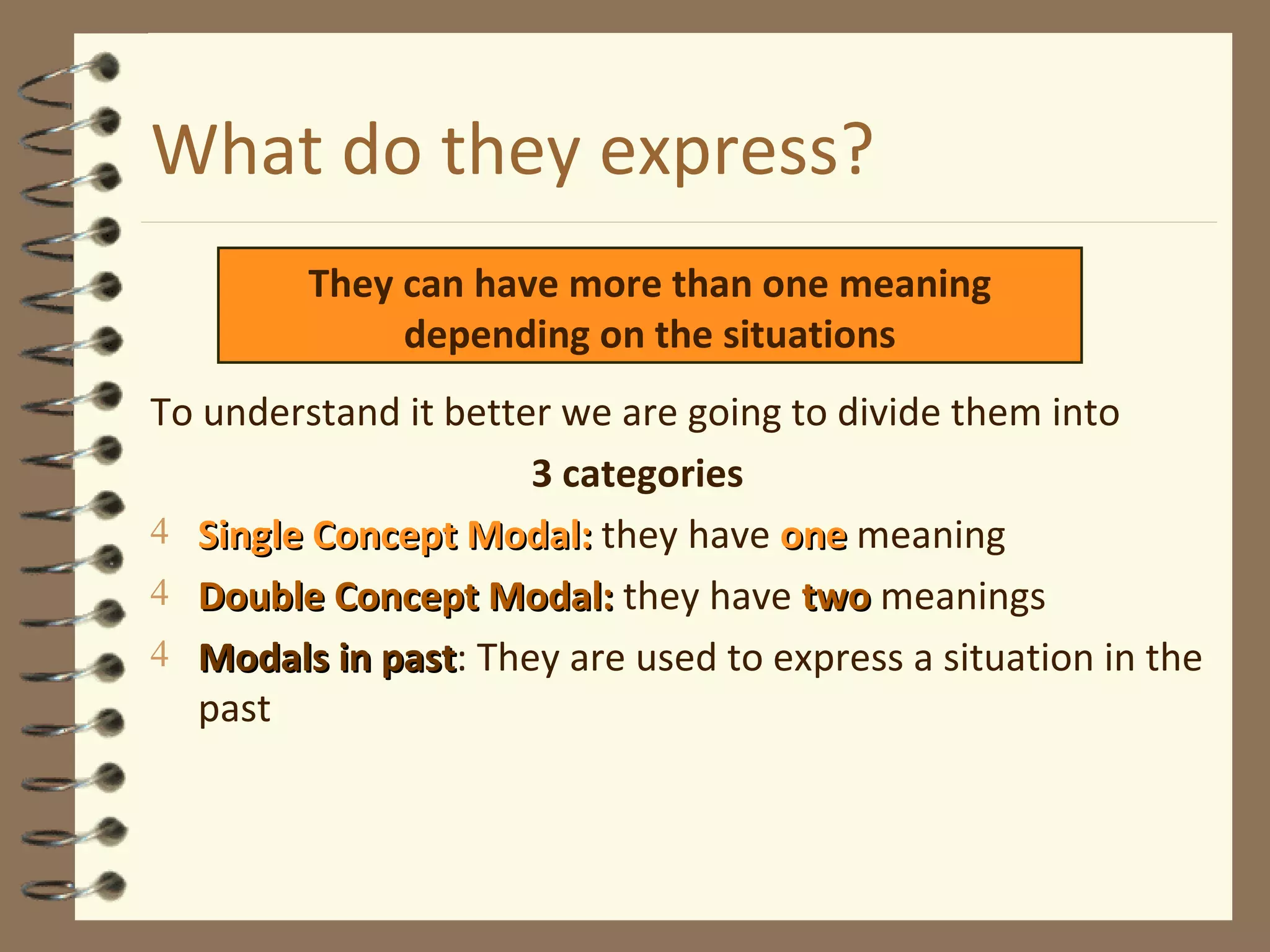
What do they express? To understand it better we are going to divide them into  3   categories Single Concept Modal:  they have  one  meaning Double Concept Modal:  they have  two  meanings Modals in past : They are used to express a situation in the past They can have more than one meaning depending on the situations
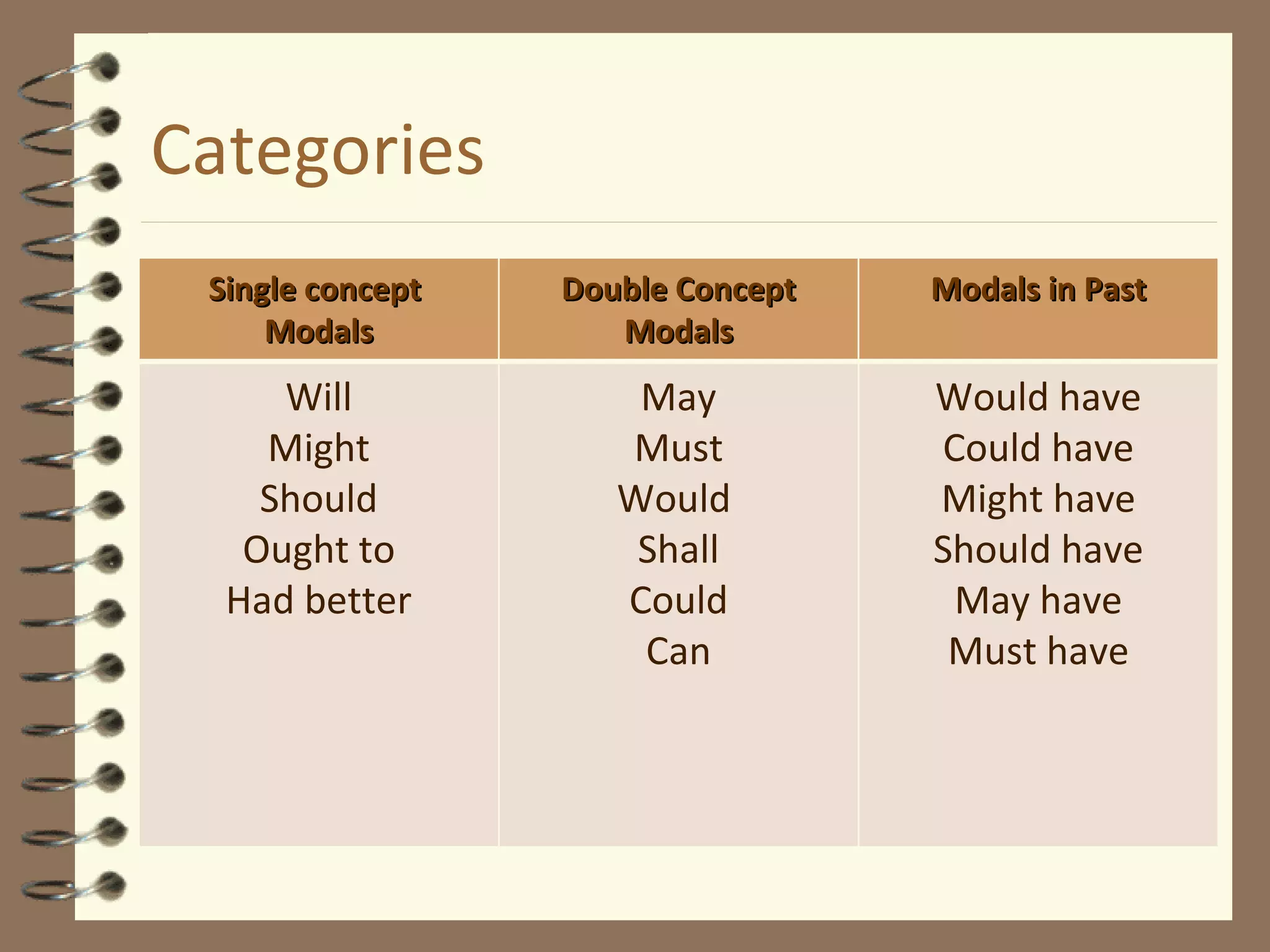
Categories Single concept  Modals Double Concept Modals Modals in Past Will Might Should Ought to Had better May Must Would  Shall Could Can Would have Could have Might have Should have May have Must have
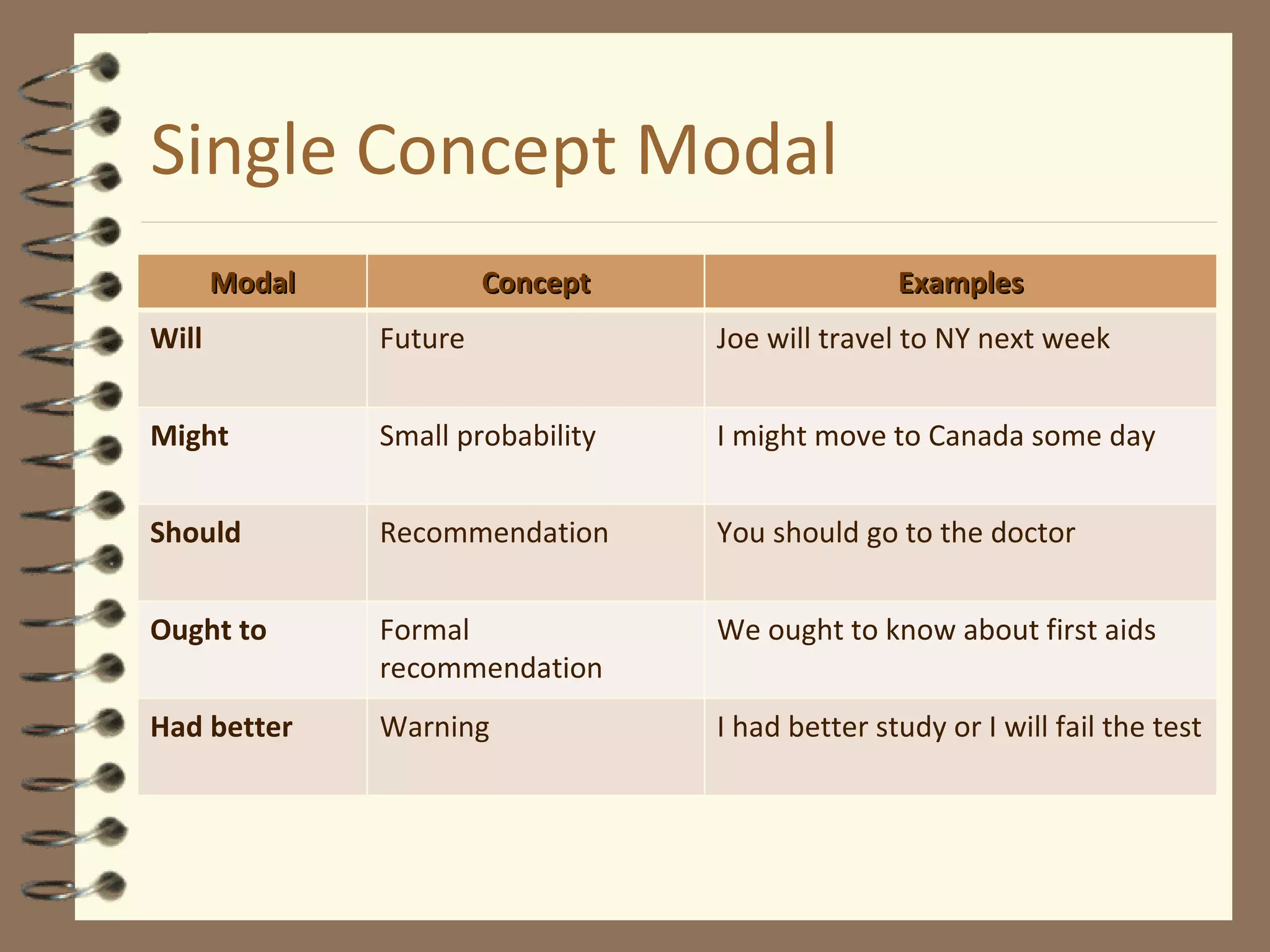
Single Concept Modal Modal Concept Examples Will Future Joe will travel to NY next week Might Small probability I might move to Canada some day Should Recommendation You should go to the doctor Ought to Formal recommendation We ought to know about first aids Had better Warning I had better study or I will fail the test
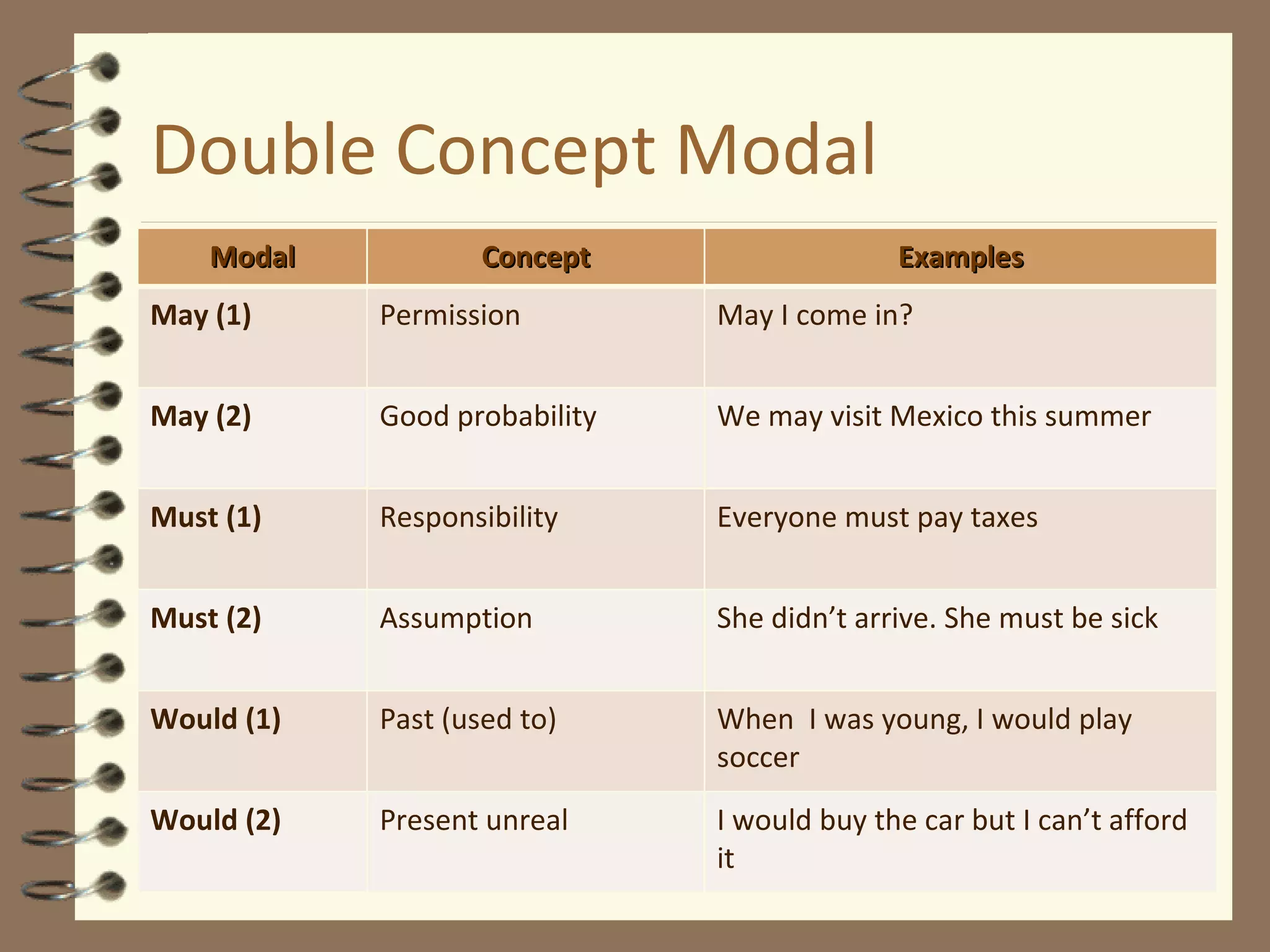
Double  Concept Modal Modal Concept Examples May (1) Permission May I come in? May (2) Good probability We may visit Mexico this summer Must (1) Responsibility Everyone must pay taxes Must (2) Assumption She didn’t arrive. She must be sick Would (1) Past (used to) When  I was young, I would play soccer Would (2) Present unreal I would buy the car but I can’t afford it
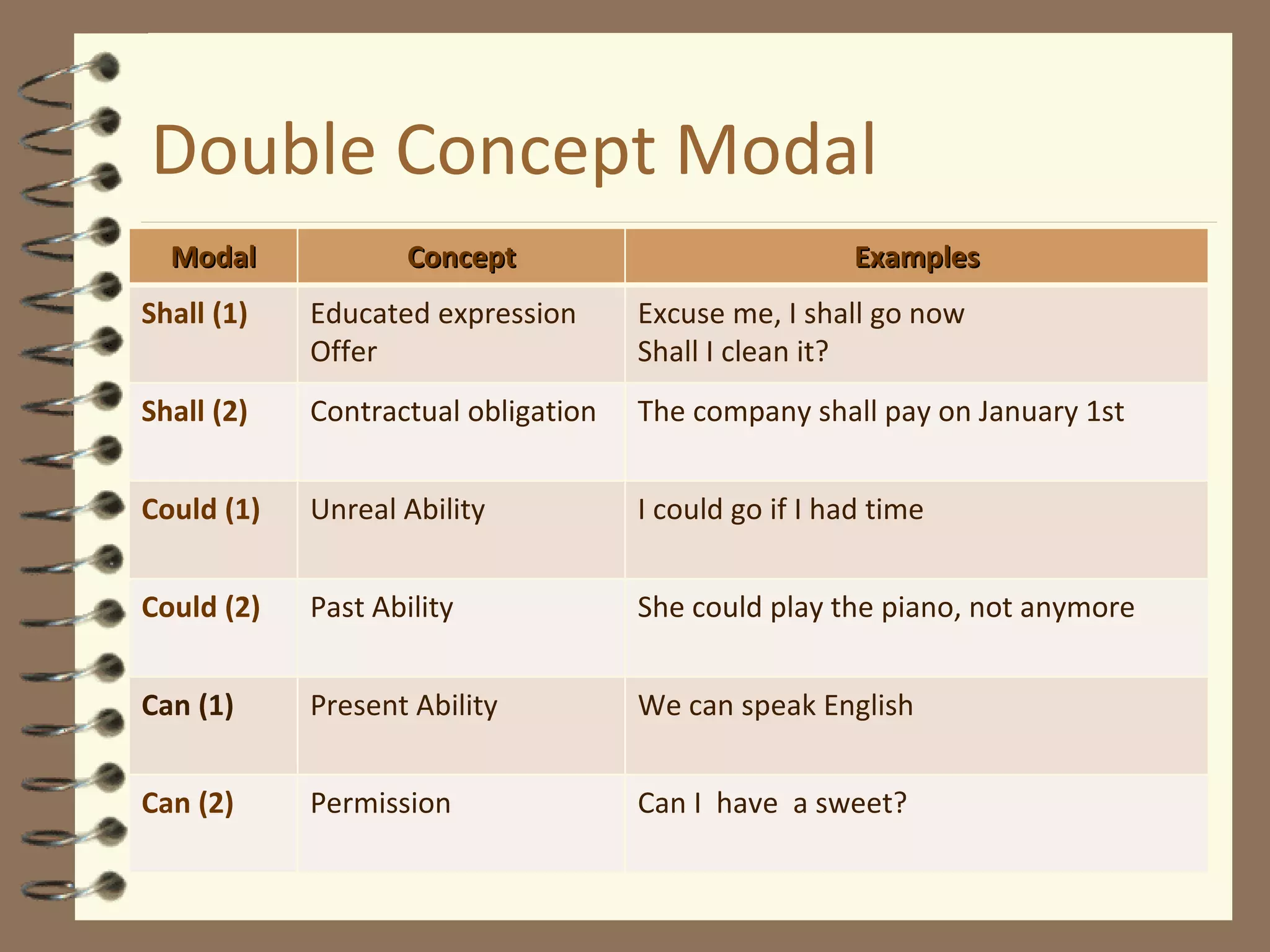
Double Concept Modal Modal Concept Examples Shall (1) Educated expression Offer Excuse me, I shall go now Shall I clean it? Shall (2) Contractual obligation The company shall pay on January 1st Could (1) Unreal Ability I could go if I had time Could (2) Past Ability She could play the piano, not anymore Can (1) Present Ability We can speak English Can (2) Permission Can I  have  a sweet?
 
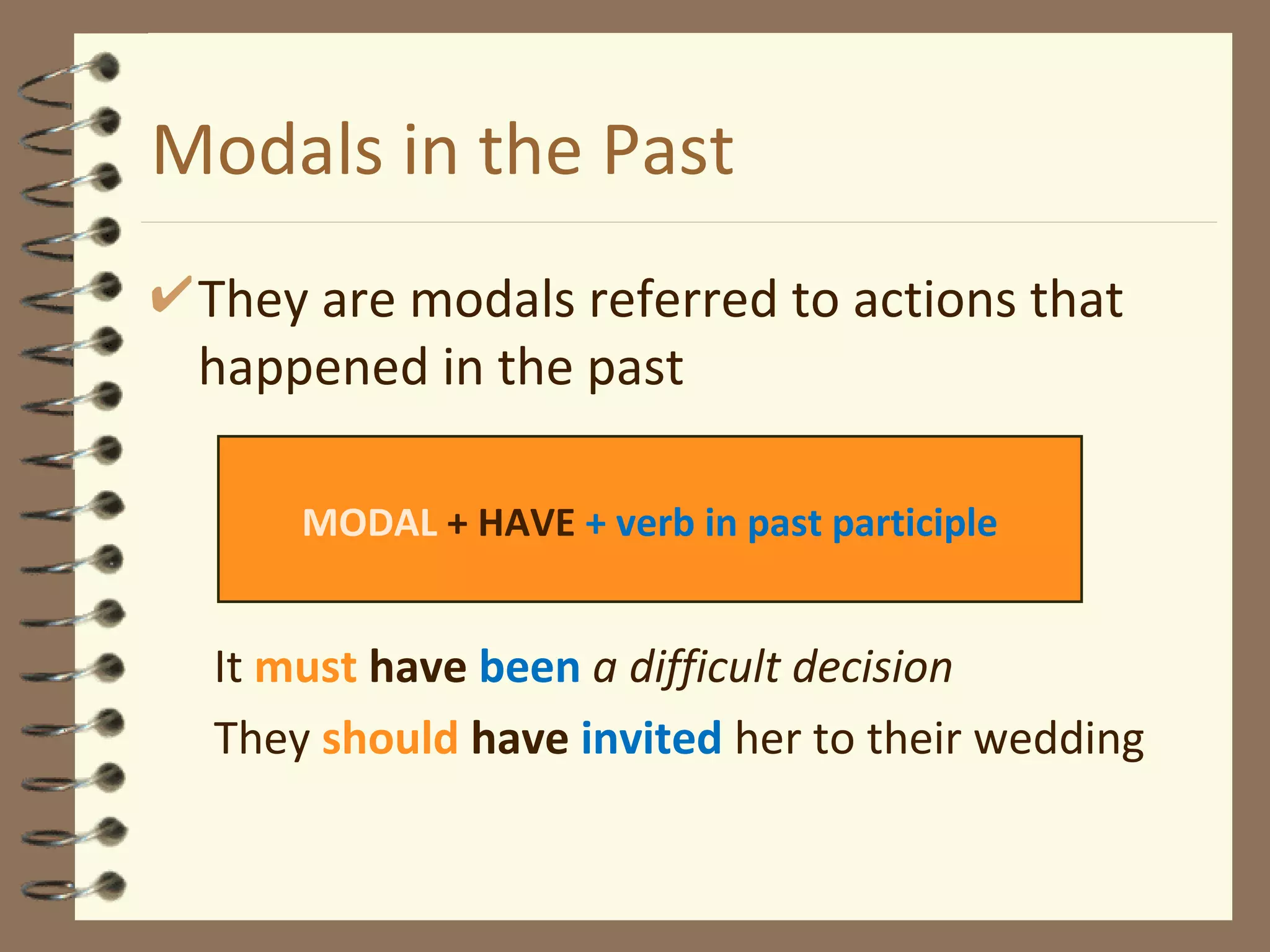
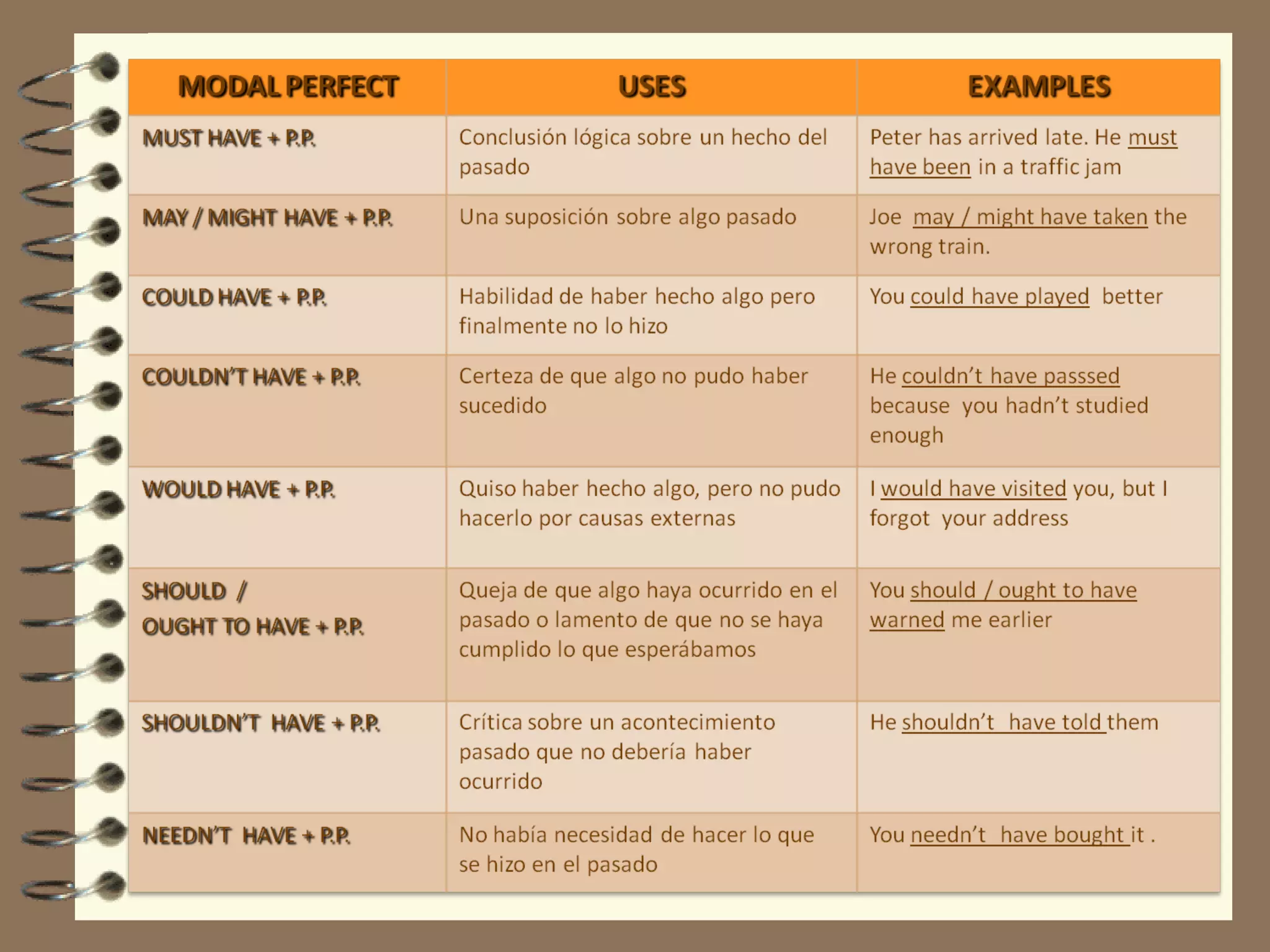
Modals in the Past They are modals referred to actions that  happened in the past It   must  have  been   a difficult decision They  should  have  invited  her to their wedding MODAL  + HAVE  + verb in past participle
 
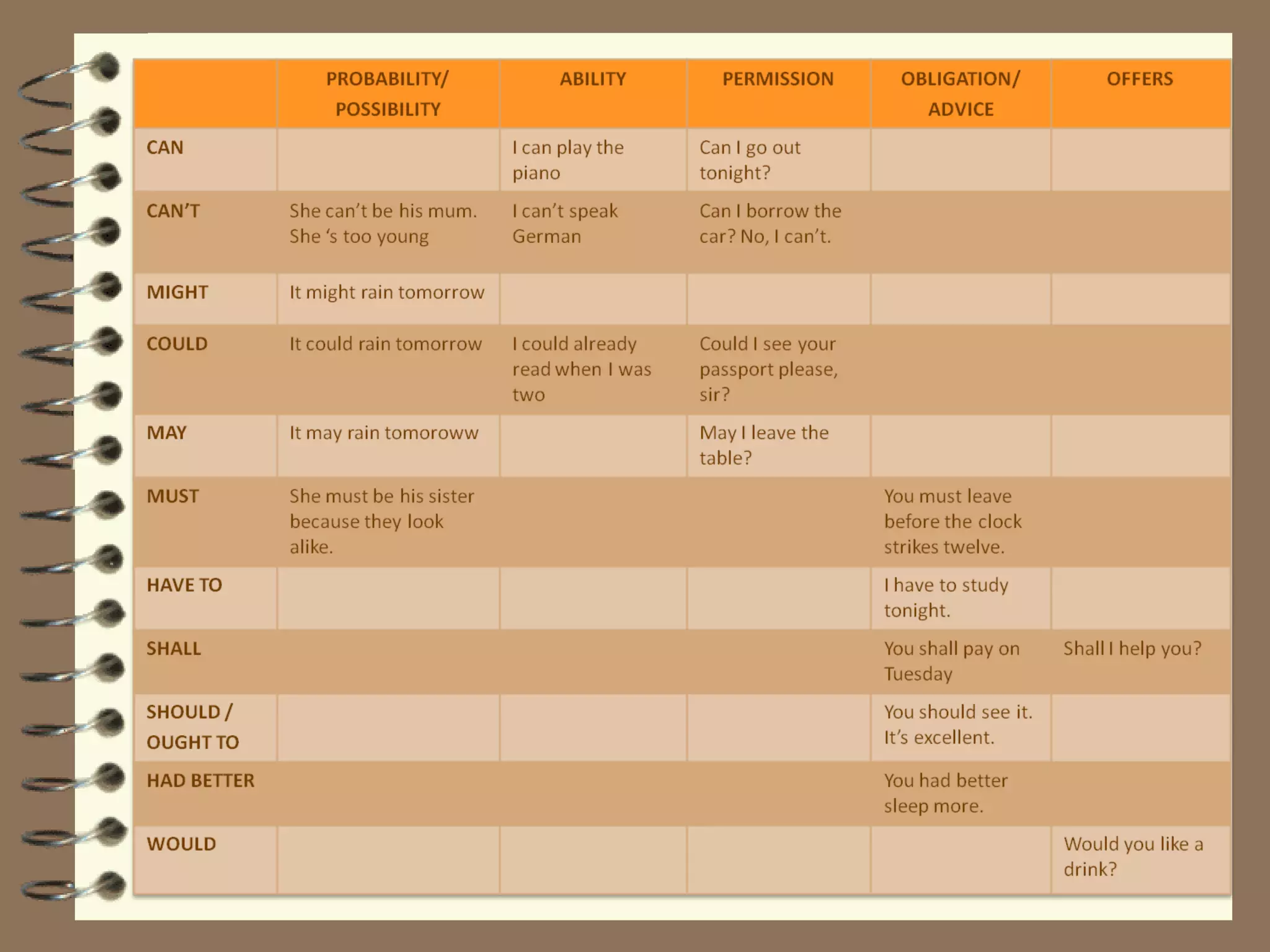
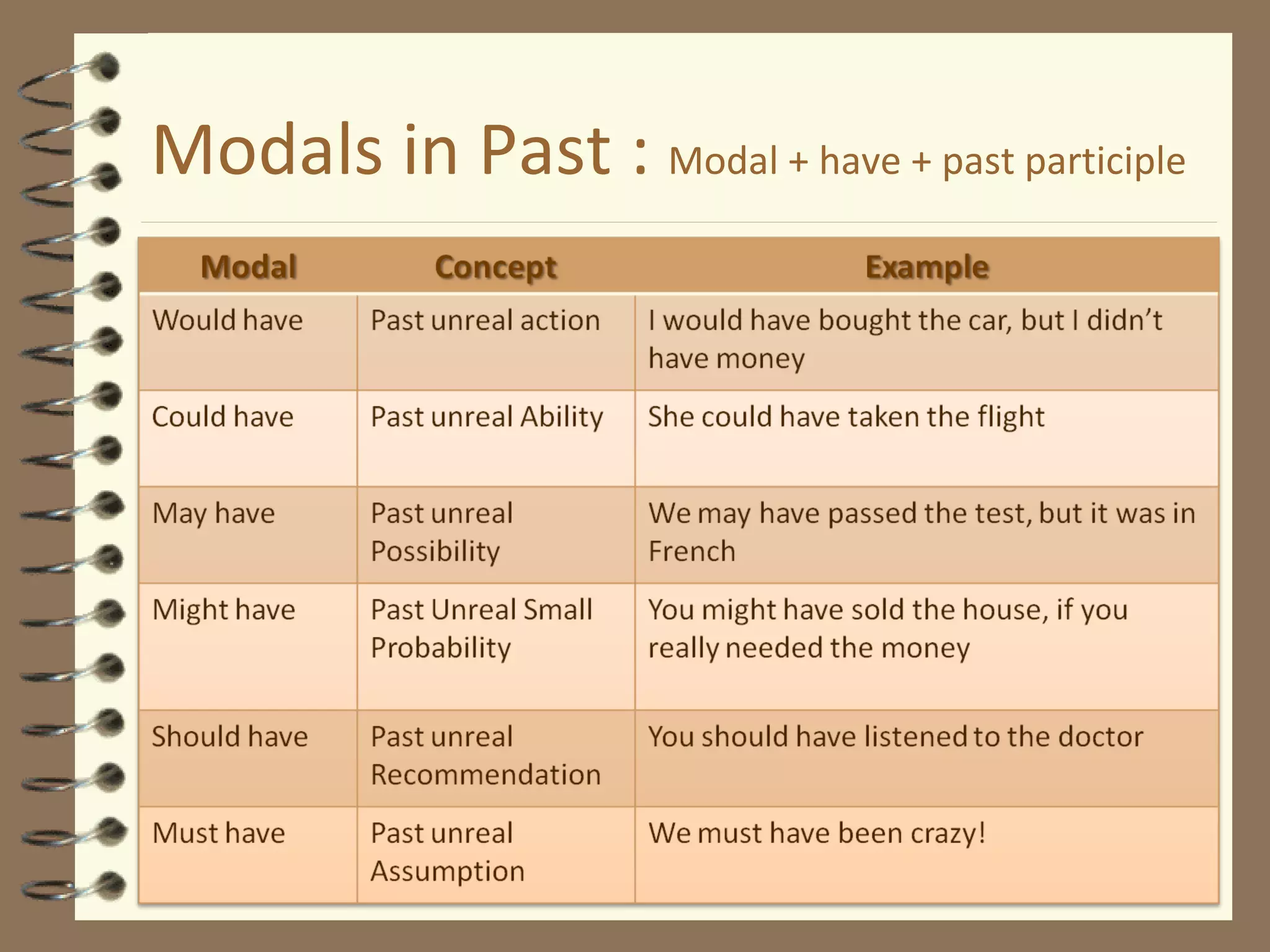
Modals in Past :  Modal + have + past participle
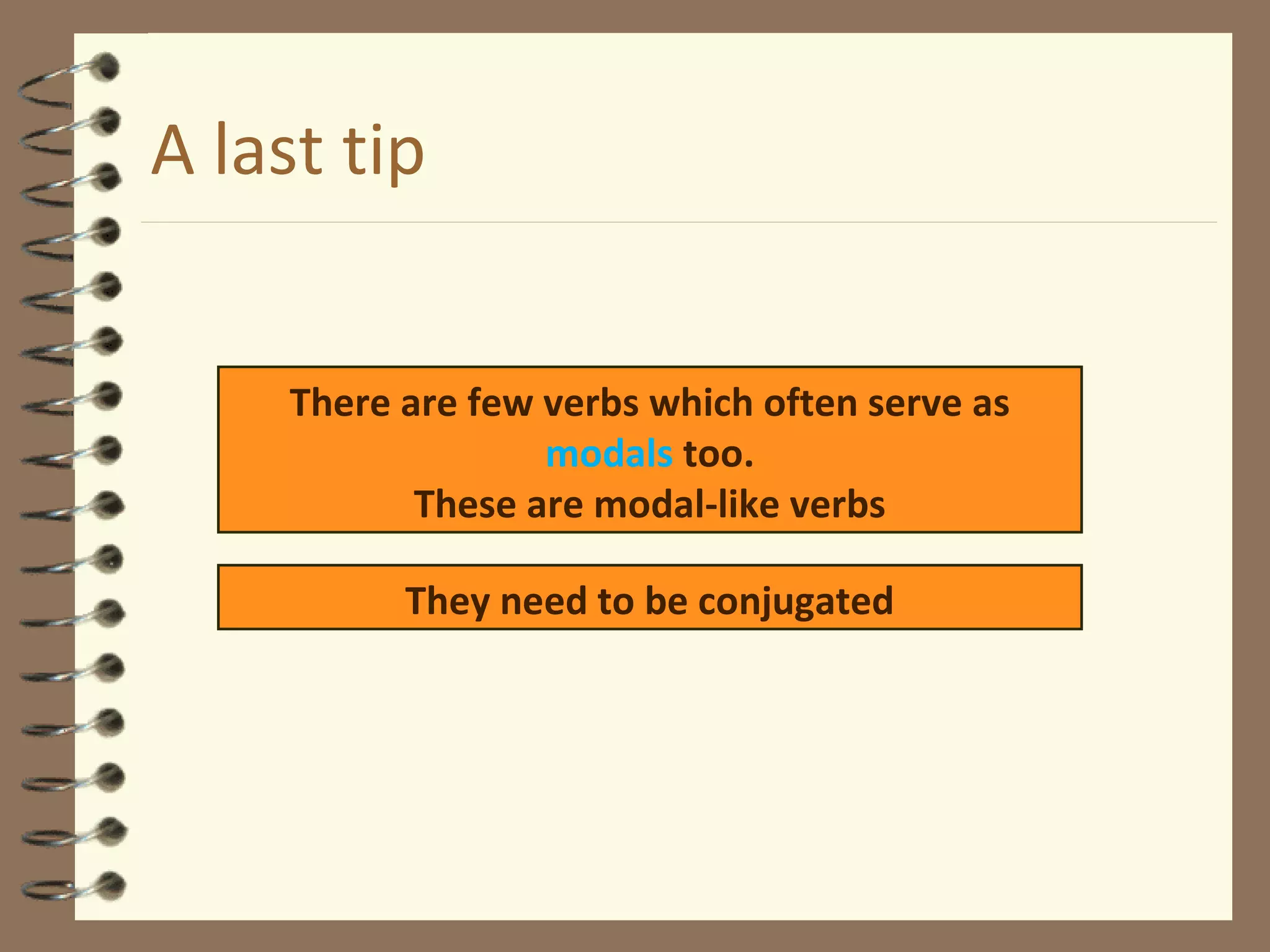
A last tip There are few verbs which often serve as  modals  too. These are modal-like verbs They need to be conjugated
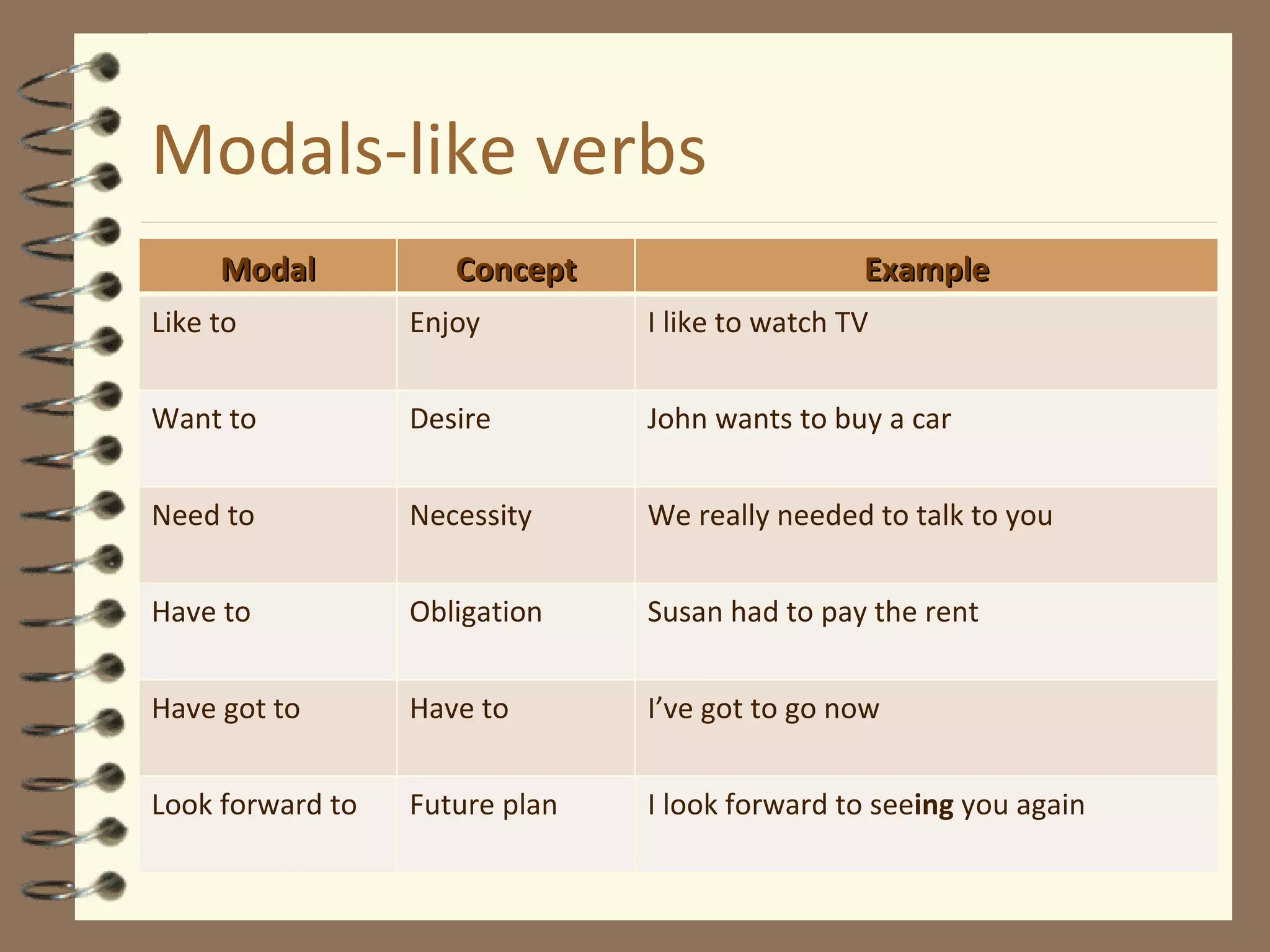
Modals-like verbs Modal Concept Example Like to Enjoy I like to watch TV Want to Desire John wants to buy a car Need to Necessity We really needed to talk to you Have to Obligation Susan had to pay the rent Have got to Have to I’ve got to go now Look forward to Future plan I look forward to see ing  you again
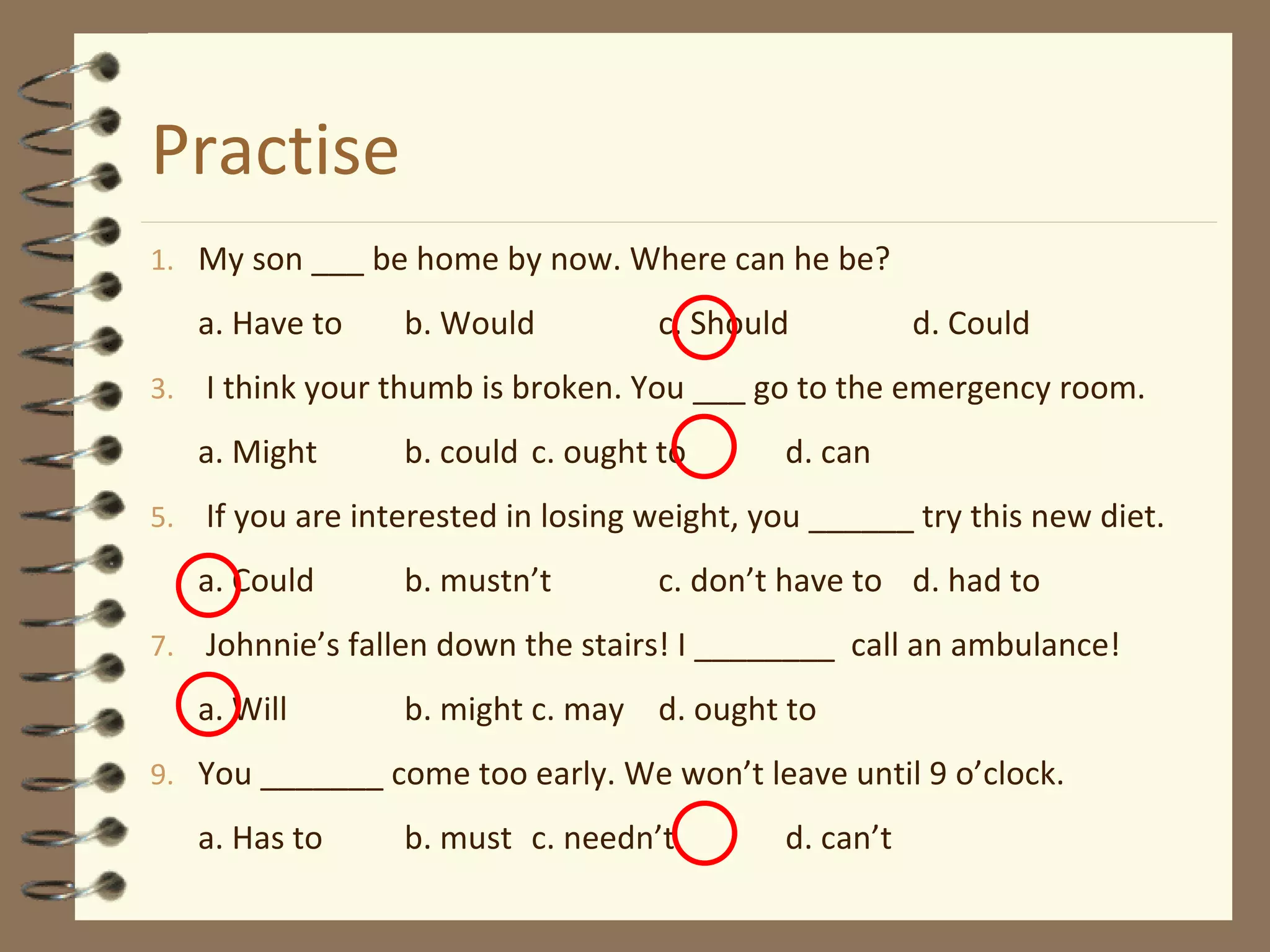
Practise My son ___ be home by now. Where can he be? a. Have to b. Would c. Should d. Could I think your thumb is broken. You ___ go to the emergency room. a. Might b. could c. ought to d. can If you are interested in losing weight, you ______ try this new diet. a. Could b. mustn’t c. don’t have to d. had to Johnnie’s fallen down the stairs! I ________  call an ambulance! a. Will b. might c. may d. ought to You _______ come too early. We won’t leave until 9 o’clock. a. Has to b. must c. needn’t d. can’t
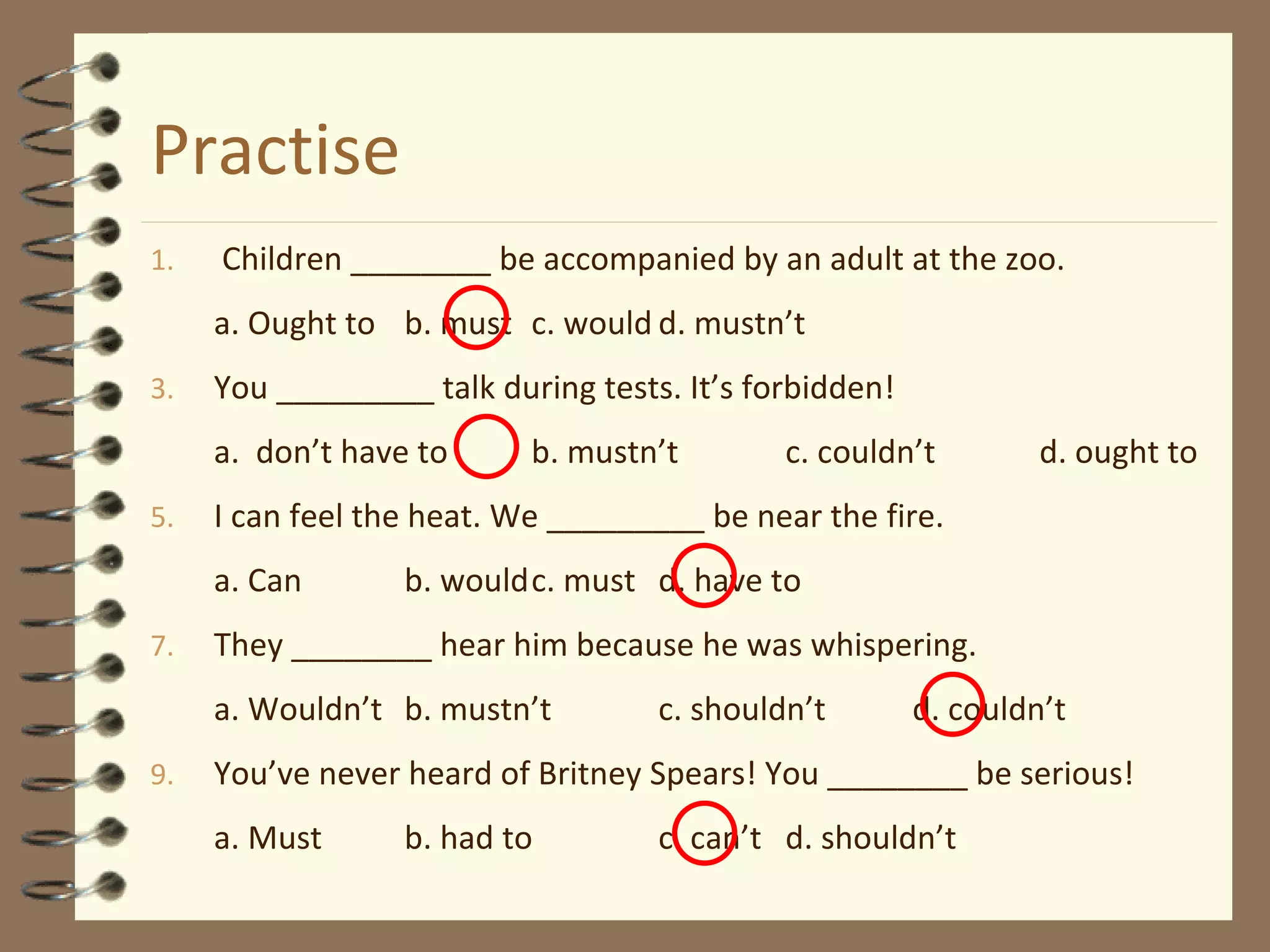
Practise Children ________ be accompanied by an adult at the zoo. a. Ought to b. must c. would d. mustn’t You _________ talk during tests. It’s forbidden! a.  don’t have to b. mustn’t c. couldn’t d. ought to I can feel the heat. We _________ be near the fire. a. Can b. would c. must d. have to They ________ hear him because he was whispering. a. Wouldn’t b. mustn’t c. shouldn’t d. couldn’t You’ve never heard of Britney Spears! You ________ be serious! a. Must b. had to c. can’t d. shouldn’t
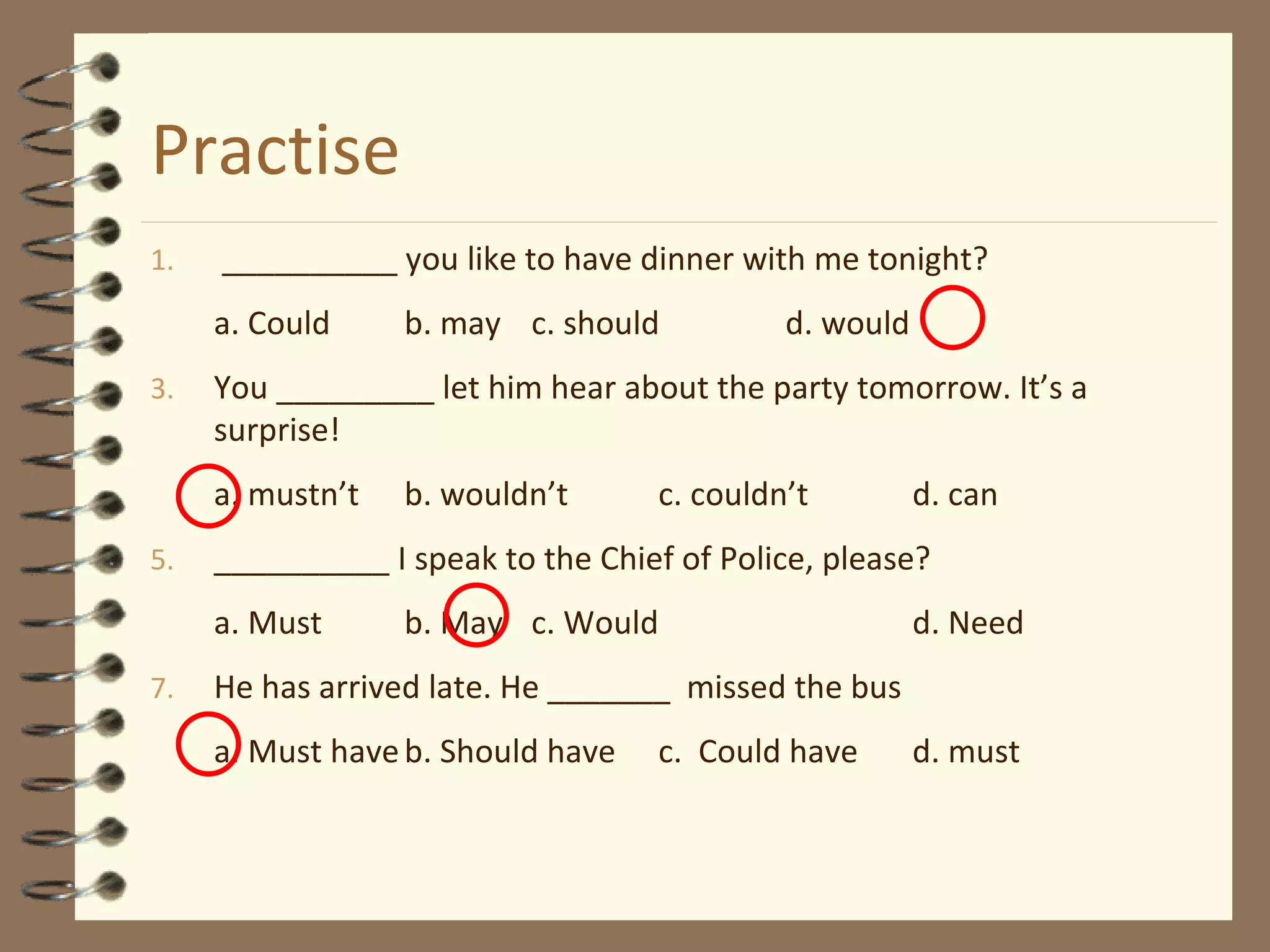
Practise __________  you   like  to have dinner with me tonight? a. Could b.  may c. should d. would You _________ let him hear about the party tomorrow. It’s a surprise! a. mustn’t b. wouldn’t c. couldn’t d. can __________ I speak to the Chief of Police, please? a. Must b. May c. Would d. Need He has arrived late. He _______  missed the bus a. Must have b. Should have c.  Could have d. must
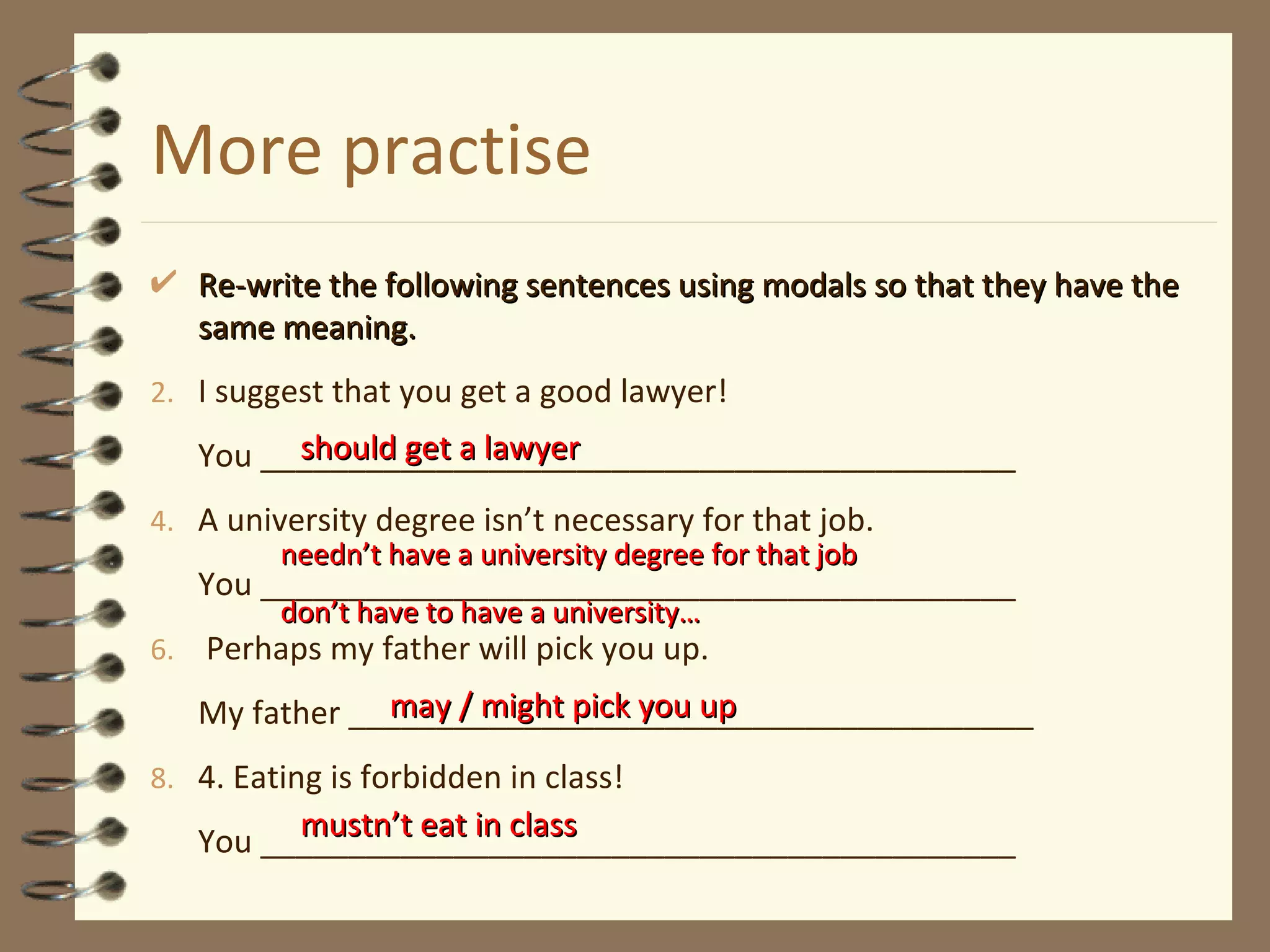
More practise Re-write the following sentences using modals so that they have the same meaning. I suggest that you get a good lawyer! You ___________________________________________ A university degree isn’t necessary for that job. You ___________________________________________ Perhaps my father will pick you up. My father _______________________________________ 4. Eating is forbidden in class! You ___________________________________________ should get a lawyer needn’t have a university degree for that job  don’t have to have a university…  may / might pick you up mustn’t eat in class
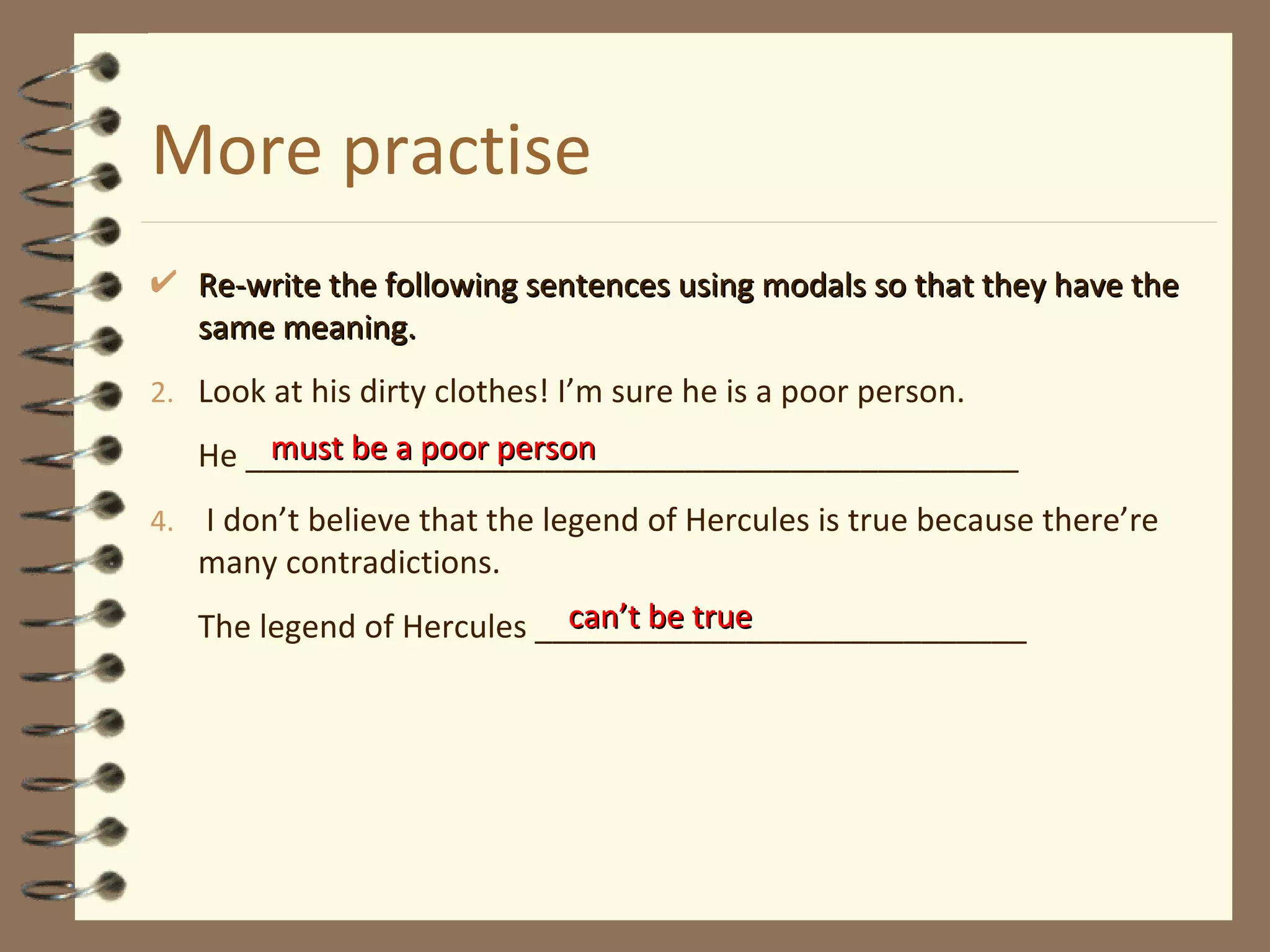
More practise Re-write the following sentences using modals so that they have the same meaning. Look at his dirty clothes! I’m sure he is a poor person. He ____________________________________________ I don’t believe that the legend of Hercules is true because there’re many contradictions. The legend of Hercules ____________________________ must be a poor person can’t be true
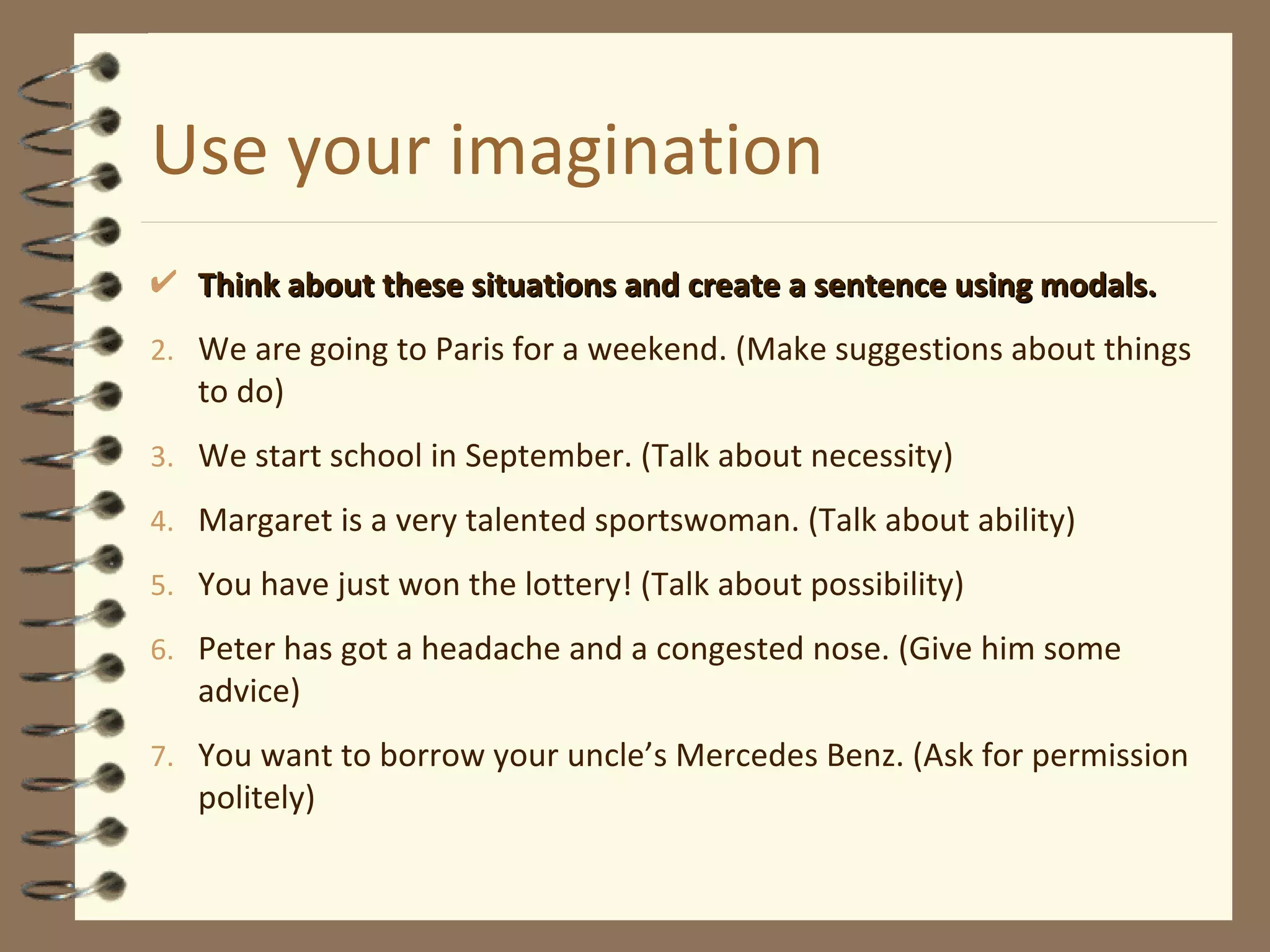
Use your imagination Think about these situations and create a sentence using modals. We are going to Paris for a weekend. (Make suggestions about things to do) We start school in September. (Talk about necessity) Margaret is a very talented sportswoman. (Talk about ability) You have just won the lottery! (Talk about possibility) Peter has got a headache and a congested nose. (Give him some advice) You want to borrow your uncle’s Mercedes Benz. (Ask for permission politely)
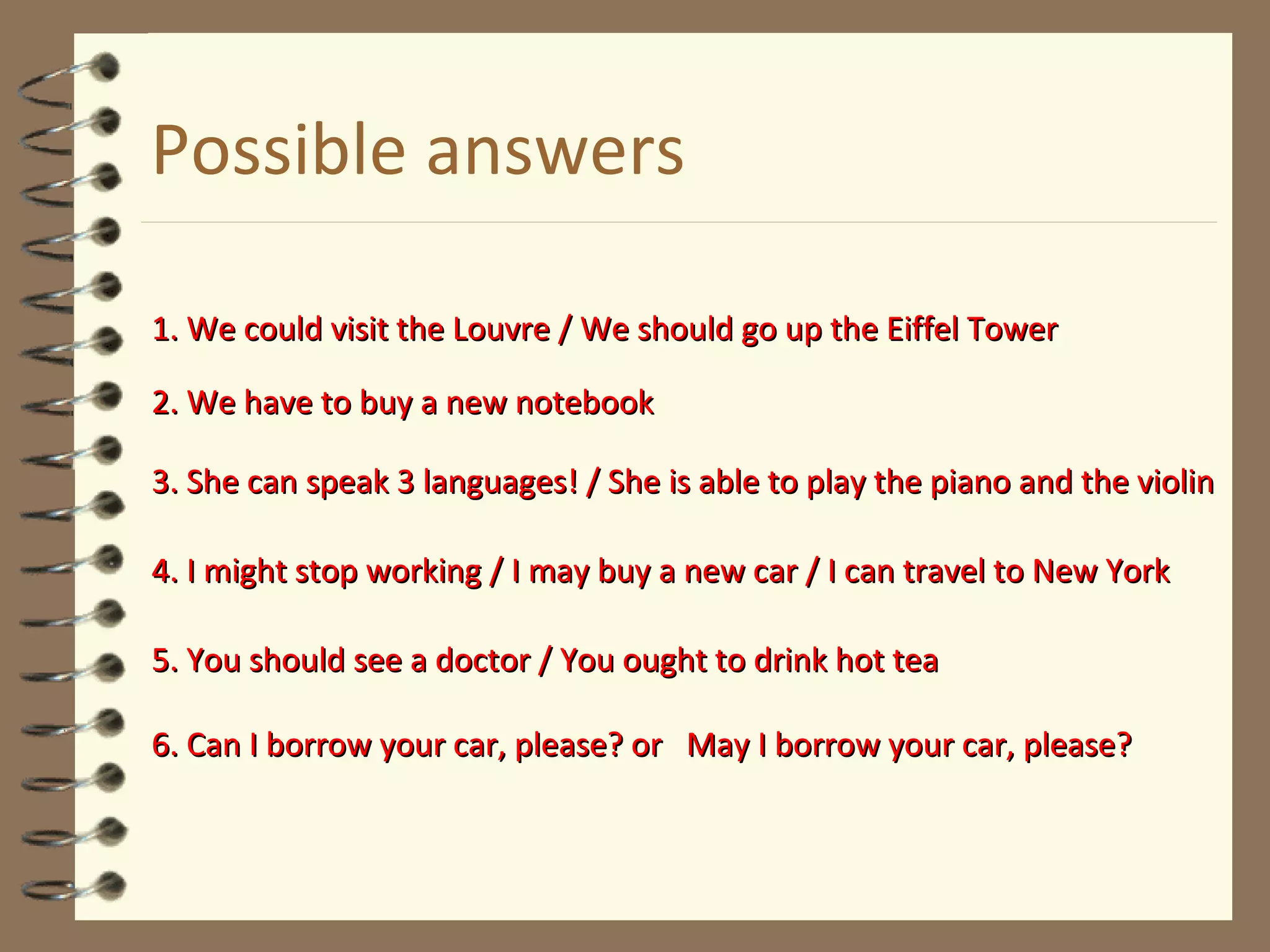
Possible answers 1. We could visit the Louvre / We should go up the Eiffel Tower 2. We have to buy a new notebook 3. She can speak 3 languages! / She is able to play the piano and the violin 4. I might stop working / I may buy a new car / I can travel to New York 5. You should see a doctor / You ought to drink hot tea 6. Can I borrow your car, please? or  May I borrow your car, please?

Modal Verbs

  • 1.
  • 2.
    What are modalverbs? They are: Can Could May Might Must Shall Should Will Would Ought to Modal verbs are sometimes referred to as Modal Auxiliary verbs because they help other verbs They are Auxiliary verbs that provide additional and specific meaning to the main verb of the sentence
  • 3.
    How do weuse modals? Example: Mary could play the piano They do not accept conjugation They do not need other auxiliary verbs S Subject V Verb M
  • 4.
    Form He can ski He can s ski or He can ski s Would you like to come with me? Do you would like to come with me? They can’t be serious They don’t can be serious There is no “s” in singular There is no “do / does” in the question There is no “don’t / doesn’t” in the negative
  • 5.
    Form to can / caning to must /musting She must study We should have gone the other way He could play football in his youth (general ability ) Modal verbs do not have infinitives or – ing forms Modal verbs are followed by an infinitive without to
  • 6.
    Form Modal verbs do not have all the tenses Modal verbs use other verbs to complete the tenses Can is completed with be able to Must is completed with have to They can play the piano They will be able to play the piano in the future You must come early You had to come early yesterday
  • 7.
    What do theyexpress? To understand it better we are going to divide them into 3 categories Single Concept Modal: they have one meaning Double Concept Modal: they have two meanings Modals in past : They are used to express a situation in the past They can have more than one meaning depending on the situations
  • 8.
    Categories Single concept Modals Double Concept Modals Modals in Past Will Might Should Ought to Had better May Must Would Shall Could Can Would have Could have Might have Should have May have Must have
  • 9.
    Single Concept ModalModal Concept Examples Will Future Joe will travel to NY next week Might Small probability I might move to Canada some day Should Recommendation You should go to the doctor Ought to Formal recommendation We ought to know about first aids Had better Warning I had better study or I will fail the test
  • 10.
    Double ConceptModal Modal Concept Examples May (1) Permission May I come in? May (2) Good probability We may visit Mexico this summer Must (1) Responsibility Everyone must pay taxes Must (2) Assumption She didn’t arrive. She must be sick Would (1) Past (used to) When I was young, I would play soccer Would (2) Present unreal I would buy the car but I can’t afford it
  • 11.
    Double Concept ModalModal Concept Examples Shall (1) Educated expression Offer Excuse me, I shall go now Shall I clean it? Shall (2) Contractual obligation The company shall pay on January 1st Could (1) Unreal Ability I could go if I had time Could (2) Past Ability She could play the piano, not anymore Can (1) Present Ability We can speak English Can (2) Permission Can I have a sweet?
  • 12.
  • 13.
    Modals in thePast They are modals referred to actions that happened in the past It must have been a difficult decision They should have invited her to their wedding MODAL + HAVE + verb in past participle
  • 14.
  • 15.
    Modals in Past: Modal + have + past participle
  • 16.
    A last tipThere are few verbs which often serve as modals too. These are modal-like verbs They need to be conjugated
  • 17.
    Modals-like verbs ModalConcept Example Like to Enjoy I like to watch TV Want to Desire John wants to buy a car Need to Necessity We really needed to talk to you Have to Obligation Susan had to pay the rent Have got to Have to I’ve got to go now Look forward to Future plan I look forward to see ing you again
  • 18.
    Practise My son___ be home by now. Where can he be? a. Have to b. Would c. Should d. Could I think your thumb is broken. You ___ go to the emergency room. a. Might b. could c. ought to d. can If you are interested in losing weight, you ______ try this new diet. a. Could b. mustn’t c. don’t have to d. had to Johnnie’s fallen down the stairs! I ________ call an ambulance! a. Will b. might c. may d. ought to You _______ come too early. We won’t leave until 9 o’clock. a. Has to b. must c. needn’t d. can’t
  • 19.
    Practise Children ________be accompanied by an adult at the zoo. a. Ought to b. must c. would d. mustn’t You _________ talk during tests. It’s forbidden! a. don’t have to b. mustn’t c. couldn’t d. ought to I can feel the heat. We _________ be near the fire. a. Can b. would c. must d. have to They ________ hear him because he was whispering. a. Wouldn’t b. mustn’t c. shouldn’t d. couldn’t You’ve never heard of Britney Spears! You ________ be serious! a. Must b. had to c. can’t d. shouldn’t
  • 20.
    Practise __________ you like to have dinner with me tonight? a. Could b. may c. should d. would You _________ let him hear about the party tomorrow. It’s a surprise! a. mustn’t b. wouldn’t c. couldn’t d. can __________ I speak to the Chief of Police, please? a. Must b. May c. Would d. Need He has arrived late. He _______ missed the bus a. Must have b. Should have c. Could have d. must
  • 21.
    More practise Re-writethe following sentences using modals so that they have the same meaning. I suggest that you get a good lawyer! You ___________________________________________ A university degree isn’t necessary for that job. You ___________________________________________ Perhaps my father will pick you up. My father _______________________________________ 4. Eating is forbidden in class! You ___________________________________________ should get a lawyer needn’t have a university degree for that job don’t have to have a university… may / might pick you up mustn’t eat in class
  • 22.
    More practise Re-writethe following sentences using modals so that they have the same meaning. Look at his dirty clothes! I’m sure he is a poor person. He ____________________________________________ I don’t believe that the legend of Hercules is true because there’re many contradictions. The legend of Hercules ____________________________ must be a poor person can’t be true
  • 23.
    Use your imaginationThink about these situations and create a sentence using modals. We are going to Paris for a weekend. (Make suggestions about things to do) We start school in September. (Talk about necessity) Margaret is a very talented sportswoman. (Talk about ability) You have just won the lottery! (Talk about possibility) Peter has got a headache and a congested nose. (Give him some advice) You want to borrow your uncle’s Mercedes Benz. (Ask for permission politely)
  • 24.
    Possible answers 1.We could visit the Louvre / We should go up the Eiffel Tower 2. We have to buy a new notebook 3. She can speak 3 languages! / She is able to play the piano and the violin 4. I might stop working / I may buy a new car / I can travel to New York 5. You should see a doctor / You ought to drink hot tea 6. Can I borrow your car, please? or May I borrow your car, please?