Research Quality in
Qualitative Methods
Class Session 6
ADLT 673, October 13, 2015
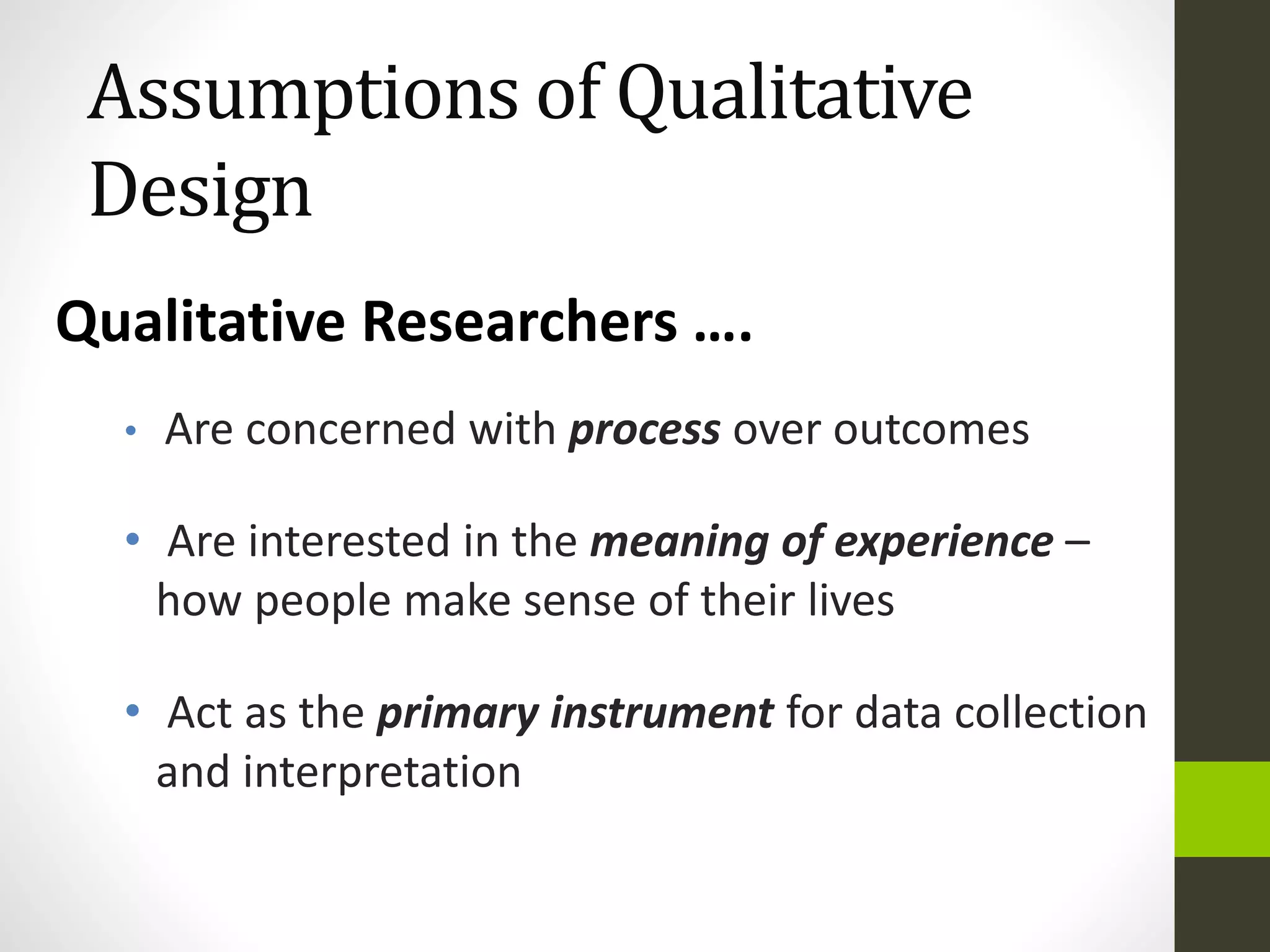
Assumptions of Qualitative
Design
• Are concerned with process over outcomes
• Are interested in the meaning of experience –
how people make sense of their lives
• Act as the primary instrument for data collection
and interpretation
Qualitative Researchers ….
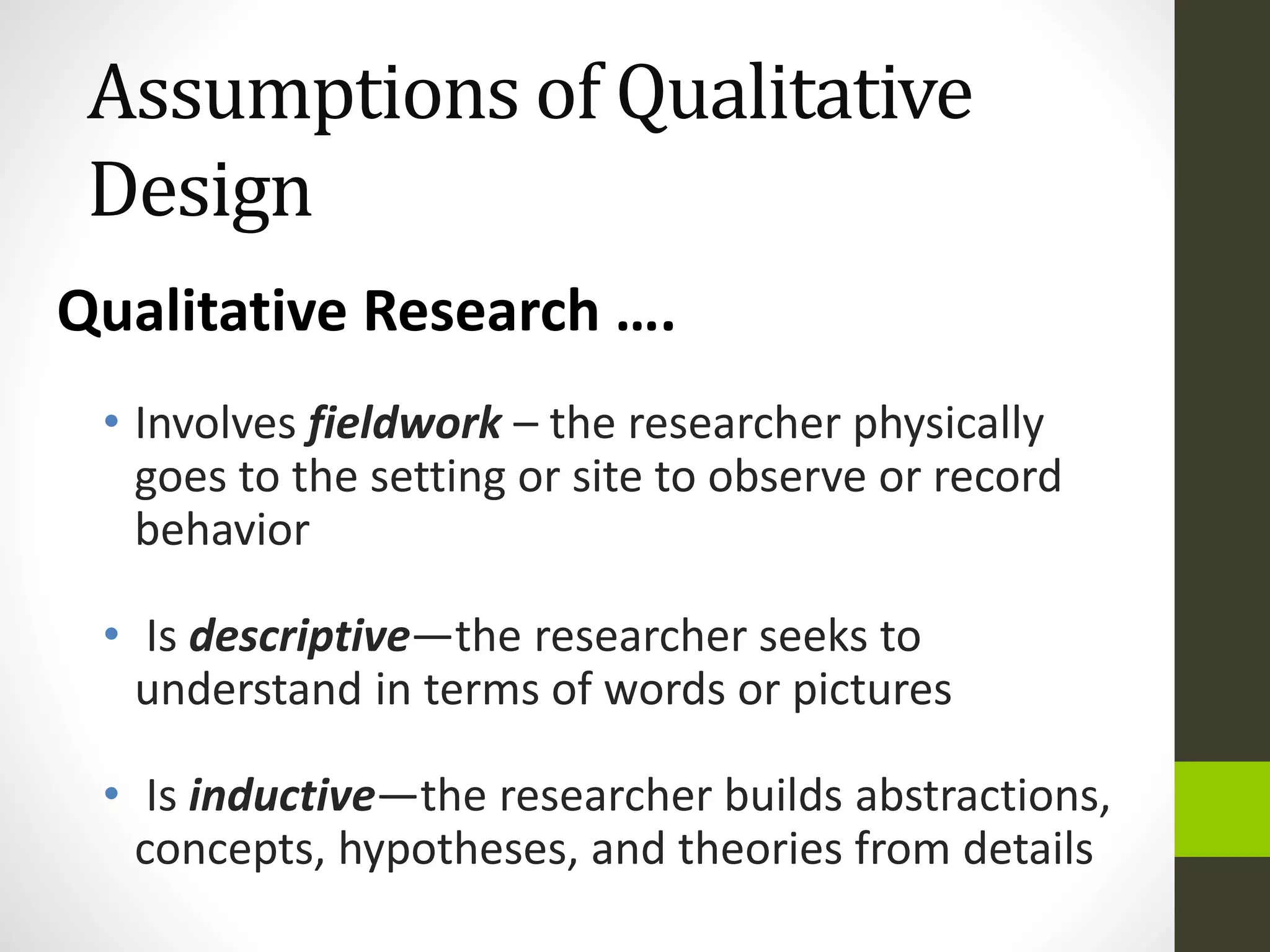
Assumptions of Qualitative
Design
• Involves fieldwork – the researcher physically
goes to the setting or site to observe or record
behavior
• Is descriptive—the researcher seeks to
understand in terms of words or pictures
• Is inductive—the researcher builds abstractions,
concepts, hypotheses, and theories from details
Qualitative Research ….
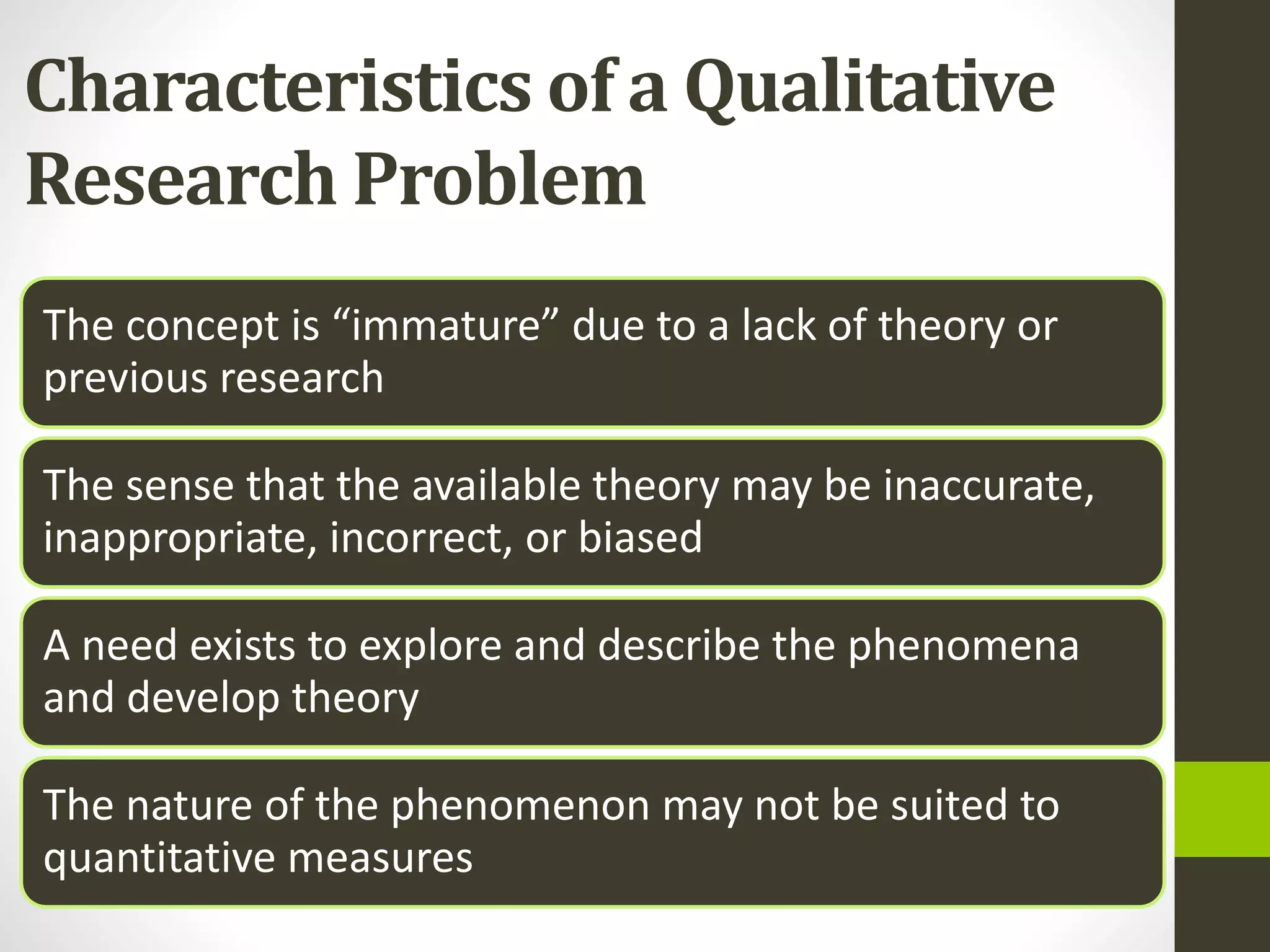
Characteristics of a Qualitative
Research Problem
The concept is “immature” due to a lack of theory or
previous research
The sense that the available theory may be inaccurate,
inappropriate, incorrect, or biased
A need exists to explore and describe the phenomena
and develop theory
The nature of the phenomenon may not be suited to
quantitative measures
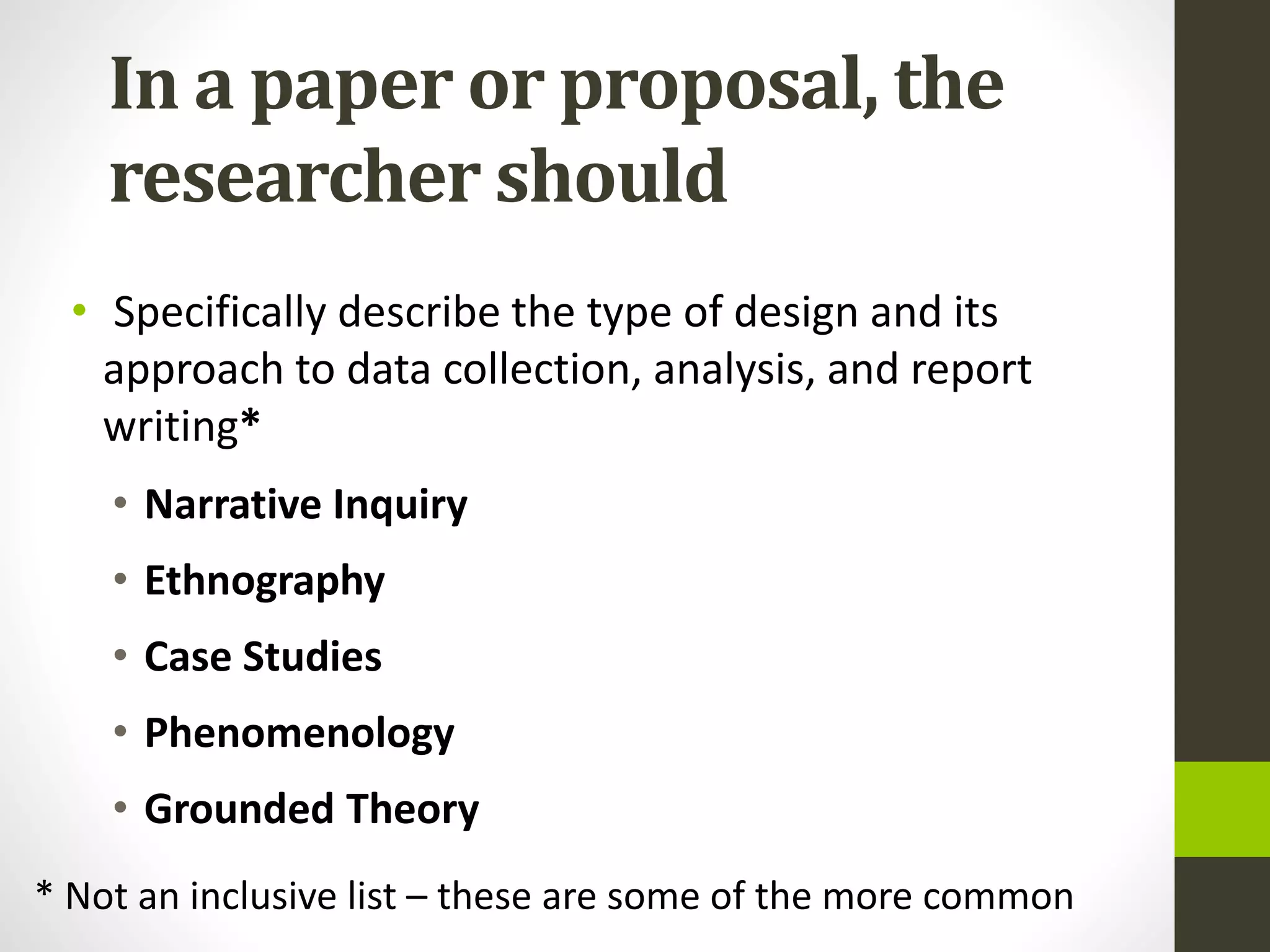
In a paper or proposal, the
researcher should
• Specifically describe the type of design and its
approach to data collection, analysis, and report
writing*
• Narrative Inquiry
• Ethnography
• Case Studies
• Phenomenology
• Grounded Theory
* Not an inclusive list – these are some of the more common
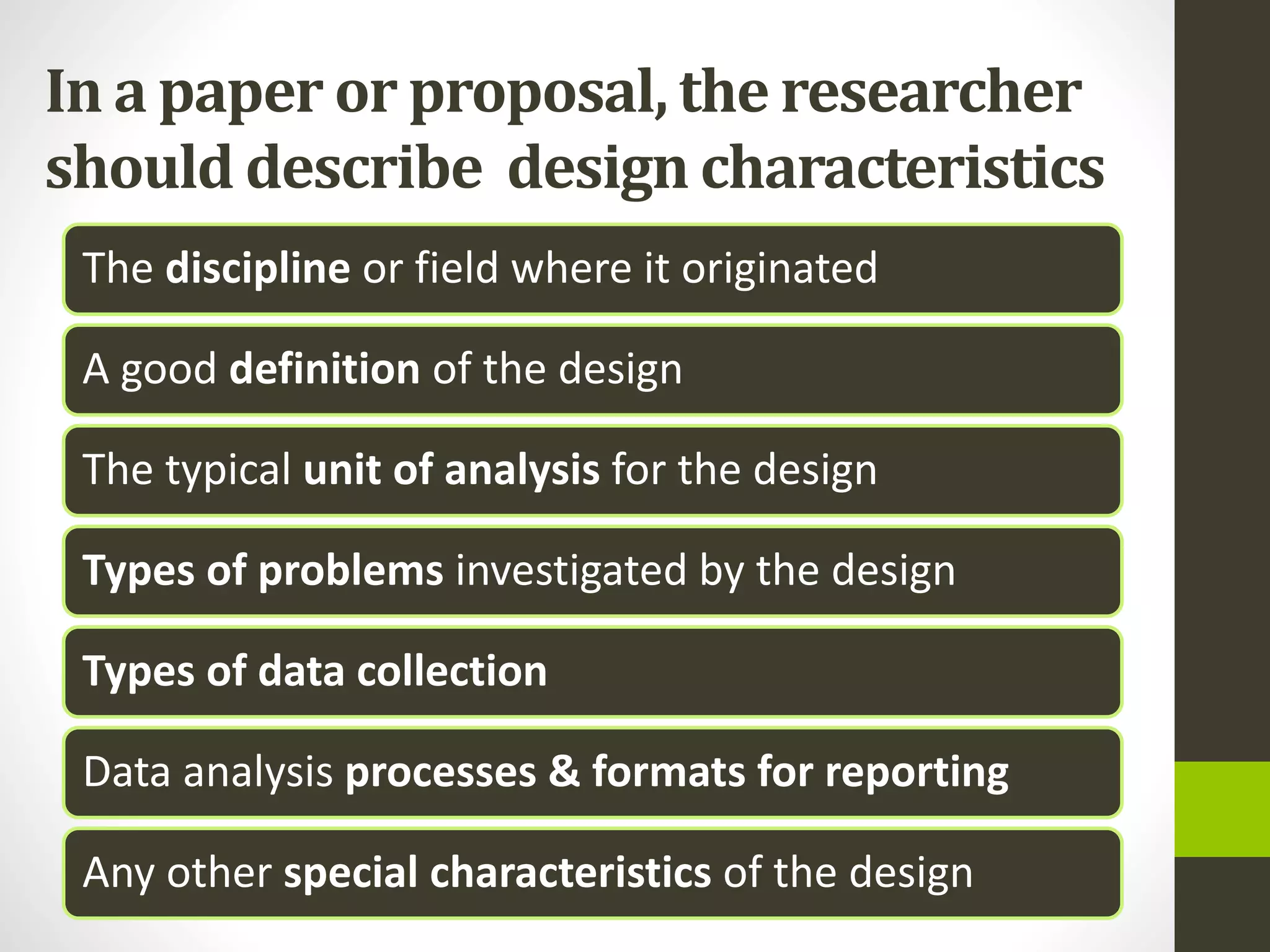
In a paper or proposal, the researcher
should describe design characteristics
The discipline or field where it originated
A good definition of the design
The typical unit of analysis for the design
Types of problems investigated by the design
Types of data collection
Data analysis processes & formats for reporting
Any other special characteristics of the design
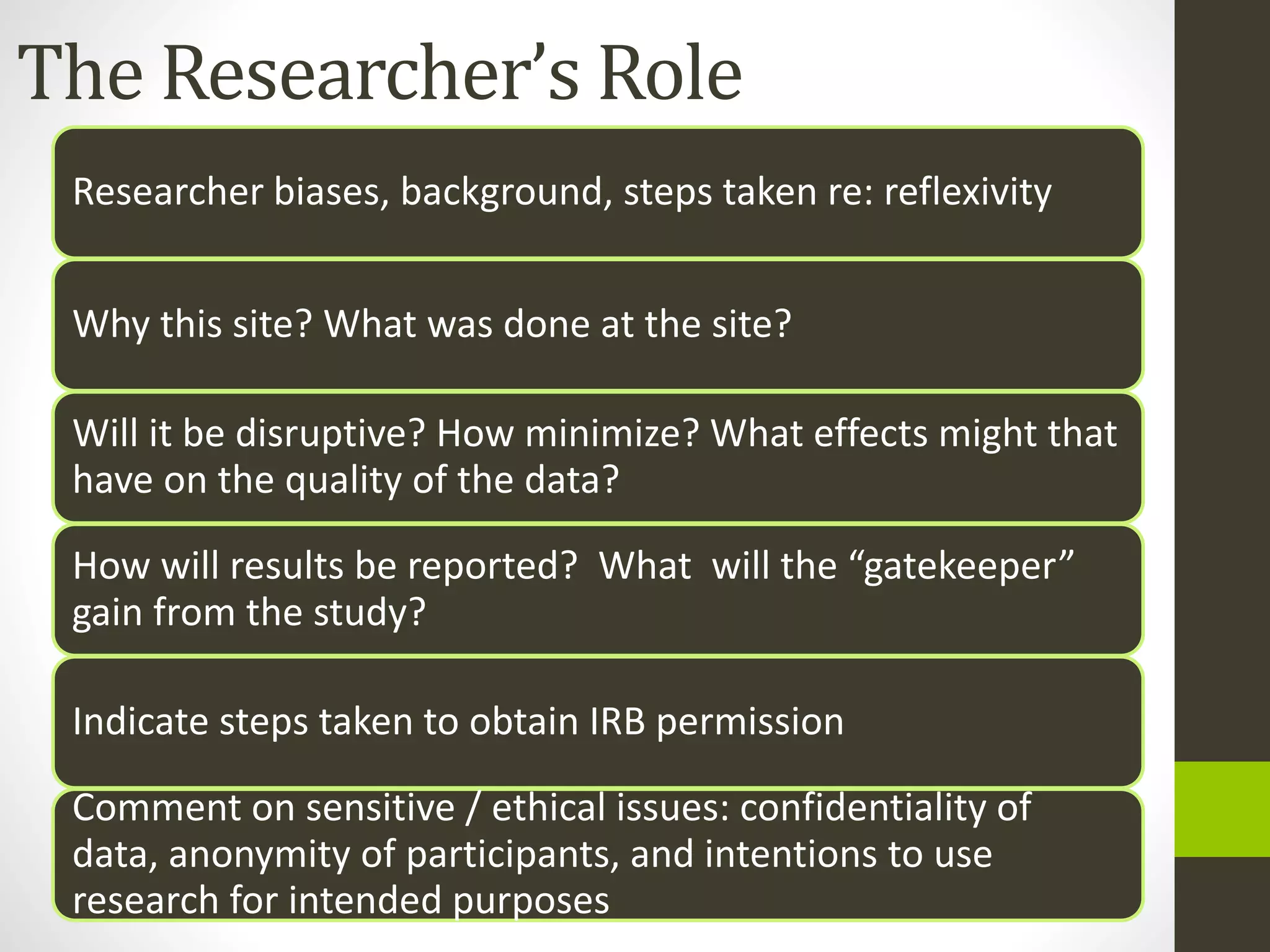
The Researcher’s Role
Researcher biases, background, steps taken re: reflexivity
Why this site? What was done at the site?
Will it be disruptive? How minimize? What effects might that
have on the quality of the data?
How will results be reported? What will the “gatekeeper”
gain from the study?
Indicate steps taken to obtain IRB permission
Comment on sensitive / ethical issues: confidentiality of
data, anonymity of participants, and intentions to use
research for intended purposes
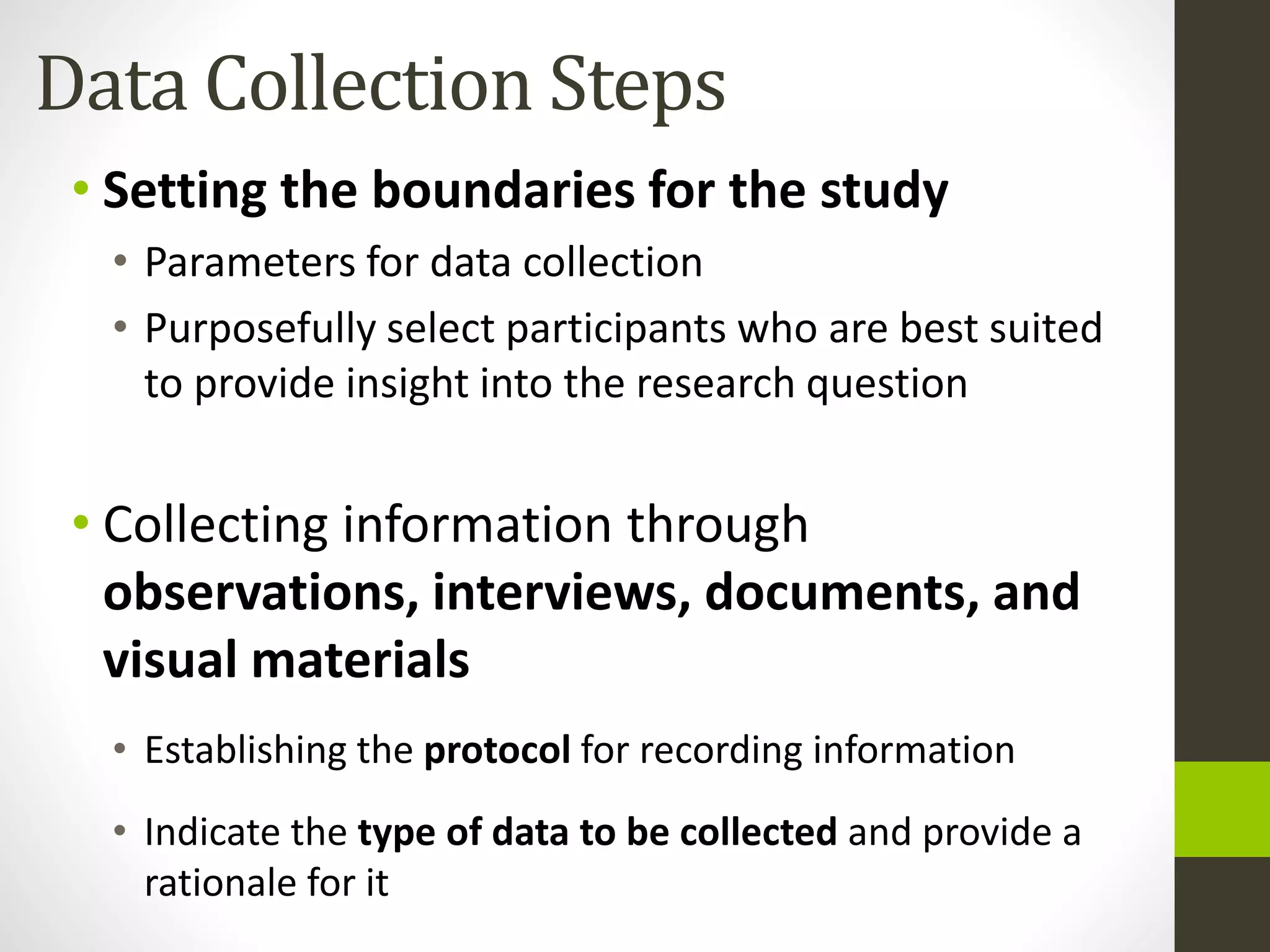
Data Collection Steps
• Setting the boundaries for the study
• Parameters for data collection
• Purposefully select participants who are best suited
to provide insight into the research question
• Collecting information through
observations, interviews, documents, and
visual materials
• Establishing the protocol for recording information
• Indicate the type of data to be collected and provide a
rationale for it
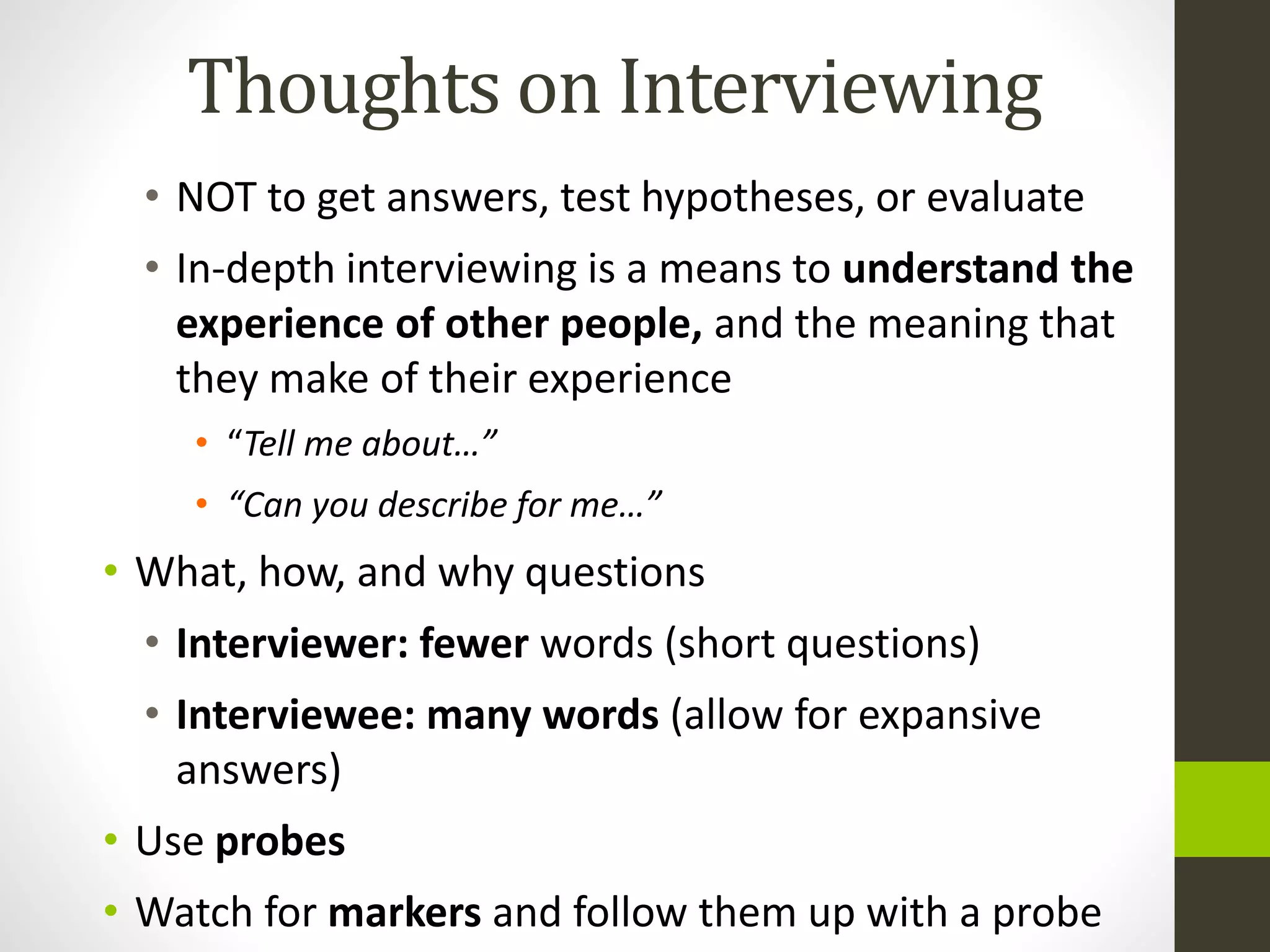
Thoughts on Interviewing
• NOT to get answers, test hypotheses, or evaluate
• In-depth interviewing is a means to understand the
experience of other people, and the meaning that
they make of their experience
• “Tell me about…”
• “Can you describe for me…”
• What, how, and why questions
• Interviewer: fewer words (short questions)
• Interviewee: many words (allow for expansive
answers)
• Use probes
• Watch for markers and follow them up with a probe
Conducting Focus Groups
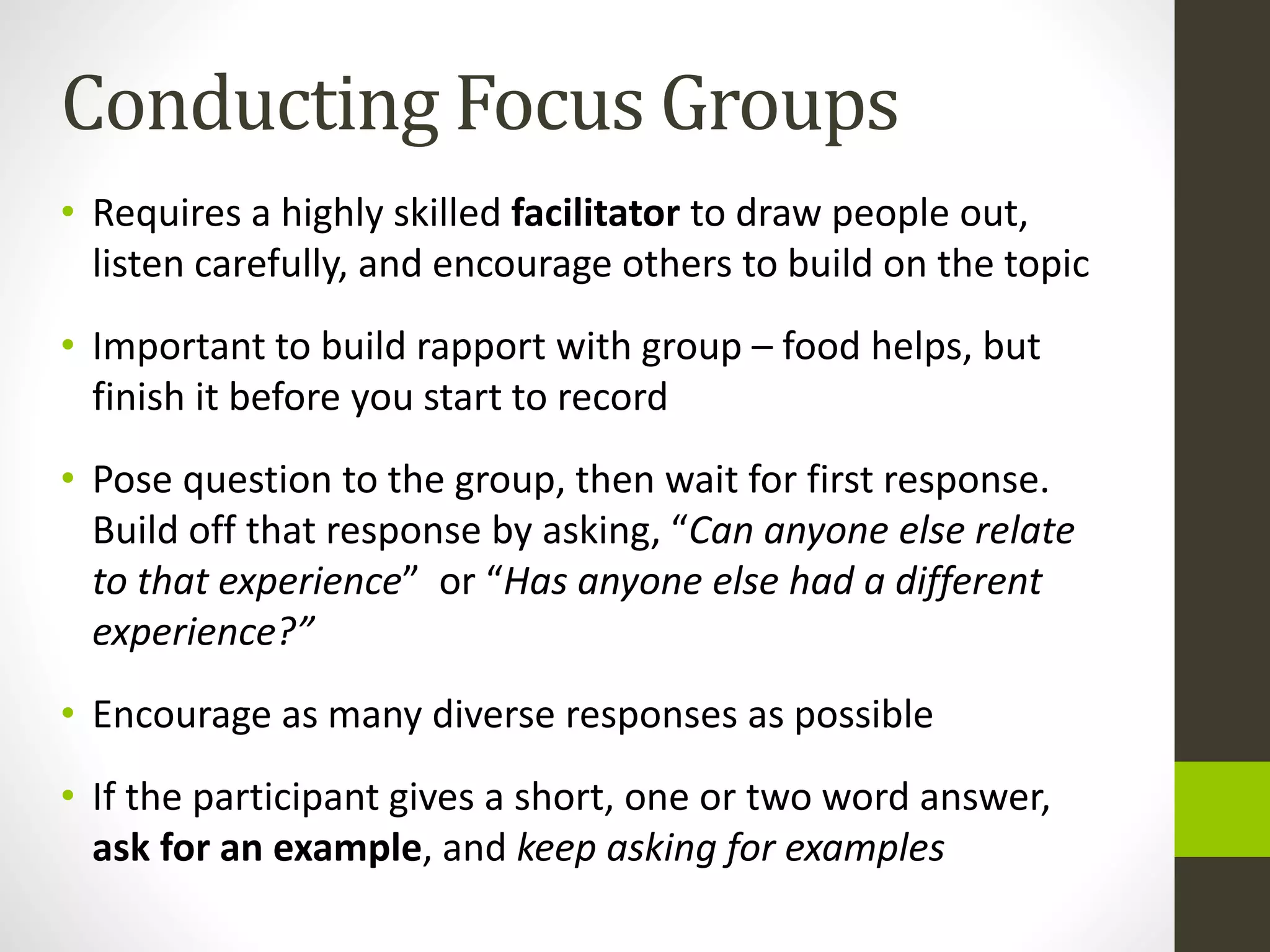
• Requires a highly skilled facilitator to draw people out,
listen carefully, and encourage others to build on the topic
• Important to build rapport with group – food helps, but
finish it before you start to record
• Pose question to the group, then wait for first response.
Build off that response by asking, “Can anyone else relate
to that experience” or “Has anyone else had a different
experience?”
• Encourage as many diverse responses as possible
• If the participant gives a short, one or two word answer,
ask for an example, and keep asking for examples
Tricks of the Trade
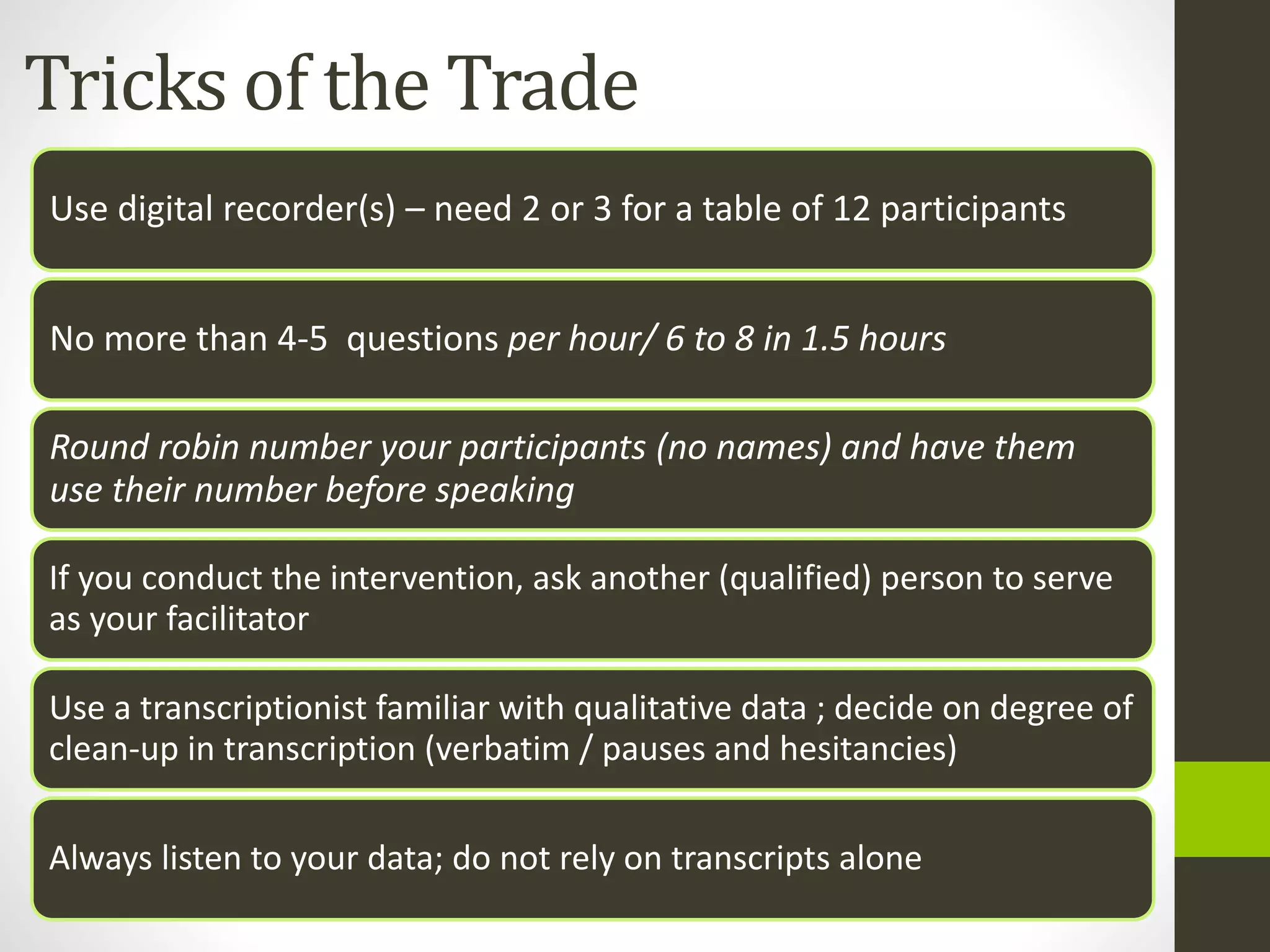
Use digital recorder(s) – need 2 or 3 for a table of 12 participants
No more than 4-5 questions per hour/ 6 to 8 in 1.5 hours
Round robin number your participants (no names) and have them
use their number before speaking
If you conduct the intervention, ask another (qualified) person to serve
as your facilitator
Use a transcriptionist familiar with qualitative data ; decide on degree of
clean-up in transcription (verbatim / pauses and hesitancies)
Always listen to your data; do not rely on transcripts alone
Triangulation: An Important Feature in
Qualitative Studies
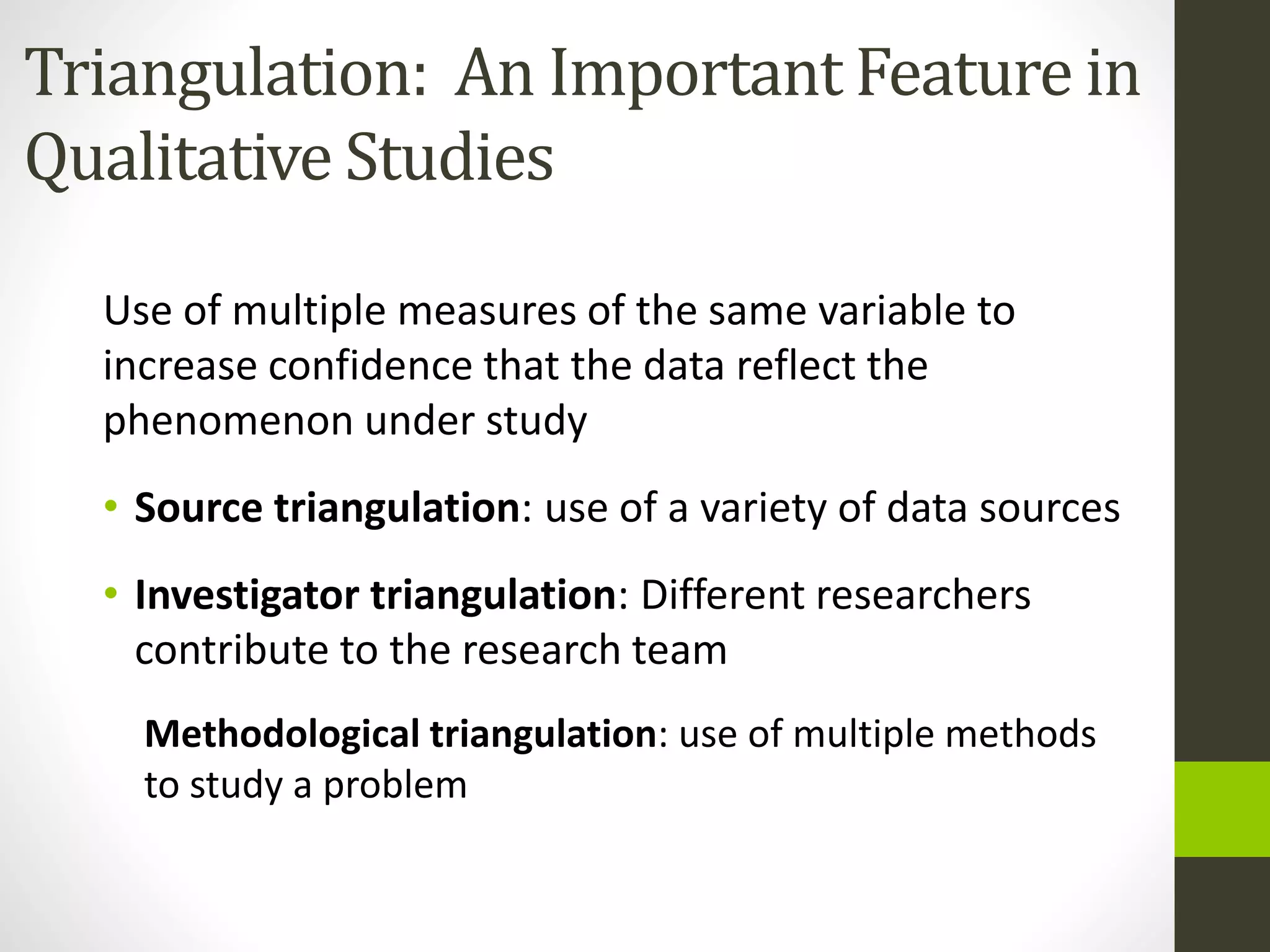
Use of multiple measures of the same variable to
increase confidence that the data reflect the
phenomenon under study
• Source triangulation: use of a variety of data sources
• Investigator triangulation: Different researchers
contribute to the research team
Methodological triangulation: use of multiple methods
to study a problem
Characteristics: Narrative Studies
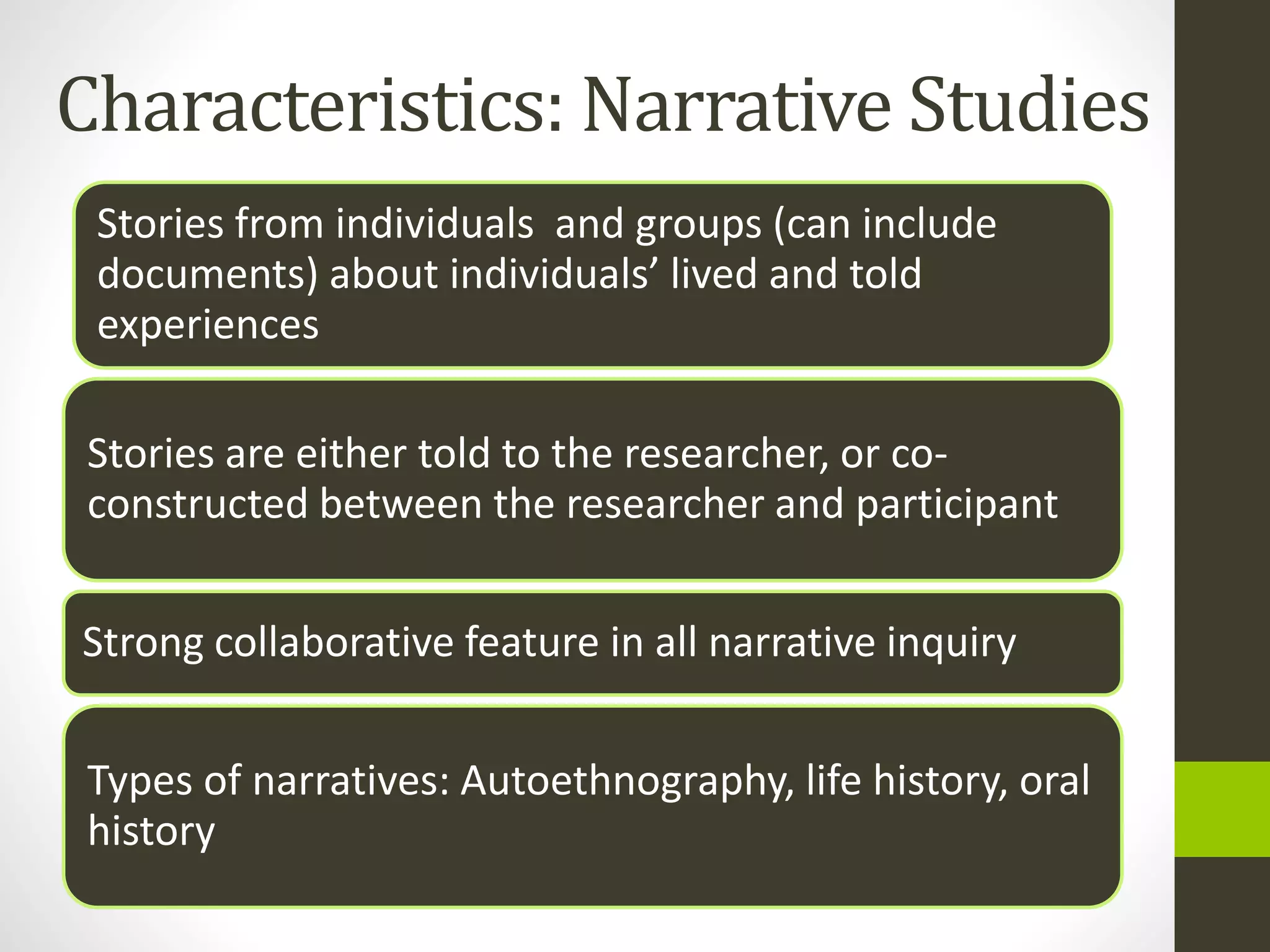
Stories from individuals and groups (can include
documents) about individuals’ lived and told
experiences
Stories are either told to the researcher, or co-
constructed between the researcher and participant
Strong collaborative feature in all narrative inquiry
Types of narratives: Autoethnography, life history, oral
history
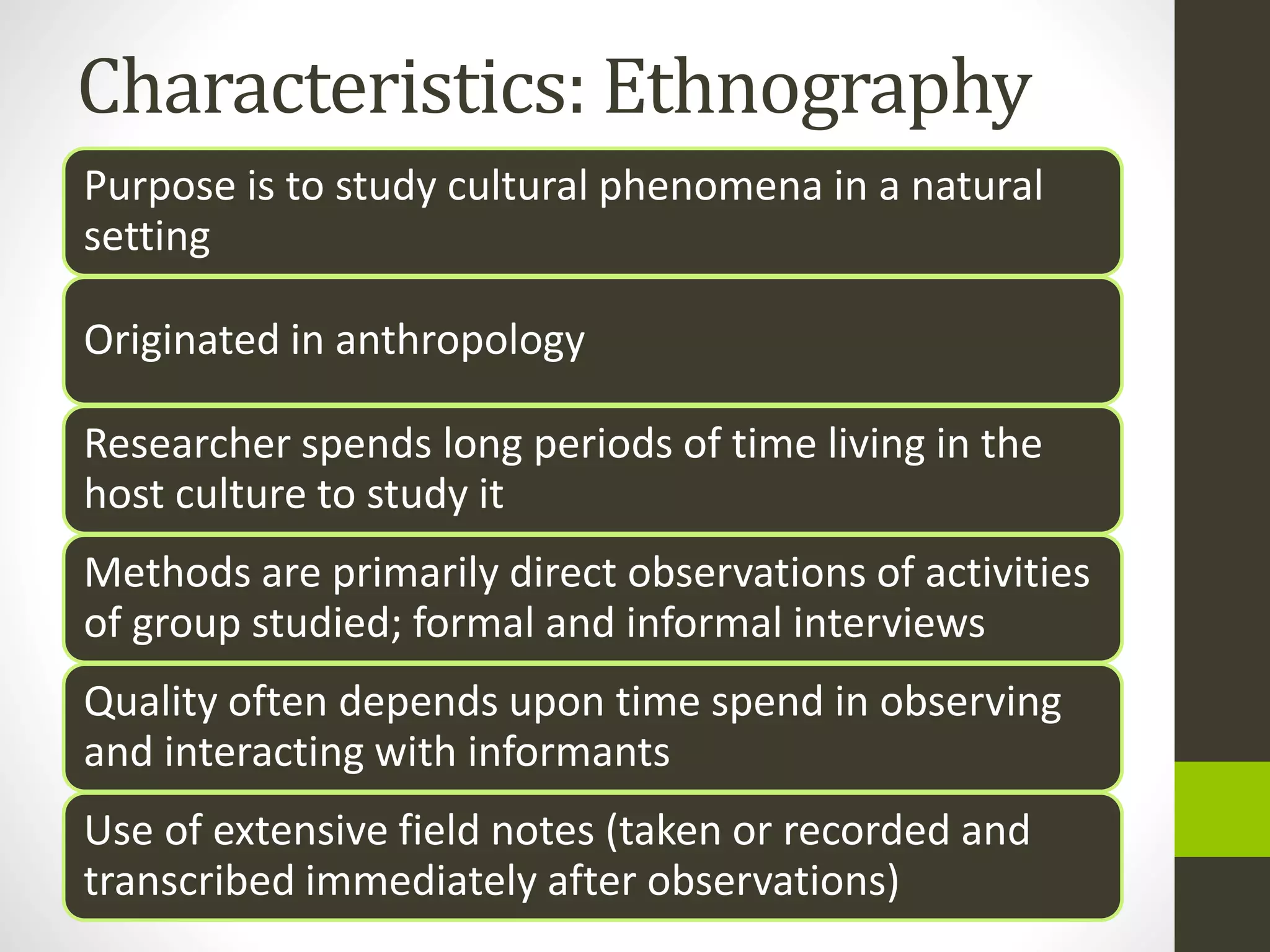
Characteristics: Ethnography
Purpose is to study cultural phenomena in a natural
setting
Originated in anthropology
Researcher spends long periods of time living in the
host culture to study it
Methods are primarily direct observations of activities
of group studied; formal and informal interviews
Quality often depends upon time spend in observing
and interacting with informants
Use of extensive field notes (taken or recorded and
transcribed immediately after observations)
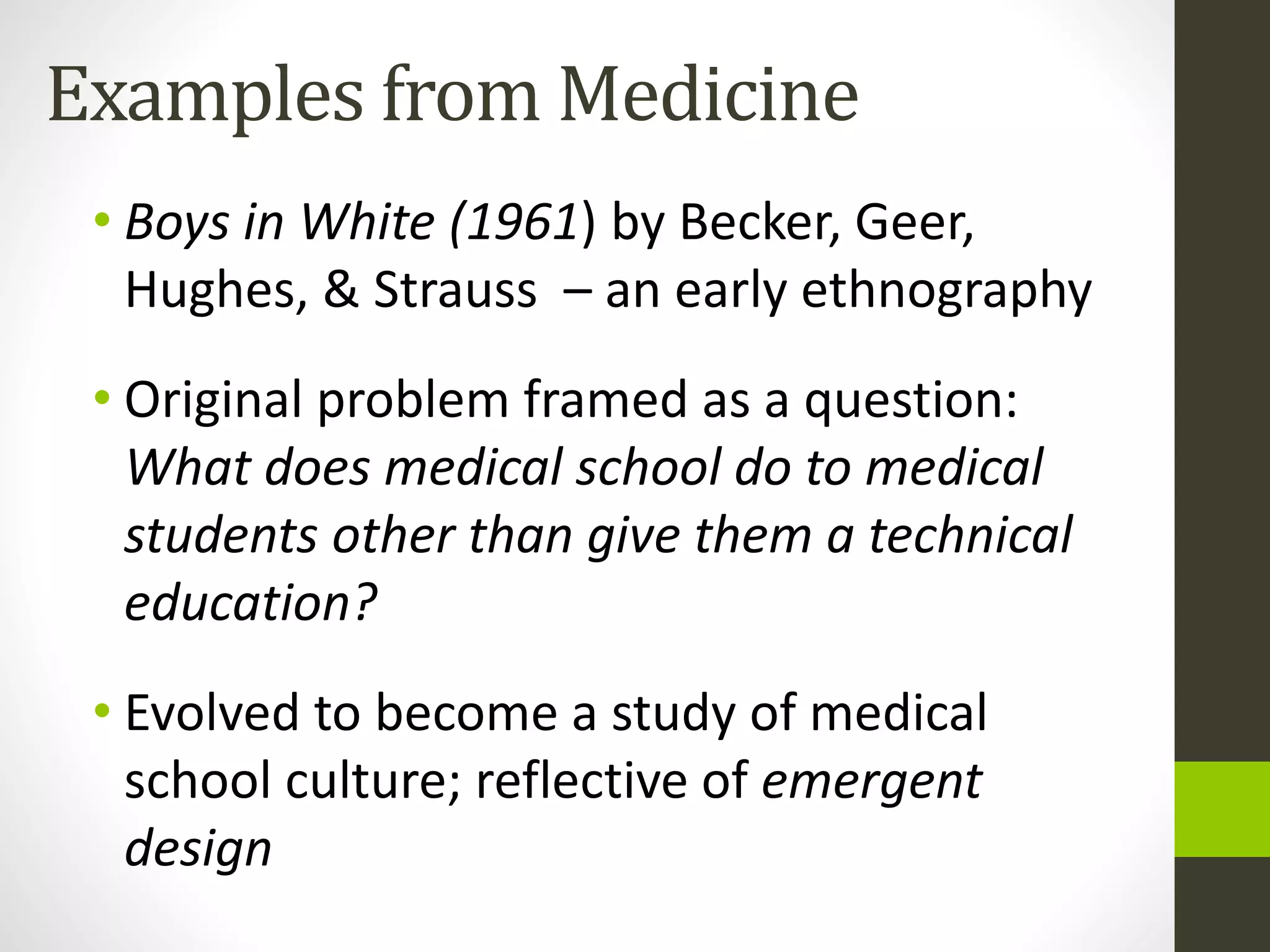
Examples from Medicine
• Boys in White (1961) by Becker, Geer,
Hughes, & Strauss – an early ethnography
• Original problem framed as a question:
What does medical school do to medical
students other than give them a technical
education?
• Evolved to become a study of medical
school culture; reflective of emergent
design
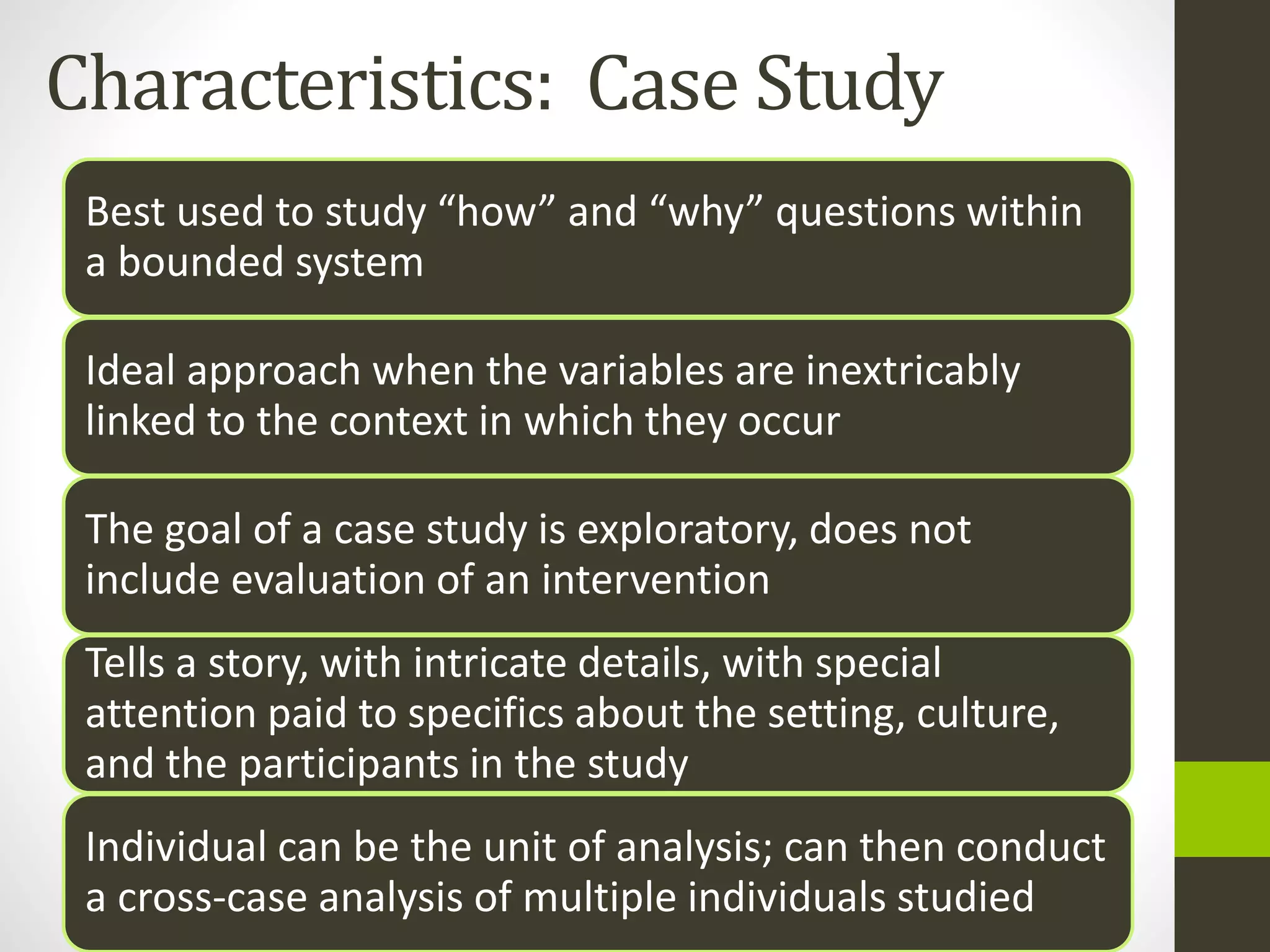
Characteristics: Case Study
Best used to study “how” and “why” questions within
a bounded system
Ideal approach when the variables are inextricably
linked to the context in which they occur
The goal of a case study is exploratory, does not
include evaluation of an intervention
Tells a story, with intricate details, with special
attention paid to specifics about the setting, culture,
and the participants in the study
Individual can be the unit of analysis; can then conduct
a cross-case analysis of multiple individuals studied
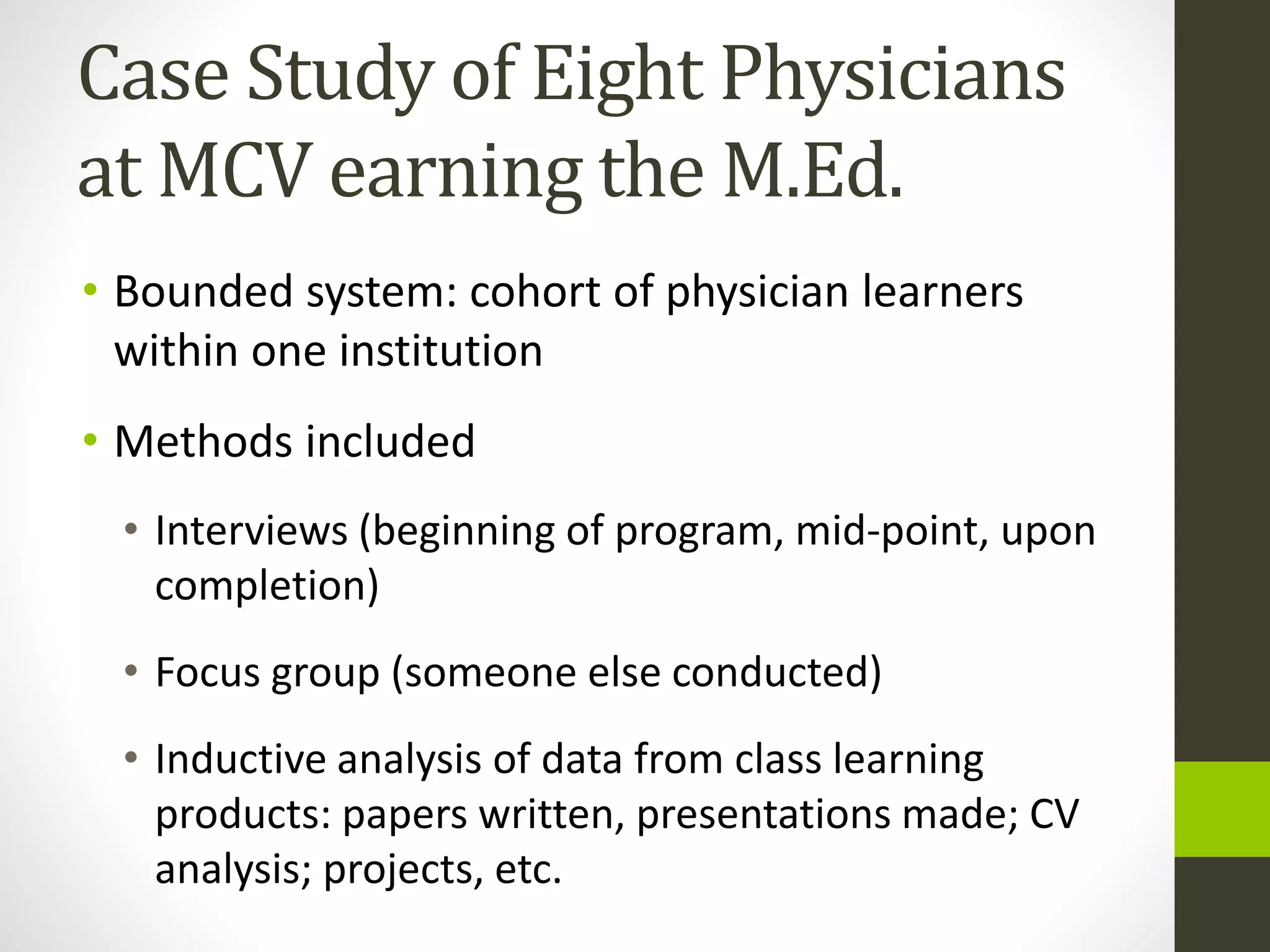
Case Study of Eight Physicians
at MCV earning the M.Ed.
• Bounded system: cohort of physician learners
within one institution
• Methods included
• Interviews (beginning of program, mid-point, upon
completion)
• Focus group (someone else conducted)
• Inductive analysis of data from class learning
products: papers written, presentations made; CV
analysis; projects, etc.
Characteristics: Phenomenology
Purpose is to identify phenomena as they are perceived
by the study participants
What is the meaning, structure, and essence of the lived
experience of this phenomenon by individual(s)?
Direct investigation and description of phenomena
without a priori theories about causal explanations
Has many derivatives, such as phenomenological
heuristic inquiry (Moustakas): researcher must have
experienced the phenomena him/herself
Characteristics: Grounded Theory
Involves the discovery of theory through the analysis of
data
Involves both inductive and deductive thinking through
a constant comparison of data at different levels of
abstraction
Not a descriptive qualitative method
Researcher does not formulate hypotheses in advance
since preconceived hypotheses result in theory
ungrounded in data
Goal is to generate explanatory concepts: the unit of
analysis is the incident as reported by individuals
Key Concepts in Grounded Theory
Continual questioning of gaps, omissions, inconsistencies,
and incomplete understandings – this informs the need for
additional data on the situation being studied
Open processes in conducting research, rather than fixed
methods and procedures
Generate theory and data from interviewing, rather than
observation practices
Data collection, coding and analysis occur simultaneously,
not as separate components of research design
Inductive: theory must grow out of the data and be
grounded in the data
How does grounded theory work?
Initial (or open) coding and categorization of
data
• Identify important words, or groups of words in the data and
then label them
• In vivo codes, words taken verbatim from participants
Concurrent data collection and data analysis
• Researcher collects data with an initially purposive sample
• These data are coded before more data are collected
• Researcher constructs a theoretical proposition and then
collects data to test the hypothesis
• Engages in a constant comparison analysis
• Result is theory built up from the data themselves
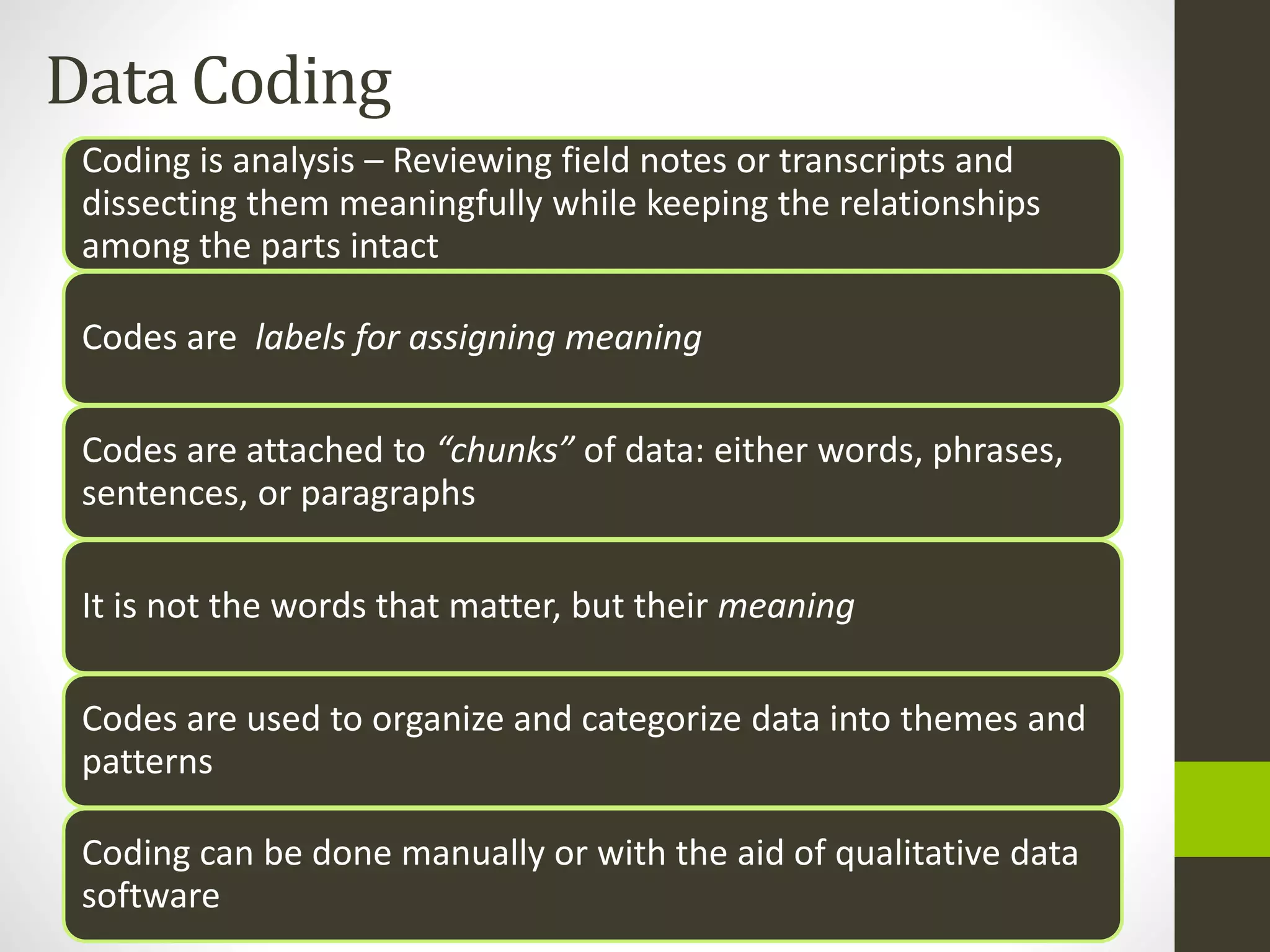
Data Coding
Coding is analysis – Reviewing field notes or transcripts and
dissecting them meaningfully while keeping the relationships
among the parts intact
Codes are labels for assigning meaning
Codes are attached to “chunks” of data: either words, phrases,
sentences, or paragraphs
It is not the words that matter, but their meaning
Codes are used to organize and categorize data into themes and
patterns
Coding can be done manually or with the aid of qualitative data
software
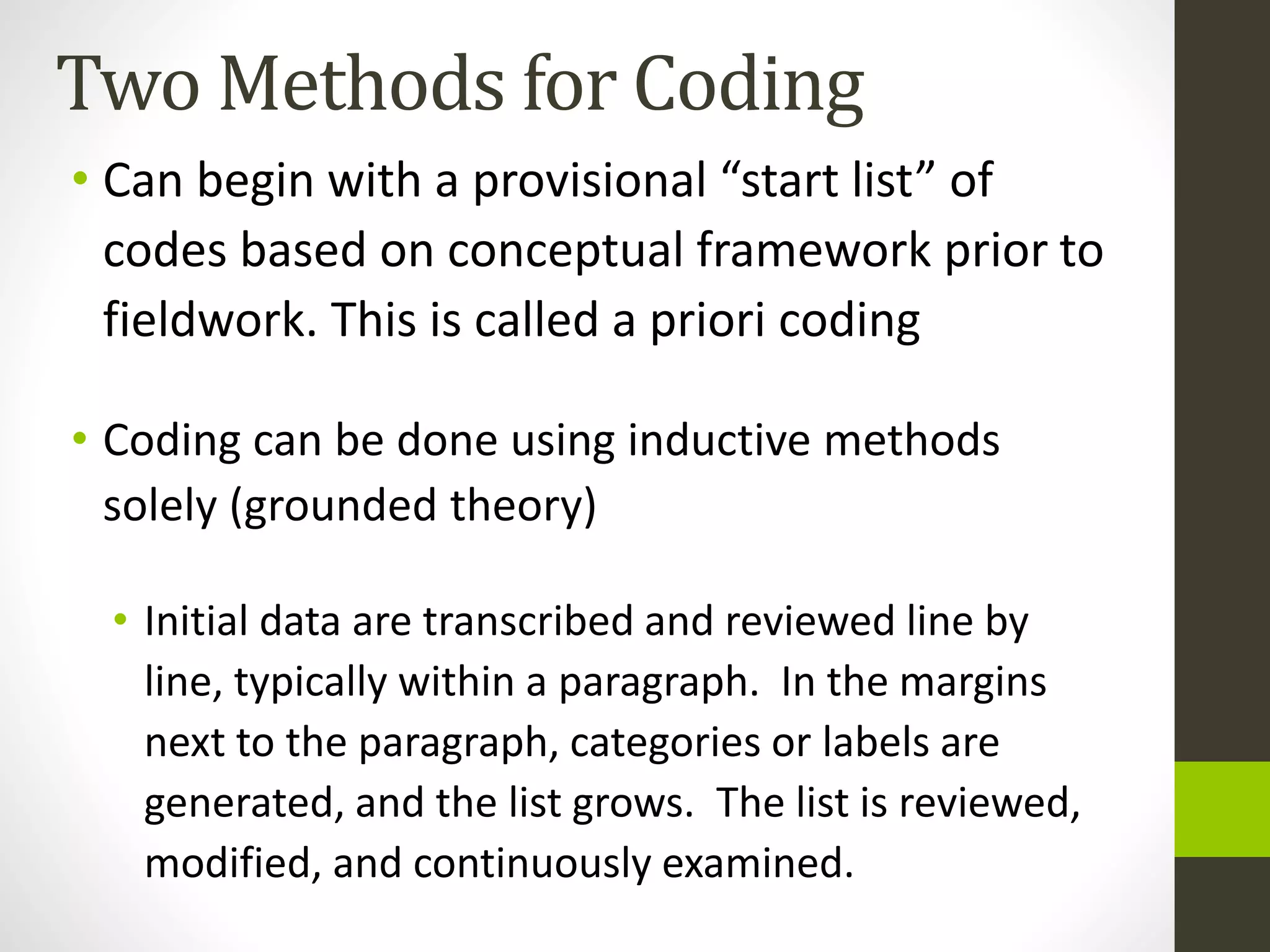
Two Methods for Coding
• Can begin with a provisional “start list” of
codes based on conceptual framework prior to
fieldwork. This is called a priori coding
• Coding can be done using inductive methods
solely (grounded theory)
• Initial data are transcribed and reviewed line by
line, typically within a paragraph. In the margins
next to the paragraph, categories or labels are
generated, and the list grows. The list is reviewed,
modified, and continuously examined.
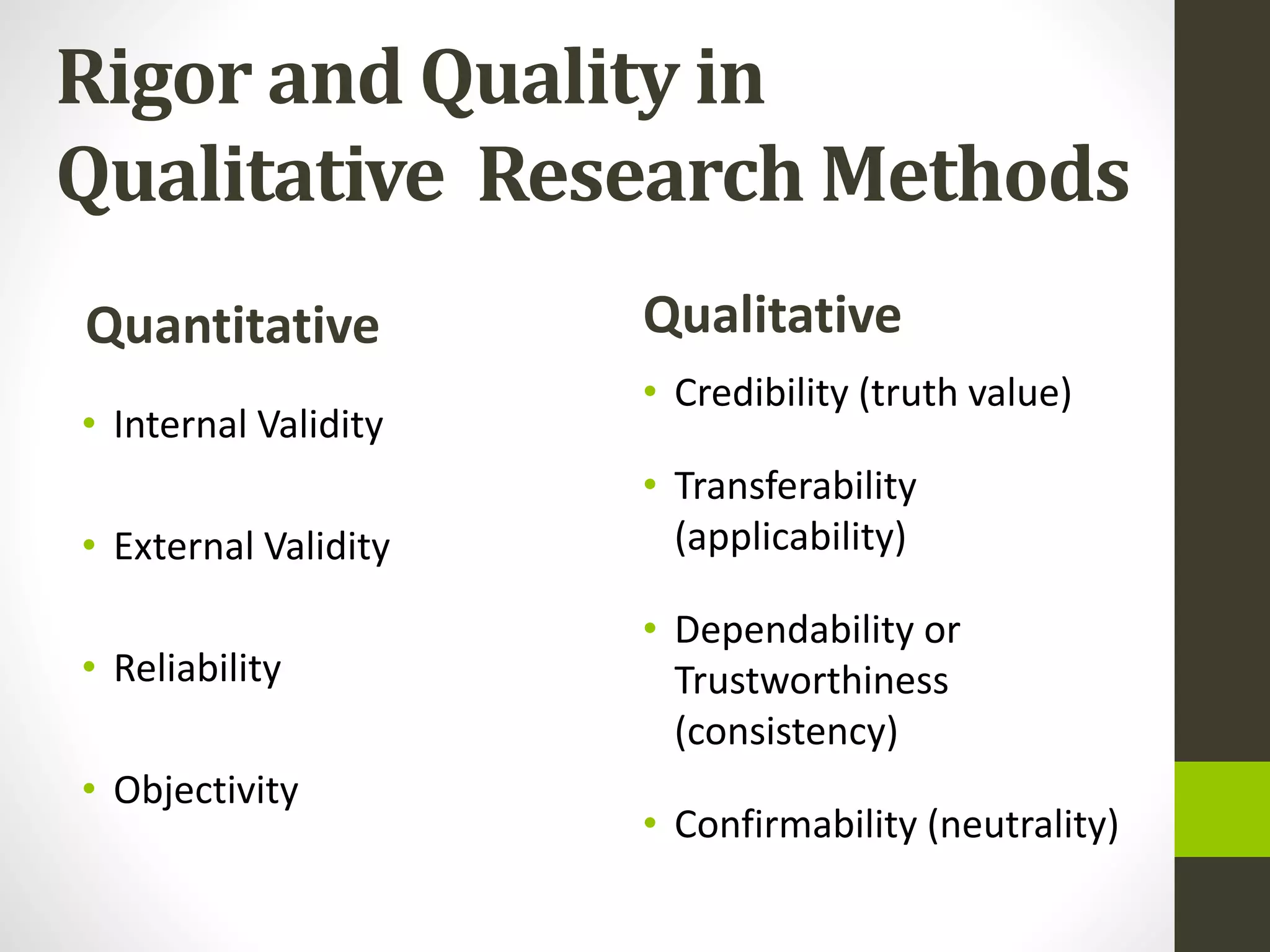
Rigor and Quality in
Qualitative Research Methods
Quantitative Qualitative
• Internal Validity
• External Validity
• Reliability
• Objectivity
• Credibility (truth value)
• Transferability
(applicability)
• Dependability or
Trustworthiness
(consistency)
• Confirmability (neutrality)
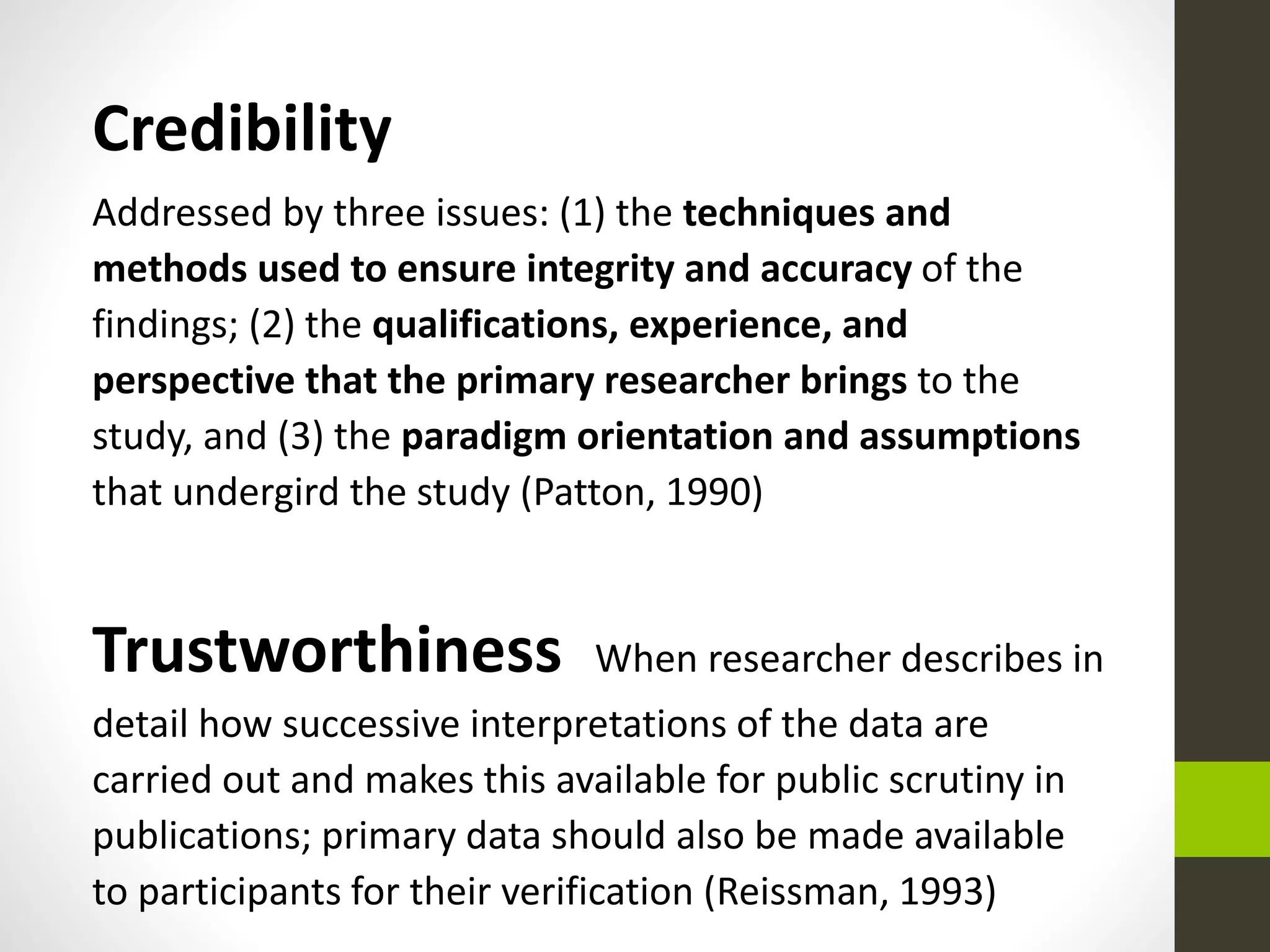
Credibility
Addressed by three issues: (1) the techniques and
methods used to ensure integrity and accuracy of the
findings; (2) the qualifications, experience, and
perspective that the primary researcher brings to the
study, and (3) the paradigm orientation and assumptions
that undergird the study (Patton, 1990)
Trustworthiness When researcher describes in
detail how successive interpretations of the data are
carried out and makes this available for public scrutiny in
publications; primary data should also be made available
to participants for their verification (Reissman, 1993)

Class 6 research quality in qualitative methods oct 13 2015

  • 1.
    Research Quality in QualitativeMethods Class Session 6 ADLT 673, October 13, 2015
  • 2.
    Assumptions of Qualitative Design •Are concerned with process over outcomes • Are interested in the meaning of experience – how people make sense of their lives • Act as the primary instrument for data collection and interpretation Qualitative Researchers ….
  • 3.
    Assumptions of Qualitative Design •Involves fieldwork – the researcher physically goes to the setting or site to observe or record behavior • Is descriptive—the researcher seeks to understand in terms of words or pictures • Is inductive—the researcher builds abstractions, concepts, hypotheses, and theories from details Qualitative Research ….
  • 4.
    Characteristics of aQualitative Research Problem The concept is “immature” due to a lack of theory or previous research The sense that the available theory may be inaccurate, inappropriate, incorrect, or biased A need exists to explore and describe the phenomena and develop theory The nature of the phenomenon may not be suited to quantitative measures
  • 5.
    In a paperor proposal, the researcher should • Specifically describe the type of design and its approach to data collection, analysis, and report writing* • Narrative Inquiry • Ethnography • Case Studies • Phenomenology • Grounded Theory * Not an inclusive list – these are some of the more common
  • 6.
    In a paperor proposal, the researcher should describe design characteristics The discipline or field where it originated A good definition of the design The typical unit of analysis for the design Types of problems investigated by the design Types of data collection Data analysis processes & formats for reporting Any other special characteristics of the design
  • 7.
    The Researcher’s Role Researcherbiases, background, steps taken re: reflexivity Why this site? What was done at the site? Will it be disruptive? How minimize? What effects might that have on the quality of the data? How will results be reported? What will the “gatekeeper” gain from the study? Indicate steps taken to obtain IRB permission Comment on sensitive / ethical issues: confidentiality of data, anonymity of participants, and intentions to use research for intended purposes
  • 8.
    Data Collection Steps •Setting the boundaries for the study • Parameters for data collection • Purposefully select participants who are best suited to provide insight into the research question • Collecting information through observations, interviews, documents, and visual materials • Establishing the protocol for recording information • Indicate the type of data to be collected and provide a rationale for it
  • 9.
    Thoughts on Interviewing •NOT to get answers, test hypotheses, or evaluate • In-depth interviewing is a means to understand the experience of other people, and the meaning that they make of their experience • “Tell me about…” • “Can you describe for me…” • What, how, and why questions • Interviewer: fewer words (short questions) • Interviewee: many words (allow for expansive answers) • Use probes • Watch for markers and follow them up with a probe
  • 10.
    Conducting Focus Groups •Requires a highly skilled facilitator to draw people out, listen carefully, and encourage others to build on the topic • Important to build rapport with group – food helps, but finish it before you start to record • Pose question to the group, then wait for first response. Build off that response by asking, “Can anyone else relate to that experience” or “Has anyone else had a different experience?” • Encourage as many diverse responses as possible • If the participant gives a short, one or two word answer, ask for an example, and keep asking for examples
  • 11.
    Tricks of theTrade Use digital recorder(s) – need 2 or 3 for a table of 12 participants No more than 4-5 questions per hour/ 6 to 8 in 1.5 hours Round robin number your participants (no names) and have them use their number before speaking If you conduct the intervention, ask another (qualified) person to serve as your facilitator Use a transcriptionist familiar with qualitative data ; decide on degree of clean-up in transcription (verbatim / pauses and hesitancies) Always listen to your data; do not rely on transcripts alone
  • 12.
    Triangulation: An ImportantFeature in Qualitative Studies Use of multiple measures of the same variable to increase confidence that the data reflect the phenomenon under study • Source triangulation: use of a variety of data sources • Investigator triangulation: Different researchers contribute to the research team Methodological triangulation: use of multiple methods to study a problem
  • 13.
    Characteristics: Narrative Studies Storiesfrom individuals and groups (can include documents) about individuals’ lived and told experiences Stories are either told to the researcher, or co- constructed between the researcher and participant Strong collaborative feature in all narrative inquiry Types of narratives: Autoethnography, life history, oral history
  • 14.
    Characteristics: Ethnography Purpose isto study cultural phenomena in a natural setting Originated in anthropology Researcher spends long periods of time living in the host culture to study it Methods are primarily direct observations of activities of group studied; formal and informal interviews Quality often depends upon time spend in observing and interacting with informants Use of extensive field notes (taken or recorded and transcribed immediately after observations)
  • 15.
    Examples from Medicine •Boys in White (1961) by Becker, Geer, Hughes, & Strauss – an early ethnography • Original problem framed as a question: What does medical school do to medical students other than give them a technical education? • Evolved to become a study of medical school culture; reflective of emergent design
  • 16.
    Characteristics: Case Study Bestused to study “how” and “why” questions within a bounded system Ideal approach when the variables are inextricably linked to the context in which they occur The goal of a case study is exploratory, does not include evaluation of an intervention Tells a story, with intricate details, with special attention paid to specifics about the setting, culture, and the participants in the study Individual can be the unit of analysis; can then conduct a cross-case analysis of multiple individuals studied
  • 17.
    Case Study ofEight Physicians at MCV earning the M.Ed. • Bounded system: cohort of physician learners within one institution • Methods included • Interviews (beginning of program, mid-point, upon completion) • Focus group (someone else conducted) • Inductive analysis of data from class learning products: papers written, presentations made; CV analysis; projects, etc.
  • 18.
    Characteristics: Phenomenology Purpose isto identify phenomena as they are perceived by the study participants What is the meaning, structure, and essence of the lived experience of this phenomenon by individual(s)? Direct investigation and description of phenomena without a priori theories about causal explanations Has many derivatives, such as phenomenological heuristic inquiry (Moustakas): researcher must have experienced the phenomena him/herself
  • 19.
    Characteristics: Grounded Theory Involvesthe discovery of theory through the analysis of data Involves both inductive and deductive thinking through a constant comparison of data at different levels of abstraction Not a descriptive qualitative method Researcher does not formulate hypotheses in advance since preconceived hypotheses result in theory ungrounded in data Goal is to generate explanatory concepts: the unit of analysis is the incident as reported by individuals
  • 20.
    Key Concepts inGrounded Theory Continual questioning of gaps, omissions, inconsistencies, and incomplete understandings – this informs the need for additional data on the situation being studied Open processes in conducting research, rather than fixed methods and procedures Generate theory and data from interviewing, rather than observation practices Data collection, coding and analysis occur simultaneously, not as separate components of research design Inductive: theory must grow out of the data and be grounded in the data
  • 21.
    How does groundedtheory work? Initial (or open) coding and categorization of data • Identify important words, or groups of words in the data and then label them • In vivo codes, words taken verbatim from participants Concurrent data collection and data analysis • Researcher collects data with an initially purposive sample • These data are coded before more data are collected • Researcher constructs a theoretical proposition and then collects data to test the hypothesis • Engages in a constant comparison analysis • Result is theory built up from the data themselves
  • 22.
    Data Coding Coding isanalysis – Reviewing field notes or transcripts and dissecting them meaningfully while keeping the relationships among the parts intact Codes are labels for assigning meaning Codes are attached to “chunks” of data: either words, phrases, sentences, or paragraphs It is not the words that matter, but their meaning Codes are used to organize and categorize data into themes and patterns Coding can be done manually or with the aid of qualitative data software
  • 23.
    Two Methods forCoding • Can begin with a provisional “start list” of codes based on conceptual framework prior to fieldwork. This is called a priori coding • Coding can be done using inductive methods solely (grounded theory) • Initial data are transcribed and reviewed line by line, typically within a paragraph. In the margins next to the paragraph, categories or labels are generated, and the list grows. The list is reviewed, modified, and continuously examined.
  • 24.
    Rigor and Qualityin Qualitative Research Methods Quantitative Qualitative • Internal Validity • External Validity • Reliability • Objectivity • Credibility (truth value) • Transferability (applicability) • Dependability or Trustworthiness (consistency) • Confirmability (neutrality)
  • 25.
    Credibility Addressed by threeissues: (1) the techniques and methods used to ensure integrity and accuracy of the findings; (2) the qualifications, experience, and perspective that the primary researcher brings to the study, and (3) the paradigm orientation and assumptions that undergird the study (Patton, 1990) Trustworthiness When researcher describes in detail how successive interpretations of the data are carried out and makes this available for public scrutiny in publications; primary data should also be made available to participants for their verification (Reissman, 1993)