How do we know when our students are learning? Richard Dettling Alexandra Escobar  | January 26, 2012
Objectives  Recognize the differences between formative and summative assessments  Understand Bloom’s Mastery Learning Process and its essential elements Identify different ways to apply formative assessment techniques in the classroom  Explore technology tools available to assess student learning Identify ways to collect and analyze formative assessment data
Assessment in Higher Education Institutional  – very broad, looks at how students are meeting standards at a very broad (high) level  College/Program  – more focused but scores are still aggregated across programs. Focus on program outcomes versus course outcomes  Course  – even more focus, scores are aggregated by students within a specific class  Student  – extreme focus on students’ work product
Faculty’s Role in Student Assessment  It starts in the classroom….  What skills and knowledge should students have at the end of a course?  How does this build on previous courses and serve as foundations for future courses?  How do you know, they know?
Faculty’s Role in Student Assessment  Formative Assessments An assessment that is used for ongoing improvement while teaching and learning  is occurring  Summative Assessments  An assessment that occurs at the end of a structured learning experience to evaluate the level of learning that has occurred (Popham, 2011)
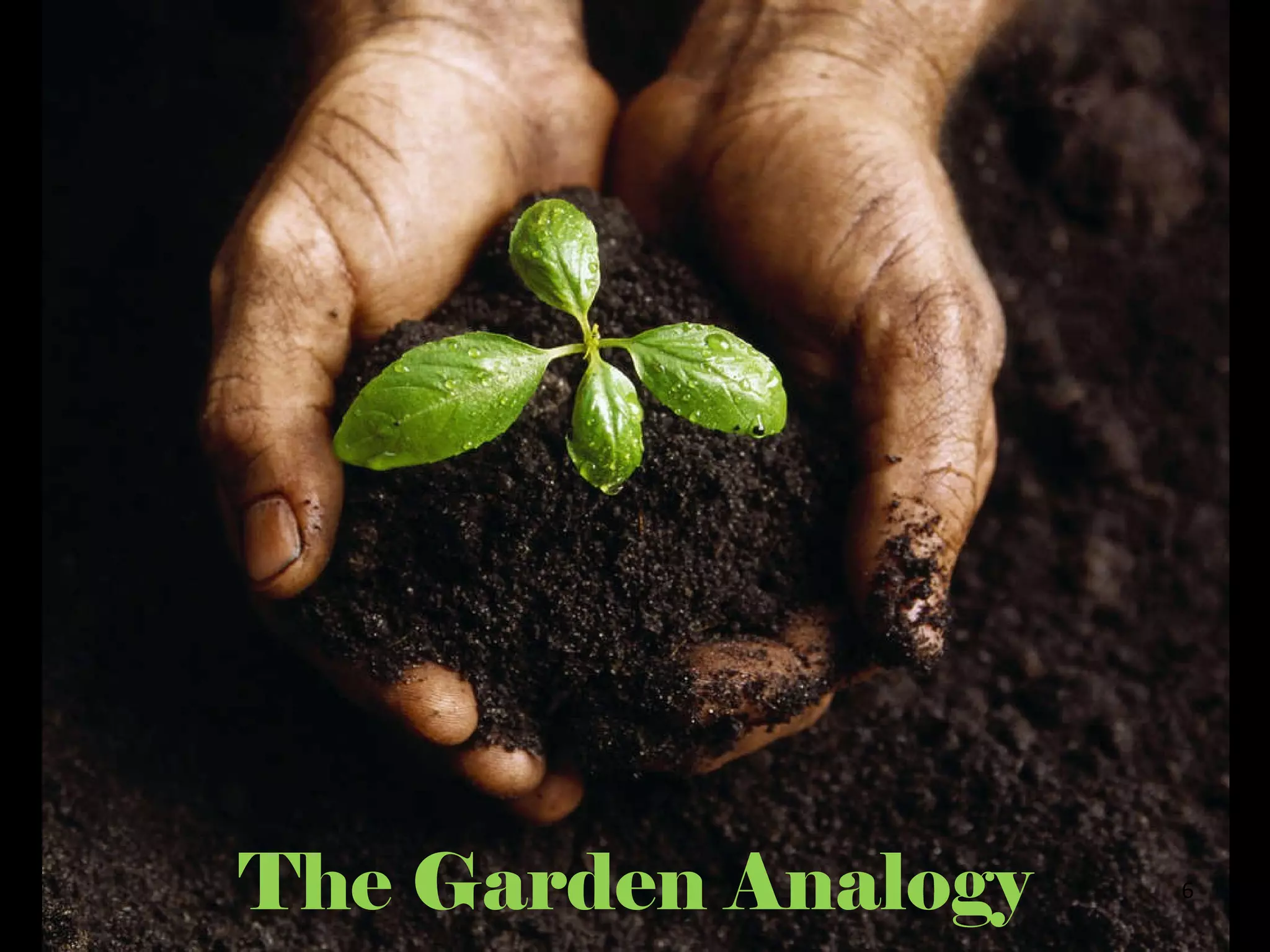
The Garden Analogy
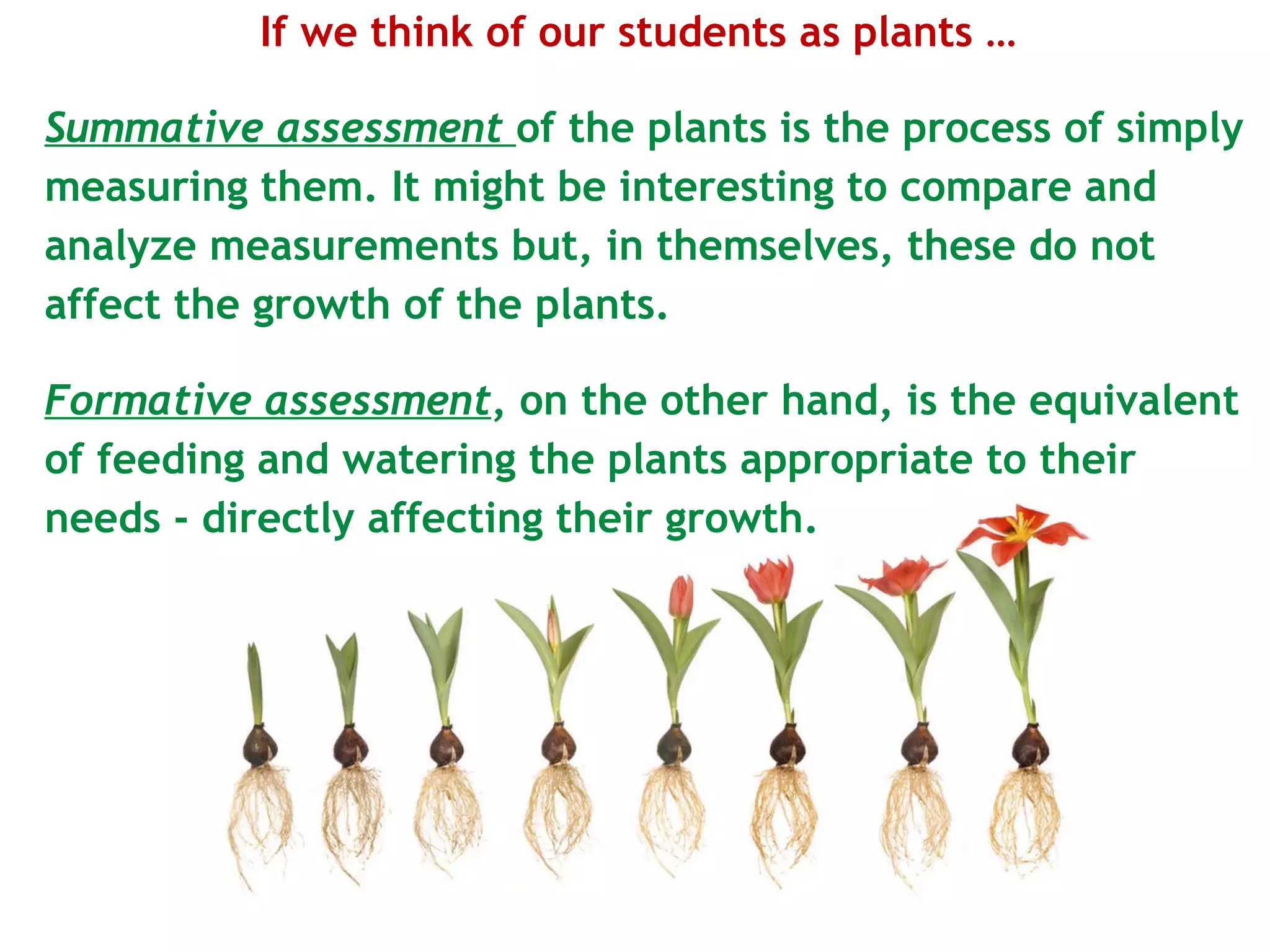
If we think of our students as plants …  Summative assessment   of the plants is the process of simply measuring them. It might be interesting to compare and analyze measurements but, in themselves, these do not affect the growth of the plants. Formative assessment , on the other hand, is the equivalent of feeding and watering the plants appropriate to their needs - directly affecting their growth.
Improving learning through assessment  Black and Wiliam’s (1998) research indicates that improving learning through assessment depends on five deceptively simple factors: Providing effective feedback to students  Students’ active involvement in their own learning Adjusting teaching to take into account  the results of assessment Recognizing the profound influence of assessment on students’ motivation and self-esteem - both crucial influences on learning Ensuring students assess themselves and understand how to improve
Mastery Learning Process
Mastery Learning Process Benjamin Bloom investigated the most effective components of one-on-one tutoring and adapted these to teaching in a whole group setting Dividing up concepts into smaller units Implementing frequent assessments, followed by instructor feedback and direction on how to improve Revisiting key concepts to ensure mastery These served as the foundation for the development of Mastery Learning  The essential elements of Mastery Learning are:  Feedback, Correctives, and Enrichment Instructional Alignment  (Guskey, 1996)
Feedback, Correctives, and Enrichment “ Just in Time” Feedback  Reinforces the essential objectives  Recognizes what was done well  Identifies what needs more work  Correctives  Explicit guidance on how to improve errors Identification of resources available Approach recommended is different than initial instruction – materials should be presented differently and students should be involved differently  Incorporate different learning styles/modalities Enrichments Opportunities to broaden learning, higher level activities (Guskey, 1996)
Instructional Alignment  Congruence among instructional components: learning outcomes, instruction, and evaluation  The desired learner outcomes should dictate the level of rigor and focus of instruction,  Formative assessment feedback should emphasize students’ performance based on the objectives  Summative evaluation should reflect the rigor of learning parallel to the instruction and assessment Not to be confused with “teaching to the test”, but “testing what is taught”  (Guskey, 1996)
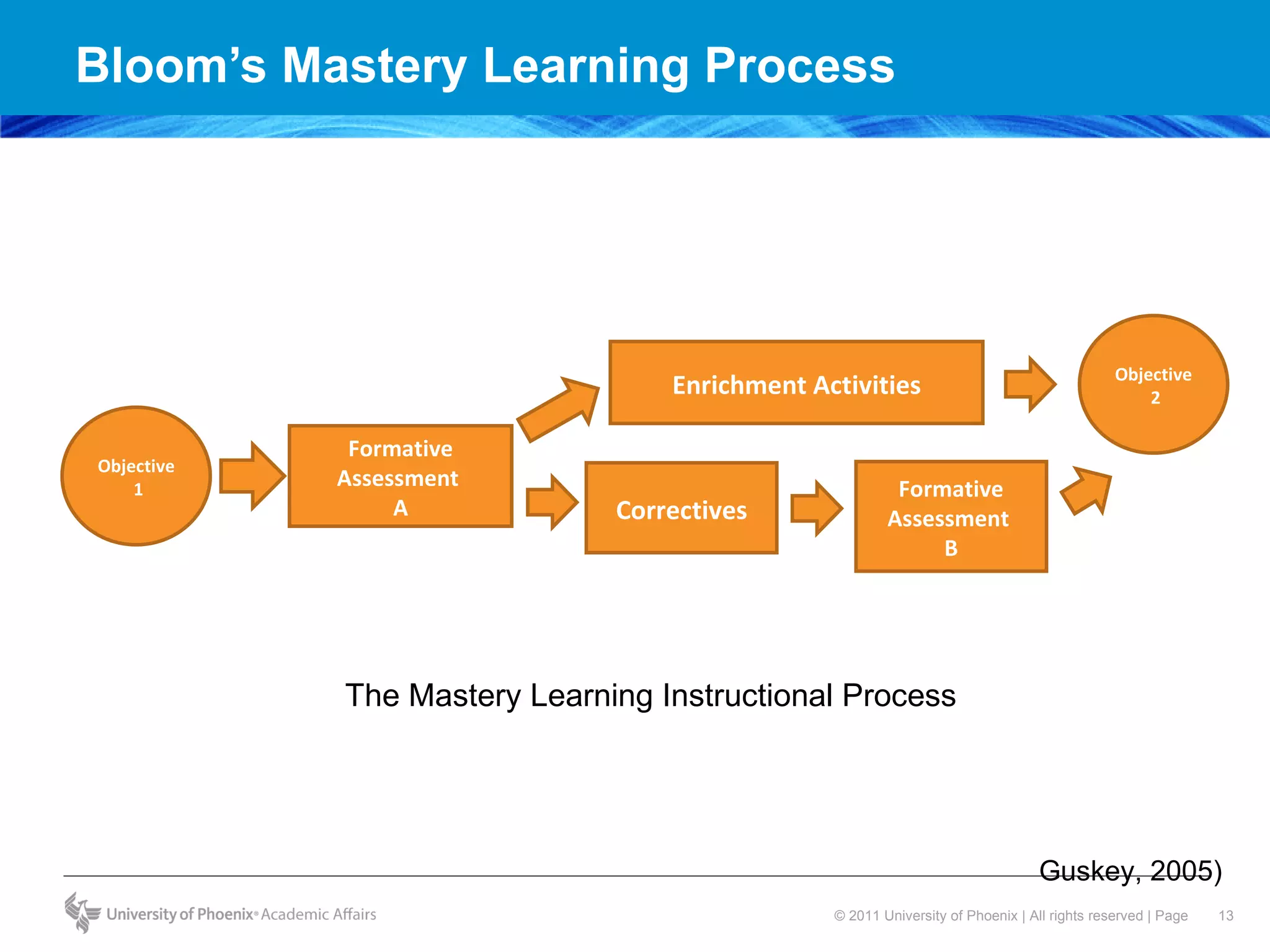
Bloom’s Mastery Learning Process The Mastery Learning Instructional Process  (Guskey, 2005) Objective 1 Formative Assessment  A Correctives Enrichment Activities Formative Assessment  B Objective 2
Formative Assessment Ideas Using formative assessment classroom techniques with the adult learner
Plan of Action Suggest a few formative assessments to use in the classroom Provide you with internet resources to create formative assessments All free for educators Show you how to use these formative assessments within the framework of Bloom’s Mastery Learning Process
Use a Pretest/Post-test Approach Pretest/Post-test is the ideal formative assessment Pretest/Post-test measures students knowledge and skills before instruction Measures growth and knowledge during instruction Measures what students learned at the end of instruction It is can directly measure how effective you are as an instructor.
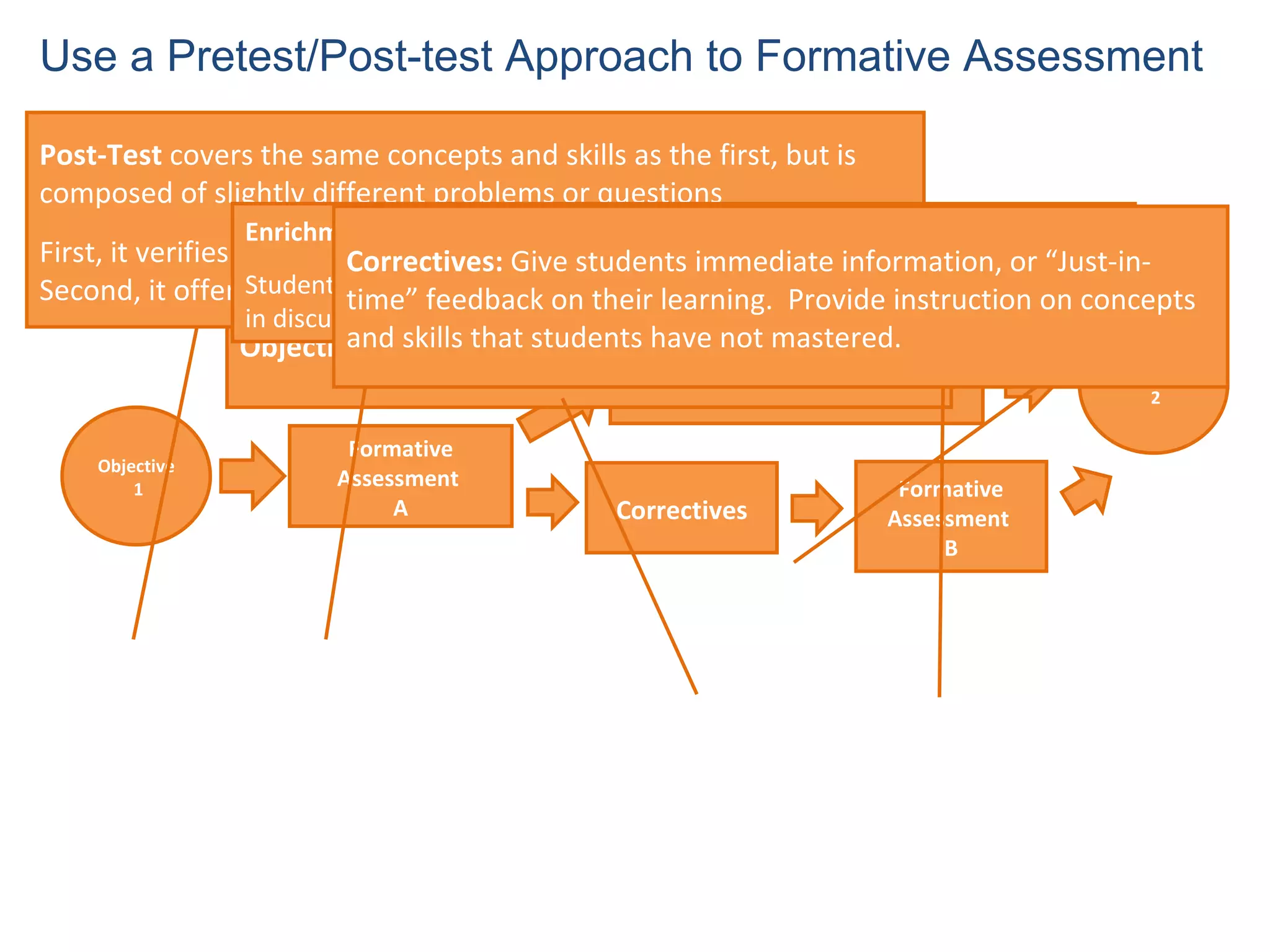
Objective 1 Formative Assessment  A Enrichment Activities Formative Assessment  B Objective 2 Correctives Use a Pretest/Post-test Approach to Formative Assessment Course:  SCI/263   Environmental Science  Objective 1:  Understands energy transfer in the food chain Pre-test:  administer a brief assessment based on the learning objective Post-Test  covers the same concepts and skills as the first, but is composed of slightly different problems or questions   First, it verifies whether or not the “correctives” were successful  Second, it offers students a second chance at success  Enrichment  activities to broaden student-learning experiences.  Students who mastered the content are asked to facilitate and lead the class in discussion Correctives:  Give students immediate information, or “Just-in-time” feedback on their learning.  Provide instruction on concepts and skills that students have not mastered.
Use Quizzes as a Formative Assessment Quizzes are the time-tested summative assessment Quizzes test student’s knowledge by posing questions Connect questions to specific learning objectives. Create quiz questions that are true-false, matching, multiple choice, completion, and short-answer, or essay. Using Internet tools
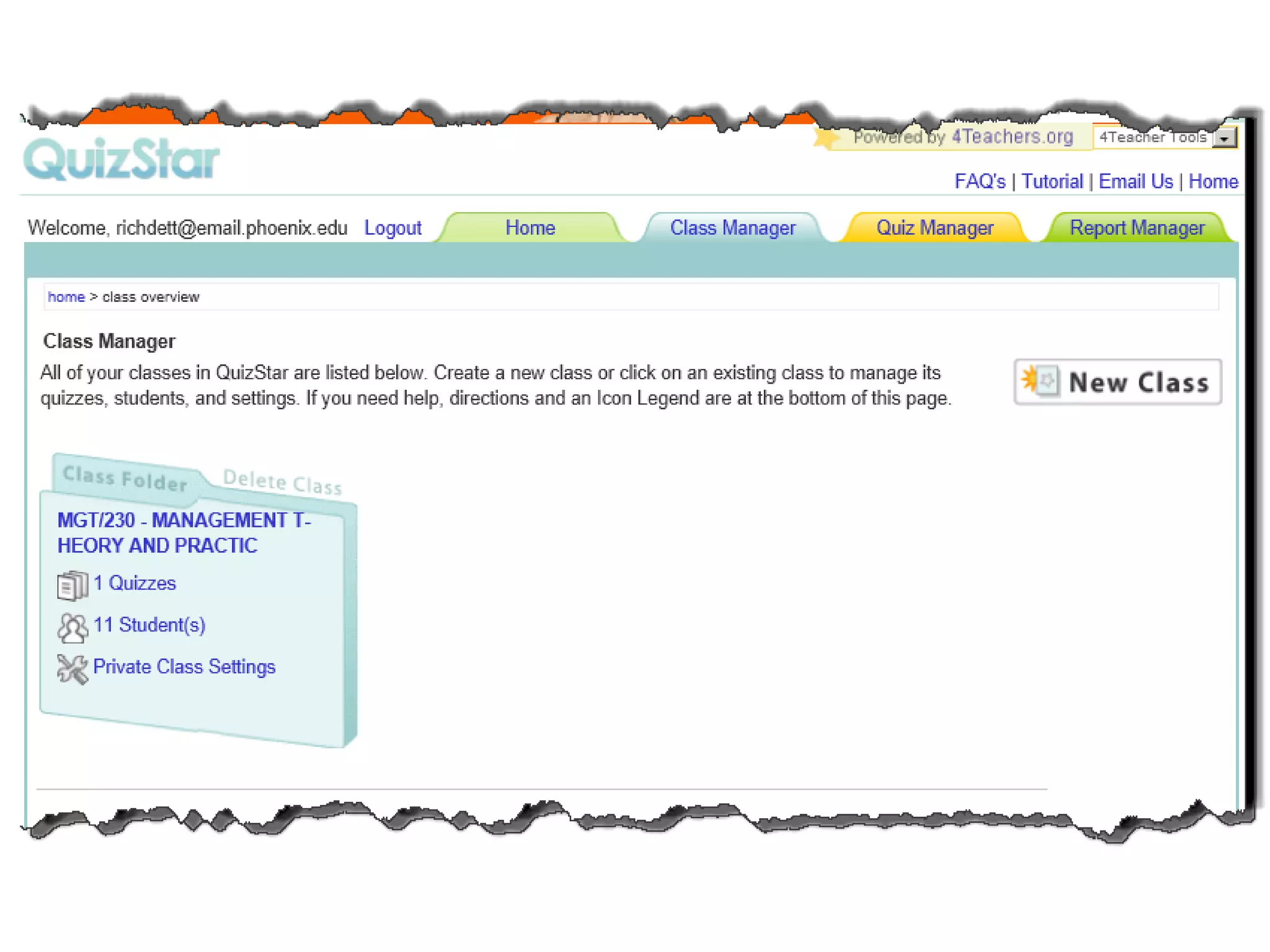
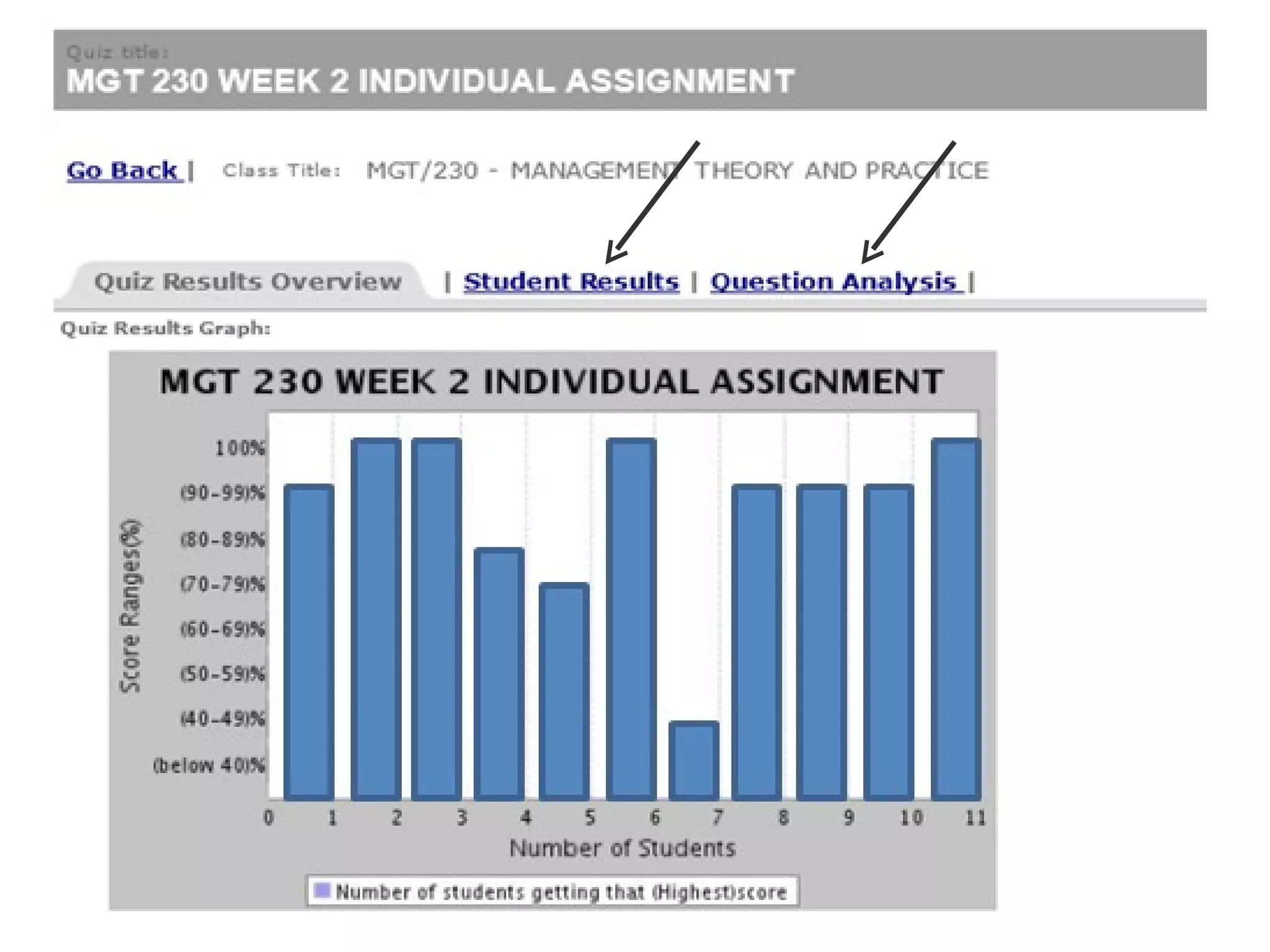
Quiz Star quizstar.4teachers.org  QuizStar allows instructors to create formative quizzes users can take online.  Students can take the quiz at the end of class or between classes. Graded or Non-Graded Feedback is given immediately to students and see their overall scores.  It's best to use QuizStar as a learning tool, rather than for  final assessment Include an unlimited number of multiple choice, true or false, and short answer questions. see trends for the class
 
 
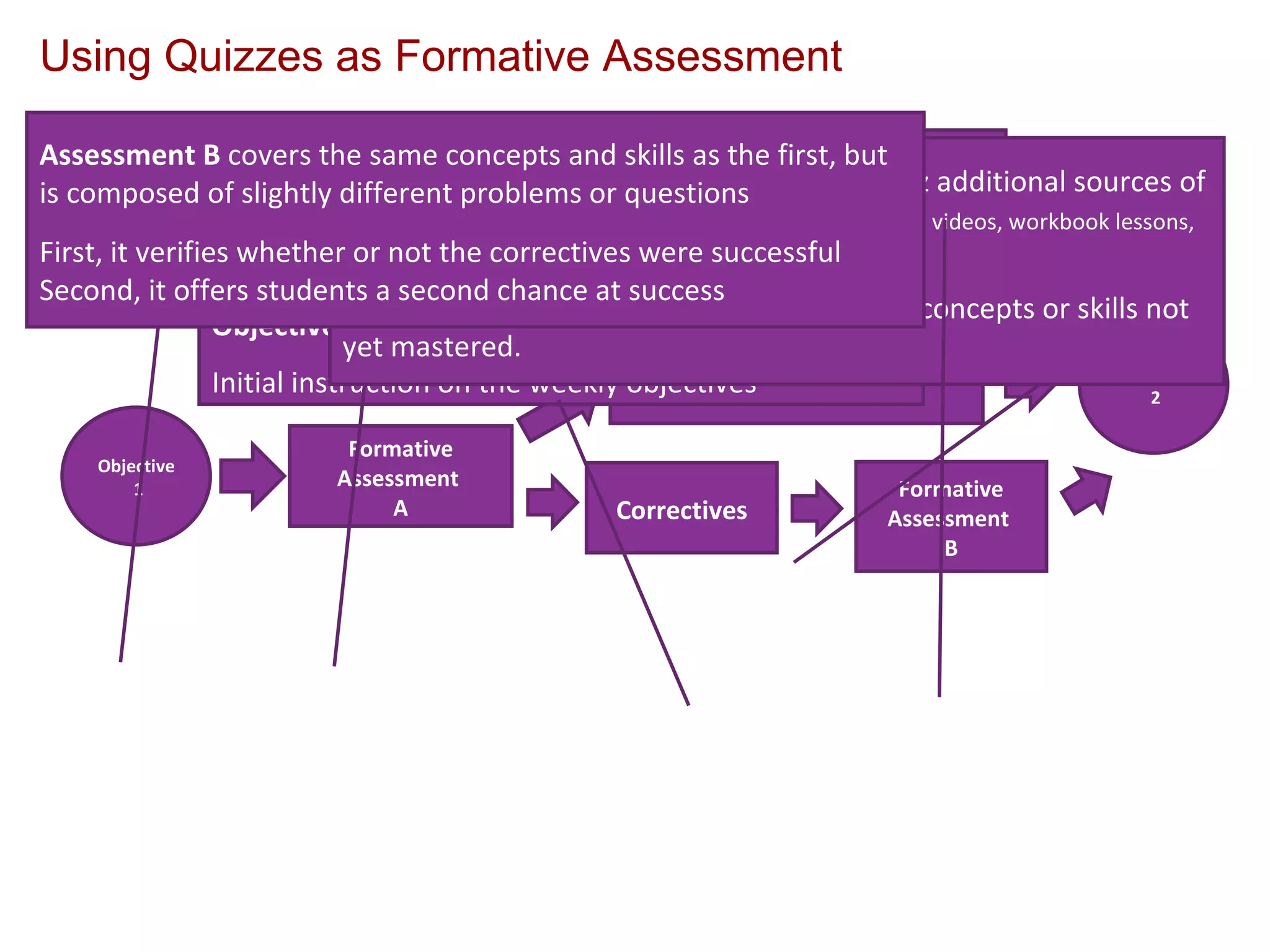
Objective 1 Formative Assessment  A Enrichment Activities Formative Assessment  B Objective 2 Correctives Enrichment  activities to broaden student-learning experiences.  Compile topic related website list will be given to students to accelerate their understanding Using Quizzes as Formative Assessment Course:  MGT/230 Management Theory Objective 1:  Define the four functions of management. Objective 2:  Explain how internal and external factors impact the four functions of management. Objective 3:  Explain how managers use delegation Initial instruction on the weekly objectives Assessment A:  At the end of class or as an assignment between classes, students will take a quiz on the Week 1 Objectives Quizstar will provide instant feedback on students incorrect answers Correctives:  Match each question on the quiz additional sources of information,  (page numbers in the textbook, websites, videos, workbook lessons, etc).  Have students do a written activity on those concepts or skills not yet mastered.  Assessment B  covers the same concepts and skills as the first, but is composed of slightly different problems or questions   First, it verifies whether or not the correctives were successful  Second, it offers students a second chance at success
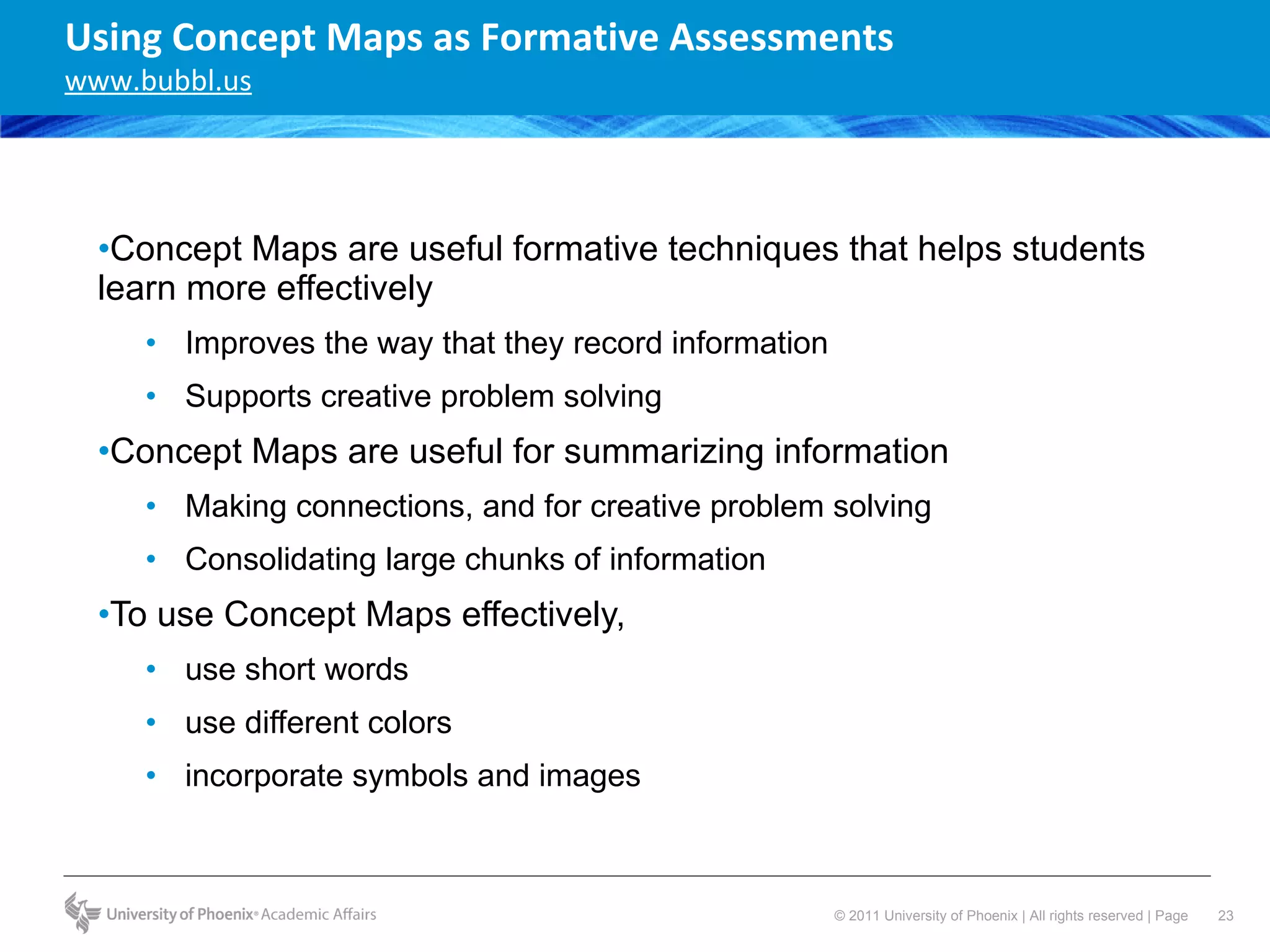
Concept Maps are useful formative techniques that helps students learn more effectively Improves the way that they record information Supports creative problem solving Concept Maps are useful for summarizing information Making connections, and for creative problem solving Consolidating large chunks of information To use Concept Maps effectively,  use short words use different colors  incorporate symbols and images Using Concept Maps as Formative Assessments www.bubbl.us
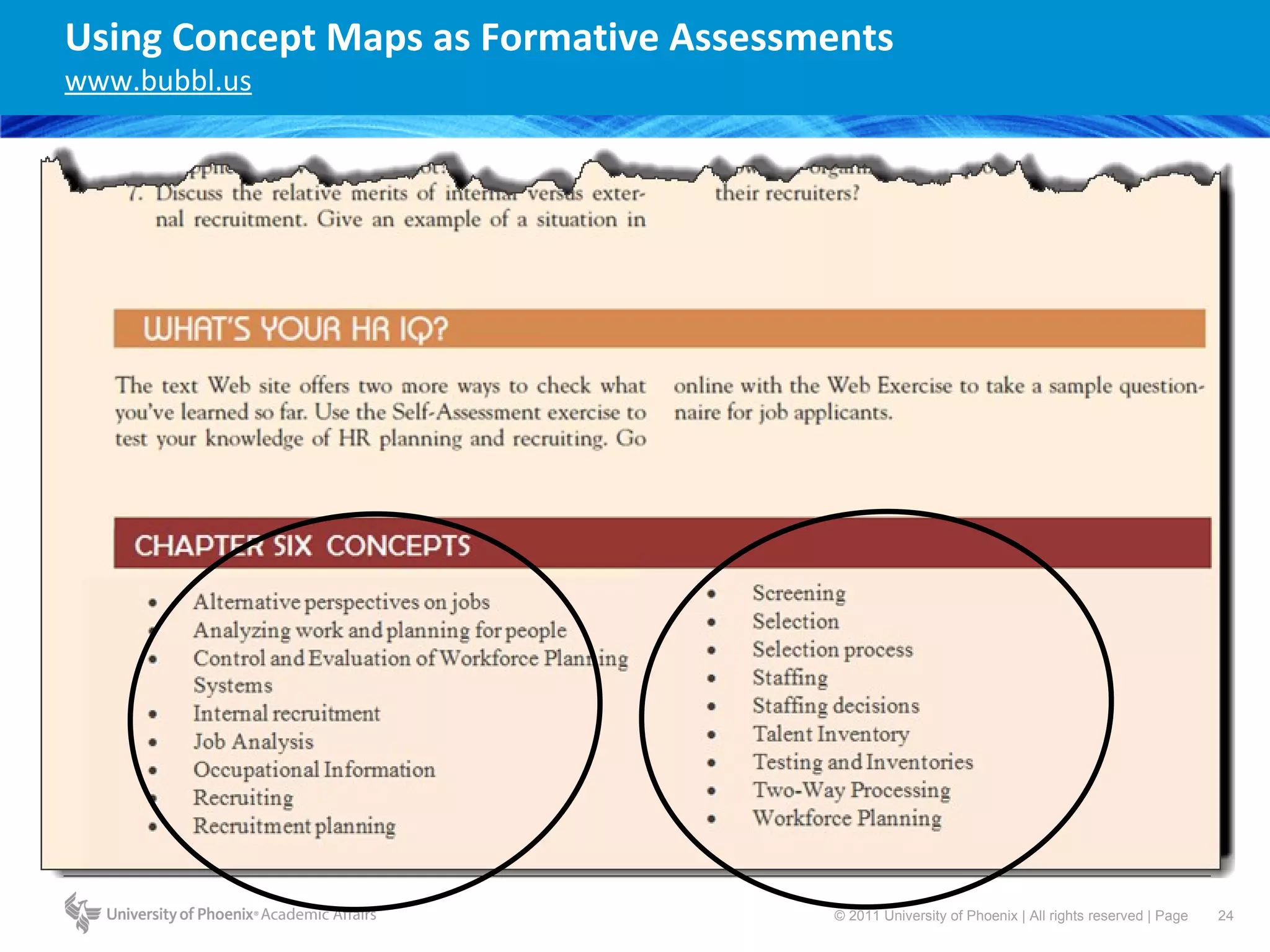
Using Concept Maps as Formative Assessments www.bubbl.us
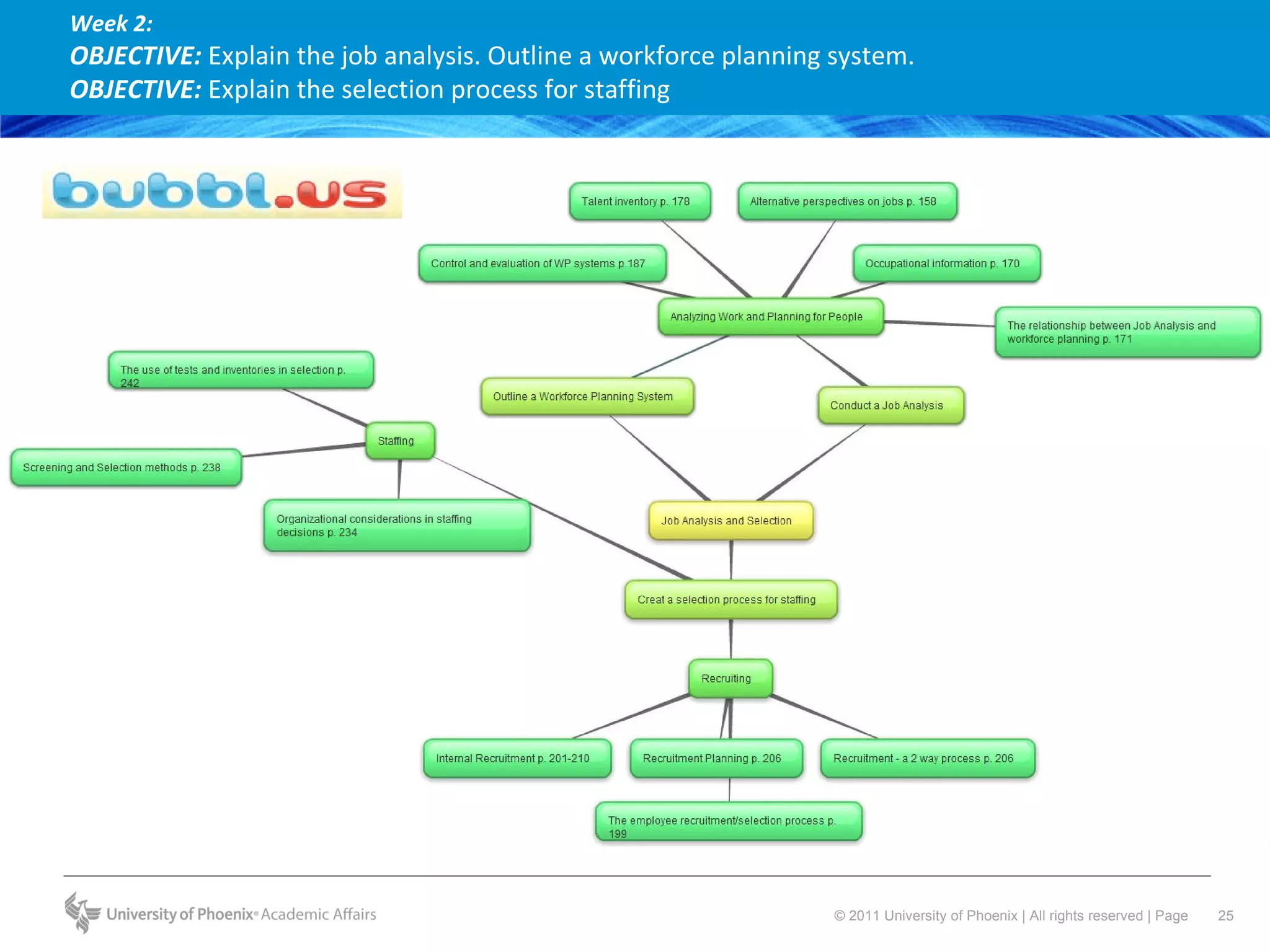
Week 2: OBJECTIVE:  Explain the job analysis. Outline a workforce planning system. OBJECTIVE:  Explain the selection process for staffing
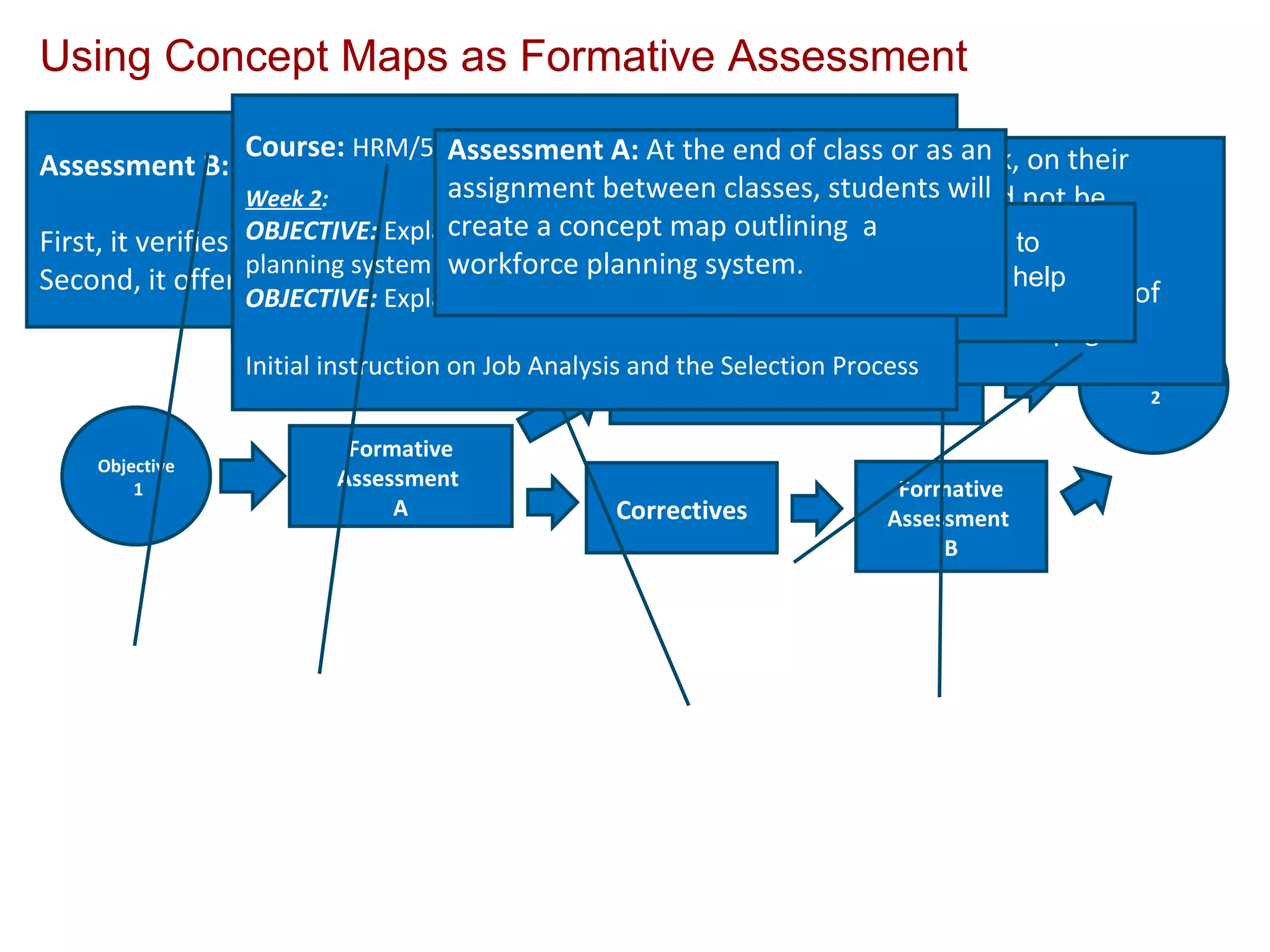
Objective 1 Formative Assessment  A Enrichment Activities Formative Assessment  B Objective 2 Correctives Using Concept Maps as Formative Assessment Correctives:  Give students information, or feedback, on their learning  by identifying  course concepts that should not be connected. Have students explain (written or verbal) the their  rationale  of these relationships between course concepts from the page numbers in the textbook.  Assessment B:  Have students recreate the Concept Map  First, it verifies whether or not the correctives were successful  Second, it offers students a second chance at success  Enrichment:  Students who mastered the content were asked to partner with students who did not understand the objective to help facilitate the learning. Course:  HRM/531 Human Capital Management Week 2 : OBJECTIVE:  Explain the job analysis. Outline a workforce planning system. OBJECTIVE:  Explain the selection process for staffing Initial instruction on Job Analysis and the Selection Process Assessment A:  At the end of class or as an assignment between classes, students will create a concept map outlining  a workforce planning system.
Use Journals/Reflective Exercises Promotes self-reflection; good tool for formative learning Gives the student the opportunity to reflect on their own learning and experiences in the class In some cases, the personal journey of each student may be more significant than the instructor can observe from the outside.
Go! Animate www.Goanimate.com Make Amazing Animated Videos! Help students engage in reflective practice and integrate technology in a dynamic way using video animation.  Use Go Animate to create videos GoAnimate is easy to use and free!
 
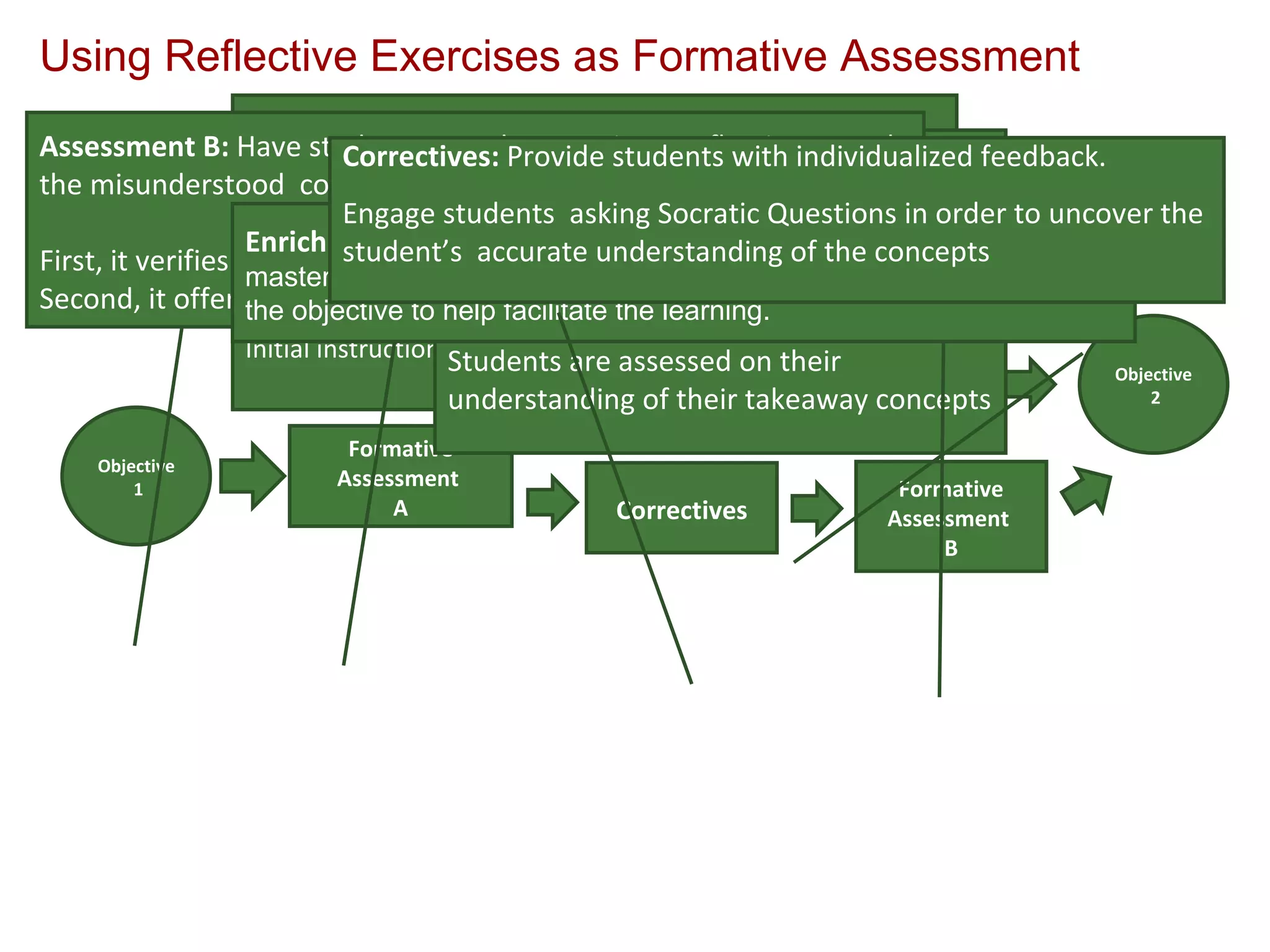
Objective 1 Formative Assessment  A Enrichment Activities Formative Assessment  B Objective 2 Correctives Using Reflective Exercises as Formative Assessment Course:  LDR/531 Organizational Leadership Week 1 : OBJECTIVE:  Compare and contrast management and leadership Initial instruction on  Leadership in Organizations Assessment A:  At the end of class or as an assignment between classes, individual students or learning team their major “takeaways” from the weeks instruction and readings. Students are assessed on their understanding of their takeaway concepts Assessment B:  Have students complete a written reflection on only the misunderstood  concepts First, it verifies whether or not the correctives were successful  Second, it offers students a second chance at success  Enrichment:  Students who grasped the weekly course concepts mastered were asked to partner with students who did not understand the objective to help facilitate the learning. Correctives:  Provide students with individualized feedback. Engage students  asking Socratic Questions in order to uncover the student’s  accurate understanding of the concepts
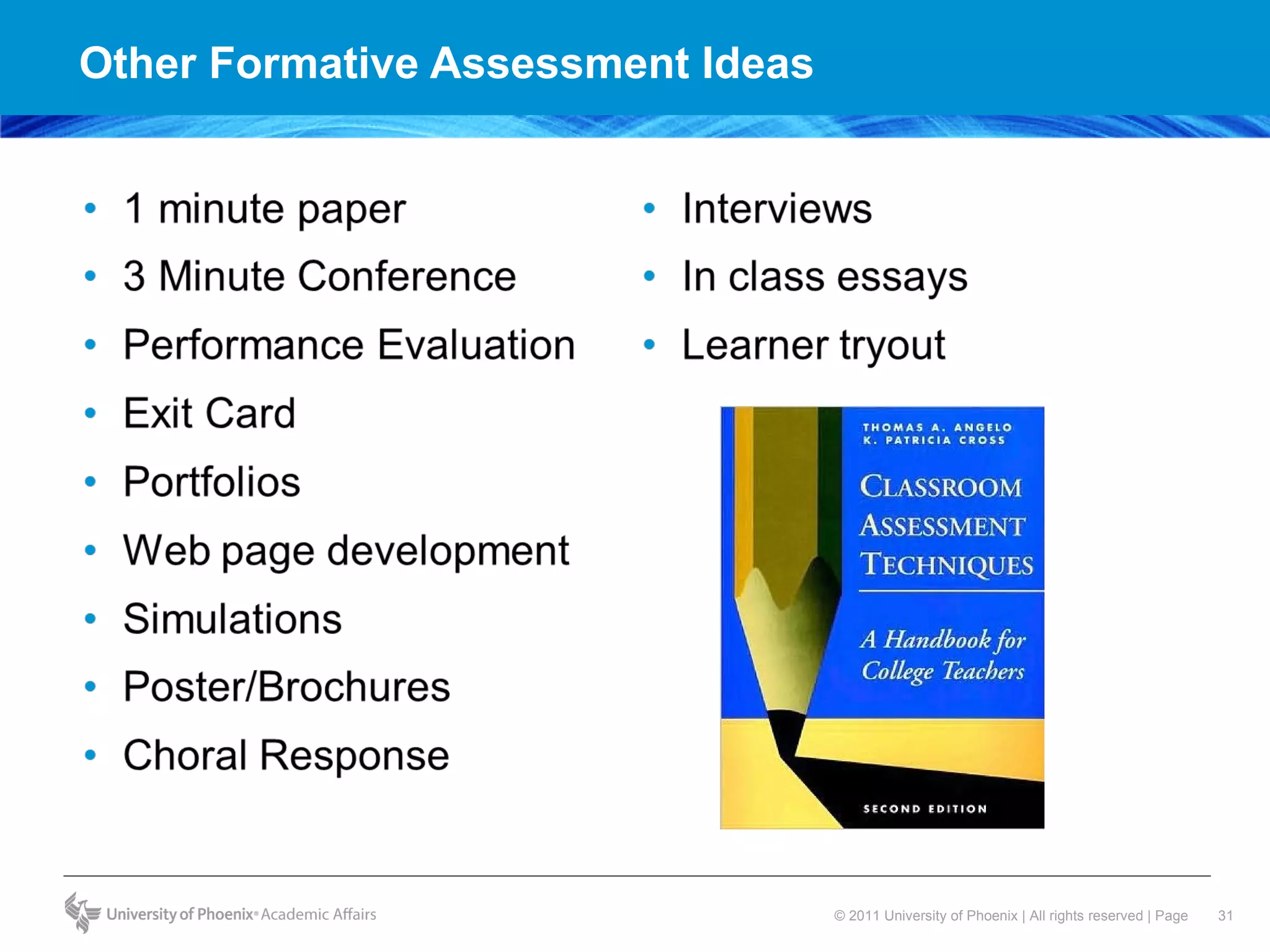
Other Formative Assessment Ideas
Evaluating Formative Assessment Practices Using formative assessment classroom techniques with the adult learner
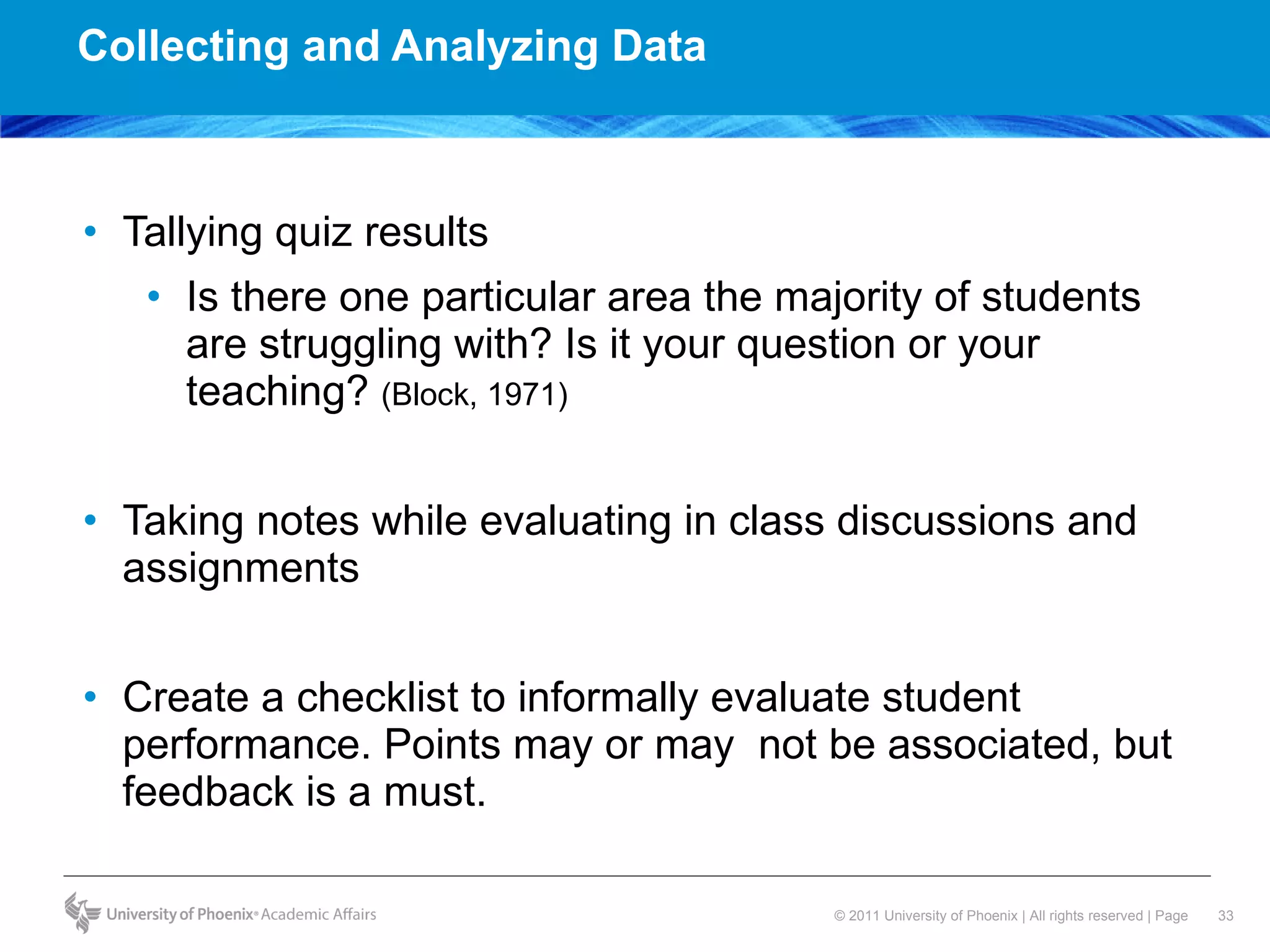
Collecting and Analyzing Data  Tallying quiz results  Is there one particular area the majority of students are struggling with? Is it your question or your teaching?  (Block, 1971)  Taking notes while evaluating in class discussions and assignments Create a checklist to informally evaluate student performance. Points may or may  not be associated, but feedback is a must.
Final Thoughts  “ Mastery learning is not an educational panacea and will not solve all the complex problems facing educators…. Careful attention to the essential elements of mastery learning will, however, allow educators at all levels to make great strides toward the goal of all [students] learning excellently.”  (Guskey, 1996).
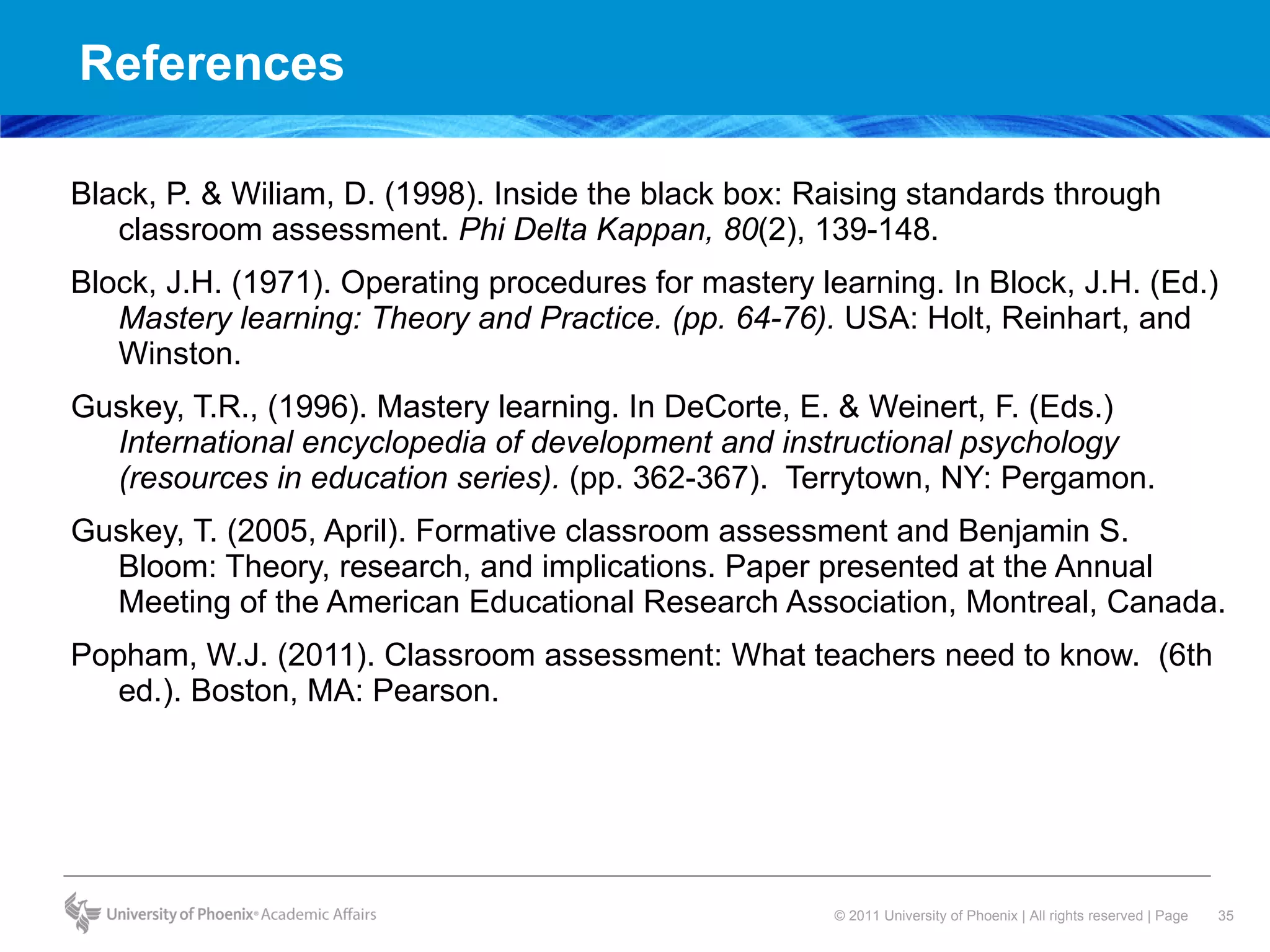
References Black, P. & Wiliam, D. (1998). Inside the black box: Raising standards through classroom assessment.  Phi Delta Kappan, 80 (2), 139-148. Block, J.H. (1971). Operating procedures for mastery learning. In Block, J.H. (Ed.)  Mastery learning: Theory and Practice. (pp. 64-76).  USA: Holt, Reinhart, and Winston.  Guskey, T.R., (1996). Mastery learning. In DeCorte, E. & Weinert, F. (Eds.)  International encyclopedia of development and instructional psychology (resources in education series).  (pp. 362-367).  Terrytown, NY: Pergamon.  Guskey, T. (2005, April). Formative classroom assessment and Benjamin S. Bloom: Theory, research, and implications. Paper presented at the Annual Meeting of the American Educational Research Association, Montreal, Canada. Popham, W.J. (2011). Classroom assessment: What teachers need to know.  (6th ed.). Boston, MA: Pearson.
Questions?

Formative Assessment Classroom Techniques using Bloom's Mastery Learning Model

  • 1.
    How do weknow when our students are learning? Richard Dettling Alexandra Escobar | January 26, 2012
  • 2.
    Objectives Recognizethe differences between formative and summative assessments Understand Bloom’s Mastery Learning Process and its essential elements Identify different ways to apply formative assessment techniques in the classroom Explore technology tools available to assess student learning Identify ways to collect and analyze formative assessment data
  • 3.
    Assessment in HigherEducation Institutional – very broad, looks at how students are meeting standards at a very broad (high) level College/Program – more focused but scores are still aggregated across programs. Focus on program outcomes versus course outcomes Course – even more focus, scores are aggregated by students within a specific class Student – extreme focus on students’ work product
  • 4.
    Faculty’s Role inStudent Assessment It starts in the classroom…. What skills and knowledge should students have at the end of a course? How does this build on previous courses and serve as foundations for future courses? How do you know, they know?
  • 5.
    Faculty’s Role inStudent Assessment Formative Assessments An assessment that is used for ongoing improvement while teaching and learning is occurring Summative Assessments An assessment that occurs at the end of a structured learning experience to evaluate the level of learning that has occurred (Popham, 2011)
  • 6.
  • 7.
    If we thinkof our students as plants … Summative assessment of the plants is the process of simply measuring them. It might be interesting to compare and analyze measurements but, in themselves, these do not affect the growth of the plants. Formative assessment , on the other hand, is the equivalent of feeding and watering the plants appropriate to their needs - directly affecting their growth.
  • 8.
    Improving learning throughassessment Black and Wiliam’s (1998) research indicates that improving learning through assessment depends on five deceptively simple factors: Providing effective feedback to students Students’ active involvement in their own learning Adjusting teaching to take into account the results of assessment Recognizing the profound influence of assessment on students’ motivation and self-esteem - both crucial influences on learning Ensuring students assess themselves and understand how to improve
  • 9.
  • 10.
    Mastery Learning ProcessBenjamin Bloom investigated the most effective components of one-on-one tutoring and adapted these to teaching in a whole group setting Dividing up concepts into smaller units Implementing frequent assessments, followed by instructor feedback and direction on how to improve Revisiting key concepts to ensure mastery These served as the foundation for the development of Mastery Learning The essential elements of Mastery Learning are: Feedback, Correctives, and Enrichment Instructional Alignment (Guskey, 1996)
  • 11.
    Feedback, Correctives, andEnrichment “ Just in Time” Feedback Reinforces the essential objectives Recognizes what was done well Identifies what needs more work Correctives Explicit guidance on how to improve errors Identification of resources available Approach recommended is different than initial instruction – materials should be presented differently and students should be involved differently Incorporate different learning styles/modalities Enrichments Opportunities to broaden learning, higher level activities (Guskey, 1996)
  • 12.
    Instructional Alignment Congruence among instructional components: learning outcomes, instruction, and evaluation The desired learner outcomes should dictate the level of rigor and focus of instruction, Formative assessment feedback should emphasize students’ performance based on the objectives Summative evaluation should reflect the rigor of learning parallel to the instruction and assessment Not to be confused with “teaching to the test”, but “testing what is taught” (Guskey, 1996)
  • 13.
    Bloom’s Mastery LearningProcess The Mastery Learning Instructional Process (Guskey, 2005) Objective 1 Formative Assessment A Correctives Enrichment Activities Formative Assessment B Objective 2
  • 14.
    Formative Assessment IdeasUsing formative assessment classroom techniques with the adult learner
  • 15.
    Plan of ActionSuggest a few formative assessments to use in the classroom Provide you with internet resources to create formative assessments All free for educators Show you how to use these formative assessments within the framework of Bloom’s Mastery Learning Process
  • 16.
    Use a Pretest/Post-testApproach Pretest/Post-test is the ideal formative assessment Pretest/Post-test measures students knowledge and skills before instruction Measures growth and knowledge during instruction Measures what students learned at the end of instruction It is can directly measure how effective you are as an instructor.
  • 17.
    Objective 1 FormativeAssessment A Enrichment Activities Formative Assessment B Objective 2 Correctives Use a Pretest/Post-test Approach to Formative Assessment Course: SCI/263 Environmental Science Objective 1: Understands energy transfer in the food chain Pre-test: administer a brief assessment based on the learning objective Post-Test covers the same concepts and skills as the first, but is composed of slightly different problems or questions   First, it verifies whether or not the “correctives” were successful Second, it offers students a second chance at success Enrichment activities to broaden student-learning experiences. Students who mastered the content are asked to facilitate and lead the class in discussion Correctives: Give students immediate information, or “Just-in-time” feedback on their learning. Provide instruction on concepts and skills that students have not mastered.
  • 18.
    Use Quizzes asa Formative Assessment Quizzes are the time-tested summative assessment Quizzes test student’s knowledge by posing questions Connect questions to specific learning objectives. Create quiz questions that are true-false, matching, multiple choice, completion, and short-answer, or essay. Using Internet tools
  • 19.
    Quiz Star quizstar.4teachers.org QuizStar allows instructors to create formative quizzes users can take online. Students can take the quiz at the end of class or between classes. Graded or Non-Graded Feedback is given immediately to students and see their overall scores. It's best to use QuizStar as a learning tool, rather than for final assessment Include an unlimited number of multiple choice, true or false, and short answer questions. see trends for the class
  • 20.
  • 21.
  • 22.
    Objective 1 FormativeAssessment A Enrichment Activities Formative Assessment B Objective 2 Correctives Enrichment activities to broaden student-learning experiences. Compile topic related website list will be given to students to accelerate their understanding Using Quizzes as Formative Assessment Course: MGT/230 Management Theory Objective 1: Define the four functions of management. Objective 2: Explain how internal and external factors impact the four functions of management. Objective 3: Explain how managers use delegation Initial instruction on the weekly objectives Assessment A: At the end of class or as an assignment between classes, students will take a quiz on the Week 1 Objectives Quizstar will provide instant feedback on students incorrect answers Correctives: Match each question on the quiz additional sources of information, (page numbers in the textbook, websites, videos, workbook lessons, etc). Have students do a written activity on those concepts or skills not yet mastered. Assessment B covers the same concepts and skills as the first, but is composed of slightly different problems or questions   First, it verifies whether or not the correctives were successful Second, it offers students a second chance at success
  • 23.
    Concept Maps areuseful formative techniques that helps students learn more effectively Improves the way that they record information Supports creative problem solving Concept Maps are useful for summarizing information Making connections, and for creative problem solving Consolidating large chunks of information To use Concept Maps effectively, use short words use different colors incorporate symbols and images Using Concept Maps as Formative Assessments www.bubbl.us
  • 24.
    Using Concept Mapsas Formative Assessments www.bubbl.us
  • 25.
    Week 2: OBJECTIVE: Explain the job analysis. Outline a workforce planning system. OBJECTIVE: Explain the selection process for staffing
  • 26.
    Objective 1 FormativeAssessment A Enrichment Activities Formative Assessment B Objective 2 Correctives Using Concept Maps as Formative Assessment Correctives: Give students information, or feedback, on their learning by identifying course concepts that should not be connected. Have students explain (written or verbal) the their rationale of these relationships between course concepts from the page numbers in the textbook. Assessment B: Have students recreate the Concept Map First, it verifies whether or not the correctives were successful Second, it offers students a second chance at success Enrichment: Students who mastered the content were asked to partner with students who did not understand the objective to help facilitate the learning. Course: HRM/531 Human Capital Management Week 2 : OBJECTIVE: Explain the job analysis. Outline a workforce planning system. OBJECTIVE: Explain the selection process for staffing Initial instruction on Job Analysis and the Selection Process Assessment A: At the end of class or as an assignment between classes, students will create a concept map outlining a workforce planning system.
  • 27.
    Use Journals/Reflective ExercisesPromotes self-reflection; good tool for formative learning Gives the student the opportunity to reflect on their own learning and experiences in the class In some cases, the personal journey of each student may be more significant than the instructor can observe from the outside.
  • 28.
    Go! Animate www.Goanimate.comMake Amazing Animated Videos! Help students engage in reflective practice and integrate technology in a dynamic way using video animation. Use Go Animate to create videos GoAnimate is easy to use and free!
  • 29.
  • 30.
    Objective 1 FormativeAssessment A Enrichment Activities Formative Assessment B Objective 2 Correctives Using Reflective Exercises as Formative Assessment Course: LDR/531 Organizational Leadership Week 1 : OBJECTIVE: Compare and contrast management and leadership Initial instruction on Leadership in Organizations Assessment A: At the end of class or as an assignment between classes, individual students or learning team their major “takeaways” from the weeks instruction and readings. Students are assessed on their understanding of their takeaway concepts Assessment B: Have students complete a written reflection on only the misunderstood concepts First, it verifies whether or not the correctives were successful Second, it offers students a second chance at success Enrichment: Students who grasped the weekly course concepts mastered were asked to partner with students who did not understand the objective to help facilitate the learning. Correctives: Provide students with individualized feedback. Engage students asking Socratic Questions in order to uncover the student’s accurate understanding of the concepts
  • 31.
  • 32.
    Evaluating Formative AssessmentPractices Using formative assessment classroom techniques with the adult learner
  • 33.
    Collecting and AnalyzingData Tallying quiz results Is there one particular area the majority of students are struggling with? Is it your question or your teaching? (Block, 1971) Taking notes while evaluating in class discussions and assignments Create a checklist to informally evaluate student performance. Points may or may not be associated, but feedback is a must.
  • 34.
    Final Thoughts “ Mastery learning is not an educational panacea and will not solve all the complex problems facing educators…. Careful attention to the essential elements of mastery learning will, however, allow educators at all levels to make great strides toward the goal of all [students] learning excellently.” (Guskey, 1996).
  • 35.
    References Black, P.& Wiliam, D. (1998). Inside the black box: Raising standards through classroom assessment. Phi Delta Kappan, 80 (2), 139-148. Block, J.H. (1971). Operating procedures for mastery learning. In Block, J.H. (Ed.) Mastery learning: Theory and Practice. (pp. 64-76). USA: Holt, Reinhart, and Winston. Guskey, T.R., (1996). Mastery learning. In DeCorte, E. & Weinert, F. (Eds.) International encyclopedia of development and instructional psychology (resources in education series). (pp. 362-367). Terrytown, NY: Pergamon. Guskey, T. (2005, April). Formative classroom assessment and Benjamin S. Bloom: Theory, research, and implications. Paper presented at the Annual Meeting of the American Educational Research Association, Montreal, Canada. Popham, W.J. (2011). Classroom assessment: What teachers need to know. (6th ed.). Boston, MA: Pearson.
  • 36.