PERFORMANCE-BASED-
ASSESSMENT

  JUAN PABLO RAMIREZ
  LUISA FERNANDA GODOY
IMPLEMENTIG PERFORMANCE-BASED
    ASSESSMENT IN THE EFL CLASSROOM
             by Irit Ferman

• Represent a set of strategies for the apliaction
  of knowledge, skills and work habits through
  the performance of task.
• This type of assessment provides the teacher
  with information about how students
  understand and applies knowledge.
• Students apply their knowledge and skills in
  context.
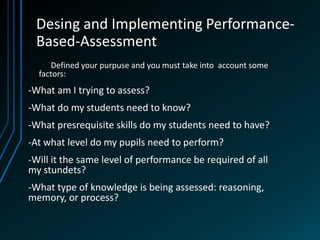
Desing and Implementing Performance-
 Based-Assessment
     Defined your purpuse and you must take into account some
  factors:
-What am I trying to assess?
-What do my students need to know?
-What presrequisite skills do my students need to have?
-At what level do my pupils need to perform?
-Will it the same level of performance be required of all
my stundets?
-What type of knowledge is being assessed: reasoning,
memory, or process?
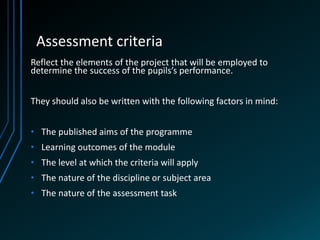
Assessment criteria
Reflect the elements of the project that will be employed to
determine the success of the pupils’s performance.


They should also be written with the following factors in mind:


• The published aims of the programme
• Learning outcomes of the module
• The level at which the criteria will apply
• The nature of the discipline or subject area
• The nature of the assessment task
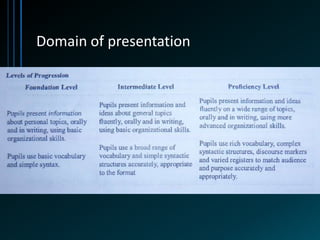
Domain of presentation
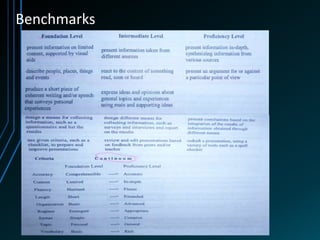
Benchmarks
Steps to develop it :

• Identify the overall performance or task, and perform it
  yourself or imagine it.
• List the important aspect of the performance or product.
• Try to limit the number of performance criteria, so they can all
  be observed during the students’ performance.
• If possible, have groups of teacher think through the important
  behaviors includes in a task
• Express the performance criteria in terms of observable
  students behaviors
• Don’t use ambiguous words that cloud the meaning of the
  performance criteria
• Arrange the criteria for students understand how they would
  be observed.
ADVANTAGES
AND
DISADVANTAGES
THIS PARTS WAS TAKED OF A WEB
PAGE, BUT IT DOESN’T HAVE A NAME
OF THE AUTHOR.
Advantages
•   Can be used to assess from multiple perspectives‡

•   Using a student-centered design can promote student motivation‡

•   Can be used to assess transfer of skills and integration of content‡ Engages student in active learning‡

•   Encourages time on academics outside of class‡

•   Can provide a dimension of depth not available in classroom‡

•   Can promote student creativity‡

•   May allow probes by faculty to gain clearer picture of student understanding or though processes‡

•   Can provide closing of feedback loop between students and faculty‡

•   Can place faculty more in a mentor role than as judge‡

•   Can be summative or formative‡

•   Can provide an avenue for student self-assessment and reflection‡

•   Can adapt current assignments
Disadvantages

  • ‡Usually the mostly costly approach‡
  • Time consuming and labor intensive to design and
    execute for faculty and students‡
  • Must be carefully designed if used to document
    obtainment of student learning out comes.‡
  • Ratings can be more subjective‡
  • Requires careful training of rater
  • Inter-rater reliability must be addressed‡
  • Sample of behavior or performance may not be
    typical, especially if observers a represent
Performance Assessment in language
                 testing
                       by MOHAMMAD ALI SAMANI-NODUUSHAN


•    Performance task introduce

•   Detecting nonlinguistic factor

Role with language performance


Construction of performance test

•   Needs Analysis.

•   Detail description of a context.

•   Defined the task

•   Creating judgments.
Define scoring system
• Attributes being evaluated.
• Place one self in a hypothetical situation
• Developing performance criteria
• List the skills and knowledge
• Alternatives assessment. --- > Portafolio.
Students role
• Créate
• Reflect
• Solve problems
• Collect
• Use information
• Formulate question
LINKS WHERE WERE TAKED ADDITIONAL
INFORMATION
• http://es.scribd.com/doc/49749305/Advantages-
  and-disadvantages-of-Performance-based-
  assessment
• http://www.bath.ac.uk/learningandteaching/the
  mes/assessment-criteria/

Performance based-assessment

  • 1.
    PERFORMANCE-BASED- ASSESSMENT JUANPABLO RAMIREZ LUISA FERNANDA GODOY
  • 2.
    IMPLEMENTIG PERFORMANCE-BASED ASSESSMENT IN THE EFL CLASSROOM by Irit Ferman • Represent a set of strategies for the apliaction of knowledge, skills and work habits through the performance of task. • This type of assessment provides the teacher with information about how students understand and applies knowledge. • Students apply their knowledge and skills in context.
  • 3.
    Desing and ImplementingPerformance- Based-Assessment Defined your purpuse and you must take into account some factors: -What am I trying to assess? -What do my students need to know? -What presrequisite skills do my students need to have? -At what level do my pupils need to perform? -Will it the same level of performance be required of all my stundets? -What type of knowledge is being assessed: reasoning, memory, or process?
  • 4.
    Assessment criteria Reflect theelements of the project that will be employed to determine the success of the pupils’s performance. They should also be written with the following factors in mind: • The published aims of the programme • Learning outcomes of the module • The level at which the criteria will apply • The nature of the discipline or subject area • The nature of the assessment task
  • 5.
  • 6.
  • 7.
    Steps to developit : • Identify the overall performance or task, and perform it yourself or imagine it. • List the important aspect of the performance or product. • Try to limit the number of performance criteria, so they can all be observed during the students’ performance. • If possible, have groups of teacher think through the important behaviors includes in a task • Express the performance criteria in terms of observable students behaviors • Don’t use ambiguous words that cloud the meaning of the performance criteria • Arrange the criteria for students understand how they would be observed.
  • 8.
    ADVANTAGES AND DISADVANTAGES THIS PARTS WASTAKED OF A WEB PAGE, BUT IT DOESN’T HAVE A NAME OF THE AUTHOR.
  • 9.
    Advantages • Can be used to assess from multiple perspectives‡ • Using a student-centered design can promote student motivation‡ • Can be used to assess transfer of skills and integration of content‡ Engages student in active learning‡ • Encourages time on academics outside of class‡ • Can provide a dimension of depth not available in classroom‡ • Can promote student creativity‡ • May allow probes by faculty to gain clearer picture of student understanding or though processes‡ • Can provide closing of feedback loop between students and faculty‡ • Can place faculty more in a mentor role than as judge‡ • Can be summative or formative‡ • Can provide an avenue for student self-assessment and reflection‡ • Can adapt current assignments
  • 10.
    Disadvantages •‡Usually the mostly costly approach‡ • Time consuming and labor intensive to design and execute for faculty and students‡ • Must be carefully designed if used to document obtainment of student learning out comes.‡ • Ratings can be more subjective‡ • Requires careful training of rater • Inter-rater reliability must be addressed‡ • Sample of behavior or performance may not be typical, especially if observers a represent
  • 11.
    Performance Assessment inlanguage testing by MOHAMMAD ALI SAMANI-NODUUSHAN • Performance task introduce • Detecting nonlinguistic factor Role with language performance Construction of performance test • Needs Analysis. • Detail description of a context. • Defined the task • Creating judgments.
  • 12.
    Define scoring system •Attributes being evaluated. • Place one self in a hypothetical situation • Developing performance criteria • List the skills and knowledge • Alternatives assessment. --- > Portafolio.
  • 13.
    Students role • Créate •Reflect • Solve problems • Collect • Use information • Formulate question
  • 14.
    LINKS WHERE WERETAKED ADDITIONAL INFORMATION • http://es.scribd.com/doc/49749305/Advantages- and-disadvantages-of-Performance-based- assessment • http://www.bath.ac.uk/learningandteaching/the mes/assessment-criteria/