Assessment for learning
  At the heart of quality teaching
 — 


      http://talkingaboutteaching.wordpress.com


               2nd March 2012
Outline of the day
•  Assessment for learning - shared understanding
•  Investigating current assessment strategies and
  classroom practice.

•  Planning for future assessment strategies and
  classroom practice

•  Developing student skills - study skills
Aim
—  Develop a common language & understanding of
  assessment for learning processes.

—  Reflect on our current teaching and learning
  practices and their impact on learning

—  Modify a program to improve assessment for
  learning approaches.

—  Lead to increased student self regulation and
  responsibility for learning.
Overwhelming research
            evidence
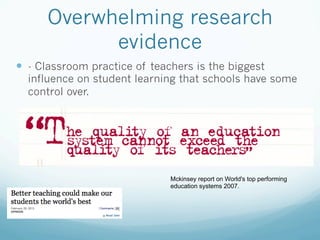
—  - Classroom practice of teachers is the biggest
  influence on student learning that schools have some
  control over.


                               Mckinsey report on World's top performing
                               education systems 2007.
Why assessment for
             learning?
—  - Integral in the majority of highest impact
  strategies that current research has identified.

—  - Assessment for learning approaches can be easily
  incorporated into teaching, in many cases with less
  work for the teacher to do.

—  - Inside the black box - Dylan William & Paul Black
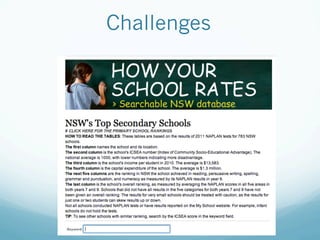
Challenges
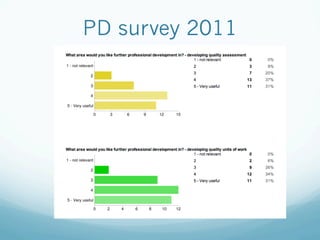
PD survey 2011
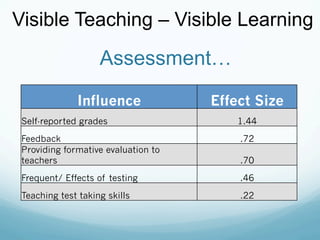
Visible Teaching – Visible Learning
                    Assessment…
              Influence              Effect Size
 Self-reported grades                    1.44
 Feedback                                .72
 Providing formative evaluation to
 teachers                                .70
 Frequent/ Effects of testing            .46
 Teaching test taking skills             .22
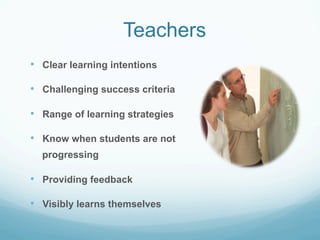
Teachers
•  Clear learning intentions

•  Challenging success criteria

•  Range of learning strategies

•  Know when students are not
  progressing

•  Providing feedback

•  Visibly learns themselves
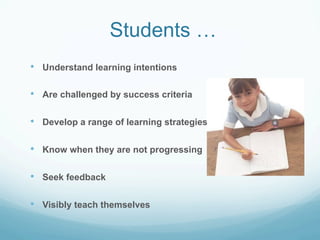
Students …
•    Understand learning intentions

•    Are challenged by success criteria


•    Develop a range of learning strategies


•    Know when they are not progressing


•    Seek feedback


•    Visibly teach themselves
Exploring assessment
      further ...
Current use of assessment
—  What are some of the ways you currently assess
      students in your classroom?


—  How effective are your current assessment strategies?


—  What is your current understanding of 'Assessment for
      learning'?


— 
Assessment 'of', 'for' and 'as'
           learning
—  Assessment of learning - summative tasks at the
  completion of a unit that tell us what students have
  learned.

—  Assessment for learning - assessment that provides
  feedback to teachers (about students) on how learning
  is progressing and where learning should go next.

—  Assessment as learning - focuses on self assessment
  where students are active, engaged, and critical
  assessors. They can make sense of information, relate
  it to prior knowledge and master the skills involved. It
  builds the capacity of students so they can understand
  what to do next.
Assessment
—  http://www.journeytoexcellence.org.uk/videos/
  expertspeakers/
  formativeassessmentdylanwiliam.asp
Dylan William
—  What resonated with you from the video?


—  How would you modify your definition based on
  what you have just heard? (if at all)
Assessment for learning
  —  FUNDAMENTAL UNDERSTANDINGS:


           —  A process not a task


—  It's only assessment for learning if you do
  something with the feedback you receive.
5 Key strategies of classroom
          formative assessment

•  Clarifying, sharing and understanding learning
  intentions and criteria for success

•  Engineering effective classroom discussions, activities,
  and learning tasks that elicit evidence of learning

•  Providing feedback that moves learning forward
•  Activating learners as instructional resources for one
  another

•  Activating learners as owners of their own learning.
Classroom assessment
—  Professional reading
—  1. Which aspects do you feel are most important
  for your KLA to focus on to move forward?


—  consider:
—  - aspects currently used effectively.
— - aspects which require greater focus?
Powerful assessment ...
—  Provides teachers with timely feedback to know if
  their teaching has been effective while still in the
  classroom.


—  Looks for evidence that students have not learned.


— Raises the question about what to do next when
learning has not occurred.
Evaluating the quality of our
            programs
•  Understanding by design / constructive alignment.


— To   what extent do we:

•  Have clear learning intentions and outcomes for the unit.
•  Have assessment that accurately determines student
  progress towards these outcomes.

•  Teaching and learning activities directly align with the
  outcomes and assessment activities.
                    NB: FEEDBACK ASPECTS TO BE EVALUATED LATER
For a chosen faculty unit of work
— Reflect on the alignment of learning goals, activities and
assessment.

— Highlight any activities at present that provide 'hinge
point' opportunities for the assessment for learning
process.

— Identify any formative assessment tasks or activities
that are currently undertaken?

— Develop or refine a formative assessment activity for the
unit.
Discussion questions
—  - How often do you check that students have
  understood what is taught?

—  - How many students do you check with?
—  - What happens when students do not understand
  work that is covered?
FEEDBACK
ARC –BOS assessment for
     learning guidelines
•  http://arc.boardofstudies.nsw.edu.au/go/7-8/
  assessment-for-learning-in-years-7-10/#The-principles-
  of-assessment-for-learning

Assessment for learning

  • 1.
    Assessment for learning At the heart of quality teaching —  http://talkingaboutteaching.wordpress.com 2nd March 2012
  • 2.
    Outline of theday •  Assessment for learning - shared understanding •  Investigating current assessment strategies and classroom practice. •  Planning for future assessment strategies and classroom practice •  Developing student skills - study skills
  • 3.
    Aim —  Develop acommon language & understanding of assessment for learning processes. —  Reflect on our current teaching and learning practices and their impact on learning —  Modify a program to improve assessment for learning approaches. —  Lead to increased student self regulation and responsibility for learning.
  • 4.
    Overwhelming research evidence —  - Classroom practice of teachers is the biggest influence on student learning that schools have some control over. Mckinsey report on World's top performing education systems 2007.
  • 5.
    Why assessment for learning? —  - Integral in the majority of highest impact strategies that current research has identified. —  - Assessment for learning approaches can be easily incorporated into teaching, in many cases with less work for the teacher to do. —  - Inside the black box - Dylan William & Paul Black
  • 6.
  • 7.
  • 8.
    Visible Teaching –Visible Learning Assessment… Influence Effect Size Self-reported grades 1.44 Feedback .72 Providing formative evaluation to teachers .70 Frequent/ Effects of testing .46 Teaching test taking skills .22
  • 9.
    Teachers •  Clear learningintentions •  Challenging success criteria •  Range of learning strategies •  Know when students are not progressing •  Providing feedback •  Visibly learns themselves
  • 10.
    Students … •  Understand learning intentions •  Are challenged by success criteria •  Develop a range of learning strategies •  Know when they are not progressing •  Seek feedback •  Visibly teach themselves
  • 11.
  • 12.
    Current use ofassessment —  What are some of the ways you currently assess students in your classroom? —  How effective are your current assessment strategies? —  What is your current understanding of 'Assessment for learning'? — 
  • 13.
    Assessment 'of', 'for'and 'as' learning —  Assessment of learning - summative tasks at the completion of a unit that tell us what students have learned. —  Assessment for learning - assessment that provides feedback to teachers (about students) on how learning is progressing and where learning should go next. —  Assessment as learning - focuses on self assessment where students are active, engaged, and critical assessors. They can make sense of information, relate it to prior knowledge and master the skills involved. It builds the capacity of students so they can understand what to do next.
  • 14.
    Assessment —  http://www.journeytoexcellence.org.uk/videos/ expertspeakers/ formativeassessmentdylanwiliam.asp
  • 15.
    Dylan William —  Whatresonated with you from the video? —  How would you modify your definition based on what you have just heard? (if at all)
  • 16.
    Assessment for learning —  FUNDAMENTAL UNDERSTANDINGS: —  A process not a task —  It's only assessment for learning if you do something with the feedback you receive.
  • 17.
    5 Key strategiesof classroom formative assessment •  Clarifying, sharing and understanding learning intentions and criteria for success •  Engineering effective classroom discussions, activities, and learning tasks that elicit evidence of learning •  Providing feedback that moves learning forward •  Activating learners as instructional resources for one another •  Activating learners as owners of their own learning.
  • 18.
    Classroom assessment —  Professionalreading —  1. Which aspects do you feel are most important for your KLA to focus on to move forward? —  consider: —  - aspects currently used effectively. — - aspects which require greater focus?
  • 19.
    Powerful assessment ... — Provides teachers with timely feedback to know if their teaching has been effective while still in the classroom. —  Looks for evidence that students have not learned. — Raises the question about what to do next when learning has not occurred.
  • 20.
    Evaluating the qualityof our programs •  Understanding by design / constructive alignment. — To what extent do we: •  Have clear learning intentions and outcomes for the unit. •  Have assessment that accurately determines student progress towards these outcomes. •  Teaching and learning activities directly align with the outcomes and assessment activities. NB: FEEDBACK ASPECTS TO BE EVALUATED LATER
  • 21.
    For a chosenfaculty unit of work — Reflect on the alignment of learning goals, activities and assessment. — Highlight any activities at present that provide 'hinge point' opportunities for the assessment for learning process. — Identify any formative assessment tasks or activities that are currently undertaken? — Develop or refine a formative assessment activity for the unit.
  • 22.
    Discussion questions —  -How often do you check that students have understood what is taught? —  - How many students do you check with? —  - What happens when students do not understand work that is covered?
  • 23.
  • 24.
    ARC –BOS assessmentfor learning guidelines •  http://arc.boardofstudies.nsw.edu.au/go/7-8/ assessment-for-learning-in-years-7-10/#The-principles- of-assessment-for-learning