CBI is an effective method of combining
language and content learning. Theme based CBI
works well in EFL contexts
   Content-based instruction (CBI) is teaching
    organized around the content or information
    that students will acquire, and not around the
    linguistic or other type of syllabus.
   Content refers to the substance or subject matter
    that we learn or communicate through language
    content rather that the language use to convey
    it.
   CBI is built on the principles of Communicative
    Language Teaching.

   Classroom needs to be filled with real and
    meaningful communication where information
    is exchanged.
   Content-based instruction is based in two
    principles:
   1 People learn a second language more
    successfully when they use the language as a
    means of acquiring information, rather than as
    an end in it. This principle reflects one of the
    motivations for CBI noted earlier that it leads to
    more effective language learning.
   2 It better reflect learners needs for learning a
    second language. Many ESL,EFL programs focus
    on preparing students for academic studies or for
    mainstreaming.
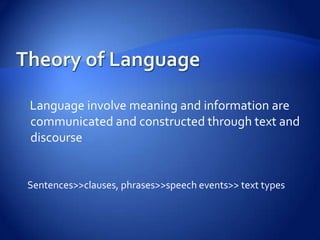
Language involve meaning and information are
communicated and constructed through text and
discourse


Sentences>>clauses, phrases>>speech events>> text types
   CBI sees language as combination of several
    skills used together.
   Grammar is seen as a component of other skills.
   Language is use for a specific purpose such
    as, vocational, social or recreational. In order to
    make the content comprehensible, teachers
    need to make adjustments and simplifications
    for the students to.
   CBI makes an assumption that learners learn best
    when they are given language in a meaningful
    , contextualized form with the primary focus on
    acquiring information.
    1 People learn a second language more
    successfully when the information they are
    acquiring is perceived as interesting , useful and
    leading to a desire goal.

   2 Language learning is more motivating when
    students are focusing on something other than
    language , such as ideas, issues and opinions.
   3 Some content areas are more useful than
    others.

   4 Teaching builds on the previous experiences of
    the learners. CBI build on students knowledge
    and previous experiences. Students bring a
    wealth of knowledge to the classroom.
   Objectives :

   In CBI, the language is second to learning the
    content. The objectives relate to the content, not
    to the language.
   The syllabus comes from the content. However
    it is common for a topical syllabus to be used in
    theme-based CBI.
 Stroller (1997) proposed classification categories
1. Language skills improvement
2. Vocabulary building
3. Discourse organization
4. Communicative interaction
5. Study skills
6. Synthesis of content materials and grammar
   Become autonomous

   Support each other

   Active interpreters of input
   Willing to tolerate uncertainty

   Willing to explore alternative learning strategies
    and sources of content

   And have a learn by doing attitude
1.   A good language teacher
2.   Knowledgeable in the subject matter
3.   Be able to draw out that knowledge from
     students
1.   Varying the format of classroom instruction
2.   Using group work and team-building
     techniques
3.   Organization jigsaw arrangements
4.   Defining the background knowledge and
     language skills required for students success
   Whatever facilitates subject matter of the
    content course. Comprehensibility and
    authenticity are both important in CBI. In
    addition, instructional media enriches the
    context.
1)   Sheltered content instruction
2)   Adjunct language instruction
3)   Team teach approach
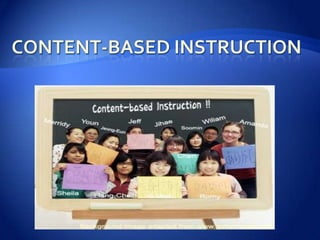
Content based instruction

Content based instruction

  • 2.
    CBI is aneffective method of combining language and content learning. Theme based CBI works well in EFL contexts
  • 3.
    Content-based instruction (CBI) is teaching organized around the content or information that students will acquire, and not around the linguistic or other type of syllabus.
  • 4.
    Content refers to the substance or subject matter that we learn or communicate through language content rather that the language use to convey it.
  • 5.
    CBI is built on the principles of Communicative Language Teaching.  Classroom needs to be filled with real and meaningful communication where information is exchanged.
  • 6.
    Content-based instruction is based in two principles:
  • 7.
    1 People learn a second language more successfully when they use the language as a means of acquiring information, rather than as an end in it. This principle reflects one of the motivations for CBI noted earlier that it leads to more effective language learning.
  • 8.
    2 It better reflect learners needs for learning a second language. Many ESL,EFL programs focus on preparing students for academic studies or for mainstreaming.
  • 9.
    Language involve meaningand information are communicated and constructed through text and discourse Sentences>>clauses, phrases>>speech events>> text types
  • 10.
    CBI sees language as combination of several skills used together.  Grammar is seen as a component of other skills.
  • 11.
    Language is use for a specific purpose such as, vocational, social or recreational. In order to make the content comprehensible, teachers need to make adjustments and simplifications for the students to.
  • 12.
    CBI makes an assumption that learners learn best when they are given language in a meaningful , contextualized form with the primary focus on acquiring information.
  • 13.
    1 People learn a second language more successfully when the information they are acquiring is perceived as interesting , useful and leading to a desire goal.  2 Language learning is more motivating when students are focusing on something other than language , such as ideas, issues and opinions.
  • 14.
    3 Some content areas are more useful than others.  4 Teaching builds on the previous experiences of the learners. CBI build on students knowledge and previous experiences. Students bring a wealth of knowledge to the classroom.
  • 15.
    Objectives :  In CBI, the language is second to learning the content. The objectives relate to the content, not to the language.
  • 16.
    The syllabus comes from the content. However it is common for a topical syllabus to be used in theme-based CBI.
  • 17.
     Stroller (1997)proposed classification categories 1. Language skills improvement 2. Vocabulary building 3. Discourse organization 4. Communicative interaction 5. Study skills 6. Synthesis of content materials and grammar
  • 18.
    Become autonomous  Support each other  Active interpreters of input
  • 19.
    Willing to tolerate uncertainty  Willing to explore alternative learning strategies and sources of content  And have a learn by doing attitude
  • 20.
    1. A good language teacher 2. Knowledgeable in the subject matter 3. Be able to draw out that knowledge from students
  • 21.
    1. Varying the format of classroom instruction 2. Using group work and team-building techniques 3. Organization jigsaw arrangements 4. Defining the background knowledge and language skills required for students success
  • 22.
    Whatever facilitates subject matter of the content course. Comprehensibility and authenticity are both important in CBI. In addition, instructional media enriches the context.
  • 23.
    1) Sheltered content instruction 2) Adjunct language instruction 3) Team teach approach