Content without
purpose is only trivia.
-Steve Revington
OUTCOMES-BASED
EDUCATION AND
ASSESSMENT
OUTCOMES-BASED EDUCATION
OBE is education based on outcome.
This outcome may refer to immediate outcome or
deferred outcome
Immediate Outcomes are competencies/skills upon
completion of a lesson, subject, a grade/year, a
course, or a program itself.
Deferred Outcomes refer to the ability to apply
cognitive, psychomotor, and affective
skills/competencies in the various aspects of
professional and workplace practice (Navarro,
2019).
OUTCOMES-BASED EDUCATION
(Spady, 2007)
Spady spouses Transformational OBE
Transformational OBE is concerned with long-term,
cross-curricular outcomes that are related directly
to students’ future life roles such as being a
productive worker or a responsible citizen or a
parent.
Spady describes outcomes as clear learning results that
we want students to demonstrate at the end of the
learning experiences.; what learners can actually do
with what they know and have learned and tangible
application of what have been learned.
OUTCOMES-BASED TEACHING AND
LEARNING (OBTL) (Biggs, 2007)
Biggs and Tang (2007) makes use of the term
outcomes-based teaching and learning
(OBTL) which in essence is OBE applied in
teaching-learning process.
They defined outcomes as learning outcomes
which are more specific than institutional
outcomes, program outcomes, and course
outcomes.
OUTCOMES-BASED TEACHING AND
LEARNING (OBTL) (Biggs, 2007)
Outcomes are statements of what we expect
students to demonstrate after what they
have been taught.
These are referred to as learning outcomes.
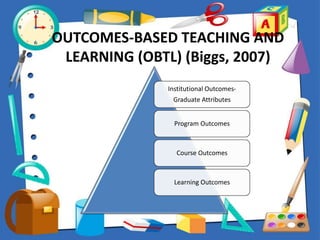
OUTCOMES-BASED TEACHING AND
LEARNING (OBTL) (Biggs, 2007)
Institutional Outcomes-
Graduate Attributes
Program Outcomes
Course Outcomes
Learning Outcomes
Principles of OBE
(Spady, 1996)
1. Clarity of focus
Outcomes which students are expected to
demonstrate at the end of the program
are clear
2. Designing down
Basing the details of your instructional design
on the outcomes, the focus of instruction
Principles of OBE
(Spady, 1996)
3. High Expectations
Believing that all learners can learn and
succeed, but not all in the same time or in
the same way. Not all learners can learn the
same thing in the same way and in the same
amount of time but all are capable of
mastery and meaningful learning.
Principles of OBE
(Spady, 1996)
4. Expanded opportunities
Teachers must provide expanded
opportunities for all learners.
Most learners can achieve high standards if
they are given appropriate opportunities.
OBE is anchored on the premise that all
learners are teachable.
Constructive Alignment
Constructive alignment is Biggs’ term of
designing down given by Spady.
Constructive alignment is the process of
creating a learning environment that
supports the learning activities that lead to
the achievement of the desired learning
outcomes.
Constructive Alignment
In the context of assessment, constructive
alignment also means that the assessment
tasks and the specific criteria as bases of
judgment of students’ performance are
aligned to the intended learning outcomes.
The assessment tasks are aligned to the
learning outcomes.
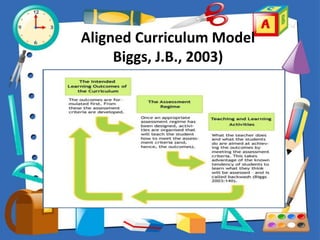
Aligned Curriculum Model
Biggs, J.B., 2003)
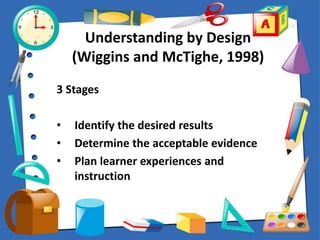
Understanding by Design
(Wiggins and McTighe, 1998)
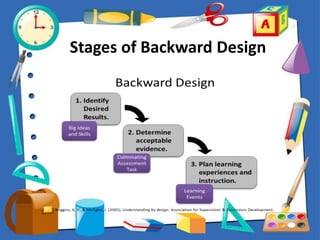
3 Stages
• Identify the desired results
• Determine the acceptable evidence
• Plan learner experiences and
instruction
Stages of Backward Design
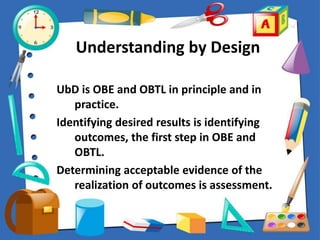
Understanding by Design
UbD is OBE and OBTL in principle and in
practice.
Identifying desired results is identifying
outcomes, the first step in OBE and
OBTL.
Determining acceptable evidence of the
realization of outcomes is assessment.
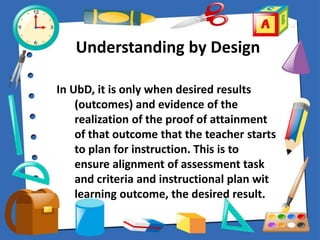
Understanding by Design
In UbD, it is only when desired results
(outcomes) and evidence of the
realization of the proof of attainment
of that outcome that the teacher starts
to plan for instruction. This is to
ensure alignment of assessment task
and criteria and instructional plan wit
learning outcome, the desired result.
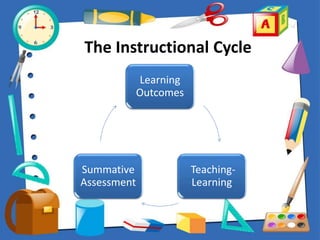
The Instructional Cycle
Learning
Outcomes
Teaching-
Learning
Summative
Assessment
The Instructional Cycle
The cycle begins with setting clear
learning outcomes.
Teaching-learning which begins with
preinstruction assessment, teaching
process which includes Teaching-
Learning Activities, Formative
Assessment and Reteaching if
necessary.
The Instructional Cycle
When every effort has been exerted to
help the learners attain the intended
learning outcomes, assessment for
scoring and grading (summative
assessment takes place.

Outcomes Based Education and Assessment.pptx

  • 1.
    Content without purpose isonly trivia. -Steve Revington
  • 2.
  • 3.
    OUTCOMES-BASED EDUCATION OBE iseducation based on outcome. This outcome may refer to immediate outcome or deferred outcome Immediate Outcomes are competencies/skills upon completion of a lesson, subject, a grade/year, a course, or a program itself. Deferred Outcomes refer to the ability to apply cognitive, psychomotor, and affective skills/competencies in the various aspects of professional and workplace practice (Navarro, 2019).
  • 4.
    OUTCOMES-BASED EDUCATION (Spady, 2007) Spadyspouses Transformational OBE Transformational OBE is concerned with long-term, cross-curricular outcomes that are related directly to students’ future life roles such as being a productive worker or a responsible citizen or a parent. Spady describes outcomes as clear learning results that we want students to demonstrate at the end of the learning experiences.; what learners can actually do with what they know and have learned and tangible application of what have been learned.
  • 5.
    OUTCOMES-BASED TEACHING AND LEARNING(OBTL) (Biggs, 2007) Biggs and Tang (2007) makes use of the term outcomes-based teaching and learning (OBTL) which in essence is OBE applied in teaching-learning process. They defined outcomes as learning outcomes which are more specific than institutional outcomes, program outcomes, and course outcomes.
  • 6.
    OUTCOMES-BASED TEACHING AND LEARNING(OBTL) (Biggs, 2007) Outcomes are statements of what we expect students to demonstrate after what they have been taught. These are referred to as learning outcomes.
  • 7.
    OUTCOMES-BASED TEACHING AND LEARNING(OBTL) (Biggs, 2007) Institutional Outcomes- Graduate Attributes Program Outcomes Course Outcomes Learning Outcomes
  • 8.
    Principles of OBE (Spady,1996) 1. Clarity of focus Outcomes which students are expected to demonstrate at the end of the program are clear 2. Designing down Basing the details of your instructional design on the outcomes, the focus of instruction
  • 9.
    Principles of OBE (Spady,1996) 3. High Expectations Believing that all learners can learn and succeed, but not all in the same time or in the same way. Not all learners can learn the same thing in the same way and in the same amount of time but all are capable of mastery and meaningful learning.
  • 10.
    Principles of OBE (Spady,1996) 4. Expanded opportunities Teachers must provide expanded opportunities for all learners. Most learners can achieve high standards if they are given appropriate opportunities. OBE is anchored on the premise that all learners are teachable.
  • 11.
    Constructive Alignment Constructive alignmentis Biggs’ term of designing down given by Spady. Constructive alignment is the process of creating a learning environment that supports the learning activities that lead to the achievement of the desired learning outcomes.
  • 12.
    Constructive Alignment In thecontext of assessment, constructive alignment also means that the assessment tasks and the specific criteria as bases of judgment of students’ performance are aligned to the intended learning outcomes. The assessment tasks are aligned to the learning outcomes.
  • 13.
  • 14.
    Understanding by Design (Wigginsand McTighe, 1998) 3 Stages • Identify the desired results • Determine the acceptable evidence • Plan learner experiences and instruction
  • 15.
  • 16.
    Understanding by Design UbDis OBE and OBTL in principle and in practice. Identifying desired results is identifying outcomes, the first step in OBE and OBTL. Determining acceptable evidence of the realization of outcomes is assessment.
  • 17.
    Understanding by Design InUbD, it is only when desired results (outcomes) and evidence of the realization of the proof of attainment of that outcome that the teacher starts to plan for instruction. This is to ensure alignment of assessment task and criteria and instructional plan wit learning outcome, the desired result.
  • 18.
  • 19.
    The Instructional Cycle Thecycle begins with setting clear learning outcomes. Teaching-learning which begins with preinstruction assessment, teaching process which includes Teaching- Learning Activities, Formative Assessment and Reteaching if necessary.
  • 20.
    The Instructional Cycle Whenevery effort has been exerted to help the learners attain the intended learning outcomes, assessment for scoring and grading (summative assessment takes place.