Rorschach Ink-blot Test
Niharika Thakkar
B.A, M.A, N.E.T, MBPsS,
Clinical Psychology
History
(1921) Hermann Rorschach
 Psychodiagnostik
 Original set contained 40 inkblots
 15 used regularly (eventually narrowed down to 10 due to printing
costs)
 Devised a set of codes
 Printing error led to use of shading
Systems
Focus on content analysis
David Levy (1926) brought plates to US
Samuel Beck (1927)
 standardization study of the inkblots
Bruno Klopfer (1922) - Germany
 studied under Carl Jung in Zurich
 immigrated to US in 1934
 Klopfer and his students developed a scoring system(1936)
 Beck scoring system (1937)
 David Rapaport - Psychological Diagnostic Testing (1946)
 clinical applications of 8 tests including the Rorschach
 Roy Schafer (1954)
 Psychoanalytic Interpretation in Rorschach Testing
 content analysis
 John Exner (1995-2003)
 Most extensive and well researched scoring system
Administration
Steps in administration
1. Introducing the subject to the
technique
2. Giving the test instructions
3. The Response Phase
4. The Inquiry Phase
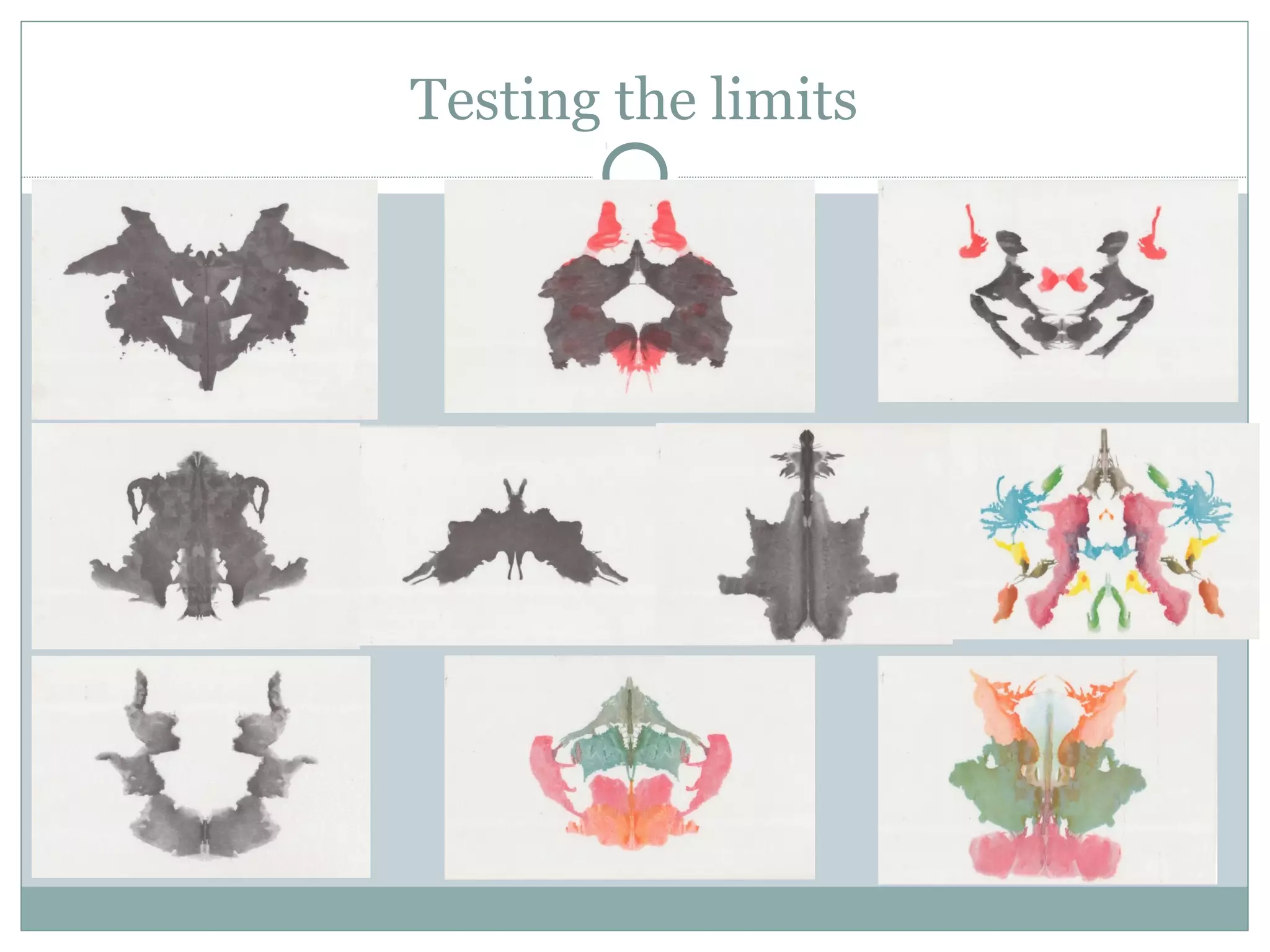
5. Testing the limits
Introduction/Test Instructions
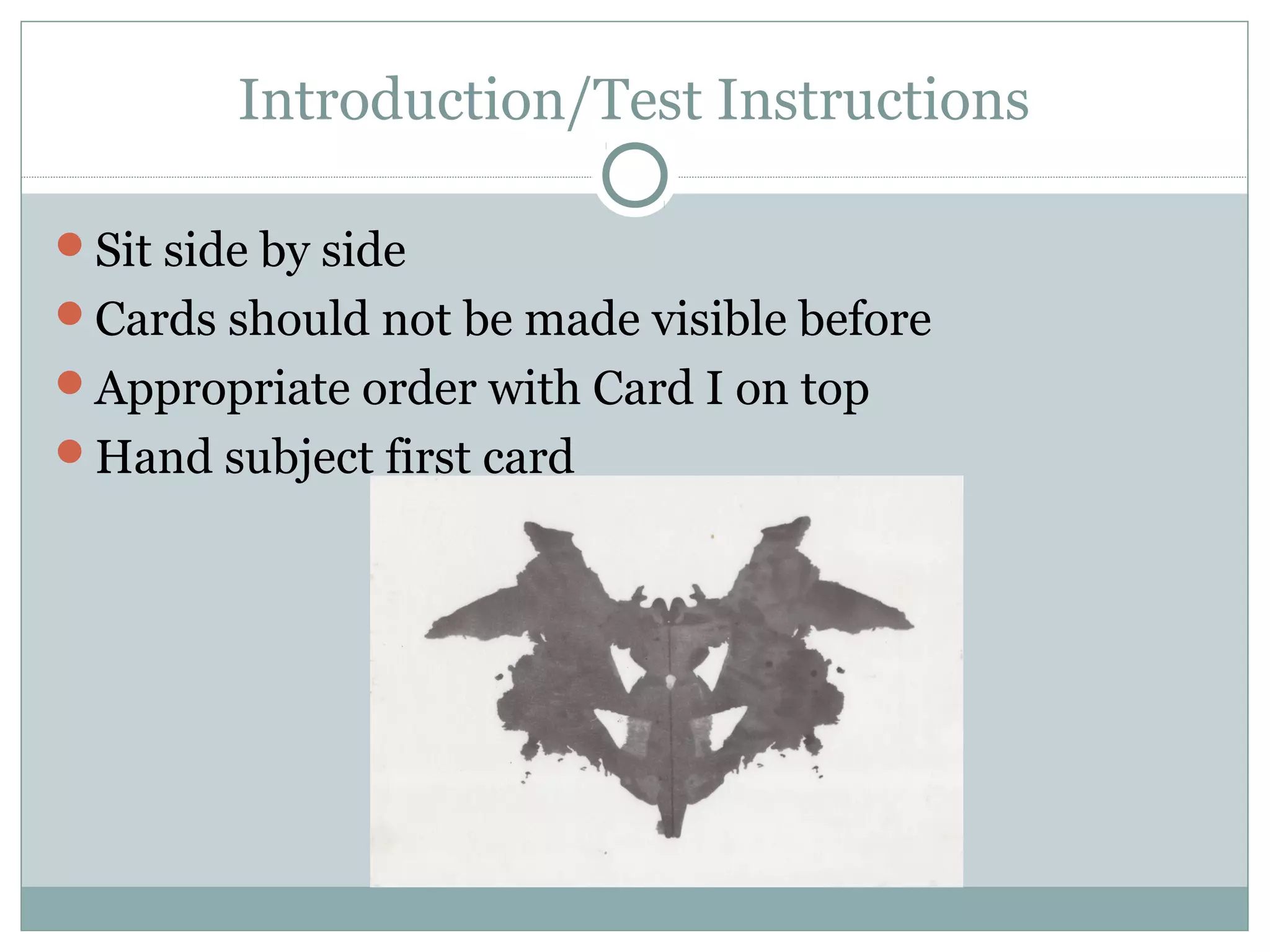
Sit side by side
Cards should not be made visible before
Appropriate order with Card I on top
Hand subject first card
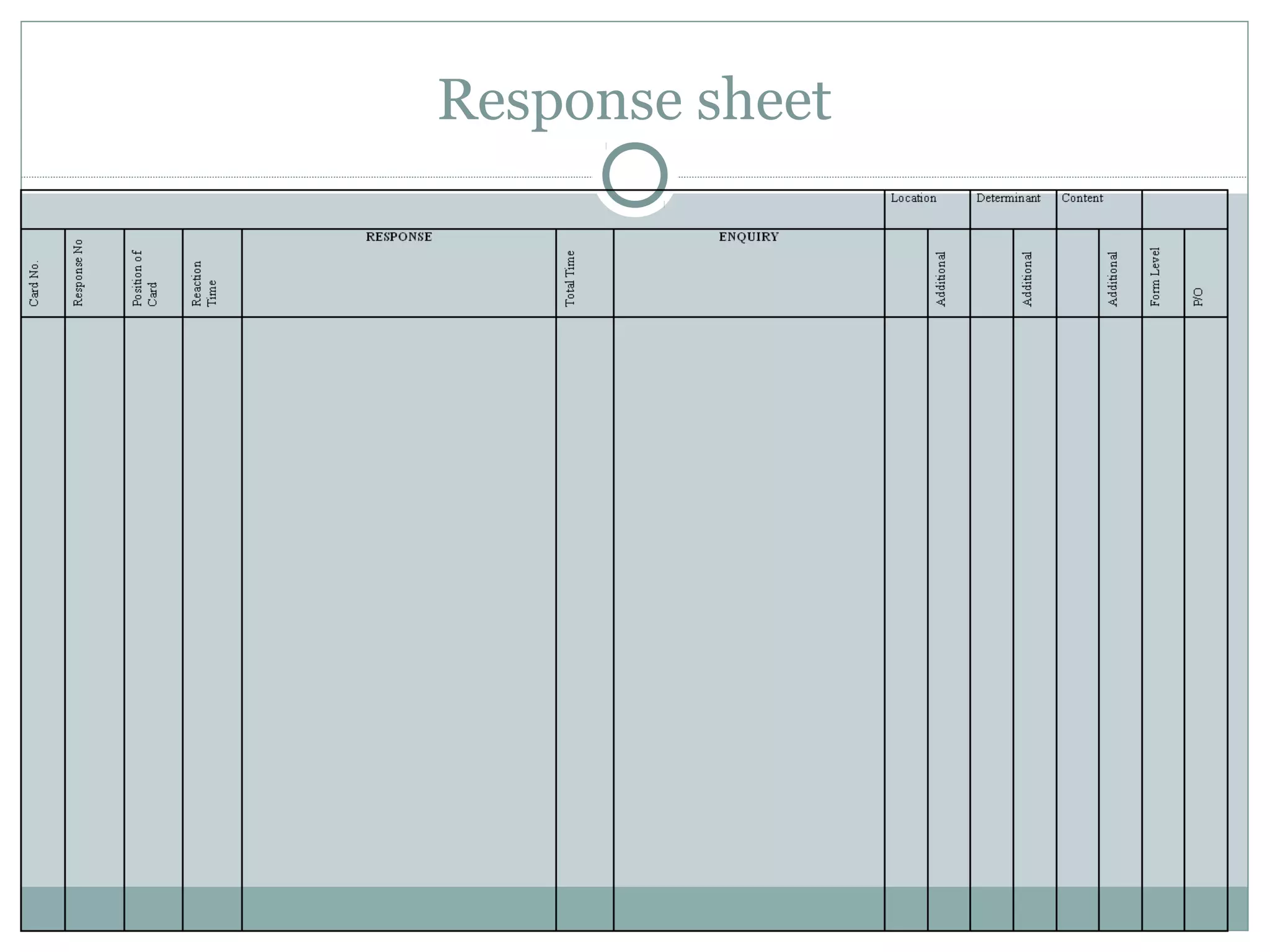
Response sheet
Response Phase
Verbatim, no probing, Silence by examiner is the
rule
Position of card<,^,>, 0
“I don’t see anything there”
 Take your time, we’re in no hurry (everyone can find
something).”
 “If you take your time and look some more, I think you’ll
find something else too.”
Response time to be noted
Total time to be noted
Enquiry Phase
Conducted after all responses are given to all 10
cards
Gain information needed to score accurately
Nondirective questions
Complete location sheet
Not used to generate new information
 “ O.K., we’ve done them all. Now we are going to go back through
them. It won’t take long. I want you to help me see what you saw. I’m
going to read what you said, and then I want you to show me where in
the blot you saw it and what is there that makes it look like that, so I
can see it too. I’d like to see it just like you did, so help me now. Do you
understand?”
Enquiry (cont.)
“Focus on gaining information and asking questions on:
 Location (Where is it?)
 Determinants (What makes it look like that?)
 Content (What is it?)
Example
 Response:
Its a pretty flower
 Inquiry:
E: (Repeats response)
S: Yes that’s the stem & here are the petals
E: U mentioned that it is pretty
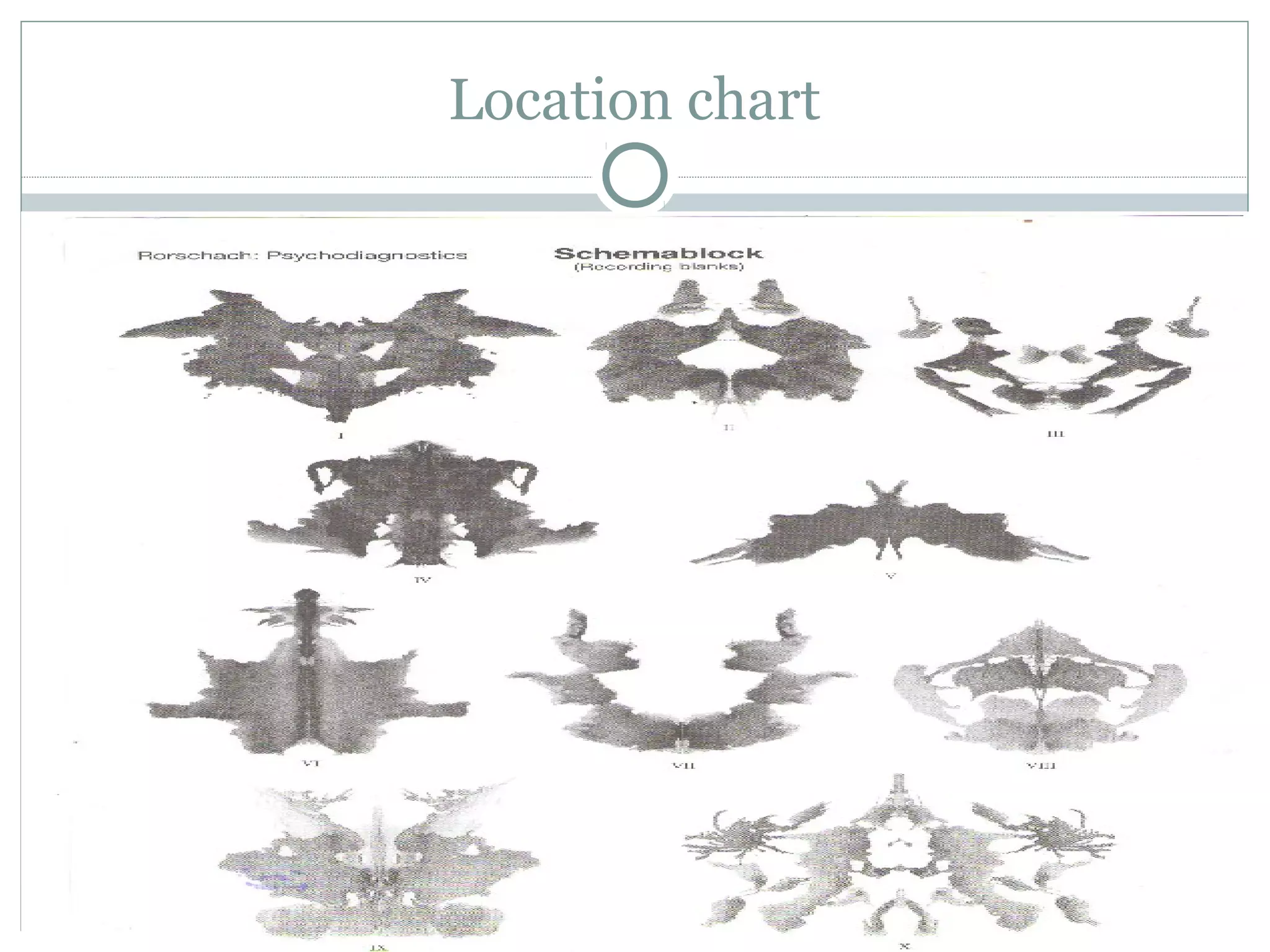
Location chart
Rorschach: Assumptions
“Perceptual sets” displayed through projective techniques
Ambiguous stimuli
Responses are scored along three categories:
 location
 determinants
 Content
 form
Scoring and Interpretation
Scoring
Location
Determinants
Content
Popularity
Form
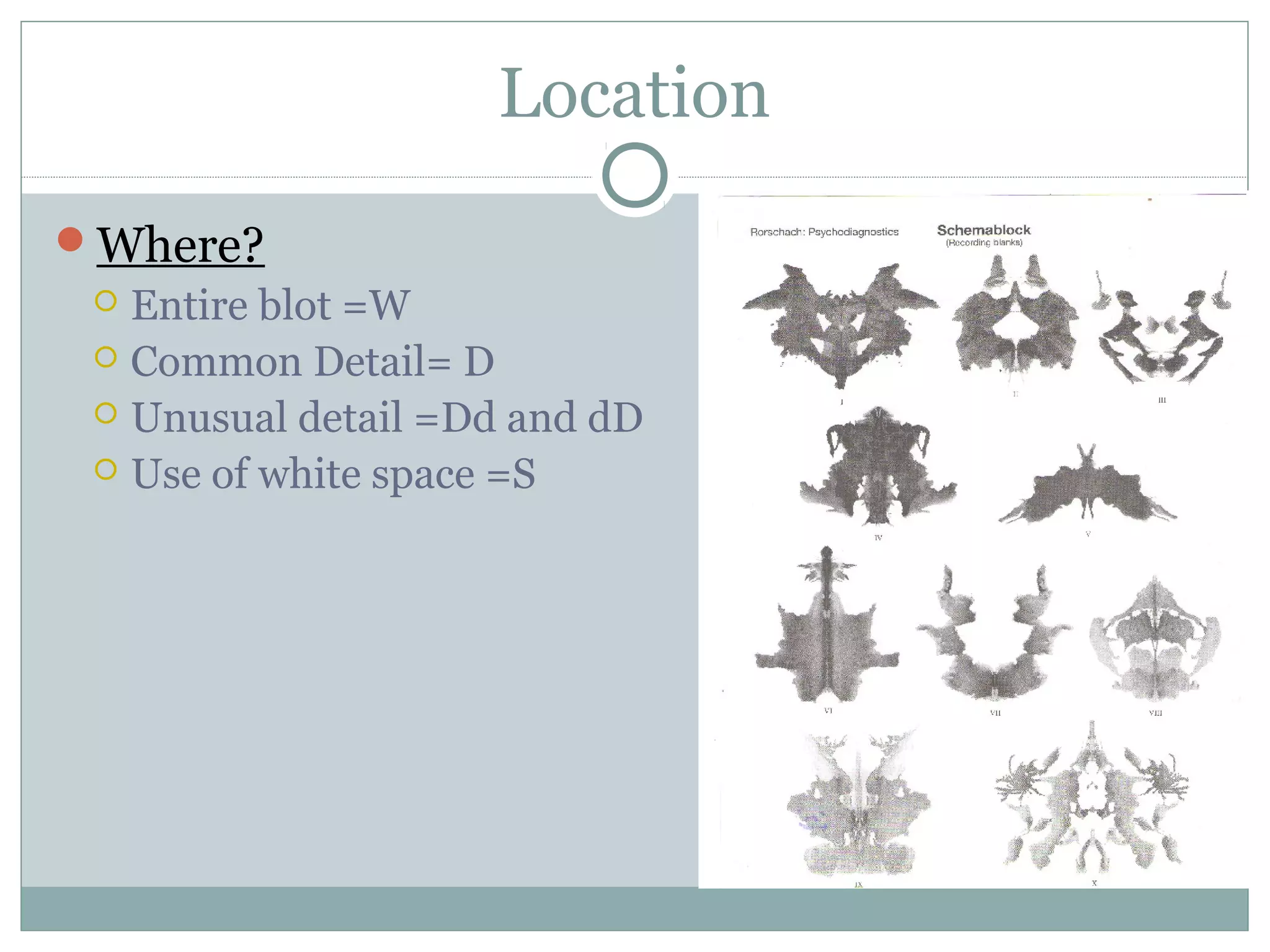
Location
Where?
 Entire blot =W
 Common Detail= D
 Unusual detail =Dd and dD
 Use of white space =S
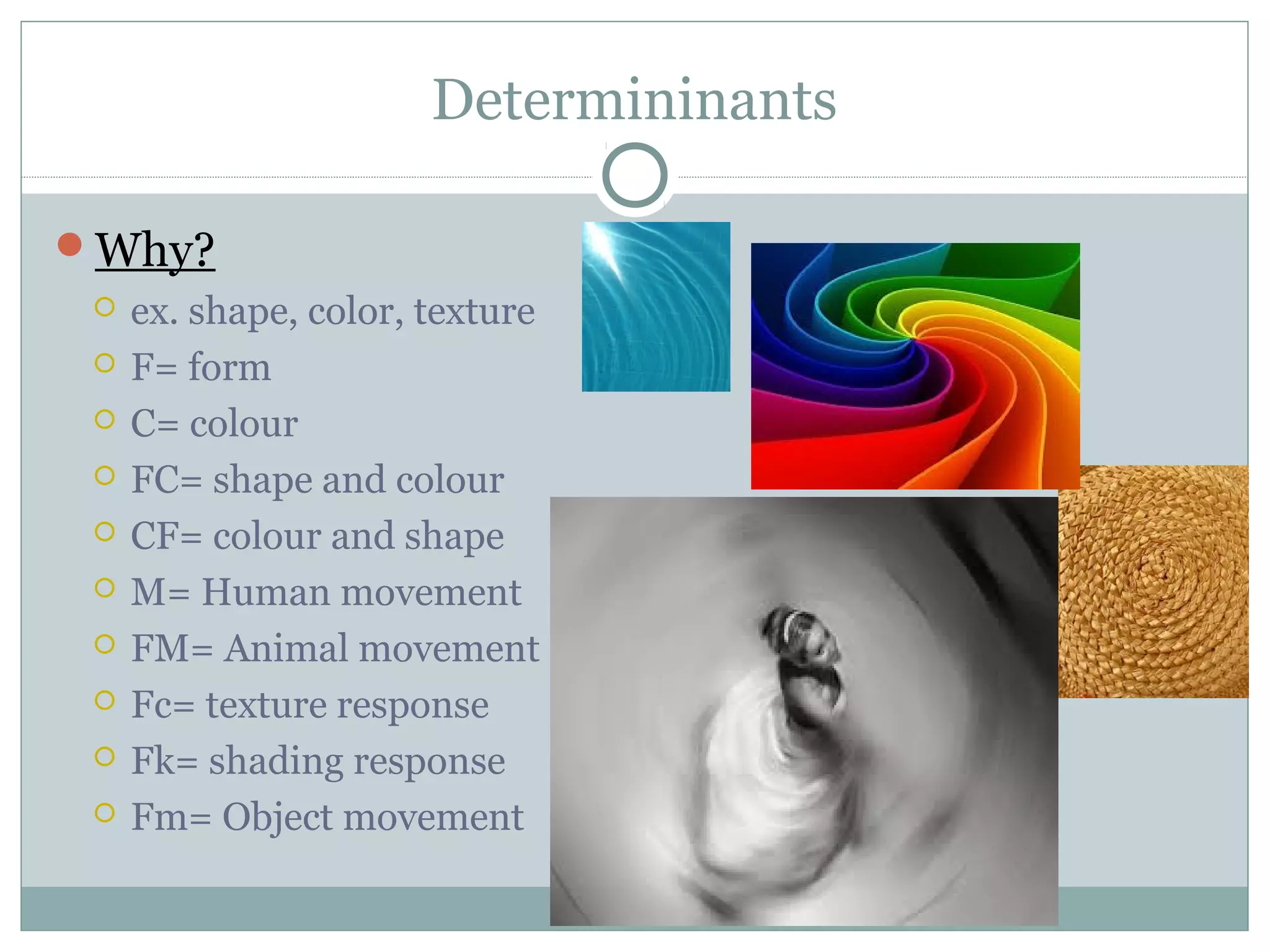
Determininants
Why?
 ex. shape, color, texture
 F= form
 C= colour
 FC= shape and colour
 CF= colour and shape
 M= Human movement
 FM= Animal movement
 Fc= texture response
 Fk= shading response
 Fm= Object movement
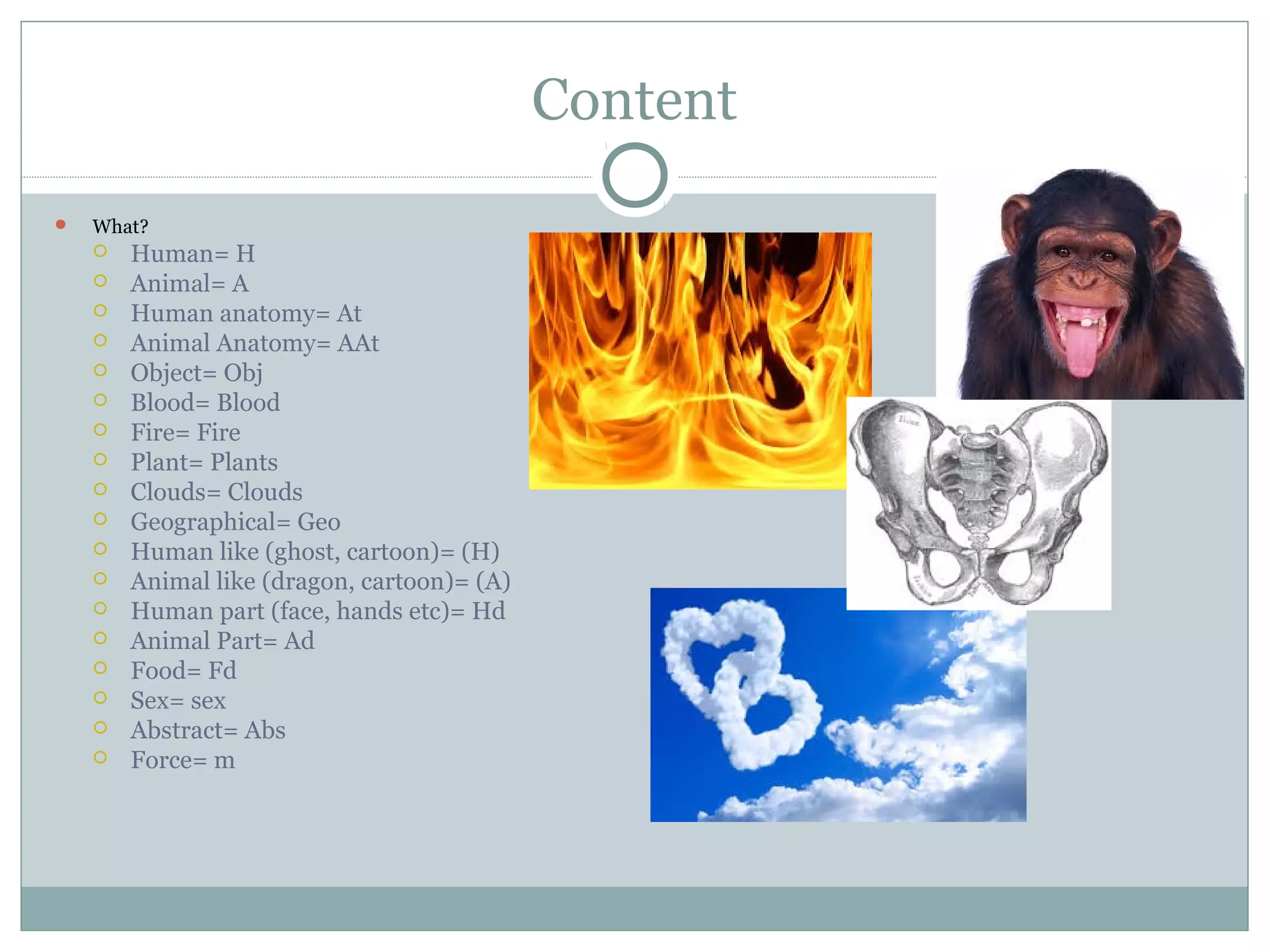
Content
 What?
 Human= H
 Animal= A
 Human anatomy= At
 Animal Anatomy= AAt
 Object= Obj
 Blood= Blood
 Fire= Fire
 Plant= Plants
 Clouds= Clouds
 Geographical= Geo
 Human like (ghost, cartoon)= (H)
 Animal like (dragon, cartoon)= (A)
 Human part (face, hands etc)= Hd
 Animal Part= Ad
 Food= Fd
 Sex= sex
 Abstract= Abs
 Force= m
Popular Responses
(P) frequently perceived responses
Average is 6.9 in non patient populations
5= Adequate
Most frequent on I, III, V, VIII
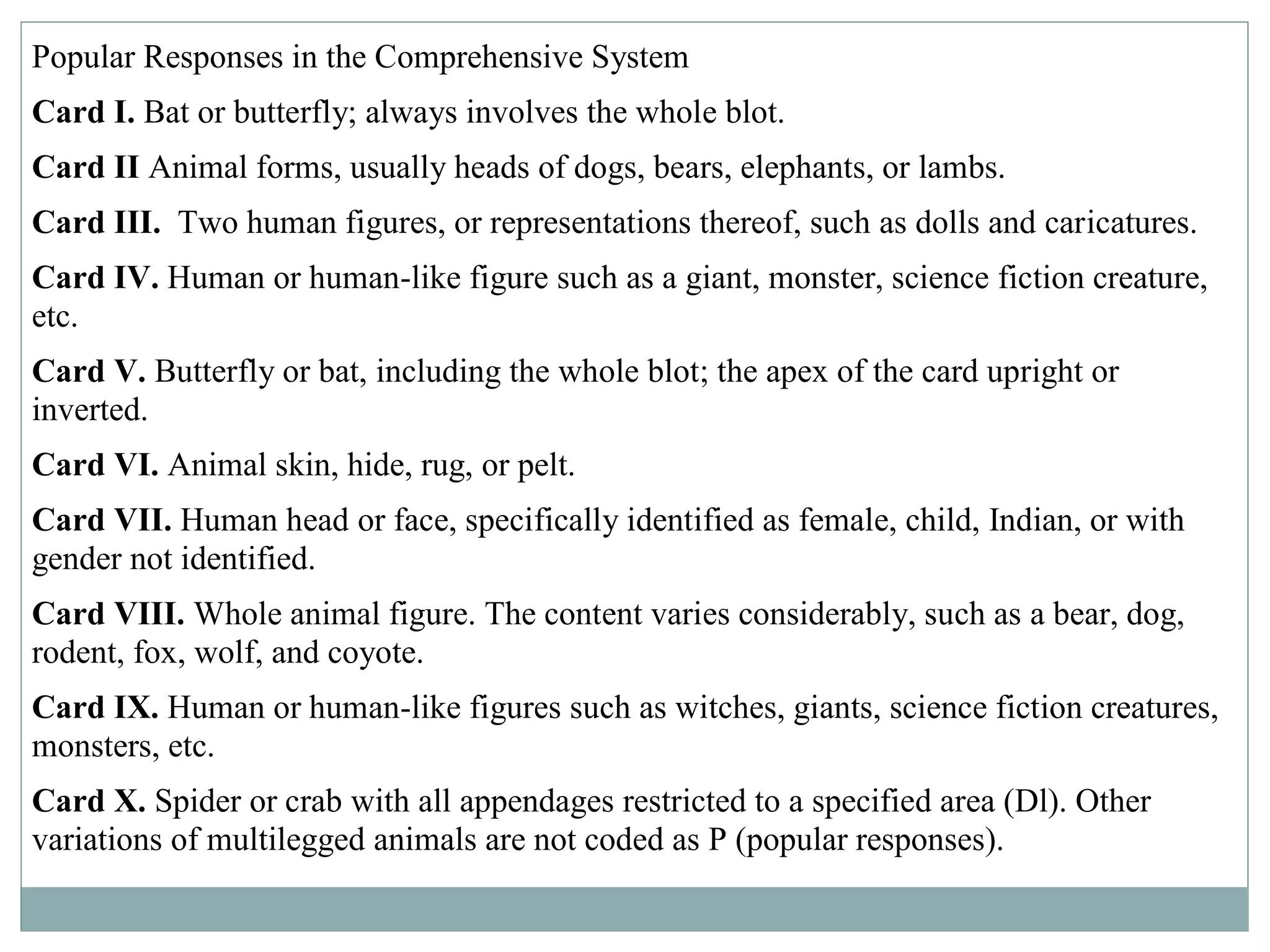
Popular Responses in the Comprehensive System
Card I. Bat or butterfly; always involves the whole blot.
Card II Animal forms, usually heads of dogs, bears, elephants, or lambs.
Card III. Two human figures, or representations thereof, such as dolls and caricatures.
Card IV. Human or human-like figure such as a giant, monster, science fiction creature,
etc.
Card V. Butterfly or bat, including the whole blot; the apex of the card upright or
inverted.
Card VI. Animal skin, hide, rug, or pelt.
Card VII. Human head or face, specifically identified as female, child, Indian, or with
gender not identified.
Card VIII. Whole animal figure. The content varies considerably, such as a bear, dog,
rodent, fox, wolf, and coyote.
Card IX. Human or human-like figures such as witches, giants, science fiction creatures,
monsters, etc.
Card X. Spider or crab with all appendages restricted to a specified area (Dl). Other
variations of multilegged animals are not coded as P (popular responses).
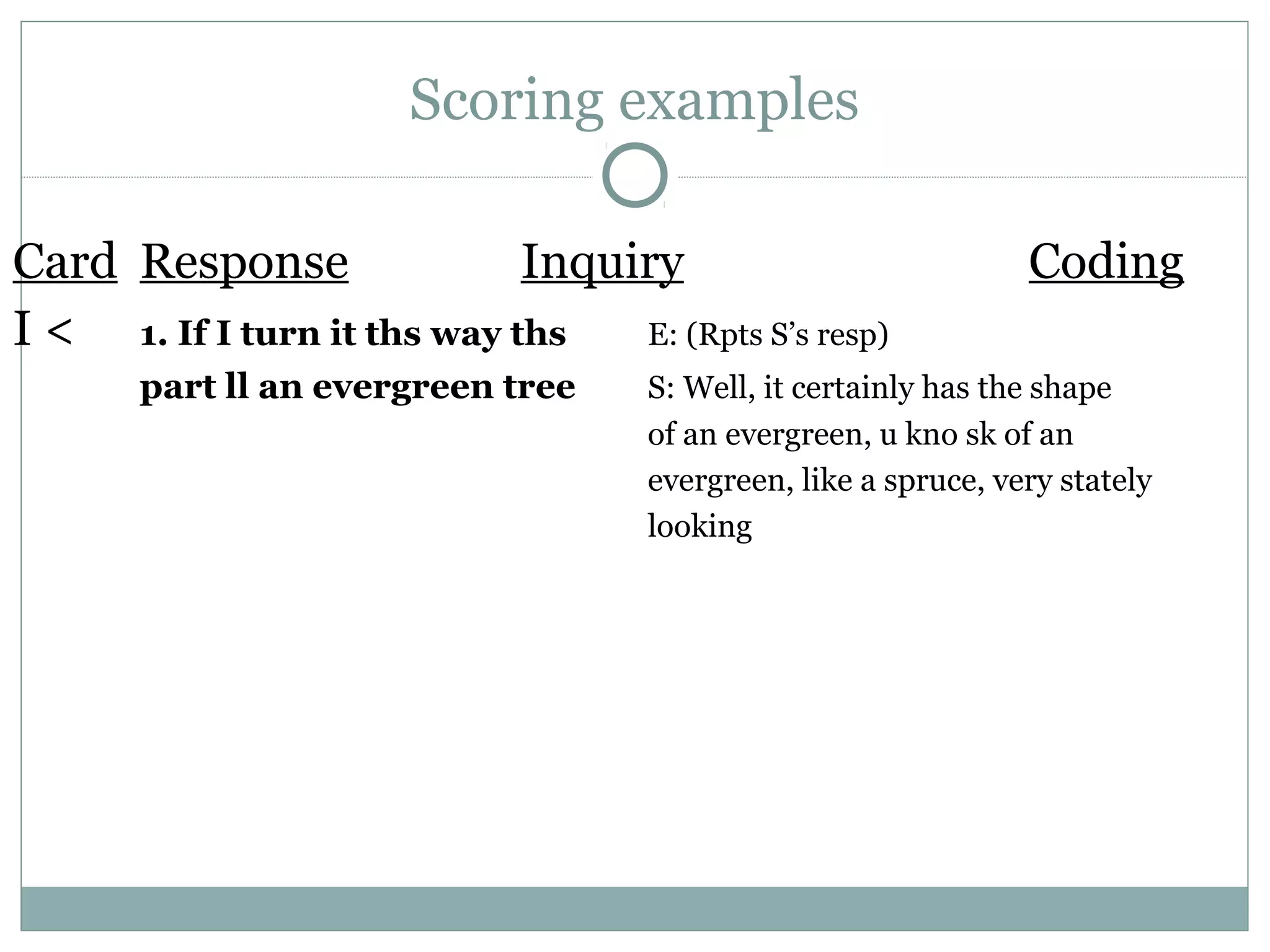
Scoring examples
Card Response Inquiry Coding
I < 1. If I turn it ths way ths E: (Rpts S’s resp)
part ll an evergreen tree S: Well, it certainly has the shape
of an evergreen, u kno sk of an
evergreen, like a spruce, very stately
looking
Interpretation
 Three steps:
1. Listing the sequence of codes or scores
2. Recording frequencies for each variable
3. Performing various calculations required to obtain
the ratios, percentages and derived scores
Calculations
Total responses
Popular Responses
Colour shock and shading shock
Form Quality
Qualitative analysis
Quantitative analysis
Psychogram
Testing the limits
Thank you

Rorschach ink blot test

  • 1.
    Rorschach Ink-blot Test NiharikaThakkar B.A, M.A, N.E.T, MBPsS, Clinical Psychology
  • 2.
    History (1921) Hermann Rorschach Psychodiagnostik  Original set contained 40 inkblots  15 used regularly (eventually narrowed down to 10 due to printing costs)  Devised a set of codes  Printing error led to use of shading
  • 3.
    Systems Focus on contentanalysis David Levy (1926) brought plates to US Samuel Beck (1927)  standardization study of the inkblots Bruno Klopfer (1922) - Germany  studied under Carl Jung in Zurich  immigrated to US in 1934  Klopfer and his students developed a scoring system(1936)  Beck scoring system (1937)  David Rapaport - Psychological Diagnostic Testing (1946)  clinical applications of 8 tests including the Rorschach  Roy Schafer (1954)  Psychoanalytic Interpretation in Rorschach Testing  content analysis  John Exner (1995-2003)  Most extensive and well researched scoring system
  • 4.
  • 5.
    Steps in administration 1.Introducing the subject to the technique 2. Giving the test instructions 3. The Response Phase 4. The Inquiry Phase 5. Testing the limits
  • 6.
    Introduction/Test Instructions Sit sideby side Cards should not be made visible before Appropriate order with Card I on top Hand subject first card
  • 7.
  • 8.
    Response Phase Verbatim, noprobing, Silence by examiner is the rule Position of card<,^,>, 0 “I don’t see anything there”  Take your time, we’re in no hurry (everyone can find something).”  “If you take your time and look some more, I think you’ll find something else too.” Response time to be noted Total time to be noted
  • 9.
    Enquiry Phase Conducted afterall responses are given to all 10 cards Gain information needed to score accurately Nondirective questions Complete location sheet Not used to generate new information  “ O.K., we’ve done them all. Now we are going to go back through them. It won’t take long. I want you to help me see what you saw. I’m going to read what you said, and then I want you to show me where in the blot you saw it and what is there that makes it look like that, so I can see it too. I’d like to see it just like you did, so help me now. Do you understand?”
  • 10.
    Enquiry (cont.) “Focus ongaining information and asking questions on:  Location (Where is it?)  Determinants (What makes it look like that?)  Content (What is it?) Example  Response: Its a pretty flower  Inquiry: E: (Repeats response) S: Yes that’s the stem & here are the petals E: U mentioned that it is pretty
  • 11.
  • 12.
    Rorschach: Assumptions “Perceptual sets”displayed through projective techniques Ambiguous stimuli Responses are scored along three categories:  location  determinants  Content  form
  • 13.
  • 14.
  • 15.
    Location Where?  Entire blot=W  Common Detail= D  Unusual detail =Dd and dD  Use of white space =S
  • 16.
    Determininants Why?  ex. shape,color, texture  F= form  C= colour  FC= shape and colour  CF= colour and shape  M= Human movement  FM= Animal movement  Fc= texture response  Fk= shading response  Fm= Object movement
  • 17.
    Content  What?  Human=H  Animal= A  Human anatomy= At  Animal Anatomy= AAt  Object= Obj  Blood= Blood  Fire= Fire  Plant= Plants  Clouds= Clouds  Geographical= Geo  Human like (ghost, cartoon)= (H)  Animal like (dragon, cartoon)= (A)  Human part (face, hands etc)= Hd  Animal Part= Ad  Food= Fd  Sex= sex  Abstract= Abs  Force= m
  • 18.
    Popular Responses (P) frequentlyperceived responses Average is 6.9 in non patient populations 5= Adequate Most frequent on I, III, V, VIII
  • 19.
    Popular Responses inthe Comprehensive System Card I. Bat or butterfly; always involves the whole blot. Card II Animal forms, usually heads of dogs, bears, elephants, or lambs. Card III. Two human figures, or representations thereof, such as dolls and caricatures. Card IV. Human or human-like figure such as a giant, monster, science fiction creature, etc. Card V. Butterfly or bat, including the whole blot; the apex of the card upright or inverted. Card VI. Animal skin, hide, rug, or pelt. Card VII. Human head or face, specifically identified as female, child, Indian, or with gender not identified. Card VIII. Whole animal figure. The content varies considerably, such as a bear, dog, rodent, fox, wolf, and coyote. Card IX. Human or human-like figures such as witches, giants, science fiction creatures, monsters, etc. Card X. Spider or crab with all appendages restricted to a specified area (Dl). Other variations of multilegged animals are not coded as P (popular responses).
  • 20.
    Scoring examples Card ResponseInquiry Coding I < 1. If I turn it ths way ths E: (Rpts S’s resp) part ll an evergreen tree S: Well, it certainly has the shape of an evergreen, u kno sk of an evergreen, like a spruce, very stately looking
  • 21.
    Interpretation  Three steps: 1.Listing the sequence of codes or scores 2. Recording frequencies for each variable 3. Performing various calculations required to obtain the ratios, percentages and derived scores
  • 22.
    Calculations Total responses Popular Responses Colourshock and shading shock Form Quality Qualitative analysis Quantitative analysis Psychogram
  • 23.
  • 24.

Editor's Notes

  • #3 Binet and Henri - attempted to incorporate them in intelligence testing “visual Imagination” Dimilar to children’s game “Blotto” in Europe - poem like associations to the blots or centerpiece for charades used as a reinforcer for classroom management problmes - Knead Gehring - teacher in german school near where Rorscach did his residencye - Ror became intrigued with comparing his pts responses with those of male adoelscents Sameyear that Eugen bleuler famed work on Dementia Praecox - schizophrenia - he was one of R’s professor’s and supervisors- those with SX responsded differently than those with dementia on Rorscach - mad a brief report on thi - little interest - not until later in his career after he completed hi s degree did he3 return to looking at it R dies at 37 of abdominal pains - spent only 4 years investigating his test early ciodoing - area of blot - W vs. D features of blot - F form, C color, M movementy 3rd set = content - H = human, A= animal, An= anatomy
  • #4 Levy - staff psychiatrist at Institute of Guidance in NY - psych, academic needs of children Diisertaiomn for Beck and Marguerite Hertzx s
  • #7 Can answer questions abouit how inkblot made kjust some inkblots I’ll show you and ask you what they might be if ask about correctiness - “people see all sorts pof things provides some info about characteriostcis of people or helps us understand something about personality That’s right this is an inkblot test - I want you to tell me what it might be S should take the card - if not say - here take it.
  • #9 How many should I see - it’s up to you records less than 14 are not validIf more than to the first blot - take the card and intervene or 5 to second - beyond that leass than 5 okay Average nuumber of responses is usu 22.32 (17-27_0
  • #10 The soft underbelly of the test - treat delicately Don’t ask “is tit the shape” ask “What about it made it look like that?”
  • #11 Don’t ask directly - I’m not seeing it as you are I’m not sure I know ehere you’re seeing it “ I’m not sure whata there is that makes it look like that I know it looks like that to you but help me see it location - run your finger arounf it and show nme some of theparts
  • #15 15 sepcial scores - unusual verba;lizations and aggressive movement Special indices - reorg and comparisons of scores from different catgeories
  • #16 made by less than 5% of population + = two or more objects separate but related – at least 1 has tohave form demand – dog walking among some bushes, man with a funny hat on 0 – single object features create a natural form – fir tree, cat, totem pole v/+ = two or more objects sep but related – non have specific form demand – clouds coming together, rock with some dirt around it V – no specific form demand – ice, cloud, sky Location – interpretation: refelcts overall style as to how they approach the world. Do they focus on small details and neglect more significant issues? Frequently used locations if they are good quality reflect good ties with reality, intelligence, ambition, good reasoning, ability to generalize Unusual may refelct – OCD, psychopathology Wholes should be 30 to 40 % of adult record – young children show a lot of wholes Only considered high intellectual activity if W+ - if so, particularly on X, IX, III and VIII – good synthesizing and abstracting abilities Low W can reflect deoression – or if frequency and quality low – int. deterioration c/o brain damage. Or MR High D – will be greater with more R – overemphasize the concrete and obvious aspects of situations – less energy, less integration. – focuses on safe and obvious to sacrifice of using full int. [potential D+ high – good dev. Functioning and precision Low D – usu increased Dd – person under stress. D is lowest in young children Dd – retreat from env by focusing on details rather than perceiving whole sit or more obvious elements – 6% of R for normal adult – higher in kids ansd adolescents and sx and impaired compulsives – DD in balnce with W and D – healthy adjustment – withdraws when needed. S – more than 3 = negativism, difficulty handlig anger , oppositional tendencies – more independence- self assertionin nomral pops DQ +(above 9 or 10) more intelligent, complex, sophisticated but look at Zd for efficiency and saccuracy Higher amount of DQv = immature, less sophisticated – children, neuro, MR
  • #17 See handout Form – Pure F = extent to which person removes affect from situation – presence of form in a reponse indicates degree of respect for standards of env – attention, concentration, affective control or dely Sx have increases in pure F following tx – better progrnosis People in emotional turmoil produce less Pure f High pure F = highly defensive and constricted or merelly good abilty to suspend/control afefct – after ECT, alcoholics,psych dist and low back pain Low pure f = level of turmoil high to preevnt screening out affective response to a sit. – Sx, characterological, organic – diff controlling impulse Fq = + - elaborated description will include three or rfour other features such as facial characteriostics, arms, waistline, feet or shoies. Most well educated protocols will contain two or three + 0 – the common response – easy to dsee answers reported by at least 2% of poepl – no unduial welaboration – angel on card 1, bat on Card 5 U – a low freq response basci contours are appropriare – iuncommon but seen quickly and easily by obsefrver - = distorted, arbitrary, unrealistic use of form – disregard for countours of the bloto
  • #19 Number refelcts subjet’s degree of sim to most people – conform to social standards – ease with which infoluece by interpersonal relations Persons who reject norms give lower Ps – average number for nonpsych is 6.9 Outpt and nonsx 7 Inpt sx give 4 or less Axis II and depressives around 5 High P = anxiety related to making mistakes, common perceptions, wants approval – conventional, conforming, guarded frequently depressed Low P = poor contact with realiyt – poor adjustment – detached, aloof P is common to I, III, V and VIII – absence is significant But look at forma quality and Z – low P could just be creativity