Collecting Biophysiologic
and OtherData Collection
Method
RizabiePodirsky
Contents of Module13
Biophysiologic Measures
Record, Documentsand AvailableData
Q Methodology
Pro jective Techniques
Vignettes
Co gnitive and Neuro psycho lo gicalTests
Objectives
To be able to understand
Pro jective Techniques
Vignettes
Co gnitive and Neuro psycho lo gicalTests
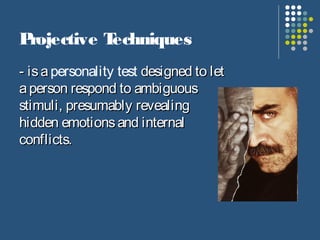
Projective Techniques
- isa - isa personality test designed to let designed to let
aa person respond to ambiguousperson respond to ambiguous
stimuli, presumably revealingstimuli, presumably revealing
hidden emotions and internalhidden emotions and internal
conflicts.conflicts.
Types of Projective TechniquesTypes of Projective Techniques
 Pictorial projective techniquePictorial projective technique
 Rorschach ink blot testRorschach ink blot test
 Thematic Apperception Test (TAT)Thematic Apperception Test (TAT)
 Verbal projective techniqueVerbal projective technique
 Association techniquesAssociation techniques
 Word-association methodWord-association method
 Completion techniquesCompletion techniques
 Sentence completionSentence completion
 Expressive MethodsExpressive Methods
 Play techniquesPlay techniques
 Drawing and paintingDrawing and painting
 Role-playingRole-playing
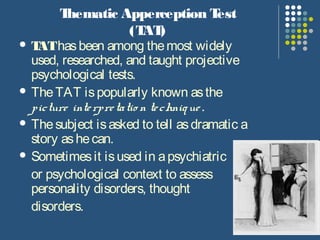
Thematic Apperception Test
(TAT)
 TAThasbeen among themost widely
used, researched, and taught projective
psychological tests.
 TheTAT ispopularly known asthe
picture interpretatio n technique .
 Thesubject isasked to tell asdramatic a
story ashecan.
 Sometimesit isused in apsychiatric
or psychological context to assess
personality disorders, thought
disorders.
 Thelargenumber of research studiesthat have
used theTAT haveindicated that cultural, gender,
and classissuesmust betaken into account.
Rorschach test
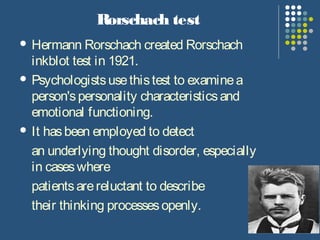
 Hermann Rorschach created Rorschach
inkblot test in 1921.
 Psychologistsusethistest to examinea
person'spersonality characteristicsand
emotional functioning.
 It hasbeen employed to detect
an underlying thought disorder, especially
in caseswhere
patientsarereluctant to describe
their thinking processesopenly.
Method
 Presentation of Inkblot Test
 Thepsychologist writes
down everything thesubject says
or does, no matter how trivial.
Vignettes
 Brief description of events or situations to whichBrief description of events or situations to which
respondents are ask to react.respondents are ask to react.
Aim is to get info about respondents’:Aim is to get info about respondents’:
 PerceptionPerception
 OpinionOpinion
 Knowledge about some phenomenonKnowledge about some phenomenon
Cognitive andCognitive and
Neuropsychological TestNeuropsychological Test
 Cognitive tests are assessments of
the cognitive capabilities of humans and
other animals.
 Neuropsychological tests are specifically
designed tasks used to measure a
psychological function known to be linked to
a particular brain structure or pathway.
Reasons/Purposes of
Cognitive Assessment
 Screening
-to determine the absence or presence of
impairment.
 Monitoring
-to track cognitive status over time,
especially response to treatment.
The major purposes of a neuropsychological
assessment are to assist with questions
about:
 Integrity of cognitive functions
 Differential diagnosis – to confirm or
clarify a diagnosis
 Treatment planning
 Capacity
References
 Nursing Research-Principles and Methods, 7th
edition, Denise F. Polit/Cheryl Tatano Beck,
2004
 www.youtube.com
 www.wikipedia.com
 http://stanfordhospital.org/
 www.iamure.com
 www.goodreads.com
Synthesis
“I want t o underst and t he world f rom
your point of view. I want t o know
what you know in t he way you know it .
I want t o underst and t he meaning of
your experience, t o walk in your
shoes, t o f eel t hings as you f eel
t hem, t o explain t hings as you explain
t hem. Will you become my t eacher
and help me underst and?” 

Projective Technique

  • 1.
    Collecting Biophysiologic and OtherDataCollection Method RizabiePodirsky
  • 2.
    Contents of Module13 BiophysiologicMeasures Record, Documentsand AvailableData Q Methodology Pro jective Techniques Vignettes Co gnitive and Neuro psycho lo gicalTests
  • 3.
    Objectives To be ableto understand Pro jective Techniques Vignettes Co gnitive and Neuro psycho lo gicalTests
  • 4.
    Projective Techniques - isa - isa personality test designedto let designed to let aa person respond to ambiguousperson respond to ambiguous stimuli, presumably revealingstimuli, presumably revealing hidden emotions and internalhidden emotions and internal conflicts.conflicts.
  • 5.
    Types of ProjectiveTechniquesTypes of Projective Techniques  Pictorial projective techniquePictorial projective technique  Rorschach ink blot testRorschach ink blot test  Thematic Apperception Test (TAT)Thematic Apperception Test (TAT)  Verbal projective techniqueVerbal projective technique  Association techniquesAssociation techniques  Word-association methodWord-association method  Completion techniquesCompletion techniques  Sentence completionSentence completion  Expressive MethodsExpressive Methods  Play techniquesPlay techniques  Drawing and paintingDrawing and painting  Role-playingRole-playing
  • 6.
    Thematic Apperception Test (TAT) TAThasbeen among themost widely used, researched, and taught projective psychological tests.  TheTAT ispopularly known asthe picture interpretatio n technique .  Thesubject isasked to tell asdramatic a story ashecan.  Sometimesit isused in apsychiatric or psychological context to assess personality disorders, thought disorders.
  • 7.
     Thelargenumber ofresearch studiesthat have used theTAT haveindicated that cultural, gender, and classissuesmust betaken into account.
  • 8.
    Rorschach test  HermannRorschach created Rorschach inkblot test in 1921.  Psychologistsusethistest to examinea person'spersonality characteristicsand emotional functioning.  It hasbeen employed to detect an underlying thought disorder, especially in caseswhere patientsarereluctant to describe their thinking processesopenly.
  • 9.
    Method  Presentation ofInkblot Test  Thepsychologist writes down everything thesubject says or does, no matter how trivial.
  • 10.
    Vignettes  Brief descriptionof events or situations to whichBrief description of events or situations to which respondents are ask to react.respondents are ask to react. Aim is to get info about respondents’:Aim is to get info about respondents’:  PerceptionPerception  OpinionOpinion  Knowledge about some phenomenonKnowledge about some phenomenon
  • 11.
    Cognitive andCognitive and NeuropsychologicalTestNeuropsychological Test  Cognitive tests are assessments of the cognitive capabilities of humans and other animals.  Neuropsychological tests are specifically designed tasks used to measure a psychological function known to be linked to a particular brain structure or pathway.
  • 12.
    Reasons/Purposes of Cognitive Assessment Screening -to determine the absence or presence of impairment.  Monitoring -to track cognitive status over time, especially response to treatment.
  • 13.
    The major purposesof a neuropsychological assessment are to assist with questions about:  Integrity of cognitive functions  Differential diagnosis – to confirm or clarify a diagnosis  Treatment planning  Capacity
  • 14.
    References  Nursing Research-Principlesand Methods, 7th edition, Denise F. Polit/Cheryl Tatano Beck, 2004  www.youtube.com  www.wikipedia.com  http://stanfordhospital.org/  www.iamure.com  www.goodreads.com
  • 15.
    Synthesis “I want to underst and t he world f rom your point of view. I want t o know what you know in t he way you know it . I want t o underst and t he meaning of your experience, t o walk in your shoes, t o f eel t hings as you f eel t hem, t o explain t hings as you explain t hem. Will you become my t eacher and help me underst and?”