Rorschach inkblot
test
Aneeza Farooq
Laraib kanwal
MSc-II
Rorschach inkblot test
Is a psychological test in which subjects perception of
inkblot are recorded and then analyzed using psychological
interpretation, complex scientifically derived algorithms, or
both.
Some psychologists use use these test to examine a person
personality characteristics and emotional functioning.
It has been employ to detect an underlying thought disorder
especially in the case where patients are reluctant to
describe their thinking process openly.
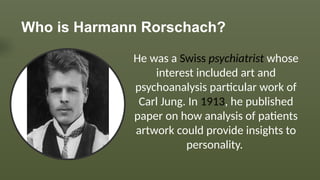
Who is Harmann Rorschach?
He was a Swiss psychiatrist whose
interest included art and
psychoanalysis particular work of
Carl Jung. In 1913, he published
paper on how analysis of patients
artwork could provide insights to
personality.
Description
History
Herman Rorschach published his most famous test based
on ink blot in 1921.
But the idea was prevailing even before his birth.
“individual frequently report unique meaning while
viewing inkblot”.
Whipple was the first who published the first set of
standardized inkblot in 1910.
Age range
The Rorschach test is appropriate for the subject from the
age of five to adult hood.
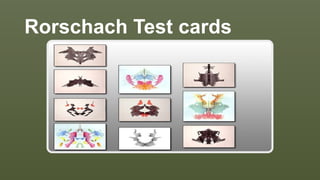
Rorschach Test cards
Test construction
Rorschach constructed each stimulus card by dropping ink into a
piece of paper and folding it. After experimenting with thousands
of such blots, he selected 20. and finally selected 10, five were
black and grey, two contained black, grey and red and three
contained pastels colors of various shades.
Inkblot cards
Rorschach consist of ten (10) bilaterally symmetrical
(mirrored image) inkblot printed in separate cards.
 Five achromatic inkblot or without color black and white.
 Two inkblot are black, red and white.
 The remaining three card are multicolored.
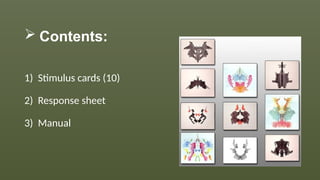
 Contents:
1) Stimulus cards (10)
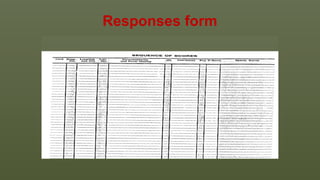
2) Response sheet
3) Manual
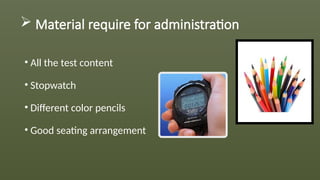
 Material require for administration
• All the test content
• Stopwatch
• Different color pencils
• Good seating arrangement
Steps of Administration
Steps of administration
1) Introducing subject to the technique.
2) Giving the test instruction
3) The response phase
4) The inquiry phase
Introducing/ Test Instruction
Sit side by side.
Cards should not be made visible before.
Appropriate order with card 1 on top.
Hand the person the first card and asking “what might be
this?”.
Probable questions
• How many things I should find?
• Can I turn it?
“it is up to you.”
• Should I just use my imagination?
“just tell me what you see there”.
• Examiner should use good common sense and answer in a non direct
way.
• The client should hold the card.
Administration
Responses or free association phase
Test taker is instructed to tell what is on each of the card.
“what might this be?”
Inquiry phase
Examiner attempts to determine what features of the inkblot
played a role in formulate the test takers percept (perception of an
image).
Responses phase
Verbatim, no probing, silence by examiner is the rule.
I don’t see any thing there
Take your time, we’re in no hurry (everyone can find something)
if you take time and look some more, I think you’ll find something
else too.
Response time should be noted.
Total time to be noted.
Inquiry phase
Conducted after all responses are given to all 10 cards
Gain information needed to secure accurately
Non directive questions
Complete location sheet
Not used to generate new information
“OK,.. we’ve done them all. Now we are going back through them.
It won’t take long I want to help me to see what you saw. I am going to read
what you said, and them I want you to show me where in the blot you saw it and
what is there that makes it look like that, so I can see it too. I’d like to see it just like
you did, so help me now.”
Inquiry (cont.)
Focus on gaining information and ask question on:
Location (where is it)
Determinants (what makes it look like that?)
Content (what is it?)
 Example
 Responses:
It is a pretty flower
Inquiry :
E: (repeat responses)
S: yes that the stem & here are the petals
E: U mentioned that it is pretty
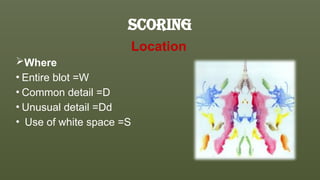
scoring
Location
Where
• Entire blot =W
• Common detail =D
• Unusual detail =Dd
• Use of white space =S
Determinants
Why
F = formshape
C = color
FC = shape and color
CF = color and shape
M = human movement
FM = animal movement
Fc = texture response
Fk = shading response
Fm = object movement
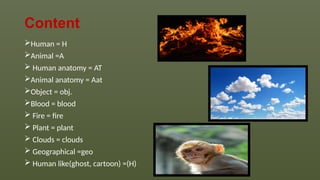
Content
Human = H
Animal =A
 Human anatomy = AT
Animal anatomy = Aat
Object = obj.
Blood = blood
 Fire = fire
 Plant = plant
 Clouds = clouds
 Geographical =geo
 Human like(ghost, cartoon) =(H)
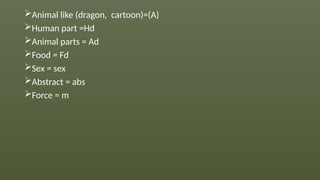
Animal like (dragon, cartoon)=(A)
Human part =Hd
Animal parts = Ad
Food = Fd
Sex = sex
Abstract = abs
Force = m
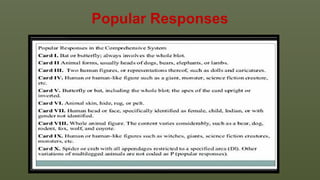
Popular Responses
Responses form
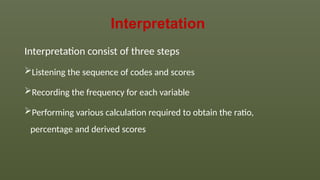
Interpretation
Interpretation consist of three steps
Listening the sequence of codes and scores
Recording the frequency for each variable
Performing various calculation required to obtain the ratio,
percentage and derived scores
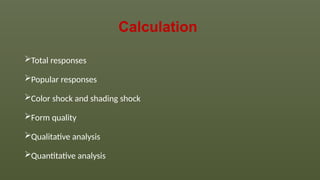
Calculation
Total responses
Popular responses
Color shock and shading shock
Form quality
Qualitative analysis
Quantitative analysis
Psychometric properties
The Rorschach is a popular test, however, it has been plagued by low
reliability and validity.
Obviously, it is difficult to measure any of the usual psychometric
property in the usual way.
 Validity and reliability are usually low because of the open-ended
multiplicity of possibility that is allowed and by the lack of
universally-accepted standardized instructions, administration
protocol and scoring procedure.
Limitations
1. Rorschach test lacks a universally accepted standard of
administration, scoring and interpretation.
2. The most common objection is related to subjectivity.
3. Its results are seen unstable overtime.
4. Some critics consider it an unscientific test.
5. Some critics say it does not avail all traditional standardization.
Thank you

Rorschach inkblot test ppt history, construction scoring interpretation

  • 1.
  • 2.
    Rorschach inkblot test Isa psychological test in which subjects perception of inkblot are recorded and then analyzed using psychological interpretation, complex scientifically derived algorithms, or both. Some psychologists use use these test to examine a person personality characteristics and emotional functioning. It has been employ to detect an underlying thought disorder especially in the case where patients are reluctant to describe their thinking process openly.
  • 3.
    Who is HarmannRorschach? He was a Swiss psychiatrist whose interest included art and psychoanalysis particular work of Carl Jung. In 1913, he published paper on how analysis of patients artwork could provide insights to personality.
  • 4.
    Description History Herman Rorschach publishedhis most famous test based on ink blot in 1921. But the idea was prevailing even before his birth. “individual frequently report unique meaning while viewing inkblot”. Whipple was the first who published the first set of standardized inkblot in 1910. Age range The Rorschach test is appropriate for the subject from the age of five to adult hood.
  • 5.
  • 6.
    Test construction Rorschach constructedeach stimulus card by dropping ink into a piece of paper and folding it. After experimenting with thousands of such blots, he selected 20. and finally selected 10, five were black and grey, two contained black, grey and red and three contained pastels colors of various shades.
  • 7.
    Inkblot cards Rorschach consistof ten (10) bilaterally symmetrical (mirrored image) inkblot printed in separate cards.  Five achromatic inkblot or without color black and white.  Two inkblot are black, red and white.  The remaining three card are multicolored.
  • 8.
     Contents: 1) Stimuluscards (10) 2) Response sheet 3) Manual
  • 9.
     Material requirefor administration • All the test content • Stopwatch • Different color pencils • Good seating arrangement
  • 10.
  • 11.
    Steps of administration 1)Introducing subject to the technique. 2) Giving the test instruction 3) The response phase 4) The inquiry phase
  • 12.
    Introducing/ Test Instruction Sitside by side. Cards should not be made visible before. Appropriate order with card 1 on top. Hand the person the first card and asking “what might be this?”.
  • 13.
    Probable questions • Howmany things I should find? • Can I turn it? “it is up to you.” • Should I just use my imagination? “just tell me what you see there”. • Examiner should use good common sense and answer in a non direct way. • The client should hold the card.
  • 14.
    Administration Responses or freeassociation phase Test taker is instructed to tell what is on each of the card. “what might this be?” Inquiry phase Examiner attempts to determine what features of the inkblot played a role in formulate the test takers percept (perception of an image).
  • 15.
    Responses phase Verbatim, noprobing, silence by examiner is the rule. I don’t see any thing there Take your time, we’re in no hurry (everyone can find something) if you take time and look some more, I think you’ll find something else too. Response time should be noted. Total time to be noted.
  • 16.
    Inquiry phase Conducted afterall responses are given to all 10 cards Gain information needed to secure accurately Non directive questions Complete location sheet Not used to generate new information “OK,.. we’ve done them all. Now we are going back through them. It won’t take long I want to help me to see what you saw. I am going to read what you said, and them I want you to show me where in the blot you saw it and what is there that makes it look like that, so I can see it too. I’d like to see it just like you did, so help me now.”
  • 17.
    Inquiry (cont.) Focus ongaining information and ask question on: Location (where is it) Determinants (what makes it look like that?) Content (what is it?)  Example  Responses: It is a pretty flower Inquiry : E: (repeat responses) S: yes that the stem & here are the petals E: U mentioned that it is pretty
  • 18.
    scoring Location Where • Entire blot=W • Common detail =D • Unusual detail =Dd • Use of white space =S
  • 19.
    Determinants Why F = formshape C= color FC = shape and color CF = color and shape M = human movement FM = animal movement Fc = texture response Fk = shading response Fm = object movement
  • 20.
    Content Human = H Animal=A  Human anatomy = AT Animal anatomy = Aat Object = obj. Blood = blood  Fire = fire  Plant = plant  Clouds = clouds  Geographical =geo  Human like(ghost, cartoon) =(H)
  • 21.
    Animal like (dragon,cartoon)=(A) Human part =Hd Animal parts = Ad Food = Fd Sex = sex Abstract = abs Force = m
  • 22.
  • 23.
  • 24.
    Interpretation Interpretation consist ofthree steps Listening the sequence of codes and scores Recording the frequency for each variable Performing various calculation required to obtain the ratio, percentage and derived scores
  • 25.
    Calculation Total responses Popular responses Colorshock and shading shock Form quality Qualitative analysis Quantitative analysis
  • 26.
    Psychometric properties The Rorschachis a popular test, however, it has been plagued by low reliability and validity. Obviously, it is difficult to measure any of the usual psychometric property in the usual way.  Validity and reliability are usually low because of the open-ended multiplicity of possibility that is allowed and by the lack of universally-accepted standardized instructions, administration protocol and scoring procedure.
  • 27.
    Limitations 1. Rorschach testlacks a universally accepted standard of administration, scoring and interpretation. 2. The most common objection is related to subjectivity. 3. Its results are seen unstable overtime. 4. Some critics consider it an unscientific test. 5. Some critics say it does not avail all traditional standardization. Thank you